

merge_reloc_roots(). The patch is already in multiple Linux stable branches, but the CVE was only added to the National Vulnerability Database on August 10, roughly two months after the fix was posted and reviewed on the Linux Btrfs mailing list.For administrators, this is an update-the-kernel issue rather than an emergency incident-response event. The vulnerable path is reached while Btrfs merges relocation trees—internal temporary trees used during data relocation—and only after the code finds an unexpected relocation root. The upstream patch does not describe a route to privilege escalation, data disclosure, remote code execution, or filesystem corruption by itself. NVD has assigned no CVSS score, no CWE category, and lists no exploit information.
The practical point is less dramatic but still worth fixing: a Btrfs inconsistency that should fail cleanly instead leaves a kernel root object referenced. On a server performing balances, device removal, or other relocation-heavy maintenance, error paths need to be just as correct as ordinary operation. A leaked root reference keeps the object from being released when the code expects it to be, turning an already abnormal Btrfs state into a resource-cleanup defect.
The missing call is one line, on an error path
The Linux Btrfs mailing list shows the full upstream change from Filipe Manana, posted June 11 and reviewed the following day by Johannes Thumshirn and Qu Wenruo. It adds one call to btrfs_put_root(root) immediately before the function jumps to its common exit path after detecting a relocation-tree mismatch.
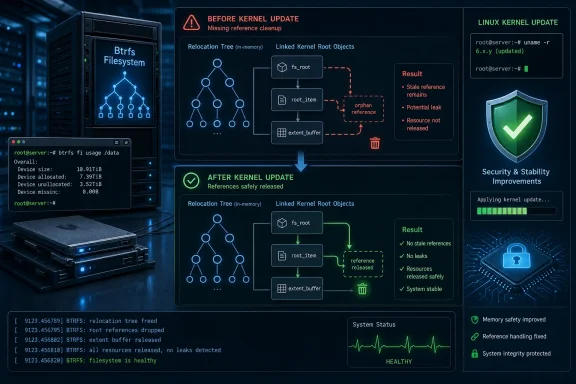
That small diff is unusually clear about the failure mode. merge_reloc_roots() retrieves the filesystem root corresponding to a relocation root and checks that root->reloc_root matches the relocation root it is processing. If it does not match, the code logs a “reloc tree mismatch” error and sets -EINVAL. Before the correction, it then exited without dropping the reference obtained when it loaded root.
In kernel terms, this is a reference-count leak. It does not mean Btrfs loses a mounted filesystem “root,” leaks a Windows administrator account, or exposes directory roots to another user. The term root here is a Btrfs kernel object representing a filesystem tree or subvolume tree. The new btrfs_put_root() balances the earlier acquisition of that object and permits normal cleanup.
The upstream patch itself says the mismatch may represent corruption, giving a bad relocation-tree key offset as an example. That context is important: the CVE is attached to the code that handles an unexpected internal state, not to a normal user operation that reliably produces a leak on a healthy filesystem.
The CVE arrived after the repair work
NVD’s record describes the same missing-reference problem and identifies the original faulty commit as 24213fa46c70, abbreviated from the full 24213fa46c7080c31d79aa2e3e2f0d9480cab700. That commit introduced the affected error handling in Linux kernel 5.13, according to the CVE’s version data.
But the chronology tells a more useful operational story than the publication date alone. The mailing-list patch was posted on June 11, 2026, reviewed on June 12, and the NVD record was received from kernel.org on August 10. This is a CVE-tracking lag, not evidence that the flaw was newly discovered on August 10.
That distinction matters for patch compliance teams that treat a newly published CVE as a newly available fix. In this case, some current distributions may already have carried the corrective stable backport before vulnerability scanners began presenting CVE-2026-68422 as an open finding. Conversely, a scanner that checks only broad kernel version labels could report the CVE even when a vendor has cherry-picked the one-line fix into a customized kernel.
The NVD record references five stable-kernel commits and identifies the repaired release points as Linux 6.6.148, 6.12.101, 6.18.42, 7.1.6, and 7.2-rc4. Its version data marks kernels before 5.13 as unaffected and treats those listed branch points as fixed. Administrators should not infer that every kernel numerically older than one of those releases remains vulnerable: long-term-support distributions routinely backport security and reliability fixes without changing their upstream base version in a way a simple version comparison captures.
Why relocation makes this a specialized Btrfs problem
Btrfs relocation is the machinery used to move data and metadata away from a block group or device while keeping the filesystem consistent. It is involved in operations such as balancing a filesystem, removing or replacing storage devices, and reshaping storage layouts. During that work, Btrfs creates relocation trees that temporarily mirror filesystem trees while the relevant extents are moved and merged.
The source code documents that a relocation root can carry separate references: one attached to the original filesystem root and another associated with the relocation-root list. merge_reloc_roots() is part of the final handoff, where those temporary structures are reconciled. A failure in that bookkeeping is therefore isolated from everyday reads, writes, snapshot creation, and mounting a healthy volume.
The corrected check is specifically handling the case where the filesystem root’s recorded relocation root either does not match the one currently being merged or is absent entirely. The code logs detailed root-key and generation information when it sees a mismatch, then stops the merge with -EINVAL. The repair ensures that aborting there leaves no borrowed root reference behind.
That means the immediate observable symptom, if this defect is triggered, is more likely to be an existing Btrfs relocation or integrity problem accompanied by a kernel error message—not a silent, standalone data-loss event. The leak may persist until later cleanup or unmount because the root object remains referenced, but neither the NVD entry nor the upstream discussion reports a reproducible escalation, crash, or corruption chain arising from this missing call alone.
There is a relevant boundary here: Btrfs has had other relocation-related defects, including bugs involving leaked relocation roots and use-after-free conditions. Those are separate flaws. CVE-2026-68422 should not be inflated into a catch-all warning about Btrfs balance operations; it fixes one missed release in one mismatch branch.
Patch verification needs a package-level check
Linux administrators using Btrfs should apply their distribution’s latest supported kernel package and verify its changelog or vendor advisory for CVE-2026-68422 or the associated stable backport. The kernel.org identifiers in NVD are useful for source builders, but packaged-kernel users should not try to map their exposure solely from the five commit hashes.
A sensible triage order is:
- Systems that do not use Btrfs are not exposed through this code path.
- Btrfs systems that do not perform balance, device removal, replacement, or similar relocation work face a more limited practical trigger surface, though updating remains appropriate.
- Btrfs servers that routinely rebalance large pools or manage changing device sets should move to a vendor kernel containing the fix during normal patch maintenance.
- Systems already reporting relocation-tree mismatches or Btrfs metadata-corruption messages deserve separate filesystem investigation; this patch corrects cleanup after detection and does not repair damaged metadata.
For Windows users, there is no native Windows kernel exposure because Windows does not ship Btrfs as a standard filesystem driver. The relevant cases are Linux guests in Hyper-V or other virtualization platforms, dual-boot Linux installations, appliances managed from Windows, and potentially specialized WSL2 setups using Btrfs-backed storage. Those systems must be assessed by the Linux kernel actually booted in the guest or environment, not by the Windows build number.
The immediate action is straightforward: update Btrfs-enabled Linux systems to a kernel where the distributor confirms the backport, then schedule any necessary Btrfs integrity review separately. CVE-2026-68422 closes a real cleanup hole, but the record supports treating it as a targeted kernel reliability fix—not a reason to assume every Btrfs system has suffered compromise or data damage.