
Microsoft has published CVE-2026-70332, titled Microsoft Office SharePoint Spoofing Vulnerability, but the August 6 advisory currently functions as an identifier rather than an actionable patch bulletin. Microsoft’s Security Update Guide entry establishes that the issue exists and is being tracked, yet the publicly visible material does not name affected SharePoint editions, fixed builds, KB articles, a CVSS score, an exploitability assessment, or a workaround.
For SharePoint administrators, the immediate operational conclusion is straightforward: add CVE-2026-70332 to vulnerability tracking, but do not assume that installing the latest Windows cumulative update—or an unrelated Microsoft 365 update—remediates it. There is not enough published evidence to map the CVE to a specific product or update package.
The advisory was published Thursday, August 6, 2026, five days before Microsoft’s regular August Patch Tuesday on August 11. That timing leaves two plausible explanations: Microsoft may be preparing the record for a forthcoming release, or the CVE may correspond to an out-of-band servicing action that has not yet been fully documented. Microsoft has not publicly said which is the case.
Microsoft’s title uses “Microsoft Office SharePoint,” a product family label that has historically covered on-premises SharePoint Server advisories. It does not, by itself, prove that SharePoint Server 2016, SharePoint Server 2019, SharePoint Server Subscription Edition, SharePoint Online, or SharePoint Embedded are affected by this particular flaw.
That distinction is more than nomenclature. SharePoint Online is service-operated by Microsoft, while SharePoint Server deployments are customer-operated Windows Server workloads that require administrators to acquire, stage, install, and complete the SharePoint Products Configuration Wizard after applicable updates. Treating an on-premises SharePoint Server issue as a cloud-service issue can leave a farm unpatched; treating a cloud-only issue as an on-premises patch emergency can waste scarce maintenance capacity.
Microsoft has supplied neither a product table nor security-update links in the submitted record. No KB number, SharePoint build number, or minimum fixed version is available to validate against a farm’s installed patch level. The National Vulnerability Database and the CVE Program also did not surface a public entry for CVE-2026-70332 in searches conducted after Microsoft’s publication, so there is no independent enrichment record yet to fill those gaps.
This is a case where the CVE number should be treated as a watch item, not evidence that every SharePoint deployment is vulnerable.
The problem is that the advisory does not yet identify the underlying weakness. It does not say whether the flaw involves cross-site scripting, input validation, token handling, URL canonicalization, a misleading user interface condition, authentication state, or a server-side request workflow. It also does not disclose whether an attacker needs credentials, whether user interaction is required, or whether the issue is reachable over a network.
Those missing facts decide the real priority:
That is especially important after the series of high-profile SharePoint Server vulnerabilities disclosed in 2025 and 2026. Those events made “SharePoint CVE” a justifiably urgent phrase, but they also created a trap: a new SharePoint advisory can be mistaken for another internet-wide compromise path before Microsoft has described the attack requirements. The available record does not support that conclusion here.
It is not.
The text is standard explanatory language used by Microsoft’s Security Update Guide to define the metric. It does not state that CVE-2026-70332 has been rated “Confirmed,” that a proof of concept exists, that exploit code is public, or that attackers are using the vulnerability. The advisory excerpt also provides no value for report confidence, no CVSS vector, and no exploitability designation.
Microsoft’s publication is sufficient to confirm that the company recognizes CVE-2026-70332 as a vulnerability record. But it does not establish the technical maturity of public attack knowledge. Security teams should therefore avoid labeling it a zero-day, an actively exploited vulnerability, or a confirmed public exploit based on the title and boilerplate alone.
The same restraint applies to patch status. Microsoft’s Security Update Guide ordinarily links affected products to updates when fixes are released. Since no such linkage appears in the material provided, there is no defensible basis to declare the issue patched, unpatched, mitigated, or limited to a particular servicing channel.
Organizations should also separate their inventory into cloud and server-operated services. Microsoft 365 administrators should verify whether their SharePoint usage is exclusively SharePoint Online or includes retained SharePoint Server infrastructure for legacy sites, line-of-business integrations, hybrid search, Workflow Manager, or records repositories. Hybrid environments are where incomplete ownership most often turns a routine advisory into an overlooked server exposure.
For farms that are externally reachable, security teams should make sure ordinary web, IIS, SharePoint Unified Logging System, authentication, and proxy logs are being retained and are searchable. That is sound hygiene rather than a CVE-specific detection prescription; Microsoft has not provided indicators of compromise, suspicious endpoints, vulnerable request patterns, or attacker behavior for CVE-2026-70332.
Do not disable SharePoint features or apply registry changes based on similarly named older vulnerabilities. A workaround for a prior SharePoint spoofing issue may have no effect on this flaw and can introduce a service outage or break an established business workflow.
Until Microsoft publishes those fields, the best action is to preserve a clean SharePoint inventory and make sure normal servicing is current. When Microsoft attaches CVE-2026-70332 to a SharePoint Server update or clarifies service-side remediation, administrators will need that inventory to determine whether the advisory is a routine patching task or an urgent farm-level response.
The advisory was published Thursday, August 6, 2026, five days before Microsoft’s regular August Patch Tuesday on August 11. That timing leaves two plausible explanations: Microsoft may be preparing the record for a forthcoming release, or the CVE may correspond to an out-of-band servicing action that has not yet been fully documented. Microsoft has not publicly said which is the case.
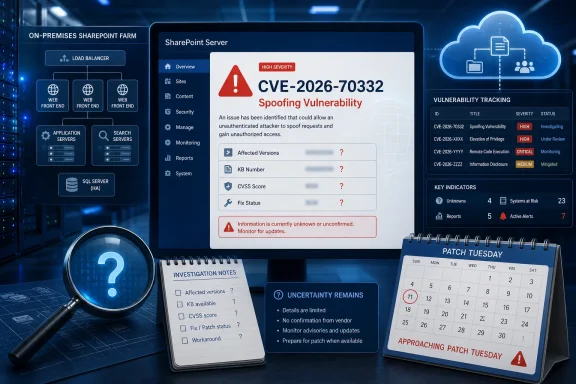 The public record establishes a CVE, not a remediation path
Microsoft’s title uses “Microsoft Office SharePoint,” a product family label that has historically covered on-premises SharePoint Server advisories. It does not, by itself, prove that SharePoint Server 2016, SharePoint Server 2019, SharePoint Server Subscription Edition, SharePoint Online, or SharePoint Embedded are affected by this particular flaw.That distinction is more than nomenclature. SharePoint Online is service-operated by Microsoft, while SharePoint Server deployments are customer-operated Windows Server workloads that require administrators to acquire, stage, install, and complete the SharePoint Products Configuration Wizard after applicable updates. Treating an on-premises SharePoint Server issue as a cloud-service issue can leave a farm unpatched; treating a cloud-only issue as an on-premises patch emergency can waste scarce maintenance capacity.
Microsoft has supplied neither a product table nor security-update links in the submitted record. No KB number, SharePoint build number, or minimum fixed version is available to validate against a farm’s installed patch level. The National Vulnerability Database and the CVE Program also did not surface a public entry for CVE-2026-70332 in searches conducted after Microsoft’s publication, so there is no independent enrichment record yet to fill those gaps.
This is a case where the CVE number should be treated as a watch item, not evidence that every SharePoint deployment is vulnerable.
“Spoofing” says little about the attack chain
Microsoft classifies CVE-2026-70332 as a spoofing vulnerability. In Microsoft’s taxonomy, that can cover attacks that misrepresent information, identities, content origins, URLs, authorization states, or other trust signals. It does not automatically mean remote code execution, authentication bypass, data exfiltration, or server takeover.The problem is that the advisory does not yet identify the underlying weakness. It does not say whether the flaw involves cross-site scripting, input validation, token handling, URL canonicalization, a misleading user interface condition, authentication state, or a server-side request workflow. It also does not disclose whether an attacker needs credentials, whether user interaction is required, or whether the issue is reachable over a network.
Those missing facts decide the real priority:
- A flaw requiring a low-privileged authenticated user and a victim to click a crafted SharePoint link belongs in a different response lane from an unauthenticated internet-facing server flaw.
- A bug confined to a particular SharePoint feature can be managed through targeted configuration changes if Microsoft provides them.
- A flaw that permits convincing internal-content impersonation can still be serious in environments where SharePoint is used for finance, HR, executive communications, procurement, or document approval—even if it does not provide code execution.
That is especially important after the series of high-profile SharePoint Server vulnerabilities disclosed in 2025 and 2026. Those events made “SharePoint CVE” a justifiably urgent phrase, but they also created a trap: a new SharePoint advisory can be mistaken for another internet-wide compromise path before Microsoft has described the attack requirements. The available record does not support that conclusion here.
The advisory’s confidence text is generic documentation
The supplied material includes an explanation of the CVSS Report Confidence metric, describing how confidence rises when a vendor confirms a vulnerability or a functional reproduction exists. That paragraph is easy to misread as an assessment of CVE-2026-70332 itself.It is not.
The text is standard explanatory language used by Microsoft’s Security Update Guide to define the metric. It does not state that CVE-2026-70332 has been rated “Confirmed,” that a proof of concept exists, that exploit code is public, or that attackers are using the vulnerability. The advisory excerpt also provides no value for report confidence, no CVSS vector, and no exploitability designation.
Microsoft’s publication is sufficient to confirm that the company recognizes CVE-2026-70332 as a vulnerability record. But it does not establish the technical maturity of public attack knowledge. Security teams should therefore avoid labeling it a zero-day, an actively exploited vulnerability, or a confirmed public exploit based on the title and boilerplate alone.
The same restraint applies to patch status. Microsoft’s Security Update Guide ordinarily links affected products to updates when fixes are released. Since no such linkage appears in the material provided, there is no defensible basis to declare the issue patched, unpatched, mitigated, or limited to a particular servicing channel.
What SharePoint teams should do before Microsoft adds detail
The appropriate response is preparation, not blind emergency maintenance. Identify every on-premises SharePoint farm, record its edition and installed build, and confirm who owns patch deployment and PSConfig completion. A SharePoint update that is merely installed but not fully configured across the farm is not the same as a completed remediation.Organizations should also separate their inventory into cloud and server-operated services. Microsoft 365 administrators should verify whether their SharePoint usage is exclusively SharePoint Online or includes retained SharePoint Server infrastructure for legacy sites, line-of-business integrations, hybrid search, Workflow Manager, or records repositories. Hybrid environments are where incomplete ownership most often turns a routine advisory into an overlooked server exposure.
For farms that are externally reachable, security teams should make sure ordinary web, IIS, SharePoint Unified Logging System, authentication, and proxy logs are being retained and are searchable. That is sound hygiene rather than a CVE-specific detection prescription; Microsoft has not provided indicators of compromise, suspicious endpoints, vulnerable request patterns, or attacker behavior for CVE-2026-70332.
Do not disable SharePoint features or apply registry changes based on similarly named older vulnerabilities. A workaround for a prior SharePoint spoofing issue may have no effect on this flaw and can introduce a service outage or break an established business workflow.
Microsoft’s next revision is the real decision point
CVE-2026-70332 is now a real item on the SharePoint security calendar, but its risk cannot yet be calculated from the available record. The missing data is unusually consequential: affected product versions determine the exposure population; a CVSS vector determines whether the issue is remotely reachable and whether credentials or user interaction are needed; KB and build information determine whether a farm can be remediated.Until Microsoft publishes those fields, the best action is to preserve a clean SharePoint inventory and make sure normal servicing is current. When Microsoft attaches CVE-2026-70332 to a SharePoint Server update or clarifies service-side remediation, administrators will need that inventory to determine whether the advisory is a routine patching task or an urgent farm-level response.
References
- Primary source: MSRC
Published: 2026-08-06T07:00:00-07:00
Security Update Guide - Microsoft Security Response Center
 msrc.microsoft.com
- Related coverage: msrc.microsoft.com
Security Update Guide - Microsoft Security Response Center
msrc.microsoft.com
- Related coverage: support.microsoft.com
Description of the security update for SharePoint Server Subscription Edition: June 9, 2026 (KB5002873) | Microsoft Support
Description of the security update for SharePoint Server Subscription Edition: June 9, 2026 (KB5002873)support.microsoft.com - Related coverage: cert.europa.eu
- Related coverage: techradar.com
Microsoft 365 Copilot can be turned into a one-click data theft tool — inbox, OneDrive, and SharePoint data all at risk, so patch now | TechRadar
Varonis found a way to chain three bugs into one exploitwww.techradar.com - Related coverage: pcgamer.com
Microsoft warns of 'active attacks' on its government and business server tech, with one cybersecurity expert claiming that they should 'assume that you have been compromised' | PC Gamer
There are a bunch of security agencies on the case, though.www.pcgamer.com - Related coverage: techradar.com
Hackers hijack Microsoft SharePoint flaw to unleash devastating ransomware that’s already hitting US government systems hard | TechRadar
Hackers switch from spying to ransom demandswww.techradar.com - Related coverage: tomshardware.com
Microsoft says China-based hackers exploiting critical SharePoint vulnerabilities to deploy Warlock ransomware — three China-affiliated threat actors seen taking advantage | Tom's Hardware
The company has attributed these attacks to a group it calls Storm-2603.www.tomshardware.com - Related coverage: windowscentral.com
Microsoft issues emergency SharePoint patches for ToolShell | Windows Central
Microsoft has issued emergency patches for two zero-day vulnerabilities.www.windowscentral.com - Related coverage: itpro.com
Microsoft just confirmed a huge SharePoint zero day vulnerability – here's everything you need to know | IT Pro
Microsoft has warned hackers are exploiting a newly-discovered vulnerability in on-premises SharePoint servers and urged enterprises to patch immediately.www.itpro.com - Related coverage: support.microsoft.com
Description of the security update for SharePoint Server Subscription Edition: March 10, 2026 (KB5002843) | Microsoft Support
Description of the security update for SharePoint Server Subscription Edition: March 10, 2026 (KB5002843)support.microsoft.com - Related coverage: nvd.nist.gov
NVD - CVE-2026-45464
 nvd.nist.gov
- Related coverage: github.com
GitHub - microsoft/MSRC-Microsoft-Security-Updates-API: Repo with getting started projects for the Microsoft Security Updates API (msrc.microsoft.com/update-guide) · GitHub
Repo with getting started projects for the Microsoft Security Updates API (msrc.microsoft.com/update-guide) - microsoft/MSRC-Microsoft-Security-Updates-API github.com
- Related coverage: github.com
"cvrf" data of JSON fomat is not found on "https://api.msrc.microsoft.com/cvrf/v3.0/cvrf/yyyy-mmm". · Issue #143 · microsoft/MSRC-Microsoft-Security-Updates-API · GitHub
I have been retrieving monthly JSON format "cvrf" data via the API below by specifying "application/json" for the "Content-Type" header. However, from this month, I cannot seem to find the JSON format data, and only XML format seems to b...
github.com
- Related coverage: microsoft.com
continuing-to-listen-good-news-about-the-security-update-guide-api
www.microsoft.com
- Related coverage: threats.kaspersky.com
Kaspersky Threats — KLA11551
threats.kaspersky.com
- Related coverage: microsoft.com
Announcing the CVRF API 3.0 upgrade
- Related coverage: bleepingcomputer.com
Microsoft June 2026 Patch Tuesday fixes 6 zero-days, 200 flaws
Today is Microsoft's June 2026 Patch Tuesday, with security updates for 200 flaws, including five publicly disclosed zero-day vulnerabilities and one actively exploited in attacks.www.bleepingcomputer.com
- Related coverage: hoploninfosec.com
SharePoint Spoofing Vulnerability: 1,300+ Servers Exposed
SharePoint spoofing vulnerability leaves 1,300+ exposed servers at risk as attacks continue. See affected versions, impact, fixes, and mitigation steps.hoploninfosec.com - Related coverage: techcommunity.microsoft.com
- Related coverage: vulnerabilities.ncsc.nl
- Related coverage: vulnerabilities.ncsc.nl
- Related coverage: linkedin.com
Announcing the CVRF API 3.0 upgrade | Microsoft Security Response Center
CVRF API 3.0 is here! It's faster and more secure. Update your PowerShell module with a few simple commands for an improved experience. Learn more in our blog post: https://lnkd.in/gws23XaHwww.linkedin.com
- Related coverage: docs.brinqa.com
Microsoft Security Response Center · Brinqa Documentation
Microsoft Security Response Centerdocs.brinqa.com - Related coverage: advisories.ncsc.nl
- Related coverage: sra.io
- Related coverage: cirt.gy