
CISA added CVE-2026-8037, a command-injection flaw in Progress LoadMaster, to its Known Exploited Vulnerabilities catalog on August 7 after evidence of active exploitation attempts. The immediate action for administrators is to identify exposed LoadMaster appliances with the API enabled and move them to LoadMaster GA 7.2.63.2 or LTSF 7.2.54.18, the fixed releases Progress issued in June.
The addition gives federal civilian agencies until August 10, 2026 to complete the required action under CISA’s new Binding Operational Directive 26-04 framework. That is three calendar days from catalog entry, and CISA’s KEV record explicitly pairs remediation with its forensic-triage guidance rather than treating this as a patch-only event.
For Windows-centric IT teams, this may not look like a desktop or server vulnerability at first glance. LoadMaster is an application delivery controller and load balancer, frequently deployed in front of Windows-hosted web applications, IIS farms, Exchange-adjacent services, VPN portals, and internal line-of-business systems. A compromise at that point in the network can hand an intruder a privileged foothold with visibility and reach well beyond the appliance itself.
CISA’s August 7 notice confirms the KEV designation. Progress published the patch on June 4, and eSentire reported exploitation attempts beginning June 29, the same day watchTowr Labs published functional technical research. The security story here is therefore not a newly discovered zero-day: it is a two-month-old patch that has now crossed CISA’s threshold for known exploitation.
CVE-2026-8037 is tracked as an OS command-injection vulnerability in the API used by Progress ADC products. The NVD record, based on information submitted by Progress, says an unauthenticated attacker can execute arbitrary commands on a LoadMaster appliance by supplying unsanitized input to multiple command endpoints.
That description alone warrants priority treatment. A remote, unauthenticated command-execution route on an internet-facing traffic-management appliance is the sort of defect attackers can use for initial access without phishing a user, cracking a password, or compromising a Windows endpoint first.
watchTowr Labs’ June research supplies the mechanism omitted from CISA’s short alert. Its analysis found that a vulnerable string-handling routine did not properly terminate escaped data in memory. By manipulating heap memory through API requests, an attacker could cause the appliance to incorporate attacker-controlled command content into a shell command. The research identifies the
The distinction is important operationally. Disabling or restricting API access can reduce exposure during an emergency response, but it is not a substitute for the fixed firmware. The underlying flaw was in the appliance’s handling of API-supplied data, and public proof-of-concept research is already available.
Progress’ release notes characterize the fix more narrowly as an update to the cipher-set UI and API command that prevents unintended remote-command execution. The patched versions are clear:
eSentire’s Threat Response Unit reported that it began seeing exploitation attempts on June 29. Its observed attempts failed, and it reported no resulting post-compromise activity in those cases. That is a meaningful caveat: public reporting does not establish a successful intrusion tied to the observed activity. But the same reporting identified attacker interest after public exploit research appeared, which is precisely the point at which exposed edge appliances tend to become scanning and opportunistic-access targets.
CISA’s inclusion changes the response expectation for federal agencies. BOD 26-04, issued June 10, replaced the older one-size-fits-all KEV remediation model with a risk-based approach that considers asset exposure, KEV status, exploit automation, and post-exploitation technical impact. A public-facing appliance vulnerable to unauthenticated command execution is the type of asset the directive is meant to force to the front of a remediation queue.
The agency’s KEV record makes this unusually explicit. It tells stakeholders to evaluate each asset’s internet exposure, follow BOD 26-04 patching guidance, and apply CISA’s forensic-triage requirements. In practical terms, agencies with an affected externally reachable LoadMaster should establish whether compromise indicators exist before the appliance is patched or rebuilt, because a clean patched state does not answer whether the device was previously accessed.
Private-sector organizations are not bound by the directive, but CISA’s recommendation to use KEV as a risk-prioritization input applies just as well to them. A LoadMaster appliance sitting in front of Windows services is infrastructure security, not an isolated network-team maintenance task.
However, the NVD record’s affected-product data, supplied by Progress, lists more than LoadMaster: it also identifies ECS Connection Manager, Object Scale Connection Manager, and MOVEit WAF within affected version ranges. The public LoadMaster release notes only document the LoadMaster 7.2.63.2 fix, while CISA’s KEV record is likewise LoadMaster-specific.
This does not prove every listed product is deployed in a configuration reachable through the same attack path. It does mean that asset inventories and vulnerability-management platforms should not filter CVE-2026-8037 solely on the string “LoadMaster.” Administrators responsible for Progress ADC-adjacent products should check the vendor’s current advisories and installed versions, especially where shared appliance code or management components are present.
The same underlying record also contains a scoring inconsistency. Progress assigned CVSS 9.6 with an adjacent-network attack vector, while NVD’s enrichment assigns CVSS 9.8 with a network attack vector and no required privileges. The higher NVD score aligns with the publicly available research describing a remotely reachable, unauthenticated API path. More importantly, neither number changes the remediation decision after CISA has placed the CVE in KEV.
For affected appliances, preserve relevant logs and configuration evidence before making disruptive changes. CISA’s required-action language specifically points agencies to its forensic-triage requirements, which is a signal that post-patch validation alone is inadequate for systems that were exposed during the vulnerable period.
Review web and appliance logs for unexpected requests to the LoadMaster API, particularly the
Then apply the appropriate Progress update:
For Windows-centric IT teams, this may not look like a desktop or server vulnerability at first glance. LoadMaster is an application delivery controller and load balancer, frequently deployed in front of Windows-hosted web applications, IIS farms, Exchange-adjacent services, VPN portals, and internal line-of-business systems. A compromise at that point in the network can hand an intruder a privileged foothold with visibility and reach well beyond the appliance itself.
CISA’s August 7 notice confirms the KEV designation. Progress published the patch on June 4, and eSentire reported exploitation attempts beginning June 29, the same day watchTowr Labs published functional technical research. The security story here is therefore not a newly discovered zero-day: it is a two-month-old patch that has now crossed CISA’s threshold for known exploitation.
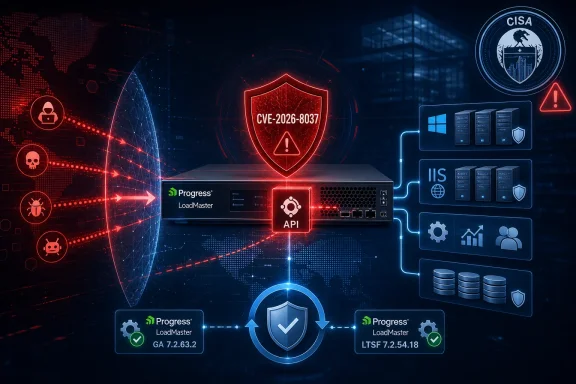 The vulnerable API can expose an edge appliance to pre-authentication command execution
CVE-2026-8037 is tracked as an OS command-injection vulnerability in the API used by Progress ADC products. The NVD record, based on information submitted by Progress, says an unauthenticated attacker can execute arbitrary commands on a LoadMaster appliance by supplying unsanitized input to multiple command endpoints.That description alone warrants priority treatment. A remote, unauthenticated command-execution route on an internet-facing traffic-management appliance is the sort of defect attackers can use for initial access without phishing a user, cracking a password, or compromising a Windows endpoint first.
watchTowr Labs’ June research supplies the mechanism omitted from CISA’s short alert. Its analysis found that a vulnerable string-handling routine did not properly terminate escaped data in memory. By manipulating heap memory through API requests, an attacker could cause the appliance to incorporate attacker-controlled command content into a shell command. The research identifies the
/accessv2 API endpoint and says the practical exposure depends on the API being enabled.The distinction is important operationally. Disabling or restricting API access can reduce exposure during an emergency response, but it is not a substitute for the fixed firmware. The underlying flaw was in the appliance’s handling of API-supplied data, and public proof-of-concept research is already available.
Progress’ release notes characterize the fix more narrowly as an update to the cipher-set UI and API command that prevents unintended remote-command execution. The patched versions are clear:
- LoadMaster GA 7.2.63.2 fixes the issue for the current GA train.
- LoadMaster LTSF 7.2.54.18 fixes the issue for the long-term-support train.
CISA’s deadline reflects exposure and impact, not a confirmed ransomware campaign
The KEV entry sets an August 10 due date and labels known ransomware use as “Unknown.” That field should not be misread as a low-risk signal. It means CISA has not confirmed that this particular CVE has been used in ransomware operations; it does not mean exploitation has not been observed.eSentire’s Threat Response Unit reported that it began seeing exploitation attempts on June 29. Its observed attempts failed, and it reported no resulting post-compromise activity in those cases. That is a meaningful caveat: public reporting does not establish a successful intrusion tied to the observed activity. But the same reporting identified attacker interest after public exploit research appeared, which is precisely the point at which exposed edge appliances tend to become scanning and opportunistic-access targets.
CISA’s inclusion changes the response expectation for federal agencies. BOD 26-04, issued June 10, replaced the older one-size-fits-all KEV remediation model with a risk-based approach that considers asset exposure, KEV status, exploit automation, and post-exploitation technical impact. A public-facing appliance vulnerable to unauthenticated command execution is the type of asset the directive is meant to force to the front of a remediation queue.
The agency’s KEV record makes this unusually explicit. It tells stakeholders to evaluate each asset’s internet exposure, follow BOD 26-04 patching guidance, and apply CISA’s forensic-triage requirements. In practical terms, agencies with an affected externally reachable LoadMaster should establish whether compromise indicators exist before the appliance is patched or rebuilt, because a clean patched state does not answer whether the device was previously accessed.
Private-sector organizations are not bound by the directive, but CISA’s recommendation to use KEV as a risk-prioritization input applies just as well to them. A LoadMaster appliance sitting in front of Windows services is infrastructure security, not an isolated network-team maintenance task.
The KEV label omits part of the CVE’s reported product scope
There is a scope mismatch administrators should not overlook. CISA’s KEV entry names the product as Progress LoadMaster, and its description repeatedly refers to command execution on the LoadMaster appliance. That is the correct immediate focus for most organizations.However, the NVD record’s affected-product data, supplied by Progress, lists more than LoadMaster: it also identifies ECS Connection Manager, Object Scale Connection Manager, and MOVEit WAF within affected version ranges. The public LoadMaster release notes only document the LoadMaster 7.2.63.2 fix, while CISA’s KEV record is likewise LoadMaster-specific.
This does not prove every listed product is deployed in a configuration reachable through the same attack path. It does mean that asset inventories and vulnerability-management platforms should not filter CVE-2026-8037 solely on the string “LoadMaster.” Administrators responsible for Progress ADC-adjacent products should check the vendor’s current advisories and installed versions, especially where shared appliance code or management components are present.
The same underlying record also contains a scoring inconsistency. Progress assigned CVSS 9.6 with an adjacent-network attack vector, while NVD’s enrichment assigns CVSS 9.8 with a network attack vector and no required privileges. The higher NVD score aligns with the publicly available research describing a remotely reachable, unauthenticated API path. More importantly, neither number changes the remediation decision after CISA has placed the CVE in KEV.
What administrators should do before Monday’s federal due date
The response should start with asset discovery, not a blanket assumption that LoadMaster is safely buried behind a firewall. Identify every Progress LoadMaster instance, determine whether its management or API interfaces are reachable from the internet or untrusted network segments, and establish whether the API is enabled.For affected appliances, preserve relevant logs and configuration evidence before making disruptive changes. CISA’s required-action language specifically points agencies to its forensic-triage requirements, which is a signal that post-patch validation alone is inadequate for systems that were exposed during the vulnerable period.
Review web and appliance logs for unexpected requests to the LoadMaster API, particularly the
/accessv2 route identified in watchTowr Labs’ technical analysis. eSentire published three source IP addresses associated with observed attempts, but IP blocking should be treated as a supplementary detection measure, not a control: attackers can change infrastructure easily, while the vulnerability remains available to anyone who can reach an unpatched API.Then apply the appropriate Progress update:
- Upgrade GA deployments to 7.2.63.2 or later.
- Upgrade LTSF deployments to 7.2.54.18 or later.
- Verify the running version after the maintenance window rather than relying on a completed-job status from a centralized tool.
- Restrict management and API access to explicitly authorized administrative networks while the patch is being staged and after it is installed.
References
- Primary source: CISA
Published: August 7, 2026 at 12:00 PM UTC
Loading…
www.cisa.gov - Related coverage: nvd.nist.gov
Loading…
nvd.nist.gov - Related coverage: cisa.gov
Loading…
www.cisa.gov - Related coverage: cyber.gc.ca
Loading…
www.cyber.gc.ca - Related coverage: esentire.com
Loading…
www.esentire.com - Related coverage: github.com
kev-data/known_exploited_vulnerabilities_schema.json at develop · cisagov/kev-data · GitHub
Mirror of cisa.gov/kev data files. Contribute to cisagov/kev-data development by creating an account on GitHub. github.com
- Related coverage: github.com
Loading…
github.com