

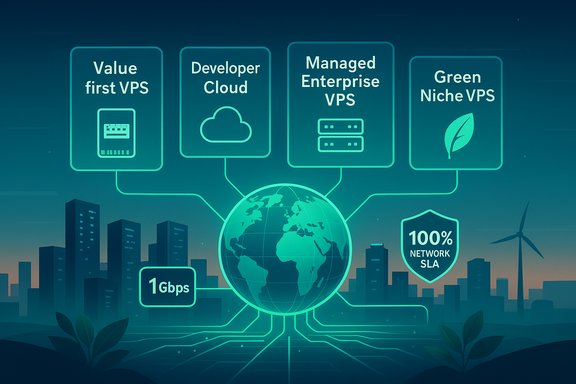
The 2025 roundup of the year’s best VPS hosting services — curated from All About Cookies’ roundup and cross‑checked against vendor documentation and independent reviews — confirms one thing: the VPS market is no longer a commodity race on price alone. Providers have segmented into clear use‑case tiers — value-first VPS, developer/cloud‑native VPS, managed enterprise VPS, and green / niche VPS — and each category brings different tradeoffs in performance, support, pricing transparency, and contractual risk. The All About Cookies overview frames those differences and flags the usual traps — promotional entry pricing, renewal shock, and headline SLAs that hide fine‑print exclusions — while recommending providers aligned to specific needs.
The last two years have accelerated specialization across VPS offerings. Hyperscalers and IaaS vendors focus on scale and global distribution; developer‑friendly clouds promise predictable VM pricing and fast provisioning; managed hosts package convenience for non‑ops teams; and a growing number of hosts push sustainability and regional data‑center footprints as differentiators. The All About Cookies summary mirrors this segmentation and highlights the editors’ picks for 2025, including HostGator, Liquid Web, GreenGeeks, ScalaHosting, Hostinger and others — each chosen to match a specific buyer profile.
What’s changed materially in 2025:
Where readers should be skeptical:
Source: All About Cookies https://allaboutcookies.org/best-vps-hosting-services/
 Background / Overview
The last two years have accelerated specialization across VPS offerings. Hyperscalers and IaaS vendors focus on scale and global distribution; developer‑friendly clouds promise predictable VM pricing and fast provisioning; managed hosts package convenience for non‑ops teams; and a growing number of hosts push sustainability and regional data‑center footprints as differentiators. The All About Cookies summary mirrors this segmentation and highlights the editors’ picks for 2025, including HostGator, Liquid Web, GreenGeeks, ScalaHosting, Hostinger and others — each chosen to match a specific buyer profile.What’s changed materially in 2025:
- SLA positioning has grown sharper: a few vendors now advertise aggressive network/power SLAs (including 100% for specific scopes), but the practical value depends on exclusions and claims processes.
- NVMe storage is mainstream even in budget VPS tiers; Latency and IOPS now move ahead of raw CPU counts for most web workloads.
- Sustainability claims are marketing differentiators for SMBs and agencies that need to show environmental responsibility, but methodologies for “energy matching” vary widely.
What the All About Cookies roundup actually says (summary)
All About Cookies’ “Best VPS Hosting Services of 2025” is a use‑case driven list rather than a single ‘best of’ table. Key editorial positions:- HostGator: recommended for beginners and budget projects due to accessible onboarding and predictable shared/VPS features, with the usual caveat about promotional pricing and renewals.
- Liquid Web: the enterprise managed pick with 100% network/power SLA on many tiers, robust support SLAs and pricing geared toward revenue‑critical apps.
- GreenGeeks: the eco‑focused choice, marketed around a 300% renewable energy match and tree‑planting commitments, paired with competitive managed VPS and WordPress plans.
- ScalaHosting: a middle‑ground VPS host with SPanel (a cPanel alternative) and flexible configuration sliders for resource sizing.
- Hostinger: the value champion with aggressive introductory VPS pricing and NVMe storage in entry tiers, attractive for hobby projects and game servers if you accept chat‑first support.
Vendor claims verified and where to be cautious
Below I verify the most consequential claims All About Cookies highlights, pairing vendor documentation with independent review corroboration.Liquid Web — 100% network/power SLA (verified)
Liquid Web publicly publishes a Network Uptime SLA of 100%, defined as the reachability of major routing devices within their network, with a compensation model that multiplies downtime by a factor (e.g., 1,000%) but caps credits at the customer’s monthly fee. The SLA also requires customers to file claims and excludes breaches, scheduled maintenance and force majeure events. Independent reviews and market analyses consistently position Liquid Web as a managed‑hosting vendor built for high‑assurance, revenue‑critical workloads; they praise the SLA posture but also remind buyers to read the exclusions and the credit claim process. This combination — strong SLA headline plus a claims procedure and caps — is typical in the industry: the guarantee reduces operational risk but rarely compensates fully for extended business losses. Caution: A 100% network SLA is not the same as a 100% application uptime guarantee. Application‑level outages (app bugs, plugin conflicts, database errors) remain the customer’s responsibility unless the managed plan explicitly covers app‑level remediation.GreenGeeks — “300% renewable energy match” (context and verification)
GreenGeeks’ sustainability messaging — most prominently a claimed 300% renewable energy match and a tree‑planting program for new accounts — is accurate as a marketing statement and is repeatedly reported in independent reviews. TechRadar’s 2025 GreenGeeks review echoes the 300% matching claim and quantifies offsets in kWh on a yearly basis. Caution: “300% match” is an accounting model. It means the provider purchases renewable energy credits (RECs) equal to three times their reported consumption, not that every watt powering your server came physically from wind or solar. For corporate sustainability reporting or regulated carbon accounting, buyers should request third‑party attestations or REC purchase records. All About Cookies flags this same verification need.Hostinger — aggressive entry VPS pricing and NVMe hardware (verified)
Hostinger’s public pricing pages show entry VPS tiers that, in promotional windows, can appear extremely low (e.g., $4.99/month KVM 1 promotional), and their plan matrix confirms NVMe storage and AMD EPYC CPUs at mainstream price points. Hostinger bundles features such as weekly backups, 1 Gbps ports and global data center choices at many tiers. Independent guides that rank Hostinger highly for value echo the same strengths and the need for caution: promotional prices often require multi‑year prepayment and renew at higher rates. Model first‑year and renewal TCO before committing to long terms.ScalaHosting and SPanel — control‑panel licensing and migration advantages (verified)
ScalaHosting has invested in SPanel, a proprietary control panel positioned as a cPanel alternative to avoid per‑account cPanel licensing fees. ScalaHosting documents SPanel availability and migration workflows on vendor pages, and independent reviews corroborate that SPanel reduces licensing cost exposure while providing comparable features. Caution: If you have third‑party tooling tightly coupled to cPanel’s APIs or expect managed CPanel‑specific migrations, validate compatibility with the vendor before relying on an SPanel migration path.IONOS — Cloud Cubes pricing (verified)
IONOS Cloud Cubes are listed with simple preconfigured building blocks (e.g., Basic Cube XS: 1 vCPU / 2 GB RAM / 60 GB SSD ≈ $5.76 per 30 days) on IONOS’ product pages, making cost modeling straightforward for predictable workloads. This pay‑as‑you‑go, minutewise billing model is explicit in vendor documentation. Caveat: IONOS’ low list prices are accurate for the described cube, but network features, backups and managed services typically add cost. Always pull the exact product SKU and confirm contractual SLAs for the configuration you intend to use.Hostwinds — high‑RAM templates and large VPS ceilings (verified)
Hostwinds publishes VPS templates that scale to very large memory and CPU allocations; public pricing pages show managed and unmanaged templates up to 96 GB RAM and 16 vCPU, and higher if you use dedicated/dedicated‑like offerings. Hostwinds’ high‑ceiling templates make it a cost‑effective option for memory‑intensive workloads such as caching layers or in‑memory analytics. Caveat: Hostwinds is a good raw‑resource play, but if you need enterprise SLAs, compliance attestations, or managed application‑level support, factor those needs into the TCO.InMotion — 90‑day money‑back guarantee (verified)
InMotion Hosting publicly advertises a 90‑day money‑back guarantee on qualifying plans and is commonly recommended for SMBs that value a longer trial window and good support. This policy is highlighted in both vendor documentation and independent reviews. Caveat: Guarantee eligibility varies by product (e.g., some cloud/dedicated tiers may have different refund terms). Confirm the exact refund policy for the plan you choose.Strengths and risks across the 2025 VPS landscape
Strengths (what’s improved)
- Performance parity at entry levels: NVMe SSDs and 1 Gbps ports are now common, making basic VPS performance surprisingly good even on value plans. This reduces the need to overprovision CPU to chase I/O.
- Choice by use case: The market now supports clear buyer journeys — low‑cost hobby VPS, developer clouds (API + predictable pricing), managed revenue‑critical VPS, and green/niche providers for sustainability goals.
- Control‑panel alternatives: SPanel and other non‑cPanel panels reduce licensing shock for SMBs and agencies with many accounts.
Risks (what to watch)
- Promotional pricing and renewal shock: Many vendors advertise extremely low entry prices tied to 24–36 month prepay windows. Model first‑year vs multi‑year TCO before signing.
- SLA nuance and claim friction: A lot of “100%” uptime marketing applies to narrow definitions (network/rack power), excludes scheduled maintenance and third‑party outages, and often requires the customer to file a claim within a tight window to receive credit. Credits rarely equal business damages.
- Greenwashing risk: Renewable energy matching and offset claims use different accounting methods; demand documentation if environmental compliance matters to your organization.
- Hidden add‑ons: Backups beyond the included retention, managed database tiers, control panels (cPanel/Plesk), and DDoS mitigation are frequent incremental costs.
How to pick the right VPS in 2025 — checklist and procurement flow
Short checklist (operational):- Read the SLA PDF end‑to‑end. Note exclusions, downtime definitions, and how credits are calculated.
- Calculate first‑year and year‑2 bills with realistic growth: factor renewals and common add‑ons (backups, control panels, managed services).
- Confirm recovery objectives: backup frequency, retention, and expected restore time (RTO/RPO).
- Validate compliance: SOC 2, PCI DSS, HIPAA needs must be validated with current third‑party attestations.
- Test support: open a ticket for a simulated incident and time the response/triage process.
- Define baseline needs: CPU, RAM, storage type (NVMe vs SSD), bandwidth, and OS (Linux vs Windows).
- Shortlist by use case: low‑cost value hosts, developer clouds (pay‑as‑you‑go), managed vendors for revenue‑critical apps.
- Run a 30–90 day proof of concept with two providers in production‑like conditions.
- Compare measured performance and support response, then negotiate an SLA/escalation path in writing.
- Sign with a provider that matches both technical and contractual needs.
- Keep staging and production on separate providers for critical apps to avoid single‑vendor outages.
- Automate backups and test restores weekly.
- Use an external monitoring service to detect downtime before vendor alerts arrive.
- For public‑facing global apps, always pair your VPS with a CDN to shield you from egress spikes and to improve P95 latency.
Deep dives: SLA language, backup terms, and pricing traps
SLA language — what to parse
- Look for the SLA’s definition of “downtime.” Is it measured at the data center edge, rack, or at the VM level?
- Check exclusions: scheduled maintenance, DDoS, and third‑party network failures are commonly excluded.
- Confirm whether credits are automatic or require a claim within a set window; ask whether they are capped or limited to monthly fees. Liquid Web’s SLA illustrates the approach: strong headline guarantees with specific claim processes and caps.
Backup and restore
- Confirm whether backups are stored offsite and whether restores are included or billed per‑incident.
- Check retention windows — daily vs weekly — and make sure the vendor’s RTO can meet your recovery goals.
Pricing traps
- Promotional or “limited time” rates almost always require upfront payment and a new‑customer status. Confirm renewal pricing in writing or on the checkout page.
- Control panel licensing (cPanel/Plesk) can add $10–$30+ per month depending on account counts.
- Egress and bandwidth policies vary. If your workload is egress‑heavy (video, large downloads), model those costs carefully.
Use‑case recommendations and representative providers
Below are practical matches built from the All About Cookies editorial positioning plus independent verification.Best for beginners on a budget
- HostGator or Hostinger: accessible onboarding, one‑click installs, low entry pricing; watch renewal rates. Hostinger provides NVMe and clear plan matrices for KVM VPS tiers.
Best value / game servers / hobby projects
- Hostinger: low advertised VPS entry prices, hPanel, and game‑oriented VPS templates make it a common pick for hobbyist game servers. Ensure you plan for chat‑first support models.
Best for revenue‑critical, SLA‑backed hosting
- Liquid Web: managed stack, strong SLA posture, enterprise support. Great for e‑commerce checkout servers and business apps that cannot tolerate extended downtime. Verify contract scope before production cutover.
Best for eco‑conscious SMBs
- GreenGeeks: strong renewable energy matching and environmental programs. Confirm REC documentation for corporate sustainability reporting.
Best for developer clouds / pay‑as‑you‑go
- IONOS Cloud Cubes, DreamHost DreamCompute, AccuWeb Cloud: predictable building blocks and pay‑as‑you‑go pricing make these attractive for experiment‑driven developer workflows and small teams. IONOS documents simple cube pricing that’s easy to model.
Best for high‑RAM application servers
- Hostwinds: very large memory ceilings and flexible templates make Hostwinds an attractive option for caching nodes, in‑memory analytics, and other RAM‑heavy roles. Validate support coverage for memory‑heavy incidents.
Migration and operational readiness
Practical migration steps for moving to a new VPS host:- Inventory dependencies: OS, DB engine versions, cron jobs, SSL certs, and external integrations.
- Script configuration and environment reproducibility (IaC, dotfiles, container images).
- Provision a staging VPS in the target data center and run a parallel production‑like load test for at least 14–30 days.
- Validate backups and perform a full restore test to ensure RTO requirements can be met.
- Schedule a DNS cutover with TTL‑based planning and have rollback steps documented.
- Use an external synthetic monitoring provider to detect geographic outages.
- Keep automated, immutable snapshots to reduce human error during restores.
- For Windows/.NET stacks, confirm the provider’s supported Windows Server versions and licensing model (some vendors include Windows licensing; others pass through MS licensing costs).
Final assessment — what All About Cookies gets right (and where to be skeptical)
All About Cookies’ 2025 VPS roundup is a pragmatic, use‑case oriented guide: it frames each vendor’s strengths, flags likely buyer traps (promotions, renewals, SLA nuance), and supplies a practical procurement checklist that scales from hobby sites to revenue‑critical apps. The editorial advice aligns with vendor pages and independent reviewers on the most load‑bearing claims: Liquid Web’s SLA posture, GreenGeeks’ renewable messaging, ScalaHosting’s SPanel strategy and Hostinger’s price‑to‑feature value are all verifiable in official documentation and independent coverage.Where readers should be skeptical:
- Treat headline SLA percentages as the starting point, not the final risk assessment. Read the SLA fine print and test the claims process.
- Promotional pricing can distort short‑term comparisons; always compute multi‑year TCO including probable renewals and needed add‑ons.
- Sustainability claims vary in method. Request third‑party evidence if you must report carbon offsets formally.
Conclusion
The 2025 VPS market rewards specificity: match your workload to a clearly aligned provider rather than chasing a single “best VPS” label. For hobby projects and game servers, Hostinger’s NVMe‑backed value remains compelling. For managed, revenue‑critical applications, Liquid Web’s SLA and enterprise support set a high bar — but confirm exclusions and claims procedures. GreenGeeks provides a credible sustainability story for brands that need it, while ScalaHosting’s SPanel offers a practical way to avoid control‑panel licensing shock. Across the board, the editorial themes from All About Cookies — read SLA fine print, model renewal TCO, verify backup/restore behavior — remain the most enduring and actionable advice for buyers in 2025.Source: All About Cookies https://allaboutcookies.org/best-vps-hosting-services/
