

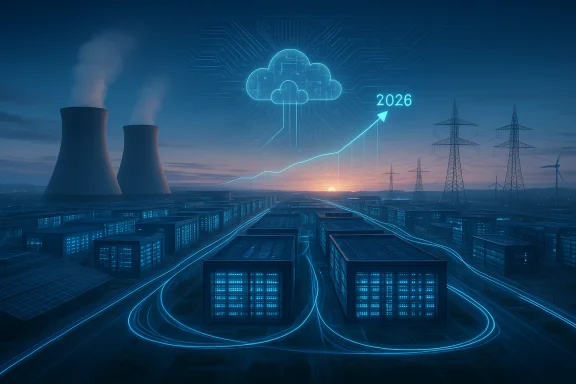
Big Tech’s 2026 AI spending plans are not a gentle ramp — they are a once‑in‑corporate‑history infrastructure buildout that, by most estimates, pushes annual hyperscaler capital expenditure into the low‑hundreds of billions and creates a concentrated, high‑stakes market for chips, data centers, power and specialized services.
Background
The past three years have seen cloud giants shift from incremental AI experiments to programmatic, multi‑year engineering campaigns. What began as model experiments and pilot projects has moved decisively into production: large language models, multimodal engines, and inference platforms now sit at the center of future revenue plans for the largest cloud providers. That transition has a clear and measurable consequence — massive capital investment in compute, networking, storage and facility capacity.In early 2026 several hyperscalers disclosed or guided to dramatically higher capital‑expenditure (capex) plans for the year, creating what industry observers describe as the largest AI infrastructure buildout ever attempted by a group of private companies. While precise totals vary between reports, the range that has circulated publicly for 2026 AI‑related capex sits broadly between about $630 billion and $680 billion when the major hyperscalers’ commitments are aggregated. Those headline totals mask important differences in how each company spends, finances and expects to monetize the buildout.
Who’s spending — and how much
Alphabet (Google)
Alphabet’s 2026 capex guidance is the most eye‑catching. Management communicated a significant increase in capital commitments for 2026, with public commentary and investor materials pointing to a figure dramatically higher than the previous year. This jump is explicitly tied to AI infrastructure: data centers, custom accelerators and networking for model training and inference.- Alphabet’s announced guidance for 2026 capex is reported in the high tens of billions, widely cited in the range of $175–$185 billion for the calendar year.
- That represents a near‑doubling (or more) compared with its prior year spend and reflects an aggressive strategy to scale models, protect search and advertising dominance, and expand Google Cloud’s capacity to host third‑party AI workloads.
Meta
Meta’s 2026 plan is also substantial and concentrated in hyperscale facilities and compute.- The company has communicated a 2026 capex range with a high end that approaches $115–$135 billion, driven by new data centers, large GPU clusters, and related power and networking investments.
- Meta’s buildout includes several very large projects (including multi‑hundred‑megawatt sites) designed specifically for AI training and inference workloads.
Amazon (AWS)
Amazon’s 2026 guidance pushed capex materially higher than 2025 levels, with the company signaling large commitments across AI, chips, robotics and satellite initiatives.- Publicly reported guidance places Amazon’s 2026 investment in the neighborhood of $200 billion, a substantial increase aimed mainly at expanding AWS capacity for AI services as well as internal retail and logistics automation.
Microsoft
Microsoft has also committed to sizeable investments to support Azure’s AI platform and its partnership/ecosystem play with other AI providers. While Microsoft’s corporate capex disclosure is expressed differently than some peers, the operational reality is clear: expansion of data center footprint, acquisition of high‑performance accelerators and investments in networking and power are central to its fiscal 2026 program.- Microsoft’s quarterly reports and investor commentary indicate elevated quarterly capex and a multi‑year data center expansion plan; this ties into its strategy to scale Copilot and enterprise AI offerings at Azure.
Oracle and other players
Oracle, historically not a hyperscaler in scale, has dramatically repositioned to compete for AI workloads — renting Nvidia‑powered nodes, investing in cloud infrastructure and pursuing financing strategies to accelerate growth. Smaller hyperscalers and cloud specialists (including vertical cloud providers and GPU‑native hosts) add to the aggregate demand picture, but the lion’s share of spending is concentrated in the largest firms listed above.What the money buys
The headline capex numbers translate into real, tangible hardware and infrastructure that takes time, energy and specialized supply chains to assemble.- High‑density GPU clusters and custom accelerators for training and inference.
- Network fabrics and optical interconnects to move massive datasets between nodes with low latency.
- Hyperscale data center campuses with accompanying substations, transmission upgrades and cooling systems.
- Fabrication and procurement contracts and long‑lead ordering for semiconductors from foundries and ASIC vendors.
- Financing vehicles, including bonds and structured deals, to spread funding for multi‑year builds.
Funding the buildout: cash, debt and creative financing
This wave of spending has a financing story as important as the engineering story. Several companies have deployed debt markets and special financing structures to fund 2026 commitments without immediately eroding cash flow.- Alphabet’s large bond issuances in early 2026 reflect a deliberate decision to borrow to fund accelerated capex rather than rely exclusively on cash from operations.
- Meta has used structured financing and special purpose vehicles in some data center financing, shifting some of the capital burden into alternative structures while preserving operational liquidity.
- The aggregate effect is visible in market commentary: hyperscalers are issuing high volumes of corporate debt to match the scale and timing of the buildout.
The supply chain center stage: chips, foundries and concentration risk
The biggest single bottleneck in the AI capital story is compute silicon and the ecosystem that produces it.- NVIDIA remains the dominant supplier of datacenter GPUs used for training and inference at hyperscale. The company’s hardware architecture and software ecosystem have become de‑facto standards for large model training.
- Custom accelerators — proprietary ASICs and in‑house chips — are increasingly part of the strategy for some hyperscalers, but these still rely on a small set of foundries and packaging suppliers.
- Foundry capacity (principally at leading-edge fabs) is limited and concentrated geographically, most notably at a handful of major suppliers. That concentration magnifies geopolitical and supply‑chain risk.
Energy, real estate and environmental questions
A hyperscale AI buildout of this magnitude has massive implications for energy grids and real estate.- Sites that can deliver hundreds of megawatts of continuous power are rare; when you couple that with the need for fiber, cooling and proximity to talent pools, suitable locations become strategic assets.
- Several hyperscalers are designing multi‑hundred‑megawatt campuses; one recent example is a planned data center with roughly a gigawatt of capacity, engineered to handle both AI and conventional workloads.
- This scale raises environmental questions about carbon intensity, water usage for cooling in certain designs, and the need for major transmission upgrades and local grid resilience investments.
The advertising and revenue model shift
For companies that monetize advertising and cloud software, the capex is not an end in itself but a means to new revenue streams.- Google and Meta are building generative AI features that they expect will increase end‑user engagement and create new formats for monetization in search, social feeds and video.
- Microsoft’s enterprise strategy relies on bundling Copilot‑style assistants and developer tools with Azure consumption, increasing the lifetime value of cloud customers.
- Amazon aims to differentiate with vertically integrated services and specialized hardware for customers who run large AI workloads through AWS.
Strengths of the current buildout
- Scale and first‑mover advantage. Firms that can lock in capacity and talent today are likely to extract outsized margins once AI services mature and become sticky.
- Integration and control. Owning the stack — from silicon to cloud APIs — provides the flexibility to optimize for latency, cost and feature differentiation.
- Ecosystem leverage. Platforms with large existing enterprise and developer ecosystems (search, productivity suites, ad networks) have natural distribution channels for AI features.
- Supplier bargains and long‑term contracts. Committing early to hardware and real estate can secure capacity and pricing that later entrants will find costly or unavailable.
Risks and vulnerabilities
While the buildout creates scale advantages, it also concentrates several systemic risks.1. Financial and market risks
Large, front‑loaded capex exposes companies to interest‑rate fluctuations, credit market conditions and investor sentiment. Borrowing to fund data center expansion increases leverage and can amplify losses in a downturn. Short‑term investor reaction to heavy spending has already been visible in share‑price volatility at some large tech firms.2. Concentration in critical suppliers
A handful of vendors, particularly GPU suppliers and advanced foundries, control capacity. This concentration creates:- Price risk (suppliers can raise prices).
- Supply risk (fabrication disruptions or export controls have outsized effects).
- Strategic leverage (vendors may prioritize some customers over others).
3. Power and real‑estate constraints
Data center clusters require unprecedented local power capacity. Securing long‑term power contracts and grid upgrades is both costly and politically fraught. Local opposition, permitting delays, and grid bottlenecks can materially slow deployment and increase costs.4. Regulatory and geopolitical risk
Governments are increasingly concerned about the economic, security and societal impacts of AI. Regulatory actions could include:- Export controls and sanctions affecting chip shipments.
- Data‑localization rules impacting where models can be trained.
- Antitrust scrutiny that targets platform dominance.
5. Technology risk and stranded assets
AI hardware is evolving quickly. Spending billions on one class of accelerator risks creating stranded assets if a new architectural leap renders that hardware obsolete. The pace of innovation in chip design and model architecture increases the probability of such mismatches.6. Environmental and social license risk
Rapid buildouts can trigger community and environmental backlash. Water usage, noise, and increased local traffic for large campuses can produce active resistance that delays projects and raises costs.What this means for enterprises, developers and WindowsForum readers
For IT teams, software vendors and power users, the hyperscaler investment surge has practical consequences.- Cloud pricing and service offerings are likely to diversify as providers compete to capture AI workloads. Expect new tiers for inference, specialized accelerators, and committed‑use discounts tied to large contractual minimums.
- Enterprises should plan for vendor lock‑in risk. Heavy optimization for one provider’s accelerators or APIs can raise migration costs later.
- For Windows and PC users, there will be both local and cloud pathways for AI. While hyperscalers focus on massive model training, the commercial market for on‑device and edge inference (using smaller models or specialized chips) will grow — creating opportunities for hybrid architectures that keep latency‑sensitive tasks local.
- Developers will see richer tools and SDKs but also greater fragmentation. Competency in cross‑platform model deployment and cost‑aware engineering will be a competitive advantage.
Practical guidance: how to navigate the buildout
For IT leaders and technical decision‑makers, the immediate questions are how to leverage new capabilities while managing the risks.- Diversify vendor exposure. Avoid single‑provider dependency for core AI workloads. Use multi‑cloud or hybrid strategies to reduce supplier concentration risk.
- Negotiate consumption terms. Seek flexibility in committed spend, clear SLAs for capacity and price protection clauses given volatile hardware markets.
- Invest in portability. Adopt containerized model deployment, open model formats and abstraction layers that ease migration between ASICs and clouds.
- Plan for power and costs. Model total cost of ownership (TCO) including energy, networking and storage, not just compute hours.
- Prioritize governance. Establish policies for model auditing, data provenance and compliance up front to avoid retrofitting expensive controls later.
- Consider staged adoption. Use proof‑of‑value projects with clear KPIs before wholesale migration of mission‑critical workloads.
- Hedge hardware risk. For latency‑sensitive or high‑value workloads, evaluate on‑prem or colocation options with contractual hardware refresh pathways.
Policy and market implications
The scale of private AI capex will draw governments and regulators into the center of infrastructure policy. Key areas to watch:- Grid and transmission planning will need to accommodate clustered, high‑power data centers.
- Export controls and chip licensing regimes could reshape who can build what, where.
- Competition policy may focus on gatekeepers that combine platform reach, cloud infrastructure and model ownership.
Where returns could emerge
Despite the risks, there are plausible pathways to high returns:- Software monetization around AI features (search, ads, productivity) that increases margins once infrastructure is amortized.
- Cloud services revenue from third‑party model hosting, inference engines and enterprise AI platforms.
- Vertical specialization where hyperscalers provide industry‑specific models and data services that customers pay a premium for.
- Hardware and services partners — suppliers of accelerators, interconnects, and cooling solutions will enjoy a multi‑year demand surge.
The ethics and societal dimension
Large, centralized AI infrastructure amplifies ethical questions about access, power and oversight.- Centralized model providers control the primary training pipelines and have material influence over what capabilities are deployed and how they are governed.
- Concentration increases the consequences of abuse, model bias, or operational failure.
- Ensuring equitable access and robust safety regimes becomes not just a technical challenge, but a governance imperative.
Conclusion
The 2026 hyperscaler buildout marks a fundamental inflection point for the technology industry. Hundreds of billions in capex are being directed into AI compute, data centers and the supply chains that sustain them, creating an industrial‑scale deployment of capabilities that were once experimental.This is an era of enormous opportunity: faster models, more capable services and a reshaped software economy. It is also an era of concentrated risk: financial leverage, supplier concentration, grid constraints, regulatory uncertainty and the specter of stranded capital.
For businesses and technical teams, the right response is a blend of ambition and caution: seize new capabilities where they provide clear, measurable value; diversify exposure and insist on portability; plan for energy and operational costs; and build governance systems that match the scale of the technology. The companies that manage that balance — delivering real customer value while containing the new systemic risks — will define the winners of the next decade.
Source: Campaign Indonesia Big Tech’s AI spend in 2026: following the money
