

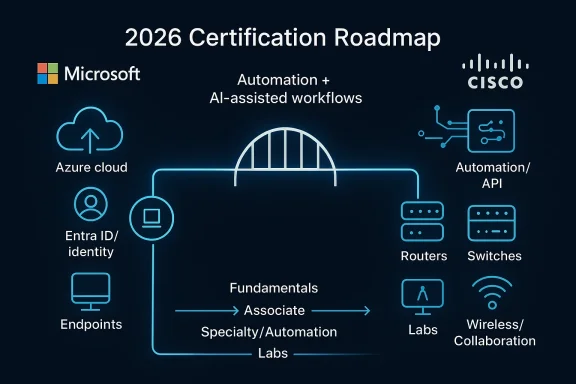
In 2026, the Microsoft and Cisco certification ecosystems are still among the clearest signals of practical IT competence, but they are no longer static badges. They are evolving credential frameworks shaped by cloud adoption, automation, AI-assisted workflows, and the need for professionals who can prove skills fast. For anyone building an IT career path, that means the right certification strategy is less about collecting logos and more about choosing a direction, sequencing your learning, and staying current. Microsoft’s renewal model and Cisco’s certification rebrands both show how quickly the ground is moving under the industry’s feet.
The appeal of Microsoft certifications has long rested on their alignment with enterprise reality. Organizations rely on Microsoft technologies for identity, endpoint management, productivity, cloud infrastructure, and increasingly AI-enabled work, which makes Microsoft Learn credentials useful across support, administration, cloud, and security roles. Microsoft now positions its certification ecosystem alongside Applied Skills and role-based certifications, signaling that employers want both broad foundations and task-specific proof.
Cisco certifications, meanwhile, remain a core language for networking careers, but Cisco is also reshaping the map. Cisco U. emphasizes learning paths, labs, and practice exams, while Cisco’s 2026 certification changes introduce a new taxonomy around CCNA, CCNP, and CCIE Automation, alongside updates for collaboration, wireless, and security. That shift is important because it reflects a market where networking, scripting, and automation are increasingly inseparable.
For job seekers, the practical takeaway is simple: certifications still open doors, but they work best when paired with real-world projects, a defined specialization, and a disciplined plan for recertification. Microsoft’s fundamentals certifications do not expire, while associate, expert, and specialty credentials require renewal; Cisco uses recertification cycles and continuing education pathways to keep professionals current. That alone changes how candidates should budget time and money over the course of a career.
The most successful IT professionals are rarely the ones who chase every exam. They are the ones who choose a domain, build depth, then use a certification ladder to demonstrate competence in a way hiring managers can quickly understand. In today’s market, that ladder often starts with foundational credentials, moves into associate-level specialization, and then branches into cloud, security, networking, or automation tracks.
The value is even higher in enterprise environments where infrastructure changes are frequent and downtime is expensive. A certified administrator or network engineer is often expected to understand not just concepts, but operational constraints, security posture, and standard troubleshooting logic. That is why certification programs continue to emphasize practical labs, scenario-based assessments, and renewal mechanisms rather than purely theoretical testing.
That structure matters for career planning because Microsoft technologies span cloud, productivity, security, data, and AI. A help desk technician, for example, may start with Microsoft 365 or Windows-related fundamentals, then move into endpoint management or identity. A cloud engineer might instead go into Azure administration, security, or AI-oriented credentials. The point is to follow the work you want to do, not just the exam that seems easiest.
Microsoft’s renewal policy also creates a different incentive structure from older certification models. According to Microsoft Learn, fundamentals certifications do not expire, while associate, expert, and specialty credentials use a six-month renewal window and free online renewal assessments. That is useful for professionals, but it also means certification is no longer a one-time event; it is a maintenance discipline.
The most visible 2026 change is Cisco’s rebranding of the DevNet line into CCNA Automation, CCNP Automation, and CCIE Automation beginning February 3, 2026. Cisco says active DevNet holders will be recognized under the new taxonomy, which is a strong signal that automation is no longer an adjacent specialty but part of the main networking story. That is a meaningful shift for enterprises trying to hire engineers who can manage infrastructure at scale.
Cisco is also pushing harder into wireless and collaboration track updates. Wireless certification changes are scheduled to launch in March 2026, and Cisco has indicated that collaboration updates are arriving around the same period. In other words, Cisco is not just refreshing exams; it is re-slicing the career map around modern operational domains.
Microsoft is usually the stronger choice if your interests include Windows Server, Microsoft 365, Azure, Entra ID, endpoint management, or cloud security. Cisco is usually the stronger choice if you enjoy routing, switching, campus networks, wireless architecture, WAN design, and network automation. The overlap is real, but the center of gravity differs.
For Microsoft, this often means beginning with a fundamentals credential that matches your target role, then pairing it with lab work in Azure or Microsoft 365. For Cisco, the most common entry is still the CCNA, especially for people who want a networking or infrastructure role. If you are undecided, start with the ecosystem closest to the jobs in your area.
For consumers, the impact is indirect but still real. Better-trained admins mean better-managed devices, safer email systems, more stable Wi-Fi, and fewer outages. When certifications track new areas like automation or AI-enabled management, end users benefit from faster incident response and more resilient infrastructure.
For Microsoft, the message is straightforward: renew your associate, expert, or specialty certification during the eligibility window, and fundamentals remain non-expiring. For Cisco, the model includes exam retakes and continuing education options depending on the certification level. The result is a career environment where learning is baked into maintenance.
That means resume language matters, but evidence matters more. A certification should be paired with a lab portfolio, a home project, a migration story, or a troubleshooting case study. Employers want to know not only that you passed an exam, but that you can survive the complexity of a live environment.
For job seekers, the best response is not to collect more certificates blindly. It is to build a roadmap that matches the kind of infrastructure you want to support, the employers you want to work for, and the long-term technical niche you want to own. A thoughtful plan will beat a crowded résumé almost every time.
Source: newskarnataka.com https://newskarnataka.com/technolog...uilding-a-successful-it-career-path/20032026/
 Overview
The appeal of Microsoft certifications has long rested on their alignment with enterprise reality. Organizations rely on Microsoft technologies for identity, endpoint management, productivity, cloud infrastructure, and increasingly AI-enabled work, which makes Microsoft Learn credentials useful across support, administration, cloud, and security roles. Microsoft now positions its certification ecosystem alongside Applied Skills and role-based certifications, signaling that employers want both broad foundations and task-specific proof.Cisco certifications, meanwhile, remain a core language for networking careers, but Cisco is also reshaping the map. Cisco U. emphasizes learning paths, labs, and practice exams, while Cisco’s 2026 certification changes introduce a new taxonomy around CCNA, CCNP, and CCIE Automation, alongside updates for collaboration, wireless, and security. That shift is important because it reflects a market where networking, scripting, and automation are increasingly inseparable.
For job seekers, the practical takeaway is simple: certifications still open doors, but they work best when paired with real-world projects, a defined specialization, and a disciplined plan for recertification. Microsoft’s fundamentals certifications do not expire, while associate, expert, and specialty credentials require renewal; Cisco uses recertification cycles and continuing education pathways to keep professionals current. That alone changes how candidates should budget time and money over the course of a career.
The most successful IT professionals are rarely the ones who chase every exam. They are the ones who choose a domain, build depth, then use a certification ladder to demonstrate competence in a way hiring managers can quickly understand. In today’s market, that ladder often starts with foundational credentials, moves into associate-level specialization, and then branches into cloud, security, networking, or automation tracks.
Why Certifications Still Matter
Certifications remain a powerful filtering mechanism in hiring because they reduce uncertainty. When a recruiter sees Microsoft Azure, Microsoft 365, CCNA, or CCNP, they can infer a baseline of structured training and exam-verified knowledge. That does not guarantee performance, but it does help employers sort candidates quickly in a crowded market.The value is even higher in enterprise environments where infrastructure changes are frequent and downtime is expensive. A certified administrator or network engineer is often expected to understand not just concepts, but operational constraints, security posture, and standard troubleshooting logic. That is why certification programs continue to emphasize practical labs, scenario-based assessments, and renewal mechanisms rather than purely theoretical testing.
The signal employers are actually buying
Employers are not just buying knowledge. They are buying reduced onboarding risk, repeatable skill validation, and a shorthand for specialization. In roles where a mistake can affect identity, connectivity, or cloud spend, that shorthand matters.- Proof of baseline competence
- Faster screening for hiring managers
- Evidence of commitment to the craft
- Better alignment with vendor ecosystems
- A structured way to specialize
- A reason to keep learning after hiring
Why the market has not moved past credentials
The shift to skills-based hiring has not eliminated certifications; it has sharpened them. In practice, companies often want both a portfolio of real work and a recognized credential that proves you can speak their technology stack. That is especially true in Microsoft-heavy enterprises and Cisco-centric network environments.Microsoft Certification Pathways
Microsoft’s ecosystem is strongest when treated as a progression rather than a menu. The fundamentals layer is designed for newcomers and cross-functional staff, while associate, expert, and specialty credentials target active practitioners. Microsoft also emphasizes a growing set of Applied Skills micro-credentials, which are intended to show ability in specific job tasks and can complement broader certifications.That structure matters for career planning because Microsoft technologies span cloud, productivity, security, data, and AI. A help desk technician, for example, may start with Microsoft 365 or Windows-related fundamentals, then move into endpoint management or identity. A cloud engineer might instead go into Azure administration, security, or AI-oriented credentials. The point is to follow the work you want to do, not just the exam that seems easiest.
Microsoft’s renewal policy also creates a different incentive structure from older certification models. According to Microsoft Learn, fundamentals certifications do not expire, while associate, expert, and specialty credentials use a six-month renewal window and free online renewal assessments. That is useful for professionals, but it also means certification is no longer a one-time event; it is a maintenance discipline.
Building a Microsoft ladder
A sensible Microsoft path usually looks like a staircase, not a leap. Start with fundamentals if you are new or changing fields, move into role-based associate certifications, then decide whether to deepen in cloud, security, productivity, or AI. The mistake many candidates make is jumping into expert-level study before they have operational experience.- Fundamentals for orientation and confidence
- Associate for role readiness
- Expert for advanced operational ownership
- Specialty for targeted differentiation
- Applied Skills for practical task validation
Microsoft’s 2026 signal
Microsoft’s AI-focused credential push is a reminder that the certification map is being redrawn around emerging workloads. The company is tying learning to real scenarios and practical assessments, which suggests the future of Microsoft credentials will be even more job-task oriented. That is a good thing for candidates who can prove they can do the work, not just describe it.Cisco Certification Pathways
Cisco remains the gold standard for networking careers, but its tracks have become more dynamic in response to automation and AI. Cisco U. promotes guided learning paths, labs, and practice exams, while Cisco’s certification pages continue to frame credentials as a route from entry-level competence to expert status. The current structure still centers on CCNA, CCNP, and CCIE, but the labels and focus areas are evolving.The most visible 2026 change is Cisco’s rebranding of the DevNet line into CCNA Automation, CCNP Automation, and CCIE Automation beginning February 3, 2026. Cisco says active DevNet holders will be recognized under the new taxonomy, which is a strong signal that automation is no longer an adjacent specialty but part of the main networking story. That is a meaningful shift for enterprises trying to hire engineers who can manage infrastructure at scale.
Cisco is also pushing harder into wireless and collaboration track updates. Wireless certification changes are scheduled to launch in March 2026, and Cisco has indicated that collaboration updates are arriving around the same period. In other words, Cisco is not just refreshing exams; it is re-slicing the career map around modern operational domains.
How Cisco’s track structure works
Cisco’s model rewards specialization, but it also rewards sequencing. A candidate usually needs a strong foundation before moving into architecture, security, automation, or expert lab work. The CCNA is still the most recognizable entry point, while CCNP and CCIE represent much deeper expertise and market value.- CCNA for foundational networking
- CCNP for professional specialization
- CCIE for expert-level validation
- Automation for programmable infrastructure
- Wireless for next-generation connectivity
- Collaboration for voice and communications environments
The new Cisco reality
Cisco’s recent announcements show that the company is treating network automation as a core competency rather than a niche add-on. That matters because network teams increasingly use APIs, scripts, and orchestration tools to handle repetitive tasks. The market is effectively telling engineers: learn the protocols, but also learn the code.Choosing Between Microsoft and Cisco
For many professionals, the decision is not Microsoft or Cisco in isolation. It is about whether they want to anchor their career in systems, cloud, and identity or in networking, infrastructure, and transport. Both paths can lead to strong careers, but the day-to-day work, hiring profiles, and technical depth are different.Microsoft is usually the stronger choice if your interests include Windows Server, Microsoft 365, Azure, Entra ID, endpoint management, or cloud security. Cisco is usually the stronger choice if you enjoy routing, switching, campus networks, wireless architecture, WAN design, and network automation. The overlap is real, but the center of gravity differs.
A career lens, not a vendor lens
A smart candidate should ask, what kind of problems do I want to solve every day? If the answer involves identity, device management, and cloud operations, Microsoft certifications can provide cleaner alignment. If the answer involves packet flows, network reliability, and secure connectivity, Cisco is likely the better anchor.- Microsoft for cloud, identity, productivity, endpoint, and security operations
- Cisco for enterprise networking, wireless, voice, and automation
- Both for infrastructure generalists in large organizations
- Either can be a strong starting point if aligned to the job market in your region
Where crossover helps
The best career moves often happen at the intersection. A network engineer who understands cloud identity becomes more valuable in hybrid environments. Likewise, a Microsoft administrator who understands network fundamentals can troubleshoot far more effectively in enterprise settings. Cross-training is a multiplier, not a distraction.Entry-Level Strategy
Entry-level candidates often want the fastest possible path to a job, but the fastest path is not always the shortest. A candidate who rushes into advanced material without a base usually struggles later, while someone who builds fundamentals can move faster once they hit the job market. In certification terms, that means choosing a path with clear milestones and avoiding the trap of studying randomly.For Microsoft, this often means beginning with a fundamentals credential that matches your target role, then pairing it with lab work in Azure or Microsoft 365. For Cisco, the most common entry is still the CCNA, especially for people who want a networking or infrastructure role. If you are undecided, start with the ecosystem closest to the jobs in your area.
A practical starting sequence
The smartest early-career sequence is usually structured, not improvised. It should move from learning to practice to credentialing in a way that creates momentum. That reduces exam churn and helps you build a portfolio of usable skills at the same time.- Pick a target role.
- Map the vendor ecosystem used by employers in your market.
- Take one fundamentals or entry-level exam.
- Build a home lab or cloud lab.
- Document projects and troubleshooting wins.
- Move to the next certification only after applying the first one.
Why labs matter more than cramming
Cisco’s emphasis on hands-on labs and Microsoft’s scenario-driven learning both reflect the same truth: modern IT work is practical. The person who can configure, recover, integrate, and document systems will almost always outperform the person who only memorizes objectives. That is especially true for beginners trying to turn credentials into first jobs.Enterprise vs Consumer Impact
The enterprise impact of certification is obvious: it affects hiring, promotion, project staffing, and support readiness. In large environments, a certified professional can influence architecture decisions because the credential provides a common vocabulary and a measure of confidence. Microsoft and Cisco both sell into enterprise customers, so their certification programs are tightly linked to how organizations deploy technology.For consumers, the impact is indirect but still real. Better-trained admins mean better-managed devices, safer email systems, more stable Wi-Fi, and fewer outages. When certifications track new areas like automation or AI-enabled management, end users benefit from faster incident response and more resilient infrastructure.
Why enterprises care about vendor credentials
Enterprises like certifications because they simplify resourcing. A hiring manager can infer that a CCNP or Microsoft associate-level professional has been exposed to a known body of knowledge and examined against a standardized rubric. That is not the same as guaranteed experience, but it is far better than guessing from a résumé alone.- Staffing confidence
- Standardized skill language
- Lower onboarding friction
- Better project placement
- Clearer promotion criteria
- Improved support coverage
Consumer outcomes are downstream
The average user never sees a certification badge, but they feel the effects. Faster ticket resolution, fewer misconfigurations, better device security, and more reliable connectivity all trace back to trained administrators and engineers. In that sense, certification programs are part of the invisible plumbing of digital life.Recertification and Staying Current
One of the biggest misunderstandings in IT is that a certification is permanent proof of competence. That is no longer true for most valuable credentials. Microsoft’s renewal process and Cisco’s recertification policies are both designed around the idea that technology changes too quickly for a once-and-done approach.For Microsoft, the message is straightforward: renew your associate, expert, or specialty certification during the eligibility window, and fundamentals remain non-expiring. For Cisco, the model includes exam retakes and continuing education options depending on the certification level. The result is a career environment where learning is baked into maintenance.
Why renewal is strategically valuable
Renewal keeps your credential aligned with current products, features, and best practices. It also protects your résumé from looking stale during hiring cycles, especially if you are targeting roles in cloud, security, or automation where product changes are constant. In a market that values relevance, renewal is a career habit, not a bureaucratic chore.- Keeps skills current
- Reduces certification drift
- Signals ongoing commitment
- Supports promotions and lateral moves
- Protects long-term credential value
The hidden benefit of recertification
Recertification forces professionals to revisit new features and modern workflows. That matters because many IT teams still operate with skills that lag several product cycles behind. The renewal process helps close that gap before it becomes a support problem.The Job Market in 2026
The 2026 job market rewards people who can prove relevance in a changing technology stack. Microsoft’s AI-oriented credential push and Cisco’s automation rebrand both reflect employer demand for skills that bridge legacy infrastructure and modern workflows. The strongest candidates are the ones who can translate a credential into operational value.That means resume language matters, but evidence matters more. A certification should be paired with a lab portfolio, a home project, a migration story, or a troubleshooting case study. Employers want to know not only that you passed an exam, but that you can survive the complexity of a live environment.
What hiring managers look for now
Hiring managers are increasingly scanning for role fit rather than generic IT enthusiasm. A candidate with Microsoft 365 or Azure exposure will fare better in endpoint-heavy and cloud-heavy shops, while a CCNA or CCNP candidate will be favored in network operations and infrastructure teams. The right certification narrows the search to the jobs you actually want.- Role alignment
- Hands-on proof
- Vendor familiarity
- Operational judgment
- Ability to learn quickly
- Security awareness
- Documentation discipline
The value of specialization
Generalists still matter, but specialists get hired for painful problems. Cisco’s automation and wireless changes, plus Microsoft’s AI and applied-skill emphasis, suggest that broad IT knowledge is no longer enough on its own. The market now rewards depth in one area and working familiarity in several adjacent ones.Strengths and Opportunities
The strongest argument for Microsoft and Cisco certifications is that they remain tightly linked to how real infrastructure is built and run. They provide a visible path from beginner to specialist, and their vendor ecosystems are large enough to support long careers. That is particularly valuable for professionals who want to move from entry-level support into architecture, cloud, networking, or security.- Clear role-based progression
- High employer recognition
- Strong alignment with enterprise tools
- Opportunities in cloud and networking
- Useful for career changers
- Structured recertification keeps skills relevant
- Hands-on learning resources are widely available
Risks and Concerns
The biggest risk is treating certifications as substitutes for experience. A badge can open a conversation, but it cannot replace the operational instincts built through real troubleshooting, deployments, and outages. There is also a risk of over-specializing too early, especially when the market shifts faster than expected.- Credential inflation
- Overreliance on exam prep without real practice
- Rapid product changes making skills stale
- Confusion during certification rebrands
- Higher cost if candidates chase too many tracks
- Mismatch between certification and local job demand
- Burnout from constant recertification pressure
Looking Ahead
The next phase of certification strategy will be shaped by automation, cloud operations, and AI-assisted workflows. Microsoft is already framing credentials around practical scenarios and task-based validation, while Cisco is moving hard toward automation as a core discipline rather than a side skill. That suggests the winners in the IT job market will be professionals who can combine vendor knowledge with scripting, observability, and operational thinking.For job seekers, the best response is not to collect more certificates blindly. It is to build a roadmap that matches the kind of infrastructure you want to support, the employers you want to work for, and the long-term technical niche you want to own. A thoughtful plan will beat a crowded résumé almost every time.
- Track Microsoft and Cisco exam updates closely
- Choose one primary specialization before broadening
- Pair each certification with a lab project
- Build a renewal calendar before the exam is taken
- Use certification to support, not replace, real experience
Source: newskarnataka.com https://newskarnataka.com/technolog...uilding-a-successful-it-career-path/20032026/
