360WiSE’s December 6 press announcement claiming that multiple AI systems — including Perplexity, Microsoft Copilot, Google AI Overview, OpenTools and ChatGPT — have identified the company as a “rising global media authority” crystallizes a new battleground in modern discoverability: the race to be legible to AI. The claim, republished across syndication networks, sits at the intersection of public relations, structured data engineering, and the opaque ingestion pipelines that power today’s answer engines. What follows is a rigorous, journalist‑level examination of the announcement, the technical plumbing behind it, what can be independently verified today, and the practical implications for brands, IT teams, and Windows‑focused media professionals evaluating AEO (Answer Engine Optimization) strategies.
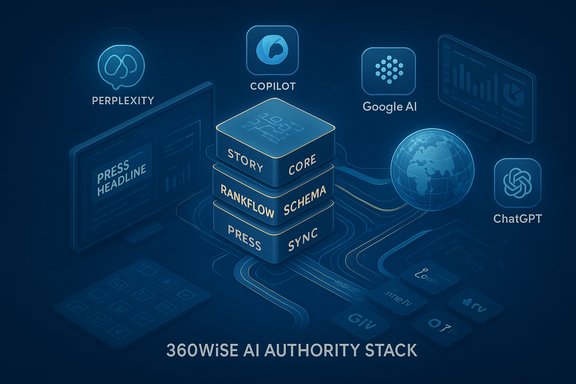
360WiSE made the claims in a syndicated press release that appeared on Digital Journal and other distribution outlets on December 6, 2025, asserting that the company had been “independently recognized by multiple AI systems” as a trending entity and media authority. The press release frames this as a rare, organic classification by AI engines — not the result of paid inclusion or a submission program. The company’s own website and product pages describe an offering called the AI Authority Stack™, a bundled approach the firm says engineers machine‑readable authority by combining schema, syndicated press, smart‑TV distribution, and continuous monitoring. 360WiSE’s public materials emphasize a packaged flow—press drops, schema markup, dedicated OTT presence (Roku, Fire TV, Apple TV, Google TV, iOS, Android), and an ongoing “authority reinforcement” cadence intended to create repeatable signals that modern LLM‑backed assistants will consume and surface. The company’s press pages further list syndication partners, pricing tiers for press campaigns, and claims about verified pickups.
The broader takeaway for WindowsForum readers and enterprise teams: invest in machine‑readability, own distribution, demand auditability, and plan for platform churn. The era of AI‑mediated discovery rewards clarity and provenance — but it also raises ethical and operational questions that must be addressed with transparent evidence, sound governance, and cross‑functional controls. The 360WiSE narrative is an instructive case study in both the potential and the caveats of attempting to engineer authority for an AI‑first web.
Source: Digital Journal AI Systems Confirm 360wise As A Rising Global Media Authority
 Background
360WiSE made the claims in a syndicated press release that appeared on Digital Journal and other distribution outlets on December 6, 2025, asserting that the company had been “independently recognized by multiple AI systems” as a trending entity and media authority. The press release frames this as a rare, organic classification by AI engines — not the result of paid inclusion or a submission program. The company’s own website and product pages describe an offering called the AI Authority Stack™, a bundled approach the firm says engineers machine‑readable authority by combining schema, syndicated press, smart‑TV distribution, and continuous monitoring. 360WiSE’s public materials emphasize a packaged flow—press drops, schema markup, dedicated OTT presence (Roku, Fire TV, Apple TV, Google TV, iOS, Android), and an ongoing “authority reinforcement” cadence intended to create repeatable signals that modern LLM‑backed assistants will consume and surface. The company’s press pages further list syndication partners, pricing tiers for press campaigns, and claims about verified pickups. Overview: Why this matters now
The industry term Answer Engine Optimization (AEO) has rapidly matured from marketing buzzword into an operational discipline. Where classic SEO focuses on search engine results pages (SERPs) and ranking signals, AEO centers on inclusion in synthesized, AI‑generated answers and assistant overviews — surfaces that increasingly act as the first impression for users. Companies that can shift their identity from a scattered set of web pages into a consolidated, machine‑friendly entity gain a structural advantage when assistants synthesize answers from multiple sources. 360WiSE’s announcement intentionally positions the company as an early mover in that space. At the same time, because major AI providers use proprietary ingestion logic and private knowledge graphs, claims of cross‑assistant “recognition” raise immediate auditability questions. Does a single phrasing appearing in a Perplexity card or a Copilot summary equal a durable classification in a vendor’s knowledge graph? The short answer for independent observers is: not necessarily — and proving it requires reproducible, time‑stamped evidence. This distinction is central to assessing the broader significance of 360WiSE’s announcement.What can be independently verified
- The press release text and its syndication are publicly available on multiple PR distribution sites, including Digital Journal. The company’s own domain hosts product pages and press materials that describe the AI Authority Stack™, Smart TV distribution, and syndication claims. These primary artifacts are visible and unchanged at the time of reporting.
- 360WiSE’s website explicitly lists Smart TV platforms (Roku, Amazon Fire TV, Apple TV, Google TV, iOS, Android) and markets its OTT/Smart TV channel capabilities and ticketing/subscription models for creators. Those product claims are verifiable as marketing assertions on the corporate site.
- There is an active industry conversation — visible in forum analyses and trade commentary — about companies packaging schema engineering, press syndication and OTT ownership as a single product targeting AI‑driven discovery. Independent analysts and community threads have parsed 360WiSE’s messaging and raised common verification questions.
What cannot be independently verified (and why it matters)
- AI providers’ internal classifications and “trending” designations
- Major AI vendors and answer engines do not publish a public, auditable registry that lists which entities are officially labeled or promoted as “trending” or “authoritative” in their internal knowledge graphs or assistant pipelines.
- Public outputs (a screenshot of an assistant answer, or a one‑off query) are useful signals but do not constitute systematic proof that an engine has programmatically upgraded an entity’s status across global ingestion windows and query contexts.
- In short: observed assistant text does not equal platform‑level certification. Independent verification would require reproducible, timestamped API logs or confirmation from the provider.
- Company‑reported analytics figures (e.g., GA4 metrics)
- The press release cited specific Google Analytics 4 (GA4) metrics for November (pageviews, new users, active users, events). GA4 is an internal property; without access to the GA4 property, Measurement Protocol logs, or a third‑party traffic audit, those numbers remain company‑reported and not independently validated.
- Best practice is to corroborate with independent telemetry (server logs, Cloudflare analytics, SimilarWeb/Comscore style estimates, or an auditor’s report). Absent that, treat the figures as asserted.
- Synchronous, cross‑platform “multi‑AI” consensus
- The press claim that “multiple AI systems” independently classified 360WiSE as trending suggests cross‑platform consensus. Demonstrating a reproducible cross‑platform consensus requires time‑stamped queries across vendors, captured prompts, and full output context. Those artifacts were not provided in the release. Without them, the evidence is anecdotal.
How modern AI assistants form summaries — a short primer
AI overviews and assistant responses are synthesized from a mix of data sources:- Indexable web content and publisher pages
- Structured data (schema.org, sameAs links, canonical pages)
- Knowledge graphs and entity clusters (internal vendor graphs such as Google’s Knowledge Graph)
- Proprietary indexes, cached news feeds, and, in some systems, human‑crafted metadata
Anatomy of 360WiSE’s claimed approach
The company advertises a seven‑layer AI Authority Stack™ that it says aligns canonical storytelling with machine‑readable signals. Core advertised components include:- Story Core™: canonical narratives and bios designed to be machine‑digestible.
- RankFlow™ Schema: entity markup and knowledge‑graph linking.
- PressSync™: automated and syndicated press placements.
- Smart TV channels and OTT distribution to generate additional session and metadata signals.
Strengths and practical benefits
- Integrated, multi‑channel strategy: Owning distribution (Smart TV) while feeding structured press and web signals reduces dependency on third‑party social platforms and gives brands a durable property for discovery. This diversification is a defensible risk‑management approach for creators and enterprises.
- Machine‑readability emphasis: Engineering clean schema, canonical bios, and consistent identity pages is a long‑recognized SEO best practice that also benefits AI systems that rely on structured inputs. Investing in entity clarity is a pragmatic move for organizations worried about algorithmic churn.
- Commercial appeal to creators: Offering direct monetization and retained revenue via owned OTT channels solves a genuine pain point for creators frustrated by opaque revenue sharing on major platforms. If operationalized transparently, this model can help creators maintain predictable income streams.
Risks, ethical concerns and technical fragility
- Message semantics vs. auditable reality
- Marketing language such as “AI systems recognize us” risks conflating observed outputs with systematic classification. LLM outputs are context‑sensitive; a single favorable phrasing is not proof of durable status. Auditability matters here.
- Potential for signal gaming and platform countermeasures
- Coordinated syndication, manipulative backlink tactics, or undisclosed paid placements could be interpreted as gaming. Search and AI platforms have historically adjusted ingestion rules when manipulation is detected. Overreliance on engineered signals is fragile if vendors change ranking or ingestion heuristics.
- Dependence on proprietary systems
- The major assistants named in the press release (Google, Microsoft, OpenAI/ChatGPT, Perplexity) run closed systems with changing models and ingestion windows. Visibility gained today can be lost tomorrow if providers alter the signals they trust. This makes the business case inherently brittle unless a company builds strong, owned channels and continues to produce high‑quality editorial content.
- Transparency, provenance and misinformation risk
- Users increasingly accept assistant outputs as factual. If assistant summaries echo press releases without provenance labels, the risk is that favorable marketing narratives will be treated as neutral facts. Brands and vendors should insist on provenance metadata and disclosure to prevent misleading impressions.
- Privacy and compliance
- Engineering “AI‑indexed identities” for creators may surface biographical details. This requires robust consent models and privacy controls to avoid exposing sensitive data or enabling misuse. Legal teams should vet how personal data is structured for ingestion.
A practical verification checklist for brands and IT teams
If a vendor claims multi‑assistant recognition, demand reproducible evidence. Practical items to request and require as part of due diligence:- Time‑stamped assistant outputs: full prompt text, exact model/engine/version used, and complete outputs (not merely screenshots).
- API logs and console traces: verifiable copies from vendor APIs or browser automation capturing the exact query and response timestamped to UTC.
- Analytics corroboration: GA4 property access or auditor‑signed telemetry; independent estimates (SimilarWeb, Cloudflare Radar) as supplemental validation.
- Syndication evidence: confirm whether placements are earned editorial coverage or republished corporate press releases via distribution networks.
- Provenance metadata: ensure syndicated pickups include explicit attribution and structured metadata so downstream assistants can trace to the original source.
- Compliance and consent records: documentation for any personal data included in machine‑readable profiles, with opt‑outs preserved.
Recommended approach for Windows‑centric IT and communications teams
- Treat AEO as cross‑disciplinary work: involve security, privacy, legal, SEO and editorial teams when designing machine‑readable identity pages.
- Build owned distribution first: invest in canonical, verifiable assets (domain, structured entity pages, and OTT endpoints) to reduce dependence on third‑party indexing whims.
- Insist on logs: never accept “we saw it” as evidence. Require time‑stamped logs or auditor verification when claims about assistant recognition are material to procurement or investor communications.
- Monitor vendor policy updates: Google and other providers adjust knowledge‑graph ingestion and AI overview algorithms — treat this as an operational risk and monitor change logs and developer docs.
- Use third‑party telemetry: complement GA4 with server logs, CDN metrics, and independent traffic estimation services for a fuller picture of reach.
Industry implications and what to watch next
The 360WiSE episode highlights an inflection many IT and communications leaders have been anticipating: AI systems are fast becoming a primary discovery surface, not just an experimental layer. Companies that invest in entity clarity and owned distribution stand to gain, but the environment will evolve in three ways to watch closely:- Platform policy tightening: Expect search and AI vendors to refine ingestion rules and to push back on manipulation. Historical precedent shows that platforms react when gaming or hallucination risks surface.
- Demand for auditability: As assistant outputs shape procurement and reputation, auditors and journalists will demand reproducible evidence — and regulators may press for provenance disclosures.
- Democratization vs. concentration: There is a risk that AI‑authority engineering privileges those with resources to buy syndication and build OTT channels. The counterbalance will be open standards for provenance and policies that reward quality and transparency rather than paid reach.
Closing analysis: a measured verdict
360WiSE’s announcement is important for what it signals about the market: integrated stacks that combine schema, press distribution, and owned OTT presence are being framed as the practical route to AI visibility, and that framing is increasingly persuasive to brands and creators. The company’s public materials and the press release itself are verifiable artifacts of a marketing and product strategy that aligns with known AEO tactics. However, the most attention‑grabbing claim — that multiple major AI assistants have independently classified 360WiSE as a trending global media authority — remains a company‑asserted milestone that is not independently auditable from the public record without time‑stamped assistant outputs, API logs, or provider confirmation. For IT leaders, communications teams and procurement officers, the responsible approach is to treat such claims as promising but provisional: valuable as a signal of market direction, but requiring documentary proof before accepting platform‑level validation.The broader takeaway for WindowsForum readers and enterprise teams: invest in machine‑readability, own distribution, demand auditability, and plan for platform churn. The era of AI‑mediated discovery rewards clarity and provenance — but it also raises ethical and operational questions that must be addressed with transparent evidence, sound governance, and cross‑functional controls. The 360WiSE narrative is an instructive case study in both the potential and the caveats of attempting to engineer authority for an AI‑first web.
Source: Digital Journal AI Systems Confirm 360wise As A Rising Global Media Authority