Microsoft Copilot’s Enterprise Momentum: NHS Scale, Usage Pricing, and AI Revenue

Microsoft’s Copilot is not clearly falling behind competitors as of June 2026: BNP Paribas argues that its enterprise capabilities have improved sharply over the past six to twelve months, while Microsoft’s new NHS England deployment gives the product a high-profile institutional proof point. The more interesting story is not whether Copilot can win a demo war against ChatGPT, Claude, Gemini, or Grok. It is whether Microsoft can turn AI from a bundled feature into a durable enterprise revenue engine without making customers feel as if every prompt has become a metered utility bill.

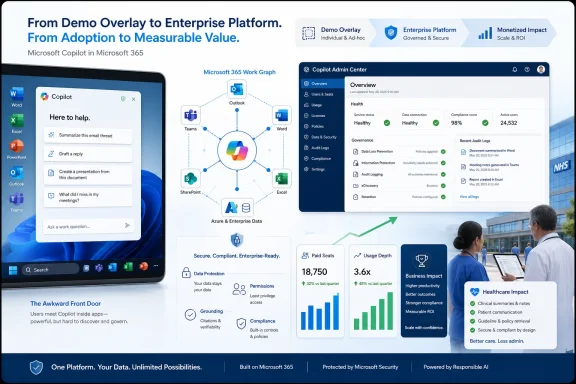
Healthcare workers view Microsoft Copilot dashboards in a modern NHS hospital at night.The Copilot Doubt Was Always About Adoption, Not Awareness​

Microsoft has never had a distribution problem. Copilot has been pushed into Windows, Microsoft 365, GitHub, Edge, Azure, Teams, and the broader productivity stack with the kind of reach only Microsoft can command. If the AI race were judged by the number of surfaces where a chatbot icon appears, Redmond would have declared victory long ago.
The skepticism came from a different place. Early enterprise buyers often found that Copilot was useful but uneven, impressive in some workflows and underwhelming in others. It could summarize a meeting, draft a document, or search corporate content, but it also depended heavily on the quality of an organization’s data estate, permissions, habits, and tolerance for imperfect automation.
That made Copilot a frustrating product for investors to assess. Consumer AI products produce visible buzz: viral screenshots, public benchmarks, model leaderboards, and app-store chatter. Microsoft’s AI bet is quieter, more bureaucratic, and more expensive to validate because its success lives inside procurement cycles, compliance reviews, tenant configuration, and the daily routines of office workers.
BNP Paribas’ latest view cuts directly through that earlier uncertainty. The bank’s argument, as relayed by Moomoo and Zhitong Finance, is that judging Copilot by impressions formed six or twelve months ago risks missing the speed of Microsoft’s product iteration and the growing evidence of large-account traction.

Microsoft’s AI Strategy Looks Boring Until the Contract Is Half a Million Seats​

The NHS England deal is precisely the kind of proof point Microsoft needed. NHS England announced plans to provide Microsoft 365 Copilot access to 505,000 clinicians and support staff, framing the deployment around service delivery, administrative efficiency, and freeing more time for care. That is not a hobbyist trial or a narrow developer pilot; it is a national-scale institutional deployment in one of the most scrutinized public-sector environments in the world.
For Microsoft, that matters because Copilot’s central pitch has always been institutional rather than merely individual. ChatGPT may win the “which bot do I open first?” contest among consumers and power users. Microsoft wants to win the “which AI system is allowed to touch regulated workflows, enterprise files, employee calendars, internal chats, and business processes?” contest.
Those are very different races. The first rewards model personality, benchmark performance, memory features, and consumer virality. The second rewards identity management, auditability, compliance, licensing familiarity, data boundaries, administrative controls, and the ability to sell into organizations that already spend millions on Microsoft software.
That is why the NHS deployment is more than a headline. It suggests Microsoft’s argument is landing with buyers who are not simply chasing the newest model. They are buying an AI layer that sits inside the software estate they already govern.

Copilot’s Improvement Curve Is the Real Rebuttal to the Laggard Narrative​

BNP Paribas analyst Stefan Slowinski reportedly told clients that Copilot’s capabilities now “far exceed” what the product offered six to twelve months earlier. That is a broad claim, but it fits the pattern across Microsoft’s AI portfolio. The company has been moving Copilot away from simple chat assistance and toward workflow-aware agents, richer app integration, and model choice in some markets.
This is where the “falling behind” claim becomes too crude. Copilot can feel behind if the comparison is a clean-room model test against the latest version of Claude or Gemini. But Microsoft is not only selling raw model intelligence. It is selling AI bound to documents, calendars, emails, spreadsheets, code repositories, security policies, and business applications.
That distinction is not an excuse for weak output. If Copilot produces mediocre drafts or unreliable answers, users will not care how beautifully it integrates with SharePoint. But enterprise AI value is often created when the model has the right context, the right permissions, and the right workflow placement rather than when it wins a benchmark in isolation.
Microsoft’s best case is that Copilot becomes less like a chatbot and more like an invisible labor-saving layer across work. That is harder to demo, harder to price, and harder to explain. It is also much harder for a standalone rival to replicate.

The Revenue Question Has Moved From Seats to Intensity​

The most investor-sensitive part of the BNP Paribas note is not the product praise. It is the suggestion that paid Copilot adoption could exceed the market’s expectations by Microsoft’s fiscal fourth quarter of 2026. The report cites a market expectation of roughly 25 million paying users by that point, with BNP Paribas arguing there may be room for upside.
That number matters because Copilot has been one of the cleanest ways for investors to model AI revenue inside Microsoft. A per-user add-on attached to Microsoft 365 is easy to understand. Multiply seats by price, assume some penetration rate, and the spreadsheet begins to look like a very large new software business.
But AI is not ordinary software. A user who asks Copilot to summarize two meetings per week does not cost Microsoft the same as a power user running complex agentic tasks across documents, spreadsheets, code, and business systems. Compute intensity varies wildly, and the cost of serving advanced models can be material.
That is why the pricing model is becoming the next battleground. BNP Paribas says Microsoft is exploring a shift away from purely traditional per-user pricing toward a hybrid model that also reflects actual usage. That would make Copilot look more like cloud consumption than a conventional Office license.
The logic is obvious. The politics are harder. Enterprises like predictable budgets, and Microsoft has spent decades training IT departments to think in seats, bundles, renewals, and enterprise agreements. Usage-based AI pricing can be more economically rational for Microsoft while feeling less comfortable for customers asked to forecast employee behavior one prompt at a time.

GitHub Copilot Is the Warning Label Attached to the Strategy​

Microsoft does not have to imagine how usage-based AI billing might land. GitHub Copilot has already become the laboratory. GitHub has moved toward AI Credits and usage-based billing, replacing simpler premium-request structures with a model that more directly reflects consumption, model selection, and token-heavy work.
From Microsoft’s perspective, this is the unavoidable direction of travel. An AI assistant that can call increasingly powerful models, review code, produce long outputs, and operate in more agentic ways cannot be priced forever as if all requests are equal. Someone has to pay for the inference.
From a customer perspective, however, the shift can feel like the cloud bill problem arriving inside the IDE. Developers who thought they had bought a subscription can suddenly discover that the most useful parts of the product are governed by credits, limits, budgets, or overages. Even when the vendor’s economic case is sound, the user experience can feel like a downgrade.
This is the tension Microsoft must manage before extending similar ideas more aggressively across Microsoft 365 Copilot and adjacent products. A usage component may be inevitable. But if the pricing language becomes too opaque, Copilot risks moving from “AI productivity assistant” to “another thing finance wants locked down.”
Enterprise buyers can tolerate complexity when value is obvious. They are less forgiving when a tool is still proving itself. Microsoft’s challenge is to time the monetization shift so that customers feel the productivity gain before they feel the meter running.

Azure Gives Microsoft Leverage, but Not Immunity​

The Copilot debate cannot be separated from Azure. Every Copilot prompt ultimately lands somewhere in Microsoft’s infrastructure and partner model ecosystem. The user sees a sidebar in Word or Teams; Microsoft sees capacity planning, GPU procurement, data-center power, model routing, latency targets, and gross-margin pressure.
BNP Paribas’ report says Microsoft management remains cautious about broad Azure price increases despite rising GPU costs. That restraint is strategically important. If Microsoft simply pushes higher infrastructure costs onto customers, it risks giving AWS and Google Cloud an opening to position themselves as the more predictable or more aggressive AI infrastructure partners.
The better Microsoft story is efficiency. If the company can improve utilization, optimize model routing, use smaller models where appropriate, and reserve frontier-class compute for tasks that justify it, Copilot margins become less frightening. That is the kind of operational advantage hyperscalers are built to exploit.
Still, investors should not pretend this is painless. AI capex is not a decorative line item. Microsoft is committing to data centers, accelerators, networking, power, and long-term supply arrangements at a scale that assumes demand will keep compounding. If Copilot adoption disappoints, the infrastructure buildout looks heavy. If Copilot adoption accelerates, the infrastructure buildout may still look heavy, just more defensible.
That is the paradox of the AI platform business in 2026. Success is expensive. Failure is also expensive.

The Competitive Map Is Wider Than Chatbot Rankings Suggest​

The Moomoo piece frames Copilot against ChatGPT, Claude, Grok, Gemini, and Apple’s new Siri AI. That is directionally fair, but it compresses several different markets into one race. OpenAI and Anthropic are fighting for frontier model credibility and developer mindshare. Google is fighting with both Gemini and its cloud productivity footprint. Apple is fighting to make AI feel native to personal devices. Microsoft is fighting to make AI native to work.
Those arenas overlap, but they are not identical. A knowledge worker may use ChatGPT for brainstorming, Claude for long-document reasoning, Gemini inside Google Workspace, Copilot inside Teams, and Siri AI on an iPhone. The future may be less a single assistant monopoly than a messy stack of context-specific agents.
Microsoft’s advantage is that work context is already inside its walls. Outlook knows the calendar. Teams knows the meeting. Word knows the draft. Excel knows the model. SharePoint knows the files. Entra ID knows who should see what. Purview knows what needs governing. Defender and Sentinel know where security operations live.
The disadvantage is that integration can become bloat. Microsoft’s product history is full of features that were everywhere and loved nowhere. Copilot must avoid becoming another omnipresent panel that users close reflexively because the first few answers were generic.
That makes quality improvements essential. Distribution gets Copilot in front of users once. Usefulness decides whether they come back tomorrow.

Enterprise AI Is Being Sold to CFOs, Not Just CIOs​

The next phase of Copilot adoption will be fought in finance departments. CIO enthusiasm can open the door, but a broad deployment needs measurable productivity, defensible security, and a budget story that survives renewal season. In that sense, Copilot is less like a new app and more like a labor-efficiency thesis.
Microsoft has leaned into that framing. The NHS deployment, like many enterprise AI announcements, emphasizes time saved from administrative work rather than magic. That is smart positioning because most large organizations do not need AI to be dazzling. They need it to remove enough friction from repetitive work to justify the spend.
But productivity claims are difficult to standardize. One team may save hours summarizing meetings and drafting documents. Another may barely use the tool. A third may spend more time checking AI output than it saves. Enterprise-wide averages can hide huge differences in value by role, workflow, and data maturity.
This is why BNP Paribas’ emphasis on customer usage is important. Paid seats alone can flatter adoption, especially when licenses are bundled or sold through broad agreements. Actual usage intensity tells a more meaningful story: whether Copilot is becoming part of the workday or merely part of the contract.
If Microsoft can show that usage deepens after deployment, the commercialization story becomes stronger. If usage plateaus after curiosity fades, the product remains vulnerable to budget scrutiny.

Windows Is the Most Visible Copilot Surface and the Least Important One for the Revenue Story​

For many WindowsForum readers, Copilot is most visible as a Windows feature. It has appeared, disappeared, moved, changed form, and been rebranded often enough to make even attentive users wonder what exactly Microsoft wants the Windows version to be. That consumer-facing churn has contributed to the perception that Copilot is strategically confused.
But the Windows surface is not where the near-term enterprise monetization thesis primarily lives. Microsoft 365 Copilot, GitHub Copilot, Azure AI, Copilot Studio, and role-based business workflows are far more important to the revenue story. Windows matters as distribution, identity, endpoint context, and habit formation, but it is not the whole product.
That distinction helps explain the disconnect between user sentiment and analyst optimism. A Windows enthusiast irritated by a Copilot button may see AI clutter. A CIO looking at Teams summaries, Outlook drafting, SharePoint-grounded search, and Copilot Studio agents may see a potential productivity platform. Both perspectives can be true.
Microsoft’s risk is that the weaker consumer and Windows experiences contaminate the brand. If “Copilot” means too many things, users may judge the entire family by its least useful incarnation. The company has spent enormous energy unifying the name; it now needs to unify the quality bar.

The NHS Deal Raises the Stakes on Trust​

Healthcare is a particularly revealing test bed. It is information-heavy, document-heavy, and administratively burdened, but it is also sensitive, regulated, and politically exposed. An AI deployment in that setting has to be framed around augmentation, governance, and human control rather than replacement.
For Microsoft, that kind of environment plays to its strengths. The company can argue that Copilot inherits enterprise controls, identity boundaries, compliance tooling, and administrative oversight. Those capabilities are less exciting than model benchmarks, but they matter enormously when the data is clinical, personal, or operationally sensitive.
The trust question will not be settled by Microsoft’s assurances. Large deployments create real-world evidence, and that evidence can cut both ways. If staff report meaningful reductions in administrative load, Copilot gains credibility. If the tool produces errors, confusion, or uneven value, critics will have a concrete case study.
That is why the NHS announcement is not merely a sales win. It is a public test of Microsoft’s enterprise AI proposition at national scale. The company now has to prove that Copilot can be useful in one of the least forgiving environments imaginable.

The OpenAI Relationship Is Still an Asset, but Microsoft Is Hedging Like a Platform Company​

Microsoft’s AI story is intertwined with OpenAI, but Copilot is increasingly larger than any single model supplier. The company has reason to keep the OpenAI partnership central, yet it also has reason to offer model choice, optimize for cost, and prevent its enterprise AI platform from being perceived as a wrapper around one lab’s roadmap.
That is especially important as competitors differentiate. Anthropic has built a strong reputation among developers and enterprise users for long-context reasoning and coding assistance. Google can pair Gemini with search, Android, Chrome, Workspace, and its own cloud stack. Apple can attack from the device and personal-context layer. OpenAI remains the consumer AI default for many users.
Microsoft’s counter is not purity. It is orchestration. The company can integrate multiple models, route tasks based on cost and capability, and package the result through familiar enterprise products. If it succeeds, customers may care less which model answered a prompt and more whether the workflow completed safely.
That is the classic Microsoft platform move. The company does not need to own every best component if it owns the place where components become business tools. But that strategy only works if Copilot feels like a coherent product, not a collection of AI features stitched together by branding.

Investors Are Right to Watch Capex, but Wrong to Treat It as a Simple Red Flag​

Microsoft management reportedly sees the current AI wave as a once-in-several-decades opportunity and has not set a rigid free-cash-flow threshold that would cap AI investment. That posture will make some investors nervous, and it should. Unlimited-sounding ambition has a way of turning into undisciplined spending when markets get euphoric.
But a strict cap would also be strange. If Microsoft genuinely believes AI will reshape productivity software, developer tools, cloud infrastructure, cybersecurity, and business applications, then underinvesting would be the more dangerous error. The company’s moat is not just Office or Windows; it is the ability to build and operate platforms at global scale.
The question is not whether Microsoft should spend. It is whether spending converts into defensible usage, pricing power, and workflow lock-in. Copilot is one of the clearest tests of that conversion.
If Copilot becomes a daily layer across work, the capex looks like infrastructure for the next software era. If it remains a premium add-on with uneven usage, the spending will invite harder questions about returns.

The “Falling Behind” Frame Misses the Microsoft Playbook​

Microsoft has rarely been at its best when judged by first impressions. The company often enters markets awkwardly, iterates through messy branding, uses distribution aggressively, and then grinds toward enterprise adoption. That pattern does not guarantee success, but it makes premature obituaries particularly risky.
Copilot’s early stumbles were real. The product was expensive, the value proposition was sometimes fuzzy, and the brand became stretched across too many experiences. Competitors moved quickly, and in some categories they still produce more impressive standalone AI experiences.
But BNP Paribas’ argument is that the laggard narrative has not kept pace with the product. The NHS deal reinforces that view by showing a major institutional buyer willing to deploy at scale. GitHub’s pricing evolution shows Microsoft learning how to monetize compute-intensive AI, even if the lesson is uncomfortable for some users. Azure’s restraint on broad price hikes shows the company understands that infrastructure economics cannot be solved simply by passing every cost downstream.
The more precise verdict is this: Microsoft may not always lead the AI conversation, but it remains extremely well positioned to lead the enterprise AI commercialization cycle.

Redmond’s Copilot Bet Now Comes Down to Five Hard Tests​

The BNP Paribas note is bullish, but the next year will determine whether that optimism reflects durable momentum or another round of AI-market expectation inflation. Microsoft has the distribution, capital, infrastructure, and enterprise relationships. Now it has to prove that Copilot is not merely widely available, but deeply used.
  • Copilot’s strongest evidence is shifting from demos to deployments, with the NHS England rollout giving Microsoft a major public-sector proof point.
  • The product’s improvement over the past six to twelve months matters because many negative perceptions were formed during an earlier, rougher phase.
  • Paid-seat growth will be less important than usage intensity if Microsoft moves more AI products toward hybrid or consumption-aware pricing.
  • GitHub Copilot’s billing changes show why AI monetization is economically logical for Microsoft but potentially painful for customers.
  • Azure cost control is central to the Copilot story because enterprise AI margins depend on infrastructure efficiency, not just software pricing.
  • Microsoft’s biggest advantage is not having the flashiest chatbot, but owning the productivity, identity, security, developer, and cloud layers where enterprise AI work actually happens.
Microsoft’s Copilot is not safely ahead, but it is also no longer easy to dismiss as a laggard. The real contest is moving away from chatbot spectacle and toward governed, metered, workflow-specific AI inside institutions that already run on Microsoft software. If Redmond can keep improving the product while making the economics feel predictable rather than punitive, Copilot may become less a late entrant in the AI race than the enterprise channel through which much of that race is monetized.

References​

  1. Primary source: Moomoo
    Published: Thu, 11 Jun 2026 14:52:27 GMT
  2. Official source: news.microsoft.com
  3. Official source: docs.github.com
  4. Official source: github.com
  5. Related coverage: support.nhs.net
  6. Official source: learn.microsoft.com
  1. Related coverage: techcrunch.com
  2. Official source: microsoft.com
  3. Related coverage: windowscentral.com
  4. Related coverage: xebia.com
  5. Related coverage: tomshardware.com
  6. Related coverage: github.blog
  7. Related coverage: itpro.com
  8. Related coverage: techradar.com
  9. Official source: cdn-dynmedia-1.microsoft.com
 

On June 11, 2026, BNP Paribas analyst Stefan Slowinski reportedly said Microsoft’s Copilot capabilities have improved meaningfully over the past year, with customer engagement and NHS England’s large rollout strengthening the case that Microsoft can beat 25 million Copilot seats in its fiscal fourth quarter. The note matters because it reframes Copilot from a flashy AI upsell into a more measurable enterprise software business. For Windows users and IT departments, the question is no longer whether Microsoft will put AI everywhere. It is whether organizations will pay for it, govern it, and trust it at scale.

Microsoft Copilot branding with NHS clinicians and secure AI dashboards showing measurable business results.Copilot Is Finally Being Judged Like Software, Not Theater​

For the first year of the Copilot era, Microsoft enjoyed an unusually generous narrative. The company had attached generative AI to Windows, Microsoft 365, GitHub, Security, Dynamics, Azure, and the developer stack faster than most rivals could name their products. Investors treated that speed as evidence that Microsoft had converted its OpenAI alliance into a durable platform advantage.
That was always only half the story. Enterprise software is not won by demos. It is won by procurement cycles, admin consoles, compliance sign-offs, renewal math, and the dull but decisive question of whether employees use the tool after the first week.
The BNP Paribas readout suggests that Microsoft may be clearing more of that bar than skeptics expected. Reported improvements in Copilot’s capability, rising customer engagement, and a large NHS England deployment all point in the same direction: Copilot is moving from trial balloon to budget line.
That does not mean the AI productivity story is settled. It means Microsoft is now entering the more difficult phase, where Copilot must justify itself against real workflows, real security boundaries, and real per-seat costs.

The NHS Deal Gives Microsoft the Case Study It Needed​

NHS England’s plan to provide Microsoft 365 Copilot access to roughly 505,000 clinicians and support staff is the sort of deal Microsoft has been trying to make visible for two years. Healthcare is not an easy environment for enterprise AI. It is regulated, politically sensitive, data-heavy, and full of workflows where small administrative gains can become system-level savings.
That is exactly why the deployment is strategically useful for Microsoft. If Copilot can be positioned as a productivity layer for a public health system, it becomes easier to sell the same idea to banks, insurers, universities, law firms, manufacturers, and government agencies.
The reported NHS trial results are also important because they translate AI hype into time. Saving dozens of minutes per worker per day is a more compelling procurement argument than saying a chatbot has become “smarter.” CIOs do not buy adjectives. They buy avoided cost, reduced backlog, faster document handling, and fewer hours lost to administrative sludge.
There is still a gap between trial findings and sustained production value. Anyone who has rolled out Microsoft 365 at scale knows that adoption is uneven, training matters, and licensing can become a maze. But a half-million-seat healthcare deployment gives Microsoft something it did not have enough of in 2023 and 2024: a concrete enterprise AI story that is about operations, not novelty.

The Seat Count Is the New Cloud Consumption Metric​

The reported 25 million Copilot seat forecast for Microsoft’s fiscal fourth quarter deserves attention because it gives investors and IT buyers a crude but useful proxy for adoption. Azure revenue has long been the market’s preferred way to measure Microsoft’s cloud momentum. Copilot seats may become the comparable figure for AI productivity software.
That number, however, needs interpretation. A Copilot seat is not the same thing as daily usage. It is not the same thing as return on investment. It is not proof that every department has redesigned work around AI.
But enterprise software markets often begin with licensing before they mature into usage discipline. Microsoft’s genius has always been turning optional software into default infrastructure. Windows, Office, Teams, SharePoint, Defender, Entra, and Intune became sticky not because every user loved every feature, but because the bundle became operationally hard to escape.
Copilot is being pushed through that same machinery. It sits inside applications employees already use, inherits Microsoft 365 identity and permissions, and gives executives a way to say they are adopting AI without buying a separate platform for every department. That is not glamorous, but it is powerful.
The risk is that seat counts can flatter reality. If companies buy Copilot broadly and usage disappoints, Microsoft will face the same backlash that has hit many SaaS vendors: shelfware, license audits, and pressure to prove consumption. The next phase of the Copilot story will be less about how many seats Microsoft sells and more about how many workflows it changes.

Pricing Is Becoming the Real Product Strategy​

Slowinski’s reported emphasis on Copilot’s evolving pricing model gets to the heart of Microsoft’s challenge. Copilot began life as an expensive add-on, and that made sense when Microsoft needed to preserve margins while inference costs were high. But the long-term opportunity is probably not a single static price.
Microsoft is likely to keep experimenting with tiers, bundles, metered agent usage, and premium capability packaging. The company already has decades of experience making enterprise licensing both frustrating and effective. Copilot gives it a new lever: AI capability can be sold as a per-user assistant, a departmental workflow tool, a security add-on, a developer accelerator, or an Azure consumption driver.
That flexibility is commercially attractive. It is also dangerous. Customers already complain that Microsoft licensing is complex, and AI risks making it worse. If every productivity feature becomes a SKU boundary, IT departments will spend as much time deciphering entitlements as deploying the technology.
The more subtle shift is that Microsoft is trying to price outcomes while still selling software. A meeting summary, a generated document, a policy search, a spreadsheet analysis, or an automated workflow all feel like small units of labor. Microsoft wants customers to see those moments as worth paying for, while Microsoft works behind the scenes to reduce the cost of generating them.
That is where Azure comes in. If Microsoft can use its cloud infrastructure, model routing, custom silicon, and software optimizations to manage AI cost inflation, Copilot margins become more plausible. If not, the company may find itself selling a beloved feature at a less lovable gross margin.

Azure Is the Margin Engine Behind the Assistant​

Copilot may appear to users as a button in Word, Excel, Outlook, Teams, Windows, or Edge, but economically it is also an Azure story. Every prompt, retrieval pass, model call, summarization, and agentic action has an infrastructure cost. Unlike classic Office features, generative AI features are not nearly free to serve once the software is shipped.
That creates a tension Microsoft has not fully escaped. The company wants Copilot to feel ubiquitous, but ubiquity increases compute demand. It wants users to ask richer questions, but richer questions can cost more. It wants agents to perform multi-step tasks, but multi-step tasks may consume more tokens, more retrieval, more orchestration, and more monitoring.
Microsoft’s answer is vertical integration. It can optimize from the app layer down through Microsoft Graph, Azure AI services, model selection, datacenter architecture, and security tooling. That is an advantage most AI application startups do not have.
The question is whether that advantage is enough. Investors are watching for signs that AI revenue is incremental rather than merely expensive. IT leaders are watching for signs that Microsoft will not use AI as a pretext to keep raising the effective price of the Microsoft 365 estate.
This is why Copilot’s capability improvements matter. Better model quality is not just a feature story. It is a pricing defense. The more useful Copilot becomes, the easier it is for Microsoft to justify the margin math.

Windows Is the Distribution Channel Microsoft Cannot Resist​

For Windows enthusiasts, the Copilot investment has always had a second meaning. Microsoft is not merely selling an enterprise assistant; it is remaking Windows as the front door to AI services. That ambition has been visible in Copilot keys, sidebar experiments, Recall-style debates, AI-powered search, Settings assistance, and the broader push to make local and cloud AI feel like part of the operating system.
The enterprise Copilot story and the Windows Copilot story are different, but they reinforce each other. If workers use Copilot in Microsoft 365 all day, they are more likely to accept AI in the OS. If Windows becomes better at surfacing documents, settings, actions, and context through AI, Microsoft 365 Copilot becomes more valuable.
That is the ecosystem play. Microsoft wants Copilot to be less a product than an interface layer across the PC, the browser, the productivity suite, and the cloud. The company has tried versions of this before with Cortana, Windows Search, Timeline, and various assistant concepts. The difference this time is that enterprises are actually budgeting for AI.
Still, Microsoft must tread carefully. Windows users have limited patience for features that feel imposed rather than earned. The history of Windows is littered with ideas that made sense in Redmond strategy meetings but irritated users at the desktop. Copilot’s success on Windows will depend on whether it becomes a useful control surface or just another place for Microsoft to advertise its cloud.

IT Departments Will Measure the Mess, Not the Demo​

The most important Copilot audience is not the investor reading a BNP Paribas note. It is the Microsoft 365 administrator deciding how to roll this out without creating a governance problem.
Copilot’s usefulness depends heavily on the quality and permissions hygiene of an organization’s data estate. If SharePoint sites are chaotic, file permissions are overly broad, Teams channels are stale, and sensitive documents are poorly labeled, an AI assistant can expose old messes at new speed. That is not necessarily Copilot’s fault, but it becomes Copilot’s problem.
This is where Microsoft’s platform advantage cuts both ways. Because Copilot works close to Microsoft Graph and existing identity controls, it can respect enterprise permissions. But because it is so deeply embedded, it can also reveal how many organizations have treated information governance as a someday project.
Security teams will also watch the rise of agents with suspicion. A chatbot that summarizes a meeting is one thing. An agent that can act across systems is another. The more Copilot moves from answering to doing, the more organizations need logging, approvals, data loss prevention, and clear accountability.
That is why Microsoft’s Agent 365 and related governance messaging matter. The company knows enterprise AI will not scale on enthusiasm alone. It has to convince admins that Copilot can be observed, constrained, audited, and revoked when necessary.

The Stock Story Is Strong, but Not Risk-Free​

Microsoft’s market capitalization near $2.9 trillion and a P/E ratio around 23 put the company in an unusual position. It is valued as a mature mega-cap, but the market still expects it to capture a large share of the AI growth cycle. That makes Copilot more than a product update; it is part of the justification for Microsoft’s valuation.
The GuruFocus-style framing around a high quality score, strong profitability, and robust growth is broadly consistent with how investors have treated Microsoft for years. The company has a fortress enterprise franchise, a massive cloud business, and one of the most effective monetization engines in software.
But insider selling, even when routine, becomes part of the texture investors examine when a stock is priced for excellence. It is not proof of trouble. Executives sell shares for many reasons, including diversification and scheduled plans. Still, when no insider purchases appear alongside millions of dollars in sales, cautious investors notice.
The bigger risk is not that Microsoft is a weak company. It is that expectations are high. If Copilot seat growth slows, if customers resist pricing, if AI margins disappoint, or if regulators scrutinize Microsoft’s bundling tactics more aggressively, the market’s confidence could wobble.
That is the burden of being Microsoft in 2026. The company does not merely have to win. It has to win in a way that confirms one of the largest valuations in public markets.

The AI Assistant Is Becoming an Enterprise Standard​

The most interesting thing about the Copilot story is how quickly the debate has shifted. Two years ago, many organizations were asking whether generative AI belonged in everyday productivity software at all. Now the more common enterprise question is which AI assistant will become standard, how it will be governed, and how much of the existing software budget it will absorb.
That shift favors Microsoft. The company does not need every worker to become an AI power user overnight. It needs procurement departments to decide that Microsoft 365 Copilot is the safest default choice because it is attached to the tools, identities, compliance controls, and vendor relationships they already have.
Google, OpenAI, Anthropic, Salesforce, ServiceNow, Adobe, and many others will fight for pieces of the enterprise AI workflow. Some will beat Microsoft in model quality, user experience, or specialized use cases. But Microsoft’s advantage is institutional gravity.
The NHS England deployment captures that gravity in one deal. A public healthcare system does not roll out AI to hundreds of thousands of workers because a demo looked clever. It does so because the vendor, licensing model, compliance posture, and productivity argument all become acceptable enough at the same time.
That phrase, acceptable enough, may sound faint. In enterprise technology, it is often decisive.

The Copilot Bet Now Has Numbers Attached​

The practical meaning of the BNP Paribas note is that Copilot is moving into the measurable phase. That is better for Microsoft than living permanently on keynote applause, but it also raises the standard of proof. The product now has to survive finance committees, security reviews, user adoption dashboards, and renewal negotiations.
For WindowsForum readers, the story is not just about MSFT shares. It is about the direction of the Microsoft ecosystem most of us administer, troubleshoot, customize, or live inside every day.
  • Microsoft’s Copilot business is reportedly improving fast enough that BNP Paribas expects the company to exceed 25 million fiscal fourth-quarter seats.
  • NHS England’s 505,000-user rollout gives Microsoft a major healthcare proof point for enterprise AI adoption.
  • Copilot’s long-term success will depend as much on pricing, governance, and usage depth as on model quality.
  • Azure remains central to the economics because AI assistance carries ongoing compute costs that traditional Office features did not.
  • Windows users should expect Microsoft to keep tying Copilot more tightly into the operating system, browser, productivity suite, and cloud services.
  • IT departments should treat Copilot deployment as an information governance project, not merely a license assignment exercise.
Microsoft’s Copilot moment is no longer about whether the company can bolt a chatbot onto every product it owns; it has already done that. The harder and more consequential test is whether Copilot can become trusted infrastructure for work without turning into expensive shelfware, an administrative headache, or another unwanted Windows intrusion. The early signs are better than they were a year ago, and the NHS deal gives Microsoft a serious proof point, but the next year will decide whether Copilot becomes the new Office or the new Cortana with a larger invoice.

References​

  1. Primary source: GuruFocus
    Published: 2026-06-11T16:15:28.622342
  2. Official source: news.microsoft.com
  3. Related coverage: enterprisedna.co
  4. Related coverage: techmarketview.com
  5. Related coverage: simplywall.st
  6. Related coverage: resultsense.com
  1. Related coverage: investing.com
  2. Related coverage: medcloudinsider.com
  3. Related coverage: prioritypixels.co.uk
  4. Related coverage: theagenttimes.com
  5. Related coverage: windowscentral.com
  6. Official source: microsoft.com
  7. Official source: fpc.microsoft.com
 

Microsoft’s Copilot business is being reappraised in June 2026 after BNP Paribas analyst Stefan Slowinski argued, following meetings with Microsoft management, that the product has improved materially and could beat market expectations for paid enterprise adoption. The claim matters because Copilot has spent much of the past year trapped between two narratives: Microsoft’s insistence that it is becoming the interface for work, and the market’s suspicion that ChatGPT, Claude, Gemini, and other assistants are moving faster. The BNP Paribas view does not prove that Microsoft has won enterprise AI. It does suggest that the “Copilot is falling behind” story is now too simple to be useful.

A businessman reviews cloud-based NHS data on a holographic computer screen in a high-tech server room.The Race Microsoft Is Running Is Not the Consumer Chatbot Race​

The easiest way to underestimate Copilot is to compare it directly with ChatGPT, Claude, Gemini, Grok, or Apple’s AI-enhanced Siri as if they were all fighting for the same daily prompt. In the consumer market, that comparison is fair enough: users notice speed, model personality, multimodal polish, and whether the assistant can give a better answer in a blank chat window.
Microsoft’s bet is different. Copilot is not merely a chatbot with a Windows logo on it. It is a distribution strategy built into Microsoft 365, Windows, GitHub, Azure, Teams, Outlook, Word, Excel, PowerPoint, Security, and the Power Platform.
That makes Copilot harder to judge from the outside. It can look less dazzling than a standalone model demo while still becoming more valuable inside a company where identity, permissions, files, meetings, email, calendars, source code, and workflow data already live in Microsoft’s stack. The enterprise buyer is not always asking which assistant writes the most charming paragraph; the buyer is asking which assistant can safely operate near the company’s actual work.
That is why BNP Paribas’s reported emphasis on product improvement and large enterprise adoption lands with more force than a generic “AI enthusiasm” note. Microsoft does not need Copilot to be the internet’s favorite chatbot to build a serious business. It needs Copilot to become useful enough, governed enough, and embedded enough that CIOs stop treating it as an experiment and start treating it as a seat, a workflow, and eventually a consumption line item.

The NHS Deal Turns Copilot From Demo Ware Into Institutional Infrastructure​

The most concrete evidence in the new bullish case is Microsoft’s agreement with NHS England, which will provide Microsoft 365 Copilot access to more than 500,000 clinicians and support staff. That is not a boutique deployment at a tech-forward company trying to generate a case study. It is a large public-sector health system putting AI into the hands of people whose work is operationally messy, regulated, and politically visible.
For Microsoft, the symbolism is obvious. Healthcare is one of the most compelling but difficult frontiers for enterprise AI: documentation burden is high, information is fragmented, privacy requirements are strict, and the cost of bad workflow design is measured in staff burnout as well as money. A deployment of this scale signals that Microsoft has convinced at least one major institution that Copilot is no longer merely an impressive meeting-summary gadget.
The NHS announcement followed a large trial involving tens of thousands of workers across dozens of organizations. That matters because enterprise AI adoption has been plagued by pilot purgatory. Companies run proofs of concept, produce enthusiastic internal slides, and then stall when the questions turn to licensing, data governance, training, ROI measurement, and support.
If Microsoft can convert trials into large-scale deployments, it gains a commercial advantage that model labs often lack. OpenAI and Anthropic may have stronger mindshare among individual power users, but Microsoft has procurement channels, admin consoles, compliance language, and an army of account teams who already know how to sell into the enterprise. The old Microsoft playbook is not glamorous, but it is brutally effective when the product becomes good enough.

“Good Enough” Is Becoming a More Dangerous Phrase​

The phrase “good enough” is often used as faint praise, especially in AI, where benchmark charts and viral demos reward frontier performance. But in enterprise software, good enough can be the moment when a product flips from optional to inevitable.
BNP Paribas reportedly says Copilot’s capabilities now far exceed where they were six to twelve months ago. That is a meaningful window. A year ago, the knock on Microsoft 365 Copilot was not just that it was expensive; it was that too many users found the experience uneven. Meeting recaps were useful, email drafting was convenient, but deeper work across files and business context could feel inconsistent enough to make the $30-per-user-per-month price tag a hard sell.
The question now is whether Microsoft has crossed the threshold where Copilot is reliable enough for routine knowledge work. Reliability is not the same as perfection. Enterprise software gets adopted when the average employee can save time without becoming an AI prompt engineer, and when the IT department can explain what is happening well enough to defend the rollout.
Microsoft has advantages here that are easy to miss. Copilot does not need to pull users away from Word or Teams; it appears inside them. It does not need to persuade a company to create a new identity layer; it can rely on Microsoft Entra and existing permissions. It does not need to invent a new productivity suite; it can attach itself to the one already deployed across much of the corporate world.
That distribution does not excuse a weak product. But once the product becomes credible, distribution becomes a weapon.

Paid Seats Are the Number Wall Street Cares About​

The market’s near-term argument is not philosophical. It is about paid seats. BNP Paribas reportedly believes consensus expectations of roughly 25 million paid Copilot users by the end of Microsoft’s fiscal fourth quarter of 2026 may be too low.
That number deserves careful handling. Microsoft has talked publicly about paid Copilot adoption growing quickly, including more than 20 million paid Microsoft 365 Copilot seats as of spring 2026. If consensus is looking for roughly 25 million by fiscal year-end, the debate is not whether Copilot has any paying users. The debate is whether adoption is accelerating quickly enough to justify the capital spending and valuation premium attached to Microsoft’s AI story.
For investors, a few million seats either way can change the tone of the conversation. At list price, Microsoft 365 Copilot is a high-value add-on layered onto an already profitable subscription base. Even allowing for discounts, phased deployments, and enterprise deal complexity, the math is attractive if Microsoft can steadily expand from early adopters into broader employee populations.
For IT leaders, however, the seat count is less interesting than seat quality. Are companies buying Copilot for executives and a few AI champions, or are they deploying it to broad operational groups? Are employees using it daily, or is it another licensed product that looks good in a renewal bundle and gathers dust? Is Copilot creating measurable savings, or merely shifting effort from writing to checking?
That is where the NHS deal again becomes useful as a signal. Large deployments do not automatically mean high engagement, but they create the conditions for enterprise habits to form. Once Copilot is present in Outlook, Teams, Word, Excel, and line-of-business workflows, Microsoft can iterate from a position of proximity.

Microsoft’s Real Moat Is the Work Graph​

The strongest version of the Copilot argument is not that Microsoft has the best model on any given day. It is that Microsoft has the work graph.
The modern office runs through permissions, meetings, email threads, shared documents, Teams channels, SharePoint sites, calendars, tickets, spreadsheets, and identity systems. That context is difficult to replicate from the outside because it is not just data; it is governed data. The assistant that can safely reason over a company’s work, while respecting access controls and administrative policy, has a different value proposition from a consumer chatbot that knows a great deal about the public internet.
This is also why Copilot can improve faster than skeptics expect. Better models help, but so do better connectors, retrieval, grounding, admin controls, evaluation tools, and user-interface choices. A dull-looking button inside Outlook may be more commercially important than a spectacular benchmark if it saves a manager 20 minutes every morning.
Microsoft’s integration strategy also changes the competitive battlefield. Anthropic can be preferred by developers. OpenAI can be culturally synonymous with consumer AI. Google can put Gemini across Workspace and Android. Apple can make Siri more useful at the device layer. But Microsoft’s enterprise advantage is that it already owns the productivity substrate for many organizations that are now trying to operationalize AI.
That does not make Copilot untouchable. It does make “falling behind” a slippery accusation. Behind on what: model quality, consumer buzz, developer enthusiasm, enterprise distribution, regulated adoption, or monetization? Microsoft can be weaker in some categories while strengthening in the one that matters most to its business model.

The Pricing Story Is About Compute, Not Just Greed​

BNP Paribas’s note reportedly says Microsoft is exploring a shift away from pure per-user pricing toward a hybrid model that blends seats with usage. That should surprise no one who has watched GitHub Copilot’s evolution.
GitHub Copilot started as a simple subscription story. Then AI coding assistants became more agentic, more model-diverse, and more computationally expensive. Premium models, long-context reasoning, code review, multi-step tasks, and autonomous workflows are not cost-equivalent to a short autocomplete suggestion. The economics pushed GitHub toward usage-based billing, AI credits, and more explicit links between consumption and cost.
The same pressure will come for Microsoft 365 Copilot. A user who asks Copilot to summarize a short meeting transcript does not impose the same cost as a user running complex analysis across documents, spreadsheets, chats, and external agents. A flat seat price is simple to sell, but it blurs the relationship between value and infrastructure cost.
The risk is that Microsoft makes Copilot feel like cloud billing: powerful, flexible, and anxiety-inducing. Administrators understand per-user subscriptions. They can budget them, allocate them, and explain them. Usage-based AI pricing introduces a different psychology, especially when a small percentage of power users can drive a disproportionate share of consumption.
That may be unavoidable. If AI assistants become agentic workers rather than text generators, charging only by seat will look increasingly artificial. Microsoft’s challenge is to create pricing that captures value without making every prompt feel like a meter running in the background.

GitHub Is the Warning Label on the Copilot Bottle​

GitHub Copilot gives Microsoft a preview of both the opportunity and the backlash. Developers are among the most eager users of AI assistants, and coding workloads are one of the clearest places where frontier models can justify real money. But they are also a constituency that notices pricing mechanics, model routing, rate limits, and unexplained bills.
The move toward AI credits and usage-based billing reflects a real economic problem. Newer models and longer agentic tasks cost more to serve. If users want access to premium models, autonomous coding agents, deep code review, and large context windows, the old flat-rate bargain becomes harder to sustain.
But the customer experience can still turn sour. Developers who thought they were buying an all-you-can-eat assistant may feel squeezed when their normal workflow starts consuming credits faster than expected. Enterprises may discover that internal adoption is uneven: a handful of heavy users produce most of the bill, while casual users barely touch the allocation.
Microsoft can learn from that friction before extending similar models deeper into Microsoft 365. A hybrid approach may work if it gives IT departments clear controls, predictable budgets, and useful analytics. It will fail if it feels like a stealth price increase hidden behind the cheerful language of “credits.”
The lesson is not that usage-based pricing is bad. The lesson is that AI cost transparency is becoming a product feature. The company that explains consumption clearly will have an advantage over the company that simply invoices for it.

Azure Is Carrying the Weight of the Copilot Promise​

Copilot is the visible product. Azure is the machine room. Every improvement in model quality, retrieval, latency, security, and agentic capability eventually turns into infrastructure demand.
That is why BNP Paribas’s reporting on Microsoft’s cost posture matters. GPU supply remains tight, AI infrastructure is expensive, and cloud providers face the awkward problem of funding massive buildouts without scaring away customers. According to the report, Microsoft is cautious about broad Azure price increases because Amazon Web Services and Google Cloud can exploit any opening with aggressive offers.
This is the uncomfortable middle phase of the AI boom. Customers want better assistants, faster inference, richer context, and lower hallucination rates. Investors want revenue growth and margins. Cloud providers want to invest ahead of demand without building stranded capacity. Nobody wants to be the first hyperscaler to admit that the economics are messier than the demo videos suggested.
Microsoft’s answer appears to be scale, optimization, and patience. Instead of simply passing GPU cost pressure through to Azure customers, the company can attempt to improve utilization, negotiate hardware supply, tune model routing, and use its own software estate to drive demand. That is rational, but it keeps capital expenditure in the spotlight.
The company’s management reportedly sees AI as a once-in-several-decades opportunity and has not set a rigid free-cash-flow threshold to cap investment. That is a bold stance, and perhaps the only stance available if Microsoft believes AI will reshape productivity software, software development, cloud computing, search, security, and business applications at the same time.
It is also where the bullish case becomes vulnerable. If Copilot adoption disappoints, the infrastructure buildout looks indulgent. If adoption accelerates, the same spending looks like foresight.

The OpenAI Relationship Is an Asset and a Constraint​

Microsoft’s Copilot strategy is inseparable from OpenAI, but no longer reducible to it. Microsoft’s early AI lead came from moving quickly with OpenAI models and Azure infrastructure. That partnership gave Microsoft a credibility boost that competitors spent months trying to match.
The relationship has also become more complicated. Microsoft needs access to frontier models, but it also needs flexibility. Enterprise buyers do not care about partnership drama; they care that the assistant works, respects data boundaries, and improves over time. Developers increasingly want model choice, not theological loyalty to one lab.
Microsoft has been moving toward a more plural model strategy, especially across developer tools and enterprise AI services. That is sensible. If Claude is better for a coding task, if an OpenAI model is better for general reasoning, if a smaller model is cheaper for a routine workflow, Microsoft’s platform value increases when it can route intelligently.
This is one reason the “Copilot versus ChatGPT” framing is too narrow. Microsoft does not need every Copilot experience to be powered by a single best model. It needs a platform that can combine models, enterprise context, security controls, and workflow surfaces into a service customers will pay for.
That model-agnostic posture could become a differentiator if the AI market remains fragmented. It could also make Copilot harder to explain. Users may not know which model they are using, why one response differs from another, or why some actions consume more credits than others. The more Microsoft abstracts the AI supply chain, the more responsibility it takes for the final experience.

Windows Is Still the Awkward Front Door​

For Windows enthusiasts, the Copilot story has a strange texture. Microsoft’s enterprise Copilot momentum may be real, but the Windows Copilot experience has often felt less central than the branding suggests.
Windows is the most visible place Microsoft can put an AI assistant, yet it is not necessarily the place where Copilot creates the most value. A desktop assistant that opens settings, answers web questions, and occasionally helps with local tasks is useful, but not transformative by itself. The deeper value emerges when Copilot can operate across work data, applications, cloud services, and organizational permissions.
That creates a branding problem. Consumers see Copilot in Windows and judge it like a general assistant. Enterprises see Microsoft 365 Copilot and judge it like a productivity layer. Developers see GitHub Copilot and judge it like a coding partner. Administrators see Copilot Studio and Azure AI services and judge them like a platform.
Microsoft uses one name across several products that share a strategic direction but differ substantially in maturity, pricing, and value. That may help brand recognition, but it also muddies market perception. A disappointing Windows sidebar can make people skeptical of an enterprise product they have never used. A great coding assistant can raise expectations that Word and Excel cannot always meet.
For WindowsForum readers, the practical takeaway is that Copilot should be judged in context. The Windows integration is part of the story, not the whole story. Microsoft’s biggest near-term money is more likely to come from enterprise seats and workflow automation than from turning every Windows PC into a sci-fi assistant.

Apple and Google Are Fighting From Different Terrain​

The competitive field is real, but uneven. Google has Gemini in Workspace, Search, Android, and Cloud, giving it both consumer reach and enterprise productivity ambitions. Apple is trying to make AI feel native to the device and personal context, which could matter enormously if it gets Siri right. OpenAI owns the public imagination around chat-based AI, while Anthropic has built a strong reputation among developers, researchers, and enterprise users who value Claude’s reasoning and writing style.
Microsoft’s weakness is that Copilot can feel corporate before it feels magical. Its strength is that corporations buy corporate software. The same procurement machinery that makes Microsoft dull also makes it durable.
Apple can win on device intimacy. Google can win on search, data, and Workspace integration. OpenAI can win on frontier mindshare. Anthropic can win on trust among certain professional users. Microsoft can still win a huge market if Copilot becomes the default AI layer for companies already standardized on Microsoft 365 and Azure.
The market’s mistake is expecting one universal AI winner. The more likely outcome is segmentation. Consumers may use one assistant, developers another, regulated enterprises another, and cloud customers several at once. Microsoft’s goal is not to eliminate competitors; it is to make Copilot unavoidable in the places where Microsoft already owns the workflow.
That is a less romantic vision than building the single best AI companion. It may also be the more profitable one.

The Case for Skepticism Has Not Disappeared​

A bullish analyst note does not erase the hard questions. Copilot still has to prove that paid adoption translates into sustained usage, measurable productivity gains, and acceptable margins. Enterprise software has a long history of products that are widely licensed and lightly loved.
There is also a training problem. Good Copilot outcomes often require users to understand what the assistant can see, what it cannot see, and how to ask for the right kind of help. If companies deploy Copilot broadly without changing work habits, they may end up with scattered productivity gains rather than systematic transformation.
Security and governance remain central. The assistant that can search across corporate knowledge is useful precisely because it sits near sensitive information. Misconfigured permissions, oversharing, weak data hygiene, and poor retention practices can all become more visible when an AI assistant makes internal information easier to retrieve.
Then there is the ROI problem. Microsoft can point to saved time, faster drafting, better meeting follow-up, and reduced administrative burden. CFOs will eventually ask how much of that saved time becomes actual cost savings, revenue gains, or capacity improvements. The answer will vary sharply by role and organization.
The most skeptical view is that Copilot becomes another expensive layer in the Microsoft stack: useful for some, ignored by many, and difficult to measure. The more optimistic view is that Copilot becomes the interface through which knowledge workers increasingly interact with software. Both outcomes are plausible, which is why the next year matters.

IT Departments Will Decide Whether Copilot Becomes Habit​

The consumer AI market is driven by delight. Enterprise AI is driven by deployment. That puts IT departments, not keynote demos, at the center of Copilot’s fate.
Administrators will need to decide who gets licenses, how usage is monitored, what data Copilot can access, how prompts and outputs are governed, and how employees are trained. They will also need to prepare for pricing models that may combine seats, credits, agent actions, and cloud consumption. That is a very different operational challenge from buying another batch of Office licenses.
The organizations that get value from Copilot will likely be the ones that treat it as a change-management project rather than a magic button. They will map use cases, clean up permissions, identify high-friction workflows, and measure outcomes. They will also accept that not every role needs the same tier of AI access.
This is where Microsoft’s sales infrastructure can make the BNP Paribas thesis more credible. Microsoft has spent decades selling not just products but enterprise programs: adoption workshops, partner ecosystems, admin tooling, compliance narratives, and renewal strategies. If Copilot is moving from pilot to platform, that machinery becomes decisive.
The irony is that Microsoft’s advantage in AI may be less about AI than about everything around it. Procurement, governance, identity, compliance, productivity software, cloud infrastructure, and partner support are not glamorous. They are exactly what turns a promising technology into an enterprise standard.

The Copilot Reassessment Now Runs Through Budgets, Not Benchmarks​

The most important Copilot debate has moved from whether Microsoft has a credible AI assistant to whether it can turn that assistant into durable, profitable, governed enterprise usage. BNP Paribas’s reported optimism is notable because it focuses on product improvement, sales maturity, large deployments, and monetization mechanics rather than hype alone.
  • Microsoft 365 Copilot appears to have moved beyond the weakest version of the “expensive demo” critique, especially as large institutional deployments such as NHS England give the product more real-world credibility.
  • Paid seat expectations around Microsoft’s fiscal 2026 year-end are now a central measure of whether Copilot adoption is merely progressing or beginning to accelerate.
  • A shift toward hybrid seat-and-usage pricing would align Copilot revenue with compute cost, but it would also force Microsoft to make AI spending far more transparent for administrators.
  • GitHub Copilot’s usage-based billing transition is an early warning that agentic AI can create pricing friction even among enthusiastic users.
  • Azure’s AI infrastructure spending is justified only if Microsoft can keep converting model capability into paid enterprise workflows at scale.
  • The strongest competitive argument for Microsoft is not that Copilot always beats ChatGPT, Claude, Gemini, or Siri in isolation, but that it sits inside the software where enterprise work already happens.
Microsoft is not obviously falling behind in enterprise AI; it is trying to convert an early distribution advantage into a metered, deeply embedded productivity business before competitors can pry open the workflow layer. The next phase will be less about who wins the most impressive chatbot demo and more about who can make AI useful, governable, and economically tolerable at enterprise scale. If Copilot keeps improving while Microsoft learns how to price usage without frightening customers, the market may discover that the boring enterprise route was not a retreat from the AI race at all, but Microsoft’s preferred way of winning it.

References​

  1. Primary source: 富途牛牛
    Published: Fri, 12 Jun 2026 01:29:32 GMT
  2. Official source: microsoft.com
  3. Official source: news.microsoft.com
  4. Official source: docs.github.com
  5. Related coverage: techcrunch.com
  6. Official source: github.com
  1. Related coverage: windowscentral.com
  2. Official source: blogs.microsoft.com
  3. Related coverage: itpro.com
  4. Related coverage: techradar.com
  5. Related coverage: github.blog
  6. Related coverage: tomshardware.com
  7. Official source: cdn-dynmedia-1.microsoft.com
 

On June 11, 2026, Microsoft’s Copilot business became the subject of a fresh bullish analyst note after BNP Paribas said the AI assistant had improved materially over the past year and could push paid seat adoption beyond prior expectations. The market read is simple enough: Copilot is no longer being judged only as a demo layered onto Office. It is being judged as a product Microsoft can sell, meter, govern, and expand through the enterprise stack. That distinction matters more than the day’s price target.

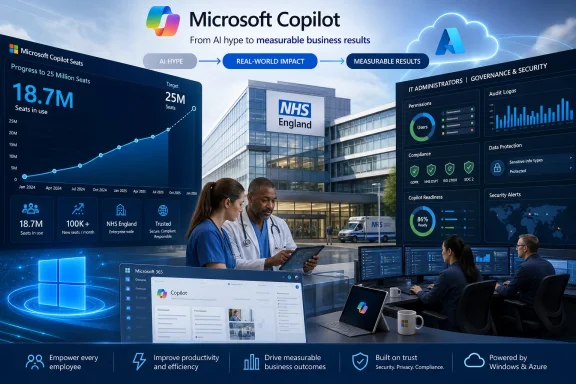
Microsoft Copilot demo-to-enterprise platform infographic with analytics, security, and healthcare impact metrics.Copilot Is Moving From Slogan to Sales Motion​

For much of the last two years, Microsoft’s AI pitch has suffered from a familiar enterprise-software problem: the branding arrived before the workflow. Copilot appeared in Windows, Microsoft 365, GitHub, Security, Dynamics, Edge, Bing, and the taskbar, often with the same name but different capabilities, licensing rules, and user expectations. That ubiquity made Microsoft look fast, but it also made Copilot feel blurry.
The BNP Paribas note is significant because it suggests that investors are seeing improvement where it counts: not in press-event spectacle, but in customer engagement and paid adoption. Analyst Stefan Slowinski reportedly came away from management discussions more confident that Copilot’s capabilities have improved markedly over the past year. He also maintained a Buy rating and a $555 price target, framing Copilot as a stronger revenue engine than skeptics had assumed.
The key number in the submitted report is the expectation that Microsoft could exceed 25 million Copilot seats for its fiscal fourth quarter. That would not, by itself, settle the debate about AI return on investment. But it would show that Microsoft’s distribution advantage is starting to convert into real enterprise licensing momentum.
Microsoft’s bet has always been that Copilot would not need to win like a consumer chatbot. It only needs to become indispensable enough inside Word, Excel, Teams, Outlook, SharePoint, Power Platform, and Azure that procurement departments stop treating it as an experiment and start treating it as the next layer of the Microsoft estate.

The NHS Deal Is the Kind of Proof Wall Street Understands​

The most concrete recent example is NHS England’s plan to provide Microsoft 365 Copilot access to 505,000 clinicians and support staff by October 2026. The rollout followed a large healthcare trial across more than 30,000 NHS workers and 90 organizations, where the reported productivity savings averaged 43 minutes per staff member per day on administrative work. Those figures are precisely the sort of enterprise evidence Microsoft needs.
Healthcare is not an easy victory lap for generative AI. It is highly regulated, politically sensitive, operationally fragmented, and full of workflows where a bad summary or misplaced recommendation can have consequences. That makes NHS England’s deployment useful for Microsoft’s sales narrative because it shows Copilot being adopted in a setting where governance and auditability matter as much as convenience.
But the NHS example also exposes the real shape of the opportunity. Copilot is not being sold as a magical doctor or a replacement clinician. It is being sold as a tool for drafting, summarizing, analyzing, and reducing administrative drag. That is less glamorous than AI diagnosing rare diseases, but it is much closer to where the money and measurable savings are.
The enterprise AI market is gradually learning that mundane work is the beachhead. Meeting notes, email triage, document drafting, spreadsheet analysis, policy search, case summaries, ticket routing, and process automation are not flashy. They are, however, everywhere. If Copilot can save even a fraction of the time its advocates claim, Microsoft does not need sci-fi adoption curves to justify the business.

Microsoft’s Advantage Is Not the Model — It Is the Office Graph​

The Copilot story is often framed as a contest of model quality: OpenAI versus Anthropic versus Google versus Meta, with Microsoft acting as OpenAI’s enterprise storefront. That framing is too narrow. Model quality matters, but Microsoft’s deeper advantage is that Copilot sits where the work already lives.
A chatbot starts with an empty prompt box. Microsoft 365 starts with your inbox, calendar, meetings, documents, chats, permissions, files, compliance settings, and corporate identity. That context is the moat. A generic assistant can write a good paragraph; a workplace assistant has to know which paragraph belongs in which deck, which numbers came from the current workbook, which meeting generated the action item, and which employee is allowed to see the underlying file.
This is why the company keeps pushing Copilot as a system rather than a feature. The paid Microsoft 365 Copilot tier, the free enterprise chat experience, Copilot Studio, agents, and role-specific Copilots are not simply product sprawl. They are Microsoft trying to turn AI into a control plane for work.
The risk, of course, is that customers experience that control plane as clutter. Windows users have already seen Copilot shift shapes several times: a sidebar, an app, a key on new keyboards, a taskbar idea, a consumer assistant, a business assistant, and a branded wrapper around very different capabilities. Microsoft’s product discipline has improved, but the company still has a habit of making the first year of any new platform feel like a licensing seminar.

Pricing Is Becoming the Real Product Strategy​

The submitted report points to Copilot’s evolving pricing model, and that may be the most important phrase in the entire note. Microsoft initially made a bold move by pricing Microsoft 365 Copilot at a premium enterprise add-on level. That sent a message to the market: this was not Clippy with a neural net, and Microsoft intended to monetize it as a new platform layer.
The hard part is that enterprises do not buy AI the way consumers sample apps. They test, pilot, negotiate, restrict, govern, and then expand. If the price is too high before the value is visible, adoption stalls. If the price is too low, Microsoft subsidizes expensive inference at scale and trains customers to undervalue the service.
That is why a more flexible pricing model matters. Microsoft needs multiple doors into Copilot: a no-additional-cost enterprise chat tier for broad familiarity, premium per-user licensing for power users, consumption-based agent pricing for process automation, and sector-specific packaging for industries such as healthcare, finance, legal services, and government. The goal is not merely to sell seats; it is to make Copilot usage appear in more budget lines.
This is also where Azure enters the story. AI software margins are not the old Office margins, at least not automatically. Every prompt has infrastructure behind it. Every agentic workflow has compute, orchestration, retrieval, security checks, and model routing. If Microsoft can use Azure scale, custom silicon, model diversity, and workload optimization to manage cost inflation, Copilot becomes a software-margin story again. If not, adoption could grow while profitability disappoints.

The Seat Count Is Impressive, but Usage Is the Harder Metric​

The market loves seat counts because they are clean. A company has 10 million seats, then 15 million, then perhaps 25 million. The graph goes up, the narrative tightens, and the sales organization has something to celebrate.
But paid seats are only the beginning of enterprise AI adoption. The more revealing questions are how often users invoke Copilot, which workflows they keep using after the novelty fades, whether teams change their processes around it, and whether customers renew at the same or higher levels. A license assigned to a knowledge worker is not the same thing as a habit.
Microsoft understands this, which is why Copilot keeps moving closer to the point of work. A standalone chat window is easy to ignore. A contextual action in Outlook, a summary inside Teams, a drafting assistant in Word, a formula helper in Excel, or a custom agent inside a business process is harder to dismiss. The less users have to “go use AI,” the more likely AI becomes part of the workday.
That approach is also why Microsoft has tolerated branding confusion. The company wants Copilot to be a broad expectation: wherever there is a Microsoft workflow, an assistant should be nearby. In the long run, that may be right. In the short run, it can make Copilot feel simultaneously everywhere and not always useful.
For IT administrators, this is the practical line to watch. The question is not whether Copilot appears in another app. The question is whether Microsoft gives admins enough control over availability, data access, auditing, retention, connector behavior, agent permissions, and user education to make widespread deployment safe.

Windows Is the Awkward Front Door​

For WindowsForum readers, Copilot’s enterprise momentum lands in an uncomfortable place: Windows itself. Microsoft wants Copilot to feel native to the PC, but the strongest business case is still in Microsoft 365 and cloud-connected enterprise workflows. That means Windows is both a showcase and a distraction.
On consumer PCs, Copilot has not yet become the revolutionary interface Microsoft once seemed eager to imply. The dedicated Copilot key, Copilot+ PC branding, Recall controversy, on-device AI features, and taskbar experiments have made Windows feel like the stage for an AI transition that is still being written in real time. Enthusiasts notice when a feature is promoted before it is finished.
In the enterprise, however, Windows can serve a more useful role. It is the endpoint where identity, device compliance, application access, and productivity converge. If Copilot becomes an interface into enterprise knowledge and automation, Windows does not need to host all the intelligence locally. It needs to provide a trustworthy, manageable, secure entry point.
That is why Microsoft’s Copilot strategy should be judged differently on PCs than in Office. In Windows, the danger is user annoyance and platform bloat. In Microsoft 365, the danger is inadequate governance and unclear return on investment. In Azure, the danger is cost inflation. The same brand carries three different sets of risks.

The OpenAI Question Has Become Less Existential​

Microsoft’s AI narrative was once almost inseparable from OpenAI. That was a strength when GPT models were clearly ahead and Microsoft needed to show it had secured privileged access to the defining technology of the moment. It became a complication as enterprises began asking about dependency, cost, data boundaries, model choice, and long-term leverage.
The more Copilot becomes a Microsoft platform, the less it can be framed as simply “OpenAI inside Office.” Microsoft has been moving toward a more model-diverse posture, with routing and orchestration becoming part of the product value. That does not make OpenAI unimportant. It does mean Microsoft wants customers to buy the workflow layer, not the model brand.
This shift is commercially necessary. Enterprise customers do not want to rebuild governance every time the model leaderboard changes. They want contractual commitments, admin controls, compliance features, and predictable integration with the systems they already run. If Microsoft can swap, route, tune, or augment models behind Copilot while preserving the enterprise surface, it owns the customer relationship.
That is also the answer to a common skeptic’s argument. Yes, frontier models may commoditize over time. But the enterprise wrapper around them will not commoditize as quickly. Identity, permissions, data residency, audit logs, connectors, workflow history, and procurement familiarity are boring. They are also durable.

Wall Street Is Buying the Platform Argument Again​

The investment case in the submitted report rests on more than Copilot enthusiasm. Microsoft’s market capitalization of roughly $2.90 trillion, the cited GF Score of 96 out of 100, strong profitability, and broad cloud exposure all reinforce the idea that this is not a speculative AI pure play. Microsoft can spend heavily, absorb experimentation, and bundle its way through product uncertainty.
That scale is both a blessing and a burden. A smaller software company can declare a successful AI product with a few million users and a dramatic growth rate. Microsoft has to move numbers large enough to matter to one of the biggest revenue bases in technology. Copilot cannot merely be popular; it has to become financially material.
This is why analysts are watching seat counts, Azure growth, pricing, and cost control together. Copilot adoption drives demand for Microsoft 365 upgrades and AI services. Azure supplies the infrastructure and potentially captures broader AI workload growth. The company’s challenge is to ensure that the cost of serving AI does not outrun the revenue gained from selling it.
The insider-selling figure in the submitted material should be treated carefully. Executives sell stock for many reasons, including scheduled plans, diversification, taxes, and compensation management. Still, the absence of insider purchases and the reported $8.7 million in recent sales will naturally sit awkwardly beside a bullish AI narrative. Investors should not overread it, but neither should they pretend it is irrelevant.

The Productivity Story Still Needs Adult Supervision​

The strongest version of the Copilot argument is that AI assistants will reduce the administrative tax on modern work. The weakest version is that companies will buy licenses, employees will generate more drafts, meetings will produce more summaries, and everyone will drown in faster-produced sludge. Microsoft’s challenge is to prove that Copilot compresses work rather than merely accelerating it.
The NHS trial numbers are compelling because they point to time saved in recognizable administrative tasks. But every organization will need its own proof. A legal department, a school district, a hospital trust, a manufacturing company, and a software vendor do not share the same risk tolerance or workflow bottlenecks. Copilot adoption that works in one environment may produce noise in another.
That is where governance becomes the hidden adoption curve. Enterprises need policies for what Copilot may access, what it may generate, which outputs require human review, how prompts and responses are logged, and when custom agents can act on behalf of users. The more capable Copilot becomes, the less acceptable it is to treat it as a toy.
Microsoft has an advantage here because it already sells to cautious buyers. Compliance, identity, eDiscovery, retention, sensitivity labels, conditional access, and admin centers are not afterthoughts in the Microsoft universe. But implementation still falls on customers. A tenant with messy permissions and chaotic SharePoint sprawl does not become magically governed because Copilot arrives.

The Real Competition Is Inertia​

It is tempting to compare Copilot directly with ChatGPT Enterprise, Google Gemini, Claude, and a growing field of specialized AI agents. Those comparisons matter, especially for model quality, developer workflows, and specific high-value use cases. But Microsoft’s biggest opponent in the enterprise is not another chatbot. It is inertia.
Most workers have learned to survive bad workflows. They search old emails, copy from prior documents, sit through redundant meetings, update spreadsheets by muscle memory, and treat enterprise knowledge as something that lives in someone else’s head. Copilot asks those users to trust a new layer of mediation over work they already barely trust.
This is why adoption depends less on a single killer feature than on repeated small wins. A useful meeting summary. A cleaner first draft. A faster policy answer. A better Excel explanation. A Teams recap that saves someone from watching a recording. A custom agent that routes a request correctly. Enterprise software habits are built through reliability, not wonder.
Microsoft’s distribution gets Copilot into the room. It does not guarantee affection. The company still has to earn daily use, especially among employees who have seen enough “productivity transformations” to know that new tools often create new work.

The Copilot Trade Is Really a Bet on Microsoft’s Control Plane​

The most important implication of the BNP Paribas view is not that Copilot has improved. Improvement was expected. The more interesting claim is that Copilot may now be improving in ways that align with Microsoft’s broader control-plane strategy.
In Microsoft’s ideal future, Copilot is not merely a writing assistant. It is the conversational and agentic interface across Microsoft 365, Windows, Azure, GitHub, Power Platform, Dynamics, Security, and industry clouds. Users ask, agents act, policies constrain, Azure computes, and Microsoft bills somewhere along the path.
That is an enormous ambition. It is also why the company has been willing to place Copilot branding on nearly everything, sometimes before the user experience deserved it. Microsoft is trying to normalize the idea that AI is not a separate application category. It is a layer across existing categories.
The danger is that platforms built too broadly can lose product focus. Windows users may want a faster, cleaner operating system more than another AI prompt. Office users may want fewer interruptions. Admins may want stable controls more than constant feature churn. Developers may want transparent APIs and predictable costs more than another branded abstraction.
Still, the direction is clear. Microsoft is not chasing the consumer chatbot market as an end in itself. It is trying to make Copilot the enterprise interface for knowledge work and automated action. If the seat numbers keep rising and deployments like NHS England produce measurable value, that strategy becomes much harder to dismiss.

The Numbers Now Have to Survive Renewal Season​

The next phase of the Copilot story will be less forgiving than the first. Early pilots can be funded by innovation budgets. Initial deployments can be justified by strategic urgency. But renewals ask colder questions: who used it, how often, for what, with what measurable effect, and at what cost?
That is where Microsoft’s product improvements must become operational proof. Better reasoning, cleaner app integration, more useful agents, and improved admin controls all matter because they support renewal logic. If Copilot becomes part of a department’s standard operating procedure, it stays. If it remains an expensive curiosity, it gets trimmed.
The same applies to Azure. Investors may tolerate near-term AI infrastructure spending if it produces durable platform revenue. They will be less patient if AI demand grows while margins compress unpredictably. Microsoft’s ability to manage inference costs, route workloads efficiently, and monetize higher-value workflows will determine whether Copilot is a margin enhancer or a very expensive retention tool.
For customers, the practical advice is not to reject Copilot hype outright, but to test it with discipline. Pick workflows where time savings can be observed. Clean up permissions before broad rollout. Train users on verification. Track usage by role. Treat custom agents like software deployments, not clever prompts. The organizations that do this well may get real value; the ones that simply assign licenses may get a bigger bill.

Microsoft’s AI Story Has Finally Reached the Procurement Department​

The useful read on this week’s Copilot optimism is not that Microsoft has solved enterprise AI. It is that the company has moved the conversation from possibility to procurement, and that is where Microsoft is historically most dangerous.
  • Microsoft’s Copilot momentum now depends less on splashy demos and more on paid seats, renewals, usage depth, and measurable workflow savings.
  • NHS England’s planned rollout to 505,000 staff gives Microsoft a powerful public-sector proof point, but it also raises the bar for governance and measurable outcomes.
  • Copilot’s long-term value is tied to Microsoft 365 context, identity, permissions, and workflow integration more than to any single frontier model.
  • Pricing flexibility will be central because enterprises need different paths for casual users, power users, custom agents, and regulated industry deployments.
  • Windows users should expect Copilot to keep moving closer to the shell, but the stronger near-term business case remains inside Microsoft 365 and Azure-connected workflows.
  • The next test is renewal behavior, because assigned seats are easier to win than durable work habits.
Microsoft has spent the last two years making Copilot impossible to ignore; the next two will determine whether it becomes impossible to remove. If BNP Paribas is right that the product has improved enough to push adoption beyond earlier expectations, Copilot may finally be crossing from AI branding exercise into enterprise platform layer. That does not mean every Windows user will love it, or every organization will save what the pilots promise. It does mean Microsoft’s AI bet is now being judged by the only audience that can make it real at scale: the administrators, finance teams, and workers who decide whether the assistant earns its place in the workday.

References​

  1. Primary source: GuruFocus
    Published: 2026-06-11T19:50:09.355227
  2. Related coverage: enterprisedna.co
  3. Related coverage: htn.co.uk
  4. Related coverage: healthcare-management.uk
  5. Related coverage: techmarketview.com
  6. Related coverage: investing.com
  1. Related coverage: resultsense.com
  2. Related coverage: medcloudinsider.com
  3. Related coverage: simplywall.st
  4. Related coverage: prioritypixels.co.uk
  5. Related coverage: windowscentral.com
  6. Official source: microsoft.com
  7. Official source: fpc.microsoft.com

  8. Official source: blogs.microsoft.com
  9. Related coverage: techtarget.com
  10. Related coverage: atonementlicensing.com
  11. Related coverage: crossing.one
  12. Official source: support.microsoft.com
  13. Related coverage: epcgroup.net
  14. Related coverage: aicosthub.com
  15. Related coverage: digi-tools.info
  16. Related coverage: aitoolradar.io
  17. Related coverage: techradar.com
  18. Related coverage: tomshardware.com
 

Back
Top