

Candidates seeking a job at Microsoft in 2026 should target roles through Microsoft Careers, match their resumes to posted qualifications, prepare for structured interviews that test practical skills and values, and build evidence of real work in software, cloud, data, security, product, or business functions. The old advice that a computer science degree is the golden ticket is now only half true. Microsoft still prizes formal training, but its hiring machinery is designed to detect whether candidates can solve problems, collaborate under ambiguity, and ship responsibly. The practical message for applicants is blunt: credentials may open the door, but demonstrated competence keeps you in the room.
For decades, the dream version of a Microsoft job followed a familiar script: study computer science, master a programming language, pass a technical interview, and move to Redmond. That path still exists, and for many software engineering roles it remains the most direct one. But it is no longer the only credible path into the company.
Microsoft’s own job postings increasingly use a broader formulation: a degree in computer science or a related technical field, or equivalent experience. That phrase is not a loophole so much as a warning. It means candidates without a traditional degree must prove the same underlying capability through projects, work history, certifications, open-source contributions, internships, apprenticeships, or portfolio evidence.
For students, a B.Tech, B.E., BCA, MCA, computer science degree, information technology degree, or related engineering background can still matter. It tells recruiters that the candidate has probably encountered algorithms, operating systems, databases, networks, and software design. But a transcript alone does not show whether the candidate can debug production code, reason about trade-offs, communicate with stakeholders, or learn a new stack quickly.
That is where many applicants misread Microsoft. They assume the company is filtering for academic prestige when it is often filtering for role fit. A candidate with a strong degree but thin practical experience can lose to someone with a less conventional background and a more convincing record of building useful things.
That makes the resume more important, not less. A generic “hard-working developer seeking challenging opportunities” document is almost engineered to disappear. The better approach is to treat each application as a targeted argument: this role asks for these capabilities, and here is the evidence that I have used them.
For software engineering candidates, that means naming languages, frameworks, systems, and outcomes with precision. “Worked on web development” says little. “Built a React and .NET dashboard used by support engineers to reduce manual ticket triage” says far more. The second version gives a recruiter and interviewer something to test.
For cloud, security, data, and infrastructure roles, specificity matters even more. Azure, Kubernetes, identity, Microsoft Entra, PowerShell, Kusto Query Language, SQL, CI/CD, observability, incident response, and compliance are not interchangeable buzzwords. They point to different bodies of knowledge, and Microsoft’s hiring teams tend to know the difference.
Data structures and algorithms remain important for many software roles, especially early-career positions. Arrays, strings, hash maps, trees, graphs, recursion, dynamic programming, sorting, searching, and complexity analysis still form the grammar of many coding screens. Candidates who cannot reason clearly about time and space complexity are at a disadvantage.
But the interview has widened. Microsoft’s engineering work now spans cloud infrastructure, AI platforms, developer tools, gaming, security, enterprise productivity, hardware, and consumer services. A candidate who can solve a textbook coding problem but cannot discuss testing, maintainability, distributed systems, or user impact may look incomplete.
The strongest candidates prepare across layers. They practice coding problems until syntax no longer consumes their attention, then move upward into design. They learn how APIs are shaped, how services fail, how data moves, how authentication works, and how trade-offs change when software serves millions of users instead of one local machine.
Microsoft interviewers are often assessing the path, not only the destination. They want to hear clarifying questions, assumptions, rejected approaches, edge cases, and trade-offs. A candidate who communicates while solving gives the interviewer more evidence than one who quietly writes code and hopes for the best.
This is not theater. Modern software development is collaborative by default. Engineers review each other’s designs, debug incidents together, negotiate constraints with product managers, and explain risk to people who do not share their technical background. Thinking out loud in an interview simulates that working environment.
Preparation should therefore include verbal practice. Solve problems on a whiteboard, in a shared editor, or over a video call with another person. Explain why one data structure is better than another. Say what you would test. Say what breaks if the input size grows. The goal is not to sound rehearsed; it is to make your reasoning visible.
Cloud fluency does not mean memorizing every Azure service name. It means understanding the basic shape of cloud-native systems: compute, storage, networking, identity, monitoring, cost, reliability, and security. A junior candidate should know how a web app is deployed and observed. A mid-level candidate should understand service boundaries, scaling, retries, queues, and failure modes. A senior candidate should be able to discuss architecture, operational risk, and organizational trade-offs.
For WindowsForum readers, this is where traditional Windows knowledge can become an advantage rather than a legacy skill. Enterprise Microsoft environments increasingly span Windows endpoints, Intune, Microsoft Defender, Entra ID, Azure Virtual Desktop, Microsoft 365, PowerShell automation, and hybrid identity. The admin who understands both endpoints and cloud control planes is much more valuable than the admin who treats them as separate worlds.
Certifications can help here, but they are not magic. Azure Fundamentals, Azure Administrator, Azure Developer, Security Operations Analyst, or similar credentials can provide structure and signal commitment. The stronger signal is using that knowledge in a lab, a project, a migration, or a measurable work outcome.
Microsoft explicitly expects honest representation from candidates and responsible use of AI tools. That matters because applicants are now tempted to outsource too much of the process. A polished resume written by an AI assistant may get attention, but it creates risk if the candidate cannot defend every line in an interview.
The better strategy is to use AI as a coach, not a ghostwriter. Use it to identify gaps in a resume, generate practice questions, explain unfamiliar concepts, or simulate interview prompts. Then rewrite the output in your own voice and test yourself without assistance.
For technical candidates, AI fluency is becoming part of the toolkit. Developers should know how to work with GitHub Copilot-style assistance while reviewing generated code critically. Data and AI candidates should understand evaluation, bias, privacy, model limitations, and governance. Security candidates should understand both AI-enabled defense and AI-enabled abuse.
The new hiring question is not “Can you use AI?” It is “Can you use AI without surrendering judgment?”
Behavioral interviews are not filler between coding rounds. They are where Microsoft tests whether a candidate can operate in its actual work environment. A brilliant engineer who cannot receive feedback, collaborate across teams, or admit mistakes is a risk. A technically solid candidate who learns quickly and raises the quality of the team can be a stronger hire.
Preparation for behavioral interviews should be as concrete as preparation for technical ones. Candidates need stories about conflict, failure, learning, leadership, customer impact, and ambiguous decision-making. These stories should not be moral fables. They should be specific accounts of what happened, what the candidate did, what changed, and what they learned.
The strongest stories include tension. “Everything went well” is rarely persuasive. Microsoft works on large products with real constraints, from Windows compatibility to cloud reliability to enterprise security. Hiring teams want to know how candidates behave when requirements shift, systems fail, deadlines tighten, or people disagree.
A better path is staged. In the first phase, students should build programming fundamentals and mathematical confidence. In the second, they should build projects that are complete enough to show. In the third, they should seek internships, hackathons, open-source work, campus programs, or research experience. In the final phase, they should tailor applications and practice interviews intensively.
Projects matter because they reveal taste. A simple but finished project with authentication, deployment, logging, tests, documentation, and a clear user problem can be more impressive than a half-built clone of a famous app. Microsoft hires people to finish work, not merely to start it.
Students should also avoid chasing every technology trend at once. One strong programming language, one web or app framework, one database, one cloud platform, and one serious project can create a more coherent profile than a resume listing twenty tools at beginner level. Depth beats decorative breadth.
A teacher moving into product management may bring communication, curriculum design, and user empathy. A finance professional moving into data analytics may bring domain knowledge and quantitative discipline. A support engineer moving into cloud operations may bring incident experience and customer judgment. These are not side notes; they are differentiators.
The mistake career switchers make is presenting themselves as junior versions of traditional candidates. That discards their advantage. The better narrative is: “I have acquired the technical skills required for this role, and my previous field gives me a useful lens on the problems this team solves.”
Online courses can help, but completion certificates alone rarely carry the argument. Career switchers should convert courses into artifacts: GitHub repositories, dashboards, scripts, case studies, technical blogs, lab environments, or contributions. If a candidate says they learned Azure, the next question is what they built with it.
The best preparation looks like the work itself. A software candidate should build, test, debug, review, and deploy code. A security candidate should analyze logs, configure defenses, study attacks, and write incident notes. A data candidate should clean messy datasets, explain assumptions, and present conclusions. A product candidate should write specs, prioritize trade-offs, and defend decisions.
This is especially true for Microsoft because the company contains many Microsofts. The skills for a Windows kernel role are not the same as the skills for a Teams product role, an Azure reliability role, an Xbox services role, or a Microsoft 365 security role. Generic preparation gets candidates only so far.
Applicants should reverse-engineer the job posting. If it mentions distributed systems, prepare system design. If it mentions customer obsession, prepare examples of customer impact. If it mentions C++, review memory, performance, concurrency, and debugging. If it mentions Azure, build something on Azure. The posting is not boilerplate; it is the study guide.
The best referral request is specific and respectful. Instead of asking a Microsoft employee to “refer me to any role,” candidates should identify a particular opening, explain why their experience matches it, and attach a concise resume. That makes it easier for the employee to help and reduces the impression that the candidate is spraying applications without strategy.
Networking should not begin with a request. Candidates who participate in technical communities, contribute to open-source projects, attend meetups, write useful posts, or engage thoughtfully with Microsoft technologies build relationships before they need them. That kind of visibility can matter.
For Windows enthusiasts and IT pros, community participation is an underrated asset. A well-written forum post explaining a tricky Windows deployment issue, a PowerShell script that solves a real admin problem, or a GitHub repo documenting a home lab can show applied skill. Microsoft is full of people who notice practical competence.
Developers should understand secure coding, identity, secrets management, dependency risk, and threat modeling. Administrators should understand least privilege, conditional access, endpoint protection, patch management, and auditability. Data professionals should understand privacy, retention, access controls, and responsible analysis. AI candidates should understand safety, transparency, and evaluation.
This does not mean every candidate must become a security engineer. It means candidates should be able to show that they think about risk. In interviews, that can be as simple as discussing how an API handles authentication, how logs avoid exposing sensitive data, or how a deployment can be rolled back safely.
Microsoft has spent years under pressure from customers, regulators, and attackers to improve security practices. Candidates who treat security as someone else’s job may look out of step with where the company is going. Candidates who integrate security into their normal engineering or administrative judgment look more ready for the work.
But opacity is not the same as randomness. Large-scale hiring systems still revolve around fit, timing, headcount, location, level, and competition. A candidate may be strong and still lose because another candidate was a closer match for that exact team at that exact moment.
This is why applying broadly but intelligently matters. Candidates should not send the same resume to fifty roles. They should identify clusters of roles that genuinely match their skills, tailor the resume for each cluster, and track outcomes. If applications consistently fail before interviews, the resume or role targeting is likely the problem. If interviews happen but offers do not, preparation or level calibration may be the issue.
Rejection should be treated as data, not identity. Microsoft’s own hiring guidance encourages candidates to continue exploring roles because another team may be a better fit. That is not just a comforting phrase. In a company this large, fit is often team-specific.
The company offers roles across engineering, sales, support, design, research, product, consulting, operations, security, finance, legal, marketing, and datacenter infrastructure. A person who wants to build developer tools needs a different preparation path from someone who wants to manage enterprise customers or secure cloud workloads. “I want to work at Microsoft” is too broad to guide a serious plan.
Scope matters because Microsoft rewards people who can create impact beyond assigned tasks. That may mean improving a service, reducing operational load, mentoring others, identifying customer pain, or making a process safer. The interview process tries to detect that potential early.
Candidates should therefore ask themselves a harder question before applying: where can I credibly create value? The answer may not be the most glamorous team. It may be the team where the candidate’s skills, domain knowledge, and curiosity intersect most naturally.
Those receipts do not have to be famous. A student’s scheduling app, an admin’s PowerShell automation, a developer’s open-source patch, a data analyst’s public notebook, or a security learner’s home lab write-up can all be useful evidence. What matters is whether the work shows judgment and follow-through.
The portfolio should be curated, not dumped. Three polished projects are better than twenty abandoned repositories. Each should explain the problem, the architecture, the trade-offs, how to run it, and what the candidate would improve next. That final part matters because mature engineers know their work is never perfect.
In interviews, receipts become stories. Instead of speaking abstractly about teamwork, a candidate can describe a project where requirements changed. Instead of claiming to care about quality, they can explain a bug they found through testing. Instead of saying they love learning, they can show how they moved from tutorial knowledge to working software.
For technical candidates, the baseline is still strong fundamentals. For cloud and IT candidates, the baseline is operational fluency with modern Microsoft ecosystems. For career switchers, the baseline is a credible bridge between past experience and future contribution. For everyone, the baseline is honesty.
That last point deserves emphasis. In an era when AI can embellish resumes and generate plausible answers, Microsoft’s process is increasingly built around verification. Can you explain what you built? Can you reason under pressure? Can you admit uncertainty? Can you learn in public?
The job market will keep changing, and Microsoft’s own hiring process will keep absorbing more AI, more automation, and more scrutiny. But the durable advantage will remain surprisingly human: learn deeply, build honestly, communicate clearly, and show evidence that you can make complicated technology useful for other people.
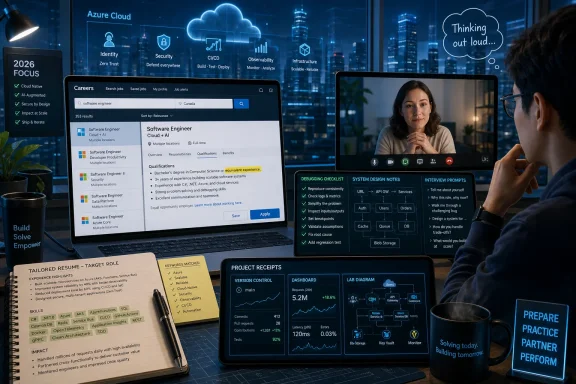 Microsoft Hiring Has Moved Past the Myth of the Perfect Degree
For decades, the dream version of a Microsoft job followed a familiar script: study computer science, master a programming language, pass a technical interview, and move to Redmond. That path still exists, and for many software engineering roles it remains the most direct one. But it is no longer the only credible path into the company.Microsoft’s own job postings increasingly use a broader formulation: a degree in computer science or a related technical field, or equivalent experience. That phrase is not a loophole so much as a warning. It means candidates without a traditional degree must prove the same underlying capability through projects, work history, certifications, open-source contributions, internships, apprenticeships, or portfolio evidence.
For students, a B.Tech, B.E., BCA, MCA, computer science degree, information technology degree, or related engineering background can still matter. It tells recruiters that the candidate has probably encountered algorithms, operating systems, databases, networks, and software design. But a transcript alone does not show whether the candidate can debug production code, reason about trade-offs, communicate with stakeholders, or learn a new stack quickly.
That is where many applicants misread Microsoft. They assume the company is filtering for academic prestige when it is often filtering for role fit. A candidate with a strong degree but thin practical experience can lose to someone with a less conventional background and a more convincing record of building useful things.
The Resume Is No Longer a Biography; It Is a Matching System
The first hurdle at Microsoft is not the interview. It is the translation of your experience into the language of a specific job posting. Microsoft’s careers platform lets applicants search by keyword, location, and job ID, and the company now uses AI-powered recommendations to suggest roles based on a candidate’s profile or uploaded resume.That makes the resume more important, not less. A generic “hard-working developer seeking challenging opportunities” document is almost engineered to disappear. The better approach is to treat each application as a targeted argument: this role asks for these capabilities, and here is the evidence that I have used them.
For software engineering candidates, that means naming languages, frameworks, systems, and outcomes with precision. “Worked on web development” says little. “Built a React and .NET dashboard used by support engineers to reduce manual ticket triage” says far more. The second version gives a recruiter and interviewer something to test.
For cloud, security, data, and infrastructure roles, specificity matters even more. Azure, Kubernetes, identity, Microsoft Entra, PowerShell, Kusto Query Language, SQL, CI/CD, observability, incident response, and compliance are not interchangeable buzzwords. They point to different bodies of knowledge, and Microsoft’s hiring teams tend to know the difference.
Practical Skill Is the Real Entrance Exam
Microsoft technical interviews are designed to evaluate problem-solving, technical judgment, and communication. For engineering roles, candidates may be asked to write code, reason through system design, discuss previous projects, or explain how they would approach a task in the role. That last part is crucial because Microsoft is not merely asking whether you know an answer; it is asking whether your thinking survives contact with ambiguity.Data structures and algorithms remain important for many software roles, especially early-career positions. Arrays, strings, hash maps, trees, graphs, recursion, dynamic programming, sorting, searching, and complexity analysis still form the grammar of many coding screens. Candidates who cannot reason clearly about time and space complexity are at a disadvantage.
But the interview has widened. Microsoft’s engineering work now spans cloud infrastructure, AI platforms, developer tools, gaming, security, enterprise productivity, hardware, and consumer services. A candidate who can solve a textbook coding problem but cannot discuss testing, maintainability, distributed systems, or user impact may look incomplete.
The strongest candidates prepare across layers. They practice coding problems until syntax no longer consumes their attention, then move upward into design. They learn how APIs are shaped, how services fail, how data moves, how authentication works, and how trade-offs change when software serves millions of users instead of one local machine.
The Microsoft Interview Rewards Thinking Out Loud
One of the most misunderstood parts of a technical interview is silence. Candidates often believe they should disappear into their own head, produce a perfect solution, and then reveal it. That instinct can backfire.Microsoft interviewers are often assessing the path, not only the destination. They want to hear clarifying questions, assumptions, rejected approaches, edge cases, and trade-offs. A candidate who communicates while solving gives the interviewer more evidence than one who quietly writes code and hopes for the best.
This is not theater. Modern software development is collaborative by default. Engineers review each other’s designs, debug incidents together, negotiate constraints with product managers, and explain risk to people who do not share their technical background. Thinking out loud in an interview simulates that working environment.
Preparation should therefore include verbal practice. Solve problems on a whiteboard, in a shared editor, or over a video call with another person. Explain why one data structure is better than another. Say what you would test. Say what breaks if the input size grows. The goal is not to sound rehearsed; it is to make your reasoning visible.
Cloud Fluency Has Become a Career Multiplier
A decade ago, Microsoft hiring advice could focus mostly on coding. In 2026, that is too narrow. Microsoft is a cloud and AI company as much as it is a Windows and productivity company, and Azure sits at the center of many technical roles.Cloud fluency does not mean memorizing every Azure service name. It means understanding the basic shape of cloud-native systems: compute, storage, networking, identity, monitoring, cost, reliability, and security. A junior candidate should know how a web app is deployed and observed. A mid-level candidate should understand service boundaries, scaling, retries, queues, and failure modes. A senior candidate should be able to discuss architecture, operational risk, and organizational trade-offs.
For WindowsForum readers, this is where traditional Windows knowledge can become an advantage rather than a legacy skill. Enterprise Microsoft environments increasingly span Windows endpoints, Intune, Microsoft Defender, Entra ID, Azure Virtual Desktop, Microsoft 365, PowerShell automation, and hybrid identity. The admin who understands both endpoints and cloud control planes is much more valuable than the admin who treats them as separate worlds.
Certifications can help here, but they are not magic. Azure Fundamentals, Azure Administrator, Azure Developer, Security Operations Analyst, or similar credentials can provide structure and signal commitment. The stronger signal is using that knowledge in a lab, a project, a migration, or a measurable work outcome.
AI Has Raised the Bar Rather Than Lowered It
Generative AI has made it easier to produce code, resumes, cover letters, and interview prep scripts. It has not made it easier to fake competence at Microsoft. If anything, it has raised the value of candidates who can use AI responsibly while still understanding the work.Microsoft explicitly expects honest representation from candidates and responsible use of AI tools. That matters because applicants are now tempted to outsource too much of the process. A polished resume written by an AI assistant may get attention, but it creates risk if the candidate cannot defend every line in an interview.
The better strategy is to use AI as a coach, not a ghostwriter. Use it to identify gaps in a resume, generate practice questions, explain unfamiliar concepts, or simulate interview prompts. Then rewrite the output in your own voice and test yourself without assistance.
For technical candidates, AI fluency is becoming part of the toolkit. Developers should know how to work with GitHub Copilot-style assistance while reviewing generated code critically. Data and AI candidates should understand evaluation, bias, privacy, model limitations, and governance. Security candidates should understand both AI-enabled defense and AI-enabled abuse.
The new hiring question is not “Can you use AI?” It is “Can you use AI without surrendering judgment?”
The Growth Mindset Is Not Corporate Decoration
Microsoft’s modern culture talks frequently about growth mindset, respect, integrity, and accountability. Skeptical candidates may hear that as corporate wallpaper. They should resist that temptation.Behavioral interviews are not filler between coding rounds. They are where Microsoft tests whether a candidate can operate in its actual work environment. A brilliant engineer who cannot receive feedback, collaborate across teams, or admit mistakes is a risk. A technically solid candidate who learns quickly and raises the quality of the team can be a stronger hire.
Preparation for behavioral interviews should be as concrete as preparation for technical ones. Candidates need stories about conflict, failure, learning, leadership, customer impact, and ambiguous decision-making. These stories should not be moral fables. They should be specific accounts of what happened, what the candidate did, what changed, and what they learned.
The strongest stories include tension. “Everything went well” is rarely persuasive. Microsoft works on large products with real constraints, from Windows compatibility to cloud reliability to enterprise security. Hiring teams want to know how candidates behave when requirements shift, systems fail, deadlines tighten, or people disagree.
Students Should Build Evidence Before They Need It
For students aiming at Microsoft, the timeline starts earlier than most people think. Waiting until the final semester to begin interview preparation is a poor strategy. By then, the candidate is trying to build skills, projects, confidence, and a resume all at once.A better path is staged. In the first phase, students should build programming fundamentals and mathematical confidence. In the second, they should build projects that are complete enough to show. In the third, they should seek internships, hackathons, open-source work, campus programs, or research experience. In the final phase, they should tailor applications and practice interviews intensively.
Projects matter because they reveal taste. A simple but finished project with authentication, deployment, logging, tests, documentation, and a clear user problem can be more impressive than a half-built clone of a famous app. Microsoft hires people to finish work, not merely to start it.
Students should also avoid chasing every technology trend at once. One strong programming language, one web or app framework, one database, one cloud platform, and one serious project can create a more coherent profile than a resume listing twenty tools at beginner level. Depth beats decorative breadth.
Career Switchers Need a Sharper Narrative
Candidates from non-CS backgrounds can absolutely break into Microsoft, but they face a different challenge. They must explain not only what they know, but why their previous experience makes them better suited for the role.A teacher moving into product management may bring communication, curriculum design, and user empathy. A finance professional moving into data analytics may bring domain knowledge and quantitative discipline. A support engineer moving into cloud operations may bring incident experience and customer judgment. These are not side notes; they are differentiators.
The mistake career switchers make is presenting themselves as junior versions of traditional candidates. That discards their advantage. The better narrative is: “I have acquired the technical skills required for this role, and my previous field gives me a useful lens on the problems this team solves.”
Online courses can help, but completion certificates alone rarely carry the argument. Career switchers should convert courses into artifacts: GitHub repositories, dashboards, scripts, case studies, technical blogs, lab environments, or contributions. If a candidate says they learned Azure, the next question is what they built with it.
The Best Preparation Looks Like the Job
Interview preparation often becomes an industry of puzzles, flashcards, and folklore. Some of that is useful. Much of it becomes performative.The best preparation looks like the work itself. A software candidate should build, test, debug, review, and deploy code. A security candidate should analyze logs, configure defenses, study attacks, and write incident notes. A data candidate should clean messy datasets, explain assumptions, and present conclusions. A product candidate should write specs, prioritize trade-offs, and defend decisions.
This is especially true for Microsoft because the company contains many Microsofts. The skills for a Windows kernel role are not the same as the skills for a Teams product role, an Azure reliability role, an Xbox services role, or a Microsoft 365 security role. Generic preparation gets candidates only so far.
Applicants should reverse-engineer the job posting. If it mentions distributed systems, prepare system design. If it mentions customer obsession, prepare examples of customer impact. If it mentions C++, review memory, performance, concurrency, and debugging. If it mentions Azure, build something on Azure. The posting is not boilerplate; it is the study guide.
Referrals Help, but They Do Not Substitute for Fit
A Microsoft referral can help an application get noticed, especially in a crowded market. But applicants often overestimate what a referral can do. It may improve visibility; it does not rewrite the job requirements.The best referral request is specific and respectful. Instead of asking a Microsoft employee to “refer me to any role,” candidates should identify a particular opening, explain why their experience matches it, and attach a concise resume. That makes it easier for the employee to help and reduces the impression that the candidate is spraying applications without strategy.
Networking should not begin with a request. Candidates who participate in technical communities, contribute to open-source projects, attend meetups, write useful posts, or engage thoughtfully with Microsoft technologies build relationships before they need them. That kind of visibility can matter.
For Windows enthusiasts and IT pros, community participation is an underrated asset. A well-written forum post explaining a tricky Windows deployment issue, a PowerShell script that solves a real admin problem, or a GitHub repo documenting a home lab can show applied skill. Microsoft is full of people who notice practical competence.
Security and Trust Now Sit Inside Almost Every Role
One of the biggest shifts in Microsoft hiring is that security is no longer confined to security job titles. The company’s products sit inside governments, hospitals, banks, schools, factories, and consumer devices. Trust is not an optional feature.Developers should understand secure coding, identity, secrets management, dependency risk, and threat modeling. Administrators should understand least privilege, conditional access, endpoint protection, patch management, and auditability. Data professionals should understand privacy, retention, access controls, and responsible analysis. AI candidates should understand safety, transparency, and evaluation.
This does not mean every candidate must become a security engineer. It means candidates should be able to show that they think about risk. In interviews, that can be as simple as discussing how an API handles authentication, how logs avoid exposing sensitive data, or how a deployment can be rolled back safely.
Microsoft has spent years under pressure from customers, regulators, and attackers to improve security practices. Candidates who treat security as someone else’s job may look out of step with where the company is going. Candidates who integrate security into their normal engineering or administrative judgment look more ready for the work.
The Global Candidate Market Is Brutal but Not Random
Applicants often experience Microsoft hiring as opaque. They apply, wait, receive no feedback, and wonder whether anyone saw their resume. The frustration is real, especially because large companies receive enormous application volumes and usually cannot provide individualized feedback to every rejected candidate.But opacity is not the same as randomness. Large-scale hiring systems still revolve around fit, timing, headcount, location, level, and competition. A candidate may be strong and still lose because another candidate was a closer match for that exact team at that exact moment.
This is why applying broadly but intelligently matters. Candidates should not send the same resume to fifty roles. They should identify clusters of roles that genuinely match their skills, tailor the resume for each cluster, and track outcomes. If applications consistently fail before interviews, the resume or role targeting is likely the problem. If interviews happen but offers do not, preparation or level calibration may be the issue.
Rejection should be treated as data, not identity. Microsoft’s own hiring guidance encourages candidates to continue exploring roles because another team may be a better fit. That is not just a comforting phrase. In a company this large, fit is often team-specific.
Salary Is the Headline, but Scope Is the Career
Microsoft’s compensation reputation attracts candidates, and understandably so. Competitive salaries, stock awards, benefits, and the prestige of the brand can be life-changing. But candidates who focus only on getting in may miss the deeper question: what kind of career do they want once inside?The company offers roles across engineering, sales, support, design, research, product, consulting, operations, security, finance, legal, marketing, and datacenter infrastructure. A person who wants to build developer tools needs a different preparation path from someone who wants to manage enterprise customers or secure cloud workloads. “I want to work at Microsoft” is too broad to guide a serious plan.
Scope matters because Microsoft rewards people who can create impact beyond assigned tasks. That may mean improving a service, reducing operational load, mentoring others, identifying customer pain, or making a process safer. The interview process tries to detect that potential early.
Candidates should therefore ask themselves a harder question before applying: where can I credibly create value? The answer may not be the most glamorous team. It may be the team where the candidate’s skills, domain knowledge, and curiosity intersect most naturally.
The Candidate Who Wins Has Receipts
A strong Microsoft candidate does not merely claim to be passionate about technology. They bring receipts. They can point to a project, a system, a bug, a migration, a paper, a dashboard, a customer problem, a community contribution, or a hard lesson.Those receipts do not have to be famous. A student’s scheduling app, an admin’s PowerShell automation, a developer’s open-source patch, a data analyst’s public notebook, or a security learner’s home lab write-up can all be useful evidence. What matters is whether the work shows judgment and follow-through.
The portfolio should be curated, not dumped. Three polished projects are better than twenty abandoned repositories. Each should explain the problem, the architecture, the trade-offs, how to run it, and what the candidate would improve next. That final part matters because mature engineers know their work is never perfect.
In interviews, receipts become stories. Instead of speaking abstractly about teamwork, a candidate can describe a project where requirements changed. Instead of claiming to care about quality, they can explain a bug they found through testing. Instead of saying they love learning, they can show how they moved from tutorial knowledge to working software.
The Microsoft Path Is Narrowest for the Unprepared
The practical path into Microsoft is not mysterious, but it is unforgiving. Candidates need to pick the right role family, build the relevant skills, create evidence, tailor the application, and prepare for interviews that test both capability and character. Skipping any one of those steps makes the process feel more random than it is.For technical candidates, the baseline is still strong fundamentals. For cloud and IT candidates, the baseline is operational fluency with modern Microsoft ecosystems. For career switchers, the baseline is a credible bridge between past experience and future contribution. For everyone, the baseline is honesty.
That last point deserves emphasis. In an era when AI can embellish resumes and generate plausible answers, Microsoft’s process is increasingly built around verification. Can you explain what you built? Can you reason under pressure? Can you admit uncertainty? Can you learn in public?
The Application That Survives the Filter Has a Point of View
The most useful advice for Microsoft hopefuls is concrete, not mystical. A candidate should leave behind the fantasy of a universal Microsoft profile and build a role-specific case instead. Near the end of the preparation cycle, that case should be simple enough to summarize aloud.- Candidates should apply through Microsoft Careers with a profile and resume tuned to the exact qualifications of each role.
- Technical applicants should prepare for coding, problem-solving, design discussion, testing, and role-specific practical exercises.
- Nontraditional candidates should turn online learning into visible projects, measurable work, or portfolio artifacts.
- Interview preparation should include behavioral stories about failure, collaboration, ambiguity, and customer or user impact.
- AI tools should be used for preparation and review, not to misrepresent experience or replace the candidate’s own reasoning.
The job market will keep changing, and Microsoft’s own hiring process will keep absorbing more AI, more automation, and more scrutiny. But the durable advantage will remain surprisingly human: learn deeply, build honestly, communicate clearly, and show evidence that you can make complicated technology useful for other people.
References
- Primary source: Dailyhunt
Published: 2026-06-12T04:30:08.201761
Loading…
m.dailyhunt.in - Official source: careers.microsoft.com
Loading…
careers.microsoft.com - Official source: microsoft.com
Loading…
www.microsoft.com - Official source: learn.microsoft.com
Loading…
learn.microsoft.com - Official source: news.microsoft.com
Loading…
news.microsoft.com - Official source: create.microsoft.com
Loading…
create.microsoft.com
- Related coverage: revarta.com
Loading…
www.revarta.com - Related coverage: scaleengineer.com
Loading…
scaleengineer.com - Related coverage: jobtestprep.com
Loading…
www.jobtestprep.com - Official source: leap.microsoft.com
Loading…
leap.microsoft.com - Related coverage: prachub.com
Loading…
prachub.com - Related coverage: fao.org
Loading…
www.fao.org - Official source: download.microsoft.com
Loading…
download.microsoft.com - Related coverage: pupr.edu
Loading…
www.pupr.edu