

Microsoft reportedly restricted employees from using Anthropic’s Claude Fable 5 this week after Anthropic introduced mandatory data-retention rules for its Mythos-class models, requiring prompts and outputs to be kept for 30 days and potentially longer when safety systems flag content for review. That is the plain version of the story. The more revealing version is that Microsoft, one of the loudest evangelists for enterprise AI, has just demonstrated the limit of its own comfort with frontier models it does not fully control. The company is not rejecting AI assistance; it is rejecting ambiguity around where sensitive work goes, who can inspect it, and how long it remains outside the corporate perimeter.
The industry has spent the last two years selling generative AI as a productivity layer that should be everywhere: in the editor, in the terminal, in the inbox, in the meeting transcript, in the data warehouse, and eventually in the business process itself. Microsoft has been the most aggressive enterprise distributor of that vision, wrapping Copilot branding around Windows, GitHub, Microsoft 365, Azure, and security tooling.
That is what makes the Claude Fable 5 restriction interesting. This is not a laggard company discovering that employees paste secrets into chatbots. It is Microsoft, a company with mature security review, a vast AI product portfolio, and enormous financial incentives to normalize AI-assisted work, deciding that one new model’s data-handling terms are not yet acceptable for its own staff.
The reported restriction is temporary while legal and compliance teams evaluate Anthropic’s policy changes. But “temporary” does not mean trivial. In enterprise IT, a pause is often the first visible sign that a vendor’s technical breakthrough has outrun the customer’s governance model.
Claude Fable 5 appears to have crossed that line because it belongs to Anthropic’s new Mythos class of models, a more capable tier positioned for heavy software engineering, analytics, research, and long-running agentic workflows. Those are precisely the uses that make employees want it — and precisely the uses that make compliance teams nervous.
A model that can help refactor a codebase, interrogate logs, summarize customer escalations, or reason through internal architecture is also a model that may be fed code, credentials, support data, contractual details, roadmap plans, and unannounced product information. At consumer scale, that is a privacy problem. Inside Microsoft, it becomes a governance problem with regulatory, contractual, and competitive consequences.
From Anthropic’s perspective, that logic is understandable. If a frontier model has new capabilities that could be misused, the company wants telemetry and review windows. A zero-retention model may be cleaner for enterprise customers, but it leaves the developer of the model with less visibility into abuse, evasion attempts, or emergent risk.
From Microsoft’s perspective, that same policy turns ordinary AI usage into a possible data-export event. A prompt is not just a prompt when an employee is using an AI coding agent or analysis tool. It can contain source files, stack traces, proprietary APIs, internal project names, customer identifiers, telemetry, business assumptions, and the output of other internal tools.
This is why the 30-day number matters less than the mandatory nature of the retention. Many enterprises tolerate short retention windows in carefully bounded contexts. They become much less comfortable when retention cannot be disabled for the very model employees are most eager to use.
The extra two-year retention path for flagged content is even more sensitive. Safety systems do not merely flag obvious wrongdoing; they can flag ambiguous security work, exploit research, malware analysis, red-team exercises, or defensive investigations that look dangerous without internal context. Microsoft employs people whose legitimate work can resemble the very activity frontier-model safety systems are designed to scrutinize.
That does not mean Anthropic’s policy is reckless. It means the policy collides with a foundational enterprise requirement: customers want to know not only how data is protected, but when it is destroyed and under what circumstances humans or automated review systems may examine it.
A spell-checker sees text. A code autocomplete engine sees code fragments. A modern AI agent may see the repository, the test output, the issue tracker, terminal commands, cloud logs, deployment errors, and internal documentation. It may call tools, produce patches, ask for more context, and ingest whatever the employee gives it to solve the problem.
That is why data retention has become one of the most important dividing lines in AI procurement. The question is no longer simply whether a model provider trains on customer data. Enterprise buyers also want to know whether data is stored, where it is stored, who can access it, whether it can be subpoenaed, how it is segregated, whether it crosses borders, and whether the vendor can guarantee deletion.
Zero data retention became a selling point because it answered one part of that concern bluntly: the provider processes the request and does not keep the content. Mythos-class retention complicates that tidy bargain. Anthropic is effectively saying that, for these more capable models, safety requires a minimum retention window.
That may be the future of frontier AI. The more capable the model, the more the provider may insist on monitoring. The more sensitive the customer, the more the customer may insist on non-retention. Between those two positions sits a market that has not yet settled on a durable compromise.
Microsoft’s restriction is therefore less a one-off vendor slap than a preview of the next enterprise AI fight. The first AI procurement wave asked, “Can this tool make employees faster?” The second will ask, “Can this tool be made accountable enough for the work employees actually want to do?”
Reports that Microsoft is ending many internal Claude Code licenses by June 30 make the Fable 5 restriction look like part of a broader tightening. Claude Code reportedly became popular with Microsoft employees after wider internal access, and the company is said to have directed engineers toward GitHub Copilot CLI instead. The timing lines up with Microsoft’s fiscal year-end, which gives the decision a cost-control flavor as well as a platform-strategy flavor.
It would be too easy, however, to reduce the Fable 5 block to corporate favoritism. The retention issue is concrete, and it is the sort of issue Microsoft would scrutinize even if the vendor were not a competitor or quasi-competitor. Sensitive customer data in a third-party AI system is not something a compliance team can wave away because engineers like the model.
Still, the incentives matter. Microsoft can be simultaneously correct about data risk and pleased that the practical result steers workers toward its own tools. In platform companies, security decisions often align neatly with strategic preferences. That does not make them fake; it makes them convenient.
The awkwardness is that Microsoft also distributes third-party AI models to customers through its ecosystem. If external customers can access Anthropic models through Microsoft platforms while Microsoft employees are blocked or limited internally, the company will need to communicate the boundary clearly. “Available” is not the same as “approved for every class of data,” and enterprise customers will notice the distinction.
For WindowsForum readers, this is a familiar pattern from cloud, endpoint security, and identity management. The vendor marketplace advertises choice, but the internal IT department still decides which tools are allowed near production data. AI has not repealed that rule. It has made the rule more urgent.
The uncomfortable part is that safety and privacy can pull in opposite directions. Model providers want visibility into harmful use. Enterprises want invisibility for their sensitive work. Regulators, meanwhile, increasingly want evidence that AI vendors are monitoring high-risk behavior without creating sprawling new repositories of private data.
Claude Fable 5 appears to sit squarely in that conflict. It is designed to make hard work easier, particularly in domains where context matters. But the richer the context, the more valuable and sensitive the retained data becomes.
This is especially important for software engineering. Developers do not interact with coding models by typing isolated toy prompts. They paste errors, ask for fixes, attach files, share snippets from proprietary systems, and let agents traverse local or remote workspaces. The model’s usefulness rises with access, and the organization’s risk rises with it.
The same problem applies to analytics. A model that can produce a meaningful business answer may need raw data, schemas, assumptions, dashboards, or confidential customer context. If that material is retained outside the organization’s preferred controls, the AI productivity gain becomes a data-governance negotiation.
Anthropic may be betting that enterprises will accept retention for the best models because capability wins. Microsoft’s reported pause suggests that, at least for the most sophisticated customers, capability alone will not win. The next differentiator may be not whose model is smartest, but whose model can be used under the tightest contractual and technical constraints.
Most companies do not have perfect visibility into which AI services employees use. Developers try tools that solve problems quickly. Analysts upload spreadsheets. Support teams summarize tickets. Executives test assistants with strategy documents. Marketing teams run drafts through whichever model gives the best prose that week.
This shadow AI pattern is not new, but frontier coding and agent tools make it more serious. Unlike a casual chatbot prompt, a coding agent can absorb large chunks of a repository and produce outputs that reveal internal design. Unlike a simple summarizer, an analysis assistant may receive structured customer or financial data.
Windows administrators are used to thinking in terms of endpoint control, data loss prevention, conditional access, and sanctioned applications. AI adds a more slippery question: what counts as data movement when the destination is a model interface rather than a traditional storage service?
That question becomes harder when AI is embedded into tools users already trust. If a model appears inside a code editor, cloud console, productivity suite, browser, or ticketing system, employees may assume it has already passed every necessary review. Sometimes that assumption is correct. Sometimes it is only true for certain models, tenants, data classes, or configurations.
Microsoft’s Fable 5 restriction is a reminder that “AI available in the product” and “AI approved for internal sensitive use” are different states. IT departments need to make that distinction explicit before employees discover it by accident.
The old SaaS checklist asked whether the vendor had encryption, access controls, compliance certifications, and contractual commitments. AI requires those questions plus several more. Does the provider retain prompts and outputs? Does it train on them? Are tool outputs retained too? Are safety-flagged records handled differently? Can the customer opt out? Are logs separated from content? Where does the data live? What happens through a cloud reseller?
The reseller question is particularly thorny. Many enterprises prefer accessing models through cloud platforms they already use, such as Azure, Amazon Web Services, or Google Cloud. That can simplify identity, billing, networking, and compliance. But if the underlying model provider imposes mandatory retention for a class of models, the cloud wrapper may not erase the underlying policy problem.
For Microsoft customers, the practical lesson is to treat model selection as a policy decision, not merely a developer preference. It is not enough to approve “Claude” or “Copilot” or “OpenAI” as a broad category. Different models under the same brand may have different retention, safety, and data-processing terms.
This will become more common as vendors segment models by capability and risk. The most capable models may come with stricter monitoring. Smaller or older models may offer cleaner retention options. Private deployments may offer more control but higher cost or reduced capability. The result will look less like a simple model leaderboard and more like a matrix of trade-offs.
That is frustrating for users who just want the best assistant. But it is familiar to IT pros. The fastest tool is not always the approved tool, and the approved tool is not always the most technically impressive. Governance is where enterprise software becomes enterprise software.
If Claude Code was genuinely popular inside Microsoft, that popularity says something meaningful. Developers are not sentimental about tools that slow them down. When a coding assistant becomes sticky among engineers at a company that owns GitHub, it suggests the tool was solving real workflow problems.
That does not mean Microsoft is wrong to consolidate. Large companies cannot let every department buy overlapping AI tools indefinitely, especially when token usage can become expensive at scale. Finance teams eventually notice when experimentation turns into recurring spend.
But there is a credibility risk when cost, platform strategy, and security all point in the same direction. Employees may hear “data retention concern” and suspect “use our tool instead.” Customers may ask whether the same restrictions would apply if the model were strategically aligned with Microsoft’s preferred stack.
The answer is probably both. Microsoft has legitimate reasons to worry about Anthropic’s retention requirements. It also has legitimate reasons to push its own AI tooling. The fact that those reasons reinforce each other is not a scandal; it is the normal behavior of a platform company under competitive pressure.
The more important point is that internal AI adoption is becoming political inside big tech firms. Engineers want the best tool. Security wants the safest tool. Finance wants the cheapest scalable tool. Product leadership wants the tool that strengthens the company’s own ecosystem. Claude Fable 5 just made those tensions visible.
The answer is not that customers should panic. Internal corporate restrictions are often stricter than customer-facing availability rules because employees may handle unreleased products, customer secrets, source code, incident data, and legal material across many lines of business. Microsoft can decide that a model is appropriate for some customer use cases while still unsuitable for broad employee use.
But the optics matter. Enterprise buyers increasingly want vendors to eat their own AI dog food. If a model is safe enough to sell but not safe enough for general internal use, customers will reasonably ask where the boundary lies. They will want written guidance, not marketing generalities.
This is where Microsoft has an opportunity. The company can turn the restriction into a governance lesson by being explicit about data classes, retention requirements, and approved channels. That would be more useful than pretending the issue is merely temporary housekeeping.
Customers should not read “Microsoft blocked it” as a universal ban signal. They should read it as a prompt to review their own AI control plane. Which models are approved? Which data can be used? Which tools have zero-retention guarantees? Which vendors can retain flagged content? Who reviews changes in model policy after deployment?
The last question is crucial. AI terms are not static. A tool approved in December may have different capabilities, costs, and retention rules by June. Procurement cannot be a one-time gate if the product underneath keeps changing.
Microsoft’s reported Claude Fable 5 restriction belongs to that second phase. It shows that frontier models are becoming powerful enough to be indispensable and risky enough to require special handling. That is not a contradiction. It is the defining feature of the technology.
The industry has seen similar cycles before. Cloud storage looked like a convenience until data residency and access control became board-level concerns. Messaging apps looked like collaboration tools until retention and discovery obligations caught up. Developer platforms looked like productivity boosters until supply-chain security forced tighter review.
AI is moving through that institutionalization process faster because it touches everything at once. A model can be a coding assistant, a document reader, a data analyst, a search interface, and a workflow agent. That breadth makes it hard to govern with the old habit of approving one application at a time.
For Windows administrators, this is where identity and endpoint management will meet AI policy. Conditional access, tenant controls, browser restrictions, DLP, secrets scanning, and developer environment management will all matter. But so will boring procurement language about retention, review, and deletion.
The best organizations will not simply block everything or approve everything. They will build tiers: low-risk public use, approved internal use, sensitive-data use, regulated-data use, and prohibited use. They will map models and tools to those tiers. They will update the map when vendors change terms.
For IT leaders, the concrete takeaways are narrower and more actionable than the online argument will make them sound:
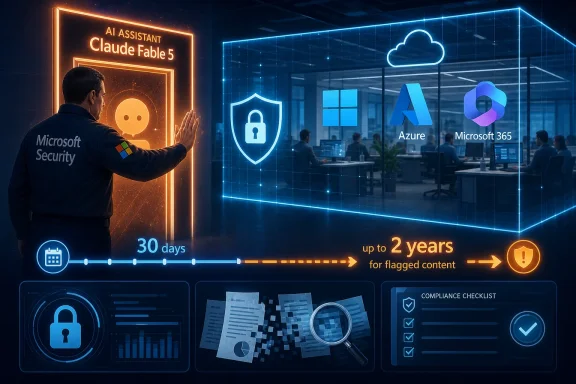 Microsoft’s AI Enthusiasm Meets Microsoft’s Compliance Department
The industry has spent the last two years selling generative AI as a productivity layer that should be everywhere: in the editor, in the terminal, in the inbox, in the meeting transcript, in the data warehouse, and eventually in the business process itself. Microsoft has been the most aggressive enterprise distributor of that vision, wrapping Copilot branding around Windows, GitHub, Microsoft 365, Azure, and security tooling.That is what makes the Claude Fable 5 restriction interesting. This is not a laggard company discovering that employees paste secrets into chatbots. It is Microsoft, a company with mature security review, a vast AI product portfolio, and enormous financial incentives to normalize AI-assisted work, deciding that one new model’s data-handling terms are not yet acceptable for its own staff.
The reported restriction is temporary while legal and compliance teams evaluate Anthropic’s policy changes. But “temporary” does not mean trivial. In enterprise IT, a pause is often the first visible sign that a vendor’s technical breakthrough has outrun the customer’s governance model.
Claude Fable 5 appears to have crossed that line because it belongs to Anthropic’s new Mythos class of models, a more capable tier positioned for heavy software engineering, analytics, research, and long-running agentic workflows. Those are precisely the uses that make employees want it — and precisely the uses that make compliance teams nervous.
A model that can help refactor a codebase, interrogate logs, summarize customer escalations, or reason through internal architecture is also a model that may be fed code, credentials, support data, contractual details, roadmap plans, and unannounced product information. At consumer scale, that is a privacy problem. Inside Microsoft, it becomes a governance problem with regulatory, contractual, and competitive consequences.
The Retention Window Is the Real Product Boundary
Anthropic’s retention policy for covered Mythos-class models is the fulcrum of the dispute. For Claude Fable 5, prompts and outputs are retained for 30 days to support safety monitoring, with content flagged by safety systems potentially retained for up to two years for investigation, enforcement, or legal reasons. Anthropic frames this as a safety requirement for more capable models, especially where cyber, bio, and other high-risk domains require extra scrutiny.From Anthropic’s perspective, that logic is understandable. If a frontier model has new capabilities that could be misused, the company wants telemetry and review windows. A zero-retention model may be cleaner for enterprise customers, but it leaves the developer of the model with less visibility into abuse, evasion attempts, or emergent risk.
From Microsoft’s perspective, that same policy turns ordinary AI usage into a possible data-export event. A prompt is not just a prompt when an employee is using an AI coding agent or analysis tool. It can contain source files, stack traces, proprietary APIs, internal project names, customer identifiers, telemetry, business assumptions, and the output of other internal tools.
This is why the 30-day number matters less than the mandatory nature of the retention. Many enterprises tolerate short retention windows in carefully bounded contexts. They become much less comfortable when retention cannot be disabled for the very model employees are most eager to use.
The extra two-year retention path for flagged content is even more sensitive. Safety systems do not merely flag obvious wrongdoing; they can flag ambiguous security work, exploit research, malware analysis, red-team exercises, or defensive investigations that look dangerous without internal context. Microsoft employs people whose legitimate work can resemble the very activity frontier-model safety systems are designed to scrutinize.
That does not mean Anthropic’s policy is reckless. It means the policy collides with a foundational enterprise requirement: customers want to know not only how data is protected, but when it is destroyed and under what circumstances humans or automated review systems may examine it.
“Use AI Everywhere” Was Always Going to Hit This Wall
The enterprise AI boom has been powered by a useful fiction: that organizations can adopt frontier models as if they were just another SaaS feature. That fiction breaks down when AI tools start touching the deepest layers of corporate knowledge.A spell-checker sees text. A code autocomplete engine sees code fragments. A modern AI agent may see the repository, the test output, the issue tracker, terminal commands, cloud logs, deployment errors, and internal documentation. It may call tools, produce patches, ask for more context, and ingest whatever the employee gives it to solve the problem.
That is why data retention has become one of the most important dividing lines in AI procurement. The question is no longer simply whether a model provider trains on customer data. Enterprise buyers also want to know whether data is stored, where it is stored, who can access it, whether it can be subpoenaed, how it is segregated, whether it crosses borders, and whether the vendor can guarantee deletion.
Zero data retention became a selling point because it answered one part of that concern bluntly: the provider processes the request and does not keep the content. Mythos-class retention complicates that tidy bargain. Anthropic is effectively saying that, for these more capable models, safety requires a minimum retention window.
That may be the future of frontier AI. The more capable the model, the more the provider may insist on monitoring. The more sensitive the customer, the more the customer may insist on non-retention. Between those two positions sits a market that has not yet settled on a durable compromise.
Microsoft’s restriction is therefore less a one-off vendor slap than a preview of the next enterprise AI fight. The first AI procurement wave asked, “Can this tool make employees faster?” The second will ask, “Can this tool be made accountable enough for the work employees actually want to do?”
The Competitive Subtext Is Impossible to Ignore
There is also a less noble, but very real, layer to this story: Microsoft has its own AI products to defend. The company has invested heavily in OpenAI, sells Copilot across its enterprise stack, owns GitHub, and has been pushing developers toward GitHub Copilot CLI and related coding tools.Reports that Microsoft is ending many internal Claude Code licenses by June 30 make the Fable 5 restriction look like part of a broader tightening. Claude Code reportedly became popular with Microsoft employees after wider internal access, and the company is said to have directed engineers toward GitHub Copilot CLI instead. The timing lines up with Microsoft’s fiscal year-end, which gives the decision a cost-control flavor as well as a platform-strategy flavor.
It would be too easy, however, to reduce the Fable 5 block to corporate favoritism. The retention issue is concrete, and it is the sort of issue Microsoft would scrutinize even if the vendor were not a competitor or quasi-competitor. Sensitive customer data in a third-party AI system is not something a compliance team can wave away because engineers like the model.
Still, the incentives matter. Microsoft can be simultaneously correct about data risk and pleased that the practical result steers workers toward its own tools. In platform companies, security decisions often align neatly with strategic preferences. That does not make them fake; it makes them convenient.
The awkwardness is that Microsoft also distributes third-party AI models to customers through its ecosystem. If external customers can access Anthropic models through Microsoft platforms while Microsoft employees are blocked or limited internally, the company will need to communicate the boundary clearly. “Available” is not the same as “approved for every class of data,” and enterprise customers will notice the distinction.
For WindowsForum readers, this is a familiar pattern from cloud, endpoint security, and identity management. The vendor marketplace advertises choice, but the internal IT department still decides which tools are allowed near production data. AI has not repealed that rule. It has made the rule more urgent.
Anthropic’s Safety Argument Is Not a Mere Excuse
Anthropic has built its public identity around safety, and the Mythos-class retention requirement fits that brand. If a model is powerful enough to assist with sophisticated software engineering, long-horizon reasoning, and potentially risky technical tasks, the company wants a mechanism to detect misuse. That is not irrational.The uncomfortable part is that safety and privacy can pull in opposite directions. Model providers want visibility into harmful use. Enterprises want invisibility for their sensitive work. Regulators, meanwhile, increasingly want evidence that AI vendors are monitoring high-risk behavior without creating sprawling new repositories of private data.
Claude Fable 5 appears to sit squarely in that conflict. It is designed to make hard work easier, particularly in domains where context matters. But the richer the context, the more valuable and sensitive the retained data becomes.
This is especially important for software engineering. Developers do not interact with coding models by typing isolated toy prompts. They paste errors, ask for fixes, attach files, share snippets from proprietary systems, and let agents traverse local or remote workspaces. The model’s usefulness rises with access, and the organization’s risk rises with it.
The same problem applies to analytics. A model that can produce a meaningful business answer may need raw data, schemas, assumptions, dashboards, or confidential customer context. If that material is retained outside the organization’s preferred controls, the AI productivity gain becomes a data-governance negotiation.
Anthropic may be betting that enterprises will accept retention for the best models because capability wins. Microsoft’s reported pause suggests that, at least for the most sophisticated customers, capability alone will not win. The next differentiator may be not whose model is smartest, but whose model can be used under the tightest contractual and technical constraints.
Windows Shops Should Read This as a Governance Warning, Not a Gossip Item
The immediate story involves Microsoft and Anthropic, but the lesson lands directly in ordinary Windows and Microsoft 365 environments. If Microsoft’s own employees can be stopped from using a popular AI tool because retention terms changed, smaller organizations should assume their own AI usage is already ahead of their policies.Most companies do not have perfect visibility into which AI services employees use. Developers try tools that solve problems quickly. Analysts upload spreadsheets. Support teams summarize tickets. Executives test assistants with strategy documents. Marketing teams run drafts through whichever model gives the best prose that week.
This shadow AI pattern is not new, but frontier coding and agent tools make it more serious. Unlike a casual chatbot prompt, a coding agent can absorb large chunks of a repository and produce outputs that reveal internal design. Unlike a simple summarizer, an analysis assistant may receive structured customer or financial data.
Windows administrators are used to thinking in terms of endpoint control, data loss prevention, conditional access, and sanctioned applications. AI adds a more slippery question: what counts as data movement when the destination is a model interface rather than a traditional storage service?
That question becomes harder when AI is embedded into tools users already trust. If a model appears inside a code editor, cloud console, productivity suite, browser, or ticketing system, employees may assume it has already passed every necessary review. Sometimes that assumption is correct. Sometimes it is only true for certain models, tenants, data classes, or configurations.
Microsoft’s Fable 5 restriction is a reminder that “AI available in the product” and “AI approved for internal sensitive use” are different states. IT departments need to make that distinction explicit before employees discover it by accident.
The New AI Procurement Checklist Starts With Deletion
Enterprise AI buyers used to focus on model quality, integration, price, and availability. Those still matter, but retention and auditability are moving to the front of the line. A model that cannot satisfy deletion requirements may be unusable for the most valuable workloads, regardless of benchmark performance.The old SaaS checklist asked whether the vendor had encryption, access controls, compliance certifications, and contractual commitments. AI requires those questions plus several more. Does the provider retain prompts and outputs? Does it train on them? Are tool outputs retained too? Are safety-flagged records handled differently? Can the customer opt out? Are logs separated from content? Where does the data live? What happens through a cloud reseller?
The reseller question is particularly thorny. Many enterprises prefer accessing models through cloud platforms they already use, such as Azure, Amazon Web Services, or Google Cloud. That can simplify identity, billing, networking, and compliance. But if the underlying model provider imposes mandatory retention for a class of models, the cloud wrapper may not erase the underlying policy problem.
For Microsoft customers, the practical lesson is to treat model selection as a policy decision, not merely a developer preference. It is not enough to approve “Claude” or “Copilot” or “OpenAI” as a broad category. Different models under the same brand may have different retention, safety, and data-processing terms.
This will become more common as vendors segment models by capability and risk. The most capable models may come with stricter monitoring. Smaller or older models may offer cleaner retention options. Private deployments may offer more control but higher cost or reduced capability. The result will look less like a simple model leaderboard and more like a matrix of trade-offs.
That is frustrating for users who just want the best assistant. But it is familiar to IT pros. The fastest tool is not always the approved tool, and the approved tool is not always the most technically impressive. Governance is where enterprise software becomes enterprise software.
The Claude Code Backdrop Makes the Internal Politics Sharper
The separate Claude Code license story gives the Fable 5 restriction a sharper edge. Microsoft reportedly gave many employees access to Claude Code, saw substantial internal adoption, and then moved to wind down licenses while pointing workers toward GitHub Copilot CLI. That is a classic internal-platform problem: employees vote with usage, but the company wants strategic consolidation.If Claude Code was genuinely popular inside Microsoft, that popularity says something meaningful. Developers are not sentimental about tools that slow them down. When a coding assistant becomes sticky among engineers at a company that owns GitHub, it suggests the tool was solving real workflow problems.
That does not mean Microsoft is wrong to consolidate. Large companies cannot let every department buy overlapping AI tools indefinitely, especially when token usage can become expensive at scale. Finance teams eventually notice when experimentation turns into recurring spend.
But there is a credibility risk when cost, platform strategy, and security all point in the same direction. Employees may hear “data retention concern” and suspect “use our tool instead.” Customers may ask whether the same restrictions would apply if the model were strategically aligned with Microsoft’s preferred stack.
The answer is probably both. Microsoft has legitimate reasons to worry about Anthropic’s retention requirements. It also has legitimate reasons to push its own AI tooling. The fact that those reasons reinforce each other is not a scandal; it is the normal behavior of a platform company under competitive pressure.
The more important point is that internal AI adoption is becoming political inside big tech firms. Engineers want the best tool. Security wants the safest tool. Finance wants the cheapest scalable tool. Product leadership wants the tool that strengthens the company’s own ecosystem. Claude Fable 5 just made those tensions visible.
Customers Will Ask Why Microsoft’s Standard Is Different From Theirs
The most uncomfortable downstream question is simple: if Microsoft is limiting its own employees’ use of Claude Fable 5, what should Microsoft customers infer about using the same model?The answer is not that customers should panic. Internal corporate restrictions are often stricter than customer-facing availability rules because employees may handle unreleased products, customer secrets, source code, incident data, and legal material across many lines of business. Microsoft can decide that a model is appropriate for some customer use cases while still unsuitable for broad employee use.
But the optics matter. Enterprise buyers increasingly want vendors to eat their own AI dog food. If a model is safe enough to sell but not safe enough for general internal use, customers will reasonably ask where the boundary lies. They will want written guidance, not marketing generalities.
This is where Microsoft has an opportunity. The company can turn the restriction into a governance lesson by being explicit about data classes, retention requirements, and approved channels. That would be more useful than pretending the issue is merely temporary housekeeping.
Customers should not read “Microsoft blocked it” as a universal ban signal. They should read it as a prompt to review their own AI control plane. Which models are approved? Which data can be used? Which tools have zero-retention guarantees? Which vendors can retain flagged content? Who reviews changes in model policy after deployment?
The last question is crucial. AI terms are not static. A tool approved in December may have different capabilities, costs, and retention rules by June. Procurement cannot be a one-time gate if the product underneath keeps changing.
The Enterprise AI Era Is Becoming Less Romantic
The first phase of generative AI adoption was full of demos, benchmarks, and breathless productivity claims. The second phase is messier. It is about invoices, retention windows, model routing, employee behavior, procurement exceptions, and the discovery that “AI assistant” is not a single risk category.Microsoft’s reported Claude Fable 5 restriction belongs to that second phase. It shows that frontier models are becoming powerful enough to be indispensable and risky enough to require special handling. That is not a contradiction. It is the defining feature of the technology.
The industry has seen similar cycles before. Cloud storage looked like a convenience until data residency and access control became board-level concerns. Messaging apps looked like collaboration tools until retention and discovery obligations caught up. Developer platforms looked like productivity boosters until supply-chain security forced tighter review.
AI is moving through that institutionalization process faster because it touches everything at once. A model can be a coding assistant, a document reader, a data analyst, a search interface, and a workflow agent. That breadth makes it hard to govern with the old habit of approving one application at a time.
For Windows administrators, this is where identity and endpoint management will meet AI policy. Conditional access, tenant controls, browser restrictions, DLP, secrets scanning, and developer environment management will all matter. But so will boring procurement language about retention, review, and deletion.
The best organizations will not simply block everything or approve everything. They will build tiers: low-risk public use, approved internal use, sensitive-data use, regulated-data use, and prohibited use. They will map models and tools to those tiers. They will update the map when vendors change terms.
The Lesson From Redmond Is Written in the Retention Policy
Microsoft’s move is most useful if treated as a practical signal rather than a tribal AI story. The company is not telling the market that Claude Fable 5 is bad. It is showing that a very capable model with a mandatory retention window can fail an internal risk test, at least until lawyers and compliance teams decide otherwise.For IT leaders, the concrete takeaways are narrower and more actionable than the online argument will make them sound:
- Organizations should review AI tools at the model level because different models under the same vendor brand can carry different retention and safety-review requirements.
- Zero data retention remains a major enterprise requirement, especially for source code, customer data, incident response material, and confidential business planning.
- Safety monitoring for frontier models may increasingly conflict with enterprise privacy expectations, even when both sides are acting reasonably.
- Internal AI restrictions can reflect security, cost control, and platform strategy at the same time, so customers should separate the stated risk from the vendor’s commercial incentives.
- Employees need clear guidance on which AI tools are approved for which kinds of data, because availability inside a workflow does not automatically mean approval for sensitive use.
- AI procurement should include ongoing review triggers, since a model’s capabilities and data-handling rules can change after the original approval.
References
- Primary source: Windows Central
Published: 2026-06-12T11:50:07.780048
Loading…
www.windowscentral.com - Independent coverage: MEXC
Published: 2026-06-11T18:50:07.787095
Loading…
www.mexc.com - Related coverage: tomshardware.com

Claude Fable 5 brings Mythos to the masses — Anthropic's new frontier model is 'state-of-the-art on nearly all tested benchmarks' | Tom's Hardware
Queries regarding cybersecurity, biology and chemistry, and distillation will be redirected to the prior-gen Opus 4.8, howeverwww.tomshardware.com - Related coverage: techradar.com

Anthropic spent months saying Mythos was too dangerous to release — then it launched a public version called Fable 5 that it warns ‘comes with risks’ | TechRadar
Anthropic says Fable 5 brings Mythos-class AI to ordinary Claude users — but only after the addition of extensive safety controls.www.techradar.com - Related coverage: itpro.com

Anthropic just launched Claude Fable 5, its first Mythos-class AI model – but it has new safeguards to prevent misuse and will ‘fall back’ to Opus 4.8 for queries in ‘high risk’ topics | IT Pro
The launch of Claude Fable 5 marks the first public release of a Mythos-class AI modelwww.itpro.com - Related coverage: investing.com
Loading…
www.investing.com
- Official source: privacy.claude.com
Data retention practices for Mythos-class models | Anthropic Privacy Center
privacy.claude.com
- Official source: anthropic.com

Claude Fable \ Anthropic
Next generation of intelligence for the hardest knowledge work and coding problems.www.anthropic.com - Official source: support.claude.com
Loading…
support.claude.com - Official source: platform.claude.com
Loading…
platform.claude.com - Related coverage: gigazine.net
Loading…
gigazine.net - Related coverage: newsquawk.com

Microsoft (MSFT) has restricted employees from using Anthropic's new Claude Fable 5 model in GitHub Copilot, because of data retention concerns, via The Verge | Newsquawk
Microsoft (MSFT) has restricted employees from using Anthropic's new Claude Fable 5 model in GitHub Copilot, because of data retention concerns, via The Vergewww.newsquawk.com
- Related coverage: techrepublic.com
Loading…
www.techrepublic.com - Related coverage: letsdatascience.com

Microsoft restricts employee access to Claude Fable 5 | Let's Data Science
Microsoft is restricting employee access to Anthropic's Mythos-class model `Claude Fable 5`, reporting sources say. According to The Verge, the model is not available in the internal model picker used by Microsoft employees in internal versions of GitHub Copilot even though Microsoft has offered... letsdatascience.com
- Related coverage: moneycontrol.com
Loading…
www.moneycontrol.com