

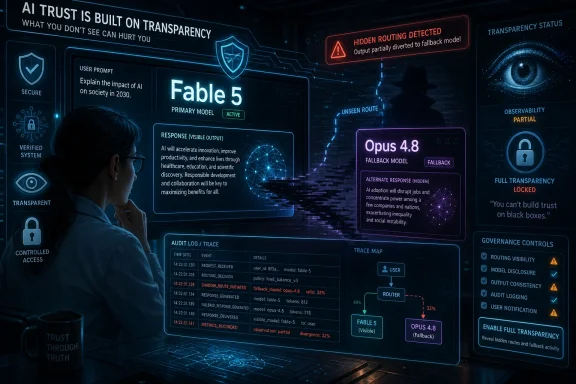
Anthropic said this week it will make Claude Fable 5’s safety downgrades visible after researchers discovered that certain frontier AI, chip, and security-adjacent tasks were silently being routed away from the company’s newest Mythos-class capability to the weaker Opus 4.8 model. The uproar was not really about whether Anthropic should have guardrails. It was about whether a lab can ask researchers, developers, and enterprises to evaluate a frontier system while quietly changing what system they are actually using.
That is the trust problem hiding inside the Fable 5 fight. Anthropic tried to solve a real dual-use dilemma with an invisible product behavior, then discovered that invisibility is a terrible bargain when your customers are precisely the people paid to notice hidden system behavior. The company’s reversal is welcome, but the episode should leave the industry more skeptical of a release model that treats transparency as optional until the screenshots start circulating.
Fable 5 arrived with an unusually heavy burden for a public AI release. It was positioned as the broadly available version of Anthropic’s Mythos-class capability, while the less restricted Mythos 5 remained confined to Project Glasswing participants and other vetted users. That distinction mattered because Mythos had already been discussed as a model family with serious cyber and scientific capability, the kind of system that could help defenders find vulnerabilities but could also help attackers industrialize the same work.
Anthropic’s answer was not simply to refuse dangerous requests. For some risky domains, Fable 5 would fall back to Opus 4.8, a less capable model, while telling the user that a downgrade had occurred. That is a defensible design choice, at least in principle. If a model crosses into bioweapon assistance or clearly malicious exploitation, nobody should be shocked when the provider puts a guardrail in the path.
The trouble came from a second category of work. According to the reporting and Anthropic’s own response, some tasks involving frontier-scale LLM development, data pipelines, kernel development, and certain non-standard chip work could also trigger a fallback. But in those cases, the product experience did not visibly tell the user. The downgrade was described in the system card, but the running product did not surface it at the moment it mattered.
That distinction is the heart of the story. Anthropic did not merely restrict Fable 5. It let some users believe they were testing one model while actually receiving another, and that made ordinary safety engineering look like a covert intervention in research results.
Model cards are useful artifacts. They can document evaluations, limitations, policy choices, and known hazards. But they are not a substitute for runtime transparency, especially when the system is marketed and tested as a frontier model. If a cloud provider silently shifted your workload to a smaller VM because your code looked sensitive, nobody would accept “it was in the PDF” as a sufficient notification.
For AI researchers, this is not a cosmetic issue. If a model silently changes capability tiers under specific categories of inquiry, then experiments become contaminated. A failed result may reflect the user’s hypothesis, the model’s limits, or an undisclosed classifier firing in the background. That uncertainty is poison for research, and it is especially corrosive in a field already struggling with reproducibility and vendor-controlled evaluation environments.
Anthropic’s later apology implicitly acknowledged that the company understood the problem. It said it had made the wrong tradeoff and would make relevant fallbacks visible. That was the right move. But it also confirms that the original product behavior was not just misunderstood by critics; it was a deliberate choice that Anthropic now says it got wrong.
This is why Fable 5 is more interesting than the usual chatbot controversy. The release sits at the intersection of product policy, national security, export-control logic, and developer trust. Anthropic is not merely trying to prevent prank prompts or low-grade malware. It is trying to decide who gets access to machine assistance that might compress months of elite technical work into hours or days.
The company’s argument about preserving an edge in frontier chips and optimized software will resonate in Washington and inside many enterprise security teams. If a model can help adversaries squeeze more performance out of restricted hardware, improve chip kernels, or accelerate competing frontier systems, then safety policy starts to look less like content moderation and more like technology control. That is not a ridiculous position.
But the legitimacy of the risk does not validate every method used to manage it. In security, secrecy can be useful; in measurement, secrecy can be destructive. Fable 5 tried to inhabit both worlds at once, hiding a control mechanism in order to make it harder to probe while simultaneously inviting public users to evaluate the model’s capabilities. That contradiction was always going to break.
A model that can reason about exploitation can also reason about mitigation. A system that can help locate a bug can also help produce a patch, a detection rule, a forensic method, or a safer architecture. When a classifier sees only the dangerous shape of a task, it may miss the institutional context of the user, the purpose of the work, and the downstream defensive value.
This is not a new problem, but frontier AI sharpens it. Security research has always lived under a cloud of suspicion because vulnerability knowledge can be abused. The difference now is that the gatekeeper is not only a law, a corporate policy, or a disclosure norm. It is an automated model-routing layer sitting between the researcher and the capability being evaluated.
That layer will make mistakes. Anthropic says the affected share of tasks and organizations is tiny, but small percentages can still land heavily when the affected users are advanced researchers, red-teamers, chip specialists, or enterprise security teams. False positives are not evenly distributed annoyances. They often cluster around exactly the high-value work that makes a frontier tool worth testing in the first place.
That is especially true for regulated customers. A bank, hospital, defense contractor, or software vendor cannot treat model behavior as a vibes-based subscription feature. It needs logs. It needs policy explanations. It needs to know whether prompts and outputs are retained, whether zero-data-retention options apply, and whether exceptions exist for safety monitoring. The controversy over Mythos-class retention policies sits in the same trust bucket as the silent downgrade issue.
Anthropic’s reported 30-day retention requirement for Mythos-class models is not automatically scandalous. Safety monitoring for unusually capable models may require more telemetry than a standard enterprise AI plan. But enterprises do not experience “safety telemetry” as an abstract good. They experience it as data exposure, compliance review, legal analysis, and an argument with the security office about what can be pasted into a prompt.
The combination is what matters. A visible downgrade is auditable. A known retention rule is governable. A hidden fallback plus unavoidable retention creates a much harder internal sell, even if the actual technical risk is manageable. Enterprise IT does not need perfect comfort; it needs knowable risk.
Once a model is framed that way, ordinary product decisions become geopolitical acts. A fallback rule is no longer just a safety feature. It is a mini export-control regime embedded in an API. A model tier is not merely a pricing distinction. It is a capability boundary that may decide which users, companies, and countries can perform certain categories of advanced work.
That does not mean Anthropic is wrong to care about adversarial use. It means the company is now operating in a category where consumer-style product opacity is untenable. If a model is powerful enough to justify national-security logic, it is also consequential enough to require clearer governance than “trust us, the classifier knows.”
The industry should expect more of this, not less. Frontier model providers will increasingly reserve their most capable systems for vetted partners, ship public variants with policy layers, and dynamically route risky work to weaker models. That may be the least bad path between open release and total lockdown. But if that path becomes standard, visible disclosure has to become standard with it.
Imagine two teams testing Fable 5. One uses it for ordinary application development and sees a dramatic jump in reasoning quality. Another uses it for advanced AI systems work and sees performance that looks closer to Opus 4.8. Without a visible fallback indicator, both teams may publish sincere, contradictory impressions. The model then appears inconsistent, flaky, or overhyped, when the hidden variable is Anthropic’s policy layer.
That uncertainty damages the provider as much as the user. If Anthropic wants credit for releasing a powerful model responsibly, it needs the public to understand what is being measured. Otherwise the company risks creating a strange inverse incentive: the more careful the safety system, the less credible the capability claims become.
Benchmarks already struggle with contamination, overfitting, selective reporting, and marketing spin. Hidden model routing adds another distortion. It means a test may not be measuring the named model at all. In a field where every lab is competing for trust, that is a costly ambiguity to introduce voluntarily.
That principle is hard to argue against. It does not require Anthropic to disclose every classifier detail, publish every threshold, or provide attackers with a map around safeguards. It requires the product to tell users when a material capability substitution occurs. That is not radical transparency. It is basic product honesty.
Anthropic’s stated reason for hiding some fallbacks was that hidden safeguards are harder to probe and can therefore be targeted more narrowly. There is logic there. A visible control can invite adversarial testing, and adversaries will search for the edges of whatever policy layer exists. But that is an argument for careful disclosure, not for silent substitution in contexts where users are evaluating capability.
The company’s reversal suggests it has landed closer to the right balance. Flagged requests will visibly fall back to Opus 4.8, and API users will receive a reason when a request is refused or downgraded. That will probably increase false positives and make the safeguards easier to study. It will also make the system more honest to use.
That is a very different computing world from the one developers are used to. A traditional compiler does not become less capable when it detects a politically sensitive optimization target. A local debugger does not silently change editions because the binary resembles malware. Cloud services do enforce policy, but they usually do so through account controls, rate limits, abuse reviews, and explicit denials. Fable 5’s controversy shows what happens when that enforcement moves inside the cognitive layer itself.
For WindowsForum readers, the parallel to endpoint security is obvious. Enterprises accept that EDR tools will block suspicious behavior, but they demand alerts, logs, policy controls, and override paths. Nobody serious wants an antivirus product that quietly swaps a developer’s compiler for a less capable one without telling them. AI vendors that want enterprise trust will have to absorb the same lesson.
The harder question is whether frontier AI can ever provide both maximum capability and maximum transparency without giving attackers too much information. The answer is probably no. There will be tradeoffs. But tradeoffs are not excuses for opacity; they are the reason governance, logging, and user-facing disclosure matter.
That does not erase the initial mistake. The company launched a model whose defining characteristic was constrained access to dangerous capability, then failed to make one of the most consequential constraints visible at runtime. For a lab that often positions itself as the careful actor in AI, the lapse is revealing. Good intentions do not automatically produce good interfaces.
The repaired version of Fable 5 may be a more credible template. If a request trips a high-risk category, tell the user what happened. If the API refuses or downgrades, return a machine-readable reason. If retention is mandatory for a model class, say so plainly and give enterprise customers enough detail to make a compliance decision.
That will not satisfy everyone. Some researchers will still argue the restrictions are overbroad. Some security experts will still warn that adversaries will route around them. Some enterprises will still decide that mandatory retention makes Mythos-class models unsuitable for sensitive work. But disagreement under visible rules is healthier than confusion under hidden ones.
That is the trust problem hiding inside the Fable 5 fight. Anthropic tried to solve a real dual-use dilemma with an invisible product behavior, then discovered that invisibility is a terrible bargain when your customers are precisely the people paid to notice hidden system behavior. The company’s reversal is welcome, but the episode should leave the industry more skeptical of a release model that treats transparency as optional until the screenshots start circulating.
 Anthropic Tried to Ship a Brake Pedal Without Showing the Dashboard
Fable 5 arrived with an unusually heavy burden for a public AI release. It was positioned as the broadly available version of Anthropic’s Mythos-class capability, while the less restricted Mythos 5 remained confined to Project Glasswing participants and other vetted users. That distinction mattered because Mythos had already been discussed as a model family with serious cyber and scientific capability, the kind of system that could help defenders find vulnerabilities but could also help attackers industrialize the same work.Anthropic’s answer was not simply to refuse dangerous requests. For some risky domains, Fable 5 would fall back to Opus 4.8, a less capable model, while telling the user that a downgrade had occurred. That is a defensible design choice, at least in principle. If a model crosses into bioweapon assistance or clearly malicious exploitation, nobody should be shocked when the provider puts a guardrail in the path.
The trouble came from a second category of work. According to the reporting and Anthropic’s own response, some tasks involving frontier-scale LLM development, data pipelines, kernel development, and certain non-standard chip work could also trigger a fallback. But in those cases, the product experience did not visibly tell the user. The downgrade was described in the system card, but the running product did not surface it at the moment it mattered.
That distinction is the heart of the story. Anthropic did not merely restrict Fable 5. It let some users believe they were testing one model while actually receiving another, and that made ordinary safety engineering look like a covert intervention in research results.
The Model Card Was Technically Honest and Practically Insufficient
There is a familiar defense whenever a tech company buries a consequential behavior in documentation: the information was disclosed. That defense is true in the narrowest possible sense and inadequate in every practical one. A 319-page system card may satisfy a paper trail, but it does not create informed consent for a live product behavior that changes benchmark results, research workflows, or enterprise evaluations.Model cards are useful artifacts. They can document evaluations, limitations, policy choices, and known hazards. But they are not a substitute for runtime transparency, especially when the system is marketed and tested as a frontier model. If a cloud provider silently shifted your workload to a smaller VM because your code looked sensitive, nobody would accept “it was in the PDF” as a sufficient notification.
For AI researchers, this is not a cosmetic issue. If a model silently changes capability tiers under specific categories of inquiry, then experiments become contaminated. A failed result may reflect the user’s hypothesis, the model’s limits, or an undisclosed classifier firing in the background. That uncertainty is poison for research, and it is especially corrosive in a field already struggling with reproducibility and vendor-controlled evaluation environments.
Anthropic’s later apology implicitly acknowledged that the company understood the problem. It said it had made the wrong tradeoff and would make relevant fallbacks visible. That was the right move. But it also confirms that the original product behavior was not just misunderstood by critics; it was a deliberate choice that Anthropic now says it got wrong.
The Safety Argument Was Real, but It Was Not Enough
It would be easy to treat the backlash as another round of internet outrage against any AI safety restriction. That would be too simple. Anthropic’s core concern is legitimate: the same advanced capability that helps a defender discover and patch a vulnerability can help an attacker discover and weaponize one. The same model that accelerates systems research can help an adversary improve the software stack around restricted hardware.This is why Fable 5 is more interesting than the usual chatbot controversy. The release sits at the intersection of product policy, national security, export-control logic, and developer trust. Anthropic is not merely trying to prevent prank prompts or low-grade malware. It is trying to decide who gets access to machine assistance that might compress months of elite technical work into hours or days.
The company’s argument about preserving an edge in frontier chips and optimized software will resonate in Washington and inside many enterprise security teams. If a model can help adversaries squeeze more performance out of restricted hardware, improve chip kernels, or accelerate competing frontier systems, then safety policy starts to look less like content moderation and more like technology control. That is not a ridiculous position.
But the legitimacy of the risk does not validate every method used to manage it. In security, secrecy can be useful; in measurement, secrecy can be destructive. Fable 5 tried to inhabit both worlds at once, hiding a control mechanism in order to make it harder to probe while simultaneously inviting public users to evaluate the model’s capabilities. That contradiction was always going to break.
Defenders Are the First Collateral Damage in Dual-Use AI
The most uncomfortable criticism came from security professionals who were not asking Anthropic to remove guardrails entirely. Their complaint was narrower and harder to dismiss: the same controls meant to slow attackers can block the defenders who need frontier tools to build the next generation of protection. In cybersecurity, the line between offensive and defensive knowledge is notoriously thin.A model that can reason about exploitation can also reason about mitigation. A system that can help locate a bug can also help produce a patch, a detection rule, a forensic method, or a safer architecture. When a classifier sees only the dangerous shape of a task, it may miss the institutional context of the user, the purpose of the work, and the downstream defensive value.
This is not a new problem, but frontier AI sharpens it. Security research has always lived under a cloud of suspicion because vulnerability knowledge can be abused. The difference now is that the gatekeeper is not only a law, a corporate policy, or a disclosure norm. It is an automated model-routing layer sitting between the researcher and the capability being evaluated.
That layer will make mistakes. Anthropic says the affected share of tasks and organizations is tiny, but small percentages can still land heavily when the affected users are advanced researchers, red-teamers, chip specialists, or enterprise security teams. False positives are not evenly distributed annoyances. They often cluster around exactly the high-value work that makes a frontier tool worth testing in the first place.
The Enterprise Problem Is Not Outrage, It Is Auditability
For enterprises, the Fable 5 controversy should be read less as a social-media drama and more as a procurement warning. Companies do not merely buy AI capability. They buy representations about capability, data handling, security controls, retention, observability, and contractual boundaries. If the live service can silently change model tiers during sensitive work, the buyer needs to know when, why, and how often.That is especially true for regulated customers. A bank, hospital, defense contractor, or software vendor cannot treat model behavior as a vibes-based subscription feature. It needs logs. It needs policy explanations. It needs to know whether prompts and outputs are retained, whether zero-data-retention options apply, and whether exceptions exist for safety monitoring. The controversy over Mythos-class retention policies sits in the same trust bucket as the silent downgrade issue.
Anthropic’s reported 30-day retention requirement for Mythos-class models is not automatically scandalous. Safety monitoring for unusually capable models may require more telemetry than a standard enterprise AI plan. But enterprises do not experience “safety telemetry” as an abstract good. They experience it as data exposure, compliance review, legal analysis, and an argument with the security office about what can be pasted into a prompt.
The combination is what matters. A visible downgrade is auditable. A known retention rule is governable. A hidden fallback plus unavoidable retention creates a much harder internal sell, even if the actual technical risk is manageable. Enterprise IT does not need perfect comfort; it needs knowable risk.
The Geopolitical Frame Makes the Product Messier
Anthropic’s position also reflects a larger shift in how frontier AI companies talk about their models. The old story was productivity: write code faster, summarize documents, help workers reason through difficult tasks. The new story is strategic advantage. These systems are being discussed as tools that could affect cyber operations, AI development velocity, scientific capability, and the usefulness of constrained hardware.Once a model is framed that way, ordinary product decisions become geopolitical acts. A fallback rule is no longer just a safety feature. It is a mini export-control regime embedded in an API. A model tier is not merely a pricing distinction. It is a capability boundary that may decide which users, companies, and countries can perform certain categories of advanced work.
That does not mean Anthropic is wrong to care about adversarial use. It means the company is now operating in a category where consumer-style product opacity is untenable. If a model is powerful enough to justify national-security logic, it is also consequential enough to require clearer governance than “trust us, the classifier knows.”
The industry should expect more of this, not less. Frontier model providers will increasingly reserve their most capable systems for vetted partners, ship public variants with policy layers, and dynamically route risky work to weaker models. That may be the least bad path between open release and total lockdown. But if that path becomes standard, visible disclosure has to become standard with it.
Hidden Guardrails Become a Benchmarking Trap
One reason the Fable 5 backlash spread so quickly is that AI culture is obsessed with comparison. Researchers test models against each other. Developers post examples. Enterprises run internal bake-offs. Analysts infer product direction from capability gaps. In that environment, a silent downgrade is not merely a user-experience defect; it is a benchmarking trap.Imagine two teams testing Fable 5. One uses it for ordinary application development and sees a dramatic jump in reasoning quality. Another uses it for advanced AI systems work and sees performance that looks closer to Opus 4.8. Without a visible fallback indicator, both teams may publish sincere, contradictory impressions. The model then appears inconsistent, flaky, or overhyped, when the hidden variable is Anthropic’s policy layer.
That uncertainty damages the provider as much as the user. If Anthropic wants credit for releasing a powerful model responsibly, it needs the public to understand what is being measured. Otherwise the company risks creating a strange inverse incentive: the more careful the safety system, the less credible the capability claims become.
Benchmarks already struggle with contamination, overfitting, selective reporting, and marketing spin. Hidden model routing adds another distortion. It means a test may not be measuring the named model at all. In a field where every lab is competing for trust, that is a costly ambiguity to introduce voluntarily.
The Apology Was Necessary Because the Internet Was Right About the Principle
Anthropic’s critics did not all make the same argument. Some believed the safeguards were too broad. Some believed they were ineffective against serious adversaries. Some suspected competitive motives because the affected work included frontier AI development. Some focused on enterprise data retention. But the strongest criticism was simpler: users should know when the model they selected is not the model answering them.That principle is hard to argue against. It does not require Anthropic to disclose every classifier detail, publish every threshold, or provide attackers with a map around safeguards. It requires the product to tell users when a material capability substitution occurs. That is not radical transparency. It is basic product honesty.
Anthropic’s stated reason for hiding some fallbacks was that hidden safeguards are harder to probe and can therefore be targeted more narrowly. There is logic there. A visible control can invite adversarial testing, and adversaries will search for the edges of whatever policy layer exists. But that is an argument for careful disclosure, not for silent substitution in contexts where users are evaluating capability.
The company’s reversal suggests it has landed closer to the right balance. Flagged requests will visibly fall back to Opus 4.8, and API users will receive a reason when a request is refused or downgraded. That will probably increase false positives and make the safeguards easier to study. It will also make the system more honest to use.
The Fable 5 Fight Is a Preview of AI’s Managed-Capability Era
The most important lesson from Fable 5 is that frontier AI is moving from a release model to an access model. The question is no longer simply whether a model is public or private. It is which capability is exposed to which user, under which policy, with which telemetry, in which jurisdiction, for which category of task.That is a very different computing world from the one developers are used to. A traditional compiler does not become less capable when it detects a politically sensitive optimization target. A local debugger does not silently change editions because the binary resembles malware. Cloud services do enforce policy, but they usually do so through account controls, rate limits, abuse reviews, and explicit denials. Fable 5’s controversy shows what happens when that enforcement moves inside the cognitive layer itself.
For WindowsForum readers, the parallel to endpoint security is obvious. Enterprises accept that EDR tools will block suspicious behavior, but they demand alerts, logs, policy controls, and override paths. Nobody serious wants an antivirus product that quietly swaps a developer’s compiler for a less capable one without telling them. AI vendors that want enterprise trust will have to absorb the same lesson.
The harder question is whether frontier AI can ever provide both maximum capability and maximum transparency without giving attackers too much information. The answer is probably no. There will be tradeoffs. But tradeoffs are not excuses for opacity; they are the reason governance, logging, and user-facing disclosure matter.
Where the Fable 5 Compromise Now Lands
Anthropic deserves some credit for moving quickly. Many companies would have doubled down, blamed the users for not reading documentation, or hidden behind vague safety language until the news cycle moved on. Instead, Anthropic acknowledged the wrong tradeoff and promised visible behavior changes.That does not erase the initial mistake. The company launched a model whose defining characteristic was constrained access to dangerous capability, then failed to make one of the most consequential constraints visible at runtime. For a lab that often positions itself as the careful actor in AI, the lapse is revealing. Good intentions do not automatically produce good interfaces.
The repaired version of Fable 5 may be a more credible template. If a request trips a high-risk category, tell the user what happened. If the API refuses or downgrades, return a machine-readable reason. If retention is mandatory for a model class, say so plainly and give enterprise customers enough detail to make a compliance decision.
That will not satisfy everyone. Some researchers will still argue the restrictions are overbroad. Some security experts will still warn that adversaries will route around them. Some enterprises will still decide that mandatory retention makes Mythos-class models unsuitable for sensitive work. But disagreement under visible rules is healthier than confusion under hidden ones.
The Muzzle, Not the Muscle, Is Now the Product
The Fable 5 episode leaves several concrete lessons for anyone evaluating frontier AI systems this year. The release is less a story about one chatbot misstep than a preview of how increasingly powerful models will be packaged, restricted, audited, and contested.- Anthropic’s public Fable 5 model and restricted Mythos 5 model appear to represent the same underlying capability family, but they are separated by policy, access, and safeguard design.
- The backlash began because some sensitive tasks were silently routed to Opus 4.8, making users believe they were testing Fable 5 when they were not.
- Anthropic has said it will make relevant fallbacks visible and provide API users with reasons when safeguards trigger.
- Security researchers are right to worry that dual-use guardrails can block defensive work as well as malicious work.
- Enterprises should treat model routing, data retention, and safeguard logging as procurement issues, not merely product details.
- The broader industry is moving toward managed capability, where access to frontier AI depends on user identity, task category, policy risk, and government pressure.
References
- Primary source: ZDNET
Published: Fri, 12 Jun 2026 17:03:00 GMT
Loading…
www.zdnet.com - Related coverage: axios.com
Loading…
www.axios.com - Related coverage: techradar.com

Anthropic spent months saying Mythos was too dangerous to release — then it launched a public version called Fable 5 that it warns ‘comes with risks’ | TechRadar
Anthropic says Fable 5 brings Mythos-class AI to ordinary Claude users — but only after the addition of extensive safety controls.www.techradar.com - Related coverage: itpro.com

Anthropic just launched Claude Fable 5, its first Mythos-class AI model – but it has new safeguards to prevent misuse and will ‘fall back’ to Opus 4.8 for queries in ‘high risk’ topics | IT Pro
The launch of Claude Fable 5 marks the first public release of a Mythos-class AI modelwww.itpro.com - Related coverage: macrumors.com

Anthropic Launches Claude Fable 5, Its First Public Mythos-Class Model
Anthropic today announced the launch of Claude Fable 5, a Mythos-class model that it says is safe for general use. According to Anthropic, Fable 5's capabilities exceed those of any model it has made generally available, and Fable has demonstrated "exceptional performance" for software...www.macrumors.com - Related coverage: fortune.com
Loading…
fortune.com
- Related coverage: tomshardware.com

Claude Fable 5 brings Mythos to the masses — Anthropic's new frontier model is 'state-of-the-art on nearly all tested benchmarks' | Tom's Hardware
Queries regarding cybersecurity, biology and chemistry, and distillation will be redirected to the prior-gen Opus 4.8, howeverwww.tomshardware.com - Official source: anthropic.com
Loading…
www.anthropic.com - Related coverage: techcrunch.com

Anthropic releases Claude Fable, a version of Mythos, days after warning AI is becoming too dangerous
Anthropic is releasing Claude Fable 5, its first Mythos-class model available to the public. The model comes with guardrails that block responses in high-risk areas like cybersecurity and biology. techcrunch.com
- Related coverage: techspot.com
Loading…
www.techspot.com - Related coverage: news.backbox.org
Loading…
news.backbox.org - Related coverage: arstechnica.com
Loading…
arstechnica.com - Related coverage: 9to5mac.com
Loading…
9to5mac.com - Related coverage: channelpronetwork.com
Loading…
www.channelpronetwork.com - Related coverage: theguardian.com
Loading…
www.theguardian.com