

Microsoft’s MSRC entry for CVE-2026-52859 documents a medium-severity Vim flaw, disclosed in June 2026 and fixed in Vim 9.2.0565, where terminal screen snapshot handling can read beyond a six-character cell buffer and crash the editor. That sounds narrow, almost quaint, until you remember where Vim lives: inside developer workstations, build boxes, Linux servers, WSL environments, rescue shells, and the muscle memory of administrators who still type
CVE-2026-52859 sits in Vim’s
That is the sort of bug C programmers recognize immediately: a boundary condition hiding behind a convention. The code assumes an array is terminated; the library can return a fully occupied array; the caller keeps walking. In the reported failure mode, Vim reads beyond the fixed six-element array and appends values into a buffer sized for only six characters, with the reliably reproduced impact being a crash.
This is not a remote code execution advisory, and administrators should not treat it as one unless new exploit work changes the picture. The public description points to denial of service: a program whose output is rendered inside a Vim terminal window can trigger the crash with a short byte sequence, without needing Vim script. That is still meaningful, because the boundary between “program output” and “trusted editor state” is exactly where terminal integrations keep getting into trouble.
The fix is equally prosaic. Vim 9.2.0565 bounds the loop with
Vim Is No Longer Merely the Thing That Opens
The cultural mistake is to imagine Vim as the old-school editor that opens a config file, edits three lines, and exits with
The terminal emulator is a particularly interesting door because it reverses the old trust relationship. Traditionally, the editor displayed a file chosen by the user. With
CVE-2026-52859 shows how small that interface can be. The trigger is not a malicious plugin or a poisoned
That matters for Windows users more than it might appear. Vim is not a Microsoft product in the usual sense, but it appears in Windows-adjacent environments everywhere: Git for Windows shells, MSYS2 and Cygwin installations, WSL distributions, remote Linux hosts managed from Windows terminals, developer containers, and cross-platform toolchains. Microsoft listing the CVE in MSRC’s Update Guide reflects that Windows security is no longer bounded by Windows binaries alone.
That disclaimer is easy to ignore, but it quietly describes the nature of the relationship. Microsoft can surface, track, and contextualize a vulnerability without necessarily being the upstream maintainer or the sole distributor of the affected code. In a world where Windows developers run Linux userlands, package managers, language runtimes, and open-source command-line stacks, the boundary between Microsoft’s ecosystem and everyone else’s code is porous by design.
For enterprise IT, this creates a practical wrinkle. A vulnerability scanner may flag CVE-2026-52859 on a Windows endpoint not because Windows itself is vulnerable, but because an installed development environment, package bundle, Linux distribution under WSL, or third-party toolchain includes a vulnerable Vim build. The right remediation path depends on which copy of Vim is present.
That is where overbroad patch thinking can waste time. Installing the latest Windows cumulative update may do nothing for a vulnerable Vim package inside Ubuntu on WSL. Updating a WSL distribution may do nothing for a separate Vim binary shipped with Git, MSYS2, or a developer’s portable tools directory. The relevant question is not “Did we patch Windows?” but “Which Vim executable is actually in use, and who owns its update channel?”
CVE-2026-52859 lives in that complexity. A terminal cell can contain a base character plus combining marks, and the code needs to represent that compactly. The bundled libvterm permits up to six characters per cell. If fewer than six are used, a terminator can appear. If all six are used, the array is full and the caller must know the bound.
That is an old programming lesson with a modern Unicode accent. Strings and arrays are not the same thing, and the “end” of a visual character is not always the end of a storage buffer. Unicode combining behavior makes it possible for one displayed cell to contain multiple code points, and software written around simpler character assumptions can stumble when the edge case becomes perfectly valid input.
The security consequence is not that Unicode is dangerous. The consequence is that display paths process attacker-controlled data more often than people assume. Build logs, test output, compiler diagnostics, terminal UIs, remote prompts, package scripts, and command-line tools all emit byte streams that editors and terminals dutifully interpret.
But the impact depends on context. If Vim is being used interactively to inspect logs, edit production configuration, review generated output, or manage a remote session, a reliable crash can interrupt work at exactly the wrong moment. If a developer routinely opens
The risk grows in automated or semi-automated workflows where terminal output is reviewed inside long-lived editor sessions. Some developers treat Vim as an IDE-like hub, with terminal panes, plugin managers, language servers, and shell commands all living inside one process. Crashing that process may mean losing unsaved buffers, killing associated jobs, or disrupting a debugging session.
That still does not make CVE-2026-52859 a panic event. It makes it a hygiene event. The right response is to update Vim, check where Vim is installed, and avoid treating terminal output as magically safe because it is “just text.”
That distinction is central to C security. Sentinel-terminated data structures work only when every producer and consumer agrees on the contract. Fixed-size arrays work only when every reader respects the fixed size. When software mixes those models, the edge case tends to arrive eventually.
Here, the edge case is not malformed data in the ordinary sense. A cell using all six character slots is legitimate. The failure is that the caller treats legitimate fullness as impossible or at least as if it would still carry a terminator. This is why vulnerability write-ups often sound absurdly specific: the trigger lives at the intersection of two individually reasonable design choices.
For sysadmins, that specificity can be reassuring and misleading. Reassuring, because the exploit path is constrained. Misleading, because constrained bugs in ubiquitous tools still accumulate into real operational exposure. Nobody deploys Vim as a network-facing service, but plenty of people run untrusted output through it without thinking about the editor as an attack surface.
The most obvious place to look is WSL. If a Linux distribution under WSL ships Vim older than 9.2.0565, it may be affected until the distribution package is updated or the user installs a newer build. That remediation follows the distribution’s package workflow, not the Windows Update workflow.
The second place is developer tooling. Git distributions, Unix-like shell environments, package managers, and portable editor bundles can carry their own Vim builds. These copies may not appear in the same inventory system that tracks Microsoft Store apps, MSI-installed software, or winget-managed packages.
The third place is remote administration. A Windows admin may use Windows Terminal, SSH, and Vim on remote Linux servers all day without a local vulnerable Vim binary mattering at all. In that case, the affected asset is the remote server’s package, and the relevant owner may be a Linux operations team rather than the endpoint team.
This is the modern asset-management tax. The user sees one command,
The useful triage starts with version and path. A finding against Vim 9.2.0564 or earlier is materially different from a finding against 9.2.0565 or later. A vulnerable binary in an unused portable directory is different from the default editor on a shared build server. A vulnerable WSL package on a developer laptop is different from a production jump host where administrators routinely run terminal sessions inside Vim.
The next triage question is feature exposure. CVE-2026-52859 requires output rendered inside Vim’s
Finally, teams should distinguish upstream fixes from downstream availability. Vim 9.2.0565 is the upstream fixed version, but Linux distributions may backport fixes while keeping older-looking version numbers. A package version string alone can be misleading if the distributor has patched the vulnerability without rebasing to the upstream release. That is a familiar Linux packaging headache, but it becomes more confusing when the affected system is tucked inside a Windows developer workstation.
That shift is productive. It is also security-relevant. Plugins run code. Language servers parse project files. Terminals render hostile output. Completion engines may inspect or execute language constructs. File explorers traverse workspaces that came from strangers. The line between opening a project and executing part of it keeps getting thinner.
CVE-2026-52859 is a small member of that family. It does not require opening a malicious source file or installing a malicious extension. It turns a display representation into a crash condition. But the principle is the same: the development environment is part of the attack surface.
Windows security has already adapted to some of this reality. Microsoft Defender watches developer tools more closely than it once did. SmartScreen, reputation systems, and controlled folder access all acknowledge that user-space tools can be abused. But vulnerability management still often treats command-line utilities as static utilities rather than dynamic platforms.
That gap matters because developers and administrators often run with access that attackers value. A crash in Vim is not privilege escalation, but the process may be attached to sensitive files, remote sessions, credentials in environment variables, or workflows that bridge local and production systems. Security teams should not inflate the bug; they should update their mental model.
Vim’s maintainers, to their credit, fixed the issue in a targeted patch. The advisory credits a reporter for analyzing the problem and suggesting a fix. That is how open-source security is supposed to work: a precise bug report, a reproducible condition, an upstream patch, and downstream propagation.
The slow part is everything after that. Distributions need to package the fix. Users need to receive it. Enterprises need to identify affected copies. Scanners need to understand backports. Developers need to restart shells, containers, or sessions that still call old binaries.
This is where “medium” becomes a governance test. Organizations that can handle this cleanly usually have a real inventory of developer tooling, not just servers and browsers. Organizations that cannot will either ignore the finding, overreact to it, or patch the wrong copy of Vim.
The fixed upstream version is Vim 9.2.0565. The affected code is in terminal screen snapshot handling, not in ordinary editing of a text file. The known public impact is a crash triggered by crafted terminal output rendered inside Vim’s terminal window.
That should shape response priority. Internet-exposed services, actively exploited vulnerabilities, and privilege-escalation paths deserve the top of the queue. CVE-2026-52859 belongs in the steady maintenance lane: update promptly, verify the right binary, and move on.
The worst response is performative urgency. The second-worst response is dismissal. The useful middle is what mature patch management looks like most days: understand the product boundary, confirm exposure, apply the fix, and document the exception if a distributor has backported it.
vi before they type anything else. The bug is not the next wormable Windows catastrophe, but it is a useful reminder that “just a text editor” is now a terminal emulator, a plugin host, a scripting runtime, and a supply-chain dependency. The real story is less about one out-of-bounds read than about the quiet expansion of attack surface in tools we treat as infrastructure furniture.
 A Crash Bug in a Place Most Admins Forget Exists
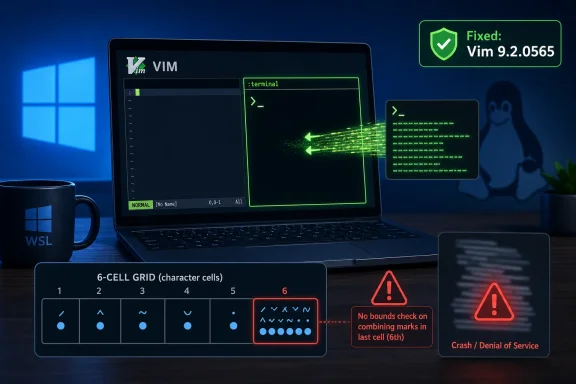
CVE-2026-52859 sits in Vim’s :terminal feature, specifically in the code path that snapshots a terminal screen into scrollback. The vulnerable function, update_snapshot() in src/terminal.c, walks through a terminal cell’s chars[] array until it sees a NUL terminator. The trouble is that a legitimate terminal cell can fill all six available character slots with a base character and combining marks, leaving no terminator for the loop to find.That is the sort of bug C programmers recognize immediately: a boundary condition hiding behind a convention. The code assumes an array is terminated; the library can return a fully occupied array; the caller keeps walking. In the reported failure mode, Vim reads beyond the fixed six-element array and appends values into a buffer sized for only six characters, with the reliably reproduced impact being a crash.
This is not a remote code execution advisory, and administrators should not treat it as one unless new exploit work changes the picture. The public description points to denial of service: a program whose output is rendered inside a Vim terminal window can trigger the crash with a short byte sequence, without needing Vim script. That is still meaningful, because the boundary between “program output” and “trusted editor state” is exactly where terminal integrations keep getting into trouble.
The fix is equally prosaic. Vim 9.2.0565 bounds the loop with
i < VTERM_MAX_CHARS_PER_CELL, mirroring a safer pattern already used elsewhere. In other words, the patch does not redesign Vim’s terminal emulator. It closes a missing guardrail.Vim Is No Longer Merely the Thing That Opens /etc/hosts
The cultural mistake is to imagine Vim as the old-school editor that opens a config file, edits three lines, and exits with :wq. That Vim still exists, but modern Vim also embeds terminals, parses file formats, evaluates scripts, integrates with interpreters, talks to plugins, and sits in automated workflows. Each feature is useful. Each feature also gives malformed input another door into a process that users tend to trust.The terminal emulator is a particularly interesting door because it reverses the old trust relationship. Traditionally, the editor displayed a file chosen by the user. With
:terminal, Vim displays a live program’s output, potentially from a build tool, test runner, package script, remote shell, container session, or hostile process on a compromised system. The terminal output is no longer passive decoration; it drives code inside the editor.CVE-2026-52859 shows how small that interface can be. The trigger is not a malicious plugin or a poisoned
.vimrc. It is a cell on a terminal screen containing the maximum number of characters the bundled libvterm representation permits. A display feature becomes a memory safety boundary.That matters for Windows users more than it might appear. Vim is not a Microsoft product in the usual sense, but it appears in Windows-adjacent environments everywhere: Git for Windows shells, MSYS2 and Cygwin installations, WSL distributions, remote Linux hosts managed from Windows terminals, developer containers, and cross-platform toolchains. Microsoft listing the CVE in MSRC’s Update Guide reflects that Windows security is no longer bounded by Windows binaries alone.
The MSRC Listing Is a Signal, Not a Windows Patch Tuesday Moment
When a CVE appears in Microsoft’s Security Update Guide, many readers reasonably expect a Windows update, a KB number, and a familiar compliance workflow. This one does not fit that mold neatly. The provided MSRC page is a vulnerability entry for Vim, and the accompanying Microsoft Knowledge Base disclaimer is the familiar legal wrapper: the information is provided “as is,” without warranty.That disclaimer is easy to ignore, but it quietly describes the nature of the relationship. Microsoft can surface, track, and contextualize a vulnerability without necessarily being the upstream maintainer or the sole distributor of the affected code. In a world where Windows developers run Linux userlands, package managers, language runtimes, and open-source command-line stacks, the boundary between Microsoft’s ecosystem and everyone else’s code is porous by design.
For enterprise IT, this creates a practical wrinkle. A vulnerability scanner may flag CVE-2026-52859 on a Windows endpoint not because Windows itself is vulnerable, but because an installed development environment, package bundle, Linux distribution under WSL, or third-party toolchain includes a vulnerable Vim build. The right remediation path depends on which copy of Vim is present.
That is where overbroad patch thinking can waste time. Installing the latest Windows cumulative update may do nothing for a vulnerable Vim package inside Ubuntu on WSL. Updating a WSL distribution may do nothing for a separate Vim binary shipped with Git, MSYS2, or a developer’s portable tools directory. The relevant question is not “Did we patch Windows?” but “Which Vim executable is actually in use, and who owns its update channel?”
The Terminal Emulator Remains a Rich Source of Weird Bugs
Terminal emulators are deceptively complex because they sit between byte streams and human-visible state. They parse escape sequences, combine Unicode characters, track screen cells, maintain scrollback, emulate historical behavior, and make old assumptions look new again. Every terminal emulator is part display engine, part protocol interpreter, and part compatibility museum.CVE-2026-52859 lives in that complexity. A terminal cell can contain a base character plus combining marks, and the code needs to represent that compactly. The bundled libvterm permits up to six characters per cell. If fewer than six are used, a terminator can appear. If all six are used, the array is full and the caller must know the bound.
That is an old programming lesson with a modern Unicode accent. Strings and arrays are not the same thing, and the “end” of a visual character is not always the end of a storage buffer. Unicode combining behavior makes it possible for one displayed cell to contain multiple code points, and software written around simpler character assumptions can stumble when the edge case becomes perfectly valid input.
The security consequence is not that Unicode is dangerous. The consequence is that display paths process attacker-controlled data more often than people assume. Build logs, test output, compiler diagnostics, terminal UIs, remote prompts, package scripts, and command-line tools all emit byte streams that editors and terminals dutifully interpret.
Denial of Service Still Matters When the Editor Is the Control Plane
It is tempting to dismiss a crash-only Vim bug as background noise. A crashed editor is not a stolen domain controller. A denial-of-service CVE in a local tool rarely commands the same attention as an exploited browser zero-day or a VPN appliance RCE.But the impact depends on context. If Vim is being used interactively to inspect logs, edit production configuration, review generated output, or manage a remote session, a reliable crash can interrupt work at exactly the wrong moment. If a developer routinely opens
:terminal inside Vim to run untrusted test cases or tooling, hostile output can attack the editor process rather than merely fail the test.The risk grows in automated or semi-automated workflows where terminal output is reviewed inside long-lived editor sessions. Some developers treat Vim as an IDE-like hub, with terminal panes, plugin managers, language servers, and shell commands all living inside one process. Crashing that process may mean losing unsaved buffers, killing associated jobs, or disrupting a debugging session.
That still does not make CVE-2026-52859 a panic event. It makes it a hygiene event. The right response is to update Vim, check where Vim is installed, and avoid treating terminal output as magically safe because it is “just text.”
The Patch Is Small Because the Lesson Is Large
The elegance of the fix is part of why the bug is worth discussing. Adding an explicit upper bound to the loop is not dramatic engineering. It is the difference between trusting a sentinel and respecting the array’s declared capacity.That distinction is central to C security. Sentinel-terminated data structures work only when every producer and consumer agrees on the contract. Fixed-size arrays work only when every reader respects the fixed size. When software mixes those models, the edge case tends to arrive eventually.
Here, the edge case is not malformed data in the ordinary sense. A cell using all six character slots is legitimate. The failure is that the caller treats legitimate fullness as impossible or at least as if it would still carry a terminator. This is why vulnerability write-ups often sound absurdly specific: the trigger lives at the intersection of two individually reasonable design choices.
For sysadmins, that specificity can be reassuring and misleading. Reassuring, because the exploit path is constrained. Misleading, because constrained bugs in ubiquitous tools still accumulate into real operational exposure. Nobody deploys Vim as a network-facing service, but plenty of people run untrusted output through it without thinking about the editor as an attack surface.
Windows Shops Should Inventory the Unix Tools They Actually Use
The WindowsForum audience is used to thinking about Windows Update, Defender, Smart App Control, Edge hardening, and the usual Microsoft security lifecycle. CVE-2026-52859 belongs to a different but increasingly common category: open-source tooling that lives inside a Windows estate because Windows has become a capable host for cross-platform development.The most obvious place to look is WSL. If a Linux distribution under WSL ships Vim older than 9.2.0565, it may be affected until the distribution package is updated or the user installs a newer build. That remediation follows the distribution’s package workflow, not the Windows Update workflow.
The second place is developer tooling. Git distributions, Unix-like shell environments, package managers, and portable editor bundles can carry their own Vim builds. These copies may not appear in the same inventory system that tracks Microsoft Store apps, MSI-installed software, or winget-managed packages.
The third place is remote administration. A Windows admin may use Windows Terminal, SSH, and Vim on remote Linux servers all day without a local vulnerable Vim binary mattering at all. In that case, the affected asset is the remote server’s package, and the relevant owner may be a Linux operations team rather than the endpoint team.
This is the modern asset-management tax. The user sees one command,
vim. The enterprise may have half a dozen copies across local Windows paths, WSL distributions, containers, dev boxes, and remote hosts. Vulnerability management has to find the copy that actually executes.Scanner Noise Will Make This Look Simpler Than It Is
CVE entries like this often produce scanner findings that appear more definitive than the underlying exposure. A scanner sees a vulnerable package version. It reports a CVE. The ticket lands in a queue. Someone is asked to “patch Vim” without context.The useful triage starts with version and path. A finding against Vim 9.2.0564 or earlier is materially different from a finding against 9.2.0565 or later. A vulnerable binary in an unused portable directory is different from the default editor on a shared build server. A vulnerable WSL package on a developer laptop is different from a production jump host where administrators routinely run terminal sessions inside Vim.
The next triage question is feature exposure. CVE-2026-52859 requires output rendered inside Vim’s
:terminal window and a snapshot path such as entering Terminal-Normal mode or terminal job exit. Users who never use :terminal have a much narrower practical exposure, though security programs generally should still patch rather than rely on usage assumptions.Finally, teams should distinguish upstream fixes from downstream availability. Vim 9.2.0565 is the upstream fixed version, but Linux distributions may backport fixes while keeping older-looking version numbers. A package version string alone can be misleading if the distributor has patched the vulnerability without rebasing to the upstream release. That is a familiar Linux packaging headache, but it becomes more confusing when the affected system is tucked inside a Windows developer workstation.
The Bigger Pattern Is Editors Becoming Execution Environments
Vim is not alone here. The editor category has been steadily transformed from “programs that manipulate text” into “local automation platforms with rendering, scripting, remote access, and package ecosystems.” Visual Studio Code, JetBrains IDEs, Emacs, Neovim, Vim, and terminal multiplexers all sit closer to execution than the word “editor” suggests.That shift is productive. It is also security-relevant. Plugins run code. Language servers parse project files. Terminals render hostile output. Completion engines may inspect or execute language constructs. File explorers traverse workspaces that came from strangers. The line between opening a project and executing part of it keeps getting thinner.
CVE-2026-52859 is a small member of that family. It does not require opening a malicious source file or installing a malicious extension. It turns a display representation into a crash condition. But the principle is the same: the development environment is part of the attack surface.
Windows security has already adapted to some of this reality. Microsoft Defender watches developer tools more closely than it once did. SmartScreen, reputation systems, and controlled folder access all acknowledge that user-space tools can be abused. But vulnerability management still often treats command-line utilities as static utilities rather than dynamic platforms.
That gap matters because developers and administrators often run with access that attackers value. A crash in Vim is not privilege escalation, but the process may be attached to sensitive files, remote sessions, credentials in environment variables, or workflows that bridge local and production systems. Security teams should not inflate the bug; they should update their mental model.
The Vulnerability Is Medium, the Maintenance Signal Is High
The public severity for this issue is medium, which fits the known impact. A local or adjacent trigger through terminal output that crashes an editor does not belong in the same category as unauthenticated remote compromise. The danger in medium CVEs is not that each one is catastrophic. It is that they are easy to postpone indefinitely.Vim’s maintainers, to their credit, fixed the issue in a targeted patch. The advisory credits a reporter for analyzing the problem and suggesting a fix. That is how open-source security is supposed to work: a precise bug report, a reproducible condition, an upstream patch, and downstream propagation.
The slow part is everything after that. Distributions need to package the fix. Users need to receive it. Enterprises need to identify affected copies. Scanners need to understand backports. Developers need to restart shells, containers, or sessions that still call old binaries.
This is where “medium” becomes a governance test. Organizations that can handle this cleanly usually have a real inventory of developer tooling, not just servers and browsers. Organizations that cannot will either ignore the finding, overreact to it, or patch the wrong copy of Vim.
The Practical Read for WindowsForum Readers
For everyday users, the advice is simple: update Vim if you use it, especially if you use:terminal. For IT pros, the better advice is to trace the update channel. Vim installed through a Linux distribution should be updated through that distribution. Vim installed through a Windows package manager should be updated there. Vim bundled with a third-party tool may require that tool’s update.The fixed upstream version is Vim 9.2.0565. The affected code is in terminal screen snapshot handling, not in ordinary editing of a text file. The known public impact is a crash triggered by crafted terminal output rendered inside Vim’s terminal window.
That should shape response priority. Internet-exposed services, actively exploited vulnerabilities, and privilege-escalation paths deserve the top of the queue. CVE-2026-52859 belongs in the steady maintenance lane: update promptly, verify the right binary, and move on.
The worst response is performative urgency. The second-worst response is dismissal. The useful middle is what mature patch management looks like most days: understand the product boundary, confirm exposure, apply the fix, and document the exception if a distributor has backported it.
The Six-Cell Edge Case That Should Change Your Checklist
The concrete lesson from CVE-2026-52859 is not that Vim is unsafe. It is that trusted tools keep gaining features that process untrusted input in surprising ways. A vulnerability that begins with six character slots in a terminal cell ends with a reminder to inventory the developer stack as seriously as the operating system.- Vim versions before 9.2.0565 are the affected upstream releases for CVE-2026-52859.
- The bug is in
:terminalscreen snapshot handling, not in ordinary text-buffer editing. - The reported impact is a denial-of-service crash caused by crafted terminal output.
- Windows environments may still be exposed through WSL, Git-related shells, MSYS2, Cygwin, containers, remote Linux systems, or bundled developer tools.
- Remediation should follow the package source that supplied Vim, because Windows Update alone may not touch the affected binary.
- Scanner findings should be checked against distributor backports and the actual executable path before teams declare victory or file exceptions.
References
- Primary source: MSRC
Published: 2026-06-13T01:01:34-07:00

Security Update Guide - Microsoft Security Response Center
 msrc.microsoft.com
- Related coverage: sentinelone.com

CVE-2026-28420: Vim Buffer Overflow Vulnerability
CVE-2026-28420 is a heap-based buffer overflow vulnerability in Vim's terminal emulator. Learn about its impact, affected versions, and mitigation methods.www.sentinelone.com
- Related coverage: blog.oxo.is
- Related coverage: cybersecuritynews.com
- Related coverage: osv.dev

OSV - Open Source Vulnerabilities
Comprehensive vulnerability database for your open source projects and dependencies.
osv.dev
- Related coverage: cyberpress.org
