

CVE-2026-47167 is a medium-severity Vim code-injection vulnerability disclosed in June 2026 that affects Vim versions before 9.2.0496 when the bundled Cucumber filetype plugin runs on builds compiled with Ruby support and processes malicious step-definition patterns from an attacker-controlled project. The bug is not a Windows worm, not a remote network exploit, and not a reason to panic-delete every copy of Vim from developer workstations. It is, however, a neat example of why modern editor security now lives less in the editor core than in the little bits of automation that make editors feel smart. For Windows administrators and developers, the uncomfortable lesson is that a text editor can become part of the supply chain the moment it starts interpreting project files.
The vulnerability sits in Vim’s Cucumber filetype plugin, specifically in logic used to match Cucumber steps against Ruby step definitions. Cucumber, for the uninitiated, is a behavior-driven development tool that lets teams write tests in human-readable feature files and bind those lines to executable step definitions, commonly in Ruby. Vim’s plugin tries to help by letting the user jump between a step in a feature file and the matching Ruby definition.
That sounds harmless because it is meant to be a navigation convenience, not an execution engine. The problem is that the plugin’s matching path could take regular-expression patterns from
The exploit path is narrower than the most alarming phrase in any advisory: code injection. An attacker needs to influence the repository contents, the user needs to open or work in that project, the Vim build needs Ruby support, and the user must invoke the step-jump mapping, commonly
The reason it matters is that developers already treat repositories as semi-trusted bundles of code. They clone a project, inspect it, run tests, open files, and lean on editor integrations to make sense of it. CVE-2026-47167 lives in precisely that gray area between “I only opened the code” and “I executed the code.”
But CVSS has always struggled with developer tooling because developer workstations are strange beasts. They often hold credentials, source code, SSH keys, package tokens, cloud CLIs, browser sessions, signing material, and access to internal systems. A “local” or “user-assisted” exploit against a developer’s editor can be a stepping stone to much more interesting places.
The realistic threat model is not a random malicious
That makes this bug more strategically interesting than its score suggests. It belongs to the same family of flaws as malicious editor project settings, unsafe modelines, build-task injection, poisoned workspace files, and plugin behaviors that blur viewing with evaluating. The attack does not ask the victim to run
The dangerous part is not the ambition. Editors have spent the last decade becoming lightweight IDEs because developers demanded exactly that. Jump-to-definition, code actions, inline testing, linting, symbol indexes, embedded terminals, debug adapters, and language servers all sit on the same premise: the editor should understand the project deeply enough to reduce friction.
CVE-2026-47167 is a reminder that “understand” is often implemented as “interpret.” Once a plugin starts evaluating language constructs from the project, it enters the same danger zone as a build system or test runner. The difference is psychological. Users expect a test runner to execute code; they do not always expect a navigation shortcut to do so.
The Ruby angle sharpens the lesson.
For WindowsForum readers, the practical question is not “Does Windows itself ship this exact vulnerable plugin?” It is “Where does Vim exist in my estate, and who uses it to inspect untrusted code?” The answer may include native Vim for Windows, Vim inside WSL distributions, Vim in development containers, Vim on build agents, Vim on admin jump boxes, and Vim packaged by tools such as Chocolatey, Scoop, winget-adjacent installers, MSYS2, Cygwin, or Linux distribution repositories.
That sprawl matters because the vulnerable condition depends on build options as well as version. The issue affects Vim builds with
The immediate Windows concern is therefore operational rather than architectural. Patch Vim where it is installed, check whether Ruby support is enabled in the builds your users actually launch, and treat repository-opening workflows as part of endpoint security. The workstation is not safer simply because the risky interpreter sits inside an editor rather than inside a standalone runtime.
That is a healthy evolution, even if it can make advisories feel more confusing. A Microsoft-branded vulnerability page does not automatically mean Windows Update will patch the issue on every system. It also does not mean the bug is in a Microsoft-authored product. It means Microsoft is acknowledging a vulnerability relevant to its ecosystem and customers, often because the affected software may be present in supported environments, development workflows, cloud images, or downstream packages.
The distinction matters for administrators. If a Windows cumulative update does not remediate the Vim copy your developers installed manually two years ago, that is not a Microsoft patch failure. It is software asset management doing what software asset management always does: punishing anyone who does not know where their tools came from.
The legal disclaimer attached to the Microsoft Knowledge Base entry is boilerplate, but its presence underscores a practical truth. Advisory pages are not a substitute for local validation. Security teams still need to confirm installed versions, packaging source, build features, compensating controls, and user behavior.
A developer reviewing a Cucumber test suite may naturally use editor mappings to jump between feature steps and Ruby definitions. That is exactly what the plugin was built to support. If the repository is malicious or compromised, the action that triggers the bug does not look suspicious. It looks like the normal next step in understanding a test failure.
That makes the vulnerability especially relevant to code-review and triage workflows. Security researchers, maintainers, SREs, and open-source contributors often open unfamiliar repositories precisely because something looks broken. They are conditioned not to execute install scripts immediately, but they may still browse code in their preferred editor with filetype plugins, syntax helpers, and navigation features enabled.
This is where the old advice “don’t run untrusted code” becomes insufficient. CVE-2026-47167 is about tooling that turns untrusted code-adjacent text into execution before the user has consciously crossed the run boundary. The better advice is more awkward: do not let rich editor automation fully activate in untrusted repositories until the repository itself has earned trust.
The messier part is knowing which Vim matters. On a single Windows developer machine,
Administrators should also check whether
The plugin layer adds another wrinkle. Some users disable filetype plugins globally or for certain repositories; others run heavily customized Vim setups. Enterprise hardening guidance often focuses on shells, browsers, macro settings, and Office add-ins. Editor runtime policy deserves a place on that list, especially for teams that routinely inspect outside code.
That model has become depressingly familiar. Malicious packages, poisoned examples, typosquatted dependencies, hostile build scripts, and compromised maintainer accounts all exploit the same trust gradient. Developers must inspect unfamiliar artifacts, and their tools are designed to reduce the friction of doing so. Attackers exploit the reduction in friction.
CVE-2026-47167 is not the largest example of that pattern, but it is a clean one. The attacker-controlled repository supplies a step-definition regex. The editor plugin consumes it for navigation. An evaluation boundary fails. Code runs in the user’s context.
The result is a vulnerability that is less about Vim as an isolated application than about the implicit execution environment around software development. The repository is no longer passive data once every tool in the chain tries to interpret it.
After patching, the more durable work is policy. Teams that review untrusted code should consider using disposable environments, restricted containers, virtual machines, or hardened accounts for first-pass inspection. That may sound heavy, but many organizations already isolate browsers for risky web activity while leaving developer editors running with full access to SSH keys and cloud credentials. The mismatch is increasingly hard to defend.
Vim users can also reduce exposure by disabling filetype plugins when opening untrusted trees, starting with a minimal configuration, or using safe inspection commands before enabling full editor automation. The goal is not to turn Vim into Notepad forever. It is to make trust progressive rather than automatic.
Enterprise endpoint detection can help, but it will not be elegant. A malicious exploit may appear as a Ruby process or shell spawned from Vim, or as unexpected network activity initiated from a developer workstation after editor interaction. Those are useful signals, but they are not substitutes for removing the vulnerable code path.
Vim’s power has always come from composability. It shells out, evaluates expressions, reads project files, honors configuration, loads filetype plugins, parses tags, integrates with interpreters, and lets users wire together workflows in terse commands. Those features made it beloved by power users. They also create many small trust boundaries.
For years, the practical security model was social and local: you controlled your files, your machine, and your configuration. That model strains under today’s development habits. People open arbitrary repositories from strangers, paste reproduction cases from issue trackers, use generated code, inspect vendor drops, and jump between host, guest, container, and remote sessions as if they were all one workspace.
Seen that way, CVE-2026-47167 is not an indictment of Vim so much as a late bill for decades of convenience. Every editor with rich project understanding has some version of this problem. Visual Studio Code has workspace trust prompts for a reason. JetBrains IDEs warn about project scripts for a reason. Emacs, Vim, Neovim, and lighter editors all live on the same spectrum once plugins and project-local automation enter the picture.
Security has changed the cost calculation. If an editor can execute code as a side effect of opening or navigating a repository, then it belongs in the managed software inventory. That does not mean every developer must use the same editor. It means organizations need minimum version baselines, update channels, prohibited legacy builds, and a way to answer basic questions during an incident.
The questions are mundane but essential. Which users have Vim before 9.2.0496? Which builds include Ruby support? Which package managers installed them? Are vulnerable copies present inside WSL distributions or developer containers? Are build images refreshed, or do they preserve editor packages indefinitely?
This is where Windows-heavy shops can be caught off guard. They may have excellent visibility into MSI-installed desktop applications and poor visibility into Linux packages inside WSL, portable tools in user profiles, or binaries living under source trees. The editor a developer actually launches at 2 a.m. may not be the editor the asset system thinks exists.
That does not mean they should stop using productive tools. It means the first-open workflow deserves more discipline. A suspicious repository should be treated less like a folder of text and more like an attachment from an unknown sender. Open it in a constrained environment, inspect it with minimal automation, and only then graduate it into the full-power workspace.
For Cucumber-heavy Ruby teams, the issue is particularly concrete. If feature files and step definitions are part of daily navigation, updating Vim should be urgent even if the CVSS score says medium. The vulnerable action is part of the normal loop, not an exotic edge case.
For teams that never use Cucumber, never compile Vim with Ruby support, and do not open untrusted Ruby repositories, the urgency drops. But the pattern still deserves attention because today’s specific plugin is tomorrow’s different helper. Security programs should not learn the lesson anew for every editor integration.
Security teams should also resist the temptation to overstate the bug. Calling it “remote code execution” without the interaction and configuration caveats will train users to ignore the next advisory. The honest framing is stronger: this is a user-assisted code-injection flaw in a common editor workflow that can matter a great deal on machines with valuable development credentials.
Developers, meanwhile, should not read “medium” as “irrelevant.” A medium flaw in the right place can be operationally high-impact. The machine on which code is written, reviewed, signed, packaged, and deployed is the right place.
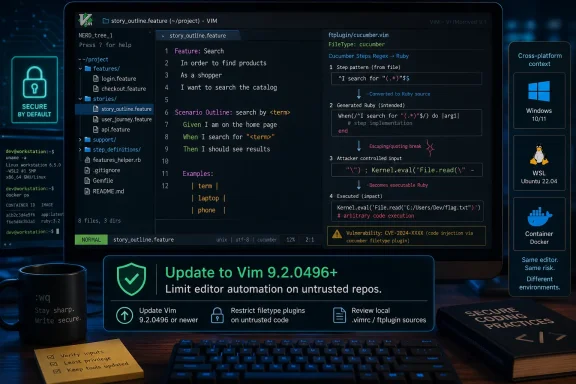 The Editor Did Not Need to Be Network-Facing to Become an Attack Surface
The vulnerability sits in Vim’s Cucumber filetype plugin, specifically in logic used to match Cucumber steps against Ruby step definitions. Cucumber, for the uninitiated, is a behavior-driven development tool that lets teams write tests in human-readable feature files and bind those lines to executable step definitions, commonly in Ruby. Vim’s plugin tries to help by letting the user jump between a step in a feature file and the matching Ruby definition.That sounds harmless because it is meant to be a navigation convenience, not an execution engine. The problem is that the plugin’s matching path could take regular-expression patterns from
.rb files under project directories such as features or stories, insert them into a Ruby Kernel.eval expression, and rely on insufficient escaping. In vulnerable builds, a crafted pattern can turn what looks like test metadata into executable Ruby.The exploit path is narrower than the most alarming phrase in any advisory: code injection. An attacker needs to influence the repository contents, the user needs to open or work in that project, the Vim build needs Ruby support, and the user must invoke the step-jump mapping, commonly
[d or ]d. That is not drive-by browser exploitation. It is also not nothing.The reason it matters is that developers already treat repositories as semi-trusted bundles of code. They clone a project, inspect it, run tests, open files, and lean on editor integrations to make sense of it. CVE-2026-47167 lives in precisely that gray area between “I only opened the code” and “I executed the code.”
A Medium CVSS Score Hides a Very Real Developer-Workstation Story
The published severity lands in the medium range, and that rating is defensible. The attack requires user interaction, the affected feature is conditional, and the vulnerable path is tied to a specific plugin and file layout rather than every Vim session. In enterprise risk language, this is not the same class of event as a remotely reachable service with unauthenticated code execution.But CVSS has always struggled with developer tooling because developer workstations are strange beasts. They often hold credentials, source code, SSH keys, package tokens, cloud CLIs, browser sessions, signing material, and access to internal systems. A “local” or “user-assisted” exploit against a developer’s editor can be a stepping stone to much more interesting places.
The realistic threat model is not a random malicious
.feature file floating around the internet. It is a poisoned repository, a compromised dependency example, a malicious pull request, a test fixture in a zip archive, or a proof-of-concept project that someone opens while debugging a production problem. The target is not Vim in isolation; the target is the trust developers place in project trees before they have decided whether the project deserves trust.That makes this bug more strategically interesting than its score suggests. It belongs to the same family of flaws as malicious editor project settings, unsafe modelines, build-task injection, poisoned workspace files, and plugin behaviors that blur viewing with evaluating. The attack does not ask the victim to run
bundle exec or execute a shell script. It waits for the editor to become helpful.The Cucumber Plugin Shows the Old Cost of Smart Navigation
Vim’s Cucumber integration is a classic example of editor intelligence built before the industry became fully paranoid about untrusted workspaces. The feature exists to answer a developer’s routine question: where is the implementation for this test step? To do that, Vim must parse the project’s step definitions, understand patterns, and compare them to the line under the cursor.The dangerous part is not the ambition. Editors have spent the last decade becoming lightweight IDEs because developers demanded exactly that. Jump-to-definition, code actions, inline testing, linting, symbol indexes, embedded terminals, debug adapters, and language servers all sit on the same premise: the editor should understand the project deeply enough to reduce friction.
CVE-2026-47167 is a reminder that “understand” is often implemented as “interpret.” Once a plugin starts evaluating language constructs from the project, it enters the same danger zone as a build system or test runner. The difference is psychological. Users expect a test runner to execute code; they do not always expect a navigation shortcut to do so.
The Ruby angle sharpens the lesson.
Kernel.eval is a powerful primitive, and powerful primitives are magnets for security mistakes when fed data that can originate in someone else’s repository. Escaping and quoting become the whole security boundary. One missed edge case can turn a regular expression into a command path.The Windows Angle Is Less About Vim.exe and More About Where Vim Runs
At first glance, a Vim vulnerability may look like Linux distribution housekeeping rather than Windows news. That is an outdated read of Windows development. Vim and gVim remain common on Windows systems, Windows Subsystem for Linux makes Linux userland tooling routine on developer PCs, Git for Windows ships Unix-flavored workflows into corporate environments, and remote development regularly crosses Windows, Linux, and container boundaries.For WindowsForum readers, the practical question is not “Does Windows itself ship this exact vulnerable plugin?” It is “Where does Vim exist in my estate, and who uses it to inspect untrusted code?” The answer may include native Vim for Windows, Vim inside WSL distributions, Vim in development containers, Vim on build agents, Vim on admin jump boxes, and Vim packaged by tools such as Chocolatey, Scoop, winget-adjacent installers, MSYS2, Cygwin, or Linux distribution repositories.
That sprawl matters because the vulnerable condition depends on build options as well as version. The issue affects Vim builds with
+ruby support. Many minimal builds will not have that feature compiled in; some developer-oriented builds will. A version inventory alone may not answer the whole risk question unless it also captures feature flags.The immediate Windows concern is therefore operational rather than architectural. Patch Vim where it is installed, check whether Ruby support is enabled in the builds your users actually launch, and treat repository-opening workflows as part of endpoint security. The workstation is not safer simply because the risky interpreter sits inside an editor rather than inside a standalone runtime.
Microsoft’s Advisory Role Reflects the New Shape of Platform Security
The source material points to Microsoft’s Security Response Center entry, which may seem odd for a Vim bug. Microsoft does not have to be the upstream maintainer of every affected open-source component for the issue to matter to Microsoft customers. The Security Update Guide increasingly functions as a map of risk across the software that touches Windows and Microsoft-managed environments, not merely a list of flaws in Windows DLLs.That is a healthy evolution, even if it can make advisories feel more confusing. A Microsoft-branded vulnerability page does not automatically mean Windows Update will patch the issue on every system. It also does not mean the bug is in a Microsoft-authored product. It means Microsoft is acknowledging a vulnerability relevant to its ecosystem and customers, often because the affected software may be present in supported environments, development workflows, cloud images, or downstream packages.
The distinction matters for administrators. If a Windows cumulative update does not remediate the Vim copy your developers installed manually two years ago, that is not a Microsoft patch failure. It is software asset management doing what software asset management always does: punishing anyone who does not know where their tools came from.
The legal disclaimer attached to the Microsoft Knowledge Base entry is boilerplate, but its presence underscores a practical truth. Advisory pages are not a substitute for local validation. Security teams still need to confirm installed versions, packaging source, build features, compensating controls, and user behavior.
The Attack Requires a Gesture, but Developers Make That Gesture All Day
The need for user interaction is often treated as a major comfort. In consumer exploitation, that can be true; convincing someone to perform a weird sequence of actions narrows the field. In developer environments, the required gesture may be part of ordinary work.A developer reviewing a Cucumber test suite may naturally use editor mappings to jump between feature steps and Ruby definitions. That is exactly what the plugin was built to support. If the repository is malicious or compromised, the action that triggers the bug does not look suspicious. It looks like the normal next step in understanding a test failure.
That makes the vulnerability especially relevant to code-review and triage workflows. Security researchers, maintainers, SREs, and open-source contributors often open unfamiliar repositories precisely because something looks broken. They are conditioned not to execute install scripts immediately, but they may still browse code in their preferred editor with filetype plugins, syntax helpers, and navigation features enabled.
This is where the old advice “don’t run untrusted code” becomes insufficient. CVE-2026-47167 is about tooling that turns untrusted code-adjacent text into execution before the user has consciously crossed the run boundary. The better advice is more awkward: do not let rich editor automation fully activate in untrusted repositories until the repository itself has earned trust.
The Fix Is Simple; the Inventory Is Not
The upstream remediation is straightforward: update Vim to version 9.2.0496 or later. That is the clean answer, and for many users it will be enough. Current package managers should eventually carry patched builds, and those compiling from source can pull the fixed release.The messier part is knowing which Vim matters. On a single Windows developer machine,
vim might resolve differently in PowerShell, Command Prompt, Git Bash, WSL Ubuntu, WSL Debian, an MSYS2 shell, a container, and a remote SSH session. gVim may be separate from terminal Vim. A vendor-packaged application may include its own embedded Vim runtime. A build image may lag behind the desktop.Administrators should also check whether
+ruby is present. Vim exposes its compiled features through version output, and the presence or absence of Ruby support changes the applicability of this specific bug. That does not mean unpatched non-Ruby builds should be ignored indefinitely, but it does let teams prioritize.The plugin layer adds another wrinkle. Some users disable filetype plugins globally or for certain repositories; others run heavily customized Vim setups. Enterprise hardening guidance often focuses on shells, browsers, macro settings, and Office add-ins. Editor runtime policy deserves a place on that list, especially for teams that routinely inspect outside code.
This Is a Supply-Chain Bug in Miniature
The word “supply chain” is overused, but here it fits in a small and concrete way. The vulnerable input is not a network packet or a document macro. It is a pattern inside a repository that the victim may have cloned because repositories are the raw material of software work.That model has become depressingly familiar. Malicious packages, poisoned examples, typosquatted dependencies, hostile build scripts, and compromised maintainer accounts all exploit the same trust gradient. Developers must inspect unfamiliar artifacts, and their tools are designed to reduce the friction of doing so. Attackers exploit the reduction in friction.
CVE-2026-47167 is not the largest example of that pattern, but it is a clean one. The attacker-controlled repository supplies a step-definition regex. The editor plugin consumes it for navigation. An evaluation boundary fails. Code runs in the user’s context.
The result is a vulnerability that is less about Vim as an isolated application than about the implicit execution environment around software development. The repository is no longer passive data once every tool in the chain tries to interpret it.
The Right Mitigation Is Patch First, Then Reduce Trust in Workspaces
Patching to Vim 9.2.0496 or later is the first move. There is no romance in leaving a known code-injection flaw around because the exploit path has caveats. Editors are sticky; vulnerable versions remain on machines long after users forget which installer they used.After patching, the more durable work is policy. Teams that review untrusted code should consider using disposable environments, restricted containers, virtual machines, or hardened accounts for first-pass inspection. That may sound heavy, but many organizations already isolate browsers for risky web activity while leaving developer editors running with full access to SSH keys and cloud credentials. The mismatch is increasingly hard to defend.
Vim users can also reduce exposure by disabling filetype plugins when opening untrusted trees, starting with a minimal configuration, or using safe inspection commands before enabling full editor automation. The goal is not to turn Vim into Notepad forever. It is to make trust progressive rather than automatic.
Enterprise endpoint detection can help, but it will not be elegant. A malicious exploit may appear as a Ruby process or shell spawned from Vim, or as unexpected network activity initiated from a developer workstation after editor interaction. Those are useful signals, but they are not substitutes for removing the vulnerable code path.
Vim’s Rough 2026 Is Really a Runtime Security Audit Arriving Late
The broader context is that Vim has seen a visible run of security fixes across plugins, parsing paths, tag handling, netrw behavior, completion logic, and other runtime features. It would be easy to draw the cheap conclusion that Vim is suddenly unsafe. The more accurate conclusion is that old editor surfaces are being examined with modern attacker models.Vim’s power has always come from composability. It shells out, evaluates expressions, reads project files, honors configuration, loads filetype plugins, parses tags, integrates with interpreters, and lets users wire together workflows in terse commands. Those features made it beloved by power users. They also create many small trust boundaries.
For years, the practical security model was social and local: you controlled your files, your machine, and your configuration. That model strains under today’s development habits. People open arbitrary repositories from strangers, paste reproduction cases from issue trackers, use generated code, inspect vendor drops, and jump between host, guest, container, and remote sessions as if they were all one workspace.
Seen that way, CVE-2026-47167 is not an indictment of Vim so much as a late bill for decades of convenience. Every editor with rich project understanding has some version of this problem. Visual Studio Code has workspace trust prompts for a reason. JetBrains IDEs warn about project scripts for a reason. Emacs, Vim, Neovim, and lighter editors all live on the same spectrum once plugins and project-local automation enter the picture.
Administrators Should Treat Editors as Managed Software, Not Personal Preferences
There is a cultural obstacle here. Editors are personal. Developers have muscle memory, dotfiles, plugin managers, patched builds, nightly versions, and opinions strong enough to derail meetings. IT departments often tolerate this because standardizing editors can look like an unnecessary fight.Security has changed the cost calculation. If an editor can execute code as a side effect of opening or navigating a repository, then it belongs in the managed software inventory. That does not mean every developer must use the same editor. It means organizations need minimum version baselines, update channels, prohibited legacy builds, and a way to answer basic questions during an incident.
The questions are mundane but essential. Which users have Vim before 9.2.0496? Which builds include Ruby support? Which package managers installed them? Are vulnerable copies present inside WSL distributions or developer containers? Are build images refreshed, or do they preserve editor packages indefinitely?
This is where Windows-heavy shops can be caught off guard. They may have excellent visibility into MSI-installed desktop applications and poor visibility into Linux packages inside WSL, portable tools in user profiles, or binaries living under source trees. The editor a developer actually launches at 2 a.m. may not be the editor the asset system thinks exists.
The Practical Risk Is Highest Where Curiosity Meets Privilege
The most exposed users are not necessarily the least technical. They are often the most curious and most privileged. Maintainers, incident responders, malware analysts, platform engineers, and senior developers open unfamiliar repositories more often than average users and may have more valuable credentials on their machines.That does not mean they should stop using productive tools. It means the first-open workflow deserves more discipline. A suspicious repository should be treated less like a folder of text and more like an attachment from an unknown sender. Open it in a constrained environment, inspect it with minimal automation, and only then graduate it into the full-power workspace.
For Cucumber-heavy Ruby teams, the issue is particularly concrete. If feature files and step definitions are part of daily navigation, updating Vim should be urgent even if the CVSS score says medium. The vulnerable action is part of the normal loop, not an exotic edge case.
For teams that never use Cucumber, never compile Vim with Ruby support, and do not open untrusted Ruby repositories, the urgency drops. But the pattern still deserves attention because today’s specific plugin is tomorrow’s different helper. Security programs should not learn the lesson anew for every editor integration.
The Patch Queue Should Include the Tools Around the Code
The most useful response to CVE-2026-47167 is boring and layered. Update Vim, verify the effective version, check build features, and reduce automatic trust for unknown repositories. None of that requires drama, but all of it requires treating development tools as part of the attack surface.Security teams should also resist the temptation to overstate the bug. Calling it “remote code execution” without the interaction and configuration caveats will train users to ignore the next advisory. The honest framing is stronger: this is a user-assisted code-injection flaw in a common editor workflow that can matter a great deal on machines with valuable development credentials.
Developers, meanwhile, should not read “medium” as “irrelevant.” A medium flaw in the right place can be operationally high-impact. The machine on which code is written, reviewed, signed, packaged, and deployed is the right place.
The Cucumber Mapping Is the Small Detail That Carries the Whole Lesson
The most concrete points are easy to lose in the broader debate about editor security, so they are worth pinning down before the next package update scrolls past.- Vim versions before 9.2.0496 are the versions to treat as vulnerable for this issue.
- The vulnerable path depends on the Cucumber filetype plugin and Vim builds compiled with Ruby support.
- The malicious input can live inside Ruby step-definition files under project directories such as
featuresorstories. - The exploit requires user interaction through the step-jump workflow rather than passive network exposure.
- Windows environments can still be affected through native Vim builds, gVim, WSL distributions, development containers, or unmanaged tool installations.
- The right operational response is to patch first, then limit rich editor automation when inspecting untrusted repositories.
References
- Primary source: MSRC
Published: 2026-06-13T01:01:41-07:00

Security Update Guide - Microsoft Security Response Center
 msrc.microsoft.com
- Related coverage: osv.dev

OSV - Open Source Vulnerabilities
Comprehensive vulnerability database for your open source projects and dependencies.
osv.dev
- Related coverage: sentinelone.com

CVE-2026-42307: Vim Text Editor RCE Vulnerability
CVE-2026-42307 is a remote code execution vulnerability in Vim text editor. Learn about its impact, affected versions, and mitigation methods.www.sentinelone.com
- Related coverage: thehackerwire.com

CVE-2026-35177 - Medium Vulnerability - TheHackerWire
TheHackerWire - Your daily source for cybersecurity news, CVE alerts, hacking tutorials, and security tool reviews. Stay ahead of cyber threats.www.thehackerwire.com
