

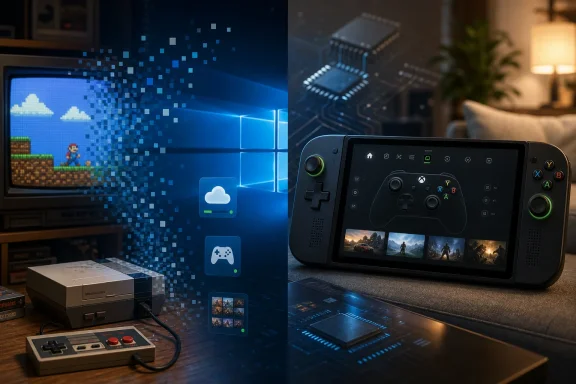
Former PlayStation executive Shuhei Yoshida this week suggested that Xbox will “dissolve into Windows,” a pointed shorthand for Microsoft’s increasingly visible shift from a traditional console business toward Windows-based gaming hardware, PC storefront flexibility, cloud services, and Xbox-branded software experiences. The remark landed because it sounds less like console-war trolling than a diagnosis of Microsoft’s actual direction. Xbox is not necessarily dying; the old idea of Xbox as a sealed box under the television is the part now looking fragile. For Windows users, PC gamers, and administrators watching Microsoft’s platform priorities, that distinction matters.
Yoshida’s comment works because it compresses several years of Microsoft strategy into one uncomfortable sentence. Xbox has spent the last decade trying to be both a console platform and a service layer, both a rival to PlayStation and a publisher that increasingly wants to sell games wherever players already are. The tension was survivable when console hardware was cheap enough, exclusives were plentiful enough, and Game Pass growth looked like a new law of physics.
That era is gone. Console economics are tighter, blockbuster development is slower, component costs are uglier, and Microsoft’s own PC inheritance is too large to ignore. Windows remains the company’s most durable gaming platform, even when it is also the source of PC gaming’s messiest rituals: launchers, drivers, overlays, anti-cheat conflicts, background services, store fragmentation, and the occasional reminder that a gaming handheld is still, underneath the friendly tiles, a Windows machine.
The reason Yoshida’s line stings is that it does not require Microsoft to cancel Xbox for it to become true. A brand can survive while its technical center of gravity moves elsewhere. Xbox could remain the logo on controllers, subscriptions, first-party games, cloud streaming, and living-room devices while the operating system substrate becomes recognizably Windows.
That would not be a retreat from gaming so much as a retreat from pretending Microsoft can win the console business by playing Sony’s game forever. Sony’s platform advantage is straightforward: PlayStation is culturally and commercially synonymous with high-end console gaming in a way Xbox has not been for years. Microsoft’s advantage is different. It owns the PC operating system where much of the industry already builds, tests, sells, mods, streams, and extends games.
The device ran Windows, but Microsoft and Asus tried to hide the rougher edges behind a full-screen Xbox experience designed for controller-first use. That is the real experiment: not whether Asus can sell another handheld PC, but whether Windows can be made to behave enough like a console that Xbox no longer needs a separate console operating identity for every form factor.
That is a hard problem. Valve’s Steam Deck succeeds not merely because it has a store or a handheld-friendly interface, but because SteamOS narrows the system around a gaming use case. It turns PC gaming into an appliance without pretending PC gaming is simple. Microsoft’s challenge is more awkward: it must make Windows feel appliance-like while preserving the compatibility and openness that make Windows valuable.
This is where the Xbox Ally matters as a signal. If Microsoft can build a console-like shell that sits on top of Windows, boots quickly, resumes reliably, respects controller navigation, and still lets players install Steam, Epic, Battle.net, GOG, Discord, browsers, mods, and utilities, it gets something the classic console cannot offer. It gets a gaming machine that is not trapped inside one store.
That is also where the skepticism comes from. The living room is unforgiving. Couch players do not want to see driver pop-ups, account prompts, Windows Update restarts, launcher authentication loops, or tiny desktop windows. A console is not powerful because it has fewer features; it is powerful because it makes the wrong features inaccessible at the right time.
Microsoft has been trying to turn that liability into a design challenge. The full-screen Xbox experience is the first credible admission that “just use Windows” is not good enough. Windows needs a gaming mode that is more than a maximized app. It needs to feel like the system has temporarily forgotten it was built for spreadsheets, printers, enterprise policy, and decades of backwards compatibility.
The appeal is obvious. Microsoft could promise players access to their Xbox library, PC games, Game Pass, cloud saves, and third-party storefronts on one living-room box. Developers could target a more unified environment. Microsoft could lean into AMD hardware, Windows compatibility, and Xbox services without constructing a sealed console world from scratch every generation.
But the danger is just as obvious. The traditional console model works because the platform holder controls the experience tightly enough to guarantee simplicity. If Helix behaves like a PC, it inherits PC complexity. If it behaves like a console, it may disappoint players expecting PC freedom. If it costs like a high-end PC, it becomes a niche product. If it is priced like a console, Microsoft may eat hardware losses at a time when the economics of memory, storage, and advanced components are getting worse.
That is the strategic trap. The more Microsoft makes Xbox like Windows, the more flexible and differentiated it becomes. The more Microsoft makes Xbox like Windows, the harder it becomes to explain why consumers should buy Microsoft’s box rather than an Asus handheld, a Lenovo handheld, a mini-PC, a gaming laptop, or a desktop connected to a television.
Helix therefore looks less like a PlayStation 6 rival than a test of whether Microsoft can define a new Windows gaming appliance category. That is a more interesting ambition than merely shipping another black rectangle. It is also less certain, because consumers understand consoles and PCs. Hybrid devices must teach the market what they are before they can compete on price, performance, and convenience.
For a console business, that is brutal. Consoles traditionally depend on predictable bill-of-materials curves. A platform holder launches expensive hardware, eats limited margins or losses, and expects components to get cheaper over time. That logic weakens when memory and storage refuse to behave, or when the parts required for a competitive 2027-era device are being priced by an AI infrastructure market with deeper pockets.
This is where the reported concern around Project Helix becomes more than rumor fodder. A hybrid Xbox that meaningfully supports PC titles may need more memory, faster storage, and more flexible hardware than a conventional fixed-function console. That could make it more expensive precisely when Microsoft needs the device to feel like an easy consumer purchase.
The classic console bargain is simple: buy the box, know it works, keep it for years. A Windows-based hybrid bargain is more complicated: buy the box, get broader compatibility, accept some PC-like tradeoffs, and maybe pay more for the privilege. That can work for enthusiasts. It is a harder sell to families comparing holiday bundles.
The memory shortage therefore does not merely threaten margins. It threatens the story Microsoft would need to tell. If the next Xbox is expensive because it is secretly a capable Windows gaming PC, Microsoft must persuade buyers that this is an advantage rather than evidence that the console lost its discipline.
This is not a theoretical move. The PC industry already knows how to produce a bewildering range of machines around a shared operating system. Some are cheap, some premium, some portable, some living-room friendly, some built for esports, some built for cloud gaming. Microsoft’s historical role is to make Windows the common layer and profit from the platform’s reach.
An Xbox-branded Windows hardware program could follow the same logic. Asus builds one device. Lenovo builds another. Maybe a living-room box arrives from a partner before or after Microsoft’s own hardware. The “Xbox” part becomes the interface, controller mapping, account system, Game Pass integration, cloud library, and compatibility promise.
That would be a radical departure from the old console model, but it would be familiar Microsoft behavior. The company has often done best when it creates a software platform that hardware partners extend. Surface exists, but it does not define the entire Windows market. Xbox may be drifting toward a similar role: important first-party hardware when useful, but not the only expression of the platform.
The risk is fragmentation. Console players buy into clarity. PC players tolerate chaos because the reward is freedom. An Xbox Windows ecosystem would need to avoid becoming the worst of both worlds: too locked down for PC enthusiasts, too fiddly for console buyers, and too inconsistent for developers trying to certify performance.
That is why Microsoft’s software work is not cosmetic. It is existential. The Xbox layer on Windows must become a coherent environment, not just an app with bigger tiles.
Microsoft knows this better than most companies. Windows Media Center, Steam Machines, mini-PCs, HDMI-connected towers, cloud boxes, and various console-PC hybrids have all circled the same problem. The hardware can be made small enough. The interface can be made attractive enough. The real challenge is behavioral: the living room punishes friction.
A PlayStation or Xbox console has historically solved this through constraint. You cannot break what you cannot access. You cannot install arbitrary background utilities. You cannot accumulate ten launchers that all want updates before game night. You cannot casually turn the system into a general-purpose computer and then be surprised when it behaves like one.
Windows brings the opposite inheritance. Its power is that it lets users do almost anything. Its weakness, in a console context, is also that it lets users do almost anything. Microsoft’s task is to design a managed openness that gives players the practical benefits of PC gaming without letting the operating system spill all over the carpet.
That may be possible. Windows already supports kiosk modes, shell replacements, game-focused overlays, controller APIs, security baselines, and increasingly modular experiences. But possible is not the same as polished. If Microsoft wants Xbox to dissolve into Windows, Windows must become less visibly Windows at the moments when players do not want a PC.
Microsoft cannot easily copy that. Its first-party portfolio is broader but less culturally concentrated. Its acquisitions have given it scale, but scale comes with cost, management complexity, and pressure to monetize beyond a single hardware base. Call of Duty, Minecraft, Bethesda, Blizzard, and the rest of the Xbox portfolio make more sense as a multi-platform empire than as ammunition for a narrow console war.
That is why Yoshida’s framing is persuasive. Microsoft’s strength is not that it can out-PlayStation PlayStation. Microsoft’s strength is that it can stop needing to. Windows, Azure, Game Pass, DirectX, developer tools, identity systems, cross-platform publishing, and PC OEM relationships give Microsoft a different route to gaming relevance.
The hard part is that abandoning the old contest can look like losing it. Console fans understandably read every multi-platform release, every PC initiative, and every hardware ambiguity as evidence that Xbox is conceding ground. In a cultural sense, it is. In a business sense, Microsoft may be deciding that the ground itself is less valuable than it used to be.
That is the difference between a brand collapse and a platform migration. Xbox may become less of a place and more of a layer. For loyal console buyers, that can feel like betrayal. For Microsoft, it may look like realism.
When a company says it remains committed to hardware while also signaling that its gaming business is overextended, observers hear both halves. Commitment is cheap in the abstract. Hardware is expensive in the specific. A next-generation console requires silicon commitments, supply chain bets, developer tooling, compatibility engineering, retail planning, support infrastructure, marketing, and years of tolerance for uncertain margins.
Microsoft can afford those things. The question is whether it wants to spend that capital on a traditional console fight or on a Windows-first gaming ecosystem that stretches across partner devices, handhelds, PCs, cloud endpoints, and perhaps one flagship living-room machine. The answer may be “both” for a while. Transitional strategies often are.
But “both” is costly. Supporting Xbox consoles, Windows handhelds, PC storefront integrations, cloud gaming, Game Pass economics, first-party publishing, multi-platform releases, and new hardware form factors means the organization must make tradeoffs somewhere. Layoffs and budget cuts, if they land as reported, would suggest those tradeoffs are becoming less theoretical.
The public messaging will likely remain careful. Microsoft has every reason to reassure existing Xbox owners, developers, retailers, and partners that the platform is not vanishing. But the more interesting story is not whether Microsoft says the word “console.” It is what kind of device that word describes by the time the next generation arrives.
But developers also value predictability. Consoles offer fixed targets. Certification may be annoying, but it also produces a baseline. A hybrid Windows Xbox could introduce uncertainty about performance tiers, storefront requirements, input assumptions, anti-cheat support, driver behavior, and whether users are running in a console-like shell or a general desktop environment.
That tension matters for IT-minded readers because it echoes the enterprise Windows problem. Flexibility creates support burden. Standardization reduces surprises. Microsoft’s best platform work usually involves giving administrators and developers enough abstraction that the underlying diversity does not become everyone else’s problem.
If Xbox becomes a Windows layer, Microsoft must solve that same issue for gaming. A developer should not have to guess whether “Xbox on Windows” means a handheld with constrained power, a living-room mini-PC, a high-end desktop, a cloud session, or a certified console-like box. Microsoft needs profiles, requirements, testing tools, and store policies that make the ecosystem legible.
The irony is that a Windows Xbox future may require more platform discipline, not less. Open ecosystems need strong contracts. Without them, openness becomes variance, and variance becomes support cost.
That is where Microsoft has reason to fight. If a player boots a Windows handheld directly into an Xbox interface, launches a Steam game, chats through Discord, claims a Game Pass perk, and resumes a cloud save, who “owns” that session? The answer is messy, but Microsoft does not need full ownership to benefit. It needs Xbox to be the front door often enough that its services remain central.
This is also why third-party storefront support is not an act of charity. If Microsoft insists on a closed store, it loses the PC advantage. If it permits rival stores but controls the shell, identity layer, and subscription hooks, it can make Windows gaming feel Xbox-like without demanding that the entire industry bend around the Microsoft Store.
That is a very Microsoft compromise. The company can tolerate competitors inside Windows as long as Windows remains the environment in which competition happens. The Xbox brand could become the curated gaming face of that environment.
For players, this could be liberating. It could also be confusing. The same device might be an Xbox, a Windows PC, a Steam machine, a Game Pass terminal, and a cloud client depending on which icon you select. Microsoft’s product challenge is to make that plurality feel like abundance rather than identity crisis.
A credible gaming shell could influence handheld PCs, mini-PCs, living-room desktops, OEM images, driver delivery, power management, HDR handling, controller navigation, anti-cheat compatibility, and update behavior. Those are not small things. They are exactly the areas where Windows gaming feels powerful but inelegant.
The ROG Xbox Ally and similar devices are therefore early indicators of a broader Windows UX campaign. Microsoft does not need every Windows user to see the Xbox shell. It needs OEMs and enthusiasts to trust that Windows can be shaped into a console-like appliance when the hardware calls for it.
There is a version of this future that benefits everyone. Handheld users get better suspend and resume. Living-room PC users get controller-first navigation. Developers get clearer device classes. Sysadmins in education, esports venues, labs, and shared entertainment spaces get more manageable gaming endpoints. Even desktop users may benefit from reduced background overhead and more coherent game mode behavior.
There is also a version that becomes another layer of Microsoft branding without solving the old annoyances. If the Xbox full-screen experience is merely a prettier launcher over the same interruptive desktop, Yoshida’s prediction becomes less a strategic triumph than a warning: Xbox dissolved into Windows before Windows was ready to absorb it.
That means the operating system experience is the product. Hardware specifications will matter, especially if memory prices force painful compromises, but the defining test will be whether Microsoft can hide complexity without removing capability. This is not a new problem in computing, but it is especially unforgiving in games because failure happens in leisure time.
The company’s advantage is that it controls enough of the stack to try. Windows, DirectX, Xbox services, Game Pass, cloud infrastructure, developer relations, and first-party studios give Microsoft a toolkit no other console maker has. Its disadvantage is that those tools were not all built for the same product vision.
A console is a promise of coherence. Windows is a promise of compatibility. The next Xbox, if it is truly a hybrid, must make those promises stop fighting each other.
The near-term picture is likely messy because transitions always are. Microsoft will reassure console owners, court PC users, support partner handhelds, experiment with full-screen shells, and keep talking about next-generation hardware. Some of that messaging will sound contradictory because Microsoft is trying to preserve the old audience while building the new one.
Here is the cleanest version of what the evidence suggests:
 Microsoft’s Console Problem Is Now a Windows Opportunity
Yoshida’s comment works because it compresses several years of Microsoft strategy into one uncomfortable sentence. Xbox has spent the last decade trying to be both a console platform and a service layer, both a rival to PlayStation and a publisher that increasingly wants to sell games wherever players already are. The tension was survivable when console hardware was cheap enough, exclusives were plentiful enough, and Game Pass growth looked like a new law of physics.That era is gone. Console economics are tighter, blockbuster development is slower, component costs are uglier, and Microsoft’s own PC inheritance is too large to ignore. Windows remains the company’s most durable gaming platform, even when it is also the source of PC gaming’s messiest rituals: launchers, drivers, overlays, anti-cheat conflicts, background services, store fragmentation, and the occasional reminder that a gaming handheld is still, underneath the friendly tiles, a Windows machine.
The reason Yoshida’s line stings is that it does not require Microsoft to cancel Xbox for it to become true. A brand can survive while its technical center of gravity moves elsewhere. Xbox could remain the logo on controllers, subscriptions, first-party games, cloud streaming, and living-room devices while the operating system substrate becomes recognizably Windows.
That would not be a retreat from gaming so much as a retreat from pretending Microsoft can win the console business by playing Sony’s game forever. Sony’s platform advantage is straightforward: PlayStation is culturally and commercially synonymous with high-end console gaming in a way Xbox has not been for years. Microsoft’s advantage is different. It owns the PC operating system where much of the industry already builds, tests, sells, mods, streams, and extends games.
The ROG Xbox Ally Was Not a Side Quest
The ROG Xbox Ally looked, at first glance, like a co-branded handheld. It was easy to treat it as Microsoft dipping a toe into the Steam Deck-shaped waters without committing to a first-party portable Xbox. But the more important part was never the plastic shell. It was the software thesis.The device ran Windows, but Microsoft and Asus tried to hide the rougher edges behind a full-screen Xbox experience designed for controller-first use. That is the real experiment: not whether Asus can sell another handheld PC, but whether Windows can be made to behave enough like a console that Xbox no longer needs a separate console operating identity for every form factor.
That is a hard problem. Valve’s Steam Deck succeeds not merely because it has a store or a handheld-friendly interface, but because SteamOS narrows the system around a gaming use case. It turns PC gaming into an appliance without pretending PC gaming is simple. Microsoft’s challenge is more awkward: it must make Windows feel appliance-like while preserving the compatibility and openness that make Windows valuable.
This is where the Xbox Ally matters as a signal. If Microsoft can build a console-like shell that sits on top of Windows, boots quickly, resumes reliably, respects controller navigation, and still lets players install Steam, Epic, Battle.net, GOG, Discord, browsers, mods, and utilities, it gets something the classic console cannot offer. It gets a gaming machine that is not trapped inside one store.
That is also where the skepticism comes from. The living room is unforgiving. Couch players do not want to see driver pop-ups, account prompts, Windows Update restarts, launcher authentication loops, or tiny desktop windows. A console is not powerful because it has fewer features; it is powerful because it makes the wrong features inaccessible at the right time.
Microsoft has been trying to turn that liability into a design challenge. The full-screen Xbox experience is the first credible admission that “just use Windows” is not good enough. Windows needs a gaming mode that is more than a maximized app. It needs to feel like the system has temporarily forgotten it was built for spreadsheets, printers, enterprise policy, and decades of backwards compatibility.
Project Helix Sounds Like a Console Built by a Company That No Longer Believes in Consoles
Project Helix, as described in reports and executive comments, is the more consequential bet. A next-generation Xbox that can run both Xbox games and PC titles would not be a normal console with a few PC-like features. It would be a hybrid device that asks whether the boundary between console and Windows PC is still worth maintaining.The appeal is obvious. Microsoft could promise players access to their Xbox library, PC games, Game Pass, cloud saves, and third-party storefronts on one living-room box. Developers could target a more unified environment. Microsoft could lean into AMD hardware, Windows compatibility, and Xbox services without constructing a sealed console world from scratch every generation.
But the danger is just as obvious. The traditional console model works because the platform holder controls the experience tightly enough to guarantee simplicity. If Helix behaves like a PC, it inherits PC complexity. If it behaves like a console, it may disappoint players expecting PC freedom. If it costs like a high-end PC, it becomes a niche product. If it is priced like a console, Microsoft may eat hardware losses at a time when the economics of memory, storage, and advanced components are getting worse.
That is the strategic trap. The more Microsoft makes Xbox like Windows, the more flexible and differentiated it becomes. The more Microsoft makes Xbox like Windows, the harder it becomes to explain why consumers should buy Microsoft’s box rather than an Asus handheld, a Lenovo handheld, a mini-PC, a gaming laptop, or a desktop connected to a television.
Helix therefore looks less like a PlayStation 6 rival than a test of whether Microsoft can define a new Windows gaming appliance category. That is a more interesting ambition than merely shipping another black rectangle. It is also less certain, because consumers understand consoles and PCs. Hybrid devices must teach the market what they are before they can compete on price, performance, and convenience.
The Memory Crunch Turns Strategy Into Arithmetic
The component story is not glamorous, but it may be decisive. Memory and storage costs have become a serious problem for hardware makers, and the AI boom has put pressure on supply chains that gaming companies do not control. When cloud providers, GPU vendors, server builders, console makers, and device manufacturers all chase high-performance memory, someone loses the pricing fight.For a console business, that is brutal. Consoles traditionally depend on predictable bill-of-materials curves. A platform holder launches expensive hardware, eats limited margins or losses, and expects components to get cheaper over time. That logic weakens when memory and storage refuse to behave, or when the parts required for a competitive 2027-era device are being priced by an AI infrastructure market with deeper pockets.
This is where the reported concern around Project Helix becomes more than rumor fodder. A hybrid Xbox that meaningfully supports PC titles may need more memory, faster storage, and more flexible hardware than a conventional fixed-function console. That could make it more expensive precisely when Microsoft needs the device to feel like an easy consumer purchase.
The classic console bargain is simple: buy the box, know it works, keep it for years. A Windows-based hybrid bargain is more complicated: buy the box, get broader compatibility, accept some PC-like tradeoffs, and maybe pay more for the privilege. That can work for enthusiasts. It is a harder sell to families comparing holiday bundles.
The memory shortage therefore does not merely threaten margins. It threatens the story Microsoft would need to tell. If the next Xbox is expensive because it is secretly a capable Windows gaming PC, Microsoft must persuade buyers that this is an advantage rather than evidence that the console lost its discipline.
Xbox Hardware Is Becoming a Brand License Before It Becomes a Box
The Asus partnership points toward another possibility: Microsoft may not need to manufacture every Xbox-branded gaming device itself. It can define the software experience, certify hardware, integrate Game Pass and Xbox accounts, and let PC OEMs take on more of the device risk. That would resemble the Windows PC ecosystem more than the console cycle.This is not a theoretical move. The PC industry already knows how to produce a bewildering range of machines around a shared operating system. Some are cheap, some premium, some portable, some living-room friendly, some built for esports, some built for cloud gaming. Microsoft’s historical role is to make Windows the common layer and profit from the platform’s reach.
An Xbox-branded Windows hardware program could follow the same logic. Asus builds one device. Lenovo builds another. Maybe a living-room box arrives from a partner before or after Microsoft’s own hardware. The “Xbox” part becomes the interface, controller mapping, account system, Game Pass integration, cloud library, and compatibility promise.
That would be a radical departure from the old console model, but it would be familiar Microsoft behavior. The company has often done best when it creates a software platform that hardware partners extend. Surface exists, but it does not define the entire Windows market. Xbox may be drifting toward a similar role: important first-party hardware when useful, but not the only expression of the platform.
The risk is fragmentation. Console players buy into clarity. PC players tolerate chaos because the reward is freedom. An Xbox Windows ecosystem would need to avoid becoming the worst of both worlds: too locked down for PC enthusiasts, too fiddly for console buyers, and too inconsistent for developers trying to certify performance.
That is why Microsoft’s software work is not cosmetic. It is existential. The Xbox layer on Windows must become a coherent environment, not just an app with bigger tiles.
The Living Room Still Resists the Desktop
Every few years, someone rediscovers that the PC is technically the most capable living-room gaming machine. Every few years, the same obstacles return. A television is not a monitor, a couch is not a desk, a controller is not a mouse, and a family room is not a troubleshooting space.Microsoft knows this better than most companies. Windows Media Center, Steam Machines, mini-PCs, HDMI-connected towers, cloud boxes, and various console-PC hybrids have all circled the same problem. The hardware can be made small enough. The interface can be made attractive enough. The real challenge is behavioral: the living room punishes friction.
A PlayStation or Xbox console has historically solved this through constraint. You cannot break what you cannot access. You cannot install arbitrary background utilities. You cannot accumulate ten launchers that all want updates before game night. You cannot casually turn the system into a general-purpose computer and then be surprised when it behaves like one.
Windows brings the opposite inheritance. Its power is that it lets users do almost anything. Its weakness, in a console context, is also that it lets users do almost anything. Microsoft’s task is to design a managed openness that gives players the practical benefits of PC gaming without letting the operating system spill all over the carpet.
That may be possible. Windows already supports kiosk modes, shell replacements, game-focused overlays, controller APIs, security baselines, and increasingly modular experiences. But possible is not the same as polished. If Microsoft wants Xbox to dissolve into Windows, Windows must become less visibly Windows at the moments when players do not want a PC.
PlayStation’s Advantage Is Focus, Microsoft’s Advantage Is Escape Velocity
Sony’s console strategy is not mysterious. It sells a high-performance box, funds prestige exclusives, courts third-party publishers, and maintains a strong consumer identity around PlayStation as the place where console gaming happens. Sony has expanded onto PC, but it has done so carefully, treating Windows as an additional revenue channel rather than the foundation of PlayStation.Microsoft cannot easily copy that. Its first-party portfolio is broader but less culturally concentrated. Its acquisitions have given it scale, but scale comes with cost, management complexity, and pressure to monetize beyond a single hardware base. Call of Duty, Minecraft, Bethesda, Blizzard, and the rest of the Xbox portfolio make more sense as a multi-platform empire than as ammunition for a narrow console war.
That is why Yoshida’s framing is persuasive. Microsoft’s strength is not that it can out-PlayStation PlayStation. Microsoft’s strength is that it can stop needing to. Windows, Azure, Game Pass, DirectX, developer tools, identity systems, cross-platform publishing, and PC OEM relationships give Microsoft a different route to gaming relevance.
The hard part is that abandoning the old contest can look like losing it. Console fans understandably read every multi-platform release, every PC initiative, and every hardware ambiguity as evidence that Xbox is conceding ground. In a cultural sense, it is. In a business sense, Microsoft may be deciding that the ground itself is less valuable than it used to be.
That is the difference between a brand collapse and a platform migration. Xbox may become less of a place and more of a layer. For loyal console buyers, that can feel like betrayal. For Microsoft, it may look like realism.
Layoff Rumors Make the Hardware Story Feel Less Theoretical
The reported prospect of major Xbox layoffs after Microsoft’s fiscal year closes adds a sharper edge to the hardware debate. Layoffs do not prove a console is canceled, and restructuring rumors are not the same as a product roadmap. But they do change how the market reads every statement from Xbox leadership.When a company says it remains committed to hardware while also signaling that its gaming business is overextended, observers hear both halves. Commitment is cheap in the abstract. Hardware is expensive in the specific. A next-generation console requires silicon commitments, supply chain bets, developer tooling, compatibility engineering, retail planning, support infrastructure, marketing, and years of tolerance for uncertain margins.
Microsoft can afford those things. The question is whether it wants to spend that capital on a traditional console fight or on a Windows-first gaming ecosystem that stretches across partner devices, handhelds, PCs, cloud endpoints, and perhaps one flagship living-room machine. The answer may be “both” for a while. Transitional strategies often are.
But “both” is costly. Supporting Xbox consoles, Windows handhelds, PC storefront integrations, cloud gaming, Game Pass economics, first-party publishing, multi-platform releases, and new hardware form factors means the organization must make tradeoffs somewhere. Layoffs and budget cuts, if they land as reported, would suggest those tradeoffs are becoming less theoretical.
The public messaging will likely remain careful. Microsoft has every reason to reassure existing Xbox owners, developers, retailers, and partners that the platform is not vanishing. But the more interesting story is not whether Microsoft says the word “console.” It is what kind of device that word describes by the time the next generation arrives.
Developers Will Follow the Least Confusing Money
For game developers, a Windows-based Xbox future has real appeal. A more PC-like Xbox could reduce porting friction, broaden storefront options, and make it easier to support cross-progression, mods, scalable settings, and multiple input styles. If Microsoft can unify more of the Xbox and Windows development pipeline, developers may welcome the reduction in platform-specific work.But developers also value predictability. Consoles offer fixed targets. Certification may be annoying, but it also produces a baseline. A hybrid Windows Xbox could introduce uncertainty about performance tiers, storefront requirements, input assumptions, anti-cheat support, driver behavior, and whether users are running in a console-like shell or a general desktop environment.
That tension matters for IT-minded readers because it echoes the enterprise Windows problem. Flexibility creates support burden. Standardization reduces surprises. Microsoft’s best platform work usually involves giving administrators and developers enough abstraction that the underlying diversity does not become everyone else’s problem.
If Xbox becomes a Windows layer, Microsoft must solve that same issue for gaming. A developer should not have to guess whether “Xbox on Windows” means a handheld with constrained power, a living-room mini-PC, a high-end desktop, a cloud session, or a certified console-like box. Microsoft needs profiles, requirements, testing tools, and store policies that make the ecosystem legible.
The irony is that a Windows Xbox future may require more platform discipline, not less. Open ecosystems need strong contracts. Without them, openness becomes variance, and variance becomes support cost.
The Old Console War Is Being Replaced by a Storefront War
The console wars were easy to narrate because the boxes were visible. PlayStation, Xbox, and Nintendo each represented hardware, software, identity, and ecosystem. A Windows-based Xbox future moves the conflict into less visible territory: stores, subscriptions, identity, cloud saves, launcher dominance, account relationships, and default interfaces.That is where Microsoft has reason to fight. If a player boots a Windows handheld directly into an Xbox interface, launches a Steam game, chats through Discord, claims a Game Pass perk, and resumes a cloud save, who “owns” that session? The answer is messy, but Microsoft does not need full ownership to benefit. It needs Xbox to be the front door often enough that its services remain central.
This is also why third-party storefront support is not an act of charity. If Microsoft insists on a closed store, it loses the PC advantage. If it permits rival stores but controls the shell, identity layer, and subscription hooks, it can make Windows gaming feel Xbox-like without demanding that the entire industry bend around the Microsoft Store.
That is a very Microsoft compromise. The company can tolerate competitors inside Windows as long as Windows remains the environment in which competition happens. The Xbox brand could become the curated gaming face of that environment.
For players, this could be liberating. It could also be confusing. The same device might be an Xbox, a Windows PC, a Steam machine, a Game Pass terminal, and a cloud client depending on which icon you select. Microsoft’s product challenge is to make that plurality feel like abundance rather than identity crisis.
The Windows Community Should Watch the Shell, Not the Slogan
For WindowsForum readers, the practical story is less about whether Yoshida is right in some dramatic console-obituary sense and more about what Microsoft changes in Windows itself. If gaming becomes a first-class Windows mode, the effects will spill beyond Xbox-branded hardware.A credible gaming shell could influence handheld PCs, mini-PCs, living-room desktops, OEM images, driver delivery, power management, HDR handling, controller navigation, anti-cheat compatibility, and update behavior. Those are not small things. They are exactly the areas where Windows gaming feels powerful but inelegant.
The ROG Xbox Ally and similar devices are therefore early indicators of a broader Windows UX campaign. Microsoft does not need every Windows user to see the Xbox shell. It needs OEMs and enthusiasts to trust that Windows can be shaped into a console-like appliance when the hardware calls for it.
There is a version of this future that benefits everyone. Handheld users get better suspend and resume. Living-room PC users get controller-first navigation. Developers get clearer device classes. Sysadmins in education, esports venues, labs, and shared entertainment spaces get more manageable gaming endpoints. Even desktop users may benefit from reduced background overhead and more coherent game mode behavior.
There is also a version that becomes another layer of Microsoft branding without solving the old annoyances. If the Xbox full-screen experience is merely a prettier launcher over the same interruptive desktop, Yoshida’s prediction becomes less a strategic triumph than a warning: Xbox dissolved into Windows before Windows was ready to absorb it.
The Next Xbox May Be Judged by How Little It Feels Like a PC
The paradox of Project Helix is that it may need Windows compatibility to justify itself and console invisibility to succeed. Enthusiasts will ask what it can run. Families will ask whether it just works. Developers will ask what they can assume. Microsoft will need to answer all three without sounding like it is selling a small gaming PC with a console logo.That means the operating system experience is the product. Hardware specifications will matter, especially if memory prices force painful compromises, but the defining test will be whether Microsoft can hide complexity without removing capability. This is not a new problem in computing, but it is especially unforgiving in games because failure happens in leisure time.
The company’s advantage is that it controls enough of the stack to try. Windows, DirectX, Xbox services, Game Pass, cloud infrastructure, developer relations, and first-party studios give Microsoft a toolkit no other console maker has. Its disadvantage is that those tools were not all built for the same product vision.
A console is a promise of coherence. Windows is a promise of compatibility. The next Xbox, if it is truly a hybrid, must make those promises stop fighting each other.
The Concrete Shape of a Dissolving Xbox
The most useful way to read Yoshida’s remark is not as a prediction that Microsoft will stop selling Xbox hardware tomorrow. It is as a claim that the center of Xbox identity is moving from hardware exclusivity to Windows-mediated access. That shift is already visible, even if the final product line remains unsettled.The near-term picture is likely messy because transitions always are. Microsoft will reassure console owners, court PC users, support partner handhelds, experiment with full-screen shells, and keep talking about next-generation hardware. Some of that messaging will sound contradictory because Microsoft is trying to preserve the old audience while building the new one.
Here is the cleanest version of what the evidence suggests:
- Xbox is increasingly becoming a Windows gaming experience rather than a console category defined only by Microsoft-built hardware.
- Project Helix appears to be important less because it is “the next Xbox” and more because it may test whether a living-room Windows hybrid can feel coherent.
- The ROG Xbox Ally showed that Microsoft’s handheld strategy depends on making Windows disappear at the right moments, not on pretending Windows is already console-ready.
- Memory and storage costs could force Microsoft to choose between premium hybrid hardware and mass-market console pricing.
- A partner-led Xbox hardware ecosystem would fit Microsoft’s Windows instincts, but it would also increase the need for strict experience standards.
- Existing Xbox console owners should expect continuity in services and libraries, but not necessarily continuity in the old console business model.
References
- Primary source: Notebookcheck
Published: 2026-06-13T02:10:07.785666
Loading…
www.notebookcheck.net - Related coverage: windowscentral.com
Loading…
www.windowscentral.com - Related coverage: tomshardware.com
Loading…
www.tomshardware.com - Related coverage: pcgamer.com

Xbox 'console exclusives' are strictly about console releases, Xbox exec affirms: Games will 'still show up on all the normal places where we sell the PC version' | PC Gamer
Some much needed clarity from Matt Booty.www.pcgamer.com - Related coverage: t3.com
Loading…
www.t3.com - Related coverage: rog.asus.com
Loading…
rog.asus.com
- Related coverage: news.xbox.com
Loading…
news.xbox.com - Related coverage: techradar.com
Loading…
www.techradar.com - Related coverage: gamespot.com
Loading…
www.gamespot.com - Related coverage: techspot.com
Loading…
www.techspot.com - Related coverage: digitaltrends.com
Loading…
www.digitaltrends.com - Related coverage: gematsu.com
Loading…
www.gematsu.com - Related coverage: notebookcheck.com
Loading…
www.notebookcheck.com - Related coverage: business-standard.com
Loading…
www.business-standard.com - Related coverage: tomsguide.com
The Xbox Full Screen Experience just arrived on all Windows handhelds — here's how to enable it | Tom's Guide
Microsoft quietly announced that all Windows-based handheld consoles will get the Xbox Full Screen Experience starting November 21.www.tomsguide.com - Related coverage: techxplore.com
Loading…
techxplore.com - Related coverage: gamesradar.com
Loading…
www.gamesradar.com - Related coverage: gamevicio.com
Loading…
www.gamevicio.com - Related coverage: as.com
Loading…
as.com - Related coverage: ppe.pl
Loading…
www.ppe.pl - Related coverage: ultimaficha.com.br
Loading…
ultimaficha.com.br - Related coverage: notebookcheck.info
Loading…
www.notebookcheck.info - Related coverage: neogaf.com
Loading…
www.neogaf.com - Related coverage: purexbox.com
Loading…
www.purexbox.com