

Apple’s first foldable iPhone is expected to launch in September 2026 alongside the iPhone 18 Pro line, with recent dummy-unit leaks showing a book-style device that opens into a small tablet and may be branded iPhone Fold or iPhone Ultra. The hardware rumor is interesting; the market signal is bigger. Apple appears ready to enter foldables not as an experimenter, but as the company that decides whether the category graduates from enthusiast hardware to default premium-phone option.
That distinction matters because foldables have spent years being simultaneously real and niche. Samsung, Google, OnePlus, Oppo, Vivo, Motorola, and others have proved that folding glass can survive everyday use, but they have not yet proved that most people need it. If Apple is finally stepping in, the question is not whether Cupertino can copy a hinge. The question is whether Apple can make the fold feel inevitable.
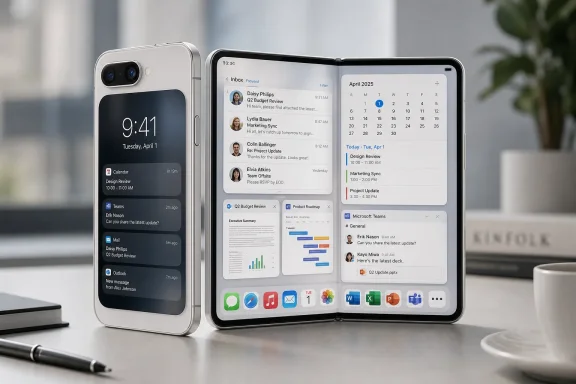
The leaked dummy images reportedly shared by Sonny Dickson show a wide, book-style foldable rather than a clamshell flip phone. That choice alone tells us where Apple thinks the opportunity sits. This is not an attempt to revive the emotional compactness of the Motorola Razr era; it is an attempt to make the iPhone behave more like a pocketable iPad.
That is why comparisons to Microsoft’s Surface Duo keep appearing, even if the engineering is likely to be very different. The Duo was not a foldable-screen device in the Samsung Galaxy Z Fold sense; it was a dual-screen Android machine joined by a hinge. But visually and conceptually, the Apple leak points to the same broader promise: phone when closed, workspace when open, and a wider canvas than the slab phone can provide.
The dummy unit reportedly shows a horizontally arranged dual rear camera system on a raised island, with flash and microphone elements nearby, and a front camera placed toward the top-left corner when unfolded. None of this is confirmation of final hardware, but dummy units generally exist for accessory makers, supply-chain partners, and case testing. They are not fantasy renders in the strictest sense; they are physical guesses built around leaked dimensions and expected industrial design.
Apple has waited long enough that the foldable phone category no longer needs to be explained. That helps. The hinge is not science fiction, the crease is not shocking, and the price tag is no longer unprecedented. Apple’s challenge is therefore subtler: it has to make a mature category feel newly disciplined.
That caveat should not be treated as a reason to ignore the leak. Apple’s industrial design language is famously conservative once a product moves toward launch. The dummy images align with months of reporting around a book-style foldable iPhone with an inner display around 7.8 inches and an outer display around 5.5 inches. The exact numbers may shift, but the strategic direction is becoming difficult to dismiss.
The rumored white-only launch is more interesting than it sounds. Apple sometimes uses restrained color choices to mark first-generation devices as premium, technical, and controlled. The first iPhone was not a rainbow product. The first Apple Watch leaned heavily on material positioning. A white foldable iPhone would not be merely a color; it would be a statement that Apple wants this object to look less like a gaming handheld and more like a piece of high-end personal equipment.
Still, the phone’s reported design raises a practical question. A wide folding iPhone may be elegant on a desk and excellent for reading, but it must also survive jeans pockets, train platforms, airport trays, school bags, and repair counters. Foldables are not judged on keynote beauty alone. They are judged at the hinge, in the pocket lint, and at the Genius Bar.
That matters because the expected starting price is around $2,000. At that level, Apple is not merely selling a phone. It is selling permission to treat a phone as a primary computing device for reading, messaging, note-taking, travel, business review, gaming, and media consumption. The device has to absorb jobs that currently belong to tablets, laptops, or a second screen.
The “Ultra” name would also protect Apple from the perception that it is simply following Samsung. Samsung owns the foldable vocabulary in the Android world: Fold, Flip, Galaxy Z, Flex Mode. Apple has little incentive to adopt a naming convention that makes its first folding iPhone sound like a late response to a competitor’s category.
But “Ultra” brings risk. Apple has already used the name for the Apple Watch Ultra, where ruggedness, battery life, and specialist use cases justify the branding. An iPhone Ultra that drops Face ID, carries a fragile inner display, and costs more than a MacBook would have to earn the word quickly. Otherwise, “Ultra” becomes a tax on curiosity.
The likely reason is physical space. Face ID requires a sensor array, not just a front-facing camera. In a device trying to be thin enough to fold, survive, and still house two displays, a hinge, batteries, cameras, speakers, antennas, thermal hardware, and magnets, every cubic millimeter becomes political. Touch ID in a side button is not retro chic; it is packaging discipline.
This could divide users more sharply than Apple expects. Many longtime iPhone owners still miss Touch ID, especially in winter, at desks, or in situations where looking directly at the device is awkward. But Face ID has become part of the modern iPhone’s muscle memory. Losing it on Apple’s most expensive iPhone would make the product feel, in one narrow but important way, less advanced than cheaper models.
The software story could soften that blow. Apple Watch unlock, passkeys, proximity authentication, and improved side-button ergonomics could make Touch ID feel less like regression. But if the rumor holds, Apple will be asking customers to pay more than ever for an iPhone that gives up one of the iPhone’s signature conveniences. That is a very Apple trade: invisible engineering victory, visible user compromise.
Apple’s rumored target of a near crease-free or crease-minimized display is exactly where the company would need to compete. Samsung has improved its foldable displays over several generations, but the crease remains part of the user experience. Google’s Pixel Fold line and Chinese foldables have attacked the same problem with different hinge geometries and panel approaches. Nobody has made the crease disappear as a consumer concern.
Apple does not need the crease to be mathematically absent. It needs the crease to be emotionally absent. If users stop seeing it while reading, editing photos, marking up PDFs, watching video, or dragging windows around, the fight is won. If reviewers spend the first week photographing reflections across the fold line, Apple will inherit the same narrative burden that Android vendors have carried for years.
The outer display may matter just as much. A 5.49-inch cover screen would make the folded device more usable than early narrow foldables, but it would still be smaller than many current flagship phones. Apple has to decide whether the closed experience is a full iPhone experience or a quick-interaction mode. If the folded device feels compromised too often, users will open it constantly; if opening it constantly feels cumbersome, the product loses its rhythm.
Foldables are power-management problems disguised as luxury devices. The inner screen is large, bright, and likely adaptive-refresh. The outer screen must remain useful. The hinge and body geometry constrain battery placement. Thinness competes with endurance, and endurance competes with weight. A foldable phone that lasts “a full day” under gentle use is not enough if opening it for maps, email, video calls, and document review drains confidence by dinner.
The rumored 5,000mAh battery would be large by iPhone standards but ordinary in the foldable world. Apple’s advantage is vertical integration: silicon, operating system, display management, app lifecycle, and hardware design all sit under one roof. That has often let iPhones do more with less battery capacity than Android rivals. But a foldable device changes the equation because user behavior changes with the screen.
If people use the unfolded display like a tablet, they will spend longer sessions inside heavier apps. Safari tabs, Mail, Notes, Freeform, Photos, YouTube, Teams, Slack, Lightroom, Remote Desktop, and games will expose the device to workloads that look less like phone usage and more like light computing. That is where the A20’s efficiency may matter more than its benchmark score.
That is not necessarily a flaw. Foldables have often made camera compromises because the hinge, battery split, and thin unfolded halves consume space. Users who buy a foldable usually accept that they are buying display flexibility before optical maximalism. Apple’s task is to make that compromise feel intentional rather than cheap.
A dual-camera system could still be excellent if Apple uses strong sensors and computational processing. The wide and ultra-wide pairing remains useful for everyday shooting, document capture, video, FaceTime, scanning, and social media. What users may miss is the psychological comfort of knowing the most expensive iPhone is also the best camera iPhone.
This is where Apple’s lineup strategy becomes tricky. If the iPhone 18 Pro Max has better zoom, Face ID, lower price, and more pocketable reliability, the foldable iPhone must win somewhere else decisively. It cannot merely be “the expensive one.” It has to be the one that changes how people use iOS.
Apple already has pieces of the answer. iPadOS has Stage Manager, Split View, Slide Over remnants, external-display support, Apple Pencil workflows, Files, Freeform, and increasingly desktop-class app ambitions. iOS has the app ecosystem, notification discipline, camera-first behavior, and tight phone identity. The foldable iPhone has to borrow from both without becoming a miniature iPad that frustrates people or an enlarged iPhone that wastes space.
That line is difficult. Android foldables have improved enormously, but they still rely on a mixture of app scaling, taskbars, split-screen modes, and developer accommodation. Some apps shine; others stretch awkwardly. Apple can enforce better adaptation through its developer tools and App Store expectations, but it cannot magically redesign every third-party app before launch.
The strongest version of the iPhone Ultra would make common tasks feel obvious. Messages beside Photos. Mail beside Calendar. Safari beside Notes. A video call with a document open. A boarding pass on the cover screen, then trip planning on the inner screen. The weakest version would simply make Instagram bigger.
A foldable iPhone that succeeds would create a new high-end endpoint class: not quite phone, not quite tablet, not quite laptop, but capable enough to handle real work in short bursts. That matters to admins because unmanaged “quick work” devices already leak into enterprise workflows. People approve documents, review spreadsheets, join Teams calls, open PDFs, sign contracts, and access dashboards from phones every day. Give them a larger screen that fits in a pocket, and they will do more of it.
Microsoft has learned this lesson from both sides. The Surface Duo showed that dual-screen mobile productivity was plausible but not sufficient. Windows on ARM, Cloud PC, Phone Link, Intune, Entra ID, and Microsoft 365 all orbit the same reality: work no longer belongs to a single form factor. Apple’s foldable iPhone could make that reality more mainstream among executives, consultants, field workers, developers, and IT decision-makers who live inside iOS but work inside Microsoft services.
The irony is hard to miss. Microsoft tried to define the pocket productivity foldable and failed commercially. Apple may now enter with a device that resembles the dream, backed by an app ecosystem and customer base Microsoft did not have in mobile. If it works, the Surface Duo will look less like a dead end and more like an idea that arrived without the platform leverage to survive.
The device’s foldable nature raises practical support questions. Cases may be expensive and awkward. Screen protectors may be nonstandard or factory-applied. Repair costs may be high. Device replacement pools may not include equivalent hardware. Help desks will need to understand whether a broken inner display is a productivity emergency or a luxury inconvenience.
Security teams will care about authentication. If Apple does ship Touch ID instead of Face ID, admins will need to evaluate user behavior and policy implications. Biometric authentication remains biometric authentication from a management perspective, but the user experience changes. Side-button Touch ID may be easier in some mounted or desk scenarios and worse in others.
App layout is another enterprise variable. Microsoft, Adobe, Salesforce, ServiceNow, Zoom, Slack, Atlassian, Citrix, VMware, and remote desktop vendors will all have incentives to optimize for the form factor if Apple sells enough units. Until then, organizations may see uneven behavior: some apps using the larger screen elegantly, others behaving like scaled phone apps. IT will not be buying a foldable; it will be inheriting a new screen class.
The answer is convenience. The iPad mini is lovely, but it is still a second device. It needs to be charged, carried, connected, and remembered. A folding iPhone collapses that decision into the phone you already bring everywhere. That is the product’s most powerful argument.
But the iPad mini has advantages Apple cannot ignore. It is cheaper. It is thinner as a tablet. It has no hinge crease. It has room for battery and speakers. It supports Apple Pencil in a way that may be difficult for a foldable inner display, depending on durability and digitizer choices. It is also easier to share, mount, hand to a child, or toss into a bag without anxiety.
Apple may be willing to let the foldable iPhone cannibalize some iPad mini demand because the price delta is so large. A $2,000 iPhone Ultra is not a threat to iPad revenue in a simple one-for-one sense. It is a way to capture customers who want one premium device rather than two midrange ones. That is classic Apple segmentation: not eliminating overlap, but charging handsomely for the most elegant overlap.
Yet the category still feels like it is waiting for a final act of translation. The hardware is impressive, but the average buyer still asks why. Why pay more? Why accept fragility? Why carry extra thickness? Why risk repair costs? Why not buy a normal phone and a tablet?
Apple’s advantage is not that it invents categories from nothing. More often, it waits until a category’s components are good enough and then supplies a reason to care. The iPod did not invent the MP3 player. The iPhone did not invent the smartphone. The Apple Watch did not invent the smartwatch. The iPhone Ultra would not invent the foldable, but it could supply the mainstream story foldables have lacked.
That story has to be more than “it opens.” It has to be about reading without squinting, editing without pinching, traveling without a tablet, working without a laptop for small tasks, and relaxing without balancing a giant slab phone. The fold must become a behavior, not a party trick.
Skipping Face ID may be one such compromise. Limiting camera hardware may be another. Launching in limited colors could simplify manufacturing. A first-generation product may also ship with constrained production volumes, which would let Apple test demand while preserving the aura of scarcity.
This creates a messaging problem. Apple customers are used to paying more, but they expect the most expensive model to be the most complete model. A foldable iPhone that is thinner, more futuristic, and more versatile can justify some trade-offs. But if buyers perceive those trade-offs as downgrades, Apple may find itself explaining why the “Ultra” iPhone lacks features found on cheaper iPhones.
That is the razor’s edge of first-generation Apple hardware. Early adopters forgive a lot when the product changes their habits. They forgive much less when the novelty fades and the missing features remain.
Reviewers will focus on predictable questions. How visible is the crease? How heavy is it? Does it close flat? Does the outer screen feel cramped? Does the inner display scratch easily? How does battery life compare with the iPhone 18 Pro Max? Is Touch ID fast enough? Do apps adapt? Is it awkward as a camera? Does it feel fragile? Does it feel worth two thousand dollars?
Apple can survive mixed answers if the core experience feels new. The first Apple Watch was slow and conceptually messy, but it established a beachhead. The first iPad was mocked as an oversized iPod touch, then quietly became a category. The first foldable iPhone does not need perfection. It needs a reason for owners to keep unfolding it after the first week.
That reason may be personal computing’s oldest lure: more space. Screens define behavior. Give people a larger screen in the device they already use most, and some will find uses Apple did not emphasize. That is how categories become real.
That distinction matters because foldables have spent years being simultaneously real and niche. Samsung, Google, OnePlus, Oppo, Vivo, Motorola, and others have proved that folding glass can survive everyday use, but they have not yet proved that most people need it. If Apple is finally stepping in, the question is not whether Cupertino can copy a hinge. The question is whether Apple can make the fold feel inevitable.
 Apple Arrives Late, Which Is Exactly How Apple Likes It
The leaked dummy images reportedly shared by Sonny Dickson show a wide, book-style foldable rather than a clamshell flip phone. That choice alone tells us where Apple thinks the opportunity sits. This is not an attempt to revive the emotional compactness of the Motorola Razr era; it is an attempt to make the iPhone behave more like a pocketable iPad.That is why comparisons to Microsoft’s Surface Duo keep appearing, even if the engineering is likely to be very different. The Duo was not a foldable-screen device in the Samsung Galaxy Z Fold sense; it was a dual-screen Android machine joined by a hinge. But visually and conceptually, the Apple leak points to the same broader promise: phone when closed, workspace when open, and a wider canvas than the slab phone can provide.
The dummy unit reportedly shows a horizontally arranged dual rear camera system on a raised island, with flash and microphone elements nearby, and a front camera placed toward the top-left corner when unfolded. None of this is confirmation of final hardware, but dummy units generally exist for accessory makers, supply-chain partners, and case testing. They are not fantasy renders in the strictest sense; they are physical guesses built around leaked dimensions and expected industrial design.
Apple has waited long enough that the foldable phone category no longer needs to be explained. That helps. The hinge is not science fiction, the crease is not shocking, and the price tag is no longer unprecedented. Apple’s challenge is therefore subtler: it has to make a mature category feel newly disciplined.
The Dummy Unit Is Less a Reveal Than a Negotiation
A dummy model can tell us shape, proportions, button placement, and camera geography. It cannot tell us whether Apple has solved the core problems that make foldables divisive: durability, display texture, software continuity, repair cost, battery life, and whether the unfolded experience is meaningfully better than simply carrying an iPhone and an iPad mini.That caveat should not be treated as a reason to ignore the leak. Apple’s industrial design language is famously conservative once a product moves toward launch. The dummy images align with months of reporting around a book-style foldable iPhone with an inner display around 7.8 inches and an outer display around 5.5 inches. The exact numbers may shift, but the strategic direction is becoming difficult to dismiss.
The rumored white-only launch is more interesting than it sounds. Apple sometimes uses restrained color choices to mark first-generation devices as premium, technical, and controlled. The first iPhone was not a rainbow product. The first Apple Watch leaned heavily on material positioning. A white foldable iPhone would not be merely a color; it would be a statement that Apple wants this object to look less like a gaming handheld and more like a piece of high-end personal equipment.
Still, the phone’s reported design raises a practical question. A wide folding iPhone may be elegant on a desk and excellent for reading, but it must also survive jeans pockets, train platforms, airport trays, school bags, and repair counters. Foldables are not judged on keynote beauty alone. They are judged at the hinge, in the pocket lint, and at the Genius Bar.
The Name War Is Really a Price War
The rumored names — iPhone Fold and iPhone Ultra — point to two very different marketing stories. “Fold” describes the mechanism. “Ultra” describes status. Apple almost certainly prefers the latter if it believes the product should sit above the Pro Max rather than beside it.That matters because the expected starting price is around $2,000. At that level, Apple is not merely selling a phone. It is selling permission to treat a phone as a primary computing device for reading, messaging, note-taking, travel, business review, gaming, and media consumption. The device has to absorb jobs that currently belong to tablets, laptops, or a second screen.
The “Ultra” name would also protect Apple from the perception that it is simply following Samsung. Samsung owns the foldable vocabulary in the Android world: Fold, Flip, Galaxy Z, Flex Mode. Apple has little incentive to adopt a naming convention that makes its first folding iPhone sound like a late response to a competitor’s category.
But “Ultra” brings risk. Apple has already used the name for the Apple Watch Ultra, where ruggedness, battery life, and specialist use cases justify the branding. An iPhone Ultra that drops Face ID, carries a fragile inner display, and costs more than a MacBook would have to earn the word quickly. Otherwise, “Ultra” becomes a tax on curiosity.
Touch ID’s Return Would Be a Design Compromise Wearing a Nostalgia Mask
One of the most persistent rumors is that Apple’s foldable iPhone will skip Face ID and use Touch ID in the side button. That would be a remarkable reversal for a company that has spent years training users to authenticate by looking at their phones. It would also be one of the clearest signs that the foldable form factor forces trade-offs even Apple cannot wish away.The likely reason is physical space. Face ID requires a sensor array, not just a front-facing camera. In a device trying to be thin enough to fold, survive, and still house two displays, a hinge, batteries, cameras, speakers, antennas, thermal hardware, and magnets, every cubic millimeter becomes political. Touch ID in a side button is not retro chic; it is packaging discipline.
This could divide users more sharply than Apple expects. Many longtime iPhone owners still miss Touch ID, especially in winter, at desks, or in situations where looking directly at the device is awkward. But Face ID has become part of the modern iPhone’s muscle memory. Losing it on Apple’s most expensive iPhone would make the product feel, in one narrow but important way, less advanced than cheaper models.
The software story could soften that blow. Apple Watch unlock, passkeys, proximity authentication, and improved side-button ergonomics could make Touch ID feel less like regression. But if the rumor holds, Apple will be asking customers to pay more than ever for an iPhone that gives up one of the iPhone’s signature conveniences. That is a very Apple trade: invisible engineering victory, visible user compromise.
The Display Is the Product, and the Crease Is the Trial
The central promise of the device is the rumored inner LTPO OLED display, reportedly around 7.76 or 7.8 inches with a 120Hz refresh rate. That would put the foldable iPhone into a space somewhere between a Pro Max and an iPad mini, but with a crucial difference: it would always be with you. The best tablet is often the one you did not leave at home.Apple’s rumored target of a near crease-free or crease-minimized display is exactly where the company would need to compete. Samsung has improved its foldable displays over several generations, but the crease remains part of the user experience. Google’s Pixel Fold line and Chinese foldables have attacked the same problem with different hinge geometries and panel approaches. Nobody has made the crease disappear as a consumer concern.
Apple does not need the crease to be mathematically absent. It needs the crease to be emotionally absent. If users stop seeing it while reading, editing photos, marking up PDFs, watching video, or dragging windows around, the fight is won. If reviewers spend the first week photographing reflections across the fold line, Apple will inherit the same narrative burden that Android vendors have carried for years.
The outer display may matter just as much. A 5.49-inch cover screen would make the folded device more usable than early narrow foldables, but it would still be smaller than many current flagship phones. Apple has to decide whether the closed experience is a full iPhone experience or a quick-interaction mode. If the folded device feels compromised too often, users will open it constantly; if opening it constantly feels cumbersome, the product loses its rhythm.
The A20 Rumor Points to a Device Built Around Efficiency, Not Speed
The reported A20 chip, expected to be manufactured on TSMC’s 2nm-class process, is the kind of specification that will dominate rumor roundups but may not be the real story. Every new iPhone chip is faster. The foldable iPhone’s actual test will be whether Apple can turn process-node gains into battery life, thermal stability, and sustained performance across two displays.Foldables are power-management problems disguised as luxury devices. The inner screen is large, bright, and likely adaptive-refresh. The outer screen must remain useful. The hinge and body geometry constrain battery placement. Thinness competes with endurance, and endurance competes with weight. A foldable phone that lasts “a full day” under gentle use is not enough if opening it for maps, email, video calls, and document review drains confidence by dinner.
The rumored 5,000mAh battery would be large by iPhone standards but ordinary in the foldable world. Apple’s advantage is vertical integration: silicon, operating system, display management, app lifecycle, and hardware design all sit under one roof. That has often let iPhones do more with less battery capacity than Android rivals. But a foldable device changes the equation because user behavior changes with the screen.
If people use the unfolded display like a tablet, they will spend longer sessions inside heavier apps. Safari tabs, Mail, Notes, Freeform, Photos, YouTube, Teams, Slack, Lightroom, Remote Desktop, and games will expose the device to workloads that look less like phone usage and more like light computing. That is where the A20’s efficiency may matter more than its benchmark score.
The Camera System Signals That This Is Not a Pro Max With a Hinge
The rumored dual 48MP rear camera setup is notable because it suggests Apple may not try to make the foldable iPhone the undisputed camera king. The current Pro Max identity is heavily bound up with camera superiority: telephoto reach, sensor improvements, spatial video, low-light performance, and computational photography. A foldable body may not have room for every one of those ambitions.That is not necessarily a flaw. Foldables have often made camera compromises because the hinge, battery split, and thin unfolded halves consume space. Users who buy a foldable usually accept that they are buying display flexibility before optical maximalism. Apple’s task is to make that compromise feel intentional rather than cheap.
A dual-camera system could still be excellent if Apple uses strong sensors and computational processing. The wide and ultra-wide pairing remains useful for everyday shooting, document capture, video, FaceTime, scanning, and social media. What users may miss is the psychological comfort of knowing the most expensive iPhone is also the best camera iPhone.
This is where Apple’s lineup strategy becomes tricky. If the iPhone 18 Pro Max has better zoom, Face ID, lower price, and more pocketable reliability, the foldable iPhone must win somewhere else decisively. It cannot merely be “the expensive one.” It has to be the one that changes how people use iOS.
iOS Has to Become a Foldable Operating System Without Becoming Android
Hardware leaks are seductive because they are visible. Software is where the product will live or die. A folding iPhone needs more than app continuity between outer and inner displays; it needs a coherent philosophy for multitasking, windowing, input, rotation, continuity, and handoff.Apple already has pieces of the answer. iPadOS has Stage Manager, Split View, Slide Over remnants, external-display support, Apple Pencil workflows, Files, Freeform, and increasingly desktop-class app ambitions. iOS has the app ecosystem, notification discipline, camera-first behavior, and tight phone identity. The foldable iPhone has to borrow from both without becoming a miniature iPad that frustrates people or an enlarged iPhone that wastes space.
That line is difficult. Android foldables have improved enormously, but they still rely on a mixture of app scaling, taskbars, split-screen modes, and developer accommodation. Some apps shine; others stretch awkwardly. Apple can enforce better adaptation through its developer tools and App Store expectations, but it cannot magically redesign every third-party app before launch.
The strongest version of the iPhone Ultra would make common tasks feel obvious. Messages beside Photos. Mail beside Calendar. Safari beside Notes. A video call with a document open. A boarding pass on the cover screen, then trip planning on the inner screen. The weakest version would simply make Instagram bigger.
Windows Users Should Watch This as a Mobility Story, Not Just an Apple Story
For WindowsForum readers, the temptation is to file this under Apple gossip and move on. That would miss the broader shift. Foldables are part of a larger rethinking of mobile productivity, and that overlaps directly with Windows, Microsoft 365, cloud PCs, remote access, Teams, OneDrive, Edge, and enterprise identity.A foldable iPhone that succeeds would create a new high-end endpoint class: not quite phone, not quite tablet, not quite laptop, but capable enough to handle real work in short bursts. That matters to admins because unmanaged “quick work” devices already leak into enterprise workflows. People approve documents, review spreadsheets, join Teams calls, open PDFs, sign contracts, and access dashboards from phones every day. Give them a larger screen that fits in a pocket, and they will do more of it.
Microsoft has learned this lesson from both sides. The Surface Duo showed that dual-screen mobile productivity was plausible but not sufficient. Windows on ARM, Cloud PC, Phone Link, Intune, Entra ID, and Microsoft 365 all orbit the same reality: work no longer belongs to a single form factor. Apple’s foldable iPhone could make that reality more mainstream among executives, consultants, field workers, developers, and IT decision-makers who live inside iOS but work inside Microsoft services.
The irony is hard to miss. Microsoft tried to define the pocket productivity foldable and failed commercially. Apple may now enter with a device that resembles the dream, backed by an app ecosystem and customer base Microsoft did not have in mobile. If it works, the Surface Duo will look less like a dead end and more like an idea that arrived without the platform leverage to survive.
Enterprise IT Will See the Device Before It Sees the Budget Line
At $2,000 or more, this will not be a fleet-standard handset for most organizations. It will enter companies through executives, early adopters, developers, sales leaders, and BYOD programs. That is exactly how many management headaches begin.The device’s foldable nature raises practical support questions. Cases may be expensive and awkward. Screen protectors may be nonstandard or factory-applied. Repair costs may be high. Device replacement pools may not include equivalent hardware. Help desks will need to understand whether a broken inner display is a productivity emergency or a luxury inconvenience.
Security teams will care about authentication. If Apple does ship Touch ID instead of Face ID, admins will need to evaluate user behavior and policy implications. Biometric authentication remains biometric authentication from a management perspective, but the user experience changes. Side-button Touch ID may be easier in some mounted or desk scenarios and worse in others.
App layout is another enterprise variable. Microsoft, Adobe, Salesforce, ServiceNow, Zoom, Slack, Atlassian, Citrix, VMware, and remote desktop vendors will all have incentives to optimize for the form factor if Apple sells enough units. Until then, organizations may see uneven behavior: some apps using the larger screen elegantly, others behaving like scaled phone apps. IT will not be buying a foldable; it will be inheriting a new screen class.
Apple’s Real Competitor Is Not Samsung, but the iPad Mini in Your Drawer
The obvious comparison is Samsung’s Galaxy Z Fold line. The more revealing comparison is Apple’s own iPad mini. The rumored inner display size puts the foldable iPhone close enough to small-tablet territory that Apple has to explain why this device exists alongside the iPad mini rather than instead of it.The answer is convenience. The iPad mini is lovely, but it is still a second device. It needs to be charged, carried, connected, and remembered. A folding iPhone collapses that decision into the phone you already bring everywhere. That is the product’s most powerful argument.
But the iPad mini has advantages Apple cannot ignore. It is cheaper. It is thinner as a tablet. It has no hinge crease. It has room for battery and speakers. It supports Apple Pencil in a way that may be difficult for a foldable inner display, depending on durability and digitizer choices. It is also easier to share, mount, hand to a child, or toss into a bag without anxiety.
Apple may be willing to let the foldable iPhone cannibalize some iPad mini demand because the price delta is so large. A $2,000 iPhone Ultra is not a threat to iPad revenue in a simple one-for-one sense. It is a way to capture customers who want one premium device rather than two midrange ones. That is classic Apple segmentation: not eliminating overlap, but charging handsomely for the most elegant overlap.
The Foldable Market Has Been Waiting for a Software Company With Hardware Taste
Samsung deserves credit for building the foldable market through persistence. The original Galaxy Fold stumbled publicly, but Samsung kept iterating, improving hinge durability, display materials, water resistance, app behavior, and mainstream availability. Google added its own software-first interpretation with the Pixel Fold family. Chinese manufacturers pushed thinness, battery capacity, charging speeds, and crease reduction.Yet the category still feels like it is waiting for a final act of translation. The hardware is impressive, but the average buyer still asks why. Why pay more? Why accept fragility? Why carry extra thickness? Why risk repair costs? Why not buy a normal phone and a tablet?
Apple’s advantage is not that it invents categories from nothing. More often, it waits until a category’s components are good enough and then supplies a reason to care. The iPod did not invent the MP3 player. The iPhone did not invent the smartphone. The Apple Watch did not invent the smartwatch. The iPhone Ultra would not invent the foldable, but it could supply the mainstream story foldables have lacked.
That story has to be more than “it opens.” It has to be about reading without squinting, editing without pinching, traveling without a tablet, working without a laptop for small tasks, and relaxing without balancing a giant slab phone. The fold must become a behavior, not a party trick.
The Cost-Cutting Rumors Are a Warning Shot
The most interesting tension in the leak cycle is the claim that Apple will use premium components while still making cost-conscious compromises. That may sound absurd for a device expected to exceed $2,000, but foldables are expensive to build. The hinge, displays, yield rates, mechanical tolerances, and durability testing all add cost before Apple gets to cameras, silicon, storage, and margin.Skipping Face ID may be one such compromise. Limiting camera hardware may be another. Launching in limited colors could simplify manufacturing. A first-generation product may also ship with constrained production volumes, which would let Apple test demand while preserving the aura of scarcity.
This creates a messaging problem. Apple customers are used to paying more, but they expect the most expensive model to be the most complete model. A foldable iPhone that is thinner, more futuristic, and more versatile can justify some trade-offs. But if buyers perceive those trade-offs as downgrades, Apple may find itself explaining why the “Ultra” iPhone lacks features found on cheaper iPhones.
That is the razor’s edge of first-generation Apple hardware. Early adopters forgive a lot when the product changes their habits. They forgive much less when the novelty fades and the missing features remain.
The First Generation Will Be Bought by Believers and Judged by Skeptics
If the launch happens in September 2026, the first buyers will not be average upgrade-cycle customers. They will be Apple loyalists, developers, executives, reviewers, collectors, productivity obsessives, and people who have been waiting for Apple to validate foldables before spending. That audience is both forgiving and loud.Reviewers will focus on predictable questions. How visible is the crease? How heavy is it? Does it close flat? Does the outer screen feel cramped? Does the inner display scratch easily? How does battery life compare with the iPhone 18 Pro Max? Is Touch ID fast enough? Do apps adapt? Is it awkward as a camera? Does it feel fragile? Does it feel worth two thousand dollars?
Apple can survive mixed answers if the core experience feels new. The first Apple Watch was slow and conceptually messy, but it established a beachhead. The first iPad was mocked as an oversized iPod touch, then quietly became a category. The first foldable iPhone does not need perfection. It needs a reason for owners to keep unfolding it after the first week.
That reason may be personal computing’s oldest lure: more space. Screens define behavior. Give people a larger screen in the device they already use most, and some will find uses Apple did not emphasize. That is how categories become real.
The Apple Foldable Era Will Start With Trade-Offs, Not Magic
The practical read is less glamorous than the leak cycle but more useful. Apple’s first foldable iPhone appears to be approaching as a high-priced, limited-audience, strategically important device that will test whether iOS can stretch into a pocket tablet without losing its phone identity.- Apple’s first foldable iPhone is expected in September 2026, but the company has not announced the product or confirmed the name.
- The leaked dummy units point to a book-style design with a wide inner display rather than a clamshell flip-phone format.
- The rumored loss of Face ID would be one of the most controversial compromises on Apple’s most expensive iPhone.
- The device’s success will depend less on raw specifications than on app continuity, multitasking, durability, and battery confidence.
- Windows and Microsoft 365 environments should treat the device as a new mobile-work endpoint class, especially in BYOD and executive fleets.
- The $2,000 price range means the first model will shape perception before it shapes mass-market adoption.
References
- Primary source: TelecomTalk
Published: 2026-06-13T09:52:07.189206
Loading…
telecomtalk.info - Related coverage: techradar.com
Loading…
www.techradar.com - Related coverage: t3.com
Loading…
www.t3.com - Related coverage: macrumors.com
Loading…
www.macrumors.com - Related coverage: macworld.com
Loading…
www.macworld.com - Related coverage: gadgets360.com
Loading…
www.gadgets360.com
- Related coverage: macobserver.com
Loading…
www.macobserver.com - Related coverage: khaleejtimes.com
Loading…
www.khaleejtimes.com - Related coverage: androidheadlines.com
Loading…
www.androidheadlines.com - Related coverage: appleinsider.com
Loading…
appleinsider.com - Related coverage: 9to5mac.com
Loading…
9to5mac.com - Related coverage: creativebloq.com
Loading…
www.creativebloq.com - Related coverage: tomsguide.com
Loading…
www.tomsguide.com - Related coverage: ashgabattimes.com
Loading…
ashgabattimes.com