

Verdict: chase the free Microsoft Certification voucher only if you can complete an eligible AI Skills Fest playlist and submit the voucher claim form before 12:00 AM UTC on June 12, 2026; otherwise, take the playlists at your own pace and treat the badge as the realistic prize. Microsoft AI Skills Fest 2026 runs June 8–12 as a free virtual training event, and Microsoft says an eligible playlist can unlock a free certification exam voucher, a Credly badge, and sweepstakes entry, but the voucher is the time-sensitive part. For WindowsForum readers, the decision is less “is free training good?” than “can I turn a short event window into an exam I will actually sit before the redemption clock runs out?”
If your goal is a Microsoft exam this summer or early autumn, the voucher is worth chasing immediately. Complete an eligible playlist inside the AI Skills Fest experience, look for the claim form that appears after completion, submit that form before the June 12 UTC deadline, then watch for the voucher email and redeem it within 60 days of issuance. The exam itself must be delivered by October 18, 2026.
That is the clean decision path. The messy part is that Microsoft’s offer is not simply “watch some training, get a free exam whenever.” The reward depends on eligibility, completion, form submission, voucher redemption, and exam scheduling. Miss one link in that chain and the remaining training may still be useful, but the economic value changes.
For an IT pro, the voucher is most valuable when it maps to an exam you already planned to take. For a student or career switcher, it can be a useful forcing function: finish a structured playlist now, pick a credential path, and give yourself a real deadline. For a casual Windows enthusiast, the better answer may be the opposite: take the playlists, ignore the certification sprint, and avoid converting a free event into another half-finished professional obligation.
The practical procedure is straightforward. Register for Microsoft AI Skills Fest, sign in with the account you want associated with the event, choose an eligible AI Skills Fest playlist, complete it in full during the event window, and then use the voucher claim form exposed inside the event experience. Do not assume the voucher is issued automatically just because the playlist shows complete; Microsoft’s own support language says the claim form must be completed.
That packaging matters because each reward behaves differently. The badge is recognition of completion. The sweepstakes is a chance-based promotional add-on. The voucher is the item with hard cash value, but also the one with the most brittle rules.
Microsoft says completing an eligible skilling playlist during the event can earn a free Microsoft Certification exam voucher and a Credly badge. It also says the voucher claim form must be submitted by 12:00 AM UTC on June 12, 2026, that the voucher must be redeemed within 60 days, and that the exam must be delivered by October 18, 2026. Those dates turn this from a general learning opportunity into a calendar-management exercise.
That is why the best advice is not “everyone should do this.” It is “only chase the voucher if you can complete the whole chain.” A free exam voucher is valuable, but a missed form deadline is just a long training session with extra frustration attached.
That is the kind of detail that catches people out. A US-based reader thinking “I have Friday” may not have Friday in the way they expect, because UTC deadlines do not politely align with local evening study plans. If the voucher matters, June 11 is the day to behave as if the offer is ending.
The event itself runs June 8–12, 2026, but the voucher claim requirement is the sharper edge. Training availability after the event is less important than the reward workflow before the deadline. Microsoft Q&A responses indicate that playlists may remain available after the event, but the exam voucher claim opportunity does not carry the same after-party guarantee.
That distinction should drive the decision. If you are here for learning, the urgency is modest. If you are here for the exam voucher, the urgency is absolute.
For sysadmins, cloud engineers, help desk leads, and Windows admins expanding into Azure or Microsoft 365 administration, the calculation is different. A Microsoft Certification exam can be a useful credential signal when it lines up with work you already perform or a platform your employer already runs. In that case, AI Skills Fest becomes a subsidy on a path you were already walking.
But if your daily work is still mostly endpoint support, imaging, Intune policy cleanup, Windows Server maintenance, or PowerShell automation, the value depends on whether the eligible playlist and the eventual exam reinforce that work. AI hype is cheap; a credential that maps to your next ticket queue or promotion path is not. The voucher is valuable only if it buys an exam that you would defend on your résumé.
The timing also matters. Redeeming within 60 days sounds generous until you remember that exam readiness is not automatic. The exam must be delivered by October 18, 2026, so this is a summer-to-early-autumn certification push, not a vague professional development bookmark.
For experienced IT pros, the badge should be treated as evidence of participation, not mastery. Employers who understand Microsoft’s credential ladder will weigh a certification exam more heavily than a playlist completion badge. That does not make the badge worthless; it makes it a different kind of artifact.
There is a useful place for it. If you are building a public profile around Microsoft ecosystem skills, a Credly badge tied to AI Skills Fest can show that you are keeping up with the direction Microsoft is pushing. It is especially useful when paired with something more concrete: an internal pilot, a governance write-up, a Copilot deployment checklist, or a certification exam.
On its own, though, the badge should not be the reason to cram. If the voucher is out of reach, take the training because the material is relevant, not because a badge will transform your professional standing.
Technical pros should ask whether the playlist supports a certification path that matters to their current job or next role. Business users should ask whether they need a formal Microsoft exam at all, or whether the training and badge are sufficient. Students should ask whether the credential will help with internships, entry-level roles, or academic requirements. Enthusiasts should be honest about whether they want the structure of an exam or just the satisfaction of learning what Microsoft is currently teaching.
The exam-type boundary also matters. Microsoft says the voucher applies to Microsoft Certification exams, including beta exams and GitHub exams, while exams delivered by Certiport and Microsoft Office Specialist exams are not eligible. That means readers chasing desktop Office credentials should not assume this offer covers them.
The regional question is trickier from the public material available. Microsoft’s AI Skills Fest page describes a virtual event aimed at a broad audience, and the support material lays out reward mechanics, but readers should still verify eligibility in the event experience and terms shown to their account. If a promotion depends on country, identity, employer, or account status, the final answer is the rule set shown during registration and claim.
That is not a dodge; it is the correct operational posture. Promotional credential offers often look global from the landing page but become specific inside the claim workflow. The only safe move is to check eligibility before investing hours solely for the voucher.
The safest approach is to use the same account consistently across registration, playlist completion, claim submission, and certification scheduling wherever Microsoft allows it. If your employer controls your work identity, think twice before anchoring a personal credential plan entirely to an account you may lose access to later. If your school account expires after graduation, the same warning applies.
This is a familiar Microsoft ecosystem problem. The company has made enormous progress connecting Learn, credentials, badges, and partner experiences, but identity remains the hidden tax on almost every user-facing Microsoft workflow. The AI Skills Fest voucher is not immune to that.
Before you start, decide which account should own the credential story. That decision is boring, but it is less boring than discovering after the fact that your completion, badge, or voucher path is split across identities.
The procedure is simple enough to write down and follow. Register, sign in, complete an eligible playlist, return to the AI Skills Fest event experience, open the voucher claim form that appears after completion, fill it out, submit it before 12:00 AM UTC on June 12, and then monitor the email address associated with the claim. After the voucher arrives, redeem it within 60 days and schedule an eligible exam to be delivered by October 18.
The phrase “eligible playlist” deserves attention. Do not assume every piece of AI-related Microsoft training qualifies just because it lives near the event. Use the playlist surfaced by the AI Skills Fest experience, and avoid modifying the path if the event terms presented to you imply that completion must happen as designed.
Also do not confuse completing training with claiming the reward. Microsoft’s support answer is unusually direct on this point: the voucher is not triggered automatically. That is the kind of sentence that should make every admin in the room take a screenshot of the completion state and the submitted form confirmation, if the site provides one.
That means latecomers should not panic if their real goal is education. You can still use Microsoft’s AI training materials to understand the company’s terminology, product direction, and recommended workflows. You can still decide later whether a certification exam is worth pursuing.
What you lose after the deadline is leverage. The free voucher changes the economics of taking an exam. Without it, the question returns to normal: is the credential worth the time, the fee, and the maintenance burden?
For many WindowsForum readers, that may still be yes. Microsoft’s AI stack is increasingly entangled with Azure, Microsoft 365, developer tooling, endpoint management, security workflows, and the Copilot brand. Even if you skip the voucher, the playlists can help decode the roadmap Microsoft is already selling to your executives.
Free training lowers friction. A badge adds social proof. A voucher creates urgency. A sweepstakes adds promotional energy. Together, those incentives move people from curiosity to action faster than documentation alone.
That is why IT pros should read the event in two layers. The first layer is personal: can I get useful training and perhaps a free exam? The second layer is organizational: Microsoft is trying to normalize AI competence as a baseline skill across roles that did not previously think of themselves as AI roles.
For Windows administrators, that shift is already visible. AI is no longer a separate research category living somewhere in the data science department. It is showing up in productivity suites, security consoles, developer environments, cloud management, and help desk expectations. Skills Fest is a promotional event, but the underlying pressure is structural.
That is especially important because AI projects often arrive at IT’s doorstep after someone else has already promised business value. The sysadmin then inherits identity, data access, endpoint readiness, compliance, logging, licensing, and user support. Training that makes those conversations less foggy has practical value even without a credential.
The certification voucher adds a second layer. If your organization is beginning to formalize AI roles, cloud roles, or Copilot-related responsibilities, a Microsoft credential can become a useful signal in internal staffing debates. It is not a substitute for experience, but it is a portable proof point.
Still, the exam should not dictate the learning. Start with the work you expect to do, then choose the training and certification path that supports it. The voucher is a coupon, not a career plan.
The catch is focus. Broad events are easy to sample and hard to finish. If you are using this as a career step, do not bounce between playlists as if the goal were entertainment. Pick the path most aligned with the exam or job family you want, complete it, claim the voucher if eligible, and schedule a study plan immediately.
Scheduling matters because motivation decays quickly after a promotional event ends. The October 18 delivery deadline gives enough time to prepare, but not enough time to drift for months. If you get the voucher, the next best move is to choose an exam date while the event is still fresh.
That may sound severe, but it is how certification actually works. The exam is not won on the day you discover the free voucher. It is won in the boring weeks afterward.
But business users should be careful about chasing a technical certification for the wrong reason. If your job does not require administering Microsoft platforms, building solutions, or defending implementation choices, the playlist and badge may be the better match. A certification exam can be valuable, but only if the credential measures skills you intend to use.
There is also a cultural risk. Organizations can mistake credential counts for readiness. A department full of badges is not the same as a governed AI deployment, a secure data model, or a supportable workflow. Skills Fest can help, but it cannot replace policy, architecture, and operational ownership.
The smarter business-user path is to take the training that clarifies concepts and responsibilities. If that later points to a certification, pursue it deliberately. Do not let a free voucher drag you into an exam just because the clock is ticking.
That does not make the offer bad. It makes it a commitment test. If you were already near the starting line, Microsoft just lowered the cost of crossing it. If you were nowhere near it, Microsoft just created a tempting distraction.
This is where WindowsForum readers should be more disciplined than the average promotion hunter. Ask whether the credential supports your next six months of work. Ask whether the exam is eligible. Ask whether the account and region rules are clear in your event experience. Ask whether you can realistically sit the exam by October 18.
If the answers are yes, chase the voucher now. If the answers are no, take the playlists without guilt. The training can still be useful, and skipping the voucher does not mean skipping AI skills.
But the offer still has the usual promotional fragility. Deadlines are UTC-based. The voucher claim is not automatic. Eligibility depends on the event experience and the rules presented there. Some exam categories are excluded. The value of the voucher depends on whether you can turn it into an actual exam sitting before the later deadline.
That last point is the one to keep repeating. A voucher sitting in an inbox is not a certification. A completed playlist is not an exam pass. A badge is not hands-on operational competence. The event can open a door, but the learner still has to walk through it.
For admins and IT managers, there is a team angle too. If staff members are participating, make sure they understand whether the organization will recognize the certification, whether study time is permitted, and whether work accounts or personal accounts should be used. A free voucher can become a support headache if nobody decides those basics in advance.
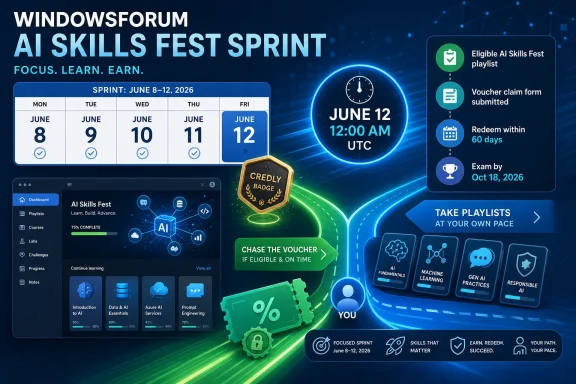 The Smart Play Is to Decide Before You Click Through the Playlist
If your goal is a Microsoft exam this summer or early autumn, the voucher is worth chasing immediately. Complete an eligible playlist inside the AI Skills Fest experience, look for the claim form that appears after completion, submit that form before the June 12 UTC deadline, then watch for the voucher email and redeem it within 60 days of issuance. The exam itself must be delivered by October 18, 2026.That is the clean decision path. The messy part is that Microsoft’s offer is not simply “watch some training, get a free exam whenever.” The reward depends on eligibility, completion, form submission, voucher redemption, and exam scheduling. Miss one link in that chain and the remaining training may still be useful, but the economic value changes.
For an IT pro, the voucher is most valuable when it maps to an exam you already planned to take. For a student or career switcher, it can be a useful forcing function: finish a structured playlist now, pick a credential path, and give yourself a real deadline. For a casual Windows enthusiast, the better answer may be the opposite: take the playlists, ignore the certification sprint, and avoid converting a free event into another half-finished professional obligation.
The practical procedure is straightforward. Register for Microsoft AI Skills Fest, sign in with the account you want associated with the event, choose an eligible AI Skills Fest playlist, complete it in full during the event window, and then use the voucher claim form exposed inside the event experience. Do not assume the voucher is issued automatically just because the playlist shows complete; Microsoft’s own support language says the claim form must be completed.
Microsoft Put the Value Behind the Form, Not the Training
The most important detail in this event is not that Microsoft is giving away AI training. Microsoft Learn has made free training a core part of its certification ecosystem for years. The new pressure point is that AI Skills Fest 2026 wraps the training in a short promotional window and attaches three incentives: a certification voucher, a Credly badge, and sweepstakes entry.That packaging matters because each reward behaves differently. The badge is recognition of completion. The sweepstakes is a chance-based promotional add-on. The voucher is the item with hard cash value, but also the one with the most brittle rules.
Microsoft says completing an eligible skilling playlist during the event can earn a free Microsoft Certification exam voucher and a Credly badge. It also says the voucher claim form must be submitted by 12:00 AM UTC on June 12, 2026, that the voucher must be redeemed within 60 days, and that the exam must be delivered by October 18, 2026. Those dates turn this from a general learning opportunity into a calendar-management exercise.
That is why the best advice is not “everyone should do this.” It is “only chase the voucher if you can complete the whole chain.” A free exam voucher is valuable, but a missed form deadline is just a long training session with extra frustration attached.
The June 12 Deadline Is the Real Product Boundary
Microsoft’s public framing makes AI Skills Fest feel like a week-long learning event. In practice, for voucher hunters, it is shorter than that. A deadline of 12:00 AM UTC on June 12 means the claim cutoff arrives at the very start of June 12 in UTC terms, not at the end of the local workday for many readers.That is the kind of detail that catches people out. A US-based reader thinking “I have Friday” may not have Friday in the way they expect, because UTC deadlines do not politely align with local evening study plans. If the voucher matters, June 11 is the day to behave as if the offer is ending.
The event itself runs June 8–12, 2026, but the voucher claim requirement is the sharper edge. Training availability after the event is less important than the reward workflow before the deadline. Microsoft Q&A responses indicate that playlists may remain available after the event, but the exam voucher claim opportunity does not carry the same after-party guarantee.
That distinction should drive the decision. If you are here for learning, the urgency is modest. If you are here for the exam voucher, the urgency is absolute.
The Voucher Is Not a Strategy Unless You Already Know the Exam
The biggest mistake is treating the free voucher as the beginning of a certification plan. It should be the final discount on a plan that already exists. If you have no target exam, no study window, and no reason to certify, the voucher can turn into a deadline trap.For sysadmins, cloud engineers, help desk leads, and Windows admins expanding into Azure or Microsoft 365 administration, the calculation is different. A Microsoft Certification exam can be a useful credential signal when it lines up with work you already perform or a platform your employer already runs. In that case, AI Skills Fest becomes a subsidy on a path you were already walking.
But if your daily work is still mostly endpoint support, imaging, Intune policy cleanup, Windows Server maintenance, or PowerShell automation, the value depends on whether the eligible playlist and the eventual exam reinforce that work. AI hype is cheap; a credential that maps to your next ticket queue or promotion path is not. The voucher is valuable only if it buys an exam that you would defend on your résumé.
The timing also matters. Redeeming within 60 days sounds generous until you remember that exam readiness is not automatic. The exam must be delivered by October 18, 2026, so this is a summer-to-early-autumn certification push, not a vague professional development bookmark.
The Badge Is Useful, but It Is Not the Same Currency
The Credly badge is a softer reward. It can show completion, signal current interest in AI skills, and fill a small gap in a professional profile. For students, early-career technologists, and business users trying to demonstrate AI literacy, that may be enough.For experienced IT pros, the badge should be treated as evidence of participation, not mastery. Employers who understand Microsoft’s credential ladder will weigh a certification exam more heavily than a playlist completion badge. That does not make the badge worthless; it makes it a different kind of artifact.
There is a useful place for it. If you are building a public profile around Microsoft ecosystem skills, a Credly badge tied to AI Skills Fest can show that you are keeping up with the direction Microsoft is pushing. It is especially useful when paired with something more concrete: an internal pilot, a governance write-up, a Copilot deployment checklist, or a certification exam.
On its own, though, the badge should not be the reason to cram. If the voucher is out of reach, take the training because the material is relevant, not because a badge will transform your professional standing.
The Eligibility Story Is Clearer Than the Marketing Makes It Feel
Microsoft positions AI Skills Fest for technical professionals, business users, students, and AI enthusiasts. That breadth is good for participation, but it makes the voucher decision harder because those audiences do not have the same goals.Technical pros should ask whether the playlist supports a certification path that matters to their current job or next role. Business users should ask whether they need a formal Microsoft exam at all, or whether the training and badge are sufficient. Students should ask whether the credential will help with internships, entry-level roles, or academic requirements. Enthusiasts should be honest about whether they want the structure of an exam or just the satisfaction of learning what Microsoft is currently teaching.
The exam-type boundary also matters. Microsoft says the voucher applies to Microsoft Certification exams, including beta exams and GitHub exams, while exams delivered by Certiport and Microsoft Office Specialist exams are not eligible. That means readers chasing desktop Office credentials should not assume this offer covers them.
The regional question is trickier from the public material available. Microsoft’s AI Skills Fest page describes a virtual event aimed at a broad audience, and the support material lays out reward mechanics, but readers should still verify eligibility in the event experience and terms shown to their account. If a promotion depends on country, identity, employer, or account status, the final answer is the rule set shown during registration and claim.
That is not a dodge; it is the correct operational posture. Promotional credential offers often look global from the landing page but become specific inside the claim workflow. The only safe move is to check eligibility before investing hours solely for the voucher.
The Account You Use Now May Matter Later
The registration flow is not just clerical. For Microsoft events, certification workflows, Learn progress, badges, and exam scheduling can touch different identity systems. A personal Microsoft account, a work account, and a school account may not behave the same way when you later try to prove completion or schedule an exam.The safest approach is to use the same account consistently across registration, playlist completion, claim submission, and certification scheduling wherever Microsoft allows it. If your employer controls your work identity, think twice before anchoring a personal credential plan entirely to an account you may lose access to later. If your school account expires after graduation, the same warning applies.
This is a familiar Microsoft ecosystem problem. The company has made enormous progress connecting Learn, credentials, badges, and partner experiences, but identity remains the hidden tax on almost every user-facing Microsoft workflow. The AI Skills Fest voucher is not immune to that.
Before you start, decide which account should own the credential story. That decision is boring, but it is less boring than discovering after the fact that your completion, badge, or voucher path is split across identities.
The Claim Flow Should Be Treated Like a Change Window
WindowsForum readers know this pattern: if something has a hard deadline, a web form, and a back-end email process, do not leave it to the final hour. AI Skills Fest is not a production migration, but the operational habits are the same. Finish early, capture confirmation where appropriate, and assume that support queues will not save a last-minute submission.The procedure is simple enough to write down and follow. Register, sign in, complete an eligible playlist, return to the AI Skills Fest event experience, open the voucher claim form that appears after completion, fill it out, submit it before 12:00 AM UTC on June 12, and then monitor the email address associated with the claim. After the voucher arrives, redeem it within 60 days and schedule an eligible exam to be delivered by October 18.
The phrase “eligible playlist” deserves attention. Do not assume every piece of AI-related Microsoft training qualifies just because it lives near the event. Use the playlist surfaced by the AI Skills Fest experience, and avoid modifying the path if the event terms presented to you imply that completion must happen as designed.
Also do not confuse completing training with claiming the reward. Microsoft’s support answer is unusually direct on this point: the voucher is not triggered automatically. That is the kind of sentence that should make every admin in the room take a screenshot of the completion state and the submitted form confirmation, if the site provides one.
What Survives After June 12 Is Learning, Not Leverage
The most useful distinction in the whole event is between content and benefits. The playlists may continue to be accessible after the event, and Microsoft’s broader Learn catalog certainly is not disappearing. But the voucher claim opportunity is tied to the event’s active reward window.That means latecomers should not panic if their real goal is education. You can still use Microsoft’s AI training materials to understand the company’s terminology, product direction, and recommended workflows. You can still decide later whether a certification exam is worth pursuing.
What you lose after the deadline is leverage. The free voucher changes the economics of taking an exam. Without it, the question returns to normal: is the credential worth the time, the fee, and the maintenance burden?
For many WindowsForum readers, that may still be yes. Microsoft’s AI stack is increasingly entangled with Azure, Microsoft 365, developer tooling, endpoint management, security workflows, and the Copilot brand. Even if you skip the voucher, the playlists can help decode the roadmap Microsoft is already selling to your executives.
Microsoft Is Training the Market as Much as the Learner
AI Skills Fest is not charity. It is a market-shaping exercise, and there is nothing inherently wrong with that. Microsoft wants technical pros, business users, students, and enthusiasts to adopt its vocabulary, tools, and certification paths at the same time the company is embedding AI features across its platform.Free training lowers friction. A badge adds social proof. A voucher creates urgency. A sweepstakes adds promotional energy. Together, those incentives move people from curiosity to action faster than documentation alone.
That is why IT pros should read the event in two layers. The first layer is personal: can I get useful training and perhaps a free exam? The second layer is organizational: Microsoft is trying to normalize AI competence as a baseline skill across roles that did not previously think of themselves as AI roles.
For Windows administrators, that shift is already visible. AI is no longer a separate research category living somewhere in the data science department. It is showing up in productivity suites, security consoles, developer environments, cloud management, and help desk expectations. Skills Fest is a promotional event, but the underlying pressure is structural.
The Sysadmin Value Is in Translation, Not Hype
A Windows admin does not need to become an AI researcher to benefit from this event. The more realistic value is translation: learning enough of Microsoft’s AI language to evaluate vendor claims, challenge vague internal mandates, and understand which workloads require real governance.That is especially important because AI projects often arrive at IT’s doorstep after someone else has already promised business value. The sysadmin then inherits identity, data access, endpoint readiness, compliance, logging, licensing, and user support. Training that makes those conversations less foggy has practical value even without a credential.
The certification voucher adds a second layer. If your organization is beginning to formalize AI roles, cloud roles, or Copilot-related responsibilities, a Microsoft credential can become a useful signal in internal staffing debates. It is not a substitute for experience, but it is a portable proof point.
Still, the exam should not dictate the learning. Start with the work you expect to do, then choose the training and certification path that supports it. The voucher is a coupon, not a career plan.
The Student and Career-Switcher Case Is Stronger Than It Looks
For students, early-career technologists, and people trying to move into cloud or AI-adjacent work, AI Skills Fest is more compelling. A free virtual event removes cost and location barriers, and the voucher can remove one of the bigger certification barriers. Even if the badge is modest, it creates a visible artifact of activity.The catch is focus. Broad events are easy to sample and hard to finish. If you are using this as a career step, do not bounce between playlists as if the goal were entertainment. Pick the path most aligned with the exam or job family you want, complete it, claim the voucher if eligible, and schedule a study plan immediately.
Scheduling matters because motivation decays quickly after a promotional event ends. The October 18 delivery deadline gives enough time to prepare, but not enough time to drift for months. If you get the voucher, the next best move is to choose an exam date while the event is still fresh.
That may sound severe, but it is how certification actually works. The exam is not won on the day you discover the free voucher. It is won in the boring weeks afterward.
Business Users Should Resist Credential Theater
Microsoft explicitly includes business users in the audience, and that is sensible. AI adoption is not limited to developers and admins. Project managers, analysts, department leads, and operations staff all need enough fluency to use tools responsibly and ask better questions.But business users should be careful about chasing a technical certification for the wrong reason. If your job does not require administering Microsoft platforms, building solutions, or defending implementation choices, the playlist and badge may be the better match. A certification exam can be valuable, but only if the credential measures skills you intend to use.
There is also a cultural risk. Organizations can mistake credential counts for readiness. A department full of badges is not the same as a governed AI deployment, a secure data model, or a supportable workflow. Skills Fest can help, but it cannot replace policy, architecture, and operational ownership.
The smarter business-user path is to take the training that clarifies concepts and responsibilities. If that later points to a certification, pursue it deliberately. Do not let a free voucher drag you into an exam just because the clock is ticking.
The Calendar Turns the Free Voucher Into a Commitment Test
Here is the uncomfortable truth: the voucher is free only if your time is free. For most professionals, it is not. Completing a playlist, claiming the voucher, preparing for an exam, and sitting that exam all consume attention that could go elsewhere.That does not make the offer bad. It makes it a commitment test. If you were already near the starting line, Microsoft just lowered the cost of crossing it. If you were nowhere near it, Microsoft just created a tempting distraction.
This is where WindowsForum readers should be more disciplined than the average promotion hunter. Ask whether the credential supports your next six months of work. Ask whether the exam is eligible. Ask whether the account and region rules are clear in your event experience. Ask whether you can realistically sit the exam by October 18.
If the answers are yes, chase the voucher now. If the answers are no, take the playlists without guilt. The training can still be useful, and skipping the voucher does not mean skipping AI skills.
Where the Offer Is Strong, and Where the Fine Print Still Bites
Microsoft deserves credit for making the decision concrete. The event is free, virtual, and short. The reward path is tied to completion. The deadlines are published. The intended audience is broad enough that most WindowsForum readers can find some relevance.But the offer still has the usual promotional fragility. Deadlines are UTC-based. The voucher claim is not automatic. Eligibility depends on the event experience and the rules presented there. Some exam categories are excluded. The value of the voucher depends on whether you can turn it into an actual exam sitting before the later deadline.
That last point is the one to keep repeating. A voucher sitting in an inbox is not a certification. A completed playlist is not an exam pass. A badge is not hands-on operational competence. The event can open a door, but the learner still has to walk through it.
For admins and IT managers, there is a team angle too. If staff members are participating, make sure they understand whether the organization will recognize the certification, whether study time is permitted, and whether work accounts or personal accounts should be used. A free voucher can become a support headache if nobody decides those basics in advance.
The WindowsForum Reader’s No-Regret Path Through AI Skills Fest
The safest way to approach AI Skills Fest 2026 is to separate urgency from value. The voucher is urgent. The learning is valuable. The badge is useful but secondary. The sweepstakes is a bonus, not a plan.- If you want the free Microsoft Certification exam voucher, complete an eligible AI Skills Fest playlist and submit the voucher claim form before 12:00 AM UTC on June 12, 2026.
- If you miss the voucher deadline, continue with the playlists only if the training itself matches your job, study plan, or AI literacy goals.
- If you receive a voucher, redeem it within 60 days of issuance and make sure the exam is delivered by October 18, 2026.
- If you are aiming at Microsoft Office Specialist or Certiport-delivered exams, do not assume this voucher applies, because Microsoft’s support language excludes those categories.
- If you are using a work or school identity, think carefully about whether that account should own your training, badge, and certification trail.
- If you are not already serious about a certification, do not let the word “free” manufacture a deadline that does not serve your career.
References
- Primary source: learn.microsoft.com
Loading…
learn.microsoft.com - Independent coverage: aiskillsnavigator.microsoft.com
Loading…
aiskillsnavigator.microsoft.com - Independent coverage: community.fabric.microsoft.com
Loading…
community.fabric.microsoft.com - Independent coverage: news.microsoft.com
Loading…
news.microsoft.com - Independent coverage: techcommunity.microsoft.com
Loading…
techcommunity.microsoft.com