

CIOs should trust Azure for Microsoft-adjacent AI workloads, governed enterprise pilots, and applications that benefit from Azure’s managed services, but they should design large GPU-heavy training, latency-sensitive inference, and non-Microsoft-dependent AI platforms for portability until power and datacenter supply becomes clearer. The practical answer is not “avoid Azure.” It is “buy Azure where Microsoft’s platform gravity lowers execution risk, and avoid making Azure capacity the single point of failure for workloads that can move.”
That is a less satisfying answer than a clean yes or no, but it is the one enterprise buyers need. Microsoft is not signaling weakness in demand; it is signaling that demand has collided with the physical world. Power, cooling, GPU availability, datacenter retrofits, and margin pressure are now part of the Azure buying decision, not background infrastructure plumbing.
For most of the cloud era, the CIO’s Azure decision was framed around software architecture: identity, compliance, application modernization, developer tooling, licensing, and integration with Windows Server, Microsoft 365, SQL Server, and Active Directory. Capacity was assumed to be Microsoft’s problem. You picked a region, picked a service tier, negotiated your enterprise agreement, and expected the cloud to feel functionally infinite.
AI has broken that illusion. Microsoft says its newest AI infrastructure requires major upgrades in power, cooling, and performance optimization, while also arguing that its datacenter strategy is being built to absorb next-generation GPUs. That combination is the key. The company is not saying, “We can do this with ordinary cloud expansion.” It is saying, “The underlying datacenter has to change.”
That matters because AI infrastructure is not just another compute SKU. Dense GPU clusters stress power delivery, cooling design, networking, storage, and scheduling in ways that conventional enterprise workloads do not. A CIO buying ordinary Azure services is buying into a mature cloud control plane; a CIO buying frontier AI capacity is buying into a construction, energy, and hardware race.
The right enterprise posture is therefore selective commitment. Azure is a strong default when the workload is tied to Microsoft’s ecosystem, governance model, data estate, identity stack, or AI platform roadmap. Azure is a risky single-vendor bet when the workload’s main requirement is raw accelerator availability at the right location, price, and time.
That tells buyers two things at once. First, customers are still coming. Second, Microsoft is spending heavily to serve them, and the cost of that infrastructure is material enough to show up in the economics of the business.
For investors, gross margin pressure is a profitability story. For CIOs, it is a capacity-allocation story. When infrastructure is expensive, power-hungry, and difficult to bring online quickly, the provider has incentives to prioritize the workloads that produce the highest strategic and financial return.
That does not mean Azure customers will be treated badly. It means the old assumption that every serious enterprise request can be satisfied on the same timeline is increasingly suspect. In an AI capacity squeeze, not all demand is equal.
A bank building a regulated copilot over Microsoft 365 data, a healthcare provider standardizing on Azure governance, and a software company buying large-scale training capacity may all be “AI customers.” But they are not the same kind of customer from Microsoft’s perspective. Their workloads differ in revenue quality, stickiness, infrastructure intensity, compliance complexity, and strategic value.
The CIO mistake would be to read Azure growth as proof that supply risk has disappeared. It is better read as evidence that Microsoft has a valuable capacity problem — and that buyers need to know where they stand in the queue.
These are the workloads where portability can be more expensive than scarcity. If your organization is building AI-assisted internal search across Microsoft 365 content, workflow automation connected to Teams, governed application agents for employees, or analytics pipelines already anchored in Azure data services, moving to another cloud may not actually reduce risk. It may create a different kind of risk: fractured identity, duplicated governance, weaker auditability, and more operational drag.
This is where Microsoft’s AI infrastructure squeeze can be misunderstood. A constrained Azure does not automatically mean a bad Azure. For many enterprises, the biggest risk is not that Microsoft cannot provide every GPU on demand; it is that the organization builds a shadow AI stack outside existing security and compliance controls because someone panicked about capacity.
The workloads to commit now are the ones with high Microsoft adjacency and moderate accelerator intensity. In plain English: enterprise AI applications that make Microsoft data and controls more useful, not speculative megaclusters whose success depends on cheap and abundant GPU supply.
That includes departmental copilots, governed retrieval-augmented generation over internal documents, app modernization where AI features are incremental rather than foundational, and inference workloads that can tolerate managed service abstraction. It also includes security, compliance, and productivity scenarios where the cost of stitching together a multi-cloud alternative could exceed the benefit.
The buyer’s test is simple: if Azure disappearing tomorrow would break the workload because of identity, data governance, platform services, and operational tooling, then commit deliberately and negotiate hard. If Azure disappearing tomorrow would mainly inconvenience the workload because another provider can run the same containers, models, and orchestration, then preserve leverage.
These workloads consume the scarce ingredients Microsoft is racing to secure: power, cooling, accelerator capacity, and datacenter density. Microsoft has publicly emphasized modern liquid-cooled datacenters and a rapid upgrade cycle. That suggests capacity is being pushed toward the places where newer hardware and higher-density facilities produce the most value.
For buyers, liquid cooling is not just a shiny engineering detail. It is a sign that AI capacity is no longer a matter of adding more generic servers to familiar rooms. It requires modernized physical plant, power planning, and datacenter designs that can accept next-generation GPUs.
That does not make Azure a bad bet. It makes Azure a bet that should be priced and architected as a bet. A CIO should be wary of any internal proposal that assumes unlimited Azure GPU availability without a fallback design.
Portability does not mean cloud nihilism. It means building with enough abstraction that the organization can move jobs, reduce scale, switch regions, change model providers, or temporarily run elsewhere. For AI teams, that means resisting unnecessary dependence on proprietary service glue when the workload is primarily about compute. For infrastructure teams, it means making quota, region selection, data gravity, and failover part of the design review.
The hardest conversations will be with business units that want AI delivery dates before the infrastructure picture is settled. The answer should not be a blanket no. It should be a tiered commitment model: reserve Azure for workloads where it is strategically correct, and keep optionality for workloads where supply risk could become project risk.
The old cloud story was built on abstraction. The hyperscaler handled land, buildings, servers, cooling, networking, and energy so customers could think in terms of APIs. AI has not killed that abstraction, but it has made the seams visible.
When Microsoft talks about datacenter modernization, liquid cooling, and infrastructure for next-generation GPUs, it is describing a world in which Azure growth is bounded by very concrete constraints. Those constraints include the ability to deliver enough electricity to the right sites, cool dense hardware, and refresh facilities fast enough to absorb each new GPU generation.
CIOs do not need to become electrical engineers. They do need to ask procurement questions that would have seemed odd in the last decade. Which Azure regions are approved for the workload? Is the required capacity available now or only expected later? Are there quota dependencies? Does the design assume a specific class of accelerator? Can the application degrade gracefully if premium AI capacity is delayed?
The energy issue also changes the politics of cloud procurement. Clean-energy commitments, grid access, local permitting, and datacenter expansion can all become part of the risk profile. Even when Microsoft executes well, the supply chain is bigger than Microsoft.
That is why “trust Azure” is the wrong framing. Trust is not a binary state. The better question is whether a given workload should depend on a specific cloud, region, hardware class, and delivery timeline. For many AI projects, the answer should be no.
Enterprise buyers should assume that premium AI capacity will be curated, not casually abundant. The most valuable customers and workloads will have the strongest path to allocation. That may include Microsoft’s own services, major AI partners, large enterprise commitments, and workloads that reinforce Azure’s broader platform strategy.
This does not require a conspiracy theory. It is basic capacity management. When supply is constrained and demand is strong, the provider optimizes.
For CIOs, the lesson is to avoid confusing a vendor roadmap with a customer entitlement. Microsoft may be building datacenters designed to absorb next-generation GPUs, but that does not mean every enterprise project will receive the exact capacity it wants on the exact timeline it prefers. “Azure supports it” is different from “our tenant, in our target region, under our commercial terms, can rely on it for production.”
That distinction should show up in architecture boards and procurement memos. If a project depends on specialized AI capacity, the risk register should say so plainly. If the business case assumes lower AI infrastructure costs over time, it should also include the possibility that supply constraints keep prices, quotas, or availability tighter than hoped.
The irony is that Azure’s strength may make this more important, not less. Microsoft’s installed enterprise base gives it enormous demand-generation power. Every Microsoft 365 tenant, every Windows estate, every SQL Server modernization plan, and every security consolidation pitch can become an AI infrastructure pull. Buyers need to recognize when they are benefiting from that gravity and when they are being pulled too far into a capacity bottleneck.
CIOs should ask Microsoft and their partners to distinguish between general Azure commitment and workload-specific assurance. A broad cloud agreement may not guarantee the accelerator capacity a machine-learning team expects. A sales deck may not be the same thing as a region-level capacity plan.
The practical move is to tie commitments to workload classes. Stable Microsoft-integrated workloads can justify longer commitments. Experimental or GPU-intensive workloads should receive shorter commitments, explicit exit paths, or staged gates.
This is especially important because Azure’s economics are under pressure from AI infrastructure investment. Microsoft’s reporting shows that spending on AI infrastructure is reducing gross margin, which means the company has every reason to improve utilization and steer customers toward higher-value consumption patterns. Buyers should expect pricing, packaging, and availability to reflect that reality.
A CIO should therefore treat AI capacity as a scarce resource to be governed, not a developer entitlement to be consumed opportunistically. Internal chargeback, approval processes, model selection, workload scheduling, and cost visibility become part of the same conversation. The organization that cannot explain its own AI demand will be in a weak position when asking Microsoft to satisfy it.
This is where WindowsForum’s traditional audience of sysadmins and IT pros has an advantage over boardroom AI tourists. Administrators already understand that capacity, patch windows, quotas, and operational constraints are where strategy meets reality. The AI boom has simply moved those familiar constraints into the executive suite.
A real diversification strategy requires more than accounts with another hyperscaler. It requires deployable workloads, portable data pipelines, reproducible infrastructure, security controls that work outside Azure, and teams that have actually tested the alternative path. Otherwise, multi-cloud is just a slide with logos.
For Microsoft-heavy enterprises, the cleanest form of diversification is not necessarily moving everything away from Azure. It is identifying the workloads where Azure lock-in creates meaningful downside and designing those workloads differently from the start. That may mean containerized services, model abstraction layers, open data formats, independent observability, and a deliberate separation between Microsoft identity integration and AI execution back ends.
The key is to avoid paying the complexity tax everywhere. Multi-cloud has costs: duplicated skills, fragmented policy, inconsistent networking, and harder incident response. If the workload is ordinary enterprise software tightly integrated with Microsoft controls, diversification may add risk rather than reduce it.
But if the workload is a GPU-hungry AI system whose business case depends on capacity availability, geographic placement, or price flexibility, portability is not optional. It is insurance.
The more strategic the AI workload, the more carefully buyers should distinguish between platform lock-in and operational leverage. Lock-in is dangerous when it prevents a needed move. Leverage is valuable when it lets the organization ship faster, govern better, and reduce integration burden. Azure can be either, depending on the workload.
That is not a fashionable message in 2026, when every enterprise feels pressure to show AI progress. But if a project has uncertain demand, unclear ROI, vague data readiness, or dependency on scarce AI infrastructure, waiting can be the most disciplined decision.
The strongest candidates for delay are projects that require large reserved capacity before proving product-market fit inside the organization. If a team wants to lock in expensive AI infrastructure but cannot explain the production use case, user adoption path, data governance model, or fallback plan, the CIO should slow it down.
Delaying does not mean doing nothing. It means prototyping at smaller scale, validating model choices, cleaning data, establishing governance, and designing for portability before making a major cloud commitment. It also means watching whether Microsoft’s infrastructure buildout turns today’s scarcity into tomorrow’s normal capacity — or whether power and datacenter constraints remain a persistent bottleneck.
This is where Microsoft’s own messaging should be read carefully. The company is clearly investing in the infrastructure needed for next-generation AI. It is also acknowledging, through its emphasis on power, cooling, and performance optimization, that this is not a trivial expansion.
A CIO who waits for every uncertainty to vanish will fall behind. A CIO who commits every AI idea to a constrained platform will waste money and bargaining power. The middle path is staged commitment: prove demand, secure capacity for what matters, and keep the rest movable.
Cloud defaults are powerful because they reduce friction. Microsoft is very good at making Azure feel like the natural extension of the Windows and Microsoft 365 estate. For many organizations, that is genuinely useful.
But defaults become dependencies quietly. A proof of concept uses a convenient managed AI service. Then it connects to production identity. Then it becomes part of a workflow. Then the data pipeline is rewritten around it. By the time procurement asks whether the workload is portable, the answer is mostly theoretical.
That is not an argument against Azure. It is an argument for conscious Azure adoption. If the dependency is worth it, name it and fund it. If it is accidental, redesign before production.
The sysadmin instinct should be welcomed here: assume failure modes, document assumptions, test restore paths, and avoid architectures that only work when the vendor roadmap, regional capacity, and budget forecast all cooperate. AI has not repealed operational discipline. It has made it more valuable.
Microsoft is building for a world in which AI demand keeps rising and datacenters become more specialized, more power-sensitive, and more tightly optimized around premium workloads. Enterprise buyers should meet that reality with a split strategy: embrace Azure where Microsoft’s platform depth is the advantage, preserve portability where raw capacity is the dependency, and wait where the business case is not yet strong enough to deserve scarce infrastructure. The winners will not be the companies that shout “all in” or “never Azure”; they will be the ones that know exactly which workloads belong in each bucket before the next capacity crunch arrives.
That is a less satisfying answer than a clean yes or no, but it is the one enterprise buyers need. Microsoft is not signaling weakness in demand; it is signaling that demand has collided with the physical world. Power, cooling, GPU availability, datacenter retrofits, and margin pressure are now part of the Azure buying decision, not background infrastructure plumbing.
 The Azure Decision Has Moved From Cloud Strategy to Supply Strategy
For most of the cloud era, the CIO’s Azure decision was framed around software architecture: identity, compliance, application modernization, developer tooling, licensing, and integration with Windows Server, Microsoft 365, SQL Server, and Active Directory. Capacity was assumed to be Microsoft’s problem. You picked a region, picked a service tier, negotiated your enterprise agreement, and expected the cloud to feel functionally infinite.AI has broken that illusion. Microsoft says its newest AI infrastructure requires major upgrades in power, cooling, and performance optimization, while also arguing that its datacenter strategy is being built to absorb next-generation GPUs. That combination is the key. The company is not saying, “We can do this with ordinary cloud expansion.” It is saying, “The underlying datacenter has to change.”
That matters because AI infrastructure is not just another compute SKU. Dense GPU clusters stress power delivery, cooling design, networking, storage, and scheduling in ways that conventional enterprise workloads do not. A CIO buying ordinary Azure services is buying into a mature cloud control plane; a CIO buying frontier AI capacity is buying into a construction, energy, and hardware race.
The right enterprise posture is therefore selective commitment. Azure is a strong default when the workload is tied to Microsoft’s ecosystem, governance model, data estate, identity stack, or AI platform roadmap. Azure is a risky single-vendor bet when the workload’s main requirement is raw accelerator availability at the right location, price, and time.
Microsoft Is Still Winning Demand, Which Is Exactly Why Buyers Should Be Careful
The uncomfortable part of the Azure story is that strong growth does not eliminate customer risk. In fact, it may increase it. Azure revenue growth remains strong, but Microsoft’s own reporting shows that AI infrastructure investment is reducing gross margin.That tells buyers two things at once. First, customers are still coming. Second, Microsoft is spending heavily to serve them, and the cost of that infrastructure is material enough to show up in the economics of the business.
For investors, gross margin pressure is a profitability story. For CIOs, it is a capacity-allocation story. When infrastructure is expensive, power-hungry, and difficult to bring online quickly, the provider has incentives to prioritize the workloads that produce the highest strategic and financial return.
That does not mean Azure customers will be treated badly. It means the old assumption that every serious enterprise request can be satisfied on the same timeline is increasingly suspect. In an AI capacity squeeze, not all demand is equal.
A bank building a regulated copilot over Microsoft 365 data, a healthcare provider standardizing on Azure governance, and a software company buying large-scale training capacity may all be “AI customers.” But they are not the same kind of customer from Microsoft’s perspective. Their workloads differ in revenue quality, stickiness, infrastructure intensity, compliance complexity, and strategic value.
The CIO mistake would be to read Azure growth as proof that supply risk has disappeared. It is better read as evidence that Microsoft has a valuable capacity problem — and that buyers need to know where they stand in the queue.
The Workloads to Commit Now Are the Ones Azure Makes Harder to Replace
The strongest case for committing to Azure now is not raw AI horsepower. It is integration. If the workload depends on Microsoft identity, Microsoft 365 data, Purview-style governance, Defender tooling, Azure networking, Windows Server modernization, SQL Server estate consolidation, or developer workflows already built around Microsoft services, Azure’s value goes beyond capacity.These are the workloads where portability can be more expensive than scarcity. If your organization is building AI-assisted internal search across Microsoft 365 content, workflow automation connected to Teams, governed application agents for employees, or analytics pipelines already anchored in Azure data services, moving to another cloud may not actually reduce risk. It may create a different kind of risk: fractured identity, duplicated governance, weaker auditability, and more operational drag.
This is where Microsoft’s AI infrastructure squeeze can be misunderstood. A constrained Azure does not automatically mean a bad Azure. For many enterprises, the biggest risk is not that Microsoft cannot provide every GPU on demand; it is that the organization builds a shadow AI stack outside existing security and compliance controls because someone panicked about capacity.
The workloads to commit now are the ones with high Microsoft adjacency and moderate accelerator intensity. In plain English: enterprise AI applications that make Microsoft data and controls more useful, not speculative megaclusters whose success depends on cheap and abundant GPU supply.
That includes departmental copilots, governed retrieval-augmented generation over internal documents, app modernization where AI features are incremental rather than foundational, and inference workloads that can tolerate managed service abstraction. It also includes security, compliance, and productivity scenarios where the cost of stitching together a multi-cloud alternative could exceed the benefit.
The buyer’s test is simple: if Azure disappearing tomorrow would break the workload because of identity, data governance, platform services, and operational tooling, then commit deliberately and negotiate hard. If Azure disappearing tomorrow would mainly inconvenience the workload because another provider can run the same containers, models, and orchestration, then preserve leverage.
The Workloads to Keep Portable Are the Ones That Burn the Most Scarce Inputs
The workloads that deserve portability are the ones most exposed to constrained physical infrastructure. Large-scale model training, GPU-dense simulation, high-throughput inference with strict latency promises, and experimental AI products with uncertain demand should not be welded to one provider unless there is a compelling business reason.These workloads consume the scarce ingredients Microsoft is racing to secure: power, cooling, accelerator capacity, and datacenter density. Microsoft has publicly emphasized modern liquid-cooled datacenters and a rapid upgrade cycle. That suggests capacity is being pushed toward the places where newer hardware and higher-density facilities produce the most value.
For buyers, liquid cooling is not just a shiny engineering detail. It is a sign that AI capacity is no longer a matter of adding more generic servers to familiar rooms. It requires modernized physical plant, power planning, and datacenter designs that can accept next-generation GPUs.
That does not make Azure a bad bet. It makes Azure a bet that should be priced and architected as a bet. A CIO should be wary of any internal proposal that assumes unlimited Azure GPU availability without a fallback design.
Portability does not mean cloud nihilism. It means building with enough abstraction that the organization can move jobs, reduce scale, switch regions, change model providers, or temporarily run elsewhere. For AI teams, that means resisting unnecessary dependence on proprietary service glue when the workload is primarily about compute. For infrastructure teams, it means making quota, region selection, data gravity, and failover part of the design review.
The hardest conversations will be with business units that want AI delivery dates before the infrastructure picture is settled. The answer should not be a blanket no. It should be a tiered commitment model: reserve Azure for workloads where it is strategically correct, and keep optionality for workloads where supply risk could become project risk.
Power Is Now a Cloud Feature, Whether Vendors Say It That Way or Not
Reuters reporting on Microsoft’s power-use and clean-energy plans signals that electricity access is now strategic, not merely operational. That is the pivot buyers need to internalize. In the AI cloud, power is not a utility bill in the background. It is a limiting reagent.The old cloud story was built on abstraction. The hyperscaler handled land, buildings, servers, cooling, networking, and energy so customers could think in terms of APIs. AI has not killed that abstraction, but it has made the seams visible.
When Microsoft talks about datacenter modernization, liquid cooling, and infrastructure for next-generation GPUs, it is describing a world in which Azure growth is bounded by very concrete constraints. Those constraints include the ability to deliver enough electricity to the right sites, cool dense hardware, and refresh facilities fast enough to absorb each new GPU generation.
CIOs do not need to become electrical engineers. They do need to ask procurement questions that would have seemed odd in the last decade. Which Azure regions are approved for the workload? Is the required capacity available now or only expected later? Are there quota dependencies? Does the design assume a specific class of accelerator? Can the application degrade gracefully if premium AI capacity is delayed?
The energy issue also changes the politics of cloud procurement. Clean-energy commitments, grid access, local permitting, and datacenter expansion can all become part of the risk profile. Even when Microsoft executes well, the supply chain is bigger than Microsoft.
That is why “trust Azure” is the wrong framing. Trust is not a binary state. The better question is whether a given workload should depend on a specific cloud, region, hardware class, and delivery timeline. For many AI projects, the answer should be no.
Microsoft’s Upgrade Cycle Favors the Workloads Microsoft Wants Most
Microsoft’s public emphasis on modern liquid-cooled datacenters and rapid upgrade cycles suggests an infrastructure strategy built around high-value AI workloads. That is rational. The newest AI hardware is expensive, power-dense, and operationally demanding. A hyperscaler will naturally want to deploy it where utilization and strategic return are strongest.Enterprise buyers should assume that premium AI capacity will be curated, not casually abundant. The most valuable customers and workloads will have the strongest path to allocation. That may include Microsoft’s own services, major AI partners, large enterprise commitments, and workloads that reinforce Azure’s broader platform strategy.
This does not require a conspiracy theory. It is basic capacity management. When supply is constrained and demand is strong, the provider optimizes.
For CIOs, the lesson is to avoid confusing a vendor roadmap with a customer entitlement. Microsoft may be building datacenters designed to absorb next-generation GPUs, but that does not mean every enterprise project will receive the exact capacity it wants on the exact timeline it prefers. “Azure supports it” is different from “our tenant, in our target region, under our commercial terms, can rely on it for production.”
That distinction should show up in architecture boards and procurement memos. If a project depends on specialized AI capacity, the risk register should say so plainly. If the business case assumes lower AI infrastructure costs over time, it should also include the possibility that supply constraints keep prices, quotas, or availability tighter than hoped.
The irony is that Azure’s strength may make this more important, not less. Microsoft’s installed enterprise base gives it enormous demand-generation power. Every Microsoft 365 tenant, every Windows estate, every SQL Server modernization plan, and every security consolidation pitch can become an AI infrastructure pull. Buyers need to recognize when they are benefiting from that gravity and when they are being pulled too far into a capacity bottleneck.
The Right Contract Is a Capacity Conversation, Not a Discount Hunt
Traditional enterprise cloud negotiations often revolve around committed spend, discounts, licensing offsets, support tiers, and migration credits. Those still matter. But for AI-heavy Azure buying, the first negotiation should be about capacity reality.CIOs should ask Microsoft and their partners to distinguish between general Azure commitment and workload-specific assurance. A broad cloud agreement may not guarantee the accelerator capacity a machine-learning team expects. A sales deck may not be the same thing as a region-level capacity plan.
The practical move is to tie commitments to workload classes. Stable Microsoft-integrated workloads can justify longer commitments. Experimental or GPU-intensive workloads should receive shorter commitments, explicit exit paths, or staged gates.
This is especially important because Azure’s economics are under pressure from AI infrastructure investment. Microsoft’s reporting shows that spending on AI infrastructure is reducing gross margin, which means the company has every reason to improve utilization and steer customers toward higher-value consumption patterns. Buyers should expect pricing, packaging, and availability to reflect that reality.
A CIO should therefore treat AI capacity as a scarce resource to be governed, not a developer entitlement to be consumed opportunistically. Internal chargeback, approval processes, model selection, workload scheduling, and cost visibility become part of the same conversation. The organization that cannot explain its own AI demand will be in a weak position when asking Microsoft to satisfy it.
This is where WindowsForum’s traditional audience of sysadmins and IT pros has an advantage over boardroom AI tourists. Administrators already understand that capacity, patch windows, quotas, and operational constraints are where strategy meets reality. The AI boom has simply moved those familiar constraints into the executive suite.
Diversification Should Be Architectural, Not Performative
Many CIOs will respond to Azure uncertainty by declaring a multi-cloud strategy. That may be wise. It may also be theater.A real diversification strategy requires more than accounts with another hyperscaler. It requires deployable workloads, portable data pipelines, reproducible infrastructure, security controls that work outside Azure, and teams that have actually tested the alternative path. Otherwise, multi-cloud is just a slide with logos.
For Microsoft-heavy enterprises, the cleanest form of diversification is not necessarily moving everything away from Azure. It is identifying the workloads where Azure lock-in creates meaningful downside and designing those workloads differently from the start. That may mean containerized services, model abstraction layers, open data formats, independent observability, and a deliberate separation between Microsoft identity integration and AI execution back ends.
The key is to avoid paying the complexity tax everywhere. Multi-cloud has costs: duplicated skills, fragmented policy, inconsistent networking, and harder incident response. If the workload is ordinary enterprise software tightly integrated with Microsoft controls, diversification may add risk rather than reduce it.
But if the workload is a GPU-hungry AI system whose business case depends on capacity availability, geographic placement, or price flexibility, portability is not optional. It is insurance.
The more strategic the AI workload, the more carefully buyers should distinguish between platform lock-in and operational leverage. Lock-in is dangerous when it prevents a needed move. Leverage is valuable when it lets the organization ship faster, govern better, and reduce integration burden. Azure can be either, depending on the workload.
Waiting Is a Strategy When the Business Case Is Still Soft
Not every AI workload deserves immediate commitment. Some should be delayed.That is not a fashionable message in 2026, when every enterprise feels pressure to show AI progress. But if a project has uncertain demand, unclear ROI, vague data readiness, or dependency on scarce AI infrastructure, waiting can be the most disciplined decision.
The strongest candidates for delay are projects that require large reserved capacity before proving product-market fit inside the organization. If a team wants to lock in expensive AI infrastructure but cannot explain the production use case, user adoption path, data governance model, or fallback plan, the CIO should slow it down.
Delaying does not mean doing nothing. It means prototyping at smaller scale, validating model choices, cleaning data, establishing governance, and designing for portability before making a major cloud commitment. It also means watching whether Microsoft’s infrastructure buildout turns today’s scarcity into tomorrow’s normal capacity — or whether power and datacenter constraints remain a persistent bottleneck.
This is where Microsoft’s own messaging should be read carefully. The company is clearly investing in the infrastructure needed for next-generation AI. It is also acknowledging, through its emphasis on power, cooling, and performance optimization, that this is not a trivial expansion.
A CIO who waits for every uncertainty to vanish will fall behind. A CIO who commits every AI idea to a constrained platform will waste money and bargaining power. The middle path is staged commitment: prove demand, secure capacity for what matters, and keep the rest movable.
The Windows Admin Lesson Is That Defaults Become Dependencies
WindowsForum readers have seen this movie in smaller form for decades. A default antivirus choice becomes a firewall conflict. A driver decision becomes a stability problem. A convenient platform feature becomes a migration headache years later. The stakes are larger with Azure AI, but the pattern is familiar.Cloud defaults are powerful because they reduce friction. Microsoft is very good at making Azure feel like the natural extension of the Windows and Microsoft 365 estate. For many organizations, that is genuinely useful.
But defaults become dependencies quietly. A proof of concept uses a convenient managed AI service. Then it connects to production identity. Then it becomes part of a workflow. Then the data pipeline is rewritten around it. By the time procurement asks whether the workload is portable, the answer is mostly theoretical.
That is not an argument against Azure. It is an argument for conscious Azure adoption. If the dependency is worth it, name it and fund it. If it is accidental, redesign before production.
The sysadmin instinct should be welcomed here: assume failure modes, document assumptions, test restore paths, and avoid architectures that only work when the vendor roadmap, regional capacity, and budget forecast all cooperate. AI has not repealed operational discipline. It has made it more valuable.
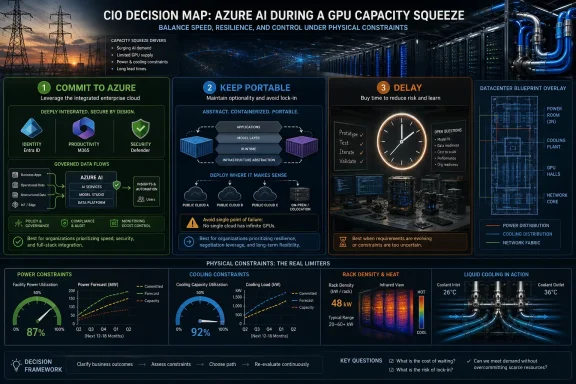
The Buyer’s Map for Azure in an AI Capacity Squeeze
The cleanest way to think about Azure right now is not as a single platform decision, but as a portfolio decision. CIOs should sort workloads by Microsoft adjacency, infrastructure intensity, portability, and timing pressure before signing long commitments.- Commit now to Azure workloads that gain most of their value from Microsoft identity, governance, data integration, security tooling, and managed enterprise services.
- Design for portability when the workload’s main dependency is scarce GPU capacity, specialized hardware, tight latency, or large-scale AI training.
- Delay commitments when the AI business case is still unproven, the data estate is not ready, or the project requires major capacity before demonstrating adoption.
- Negotiate capacity explicitly rather than assuming a broad Azure agreement guarantees the hardware, region, or timeline your AI team wants.
- Treat power, cooling, and datacenter modernization as business risks because Microsoft’s own infrastructure messaging shows they are now central to AI cloud delivery.
- Avoid performative multi-cloud plans and instead build real exit paths for the specific workloads where Azure concentration would create material risk.
Microsoft is building for a world in which AI demand keeps rising and datacenters become more specialized, more power-sensitive, and more tightly optimized around premium workloads. Enterprise buyers should meet that reality with a split strategy: embrace Azure where Microsoft’s platform depth is the advantage, preserve portability where raw capacity is the dependency, and wait where the business case is not yet strong enough to deserve scarce infrastructure. The winners will not be the companies that shout “all in” or “never Azure”; they will be the ones that know exactly which workloads belong in each bucket before the next capacity crunch arrives.
References
- Primary source: blogs.microsoft.com

Microsoft at NVIDIA GTC: New solutions for Microsoft Foundry, Azure AI infrastructure and Physical AI - The Official Microsoft Blog
Microsoft combines accelerated computing with cloud scale engineering to bring advanced AI capabilities to our customers. For years, we’ve worked with NVIDIA to integrate hardware, software and infrastructure to power many of today’s most important AI breakthroughs. What’s new at NVIDIA GTC...blogs.microsoft.com - Independent coverage: azure.microsoft.com
Loading…
azure.microsoft.com - Independent coverage: microsoft.com
Loading…
www.microsoft.com - Primary source: WindowsForum
Loading…
windowsforum.com