

Tesla’s 2026.8 and 2026.8.3 software updates began rolling out in March 2026, bringing Tesla owners a mix of comfort, safety, naming, localization, dashcam, driver-profile, and security changes across selected Model S, Model 3, Model X, Model Y, and regional FSD configurations. The release is not a headline-grabbing reinvention of the car, and that is precisely why it matters. Tesla’s software story is increasingly about small behavioral changes that accumulate into a different ownership model. For WindowsForum readers, the interesting part is not the car; it is the way a rolling software platform turns hardware you bought months or years ago into a managed endpoint.
The consumer-tech instinct is to look for the big feature: a new autonomy stack, a redesigned interface, a flashy entertainment app, or some unmistakable change that makes owners post screenshots. Version 2026.8 does have recognizable user-facing additions, including Comfort Braking on newer Model Y vehicles and parked blind-spot warnings on supported cars. But the release reads less like a product launch and more like an operating-system maintenance train.
That is not an insult. In mature platforms, maintenance trains are where trust is either built or lost. Windows admins know this rhythm well: the most consequential release is often not the one with the marquee feature, but the one that adjusts defaults, renames a component, fixes a security issue, and subtly changes the way users interact with the machine.
Tesla has spent years insisting that its vehicles are software-defined products. The 2026.8 branch shows what that phrase means after the novelty wears off. The company is not merely adding features to cars; it is curating behavior, language, safety prompts, regional capability, and diagnostic surfaces after the sale.
That makes every Tesla update a consumer convenience story and an IT governance story at the same time. The vehicle in the driveway is no longer only a vehicle. It is a rolling client device with safety-critical hardware, cloud-mediated services, regional policy constraints, and a vendor-controlled update cadence.
Traditional carmakers have long tuned braking, steering, suspension, and throttle mapping with software. The distinction is not that Tesla discovered software control. The distinction is that Tesla has normalized post-sale behavioral tuning as part of ordinary ownership. A car can feel subtly different after a download.
That is powerful and slightly unsettling. Smoother braking may be welcomed by owners, especially in stop-and-go traffic or urban driving. But the deeper precedent is that subjective driving feel is no longer frozen at delivery. It becomes another parameter in a live software branch.
For the Windows crowd, the analogy is obvious. Microsoft can change a Start menu behavior, notification prompt, driver model, or security baseline after Patch Tuesday. Tesla can change how a brake pedal feels. Both are examples of vendors asserting long-term stewardship over products customers already bought.
That stewardship can improve products dramatically. It can also make ownership feel less final. The line between “my device” and “vendor-managed endpoint” keeps moving.
This is exactly the kind of feature software-defined vehicles should deliver. The sensors already exist. The display already exists. The alerting system already exists. The update connects them in a new context and changes the car’s role from transportation machine to situational safety assistant.
What is notable is not that Tesla can do this once. It is that the car becomes a platform for opportunistic recombination. Cameras, occupancy sensors, door states, maps, displays, and mobile-app hooks can be rearranged into new features long after production.
That is also where expectations rise. Once owners understand that dormant capability can become active through an update, every missing feature begins to look like a product decision rather than a hardware limitation. The software-defined car creates appetite as quickly as it creates delight.
In enterprise IT terms, Tesla is managing a sensor fleet. The endpoint happens to have wheels, doors, seats, and a battery pack, but the pattern is familiar: collect signals, infer state, prompt the user, and update the rules over time.
The Autopilot brand has always carried baggage. It is memorable, marketable, and controversial. Critics have argued for years that Tesla’s terminology can overstate capability in the minds of some drivers, even when on-screen notices and manuals require supervision. Regulators, safety advocates, and courts have all scrutinized how driver-assistance systems are described.
Renaming “Navigate on Autopilot” to “Navigate on Autosteer” narrows the promise. It pulls the language closer to the function. “Autosteer” sounds less like a digital chauffeur and more like a constrained lane-guidance feature. That is a healthier direction for user expectations.
The “FSD Computer” to “AI Computer” shift is more ambiguous. On one hand, it separates hardware from a specific paid software package. On the other, “AI Computer” is a broader and arguably more fashionable label. It reflects the industry’s pivot from automation branding to artificial-intelligence branding, with all the hype that implies.
This is the part Windows administrators will recognize immediately. Names change when vendors want to reshape perception without necessarily changing the underlying code. Sometimes the rename clarifies. Sometimes it softens liability. Sometimes it prepares the market for a future architecture. Often, it does all three.
Consumers often imagine software rollout as a binary event: the update is out, therefore everyone gets it. Tesla’s reality is messier. A version number may appear across multiple cars while the actual payload differs substantially. The same branch can carry safety fixes for one car, autonomy features for another, and minor interface refinements for a third.
This is normal in fleet software, but it collides with consumer expectations. A phone owner may accept that a feature is region-gated because of language, carrier, or law. A car owner experiences region gating differently because the purchase price is higher, the safety implications are more visible, and the emotional attachment is stronger.
For IT professionals, the lesson is that Tesla’s release notes should be read as conditional manifests, not universal promises. Model year, computer generation, country, and installed option packages matter. A version number alone does not tell the whole story.
That is increasingly true across technology. Windows feature availability can depend on edition, region, hardware security module, enrollment state, processor generation, or cloud policy. Tesla has brought that same matrix to the garage.
No responsible vendor is going to detail every fixed vulnerability in consumer-facing release notes before patches are widely deployed. Still, the lack of specificity places trust pressure on Tesla. Owners are asked to install updates because the vendor says they matter, not because the owner can independently evaluate each fix.
That is familiar terrain for Windows users. Microsoft’s security bulletins, CVEs, and patch notes provide more structure than Tesla’s consumer release notes, but the basic social contract is similar: the platform owner sees more than the user does, and the user must decide whether to accept the update cadence.
The stakes are different in a car. A failed browser patch may expose data. A failed vehicle update can affect transportation, charging, driver assistance, camera systems, or access. Tesla’s over-the-air update system is one of its competitive strengths, but it also means software quality is part of roadworthiness.
The 2026.8 branch underscores how little patience the public has for vague software assurances when vehicles are involved. Owners want rapid security fixes. They also want predictability. Those demands are not always compatible.
Rear cameras are not infotainment fluff. In the United States, rear visibility requirements are safety requirements. If a software update introduces unacceptable delay in the rearview image, the problem enters regulatory space quickly. The fix may still be software, but the category is no longer “bug”; it is recall.
That is the paradox of OTA vehicles. Software updates can remediate safety issues faster than dealership campaigns, which is genuinely good for consumers. But software updates can also create safety issues at fleet scale, which makes release discipline even more important.
Microsoft users understand the anxiety of a bad patch. A broken Windows update can disrupt printers, VPN clients, domain joins, BitLocker recovery flows, or application compatibility. Now map that anxiety onto a machine used for transport, with federally regulated safety functions and real-time driver expectations.
Tesla’s advantage is that it can respond quickly. Tesla’s burden is that it must.
Dashcam handling is a particularly Tesla-ish feature because it blends security, liability, convenience, and evidence capture. Owners use footage for accidents, vandalism, insurance claims, and peace of mind. Any improvement to viewing, navigation, or retrieval changes the practical value of the camera system.
Driver profiles carry a different kind of weight. A profile is not just a seat position. It can represent mirrors, steering wheel, climate preferences, navigation habits, media defaults, and sometimes behavioral settings that make the car feel personally calibrated. When profiles work well, a shared car feels individualized. When they glitch, the car feels alien.
These details are where software-defined products either become beloved or resented. Users rarely judge platforms only by the keynote feature. They judge them by whether the small workflows remain reliable after each update.
That is another Windows parallel. A sysadmin may care about kernel hardening, but end users complain when their default printer changes. Tesla owners may care about FSD, but they notice when a profile resets or a dashcam viewer becomes easier to use. The visible interface is where platform trust becomes emotional.
A vehicle interface carries safety warnings, charging instructions, driver-assistance prompts, navigation cues, maintenance notices, and account-related messaging. Presenting that information in a user’s language is not a decorative feature. It reduces friction and can reduce misunderstanding.
Tesla’s global fleet makes localization more important with each regional expansion. The company’s software stack is shared, but its users live under different languages, traffic norms, regulatory regimes, and road designs. A single interface philosophy has to stretch across all of that.
This is where platform companies sometimes reveal their maturity. Early adopters tolerate English-first interfaces and rough edges. Mainstream customers do not. If Tesla wants its cars to behave like global consumer electronics, language coverage must be treated as core infrastructure.
The Windows analogy is again unavoidable. Microsoft’s dominance was never just about APIs and OEM deals. It was also about localization, input methods, regional formats, accessibility, and administrative tooling across markets. Tesla is walking a similar path, only with airbags and door handles attached.
This staged rollout model is rational. Pushing vehicle software to the entire fleet at once would be reckless. Canary deployments, phased expansion, telemetry review, and rollback decisions are standard practice in responsible software operations. The frustration comes from the fact that Tesla sells to consumers who do not always think like release engineers.
Owners often interpret delay as neglect or favoritism. Sometimes it may be ordinary deployment caution. Sometimes it may be region, model, eligibility, Wi-Fi availability, or server-side gating. Sometimes it may be that Tesla saw enough telemetry to slow or stop a rollout.
The important point is that Tesla owners are participating in a managed deployment system, whether they understand it or not. Their cars are endpoints in a global fleet. Update timing is part of the operational model.
That has practical consequences. If your car is mission-critical for commuting, accessibility, work, or family logistics, “latest” is not always synonymous with “best for me today.” Early updates bring features sooner, but they also expose owners to the first wave of field-discovered defects.
This is a familiar problem in modern software. Windows build numbers, cumulative updates, enablement packages, feature flags, and controlled feature rollouts have trained administrators to ask a second question after “what version are you on?” The better question is “what capabilities are actually enabled?”
Tesla owners are now in the same world. A screenshot of a version number is not a complete support artifact. Troubleshooting increasingly requires model, year, hardware platform, country, previous version, subscriptions, and whether the relevant feature flag has been enabled.
That complexity is not necessarily bad. It allows Tesla to tailor releases and reduce risk. But it makes public conversation messy. Forums fill with contradictory reports that can all be true at the same time.
For WindowsForum, this is the connective tissue. The Tesla update beat is not really separate from the PC update beat. It is the same platform-management story expressed through a different class of device.
Apple can drop support for old devices on a relatively predictable schedule and still maintain a tightly bounded hardware matrix. Tesla has vehicles on the road that differ by sensor suite, infotainment computer, autonomy computer, market, battery chemistry, and manufacturing era. Those cars are expensive, long-lived assets. Owners expect years of support.
That is a Microsoft-shaped problem. Windows succeeds and suffers because it runs everywhere. Tesla’s version of “everywhere” is smaller, but more safety-critical. A Model S, Model 3, Model X, Model Y, and Cybertruck do not present one uniform target.
The Autopilot hardware split is especially important. AI3, AI4, and legacy configurations create different ceilings for driver-assistance features. As Tesla’s autonomy ambitions continue, the company must navigate the uncomfortable gap between software promise and hardware reality.
That gap is where customer trust can erode. If a feature depends on newer hardware, say so clearly. If a name changes but behavior does not, say so clearly. If a region cannot receive a function because regulators have not approved it, say so clearly. Ambiguity helps marketing in the short term and hurts platforms in the long term.
For enthusiasts, the temptation is to chase the latest build. For cautious owners, the temptation is to avoid updates unless forced. Neither instinct is sufficient. A vehicle software update can fix important security or safety issues, but the first days of a rollout can also reveal defects that were not caught in testing.
Tesla gives owners some control over update preference, but not the kind of granular administrative control enterprise IT would expect. There is no familiar WSUS-style approval ring for households, no long-term servicing channel for risk-averse commuters, and no rich public changelog comparable to enterprise software documentation. The consumer experience remains simplified.
That simplicity is part of Tesla’s appeal. Most owners do not want to administer their cars. But as vehicles become more software-dependent, the lack of transparent controls becomes harder to ignore.
The industry will eventually have to reconcile those tensions. Consumers want effortless updates. Regulators want accountability. Security researchers want disclosure. Power users want control. Vendors want velocity. Tesla is simply living that conflict earlier and louder than most automakers.
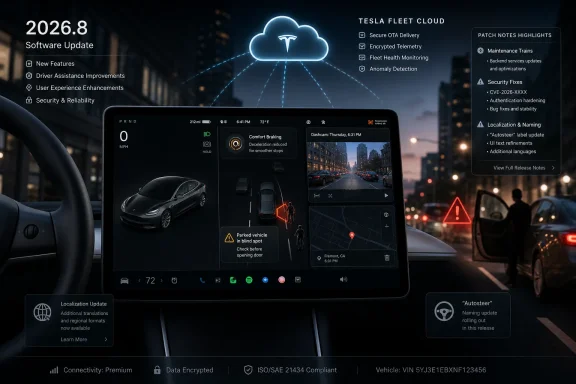 Tesla’s Boring Update Is the Important One
The consumer-tech instinct is to look for the big feature: a new autonomy stack, a redesigned interface, a flashy entertainment app, or some unmistakable change that makes owners post screenshots. Version 2026.8 does have recognizable user-facing additions, including Comfort Braking on newer Model Y vehicles and parked blind-spot warnings on supported cars. But the release reads less like a product launch and more like an operating-system maintenance train.That is not an insult. In mature platforms, maintenance trains are where trust is either built or lost. Windows admins know this rhythm well: the most consequential release is often not the one with the marquee feature, but the one that adjusts defaults, renames a component, fixes a security issue, and subtly changes the way users interact with the machine.
Tesla has spent years insisting that its vehicles are software-defined products. The 2026.8 branch shows what that phrase means after the novelty wears off. The company is not merely adding features to cars; it is curating behavior, language, safety prompts, regional capability, and diagnostic surfaces after the sale.
That makes every Tesla update a consumer convenience story and an IT governance story at the same time. The vehicle in the driveway is no longer only a vehicle. It is a rolling client device with safety-critical hardware, cloud-mediated services, regional policy constraints, and a vendor-controlled update cadence.
Comfort Braking Shows How Deep Software Now Reaches Into the Car
Comfort Braking is the sort of feature that sounds almost too modest to deserve attention. It is intended to make routine braking feel smoother, particularly on refreshed Model Y vehicles. That reads like a creature comfort, but it points to something more important: Tesla is still changing the tactile behavior of the car through software.Traditional carmakers have long tuned braking, steering, suspension, and throttle mapping with software. The distinction is not that Tesla discovered software control. The distinction is that Tesla has normalized post-sale behavioral tuning as part of ordinary ownership. A car can feel subtly different after a download.
That is powerful and slightly unsettling. Smoother braking may be welcomed by owners, especially in stop-and-go traffic or urban driving. But the deeper precedent is that subjective driving feel is no longer frozen at delivery. It becomes another parameter in a live software branch.
For the Windows crowd, the analogy is obvious. Microsoft can change a Start menu behavior, notification prompt, driver model, or security baseline after Patch Tuesday. Tesla can change how a brake pedal feels. Both are examples of vendors asserting long-term stewardship over products customers already bought.
That stewardship can improve products dramatically. It can also make ownership feel less final. The line between “my device” and “vendor-managed endpoint” keeps moving.
Parked Blind-Spot Warnings Turn Passive Hardware Into Active Supervision
The parked blind-spot warning feature is another small change with a larger meaning. If a supported Tesla detects a cyclist, vehicle, or other hazard while the car is parked and an occupant is about to open a door, the car can warn the user. It is a practical safety enhancement aimed at a real urban hazard: dooring.This is exactly the kind of feature software-defined vehicles should deliver. The sensors already exist. The display already exists. The alerting system already exists. The update connects them in a new context and changes the car’s role from transportation machine to situational safety assistant.
What is notable is not that Tesla can do this once. It is that the car becomes a platform for opportunistic recombination. Cameras, occupancy sensors, door states, maps, displays, and mobile-app hooks can be rearranged into new features long after production.
That is also where expectations rise. Once owners understand that dormant capability can become active through an update, every missing feature begins to look like a product decision rather than a hardware limitation. The software-defined car creates appetite as quickly as it creates delight.
In enterprise IT terms, Tesla is managing a sensor fleet. The endpoint happens to have wheels, doors, seats, and a battery pack, but the pattern is familiar: collect signals, infer state, prompt the user, and update the rules over time.
The Autopilot Rename Is Not Just Semantics
One of the more revealing changes in the 2026.8 family is Tesla’s continued cleanup of terminology around driver assistance. “Navigate on Autopilot” becomes “Navigate on Autosteer” in affected contexts, and “FSD Computer” becomes “AI Computer.” Tesla says such naming changes do not alter feature behavior. That may be true technically, but naming is never neutral in safety-critical software.The Autopilot brand has always carried baggage. It is memorable, marketable, and controversial. Critics have argued for years that Tesla’s terminology can overstate capability in the minds of some drivers, even when on-screen notices and manuals require supervision. Regulators, safety advocates, and courts have all scrutinized how driver-assistance systems are described.
Renaming “Navigate on Autopilot” to “Navigate on Autosteer” narrows the promise. It pulls the language closer to the function. “Autosteer” sounds less like a digital chauffeur and more like a constrained lane-guidance feature. That is a healthier direction for user expectations.
The “FSD Computer” to “AI Computer” shift is more ambiguous. On one hand, it separates hardware from a specific paid software package. On the other, “AI Computer” is a broader and arguably more fashionable label. It reflects the industry’s pivot from automation branding to artificial-intelligence branding, with all the hype that implies.
This is the part Windows administrators will recognize immediately. Names change when vendors want to reshape perception without necessarily changing the underlying code. Sometimes the rename clarifies. Sometimes it softens liability. Sometimes it prepares the market for a future architecture. Often, it does all three.
Regional FSD Reminds Owners That Software Is Also Regulation
The 2026.8.3 branch is associated in some reporting and fleet-tracking data with FSD (Supervised) v13.2.9 availability in Australia and New Zealand configurations. Whether a given owner sees that capability depends on region, model, hardware generation, entitlement, and rollout state. That fragmented availability is becoming a defining feature of modern vehicle software.Consumers often imagine software rollout as a binary event: the update is out, therefore everyone gets it. Tesla’s reality is messier. A version number may appear across multiple cars while the actual payload differs substantially. The same branch can carry safety fixes for one car, autonomy features for another, and minor interface refinements for a third.
This is normal in fleet software, but it collides with consumer expectations. A phone owner may accept that a feature is region-gated because of language, carrier, or law. A car owner experiences region gating differently because the purchase price is higher, the safety implications are more visible, and the emotional attachment is stronger.
For IT professionals, the lesson is that Tesla’s release notes should be read as conditional manifests, not universal promises. Model year, computer generation, country, and installed option packages matter. A version number alone does not tell the whole story.
That is increasingly true across technology. Windows feature availability can depend on edition, region, hardware security module, enrollment state, processor generation, or cloud policy. Tesla has brought that same matrix to the garage.
Security Improvements Are the Least Descriptive and Most Important Line
The shortest release-note entries often deserve the most attention. “Security improvements” tells owners almost nothing, yet it may be the most consequential phrase in the update. A modern Tesla is a networked computer with cellular connectivity, Bluetooth, Wi-Fi, mobile-app integration, charging communication, keyless entry, cameras, microphones, and a complex internal vehicle network.No responsible vendor is going to detail every fixed vulnerability in consumer-facing release notes before patches are widely deployed. Still, the lack of specificity places trust pressure on Tesla. Owners are asked to install updates because the vendor says they matter, not because the owner can independently evaluate each fix.
That is familiar terrain for Windows users. Microsoft’s security bulletins, CVEs, and patch notes provide more structure than Tesla’s consumer release notes, but the basic social contract is similar: the platform owner sees more than the user does, and the user must decide whether to accept the update cadence.
The stakes are different in a car. A failed browser patch may expose data. A failed vehicle update can affect transportation, charging, driver assistance, camera systems, or access. Tesla’s over-the-air update system is one of its competitive strengths, but it also means software quality is part of roadworthiness.
The 2026.8 branch underscores how little patience the public has for vague software assurances when vehicles are involved. Owners want rapid security fixes. They also want predictability. Those demands are not always compatible.
The Rear-Camera Recall Shadow Hangs Over the Branch
The 2026.8 family also sits near a separate but important episode: Tesla halted a later 2026.8.6 rollout after identifying rearview-camera latency concerns, with a recall remedy handled through an over-the-air software update. The exact affected build and issue should not be collapsed into every 2026.8 release, but the timing matters because it illustrates the risk profile of fast vehicle software deployment.Rear cameras are not infotainment fluff. In the United States, rear visibility requirements are safety requirements. If a software update introduces unacceptable delay in the rearview image, the problem enters regulatory space quickly. The fix may still be software, but the category is no longer “bug”; it is recall.
That is the paradox of OTA vehicles. Software updates can remediate safety issues faster than dealership campaigns, which is genuinely good for consumers. But software updates can also create safety issues at fleet scale, which makes release discipline even more important.
Microsoft users understand the anxiety of a bad patch. A broken Windows update can disrupt printers, VPN clients, domain joins, BitLocker recovery flows, or application compatibility. Now map that anxiety onto a machine used for transport, with federally regulated safety functions and real-time driver expectations.
Tesla’s advantage is that it can respond quickly. Tesla’s burden is that it must.
Dashcam and Driver Profile Tweaks Matter Because Owners Live in the Interface
Undocumented or semi-documented changes reported around the 2026.8 family include dashcam viewer improvements and driver-profile refinements. These are not glamorous. They are the kind of interface sanding that mature platforms need constantly.Dashcam handling is a particularly Tesla-ish feature because it blends security, liability, convenience, and evidence capture. Owners use footage for accidents, vandalism, insurance claims, and peace of mind. Any improvement to viewing, navigation, or retrieval changes the practical value of the camera system.
Driver profiles carry a different kind of weight. A profile is not just a seat position. It can represent mirrors, steering wheel, climate preferences, navigation habits, media defaults, and sometimes behavioral settings that make the car feel personally calibrated. When profiles work well, a shared car feels individualized. When they glitch, the car feels alien.
These details are where software-defined products either become beloved or resented. Users rarely judge platforms only by the keynote feature. They judge them by whether the small workflows remain reliable after each update.
That is another Windows parallel. A sysadmin may care about kernel hardening, but end users complain when their default printer changes. Tesla owners may care about FSD, but they notice when a profile resets or a dashcam viewer becomes easier to use. The visible interface is where platform trust becomes emotional.
Language Support Is a Product Feature, Not a Courtesy
Slovak language support appears in the 2026.8 family as one of those small additions that rarely receives much attention outside the affected market. It should. Localization is not merely translation; it is market access, safety comprehension, and customer respect.A vehicle interface carries safety warnings, charging instructions, driver-assistance prompts, navigation cues, maintenance notices, and account-related messaging. Presenting that information in a user’s language is not a decorative feature. It reduces friction and can reduce misunderstanding.
Tesla’s global fleet makes localization more important with each regional expansion. The company’s software stack is shared, but its users live under different languages, traffic norms, regulatory regimes, and road designs. A single interface philosophy has to stretch across all of that.
This is where platform companies sometimes reveal their maturity. Early adopters tolerate English-first interfaces and rough edges. Mainstream customers do not. If Tesla wants its cars to behave like global consumer electronics, language coverage must be treated as core infrastructure.
The Windows analogy is again unavoidable. Microsoft’s dominance was never just about APIs and OEM deals. It was also about localization, input methods, regional formats, accessibility, and administrative tooling across markets. Tesla is walking a similar path, only with airbags and door handles attached.
Fleet Rollouts Make Every Owner a Sample Point
Tesla rollouts are famously uneven. One owner gets an update immediately; another waits weeks. Some cars receive a branch because of hardware generation; others skip it. Fleet-tracking services provide useful visibility, but they also reinforce how fragmented the experience can look from the outside.This staged rollout model is rational. Pushing vehicle software to the entire fleet at once would be reckless. Canary deployments, phased expansion, telemetry review, and rollback decisions are standard practice in responsible software operations. The frustration comes from the fact that Tesla sells to consumers who do not always think like release engineers.
Owners often interpret delay as neglect or favoritism. Sometimes it may be ordinary deployment caution. Sometimes it may be region, model, eligibility, Wi-Fi availability, or server-side gating. Sometimes it may be that Tesla saw enough telemetry to slow or stop a rollout.
The important point is that Tesla owners are participating in a managed deployment system, whether they understand it or not. Their cars are endpoints in a global fleet. Update timing is part of the operational model.
That has practical consequences. If your car is mission-critical for commuting, accessibility, work, or family logistics, “latest” is not always synonymous with “best for me today.” Early updates bring features sooner, but they also expose owners to the first wave of field-discovered defects.
The Version Number No Longer Means One Thing
Version 2026.8.3 sounds precise. In practice, it is a container. Depending on the car, region, and hardware, it may mean security fixes, FSD-related content, minor fixes, localization changes, naming changes, or feature availability that another owner on the same branch never sees.This is a familiar problem in modern software. Windows build numbers, cumulative updates, enablement packages, feature flags, and controlled feature rollouts have trained administrators to ask a second question after “what version are you on?” The better question is “what capabilities are actually enabled?”
Tesla owners are now in the same world. A screenshot of a version number is not a complete support artifact. Troubleshooting increasingly requires model, year, hardware platform, country, previous version, subscriptions, and whether the relevant feature flag has been enabled.
That complexity is not necessarily bad. It allows Tesla to tailor releases and reduce risk. But it makes public conversation messy. Forums fill with contradictory reports that can all be true at the same time.
For WindowsForum, this is the connective tissue. The Tesla update beat is not really separate from the PC update beat. It is the same platform-management story expressed through a different class of device.
Tesla’s Update Culture Is Becoming More Microsoft Than Apple
Tesla is often compared to Apple because of its integrated hardware-software model, direct customer relationship, and taste for controlled ecosystems. But its update culture increasingly resembles Microsoft’s in one crucial way: it must support a sprawling installed base across hardware generations, regulatory environments, and divergent user expectations.Apple can drop support for old devices on a relatively predictable schedule and still maintain a tightly bounded hardware matrix. Tesla has vehicles on the road that differ by sensor suite, infotainment computer, autonomy computer, market, battery chemistry, and manufacturing era. Those cars are expensive, long-lived assets. Owners expect years of support.
That is a Microsoft-shaped problem. Windows succeeds and suffers because it runs everywhere. Tesla’s version of “everywhere” is smaller, but more safety-critical. A Model S, Model 3, Model X, Model Y, and Cybertruck do not present one uniform target.
The Autopilot hardware split is especially important. AI3, AI4, and legacy configurations create different ceilings for driver-assistance features. As Tesla’s autonomy ambitions continue, the company must navigate the uncomfortable gap between software promise and hardware reality.
That gap is where customer trust can erode. If a feature depends on newer hardware, say so clearly. If a name changes but behavior does not, say so clearly. If a region cannot receive a function because regulators have not approved it, say so clearly. Ambiguity helps marketing in the short term and hurts platforms in the long term.
The Car Is Becoming a Patch-Tuesday Device
The most useful mental model for Tesla owners may be the least romantic one: treat the car like a Patch Tuesday device. That does not mean panic over every update. It means understand that updates can carry feature changes, security fixes, regressions, staged rollouts, and undocumented behavior shifts.For enthusiasts, the temptation is to chase the latest build. For cautious owners, the temptation is to avoid updates unless forced. Neither instinct is sufficient. A vehicle software update can fix important security or safety issues, but the first days of a rollout can also reveal defects that were not caught in testing.
Tesla gives owners some control over update preference, but not the kind of granular administrative control enterprise IT would expect. There is no familiar WSUS-style approval ring for households, no long-term servicing channel for risk-averse commuters, and no rich public changelog comparable to enterprise software documentation. The consumer experience remains simplified.
That simplicity is part of Tesla’s appeal. Most owners do not want to administer their cars. But as vehicles become more software-dependent, the lack of transparent controls becomes harder to ignore.
The industry will eventually have to reconcile those tensions. Consumers want effortless updates. Regulators want accountability. Security researchers want disclosure. Power users want control. Vendors want velocity. Tesla is simply living that conflict earlier and louder than most automakers.
The 2026.8 Lesson Is Hiding in the Release Notes
The practical reading of 2026.8 and 2026.8.3 is straightforward: install security and safety updates, read the release notes carefully, and do not assume another owner’s experience maps perfectly to your car. The more interesting reading is that Tesla’s fleet is now mature enough for routine software governance to matter as much as feature spectacle.- Tesla’s 2026.8 branch is best understood as a maintenance-and-refinement release, not a single universal feature drop.
- Comfort Braking and parked blind-spot warnings show how Tesla can keep changing the physical and safety experience of supported vehicles after purchase.
- Autopilot-related naming changes matter because terminology shapes user expectations around supervised driver-assistance systems.
- Regional FSD availability reinforces that Tesla software is governed by hardware, geography, entitlement, and regulation.
- Security fixes remain essential even when release notes provide little detail about what changed.
- Owners should treat Tesla version numbers as starting points for troubleshooting, not complete descriptions of enabled capability.
References
- Primary source: Not a Tesla App
Published: 2026-06-13T19:00:17.732253
2026.8.3 Note di rilascio di Tesla - Aggiornamenti Software di Tesla
Note di rilascio di Tesla per la versione 2026.8.3. Questo aggiornamento include: Autopilot Naming Update, Blind Spot Warning While Parked, Frenata Comfort, Aggiornamenti minori, Miglioramenti della sicurezza, Correzioni minori, Dashcam Viewer Improvements, Driver Profile, Slovak Language...www.notateslaapp.com - Related coverage: teslaoracle.com

Tesla update 2026.8 goes wide with Comfort Braking, Cybertruck parked blind spot, and more (official release notes) - Tesla Oracle
Tesla update 2026.8 brings new features like Comfort Braking (Model Y Juniper) and Blind Spot Warning While Parked for the Cybertruck. More features and improvements (release notes). www.teslaoracle.com
- Related coverage: teslascope.com
2026.8.3 (FSD V) Tesla Software Update - Teslascope
The release notes and rollout for the Tesla software update, 2026.8.3.teslascope.com - Related coverage: basenor.com

Tesla 2026.8 Software Update Spotted: What We Know So Far
🔥 JUST IN — 0h ago 📌 UPDATE — March 18, 2026 Tesla has now pushed a point release — 2026.8.3 — which is actively rolling out to approximately 1% of the fleet in its first batch. This incremental update focuses specifically on Security Improvements. Meanwhile, the broader 2026.8 changelog has... www.basenor.com
- Related coverage: world-today-journal.com
Tesla 2026.8.200 Update: Dashcam Viewer Improvements, Driver Profile & Slovak Language Support – Full Release Notes - World Today Journal
Tesla has rolled out software update 2026.8.200, introducing a series of refinements aimed at enhancing user experience and vehicle functionality. The update,www.world-today-journal.com - Related coverage: tesla.com
- Related coverage: tesla.cn