

A CleanTechnica owner diary published June 13, 2026, describes two weeks in a 2026 Tesla Model Y with Hardware 4 and Full Self-Driving V14, claiming the system now handles garage exits, driveway starts, parking-lot departures, and many complete trips with fewer interventions than older Hardware 3 cars. The piece is not a laboratory test, and it is not a regulatory milestone. Its value is more interesting than that: it shows how Tesla’s driver-assistance story has shifted from “the car will soon drive itself” to “the car is getting useful enough that the subscription lock-in is now the product.”
That distinction matters. Tesla’s Full Self-Driving remains supervised, and the person in the driver’s seat remains responsible for the vehicle. But the latest owner reports suggest that, for some drivers on some roads, the system is moving from novelty to habit — which is exactly where the most consequential technology fights begin.
The striking part of the CleanTechnica account is not that the car follows lanes, changes lanes, or stops at traffic lights. Tesla owners have been arguing about those behaviors for years. The notable claim is that FSD V14 on Hardware 4 can stitch together the awkward, human parts of a trip: leaving the garage, backing out of a driveway, navigating a parking lot, entering public roads, arriving, and attempting to park.
That is a different sort of progress from highway lane-centering. Highway assistance is bounded, repetitive, and comparatively easy to understand. Beginning and ending a trip are messy. The car has to interpret private driveways, ambiguous curb cuts, parking-lot geometry, pedestrians, shopping carts, bad map data, and all the little unmarked spaces where humans rely on social inference rather than formal traffic control.
The owner’s report says the Model Y can automatically leave a garage after the driver taps the brake and starts self-driving, then back out to the street. It can also leave a parking space, find its way out of a lot, and later attempt to park at the destination. That does not make the car autonomous in the Level 4 sense. It does make the system feel less like an assistive feature and more like a continuous journey manager.
Tesla has been chasing that feeling for years. “Full Self-Driving” was always a marketing phrase that implied more than the shipped capability could safely deliver. “Full Self-Driving (Supervised)” is more legally sober, but it still carries the old ambition. V14’s reported improvement is that the ambition is now visible in mundane places, not just in carefully filmed turn-by-turn demos.
The owner’s experience also highlights why supervised automation can feel more persuasive than it is. A car that completes nine trips without a correction can produce trust faster than a disclaimer can restrain it. The tenth trip, however, is where the system’s limits matter.
For years, Tesla sold the idea that cars already on the road had the hardware needed for future self-driving capability. Owners bought vehicles, options, and expectations around that premise. The company did improve those vehicles substantially through software, but the CleanTechnica account is a reminder that software-defined products still hit hardware walls.
Hardware 4 brought improved cameras and more compute capacity. Reports around the current FSD branch indicate that V14 is aimed at the newer AI4 platform, leaving many HW3 owners with older code paths or reduced expectations. That is not unusual in computing. Phones age out of operating-system features, GPUs age out of games, and enterprise hardware ages out of support windows.
Cars, however, are different. A 2019 vehicle is not an ancient artifact. Many owners expect a modern car to remain a primary household asset for a decade or more. When a vehicle’s most heavily marketed future feature becomes constrained by a computer installed behind the dashboard, the lifecycle math starts to look more like consumer electronics than traditional automotive ownership.
This is where Tesla’s old confidence collides with its current architecture. If autonomy depends on rapid neural-network progress, then the installed base becomes a drag. If the installed base was sold on autonomy, then that drag becomes a trust problem.
The author’s personal turn makes the point sharply. His 2019 Model 3 was totaled in May 2026. Only then did he move into a 2026 Model Y and get access to the more advanced experience. That is an uncomfortable upgrade path: the future arriving not through the promised evolution of the old car, but through the replacement of it.
That framing is important because it separates driving style from driving correctness. Tesla gives drivers behavioral modes such as Sloth, Chill, Standard, Hurry, and Mad Max. The owner says Sloth stays near the speed limit, Standard tends to run modestly over, and Mad Max can be far more aggressive. In practical terms, Tesla is not merely automating vehicle control; it is productizing driving temperament.
This is an old human problem in software form. Some drivers want caution. Some want flow. Some want the car to behave like the assertive commuter they imagine themselves to be. Tesla’s modes give users a sense of agency over the system’s personality, which may reduce the urge to intervene when the car behaves in a way the driver expected.
But the failure examples in the article show that V14’s remaining problems are not always about steering, braking, or object detection. They are often about local knowledge. The car may drive competently while going to the wrong entrance, choosing a poor parking strategy, following stale map assumptions, or misunderstanding a one-way airport loop.
That distinction should worry anyone who thinks autonomy is just a perception problem. Cameras and neural nets can identify many objects in the scene, but destinations are social and cartographic artifacts. A store can move. A Costco can be built where a map still shows a field. A driveway can be associated with the wrong street address. A legal one-way loop can be obvious to locals and mishandled by a navigation stack.
In other words, Tesla’s FSD can improve dramatically and still fail in ways that feel stupid to a human. That does not mean the system is useless. It means its failure mode is increasingly shifting from “the car cannot drive” to “the car can drive, but does not quite know where it is in the human world.”
The author notes that GPS accuracy can be off by roughly the width of a small house lot, and that Tesla navigation relies on map data that can be wrong or stale. That matters most at the edges of trips. On a highway, a 15-foot positioning error may be tolerable if lane perception is strong. In a driveway, parking lot, or airport loop, 15 feet can be the difference between correct, awkward, and dangerous.
This is the hidden infrastructure of consumer autonomy. A human driver can compensate for bad map data with common sense. If the map points to a field but the Costco is plainly visible, the human turns into the Costco. If the navigation says the destination is one street over but the driver recognizes their own house, the human stops at home. A supervised system can rely on that human correction. An unsupervised one cannot.
The owner’s examples are almost comically ordinary. A home address points to the wrong street. A Costco that has existed for years is not represented correctly. A parking lot exit produces the wrong turn. These are not edge cases in the academic sense. They are the daily slop of real-world navigation.
That is why parking is such a useful test. Parking is not merely a low-speed maneuver. It is a negotiation between geometry, rules, preferences, accessibility needs, private property design, and incomplete data. The owner says FSD V14 can park, but public-lot parking remains iffier. It cannot choose a handicapped space when appropriate, search intelligently for the best spot, or necessarily understand the driver’s actual intent.
Tesla can solve some of this with better models and better mapping. But the deeper issue is that a car that “drives anywhere” must understand arrival, not merely motion. Getting to a coordinate is not the same as getting to the place the user meant.
For years, basic Autopilot was one of Tesla’s signature advantages. Even buyers who had no interest in FSD could use adaptive cruise and lane-centering on long highway trips. The feature became part of the ownership expectation, especially for commuters and road-trippers who valued reduced fatigue more than futuristic autonomy claims.
If new buyers must pay $99 per month to regain steering assistance that many competitors now bundle in some form, Tesla has changed the emotional contract. The hardware is still there. The cameras are still there. The compute is still there. But the capability becomes a recurring service rather than a vehicle feature.
That may be rational from Tesla’s standpoint. Recurring software revenue is attractive, and FSD is expensive to develop. A subscription model also lets Tesla avoid locking customers into a large upfront purchase for a product that is still evolving and still supervised. In the cleanest version of the argument, customers can try the system, keep it when it is useful, and cancel when it is not.
But the consumer experience is not so clean. A buyer who expects modern lane-centering in a premium EV may not care that Tesla has reorganized its software packaging. They will notice that a Toyota Corolla rental can provide steering assistance while a new Tesla asks for a monthly fee. That comparison is brutal because it strips away the autonomy debate and turns the issue into basic equipment value.
This is not just a Tesla problem. The auto industry is steadily testing which features can be turned into services, from heated seats to driver assistance to performance unlocks. Tesla is simply more aggressive, more software-native, and more willing to let the market absorb the shock.
The CleanTechnica author understands the distinction. He repeatedly describes supervising the system, watching cross traffic, and remaining aware of failures. Yet the article also shows how easily the user experience encourages a stronger belief. If the car backs out of the garage, drives across town, navigates traffic, and parks, the driver’s body learns a story that the product name only has to nudge.
Tesla’s challenge is that supervised autonomy improves by becoming boring. The less often a driver intervenes, the more the driver is tempted to disengage. This is the paradox of Level 2 systems: success can train complacency, while failure requires exactly the attention that success erodes.
Traditional driver-assistance systems often avoid this by being narrower. Adaptive cruise controls speed and distance. Lane-centering helps within a lane. Automated parking handles a small, bounded task. Tesla’s FSD tries to unify the trip, which makes the experience more magical and the supervision burden more psychologically difficult.
The owner’s report is valuable because it does not pretend the system has crossed the Level 4 line. It says the car is much better. It says the car still makes mistakes. It says the driver remains responsible. That combination is more credible than either fanboy triumphalism or reflexive dismissal.
The policy question is what happens when many drivers have the same experience. Regulators tend to think in categories. Consumers think in habits. Tesla is building the habit first.
Tesla removed radar from many vehicles as part of its Tesla Vision strategy, betting that cameras and neural-network perception could handle the driving task. The human analogy is obvious: people drive with eyes, so cars should be able to drive with cameras. The problem is that humans are not the safety benchmark autonomous systems are ultimately being sold against. Humans also drive too fast for conditions, miss hazards, and crash in fog.
Other autonomy developers have often chosen sensor redundancy. Radar can help with range and velocity in poor visibility. Lidar can provide precise depth information. Cameras provide rich semantic detail. A multi-sensor stack is not automatically superior in every implementation, but it gives engineers different channels of evidence when one modality is compromised.
Tesla’s counterargument is scale. Its vehicles collect enormous real-world driving data, and a camera-only approach is cheaper, simpler, and easier to deploy across millions of cars. If the model becomes good enough, Tesla gets a fleet advantage that more expensive sensor suites may struggle to match in consumer vehicles.
That is the grand bargain. Tesla trades sensor redundancy for scale, cost control, and software iteration. The risk is that certain physical limits do not yield to fleet learning as neatly as software optimists hope.
For supervised FSD, the answer is simple: the human takes over when conditions degrade. For unsupervised autonomy, that answer collapses. A Level 4 system needs a fallback plan that does not assume an alert human is ready to rescue it. Pulling over safely may be acceptable in some conditions, but it is not the same thing as driving the passenger wherever they wanted to go.
A car that can complete many ordinary trips without intervention is tantalizingly close to what consumers imagine a robotaxi does. The difference is that a commercial robotaxi cannot depend on a loyal owner forgiving mistakes. It has to handle airport loops, wrong map data, parking-lot ambiguity, blocked lanes, construction, emergency vehicles, accessibility requirements, and confused passengers at scale.
The reported V14 failures are exactly the kind that matter for a paid service. Taking the wrong path out of an airport is not just a quirky bug when the passenger is paying and the operator is liable. Failing to find a parking area because the map is stale is not just an annoyance when the vehicle has no driver to correct it. Choosing the wrong destination street is not a minor inconvenience for a rider who cannot manually intervene.
This is where Tesla’s consumer deployment can be both an advantage and a trap. Millions of supervised miles can reveal issues that closed fleets might encounter more slowly. But supervised use also masks severity. If drivers quietly correct the system, the ride ends successfully. The intervention becomes a data point, not a disaster.
A robotaxi business has less room for ambiguity. Either the car can operate within a defined domain without human supervision, or it cannot. The supervised consumer experience may be the road to that future, but it is not the future itself.
The CleanTechnica author’s phrase “holy grail” lands because the goal has not changed. Tesla still needs FSD to become safer than human driving without requiring human oversight. The current evidence suggests progress. It does not settle the case.
In the PC world, this pattern is familiar enough to be boring. A new AI feature requires an NPU. A security baseline requires a newer TPM. A management capability moves behind a premium license. A once-bundled feature becomes part of a cloud plan. Each individual decision may be defensible. Together, they redefine ownership.
Tesla is applying the same logic to the car. The vehicle is no longer a fixed bundle of mechanical and electronic capabilities. It is a rolling endpoint, licensed and updated over time. The upside is that a car can improve dramatically after purchase. The downside is that the line between “what I bought” and “what I rent” keeps moving.
For sysadmins and IT pros, the analogy should sharpen the skepticism. Hardware capability is not the same as feature entitlement. Software support is not the same as feature parity. A vendor roadmap is not a guarantee. And when a company says a platform is ready for the future, the fine print often arrives years later in the form of minimum hardware requirements.
That does not make Tesla uniquely villainous. It makes Tesla modern. The car industry is becoming an IT industry with tires, warranty departments, and federal safety regulators attached.
The practical question for buyers is therefore less romantic than the autonomy debate. If you buy a Tesla today, are you buying a car, a software platform, or an entry point into a subscription funnel? The honest answer is all three.
But anecdotal reports have a place in technology coverage because they capture product feel before formal institutions do. Benchmarks tell us one thing. Regulatory filings tell us another. A technically engaged owner describing how their behavior changed tells us something else: whether the product is becoming trusted in daily use.
The CleanTechnica piece is persuasive because it includes frustration. The author is not simply cheerleading. He criticizes Tesla’s unmet Hardware 3 expectations, calls out navigation errors, objects to the subscription gating of steering assistance, and lists missing functions. That mixture of enthusiasm and irritation is often where the truth of a maturing product lives.
The most important behavioral change is that the author says he is no longer overriding the system as much. That is a milestone of sorts. A driver who used to correct frequently now waits, watches, and lets the car proceed. The machine has earned more patience.
That patience is productive when the driver remains alert. It is dangerous when patience becomes faith. Tesla’s entire supervised-autonomy strategy lives on that knife edge.
The article also underlines a less discussed benefit: reduced cognitive load. If FSD handles most of a familiar trip well, the driver may arrive less fatigued, especially on long routes. That is not the same as sleeping in the back seat, but it is a real consumer value. Many technologies win not by becoming perfect, but by becoming good enough to be missed when absent.
That is precisely why they matter. Autonomy is not conquered by solving the dramatic scenes first. It is conquered by accumulating competence in thousands of boring cases that humans barely notice. A system that drives beautifully on arterial roads but mishandles school-zone lights is not ready to be treated as a driver. A system that parks somewhere but not where the user needs to park is helpful, not autonomous.
The school-zone example is especially important because it combines perception, law, and context. The car must notice the flashing lights, understand that they are active, associate them with a temporary speed limit, and behave correctly. A static speed-limit database is not enough. A camera-only perception system may see the lights, but the planner must know what they mean and when they apply.
The handicapped-parking example raises a different problem: authorization and preference. A car cannot simply decide to take an accessible space because it is open. It must know whether the occupant is legally entitled to use it. That implies user settings, verification, local law, and careful design to avoid abuse or embarrassment.
Drive-through lanes are another deceptively hard case. They mix private-property routing, low-speed negotiation, tight turns, ordering stops, pedestrians, curbs, and uncertain intent. A human understands that a McDonald’s has an ordering point, a payment window, and a pickup window. A car must learn the choreography.
These details make autonomy feel less like a single breakthrough and more like an endless backlog. Tesla may close that backlog faster than competitors because of fleet scale. But each closed item reveals another layer of ordinary human driving that was never as simple as it looked.
If an automaker sells a car on future capability, it inherits a support obligation that looks more like enterprise software than old-fashioned automotive service. Customers will ask which hardware revision they have, what model branch they are on, which features are excluded, and whether the limitation is technical or commercial. That is normal in IT. It is still culturally new in car buying.
Dealers and manufacturers are not ready for how technical the consumer conversation will become. Buyers will compare camera generations, compute platforms, sensor suites, software branches, and subscription entitlements. Used-car markets will have to price not only mileage and battery health, but autonomy hardware and transferable software rights.
This could make cars more transparent, but it could also make them more confusing. A 2026 Model Y may mean one thing. A 2024 Model Y with different hardware and software entitlement may mean another. A used Tesla that displays a driver-assistance label may not include what a buyer assumes it includes. The old window sticker was not built for this world.
Enterprise fleets will be even more cautious. A company considering EVs for employees does not want ambiguity around driver-assistance capability, liability, subscription continuity, or regional feature differences. The more software-defined the vehicle becomes, the more procurement begins to resemble SaaS due diligence.
Tesla can still benefit from that shift. It has the strongest brand association with vehicle software and over-the-air improvement. But being first also means being the company most associated with broken expectations when hardware generations diverge.
But accountability is not measured by amazement. It is measured by what happens when the map is wrong, the lane choice is bad, the weather closes in, the airport road is confusing, or the driver has stopped paying full attention because the car has been excellent for the last 40 minutes. The better the system gets, the more consequential its remaining failures become.
That is the central tension of Tesla’s autonomy strategy in 2026. FSD is good enough to change driver behavior, but not good enough to remove the driver. It is useful enough to support a subscription, but controversial enough that gating basic steering assistance feels punitive. It is advanced enough to embarrass many rival systems in scope, but inconsistent enough to validate skeptics.
Consumers often tolerate this kind of tension in software. They forgive bugs if the product is powerful, improves quickly, and delivers unique value. Cars are less forgiving because bugs move through physical space. A wrong click is not a wrong turn into a one-way loop.
Tesla’s wager is that rapid iteration will close the gap before regulators, courts, or customers lose patience. The owner diary suggests the gap is narrowing. It also shows that the gap is still very much there.
Tesla’s Full Self-Driving story is no longer just a debate about whether Elon Musk promised too much too soon, though he plainly did. It is now a more practical argument about how much imperfect automation people will pay for, how carefully they will supervise it, and how long automakers can keep moving core capabilities between hardware generations and subscription tiers. FSD V14 may not be the arrival of the driverless future, but it looks like another step toward a stranger present: a car that is increasingly capable of driving you around, while still needing you to watch it closely and pay monthly for the privilege.
That distinction matters. Tesla’s Full Self-Driving remains supervised, and the person in the driver’s seat remains responsible for the vehicle. But the latest owner reports suggest that, for some drivers on some roads, the system is moving from novelty to habit — which is exactly where the most consequential technology fights begin.
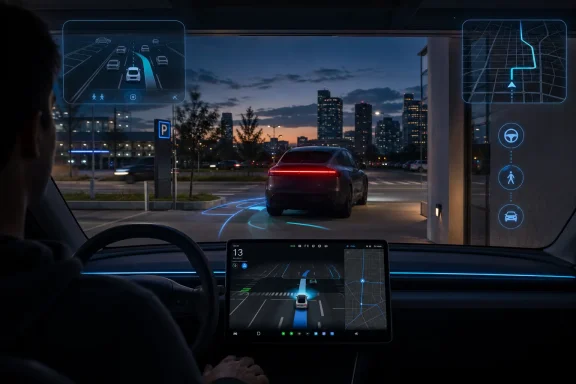 Tesla’s New Trick Is Not Autonomy, It Is Continuity
The striking part of the CleanTechnica account is not that the car follows lanes, changes lanes, or stops at traffic lights. Tesla owners have been arguing about those behaviors for years. The notable claim is that FSD V14 on Hardware 4 can stitch together the awkward, human parts of a trip: leaving the garage, backing out of a driveway, navigating a parking lot, entering public roads, arriving, and attempting to park.That is a different sort of progress from highway lane-centering. Highway assistance is bounded, repetitive, and comparatively easy to understand. Beginning and ending a trip are messy. The car has to interpret private driveways, ambiguous curb cuts, parking-lot geometry, pedestrians, shopping carts, bad map data, and all the little unmarked spaces where humans rely on social inference rather than formal traffic control.
The owner’s report says the Model Y can automatically leave a garage after the driver taps the brake and starts self-driving, then back out to the street. It can also leave a parking space, find its way out of a lot, and later attempt to park at the destination. That does not make the car autonomous in the Level 4 sense. It does make the system feel less like an assistive feature and more like a continuous journey manager.
Tesla has been chasing that feeling for years. “Full Self-Driving” was always a marketing phrase that implied more than the shipped capability could safely deliver. “Full Self-Driving (Supervised)” is more legally sober, but it still carries the old ambition. V14’s reported improvement is that the ambition is now visible in mundane places, not just in carefully filmed turn-by-turn demos.
The owner’s experience also highlights why supervised automation can feel more persuasive than it is. A car that completes nine trips without a correction can produce trust faster than a disclaimer can restrain it. The tenth trip, however, is where the system’s limits matter.
Hardware 3 Owners Are Living With the Bill for Tesla’s Old Promises
The most revealing line in the CleanTechnica piece may be the author’s frustration with Hardware 3. He says he spent nearly seven years watching FSD evolve on a 2019 Model 3, only to find himself effectively stranded on FSD V12 while newer Hardware 4 vehicles received V14. That experience turns Tesla’s hardware story into something more complicated than the usual “over-the-air updates make cars better” slogan.For years, Tesla sold the idea that cars already on the road had the hardware needed for future self-driving capability. Owners bought vehicles, options, and expectations around that premise. The company did improve those vehicles substantially through software, but the CleanTechnica account is a reminder that software-defined products still hit hardware walls.
Hardware 4 brought improved cameras and more compute capacity. Reports around the current FSD branch indicate that V14 is aimed at the newer AI4 platform, leaving many HW3 owners with older code paths or reduced expectations. That is not unusual in computing. Phones age out of operating-system features, GPUs age out of games, and enterprise hardware ages out of support windows.
Cars, however, are different. A 2019 vehicle is not an ancient artifact. Many owners expect a modern car to remain a primary household asset for a decade or more. When a vehicle’s most heavily marketed future feature becomes constrained by a computer installed behind the dashboard, the lifecycle math starts to look more like consumer electronics than traditional automotive ownership.
This is where Tesla’s old confidence collides with its current architecture. If autonomy depends on rapid neural-network progress, then the installed base becomes a drag. If the installed base was sold on autonomy, then that drag becomes a trust problem.
The author’s personal turn makes the point sharply. His 2019 Model 3 was totaled in May 2026. Only then did he move into a 2026 Model Y and get access to the more advanced experience. That is an uncomfortable upgrade path: the future arriving not through the promised evolution of the old car, but through the replacement of it.
FSD V14 Sounds Less Like a Beta and More Like a Driver With Bad Local Knowledge
The CleanTechnica report praises FSD V14’s ordinary driving behavior. The author describes it as chauffeur-like when the right mode is selected, with the car rarely making mistakes that require correction. He also says he now intervenes less often, waiting through stop-sign pauses and using that time to check cross traffic while the system resumes.That framing is important because it separates driving style from driving correctness. Tesla gives drivers behavioral modes such as Sloth, Chill, Standard, Hurry, and Mad Max. The owner says Sloth stays near the speed limit, Standard tends to run modestly over, and Mad Max can be far more aggressive. In practical terms, Tesla is not merely automating vehicle control; it is productizing driving temperament.
This is an old human problem in software form. Some drivers want caution. Some want flow. Some want the car to behave like the assertive commuter they imagine themselves to be. Tesla’s modes give users a sense of agency over the system’s personality, which may reduce the urge to intervene when the car behaves in a way the driver expected.
But the failure examples in the article show that V14’s remaining problems are not always about steering, braking, or object detection. They are often about local knowledge. The car may drive competently while going to the wrong entrance, choosing a poor parking strategy, following stale map assumptions, or misunderstanding a one-way airport loop.
That distinction should worry anyone who thinks autonomy is just a perception problem. Cameras and neural nets can identify many objects in the scene, but destinations are social and cartographic artifacts. A store can move. A Costco can be built where a map still shows a field. A driveway can be associated with the wrong street address. A legal one-way loop can be obvious to locals and mishandled by a navigation stack.
In other words, Tesla’s FSD can improve dramatically and still fail in ways that feel stupid to a human. That does not mean the system is useless. It means its failure mode is increasingly shifting from “the car cannot drive” to “the car can drive, but does not quite know where it is in the human world.”
The Map Is Now Part of the Driver
Tesla likes to emphasize vision. Elon Musk has long argued that roads built for human eyes can be driven by camera-based AI. The CleanTechnica account both supports and undercuts that thesis. The car apparently sees enough to drive many routes smoothly, but its destination failures expose how much the experience depends on navigation data that is not the same thing as real-time visual intelligence.The author notes that GPS accuracy can be off by roughly the width of a small house lot, and that Tesla navigation relies on map data that can be wrong or stale. That matters most at the edges of trips. On a highway, a 15-foot positioning error may be tolerable if lane perception is strong. In a driveway, parking lot, or airport loop, 15 feet can be the difference between correct, awkward, and dangerous.
This is the hidden infrastructure of consumer autonomy. A human driver can compensate for bad map data with common sense. If the map points to a field but the Costco is plainly visible, the human turns into the Costco. If the navigation says the destination is one street over but the driver recognizes their own house, the human stops at home. A supervised system can rely on that human correction. An unsupervised one cannot.
The owner’s examples are almost comically ordinary. A home address points to the wrong street. A Costco that has existed for years is not represented correctly. A parking lot exit produces the wrong turn. These are not edge cases in the academic sense. They are the daily slop of real-world navigation.
That is why parking is such a useful test. Parking is not merely a low-speed maneuver. It is a negotiation between geometry, rules, preferences, accessibility needs, private property design, and incomplete data. The owner says FSD V14 can park, but public-lot parking remains iffier. It cannot choose a handicapped space when appropriate, search intelligently for the best spot, or necessarily understand the driver’s actual intent.
Tesla can solve some of this with better models and better mapping. But the deeper issue is that a car that “drives anywhere” must understand arrival, not merely motion. Getting to a coordinate is not the same as getting to the place the user meant.
The Subscription Wall Changes the Meaning of a Tesla
The most pointed criticism in the CleanTechnica piece is not about FSD’s mistakes. It is about Tesla’s reported decision to stop including Autosteer as a standard feature on some new vehicles, leaving Traffic-Aware Cruise Control as the baseline and pushing lane-centering into the paid Full Self-Driving tier.For years, basic Autopilot was one of Tesla’s signature advantages. Even buyers who had no interest in FSD could use adaptive cruise and lane-centering on long highway trips. The feature became part of the ownership expectation, especially for commuters and road-trippers who valued reduced fatigue more than futuristic autonomy claims.
If new buyers must pay $99 per month to regain steering assistance that many competitors now bundle in some form, Tesla has changed the emotional contract. The hardware is still there. The cameras are still there. The compute is still there. But the capability becomes a recurring service rather than a vehicle feature.
That may be rational from Tesla’s standpoint. Recurring software revenue is attractive, and FSD is expensive to develop. A subscription model also lets Tesla avoid locking customers into a large upfront purchase for a product that is still evolving and still supervised. In the cleanest version of the argument, customers can try the system, keep it when it is useful, and cancel when it is not.
But the consumer experience is not so clean. A buyer who expects modern lane-centering in a premium EV may not care that Tesla has reorganized its software packaging. They will notice that a Toyota Corolla rental can provide steering assistance while a new Tesla asks for a monthly fee. That comparison is brutal because it strips away the autonomy debate and turns the issue into basic equipment value.
This is not just a Tesla problem. The auto industry is steadily testing which features can be turned into services, from heated seats to driver assistance to performance unlocks. Tesla is simply more aggressive, more software-native, and more willing to let the market absorb the shock.
The Name Still Does Too Much Work
“Full Self-Driving (Supervised)” is one of the strangest product names in modern technology. The first half suggests the destination. The parenthetical supplies the legal reality. Together they form a phrase that is technically more careful than the old branding but still rhetorically loaded.The CleanTechnica author understands the distinction. He repeatedly describes supervising the system, watching cross traffic, and remaining aware of failures. Yet the article also shows how easily the user experience encourages a stronger belief. If the car backs out of the garage, drives across town, navigates traffic, and parks, the driver’s body learns a story that the product name only has to nudge.
Tesla’s challenge is that supervised autonomy improves by becoming boring. The less often a driver intervenes, the more the driver is tempted to disengage. This is the paradox of Level 2 systems: success can train complacency, while failure requires exactly the attention that success erodes.
Traditional driver-assistance systems often avoid this by being narrower. Adaptive cruise controls speed and distance. Lane-centering helps within a lane. Automated parking handles a small, bounded task. Tesla’s FSD tries to unify the trip, which makes the experience more magical and the supervision burden more psychologically difficult.
The owner’s report is valuable because it does not pretend the system has crossed the Level 4 line. It says the car is much better. It says the car still makes mistakes. It says the driver remains responsible. That combination is more credible than either fanboy triumphalism or reflexive dismissal.
The policy question is what happens when many drivers have the same experience. Regulators tend to think in categories. Consumers think in habits. Tesla is building the habit first.
Camera-Only Autonomy Still Has a Weather Problem
The CleanTechnica piece argues that Tesla FSD will never drive in very bad weather or extremely low visibility because the system relies on visible-light cameras rather than radar or lidar. “Never” is a strong word, and technology has a way of punishing strong words. But the underlying concern is fair.Tesla removed radar from many vehicles as part of its Tesla Vision strategy, betting that cameras and neural-network perception could handle the driving task. The human analogy is obvious: people drive with eyes, so cars should be able to drive with cameras. The problem is that humans are not the safety benchmark autonomous systems are ultimately being sold against. Humans also drive too fast for conditions, miss hazards, and crash in fog.
Other autonomy developers have often chosen sensor redundancy. Radar can help with range and velocity in poor visibility. Lidar can provide precise depth information. Cameras provide rich semantic detail. A multi-sensor stack is not automatically superior in every implementation, but it gives engineers different channels of evidence when one modality is compromised.
Tesla’s counterargument is scale. Its vehicles collect enormous real-world driving data, and a camera-only approach is cheaper, simpler, and easier to deploy across millions of cars. If the model becomes good enough, Tesla gets a fleet advantage that more expensive sensor suites may struggle to match in consumer vehicles.
That is the grand bargain. Tesla trades sensor redundancy for scale, cost control, and software iteration. The risk is that certain physical limits do not yield to fleet learning as neatly as software optimists hope.
For supervised FSD, the answer is simple: the human takes over when conditions degrade. For unsupervised autonomy, that answer collapses. A Level 4 system needs a fallback plan that does not assume an alert human is ready to rescue it. Pulling over safely may be acceptable in some conditions, but it is not the same thing as driving the passenger wherever they wanted to go.
The Robotaxi Dream Depends on Boring Details
Tesla’s larger autonomy narrative has always pointed beyond private convenience. The company’s most ambitious claims imagine personal cars becoming robotaxis, vehicles earning money while their owners are not using them, and eventually a fleet of autonomous Teslas competing with purpose-built services. The CleanTechnica report shows both why that dream persists and why it remains hard.A car that can complete many ordinary trips without intervention is tantalizingly close to what consumers imagine a robotaxi does. The difference is that a commercial robotaxi cannot depend on a loyal owner forgiving mistakes. It has to handle airport loops, wrong map data, parking-lot ambiguity, blocked lanes, construction, emergency vehicles, accessibility requirements, and confused passengers at scale.
The reported V14 failures are exactly the kind that matter for a paid service. Taking the wrong path out of an airport is not just a quirky bug when the passenger is paying and the operator is liable. Failing to find a parking area because the map is stale is not just an annoyance when the vehicle has no driver to correct it. Choosing the wrong destination street is not a minor inconvenience for a rider who cannot manually intervene.
This is where Tesla’s consumer deployment can be both an advantage and a trap. Millions of supervised miles can reveal issues that closed fleets might encounter more slowly. But supervised use also masks severity. If drivers quietly correct the system, the ride ends successfully. The intervention becomes a data point, not a disaster.
A robotaxi business has less room for ambiguity. Either the car can operate within a defined domain without human supervision, or it cannot. The supervised consumer experience may be the road to that future, but it is not the future itself.
The CleanTechnica author’s phrase “holy grail” lands because the goal has not changed. Tesla still needs FSD to become safer than human driving without requiring human oversight. The current evidence suggests progress. It does not settle the case.
Windows People Should Recognize This Product Pattern
WindowsForum readers do not need to be Tesla owners to recognize the shape of this story. We have seen it in operating systems, cloud services, productivity suites, and enterprise management tools. A vendor ships hardware or software with a long-term promise, moves the most valuable improvements into a newer platform, then reorganizes the business model around subscriptions.In the PC world, this pattern is familiar enough to be boring. A new AI feature requires an NPU. A security baseline requires a newer TPM. A management capability moves behind a premium license. A once-bundled feature becomes part of a cloud plan. Each individual decision may be defensible. Together, they redefine ownership.
Tesla is applying the same logic to the car. The vehicle is no longer a fixed bundle of mechanical and electronic capabilities. It is a rolling endpoint, licensed and updated over time. The upside is that a car can improve dramatically after purchase. The downside is that the line between “what I bought” and “what I rent” keeps moving.
For sysadmins and IT pros, the analogy should sharpen the skepticism. Hardware capability is not the same as feature entitlement. Software support is not the same as feature parity. A vendor roadmap is not a guarantee. And when a company says a platform is ready for the future, the fine print often arrives years later in the form of minimum hardware requirements.
That does not make Tesla uniquely villainous. It makes Tesla modern. The car industry is becoming an IT industry with tires, warranty departments, and federal safety regulators attached.
The practical question for buyers is therefore less romantic than the autonomy debate. If you buy a Tesla today, are you buying a car, a software platform, or an entry point into a subscription funnel? The honest answer is all three.
The Owner Diary Gets the Mood Right Even When the Evidence Is Anecdotal
A two-week owner report is not a statistical safety study. It does not tell us intervention rates across regions, weather, road types, driver attentiveness, or near-miss severity. It cannot establish that FSD V14 is safer than a human driver. It cannot prove that Hardware 4 is sufficient for unsupervised autonomy.But anecdotal reports have a place in technology coverage because they capture product feel before formal institutions do. Benchmarks tell us one thing. Regulatory filings tell us another. A technically engaged owner describing how their behavior changed tells us something else: whether the product is becoming trusted in daily use.
The CleanTechnica piece is persuasive because it includes frustration. The author is not simply cheerleading. He criticizes Tesla’s unmet Hardware 3 expectations, calls out navigation errors, objects to the subscription gating of steering assistance, and lists missing functions. That mixture of enthusiasm and irritation is often where the truth of a maturing product lives.
The most important behavioral change is that the author says he is no longer overriding the system as much. That is a milestone of sorts. A driver who used to correct frequently now waits, watches, and lets the car proceed. The machine has earned more patience.
That patience is productive when the driver remains alert. It is dangerous when patience becomes faith. Tesla’s entire supervised-autonomy strategy lives on that knife edge.
The article also underlines a less discussed benefit: reduced cognitive load. If FSD handles most of a familiar trip well, the driver may arrive less fatigued, especially on long routes. That is not the same as sleeping in the back seat, but it is a real consumer value. Many technologies win not by becoming perfect, but by becoming good enough to be missed when absent.
The Missing Features Are a Map of the Remaining Problem
The owner’s list of desired additions is revealing because it is not exotic. He wants school-zone flashing-light behavior, garage parking, specific parking-space selection, legal handicapped-space support, drive-through-lane handling, better speed-bump slowing, and recognition of severe storm-drain dips. These are not moonshots. They are everyday driving details.That is precisely why they matter. Autonomy is not conquered by solving the dramatic scenes first. It is conquered by accumulating competence in thousands of boring cases that humans barely notice. A system that drives beautifully on arterial roads but mishandles school-zone lights is not ready to be treated as a driver. A system that parks somewhere but not where the user needs to park is helpful, not autonomous.
The school-zone example is especially important because it combines perception, law, and context. The car must notice the flashing lights, understand that they are active, associate them with a temporary speed limit, and behave correctly. A static speed-limit database is not enough. A camera-only perception system may see the lights, but the planner must know what they mean and when they apply.
The handicapped-parking example raises a different problem: authorization and preference. A car cannot simply decide to take an accessible space because it is open. It must know whether the occupant is legally entitled to use it. That implies user settings, verification, local law, and careful design to avoid abuse or embarrassment.
Drive-through lanes are another deceptively hard case. They mix private-property routing, low-speed negotiation, tight turns, ordering stops, pedestrians, curbs, and uncertain intent. A human understands that a McDonald’s has an ordering point, a payment window, and a pickup window. A car must learn the choreography.
These details make autonomy feel less like a single breakthrough and more like an endless backlog. Tesla may close that backlog faster than competitors because of fleet scale. But each closed item reveals another layer of ordinary human driving that was never as simple as it looked.
The Hardware 4 Lesson Will Not Stay Inside Tesla
The broader industry should pay attention to the Hardware 3 versus Hardware 4 divide. Every automaker now wants software-defined vehicles. Every automaker wants recurring revenue. Every automaker wants to promise that cars will improve after purchase. Tesla is simply far enough ahead in deployment to expose the lifecycle conflicts first.If an automaker sells a car on future capability, it inherits a support obligation that looks more like enterprise software than old-fashioned automotive service. Customers will ask which hardware revision they have, what model branch they are on, which features are excluded, and whether the limitation is technical or commercial. That is normal in IT. It is still culturally new in car buying.
Dealers and manufacturers are not ready for how technical the consumer conversation will become. Buyers will compare camera generations, compute platforms, sensor suites, software branches, and subscription entitlements. Used-car markets will have to price not only mileage and battery health, but autonomy hardware and transferable software rights.
This could make cars more transparent, but it could also make them more confusing. A 2026 Model Y may mean one thing. A 2024 Model Y with different hardware and software entitlement may mean another. A used Tesla that displays a driver-assistance label may not include what a buyer assumes it includes. The old window sticker was not built for this world.
Enterprise fleets will be even more cautious. A company considering EVs for employees does not want ambiguity around driver-assistance capability, liability, subscription continuity, or regional feature differences. The more software-defined the vehicle becomes, the more procurement begins to resemble SaaS due diligence.
Tesla can still benefit from that shift. It has the strongest brand association with vehicle software and over-the-air improvement. But being first also means being the company most associated with broken expectations when hardware generations diverge.
The Real Story Is the Gap Between Amazing and Accountable
Tesla’s FSD V14, as described in the CleanTechnica diary, sounds genuinely impressive. A car that leaves a garage, drives across town, and tries to park is doing something that would have seemed outlandish to most drivers a decade ago. The system’s progress deserves to be taken seriously.But accountability is not measured by amazement. It is measured by what happens when the map is wrong, the lane choice is bad, the weather closes in, the airport road is confusing, or the driver has stopped paying full attention because the car has been excellent for the last 40 minutes. The better the system gets, the more consequential its remaining failures become.
That is the central tension of Tesla’s autonomy strategy in 2026. FSD is good enough to change driver behavior, but not good enough to remove the driver. It is useful enough to support a subscription, but controversial enough that gating basic steering assistance feels punitive. It is advanced enough to embarrass many rival systems in scope, but inconsistent enough to validate skeptics.
Consumers often tolerate this kind of tension in software. They forgive bugs if the product is powerful, improves quickly, and delivers unique value. Cars are less forgiving because bugs move through physical space. A wrong click is not a wrong turn into a one-way loop.
Tesla’s wager is that rapid iteration will close the gap before regulators, courts, or customers lose patience. The owner diary suggests the gap is narrowing. It also shows that the gap is still very much there.
The Model Y Report Says More Than Tesla Intended
This is the concrete reading of the CleanTechnica account: FSD V14 on Hardware 4 appears meaningfully more capable than the author’s older Hardware 3 experience, especially at the beginning and end of trips. But it is still supervised driver assistance, and its weak points cluster around maps, local context, parking intent, and edge-case road rules.- A 2026 Tesla Model Y with Hardware 4 can reportedly use FSD V14 to leave a garage or parking spot and begin a trip with minimal driver input.
- The system can complete many ordinary drives without intervention, but the driver remains responsible and must supervise continuously.
- Navigation and map errors still create practical failures, including wrong destinations, stale business locations, and incorrect routing choices.
- Parking is improving but remains one of the clearest places where the car’s understanding of human intent falls short.
- Tesla’s move toward subscription-gated driver assistance changes the value proposition for buyers who mainly want highway lane-centering.
- Hardware 3 owners are a warning that software-defined cars can still age quickly when future features depend on newer compute and sensors.
Tesla’s Full Self-Driving story is no longer just a debate about whether Elon Musk promised too much too soon, though he plainly did. It is now a more practical argument about how much imperfect automation people will pay for, how carefully they will supervise it, and how long automakers can keep moving core capabilities between hardware generations and subscription tiers. FSD V14 may not be the arrival of the driverless future, but it looks like another step toward a stranger present: a car that is increasingly capable of driving you around, while still needing you to watch it closely and pay monthly for the privilege.
References
- Primary source: CleanTechnica
Published: Sat, 13 Jun 2026 20:33:16 GMT

Observations After Two Weeks with Tesla Hardware 4 & Full Self Driving V14 in My 2026 Tesla Model Y - CleanTechnica
Support CleanTechnica's work through a Substack subscription or on Stripe. I lived through almost 7 years of numerous releases of Tesla’s Full Self Driving (FSD) as it progressed in my 2019 Model 3 using “Hardware 3” (HW3), finally reaching FSD V12. Elon Musk promised every year...cleantechnica.com - Related coverage: tesla.com
- Related coverage: edmunds.com
- Related coverage: electrek.co

Tesla increases Actually Smart Summon speed by 33% in new FSD update | Electrek
Tesla's Actually Smart Summon now tops out at 8 mph, up from 6 mph, as part of the new FSD V14.3.3 update rolling out today to AI4 vehicles.electrek.co - Related coverage: techspot.com
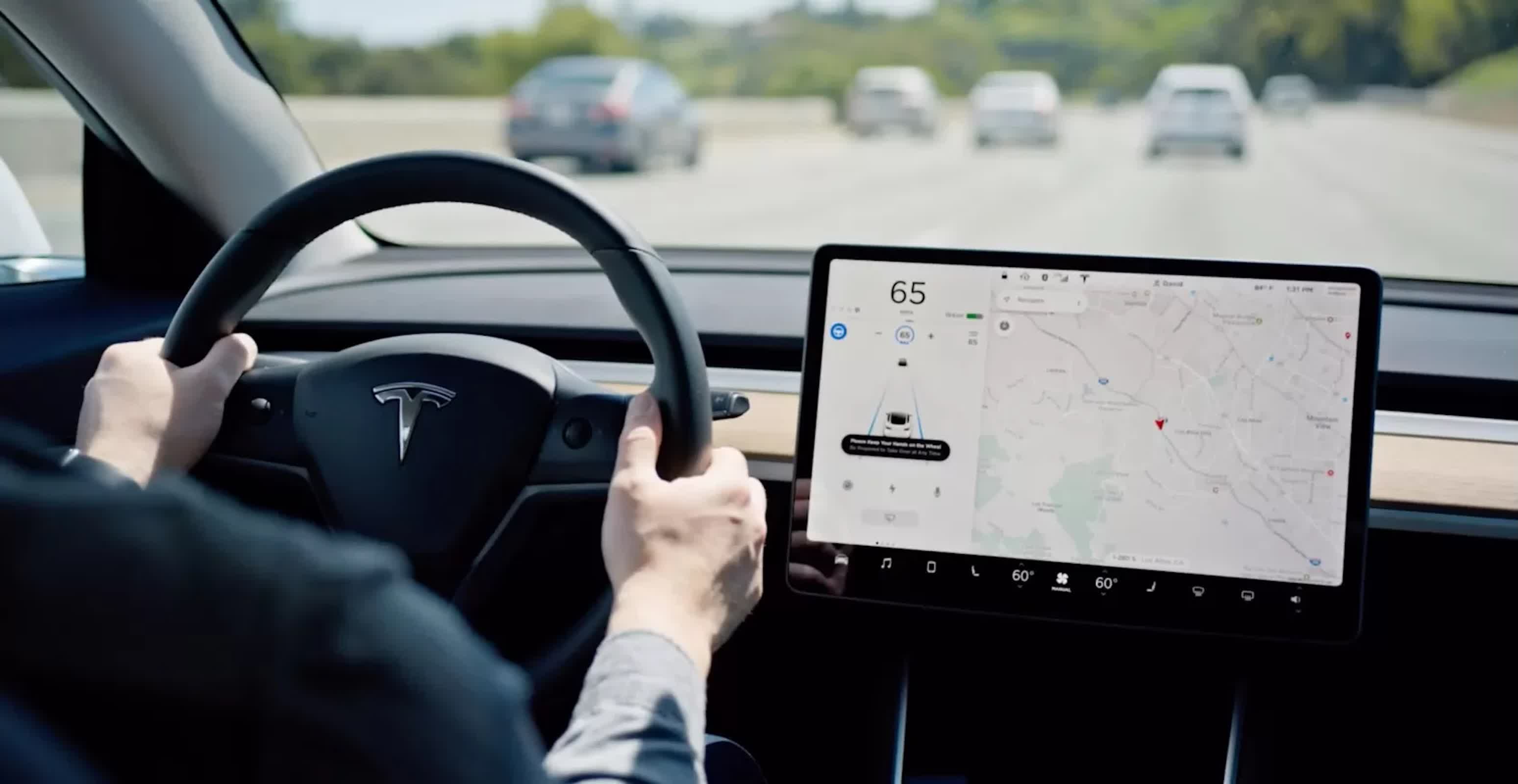
Tesla is making drivers pay monthly for features the car already has | TechSpot
For more than a decade, Autopilot has served as Tesla's foundational driver-assistance system. It pairs Traffic Aware Cruise Control, which maintains speed and following distance, with Autosteer,...www.techspot.com - Related coverage: autos.yahoo.com
Tesla Removes Autosteer From All Model 3 And Model Y Trims
Tesla has officially removed lane-centering for Model 3 and Model Y trims in the U.S. It's a big nudge toward subscription Full Self-Driving.autos.yahoo.com
- Related coverage: techradar.com

Tesla's massive Spring update leaves older cars behind — as owners spot fresh clue about a big Full Self-Driving change | TechRadar
New Self-Driving app leaves a lot of question unansweredwww.techradar.com - Related coverage: autoblog.com
- Related coverage: teslamagz.com
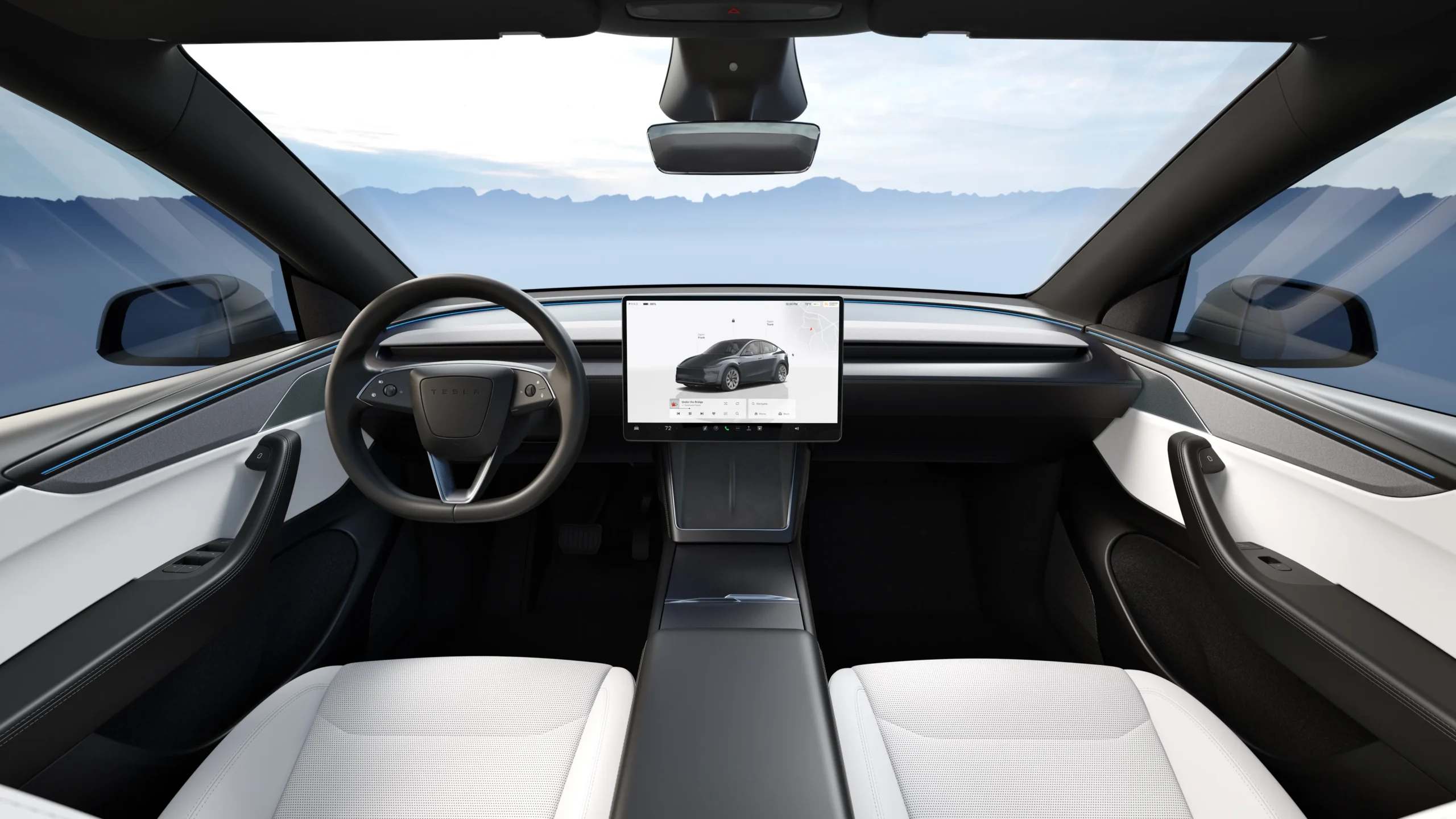
Tesla rolls out FSD v14.3.3 with a highly requested camera tweak - TeslaMagz
Tesla has started rolling out software version 2026.14.6.7, a new Spring Update that carries Full Self-Driving (Supervised) v14.3.3 and...teslamagz.com - Related coverage: creativebloq.com

Tesla ordered to rebrand Autopilot amid false advertising claims | Creative Bloq
The company could face a sales ban in California.www.creativebloq.com - Related coverage: as.com

Tesla “liquida” Autopilot entre problemas judiciales y un cambio de foco al robotaxi y las suscripciones - Meristation
Tesla elimina Autopilot y refuerza Full Self-Driving por suscripción, con Austin como vitrina tecnológica y California apretando por publicidad engañosa.as.com