

OpenAI retired GPT-5.2 from normal ChatGPT availability on June 12, 2026, moving older GPT-5.2 conversations to corresponding GPT-5.5 models while leaving developers to verify whether tuned prompts and automations still behave as expected. The change is less dramatic than a product launch, but more consequential than a routine UI tweak. It is another reminder that AI software is now built on moving ground. The model name in the picker may disappear quietly; the behavior underneath a workflow may not.
OpenAI did not need a stage event to make GPT-5.2 go away. The company’s model cadence has become fast enough that retirement is now part of the normal user experience: a capable model arrives, becomes familiar, receives smaller updates, then gets folded into a newer family once OpenAI decides the fleet should move on.
That sounds mundane until you remember what a language model is in practice. It is not just an engine. It is a collaborator, a formatter, a refusal system, a code-writing assistant, a summarizer, a translator, and—too often—a fragile dependency hidden inside a business process.
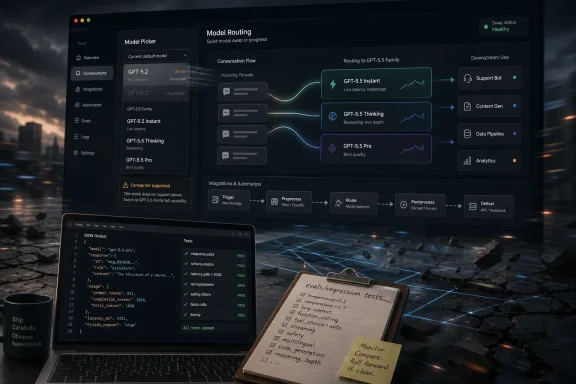
For ChatGPT users, the June 12 retirement means older conversations that had been using GPT-5.2 continue on the nearest GPT-5.5 equivalent. Instant maps to Instant, Thinking to Thinking, and Pro to Pro. That is the clean version of the story, and for many people it will be the only version that matters.
But “equivalent” is not “identical.” In traditional software, a version bump usually means a defined changelog and a set of reproducible behaviors. In large language models, a version bump can mean a different writing cadence, different defaults around brevity, different tool-use judgment, different sensitivity to ambiguous instructions, and a different instinct for when to refuse or hedge.
That is the part most ChatGPT users should care about. If you use ChatGPT for emails, explanations, job applications, coding help, spreadsheet cleanup, travel planning, or general research, you probably do not need to do anything. The model picker changes; the conversation continues; the new model is supposed to be better.
The catch is memory. Not ChatGPT’s saved-memory feature, but user memory: the habits people build around a model. Some users learn that a particular model responds best to terse prompts. Others discover that a model produces cleaner tables if asked in a certain order. Writers learn its rhythm. Developers learn its quirks. Students learn whether it overexplains.
A forced migration breaks that familiarity in subtle ways. The old chat may still be there, but the model answering inside it is no longer the one that started the thread. That matters most in long-running conversations where the user expects continuity, because the prompt history can remain constant while the system interpreting it changes.
OpenAI appears to be collapsing some specialist workflows back into the main chat surface. Instead of maintaining a separate Canvas-first experience for every model path, the company is steering more writing and coding work through standard chat responses, code blocks, and writing blocks. That simplifies the interface, but it also changes muscle memory for users who treated Canvas as a quasi-document editor.
For WindowsForum readers, this is the familiar software-platform tradeoff wearing an AI hat. Microsoft has done this for decades with Office, Windows settings, Control Panel migrations, Teams features, and Edge integrations: reduce surface complexity in the name of consistency, and power users immediately notice which specialized affordances went missing.
The practical advice is simple. If your workflow depends on Canvas, check which model path you are on before assuming the feature has vanished. GPT-5.5 does not mean one uniform experience across every tier and mode.
If a casual user gets a slightly different answer, the cost is usually a follow-up prompt. If a developer has a prompt chain feeding a parser, a support bot, a CRM action, a report generator, or an internal coding agent, a slight difference in output structure can become a bug. The model may not fail loudly. It may just become more verbose, omit a delimiter, rename a heading, soften a classification, or choose a different tool.
That is why model retirement should be treated less like a feature update and more like a dependency migration. In normal software engineering, nobody sensible updates a database driver, authentication library, or payment SDK in production without regression testing. AI models deserve the same discipline.
The bare minimum is an evaluation set. Not a grand benchmark, not a PhD project, just a representative bank of real prompts and expected properties. Does the model still return valid JSON? Does it preserve required headings? Does it classify edge cases consistently? Does it avoid forbidden claims? Does it stay within token and latency budgets?
The teams that already have that harness will absorb GPT-5.2’s retirement as a scheduled chore. The teams that do not will discover the migration through user complaints, monitoring anomalies, or downstream jobs that suddenly need manual cleanup.
If an application calls a generic “latest” model, the developer is asking the vendor to decide when production behavior changes. Sometimes that is exactly the right choice, particularly for low-risk workloads where users benefit immediately from quality improvements. But in regulated, customer-facing, or machine-parsed systems, that bargain should be explicit.
Model pinning is not a cure-all. A pinned model can still reach a shutdown date. A vendor can still announce retirement. Security and safety updates can still alter behavior around the edges. But pinning turns surprise into schedule. It gives engineering teams a migration window, a comparison target, and a reason to run tests before the old model disappears.
That distinction matters more as AI becomes infrastructure. A company would not let a cloud provider silently swap a database engine under a production workload without asking hard questions. Yet many AI integrations still rely on loose model references and vibes-based acceptance testing. GPT-5.2’s retirement is a polite warning that this era is ending.
A model that is more concise may break a workflow expecting elaboration. A model that is more cautious may refuse a borderline instruction the old model answered. A model that follows instructions more literally may expose sloppy prompts that previously worked because the old model inferred intent generously. A model with stronger reasoning may decide to restructure an answer rather than preserve the exact surface form a parser expects.
This is not a contradiction. It is the nature of probabilistic systems with product-level alignment layered on top. “Better” is measured across broad distributions of tasks. Your workflow is a tiny, idiosyncratic slice of that distribution.
That is why developers should compare behavior, not just capability claims. The question is not whether GPT-5.5 is smarter than GPT-5.2 in the abstract. The question is whether GPT-5.5 performs your task, under your constraints, with your failure modes, at the cost and latency profile you can tolerate.
For many workloads, the answer will be yes. For some, the migration will require prompt edits. For a few, it may require changing output contracts, adding validation, or splitting one large prompt into smaller controlled steps.
That may all prove directionally right. It may also be a jumble of internal labels, canary builds, temporary routing names, and wishful pattern-matching. In AI product cycles, a leaked checkpoint name is not a launch plan. It is not a model card. It is not a pricing page. It is not an enterprise availability commitment.
The safest reading is that OpenAI is obviously continuing to test successor models. That is not news; it is the company’s operating model. The unsupported leap is assuming that a rumored name, feature set, or date should influence production planning.
Developers should not wait for GPT-5.6 to fix a GPT-5.5 migration problem. They should validate against the model actually serving traffic today. If GPT-5.6 appears later this month, next month, or under a different name entirely, the same process applies again: evaluate, compare, pin where appropriate, and migrate deliberately.
OpenAI is trying to optimize a massive consumer and developer platform around constant model improvement. That means fewer stale defaults, faster safety iteration, better compute allocation, and a cleaner product lineup. It also means users and companies are being trained to accept that model behavior is temporary.
This is where AI differs from most software dependencies. A typical library update changes defined functions. A model update changes judgment. It can alter how a system interprets vagueness, weighs risk, chooses words, formats code, or decides whether a user is asking for something disallowed.
That is powerful when the model gets better. It is risky when the model sits inside a business process that was never designed for semantic drift. The hidden cost of rapid AI improvement is that everyone downstream must become better at change management.
For sysadmins and IT managers, this should sound familiar. The Windows world has spent years learning to live with evergreen browsers, cumulative updates, Microsoft 365 feature rollouts, and cloud-admin portals that change before the documentation catches up. AI adds another layer: the interface may look the same, but the reasoning substrate can change under it.
A legal department using ChatGPT Enterprise for document review wants improved reasoning, but it also wants predictable handling of privileged information and repeatable summaries. A software team using AI for code review wants better bug detection, but it also wants stable output formats and auditable recommendations. A support organization wants a more helpful bot, but not one that suddenly changes refund language or escalation thresholds.
That is why enterprise AI governance will increasingly revolve around model lifecycle management. The conversation will move beyond “which model is smartest?” toward “which model is approved for which workflow, until what date, with what evaluation evidence?”
This is not anti-innovation. It is how useful technology becomes operational technology. The moment an AI model affects customers, compliance, finances, security, or production systems, model updates become change-control events.
OpenAI and its competitors know this, which is why model cards, deprecation notices, evals, and enterprise controls are becoming part of the sales pitch. But the burden is shared. Vendors can publish timelines and recommended replacements; customers still need inventories, tests, owners, rollback plans, and monitoring.
For ChatGPT users, the migration mostly means GPT-5.5 is now the baseline experience. For developers, it means the old assumption that prompts are portable across model versions deserves to die. Prompts are code-adjacent artifacts. They need tests, owners, and version history.
The most concrete lessons are not complicated:
 The Quiet Model Swap Is the Product Strategy
OpenAI did not need a stage event to make GPT-5.2 go away. The company’s model cadence has become fast enough that retirement is now part of the normal user experience: a capable model arrives, becomes familiar, receives smaller updates, then gets folded into a newer family once OpenAI decides the fleet should move on.That sounds mundane until you remember what a language model is in practice. It is not just an engine. It is a collaborator, a formatter, a refusal system, a code-writing assistant, a summarizer, a translator, and—too often—a fragile dependency hidden inside a business process.
For ChatGPT users, the June 12 retirement means older conversations that had been using GPT-5.2 continue on the nearest GPT-5.5 equivalent. Instant maps to Instant, Thinking to Thinking, and Pro to Pro. That is the clean version of the story, and for many people it will be the only version that matters.
But “equivalent” is not “identical.” In traditional software, a version bump usually means a defined changelog and a set of reproducible behaviors. In large language models, a version bump can mean a different writing cadence, different defaults around brevity, different tool-use judgment, different sensitivity to ambiguous instructions, and a different instinct for when to refuse or hedge.
ChatGPT Users Get a Better Default, Not a Time Machine
The consumer-facing case for GPT-5.5 is straightforward. OpenAI has positioned GPT-5.5 Instant as a smarter, clearer, more personalized default model, with particular emphasis on accuracy, concision, and a more natural conversational style. GPT-5.5 Thinking is pitched as the heavier-duty reasoning option, while GPT-5.5 Pro remains the high-compute lane for users and organizations paying for it.That is the part most ChatGPT users should care about. If you use ChatGPT for emails, explanations, job applications, coding help, spreadsheet cleanup, travel planning, or general research, you probably do not need to do anything. The model picker changes; the conversation continues; the new model is supposed to be better.
The catch is memory. Not ChatGPT’s saved-memory feature, but user memory: the habits people build around a model. Some users learn that a particular model responds best to terse prompts. Others discover that a model produces cleaner tables if asked in a certain order. Writers learn its rhythm. Developers learn its quirks. Students learn whether it overexplains.
A forced migration breaks that familiarity in subtle ways. The old chat may still be there, but the model answering inside it is no longer the one that started the thread. That matters most in long-running conversations where the user expects continuity, because the prompt history can remain constant while the system interpreting it changes.
Canvas Is the Canary in the Interface
The most visible consumer wrinkle is Canvas. OpenAI’s recent GPT-5.5 notes say GPT-5.5 Instant no longer supports Canvas, and that GPT-5.5 Thinking is the route for users who still need Canvas-style creation and editing. That may sound like a small product-management distinction, but it reveals something larger about where ChatGPT is going.OpenAI appears to be collapsing some specialist workflows back into the main chat surface. Instead of maintaining a separate Canvas-first experience for every model path, the company is steering more writing and coding work through standard chat responses, code blocks, and writing blocks. That simplifies the interface, but it also changes muscle memory for users who treated Canvas as a quasi-document editor.
For WindowsForum readers, this is the familiar software-platform tradeoff wearing an AI hat. Microsoft has done this for decades with Office, Windows settings, Control Panel migrations, Teams features, and Edge integrations: reduce surface complexity in the name of consistency, and power users immediately notice which specialized affordances went missing.
The practical advice is simple. If your workflow depends on Canvas, check which model path you are on before assuming the feature has vanished. GPT-5.5 does not mean one uniform experience across every tier and mode.
Developers Should Treat This as a Production Migration
The difference between a ChatGPT user and a developer is not sophistication. It is blast radius.If a casual user gets a slightly different answer, the cost is usually a follow-up prompt. If a developer has a prompt chain feeding a parser, a support bot, a CRM action, a report generator, or an internal coding agent, a slight difference in output structure can become a bug. The model may not fail loudly. It may just become more verbose, omit a delimiter, rename a heading, soften a classification, or choose a different tool.
That is why model retirement should be treated less like a feature update and more like a dependency migration. In normal software engineering, nobody sensible updates a database driver, authentication library, or payment SDK in production without regression testing. AI models deserve the same discipline.
The bare minimum is an evaluation set. Not a grand benchmark, not a PhD project, just a representative bank of real prompts and expected properties. Does the model still return valid JSON? Does it preserve required headings? Does it classify edge cases consistently? Does it avoid forbidden claims? Does it stay within token and latency budgets?
The teams that already have that harness will absorb GPT-5.2’s retirement as a scheduled chore. The teams that do not will discover the migration through user complaints, monitoring anomalies, or downstream jobs that suddenly need manual cleanup.
Pinning Models Is Not Bureaucracy
OpenAI’s API documentation has long made the distinction between stable snapshots and aliases important. The reason is not pedantry. A floating alias is convenient during experimentation and dangerous when reproducibility matters.If an application calls a generic “latest” model, the developer is asking the vendor to decide when production behavior changes. Sometimes that is exactly the right choice, particularly for low-risk workloads where users benefit immediately from quality improvements. But in regulated, customer-facing, or machine-parsed systems, that bargain should be explicit.
Model pinning is not a cure-all. A pinned model can still reach a shutdown date. A vendor can still announce retirement. Security and safety updates can still alter behavior around the edges. But pinning turns surprise into schedule. It gives engineering teams a migration window, a comparison target, and a reason to run tests before the old model disappears.
That distinction matters more as AI becomes infrastructure. A company would not let a cloud provider silently swap a database engine under a production workload without asking hard questions. Yet many AI integrations still rely on loose model references and vibes-based acceptance testing. GPT-5.2’s retirement is a polite warning that this era is ending.
Better Models Still Break Bad Assumptions
The uncomfortable truth is that a better model can be a worse drop-in replacement.A model that is more concise may break a workflow expecting elaboration. A model that is more cautious may refuse a borderline instruction the old model answered. A model that follows instructions more literally may expose sloppy prompts that previously worked because the old model inferred intent generously. A model with stronger reasoning may decide to restructure an answer rather than preserve the exact surface form a parser expects.
This is not a contradiction. It is the nature of probabilistic systems with product-level alignment layered on top. “Better” is measured across broad distributions of tasks. Your workflow is a tiny, idiosyncratic slice of that distribution.
That is why developers should compare behavior, not just capability claims. The question is not whether GPT-5.5 is smarter than GPT-5.2 in the abstract. The question is whether GPT-5.5 performs your task, under your constraints, with your failure modes, at the cost and latency profile you can tolerate.
For many workloads, the answer will be yes. For some, the migration will require prompt edits. For a few, it may require changing output contracts, adding validation, or splitting one large prompt into smaller controlled steps.
The GPT-5.6 Rumor Mill Is Not a Roadmap
The Tech Times report also points to speculation around a GPT-5.6 “kindle-alpha” checkpoint, reportedly observed through developer or enthusiast channels. The claims attached to that rumor are exactly the sort that generate forum threads: stronger reasoning, better coding, improved vision, cleaner SVG output, and possibly a larger context window.That may all prove directionally right. It may also be a jumble of internal labels, canary builds, temporary routing names, and wishful pattern-matching. In AI product cycles, a leaked checkpoint name is not a launch plan. It is not a model card. It is not a pricing page. It is not an enterprise availability commitment.
The safest reading is that OpenAI is obviously continuing to test successor models. That is not news; it is the company’s operating model. The unsupported leap is assuming that a rumored name, feature set, or date should influence production planning.
Developers should not wait for GPT-5.6 to fix a GPT-5.5 migration problem. They should validate against the model actually serving traffic today. If GPT-5.6 appears later this month, next month, or under a different name entirely, the same process applies again: evaluate, compare, pin where appropriate, and migrate deliberately.
OpenAI’s Cadence Is Becoming the Platform Risk
The larger story is not GPT-5.2 versus GPT-5.5. It is cadence.OpenAI is trying to optimize a massive consumer and developer platform around constant model improvement. That means fewer stale defaults, faster safety iteration, better compute allocation, and a cleaner product lineup. It also means users and companies are being trained to accept that model behavior is temporary.
This is where AI differs from most software dependencies. A typical library update changes defined functions. A model update changes judgment. It can alter how a system interprets vagueness, weighs risk, chooses words, formats code, or decides whether a user is asking for something disallowed.
That is powerful when the model gets better. It is risky when the model sits inside a business process that was never designed for semantic drift. The hidden cost of rapid AI improvement is that everyone downstream must become better at change management.
For sysadmins and IT managers, this should sound familiar. The Windows world has spent years learning to live with evergreen browsers, cumulative updates, Microsoft 365 feature rollouts, and cloud-admin portals that change before the documentation catches up. AI adds another layer: the interface may look the same, but the reasoning substrate can change under it.
Enterprise IT Will Ask the Boring Questions First
Enterprise buyers do not dislike new models. They dislike unbounded change.A legal department using ChatGPT Enterprise for document review wants improved reasoning, but it also wants predictable handling of privileged information and repeatable summaries. A software team using AI for code review wants better bug detection, but it also wants stable output formats and auditable recommendations. A support organization wants a more helpful bot, but not one that suddenly changes refund language or escalation thresholds.
That is why enterprise AI governance will increasingly revolve around model lifecycle management. The conversation will move beyond “which model is smartest?” toward “which model is approved for which workflow, until what date, with what evaluation evidence?”
This is not anti-innovation. It is how useful technology becomes operational technology. The moment an AI model affects customers, compliance, finances, security, or production systems, model updates become change-control events.
OpenAI and its competitors know this, which is why model cards, deprecation notices, evals, and enterprise controls are becoming part of the sales pitch. But the burden is shared. Vendors can publish timelines and recommended replacements; customers still need inventories, tests, owners, rollback plans, and monitoring.
The Small Print Is Now the Main Event
The GPT-5.2 retirement is a reminder to read release notes the way admins read patch notes: not for marketing adjectives, but for operational consequences. A removed model, a changed default, a tool support exception, a context-window difference, or a revised usage limit can matter more than the headline benchmark.For ChatGPT users, the migration mostly means GPT-5.5 is now the baseline experience. For developers, it means the old assumption that prompts are portable across model versions deserves to die. Prompts are code-adjacent artifacts. They need tests, owners, and version history.
The most concrete lessons are not complicated:
- Older GPT-5.2 ChatGPT conversations may continue on GPT-5.5 equivalents, but equivalent model routing does not guarantee identical wording, formatting, or edge-case behavior.
- Casual users probably do not need to take action unless they relied on a specific tool path such as Canvas or noticed a meaningful change in long-running chats.
- Developers should audit production calls, avoid relying on floating aliases for sensitive workflows, and pin model versions where reproducibility matters.
- Teams should rerun representative prompts against GPT-5.5 before assuming a GPT-5.2-tuned workflow is safe.
- Rumored GPT-5.6 checkpoints are worth watching but not worth planning around until OpenAI publishes official availability, documentation, and model details.
References
- Primary source: Tech Times
Published: Sat, 13 Jun 2026 22:10:07 GMT

OpenAI Retires GPT-5.2 and Moves Everyone to GPT-5.5 and the GPT-5.6 leak
As of June 12, 2026, OpenAI removed GPT-5.2 Instant, Thinking, and Pro from ChatGPT, and existing conversations now continue on the matching GPT-5.5 model. The forced upgrade can subtly change modelwww.techtimes.com - Official source: platform.openai.com

Deprecations | OpenAI API
Find information about OpenAI API deprecations and recommended replacements. platform.openai.com
- Official source: help.openai.com

Model Release Notes | OpenAI Help Center
 help.openai.com
- Official source: openai.com

Presentamos GPT-5.2 | OpenAI
GPT-5.2 es nuestro modelo más avanzado hasta ahora para el trabajo profesional diario, con capacidades de razonamiento de última generación, comprensión de contextos extensos, programación y visión. Úsalo en ChatGPT y en la API de OpenAI para acelerar flujos de trabajo con agentes de manera más...openai.com - Official source: cdn.openai.com
- Official source: deploymentsafety.openai.com