

OpenAI released GPT-5.5 on April 23, 2026, rolling the model into ChatGPT and Codex for paid users while positioning it as a major step forward in coding, computer control, long-context work, and agent-style task execution. The release is not merely another leaderboard refresh. It is OpenAI’s latest attempt to make the chatbot less like a clever autocomplete box and more like a software operator. For Windows users, developers, and enterprise IT teams, that shift matters because the next AI battleground is not the prompt window — it is the desktop, the terminal, the IDE, and the workflow.
The headline promise of GPT-5.5 is that it can do more with less hand-holding. That sounds like ordinary launch-day marketing until you look at where the claimed improvements are concentrated: command-line work, coding, office-style knowledge tasks, customer-service workflows, and computer-use benchmarks. OpenAI is not primarily arguing that GPT-5.5 writes prettier prose. It is arguing that the model can stay oriented while doing multi-step work.
That is the real story behind the release. The consumer chatbot era rewarded models that could answer questions cleanly, explain concepts fluently, and hallucinate with enough confidence to pass as useful. The agentic era rewards models that can make a plan, operate tools, check intermediate results, and recover from mistakes without the user acting as project manager at every turn.
OpenAI President Greg Brockman’s framing — that the model can do much more with less guidance — is aimed at the enterprise buyer as much as the enthusiast. In a corporate setting, the expensive part of AI adoption is often not the model call. It is the human labor required to babysit the model, translate vague business requests into structured prompts, test the output, and decide whether the answer is safe to use.
GPT-5.5 is therefore best understood as a bet on delegation. OpenAI wants users to stop thinking of ChatGPT as a conversational sidecar and start treating it as a junior operator that can be dropped into a defined environment. That is a much more lucrative vision, and also a much more dangerous one.
The command line is where many real operational tasks happen. Package installation, log inspection, Git conflict resolution, container debugging, build failures, permissions problems, and cloud deployment errors all tend to collapse into shell sessions sooner or later. A model that can operate there reliably is closer to useful automation than a model that merely explains what a command might do.
OpenAI also points to strong scores on OSWorld-Verified, Tau2-bench Telecom, GDPval, FinanceAgent, internal investment-banking modeling tasks, and OfficeQA Pro. The thread running through those benchmarks is not general cleverness but persistence inside structured work. These are tests of whether a model can complete tasks in environments that resemble offices, customer-service systems, financial documents, and computers with actual state.
That matters because the AI industry’s definition of “smart” is changing. For years, the benchmark chase revolved around exams, programming contests, math sets, and text-based reasoning tests. GPT-5.5’s launch package still includes plenty of ranking language, but the center of gravity has moved toward models that can act.
The caveat is that benchmark performance is not the same as operational reliability. A terminal benchmark can tell us whether a model completes a curated set of command-line tasks. It cannot tell us whether an IT department should let that model loose on production servers, domain controllers, privileged PowerShell sessions, or developer workstations with access to internal source code.
That split is important because the frontier AI race is no longer a simple matter of one model being “the best.” The best coding agent, the best multilingual assistant, the best research model, the best office automation model, and the best low-cost default chatbot may be different products. Enterprises will not buy one model because a leaderboard says so; they will buy a workflow that fits their risk profile, procurement constraints, and existing tooling.
For Microsoft-heavy shops, the question is even narrower. Does the model understand PowerShell and Windows internals well enough to be trusted? Can it reason across Microsoft 365, Entra ID, Defender, Intune, Azure, Visual Studio, GitHub, and legacy Windows Server estates without flattening the details? Can it distinguish a safe remediation from a change that breaks authentication for half the company?
Those are not leaderboard questions. They are helpdesk, change-control, and incident-response questions. GPT-5.5’s numbers make OpenAI harder to ignore, but they do not remove the burden of local validation.
Long context changes the feel of AI because it reduces the amount of pre-digestion humans must perform. Instead of summarizing the problem, extracting the relevant excerpts, and feeding the model a carefully manicured prompt, a user can increasingly point the model at the messy pile. That is exactly the direction OpenAI wants to go: less prompt engineering, more task delegation.
For developers, this could mean asking Codex to reason across a large repository rather than a handful of files. For sysadmins, it could mean correlating a fleet’s worth of logs, configuration exports, and policy documents. For security teams, it could mean stitching together endpoint telemetry, detection rules, threat reports, and incident timelines.
But long context has a trap. More input does not guarantee better judgment. A model can still miss the crucial line in a log file, over-weight a stale policy document, or produce an answer that sounds comprehensive because it consumed a large amount of material. The presence of more context can create a false sense of auditability: the model “had everything,” so its answer feels more trustworthy than it deserves.
That is why GPT-5.5’s context window is both a capability upgrade and a governance problem. The larger the window, the more likely users are to paste in sensitive material. The more sensitive material enters the model workflow, the more organizations must care about retention, access controls, logging, data boundaries, and downstream exposure.
The company is not treating GPT-5.5 as a cheap default intelligence layer. It is treating it as a premium work engine. That makes sense if the model can replace hours of skilled labor in coding, analysis, or office automation, but it is a very different proposition from the low-friction chatbot subscriptions that popularized generative AI.
The economics become sharper with long context. A 1 million token window is useful precisely because it invites larger prompts, longer documents, bigger codebases, and more expansive tool traces. But the more context users feed into a premium model, the more quickly experimentation becomes a line item.
For enterprise IT, this means AI cost control is going to look less like buying software seats and more like cloud spend management. Teams will need usage policies, routing rules, model tiers, caching strategies, and monitoring. Not every task deserves GPT-5.5 Pro. Not every employee should be able to burn through premium tokens by uploading entire SharePoint libraries to answer a question that a smaller model could handle.
This is where Microsoft’s ecosystem gravity becomes relevant. If OpenAI models are increasingly embedded into ChatGPT, Codex, Microsoft 365 Copilot, GitHub tools, Azure services, and third-party products, cost visibility will become fragmented. The invoice may not say “GPT-5.5 experiment gone wild,” but the behavior will be the same.
Developer tools are also where agentic models can demonstrate value without immediately confronting the messiest parts of general office work. A coding agent can inspect a repository, propose a patch, run tests, and iterate. That loop is far more concrete than asking an assistant to “improve business operations” or “analyze strategy.”
For Windows developers, the implications are immediate. The AI coding assistant is no longer just autocompleting lines in an editor. It is increasingly expected to navigate repos, modify multiple files, run commands, interpret compiler errors, adjust dependencies, and explain the change. That is closer to a junior developer with terminal access than to IntelliSense with a personality.
The risk is that many organizations have not updated their controls to match that reality. A coding assistant with repo access can leak secrets, introduce vulnerable dependencies, mishandle licensing constraints, or generate code that passes tests while violating architectural norms. If it can execute commands, it can also alter local environments in ways that are hard to reconstruct later.
This does not mean teams should avoid GPT-5.5 or similar models. It means AI coding agents need to be treated as participants in the software supply chain. Their outputs should be reviewed, their tool permissions should be scoped, and their actions should be logged in ways that make sense to security and compliance teams.
A model that can operate tools and understand longer contexts could be genuinely useful for Windows admins. It could analyze event logs, compare Group Policy settings, draft remediation scripts, summarize Defender incidents, or help reason through why a fleet of devices failed an Intune compliance policy. The long-context window could make it easier to feed in configuration exports and historical notes that would previously have exceeded model limits.
But the same capabilities raise the stakes of bad advice. A hallucinated registry change is annoying on a test VM and catastrophic at scale. A PowerShell command copied into an elevated terminal can do real damage. A mistaken interpretation of Conditional Access policy can lock out users or weaken authentication.
The natural response is not to ban the tool. It is to put it in a workflow that assumes fallibility. GPT-5.5 can help draft a script; it should not silently run one against production. It can summarize an incident; it should not be the only analyst deciding containment. It can propose a policy change; it should not bypass change management.
The best Windows administrators already work this way with human colleagues. They test in rings, review scripts, use version control, document changes, and maintain rollback plans. AI does not remove those disciplines. It makes them more important because the assistant can produce plausible work at a speed that tempts people to skip them.
That is why GPT-5.5 lands only six weeks after GPT-5.4. The pace is part of the product strategy. Frontier labs want customers to believe that subscribing to their platform means riding the steepest improvement curve in software. If a model becomes meaningfully better every few months, procurement decisions start to look less like buying a fixed tool and more like buying access to acceleration.
But rapid model turnover is a headache for IT. Enterprises value improvement, but they also value predictability. A model that changes behavior between March and April can break prompts, alter support workflows, invalidate testing, or produce different answers to the same regulated process. In consumer software, this is called an upgrade. In enterprise environments, it can be a control failure.
The deeper issue is that AI models are not traditional software releases. A new version does not simply add features or fix bugs. It can change style, risk tolerance, reasoning patterns, refusal behavior, coding preferences, and tool-use habits. Even when the API shape remains stable, the operational behavior may not.
That means model governance has to mature quickly. Organizations need to know which model is being used, when it changed, what tasks it is approved for, what evaluation was performed, and how outputs are monitored. Otherwise, the productivity story becomes indistinguishable from shadow IT with a better interface.
The safety challenge is not only about spectacular misuse scenarios. It is about ordinary misuse at scale. A model that helps automate support workflows can mishandle customer data. A model that assists with cybersecurity can cross boundaries between defense and offensive capability. A model that writes scripts can accidentally embed secrets or destructive commands. A model that summarizes documents can leak sensitive context into places it should not go.
OpenAI’s balancing act is familiar: preserve access for beneficial work while reducing misuse. That is a reasonable goal, but the details matter. If safeguards are too strict, professionals route around them or move to less restrictive tools. If safeguards are too loose, the model becomes a liability for both OpenAI and its customers.
For enterprise customers, vendor safeguards are not enough. They need local controls: identity integration, data-loss prevention, tenant-level policy, audit logs, retention settings, role-based permissions, and clear boundaries between personal and corporate use. The model provider can reduce some risks, but it cannot know every organization’s regulatory obligations or internal threat model.
This is where AI adoption starts to resemble endpoint security. Nobody serious relies on the operating system vendor alone to solve every risk. They layer controls, monitor behavior, educate users, and assume that mistakes will happen. GPT-5.5 belongs in the same mental category.
That is why the GPT-5.5 launch is not just a model announcement. It is another move in a platform contest. The winner is unlikely to be the lab with the highest score on every benchmark, because no lab will win every category for long. The winner will be the company that turns model intelligence into trusted, governable, repeatable work inside the tools people already use.
For Windows and Microsoft 365 shops, that contest will be felt less as a brand debate and more as an integration question. Does the AI sit inside the admin center? Does it understand the tenant? Can it respect permissions? Can it cite internal documents without exposing them to the wrong user? Can it work with Teams, Outlook, SharePoint, GitHub, Visual Studio, Azure, and Defender without creating another management plane?
OpenAI’s challenge is that raw capability can attract users faster than governance can satisfy administrators. That gap is where shadow AI grows. Employees adopt the tool because it helps them finish work. IT catches up later, often after sensitive material has already flowed through unmanaged accounts.
The lesson from previous waves of cloud adoption is clear. If official tools are too slow, too locked down, or too expensive, users will find unofficial ones. GPT-5.5’s power makes that dynamic more urgent, not less.
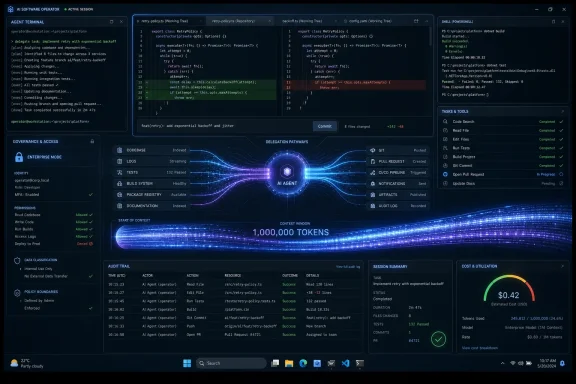 OpenAI Is Selling Less Prompting and More Delegation
The headline promise of GPT-5.5 is that it can do more with less hand-holding. That sounds like ordinary launch-day marketing until you look at where the claimed improvements are concentrated: command-line work, coding, office-style knowledge tasks, customer-service workflows, and computer-use benchmarks. OpenAI is not primarily arguing that GPT-5.5 writes prettier prose. It is arguing that the model can stay oriented while doing multi-step work.That is the real story behind the release. The consumer chatbot era rewarded models that could answer questions cleanly, explain concepts fluently, and hallucinate with enough confidence to pass as useful. The agentic era rewards models that can make a plan, operate tools, check intermediate results, and recover from mistakes without the user acting as project manager at every turn.
OpenAI President Greg Brockman’s framing — that the model can do much more with less guidance — is aimed at the enterprise buyer as much as the enthusiast. In a corporate setting, the expensive part of AI adoption is often not the model call. It is the human labor required to babysit the model, translate vague business requests into structured prompts, test the output, and decide whether the answer is safe to use.
GPT-5.5 is therefore best understood as a bet on delegation. OpenAI wants users to stop thinking of ChatGPT as a conversational sidecar and start treating it as a junior operator that can be dropped into a defined environment. That is a much more lucrative vision, and also a much more dangerous one.
The Benchmarks Point Toward the Terminal, Not the Essay
The most striking performance number in the launch material is GPT-5.5’s reported 82.7 percent score on Terminal-Bench 2.0, a benchmark designed to test whether AI systems can use command-line tools effectively. That number puts it well ahead of Claude Opus 4.7’s reported 69.4 percent on the same benchmark, at least in the cited comparison. For developers and sysadmins, that is not a trivial category.The command line is where many real operational tasks happen. Package installation, log inspection, Git conflict resolution, container debugging, build failures, permissions problems, and cloud deployment errors all tend to collapse into shell sessions sooner or later. A model that can operate there reliably is closer to useful automation than a model that merely explains what a command might do.
OpenAI also points to strong scores on OSWorld-Verified, Tau2-bench Telecom, GDPval, FinanceAgent, internal investment-banking modeling tasks, and OfficeQA Pro. The thread running through those benchmarks is not general cleverness but persistence inside structured work. These are tests of whether a model can complete tasks in environments that resemble offices, customer-service systems, financial documents, and computers with actual state.
That matters because the AI industry’s definition of “smart” is changing. For years, the benchmark chase revolved around exams, programming contests, math sets, and text-based reasoning tests. GPT-5.5’s launch package still includes plenty of ranking language, but the center of gravity has moved toward models that can act.
The caveat is that benchmark performance is not the same as operational reliability. A terminal benchmark can tell us whether a model completes a curated set of command-line tasks. It cannot tell us whether an IT department should let that model loose on production servers, domain controllers, privileged PowerShell sessions, or developer workstations with access to internal source code.
Claude Still Has Places to Win
OpenAI’s own positioning does not erase the unevenness of the field. According to the supplied comparisons, Claude Opus 4.7 beats GPT-5.5 on SWE-Bench Pro, with a reported 64.3 percent score against GPT-5.5’s 58.6 percent. Claude also appears stronger on multilingual Q&A, where GPT-5.5’s 83.2 percent trails both Opus 4.7 and Gemini 3.1 Pro.That split is important because the frontier AI race is no longer a simple matter of one model being “the best.” The best coding agent, the best multilingual assistant, the best research model, the best office automation model, and the best low-cost default chatbot may be different products. Enterprises will not buy one model because a leaderboard says so; they will buy a workflow that fits their risk profile, procurement constraints, and existing tooling.
For Microsoft-heavy shops, the question is even narrower. Does the model understand PowerShell and Windows internals well enough to be trusted? Can it reason across Microsoft 365, Entra ID, Defender, Intune, Azure, Visual Studio, GitHub, and legacy Windows Server estates without flattening the details? Can it distinguish a safe remediation from a change that breaks authentication for half the company?
Those are not leaderboard questions. They are helpdesk, change-control, and incident-response questions. GPT-5.5’s numbers make OpenAI harder to ignore, but they do not remove the burden of local validation.
A Million Tokens Changes the Shape of the Work
The 1 million token context window is one of GPT-5.5’s most consequential features, even if it sounds abstract. In practical terms, it means users can place far more material in front of the model at once: codebases, long policy documents, support logs, meeting transcripts, research papers, contracts, tickets, design documents, and historical incident reports. For knowledge workers, context is often the difference between a toy demo and a useful assistant.Long context changes the feel of AI because it reduces the amount of pre-digestion humans must perform. Instead of summarizing the problem, extracting the relevant excerpts, and feeding the model a carefully manicured prompt, a user can increasingly point the model at the messy pile. That is exactly the direction OpenAI wants to go: less prompt engineering, more task delegation.
For developers, this could mean asking Codex to reason across a large repository rather than a handful of files. For sysadmins, it could mean correlating a fleet’s worth of logs, configuration exports, and policy documents. For security teams, it could mean stitching together endpoint telemetry, detection rules, threat reports, and incident timelines.
But long context has a trap. More input does not guarantee better judgment. A model can still miss the crucial line in a log file, over-weight a stale policy document, or produce an answer that sounds comprehensive because it consumed a large amount of material. The presence of more context can create a false sense of auditability: the model “had everything,” so its answer feels more trustworthy than it deserves.
That is why GPT-5.5’s context window is both a capability upgrade and a governance problem. The larger the window, the more likely users are to paste in sensitive material. The more sensitive material enters the model workflow, the more organizations must care about retention, access controls, logging, data boundaries, and downstream exposure.
The Price Increase Is a Signal, Not a Footnote
GPT-5.5’s standard API pricing reportedly doubles GPT-5.4’s rate, moving to $5 per million input tokens and $30 per million output tokens. GPT-5.5 Pro is far more expensive, at $30 per million input tokens and $180 per million output tokens. That pricing deserves attention because it tells us what OpenAI thinks it has built.The company is not treating GPT-5.5 as a cheap default intelligence layer. It is treating it as a premium work engine. That makes sense if the model can replace hours of skilled labor in coding, analysis, or office automation, but it is a very different proposition from the low-friction chatbot subscriptions that popularized generative AI.
The economics become sharper with long context. A 1 million token window is useful precisely because it invites larger prompts, longer documents, bigger codebases, and more expansive tool traces. But the more context users feed into a premium model, the more quickly experimentation becomes a line item.
For enterprise IT, this means AI cost control is going to look less like buying software seats and more like cloud spend management. Teams will need usage policies, routing rules, model tiers, caching strategies, and monitoring. Not every task deserves GPT-5.5 Pro. Not every employee should be able to burn through premium tokens by uploading entire SharePoint libraries to answer a question that a smaller model could handle.
This is where Microsoft’s ecosystem gravity becomes relevant. If OpenAI models are increasingly embedded into ChatGPT, Codex, Microsoft 365 Copilot, GitHub tools, Azure services, and third-party products, cost visibility will become fragmented. The invoice may not say “GPT-5.5 experiment gone wild,” but the behavior will be the same.
Codex Is Becoming the Workplace Beachhead
OpenAI says GPT-5.5 is rolling out in ChatGPT and Codex, and the company claims millions of active Codex users. That pairing is deliberate. ChatGPT is the mass-market interface, but Codex is the wedge into developer workflows where measurable productivity gains are easiest to sell and where mistakes can be caught by tests, compilers, CI pipelines, and code review.Developer tools are also where agentic models can demonstrate value without immediately confronting the messiest parts of general office work. A coding agent can inspect a repository, propose a patch, run tests, and iterate. That loop is far more concrete than asking an assistant to “improve business operations” or “analyze strategy.”
For Windows developers, the implications are immediate. The AI coding assistant is no longer just autocompleting lines in an editor. It is increasingly expected to navigate repos, modify multiple files, run commands, interpret compiler errors, adjust dependencies, and explain the change. That is closer to a junior developer with terminal access than to IntelliSense with a personality.
The risk is that many organizations have not updated their controls to match that reality. A coding assistant with repo access can leak secrets, introduce vulnerable dependencies, mishandle licensing constraints, or generate code that passes tests while violating architectural norms. If it can execute commands, it can also alter local environments in ways that are hard to reconstruct later.
This does not mean teams should avoid GPT-5.5 or similar models. It means AI coding agents need to be treated as participants in the software supply chain. Their outputs should be reviewed, their tool permissions should be scoped, and their actions should be logged in ways that make sense to security and compliance teams.
Windows Shops Will Feel This Through PowerShell, Intune, and Support Desks
WindowsForum readers should not view GPT-5.5 as a distant cloud-model announcement. The practical effects will show up in places that already define modern Windows administration: PowerShell scripts, Microsoft 365 tenant management, Intune device policies, Defender alerts, Azure resources, Windows Server maintenance, and end-user support.A model that can operate tools and understand longer contexts could be genuinely useful for Windows admins. It could analyze event logs, compare Group Policy settings, draft remediation scripts, summarize Defender incidents, or help reason through why a fleet of devices failed an Intune compliance policy. The long-context window could make it easier to feed in configuration exports and historical notes that would previously have exceeded model limits.
But the same capabilities raise the stakes of bad advice. A hallucinated registry change is annoying on a test VM and catastrophic at scale. A PowerShell command copied into an elevated terminal can do real damage. A mistaken interpretation of Conditional Access policy can lock out users or weaken authentication.
The natural response is not to ban the tool. It is to put it in a workflow that assumes fallibility. GPT-5.5 can help draft a script; it should not silently run one against production. It can summarize an incident; it should not be the only analyst deciding containment. It can propose a policy change; it should not bypass change management.
The best Windows administrators already work this way with human colleagues. They test in rings, review scripts, use version control, document changes, and maintain rollback plans. AI does not remove those disciplines. It makes them more important because the assistant can produce plausible work at a speed that tempts people to skip them.
The Enterprise Pitch Is Speed, but the Enterprise Problem Is Trust
OpenAI’s reported user numbers are staggering: hundreds of millions of weekly ChatGPT users, tens of millions of subscribers, millions of Codex users, and millions of paying business users. Whether every figure maps cleanly to enterprise-grade usage is less important than the direction of travel. OpenAI is no longer trying to prove that people will talk to AI. It is trying to prove that businesses will build processes around it.That is why GPT-5.5 lands only six weeks after GPT-5.4. The pace is part of the product strategy. Frontier labs want customers to believe that subscribing to their platform means riding the steepest improvement curve in software. If a model becomes meaningfully better every few months, procurement decisions start to look less like buying a fixed tool and more like buying access to acceleration.
But rapid model turnover is a headache for IT. Enterprises value improvement, but they also value predictability. A model that changes behavior between March and April can break prompts, alter support workflows, invalidate testing, or produce different answers to the same regulated process. In consumer software, this is called an upgrade. In enterprise environments, it can be a control failure.
The deeper issue is that AI models are not traditional software releases. A new version does not simply add features or fix bugs. It can change style, risk tolerance, reasoning patterns, refusal behavior, coding preferences, and tool-use habits. Even when the API shape remains stable, the operational behavior may not.
That means model governance has to mature quickly. Organizations need to know which model is being used, when it changed, what tasks it is approved for, what evaluation was performed, and how outputs are monitored. Otherwise, the productivity story becomes indistinguishable from shadow IT with a better interface.
Safety Is Now a Product Feature and a Liability Shield
OpenAI says GPT-5.5 ships with its strongest safeguards to date. That language is now standard for major AI releases, but it carries particular weight for an agentic model. A chatbot that gives a bad answer is one kind of risk. A tool-using model that can plan, execute, and iterate is another.The safety challenge is not only about spectacular misuse scenarios. It is about ordinary misuse at scale. A model that helps automate support workflows can mishandle customer data. A model that assists with cybersecurity can cross boundaries between defense and offensive capability. A model that writes scripts can accidentally embed secrets or destructive commands. A model that summarizes documents can leak sensitive context into places it should not go.
OpenAI’s balancing act is familiar: preserve access for beneficial work while reducing misuse. That is a reasonable goal, but the details matter. If safeguards are too strict, professionals route around them or move to less restrictive tools. If safeguards are too loose, the model becomes a liability for both OpenAI and its customers.
For enterprise customers, vendor safeguards are not enough. They need local controls: identity integration, data-loss prevention, tenant-level policy, audit logs, retention settings, role-based permissions, and clear boundaries between personal and corporate use. The model provider can reduce some risks, but it cannot know every organization’s regulatory obligations or internal threat model.
This is where AI adoption starts to resemble endpoint security. Nobody serious relies on the operating system vendor alone to solve every risk. They layer controls, monitor behavior, educate users, and assume that mistakes will happen. GPT-5.5 belongs in the same mental category.
The Model Race Is Becoming a Platform Race
OpenAI’s biggest competitors are not standing still. Anthropic, Google, and others are moving quickly with models that win on different benchmarks and appeal to different customer anxieties. Some buyers will prefer Claude’s coding behavior or multilingual performance. Others will prefer Gemini’s integration with Google’s productivity stack. Microsoft-aligned organizations may default toward OpenAI-backed tooling because it is increasingly near the workflows they already use.That is why the GPT-5.5 launch is not just a model announcement. It is another move in a platform contest. The winner is unlikely to be the lab with the highest score on every benchmark, because no lab will win every category for long. The winner will be the company that turns model intelligence into trusted, governable, repeatable work inside the tools people already use.
For Windows and Microsoft 365 shops, that contest will be felt less as a brand debate and more as an integration question. Does the AI sit inside the admin center? Does it understand the tenant? Can it respect permissions? Can it cite internal documents without exposing them to the wrong user? Can it work with Teams, Outlook, SharePoint, GitHub, Visual Studio, Azure, and Defender without creating another management plane?
OpenAI’s challenge is that raw capability can attract users faster than governance can satisfy administrators. That gap is where shadow AI grows. Employees adopt the tool because it helps them finish work. IT catches up later, often after sensitive material has already flowed through unmanaged accounts.
The lesson from previous waves of cloud adoption is clear. If official tools are too slow, too locked down, or too expensive, users will find unofficial ones. GPT-5.5’s power makes that dynamic more urgent, not less.
The Upgrade That Forces a Policy Conversation
The concrete message of GPT-5.5 is that AI assistants are moving from answering to doing. That is the point Windows admins, developers, and security teams should take seriously.- GPT-5.5 appears strongest where tasks involve tools, terminals, code, documents, and multi-step workflows rather than simple one-shot answers.
- The 1 million token context window makes larger work possible, but it also increases the odds that users will feed sensitive corporate material into AI systems.
- The higher API pricing means organizations will need model-routing and cost controls instead of treating frontier AI as an unlimited utility.
- Coding and command-line gains make GPT-5.5 useful for developers and sysadmins, but they also demand stricter review, sandboxing, and logging.
- Competing models still win in some categories, so enterprises should evaluate workloads rather than crown a single universal champion.
- The pace of model releases makes AI governance a moving target, especially for regulated teams that need predictable behavior and auditable change control.
References
- Primary source: TechJuice
Published: 2026-06-13T12:20:09.760930
Loading…
www.techjuice.pk - Related coverage: effloow.com
Loading…
effloow.com - Related coverage: techcrunch.com
Loading…
techcrunch.com - Official source: help.openai.com
Loading…
help.openai.com - Related coverage: macrumors.com
Loading…
www.macrumors.com - Related coverage: callsphere.ai
Loading…
callsphere.ai
- Related coverage: axios.com

OpenAI releases "Spud" GPT-5.5 model
AI releases are getting faster, more efficient and more powerful.www.axios.com
- Related coverage: techradar.com
Loading…
www.techradar.com - Related coverage: zeronoise.ai
Loading…
zeronoise.ai - Related coverage: techxplore.com
Loading…
techxplore.com