

In June 2026, Rafizi Ramli’s new Bersama party emerged as a direct threat to Pakatan Harapan’s reformist vote bank, forcing PH and especially DAP to decide whether to contain the splinter movement before it becomes electorally credible. That is the hard arithmetic behind the drama. The moral language of democracy will be loud, but the strategic question is brutally simple: can a governing coalition afford to let a rival grow in its own backyard?
The answer, for PH, is almost certainly no. Bersama is not merely another small party seeking oxygen in Malaysia’s crowded political ecosystem. It is a breakaway vehicle led by figures who understand PH’s machinery, speak its language, know its voters, and can plausibly claim ownership of the reformist disappointment that PH has struggled to manage since entering government.
The mistake would be to treat Bersama as just another anti-government project. Perikatan Nasional attacks PH from the right, from Malay-Muslim consolidation, and from discontent with the unity government’s compromises. Barisan Nasional remains both partner and competitor, depending on the seat, the state, and the hour.
Bersama is different because it attacks PH from within PH’s own emotional territory. Its pitch is not that reform politics was wrong, but that reform politics has been diluted, absorbed, and made comfortable by incumbency. That makes it more dangerous to PH than its likely first-election seat count might suggest.
A party can defend itself easily against ideological enemies. It is much harder to defend itself against former colleagues who argue that they represent the version of you voters thought they were supporting. Bersama’s claim is not “reject reform.” Its claim is “rescue reform from the people now managing it.”
That is why DAP cannot treat this as a polite disagreement among progressives. For DAP, the danger is not that Bersama wins Putrajaya. The danger is that Bersama peels off enough urban, middle-class, multi-ethnic, reform-minded voters to turn safe seats into marginal ones and marginal seats into losses.
PH has spent years building machinery in urban and semi-urban constituencies. It has trained campaign workers, cultivated donors, built branch networks, and absorbed the scars of opposition politics. It did not do that so a former insider could arrive with a new logo, a reformist vocabulary, and a claim to the same voters.
The first election after a splinter is always decisive. If Bersama wins even a modest number of seats or performs strongly in PH-held constituencies, it gains legitimacy. If it loses badly, it risks becoming another Malaysian political acronym remembered mainly by journalists, activists, and disappointed ex-members.
That is why PH’s incentive is to overreact early. A small insurgent movement is easier to starve than a proven electoral brand. Once a party has donors, volunteers, data, and a few elected representatives, it becomes much harder to dismiss as ego, sabotage, or theatre.
That history cuts both ways. To his supporters, it proves he knows the system from the inside and has chosen rupture over submission. To his critics, it allows PH to frame Bersama as personal grievance dressed up as principle.
This is where the coming campaign will be fought. Bersama will argue that it represents betrayed voters. PH will argue that it represents frustrated politicians. The difference matters, because one story can build a movement and the other can kill one.
Rafizi’s challenge is therefore not merely organisational. It is narrative. He must convince voters that Bersama exists because PH changed, not because he lost influence inside PKR. If he fails, PH’s machinery will not need to destroy Bersama; voter scepticism will do the job.
DAP has become accustomed to being attacked by opponents who accuse it of being too powerful, too Chinese, too secular, or too dominant within PH. Bersama’s challenge is different. It does not need to defeat DAP ideologically; it only needs to convince enough PH voters that DAP’s continued support for the unity government has made reform subordinate to survival.
That is a much subtler attack. It does not require Bersama to turn DAP voters into conservatives. It only requires them to become disappointed enough to abstain, protest-vote, or split the anti-establishment vote in three-cornered contests.
For PH, the danger is not dramatic collapse. It is erosion. Malaysian coalitions do not usually die in a single speech; they lose moral authority, one compromise and one by-election at a time.
Bersama may have energy, but energy is not infrastructure. Enthusiasm fills halls; machinery turns out voters in rain, heat, and boredom. The difference is especially stark in constituencies where local service, candidate familiarity, and party logistics matter more than national speeches.
PH’s advantage is therefore real. It controls much of the political terrain Bersama wants to enter. It has incumbents who can claim delivery, ministers who can claim stability, and coalition partners who can warn voters that fragmentation risks empowering worse alternatives.
But incumbency has a cost. The longer PH governs, the harder it becomes to sound like an insurgency. Bersama’s opportunity lies in the space between PH’s old promises and its present compromises.
For reformist voters, the bargain was always uneasy. Stability came first. Reform would come later. Old enemies became partners. Institutional changes arrived more slowly than many expected. Political survival required compromises that activists once denounced when others made them.
This is the soil in which Bersama grows. It does not need to invent disappointment; it only needs to organise it. Every delayed reform, every awkward alliance, every appointment that looks like patronage, and every defensive explanation from government spokesmen becomes raw material.
PH can argue, fairly, that governing is harder than campaigning. But voters do not experience politics as a civics lecture. They experience it as trust kept or trust broken.
That argument may work. Malaysian voters have seen enough instability to be wary of experiments. A new party asking for support must explain not only what it believes, but what happens if its presence helps another bloc win.
This is where PH’s most powerful message will emerge: do not punish us in a way that empowers people you fear more. It is not an inspiring slogan, but it is often an effective one. In first-past-the-post politics, fear of the alternative can be more mobilising than love of the incumbent.
Bersama will counter that this is exactly how reform movements are domesticated. Vote for us forever, PH says, because the alternative is worse. That argument may win elections, but over time it can drain the moral urgency from a coalition built on change.
If Bersama remains a Rafizi vehicle, PH can personalise the fight. It can make the campaign about ambition, resentment, timing, and loyalty. It can ask voters whether one politician’s conflict with his former party is worth risking broader political instability.
If Bersama develops a bench of credible local candidates, policy voices, organisers, and state-level leaders, the calculation changes. Then PH is not fighting one man. It is fighting a network of reformist dissatisfaction with electoral expression.
This transition must happen fast. Splinter parties do not get long grace periods. Voters may be curious at launch, but curiosity is not commitment. The first serious test will reveal whether Bersama has a party beneath the personality.
PH can destroy a party organisation more easily than it can destroy a mood. It can outspend Bersama, out-organise Bersama, and out-message Bersama. But if enough voters believe the coalition has become too comfortable with compromises it once condemned, the pressure will reappear somewhere else.
This is the pattern established parties often miss. They defeat the dissident and declare the problem solved. Then another dissident emerges, or turnout falls, or young voters drift away, or the old base becomes transactional.
The deeper question for PH is not whether Bersama deserves survival. It is why Bersama’s appeal exists at all. A confident reform coalition would not fear a small splinter so intensely unless it recognised something familiar in the accusation.
Some voters will say no. They will see Bersama as reckless, premature, or indulgent. They will argue that Malaysia’s coalition landscape is already fragile enough and that reform must be pursued from inside government, not through fragmentation.
Others will say yes. They will argue that endless patience becomes complicity, and that incumbents only rediscover urgency when their voters develop alternatives. To them, Bersama’s value may lie less in immediate victory than in making PH afraid again.
That fear is not necessarily unhealthy. Parties that believe their supporters have nowhere else to go eventually stop listening. Competition, even disruptive competition, can remind them that loyalty is not ownership.
But the first test is not government formation. It is credibility. Can Bersama attract candidates who are not merely defectors? Can it raise money without looking captured? Can it speak to Malay voters without alienating urban progressives? Can it compete in mixed seats without simply handing victory to PH’s enemies?
These are hard questions, and PH will do everything possible to make them harder. That is not hypocrisy. That is politics. The point of an incumbent coalition is to remain incumbent.
Still, Bersama does not need to defeat PH everywhere to matter. It needs to prove that PH’s reformist base is contestable. If it does that, even losses can become leverage.
PH is now living through that transition. It must defend decisions that offend parts of its base while still insisting that it remains the best vehicle for change. That is a difficult message, especially when former insiders can point to the gap between campaign memory and governing reality.
Bersama’s emergence exposes the fragility of reform as a brand. If reform means only replacing one set of rulers with another, voters eventually notice. If reform means institutional change, transparency, accountability, and cleaner governance, then voters will ask why the process feels so slow.
PH’s strongest answer is that reform in a coalition system requires patience. Bersama’s strongest answer is that patience has become an excuse. The next phase of Malaysian politics may turn on which argument feels more believable.
The answer, for PH, is almost certainly no. Bersama is not merely another small party seeking oxygen in Malaysia’s crowded political ecosystem. It is a breakaway vehicle led by figures who understand PH’s machinery, speak its language, know its voters, and can plausibly claim ownership of the reformist disappointment that PH has struggled to manage since entering government.
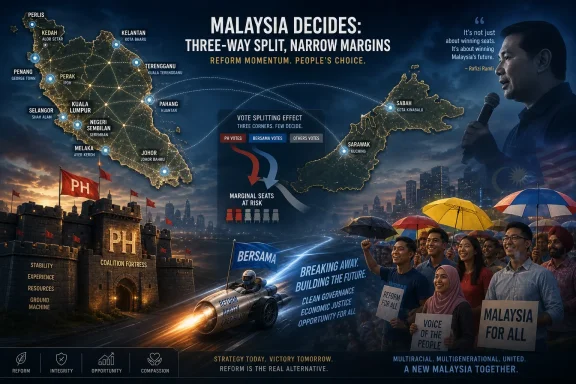 Bersama Is Not an Opposition Party in the Usual Sense
The mistake would be to treat Bersama as just another anti-government project. Perikatan Nasional attacks PH from the right, from Malay-Muslim consolidation, and from discontent with the unity government’s compromises. Barisan Nasional remains both partner and competitor, depending on the seat, the state, and the hour.Bersama is different because it attacks PH from within PH’s own emotional territory. Its pitch is not that reform politics was wrong, but that reform politics has been diluted, absorbed, and made comfortable by incumbency. That makes it more dangerous to PH than its likely first-election seat count might suggest.
A party can defend itself easily against ideological enemies. It is much harder to defend itself against former colleagues who argue that they represent the version of you voters thought they were supporting. Bersama’s claim is not “reject reform.” Its claim is “rescue reform from the people now managing it.”
That is why DAP cannot treat this as a polite disagreement among progressives. For DAP, the danger is not that Bersama wins Putrajaya. The danger is that Bersama peels off enough urban, middle-class, multi-ethnic, reform-minded voters to turn safe seats into marginal ones and marginal seats into losses.
PH’s Tolerance for Competition Ends at the Electoral Map
Political parties like to talk about democratic choice until democratic choice threatens their candidate lists. This is not unique to Malaysia, and it is not unique to PH. Every serious party in every competitive system eventually learns the same lesson: pluralism is admirable in theory, but vote-splitting is fatal in practice.PH has spent years building machinery in urban and semi-urban constituencies. It has trained campaign workers, cultivated donors, built branch networks, and absorbed the scars of opposition politics. It did not do that so a former insider could arrive with a new logo, a reformist vocabulary, and a claim to the same voters.
The first election after a splinter is always decisive. If Bersama wins even a modest number of seats or performs strongly in PH-held constituencies, it gains legitimacy. If it loses badly, it risks becoming another Malaysian political acronym remembered mainly by journalists, activists, and disappointed ex-members.
That is why PH’s incentive is to overreact early. A small insurgent movement is easier to starve than a proven electoral brand. Once a party has donors, volunteers, data, and a few elected representatives, it becomes much harder to dismiss as ego, sabotage, or theatre.
Rafizi’s Strength Is Also Bersama’s Vulnerability
Rafizi Ramli gives Bersama instant recognition, but he also gives PH an obvious target. He is not an unknown reformist emerging from civil society. He is a former senior PKR figure, former minister, and one-time symbol of technocratic reform within Anwar Ibrahim’s coalition.That history cuts both ways. To his supporters, it proves he knows the system from the inside and has chosen rupture over submission. To his critics, it allows PH to frame Bersama as personal grievance dressed up as principle.
This is where the coming campaign will be fought. Bersama will argue that it represents betrayed voters. PH will argue that it represents frustrated politicians. The difference matters, because one story can build a movement and the other can kill one.
Rafizi’s challenge is therefore not merely organisational. It is narrative. He must convince voters that Bersama exists because PH changed, not because he lost influence inside PKR. If he fails, PH’s machinery will not need to destroy Bersama; voter scepticism will do the job.
DAP Has More to Lose Than It Can Publicly Admit
DAP’s position is particularly delicate. It cannot appear panicked by Bersama, because panic grants the new party importance. But it also cannot ignore Bersama, because Bersama’s natural constituency overlaps with the voters who have long formed the backbone of PH’s urban strength.DAP has become accustomed to being attacked by opponents who accuse it of being too powerful, too Chinese, too secular, or too dominant within PH. Bersama’s challenge is different. It does not need to defeat DAP ideologically; it only needs to convince enough PH voters that DAP’s continued support for the unity government has made reform subordinate to survival.
That is a much subtler attack. It does not require Bersama to turn DAP voters into conservatives. It only requires them to become disappointed enough to abstain, protest-vote, or split the anti-establishment vote in three-cornered contests.
For PH, the danger is not dramatic collapse. It is erosion. Malaysian coalitions do not usually die in a single speech; they lose moral authority, one compromise and one by-election at a time.
Machinery Still Beats Mood Until It Doesn’t
There is a reason established parties usually survive splinters. They have databases, polling agents, lawyers, donors, war rooms, flags, transport networks, and local fixers who know which voters need a phone call and which community leader needs attention. Elections are not won by viral clips alone.Bersama may have energy, but energy is not infrastructure. Enthusiasm fills halls; machinery turns out voters in rain, heat, and boredom. The difference is especially stark in constituencies where local service, candidate familiarity, and party logistics matter more than national speeches.
PH’s advantage is therefore real. It controls much of the political terrain Bersama wants to enter. It has incumbents who can claim delivery, ministers who can claim stability, and coalition partners who can warn voters that fragmentation risks empowering worse alternatives.
But incumbency has a cost. The longer PH governs, the harder it becomes to sound like an insurgency. Bersama’s opportunity lies in the space between PH’s old promises and its present compromises.
The Unity Government Made This Fight Inevitable
The unity government was born from necessity, not ideological purity. After the 2022 general election produced a hung Parliament, PH entered a governing arrangement that required cooperation with forces many of its own supporters had spent years opposing. That may have been defensible as statecraft, but it was never going to be emotionally simple.For reformist voters, the bargain was always uneasy. Stability came first. Reform would come later. Old enemies became partners. Institutional changes arrived more slowly than many expected. Political survival required compromises that activists once denounced when others made them.
This is the soil in which Bersama grows. It does not need to invent disappointment; it only needs to organise it. Every delayed reform, every awkward alliance, every appointment that looks like patronage, and every defensive explanation from government spokesmen becomes raw material.
PH can argue, fairly, that governing is harder than campaigning. But voters do not experience politics as a civics lecture. They experience it as trust kept or trust broken.
The Anti-Splinter Playbook Is Already Written
PH’s likely strategy is not mysterious. It will question Bersama’s motives, highlight the risks of vote-splitting, pressure local networks not to defect, and force voters to choose between idealism and consequences. It will portray Bersama as a spoiler whose main practical effect is to weaken reformist representation.That argument may work. Malaysian voters have seen enough instability to be wary of experiments. A new party asking for support must explain not only what it believes, but what happens if its presence helps another bloc win.
This is where PH’s most powerful message will emerge: do not punish us in a way that empowers people you fear more. It is not an inspiring slogan, but it is often an effective one. In first-past-the-post politics, fear of the alternative can be more mobilising than love of the incumbent.
Bersama will counter that this is exactly how reform movements are domesticated. Vote for us forever, PH says, because the alternative is worse. That argument may win elections, but over time it can drain the moral urgency from a coalition built on change.
Bersama Must Become Bigger Than Rafizi Quickly
Every new party faces a founder problem. Charismatic leadership gives birth to the vehicle, but overdependence on the founder prevents it from becoming durable. Bersama’s early media attention is inseparable from Rafizi, and that is both blessing and trap.If Bersama remains a Rafizi vehicle, PH can personalise the fight. It can make the campaign about ambition, resentment, timing, and loyalty. It can ask voters whether one politician’s conflict with his former party is worth risking broader political instability.
If Bersama develops a bench of credible local candidates, policy voices, organisers, and state-level leaders, the calculation changes. Then PH is not fighting one man. It is fighting a network of reformist dissatisfaction with electoral expression.
This transition must happen fast. Splinter parties do not get long grace periods. Voters may be curious at launch, but curiosity is not commitment. The first serious test will reveal whether Bersama has a party beneath the personality.
PH’s Real Enemy Is Not Bersama but Disappointment
The easiest way for PH to misunderstand this moment is to reduce everything to betrayal. That would be emotionally satisfying and strategically incomplete. Bersama is possible because some voters already feel politically homeless.PH can destroy a party organisation more easily than it can destroy a mood. It can outspend Bersama, out-organise Bersama, and out-message Bersama. But if enough voters believe the coalition has become too comfortable with compromises it once condemned, the pressure will reappear somewhere else.
This is the pattern established parties often miss. They defeat the dissident and declare the problem solved. Then another dissident emerges, or turnout falls, or young voters drift away, or the old base becomes transactional.
The deeper question for PH is not whether Bersama deserves survival. It is why Bersama’s appeal exists at all. A confident reform coalition would not fear a small splinter so intensely unless it recognised something familiar in the accusation.
Malaysian Voters Are Being Asked to Price Risk
For voters, the Bersama choice will not be abstract. It will be a calculation about risk. Is the risk of weakening PH worth the chance of forcing reformist politics back toward its original promises?Some voters will say no. They will see Bersama as reckless, premature, or indulgent. They will argue that Malaysia’s coalition landscape is already fragile enough and that reform must be pursued from inside government, not through fragmentation.
Others will say yes. They will argue that endless patience becomes complicity, and that incumbents only rediscover urgency when their voters develop alternatives. To them, Bersama’s value may lie less in immediate victory than in making PH afraid again.
That fear is not necessarily unhealthy. Parties that believe their supporters have nowhere else to go eventually stop listening. Competition, even disruptive competition, can remind them that loyalty is not ownership.
The First Bersama Test Will Be About Credibility, Not Power
No serious observer should expect Bersama to sweep into national power overnight. Malaysia’s electoral system punishes small parties, especially those without concentrated geographic strength or durable coalition arrangements. A respectable vote share can still produce few seats.But the first test is not government formation. It is credibility. Can Bersama attract candidates who are not merely defectors? Can it raise money without looking captured? Can it speak to Malay voters without alienating urban progressives? Can it compete in mixed seats without simply handing victory to PH’s enemies?
These are hard questions, and PH will do everything possible to make them harder. That is not hypocrisy. That is politics. The point of an incumbent coalition is to remain incumbent.
Still, Bersama does not need to defeat PH everywhere to matter. It needs to prove that PH’s reformist base is contestable. If it does that, even losses can become leverage.
The Reform Brand Is Entering Its Most Dangerous Phase
Reform movements are most romantic in opposition and most vulnerable in government. In opposition, every compromise can be blamed on the people in power. In government, every compromise carries your signature.PH is now living through that transition. It must defend decisions that offend parts of its base while still insisting that it remains the best vehicle for change. That is a difficult message, especially when former insiders can point to the gap between campaign memory and governing reality.
Bersama’s emergence exposes the fragility of reform as a brand. If reform means only replacing one set of rulers with another, voters eventually notice. If reform means institutional change, transparency, accountability, and cleaner governance, then voters will ask why the process feels so slow.
PH’s strongest answer is that reform in a coalition system requires patience. Bersama’s strongest answer is that patience has become an excuse. The next phase of Malaysian politics may turn on which argument feels more believable.
The Kancil Is Small, but the Road Is Narrow
The concrete lessons from Bersama’s emergence are less romantic than the speeches surrounding it. This is a fight about incentives, constituencies, and survival, not merely ideals.- PH has a rational political incentive to contain Bersama early, before the new party converts curiosity into organisation.
- Bersama’s most dangerous appeal lies among urban and reform-minded voters who once treated PH as the natural home for political change.
- Rafizi’s personal brand gives Bersama visibility, but the party must quickly prove it is more than a vehicle for one former PKR leader.
- DAP’s concern is not that Bersama will replace it overnight, but that vote-splitting could weaken PH in seats where margins matter.
- The unity government’s compromises created the emotional opening Bersama is now trying to occupy.
- The first electoral test will measure credibility more than power, because even limited success could make Bersama harder to dismiss.
References
- Primary source: Newswav
Published: 2026-06-14T03:50:16.873996
Loading…
newswav.com - Related coverage: malaymail.com
Loading…
www.malaymail.com - Related coverage: thestar.com.my
Loading…
www.thestar.com.my - Related coverage: therakyatpost.com
Loading…
www.therakyatpost.com - Related coverage: thevibes.com
Loading…
www.thevibes.com - Related coverage: malaysia4u.com
Loading…
malaysia4u.com