

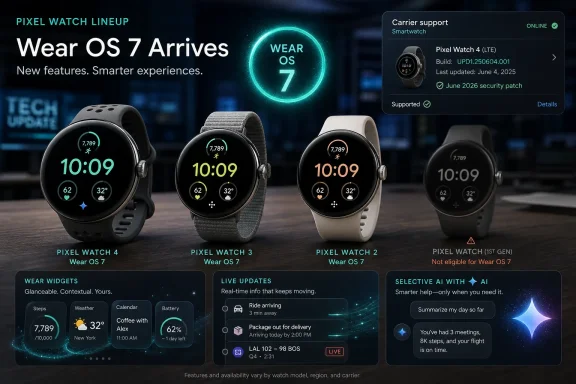
Google’s Wear OS 7 update appears poised to arrive first on the Pixel Watch 2, Pixel Watch 3, and Pixel Watch 4 after Verizon support pages briefly listed the release alongside the June 2026 security patch and software build CP2A.260603.001. The leak matters because Google announced Wear OS 7 at I/O 2026 without committing to a public rollout date or a full device list. If the carrier documentation is accurate, the first-generation Pixel Watch is now effectively on the wrong side of Google’s wearable upgrade line. That makes this less a routine watch update than a test of how long “Pixel” hardware can remain Pixel in the age of annual AI platforms.
Wear OS used to feel like the part of Android that lived on a different clock. Phones had betas, quarterly platform releases, long support pledges, and a public roadmap that developers could at least squint at. Watches, by contrast, often received updates as a mixture of platform release, OEM skin, carrier certification, app update, and firmware patch.
The Verizon listings cut through that haze in the bluntest way possible. They suggest that Wear OS 7 is not a late-year abstraction or a “coming soon” promise parked safely behind marketing language. It appears to be packaged, build-numbered, and ready enough for a major U.S. carrier to prepare customer-facing support pages.
That does not mean every Pixel Watch owner should expect a notification immediately. Carrier pages can go live early, disappear, or describe a staged rollout that takes weeks to reach all units. But the presence of a specific June 2026 security patch and a concrete software version changes the story from speculation to logistics.
It also exposes the uncomfortable middle ground Google has created for its own wearable customers. The Pixel Watch line is young enough that many buyers still think of it as a new product family. Yet the original 2022 Pixel Watch already looks like an aging endpoint rather than a long-lived platform citizen.
The most visible change is the shift toward Wear Widgets, a more flexible system that moves beyond the older Tiles model. Tiles were useful, but they often felt like single-purpose mini-screens placed in a row. Widgets imply a more composable wrist interface, one that behaves closer to Android’s broader design language and gives developers a more predictable way to present glanceable information.
Live Updates may matter even more in practice. The phone version of this idea is simple: persistent, timely information from apps should surface without forcing the user to open the app repeatedly. On a watch, that concept is almost the whole point of the device. Rides, deliveries, timers, workouts, navigation, and media playback become more valuable when they appear at precisely the moment the user raises a wrist.
Then there is Google’s claimed battery improvement, reportedly around 10 percent for watches moving from Wear OS 6 to Wear OS 7. That is not the kind of number that turns a one-day watch into a week-long Garmin competitor. But in the smartwatch world, 10 percent can be the difference between charging before bed and trusting sleep tracking overnight.
That matters because the Pixel Watch 2 occupies a familiar place in the hardware cycle. It is not new enough to be a showcase device, but not old enough for its owners to accept graceful retirement. It is the kind of device many practical buyers purchase discounted, refurbished, or bundled long after launch, expecting that “Pixel” means several meaningful platform updates rather than a short sprint.
If Wear OS 7 lands on the Pixel Watch 2, Google gets to claim a three-generation runway for the update: current, previous, and one more back. That is a defensible consumer story, especially in a category where battery wear, tiny enclosures, and sensor changes complicate support more than they do on phones.
But it also sharpens the line around the original Pixel Watch. Google’s first wearable was not a concept device sold to developers; it was a mainstream flagship product, marketed as the long-awaited arrival of the Pixel ecosystem on the wrist. Four years later, it may be left watching the next operating system from the charging puck.
The hardware was also, in retrospect, a compromise. Its design still looks distinctive, but its internals and battery ceiling were less future-proof than its price implied. That made it vulnerable to exactly this moment: a platform update that is not just a UI refresh but a new layer of real-time features, widget behavior, and AI-mediated experiences.
Consumers rarely parse that nuance. They remember the brand, the launch price, and the promise of belonging to a platform. When a first-generation flagship misses a major update while the second-generation model gets it, the message is not “hardware constraints are real.” The message is “wait for version two.”
That is particularly dangerous for wearables because adoption already depends on trust. A phone is essential enough that most people replace it on schedule. A smartwatch is easier to skip, stretch, or abandon if the owner suspects that platform enthusiasm will outlive support.
Google has described Gemini Intelligence features for select watches, which is doing a lot of work in one small phrase. “Select” lets Google avoid promising that every Wear OS 7 watch will receive every headline feature. It also signals that the operating system update and the AI feature set are no longer identical things.
That separation is becoming common across the industry. Phones receive the same major OS number while newer models get the most advanced AI tools. PCs receive the same Windows baseline while only certain neural processing units qualify for Copilot+ features. Watches are now entering the same era of tiered capability.
For users, that means the update screen tells only part of the truth. A Pixel Watch 2 getting Wear OS 7 may not behave like a Pixel Watch 4 with Wear OS 7. A Samsung watch running a future One UI Watch build may expose Google’s platform features differently again. The version number becomes a floor, not a full product description.
Widgets give developers a clearer reason to return. A fitness app can show progress without demanding a full-screen launch. A messaging app can expose a useful state rather than a dumb notification. A delivery app can become genuinely glanceable in a way that feels native to the wrist.
Live Updates could be the stronger incentive because they map directly to situations where a watch is superior to a phone. Nobody wants to keep unlocking a phone to see whether a car is two minutes away or eight. Nobody wants a workout app buried behind taps while running. Nobody wants a timer or navigation cue to behave like just another notification in the pile.
But Google must be careful not to overpromise what the developer ecosystem will deliver on day one. Platform primitives are not product experiences. Users will judge Wear OS 7 by the apps they already use, not the APIs Google made available in a developer session.
Google’s Pixel Watch line has improved over time, especially with larger models and more mature software. But the basic challenge remains: a small circular device with a bright screen, health sensors, radios, haptics, and now AI-adjacent features has very little room for waste. Every new surface area competes with battery anxiety.
This is why Wear OS 7’s power claim is more strategically important than it looks. Widgets and Live Updates can make the watch more useful, but they also risk making it busier. If the watch becomes a real-time dashboard for the user’s day, it must not punish that usefulness with a dead battery at dinner.
Google appears to understand this, at least in principle. The shift to more efficient widget frameworks and controlled real-time surfaces suggests a platform trying to replace ad hoc app behavior with standardized, battery-conscious patterns. The watch should not become a tiny phone; it should become a disciplined filter for the phone.
That does not necessarily mean Google is disorganized. Staged rollouts require coordination, and support pages often have to be prepared before the public announcement moment. But for users, the result is familiar: Android ecosystem news often arrives sideways.
This is where Apple still has the simpler story. A watchOS release may have its own exclusions and caveats, but the support matrix is usually presented as a first-party fact. Android users, by contrast, often assemble the truth from Google announcements, carrier pages, OEM posts, and enthusiast reporting.
Wear OS is better than it was, but this dynamic keeps it feeling less mature than the hardware deserves. If Google wants Pixel Watch to be a flagship platform, it should not rely on Verizon accidentally making the roadmap legible. The company needs to own the upgrade story as aggressively as it owns the AI keynote.
Windows users have already lived through this with Windows 11 hardware requirements and the growing divide between ordinary Windows PCs and Copilot+ PCs. The operating system name is no longer the full story. Two machines can run “Windows 11” while having very different access to AI features, security baselines, and performance expectations.
Wear OS 7 reflects the same shift in miniature. The OS may roll out to multiple Pixel Watch generations, but the complete experience may depend on silicon, sensors, RAM, battery capacity, and whatever Google decides “select watches” means for Gemini features. The upgrade path is becoming a ladder with missing rungs.
For IT pros, the lesson is not that smartwatches require enterprise imaging strategies. It is that consumer platform management is becoming more conditional everywhere. Version numbers are giving way to eligibility matrices, feature flags, regional approvals, app dependencies, and cloud-side switches.
That matters in mixed-device workplaces. Watches may be personal devices, but they increasingly touch work notifications, authentication flows, health policies, emergency features, and location-aware workflows. The more capable they become, the more administrators will need to understand what they can and cannot reliably do across models.
Owners of the Pixel Watch 2, Pixel Watch 3, and Pixel Watch 4 have reason to be optimistic. The appearance of a build number and June 2026 patch language suggests a real package, not a vague compatibility guess. If the rollout follows Google’s usual staged pattern, availability may vary by region, model, and connectivity variant.
Owners of the original Pixel Watch should prepare for disappointment but not panic. Missing Wear OS 7 would not instantly make the device unusable. Core apps, Play Store updates, and security maintenance can continue independently for a time, depending on Google’s support policy and app compatibility decisions.
The bigger decision is whether the missing major update changes the replacement calculus. If the watch still tracks sleep, handles payments, shows notifications, and lasts through the day, many users can keep wearing it. If Live Updates, new widgets, and future Gemini integrations are the reason they bought into the Pixel ecosystem, the first-generation model is starting to look stranded.
This is where companies often stumble. Marketing wants simplicity, but support reality is messy. Legal language wants flexibility, but customers want commitments. Engineers know why a feature may not run well on older hardware, but users only see a product that cost hundreds of dollars.
Google can reduce the frustration by being specific early. If the original Pixel Watch is excluded, say so plainly and explain whether the reason is performance, battery, silicon support, or support-window policy. If Gemini Intelligence requires newer models, define “newer.” If Wear OS 7 arrives in phases, publish the phases.
The company does not need to promise eternal support to earn trust. It needs to make the boundaries visible before buyers hit them. A hard line is easier to accept than a fog bank.
 Google’s Watch Strategy Just Got a Calendar
Wear OS used to feel like the part of Android that lived on a different clock. Phones had betas, quarterly platform releases, long support pledges, and a public roadmap that developers could at least squint at. Watches, by contrast, often received updates as a mixture of platform release, OEM skin, carrier certification, app update, and firmware patch.The Verizon listings cut through that haze in the bluntest way possible. They suggest that Wear OS 7 is not a late-year abstraction or a “coming soon” promise parked safely behind marketing language. It appears to be packaged, build-numbered, and ready enough for a major U.S. carrier to prepare customer-facing support pages.
That does not mean every Pixel Watch owner should expect a notification immediately. Carrier pages can go live early, disappear, or describe a staged rollout that takes weeks to reach all units. But the presence of a specific June 2026 security patch and a concrete software version changes the story from speculation to logistics.
It also exposes the uncomfortable middle ground Google has created for its own wearable customers. The Pixel Watch line is young enough that many buyers still think of it as a new product family. Yet the original 2022 Pixel Watch already looks like an aging endpoint rather than a long-lived platform citizen.
Wear OS 7 Is Not a Cosmetic Patch Wearing a New Number
The reason this rollout attracts attention is that Wear OS 7 is not merely another monthly update with “performance and stability improvements” doing the usual diplomatic work. Google used I/O 2026 to frame the release as a substantial rethink of what a smartwatch interface should do when it is no longer just a notification mirror.The most visible change is the shift toward Wear Widgets, a more flexible system that moves beyond the older Tiles model. Tiles were useful, but they often felt like single-purpose mini-screens placed in a row. Widgets imply a more composable wrist interface, one that behaves closer to Android’s broader design language and gives developers a more predictable way to present glanceable information.
Live Updates may matter even more in practice. The phone version of this idea is simple: persistent, timely information from apps should surface without forcing the user to open the app repeatedly. On a watch, that concept is almost the whole point of the device. Rides, deliveries, timers, workouts, navigation, and media playback become more valuable when they appear at precisely the moment the user raises a wrist.
Then there is Google’s claimed battery improvement, reportedly around 10 percent for watches moving from Wear OS 6 to Wear OS 7. That is not the kind of number that turns a one-day watch into a week-long Garmin competitor. But in the smartwatch world, 10 percent can be the difference between charging before bed and trusting sleep tracking overnight.
The Pixel Watch 2 Looks Like the Real Threshold Device
The most revealing name in the leaked support matrix is not the Pixel Watch 4. Of course Google’s newest watch should receive the newest platform. The Pixel Watch 3 was also a safe bet. The Pixel Watch 2 is the one that tells us where Google likely sees the floor for Wear OS 7.That matters because the Pixel Watch 2 occupies a familiar place in the hardware cycle. It is not new enough to be a showcase device, but not old enough for its owners to accept graceful retirement. It is the kind of device many practical buyers purchase discounted, refurbished, or bundled long after launch, expecting that “Pixel” means several meaningful platform updates rather than a short sprint.
If Wear OS 7 lands on the Pixel Watch 2, Google gets to claim a three-generation runway for the update: current, previous, and one more back. That is a defensible consumer story, especially in a category where battery wear, tiny enclosures, and sensor changes complicate support more than they do on phones.
But it also sharpens the line around the original Pixel Watch. Google’s first wearable was not a concept device sold to developers; it was a mainstream flagship product, marketed as the long-awaited arrival of the Pixel ecosystem on the wrist. Four years later, it may be left watching the next operating system from the charging puck.
The Original Pixel Watch Becomes the Cautionary Tale
The first Pixel Watch always carried a strange burden. It had to prove Google could make a polished wearable after years of letting partners carry Wear OS. It had to be a Fitbit bridge, a Pixel accessory, an Apple Watch rival, and a statement that Android users deserved a coherent first-party smartwatch.The hardware was also, in retrospect, a compromise. Its design still looks distinctive, but its internals and battery ceiling were less future-proof than its price implied. That made it vulnerable to exactly this moment: a platform update that is not just a UI refresh but a new layer of real-time features, widget behavior, and AI-mediated experiences.
Consumers rarely parse that nuance. They remember the brand, the launch price, and the promise of belonging to a platform. When a first-generation flagship misses a major update while the second-generation model gets it, the message is not “hardware constraints are real.” The message is “wait for version two.”
That is particularly dangerous for wearables because adoption already depends on trust. A phone is essential enough that most people replace it on schedule. A smartwatch is easier to skip, stretch, or abandon if the owner suspects that platform enthusiasm will outlive support.
Google’s AI Ambition Raises the Support Bar
Wear OS 7 is arriving in a Google ecosystem now organized around Gemini and so-called intelligent assistance. That changes the meaning of a smartwatch update. A watch is no longer just a place for step counts and notification triage; it is becoming an input surface for AI-mediated tasks.Google has described Gemini Intelligence features for select watches, which is doing a lot of work in one small phrase. “Select” lets Google avoid promising that every Wear OS 7 watch will receive every headline feature. It also signals that the operating system update and the AI feature set are no longer identical things.
That separation is becoming common across the industry. Phones receive the same major OS number while newer models get the most advanced AI tools. PCs receive the same Windows baseline while only certain neural processing units qualify for Copilot+ features. Watches are now entering the same era of tiered capability.
For users, that means the update screen tells only part of the truth. A Pixel Watch 2 getting Wear OS 7 may not behave like a Pixel Watch 4 with Wear OS 7. A Samsung watch running a future One UI Watch build may expose Google’s platform features differently again. The version number becomes a floor, not a full product description.
A Better Watch Interface Still Depends on Developers
The promise of Wear Widgets and Live Updates will not be fulfilled by Google alone. A smartwatch platform lives or dies by whether third-party developers think the wrist is worth designing for. Wear OS has improved dramatically since the dark years before the Samsung-Google reset, but it still fights the gravitational pull of the phone.Widgets give developers a clearer reason to return. A fitness app can show progress without demanding a full-screen launch. A messaging app can expose a useful state rather than a dumb notification. A delivery app can become genuinely glanceable in a way that feels native to the wrist.
Live Updates could be the stronger incentive because they map directly to situations where a watch is superior to a phone. Nobody wants to keep unlocking a phone to see whether a car is two minutes away or eight. Nobody wants a workout app buried behind taps while running. Nobody wants a timer or navigation cue to behave like just another notification in the pile.
But Google must be careful not to overpromise what the developer ecosystem will deliver on day one. Platform primitives are not product experiences. Users will judge Wear OS 7 by the apps they already use, not the APIs Google made available in a developer session.
Battery Life Is Still the Argument Wear OS Has Not Won
The reported 10 percent efficiency gain is welcome, but it also reminds us how constrained the smartwatch category remains. Android watches have become smoother, better-looking, and more capable, yet many still ask users to build daily charging into their lives. That is a tax, and consumers notice it.Google’s Pixel Watch line has improved over time, especially with larger models and more mature software. But the basic challenge remains: a small circular device with a bright screen, health sensors, radios, haptics, and now AI-adjacent features has very little room for waste. Every new surface area competes with battery anxiety.
This is why Wear OS 7’s power claim is more strategically important than it looks. Widgets and Live Updates can make the watch more useful, but they also risk making it busier. If the watch becomes a real-time dashboard for the user’s day, it must not punish that usefulness with a dead battery at dinner.
Google appears to understand this, at least in principle. The shift to more efficient widget frameworks and controlled real-time surfaces suggests a platform trying to replace ad hoc app behavior with standardized, battery-conscious patterns. The watch should not become a tiny phone; it should become a disciplined filter for the phone.
The Carrier Leak Shows How Fragmented Wear OS Still Feels
There is an irony in learning about Google’s watch rollout from Verizon rather than Google. Pixel is supposed to be the cleanest expression of Google hardware and software integration. Yet the most concrete device list and build information appears to have surfaced through a carrier support channel.That does not necessarily mean Google is disorganized. Staged rollouts require coordination, and support pages often have to be prepared before the public announcement moment. But for users, the result is familiar: Android ecosystem news often arrives sideways.
This is where Apple still has the simpler story. A watchOS release may have its own exclusions and caveats, but the support matrix is usually presented as a first-party fact. Android users, by contrast, often assemble the truth from Google announcements, carrier pages, OEM posts, and enthusiast reporting.
Wear OS is better than it was, but this dynamic keeps it feeling less mature than the hardware deserves. If Google wants Pixel Watch to be a flagship platform, it should not rely on Verizon accidentally making the roadmap legible. The company needs to own the upgrade story as aggressively as it owns the AI keynote.
The Windows Angle Is Bigger Than It Looks
At first glance, a Pixel Watch update may seem far from the concerns of WindowsForum readers. But the same industry pattern is visible across Windows PCs, Android phones, and smartwatches: vendors are increasingly tying headline software features to specific hardware generations, AI capability, and support windows that are shorter than users expect.Windows users have already lived through this with Windows 11 hardware requirements and the growing divide between ordinary Windows PCs and Copilot+ PCs. The operating system name is no longer the full story. Two machines can run “Windows 11” while having very different access to AI features, security baselines, and performance expectations.
Wear OS 7 reflects the same shift in miniature. The OS may roll out to multiple Pixel Watch generations, but the complete experience may depend on silicon, sensors, RAM, battery capacity, and whatever Google decides “select watches” means for Gemini features. The upgrade path is becoming a ladder with missing rungs.
For IT pros, the lesson is not that smartwatches require enterprise imaging strategies. It is that consumer platform management is becoming more conditional everywhere. Version numbers are giving way to eligibility matrices, feature flags, regional approvals, app dependencies, and cloud-side switches.
That matters in mixed-device workplaces. Watches may be personal devices, but they increasingly touch work notifications, authentication flows, health policies, emergency features, and location-aware workflows. The more capable they become, the more administrators will need to understand what they can and cannot reliably do across models.
Pixel Watch Owners Should Wait for the Official Rollout, Not the Rumor Mill
The practical advice is simple: do not buy, sell, reset, or sideload based solely on a carrier support page. The leak is credible enough to report and analyze, but Google still controls the actual over-the-air rollout. Until the update appears in the Pixel Watch app or on Google’s own support channels, users should treat it as imminent rather than guaranteed.Owners of the Pixel Watch 2, Pixel Watch 3, and Pixel Watch 4 have reason to be optimistic. The appearance of a build number and June 2026 patch language suggests a real package, not a vague compatibility guess. If the rollout follows Google’s usual staged pattern, availability may vary by region, model, and connectivity variant.
Owners of the original Pixel Watch should prepare for disappointment but not panic. Missing Wear OS 7 would not instantly make the device unusable. Core apps, Play Store updates, and security maintenance can continue independently for a time, depending on Google’s support policy and app compatibility decisions.
The bigger decision is whether the missing major update changes the replacement calculus. If the watch still tracks sleep, handles payments, shows notifications, and lasts through the day, many users can keep wearing it. If Live Updates, new widgets, and future Gemini integrations are the reason they bought into the Pixel ecosystem, the first-generation model is starting to look stranded.
The Fine Print Now Matters More Than the Launch Event
Google’s most important Wear OS communication over the next few weeks will not be a sizzle reel. It will be the support table. Users need to know which models receive Wear OS 7, which receive Gemini features, which features require newer hardware, and how long each watch will continue receiving security updates.This is where companies often stumble. Marketing wants simplicity, but support reality is messy. Legal language wants flexibility, but customers want commitments. Engineers know why a feature may not run well on older hardware, but users only see a product that cost hundreds of dollars.
Google can reduce the frustration by being specific early. If the original Pixel Watch is excluded, say so plainly and explain whether the reason is performance, battery, silicon support, or support-window policy. If Gemini Intelligence requires newer models, define “newer.” If Wear OS 7 arrives in phases, publish the phases.
The company does not need to promise eternal support to earn trust. It needs to make the boundaries visible before buyers hit them. A hard line is easier to accept than a fog bank.
The Upgrade Line Around Pixel Watch Is the Story
The emerging Wear OS 7 picture leaves Pixel Watch owners with a few concrete conclusions, even before Google publishes the final rollout post. The update looks close, the device list looks selective, and the most important features are likely to arrive unevenly across the ecosystem.- Pixel Watch 2, Pixel Watch 3, and Pixel Watch 4 appear to be the models most likely to receive Wear OS 7 first.
- The original Pixel Watch appears increasingly unlikely to receive the major platform update.
- Wear OS 7’s biggest practical changes are Wear Widgets, Live Updates, improved efficiency, and selective Gemini Intelligence features.
- A reported 10 percent battery improvement would be meaningful, but it will not erase the daily-charging reality for many users.
- The update version number will not guarantee feature parity across every supported watch.
- Google needs to publish a clear support matrix because carrier leaks should not be the primary way Pixel customers learn the fate of their devices.
References
- Primary source: Digital Trends
Published: Sat, 13 Jun 2026 22:33:36 GMT
Loading…
www.digitaltrends.com - Independent coverage: bgr.com
Published: Fri, 12 Jun 2026 19:13:05 GMT
Loading…
www.bgr.com - Related coverage: androidcentral.com
Loading…
www.androidcentral.com - Related coverage: phonearena.com
Loading…
www.phonearena.com - Related coverage: gadgets360.com
Loading…
www.gadgets360.com - Related coverage: techadvisor.com
Loading…
www.techadvisor.com
- Official source: support.google.com
Loading…
support.google.com - Related coverage: notebookcheck.net
Loading…
www.notebookcheck.net - Related coverage: droid-life.com
Loading…
www.droid-life.com - Related coverage: gadgetsandwearables.com
Loading…
gadgetsandwearables.com - Official source: 9to5google.com
Loading…
9to5google.com - Related coverage: techradar.com
Loading…
www.techradar.com - Related coverage: t3.com
Loading…
www.t3.com - Related coverage: tomsguide.com
Loading…
www.tomsguide.com - Related coverage: 0e190a550a8c4c8c4b93-fcd009c875a5577fd4fe2f5b7e3bf4eb.ssl.cf2.rackcdn.com
Loading…
0e190a550a8c4c8c4b93-fcd009c875a5577fd4fe2f5b7e3bf4eb.ssl.cf2.rackcdn.com - Related coverage: gizguide.com
Loading…
www.gizguide.com - Related coverage: techtimes.com
Loading…
www.techtimes.com - Related coverage: mysmartprice.com
Loading…
www.mysmartprice.com - Related coverage: gizbot.com
Loading…
www.gizbot.com - Related coverage: stuff.tv
Loading…
www.stuff.tv - Related coverage: technobezz.com
Loading…
www.technobezz.com - Related coverage: cincodias.elpais.com
Loading…
cincodias.elpais.com