

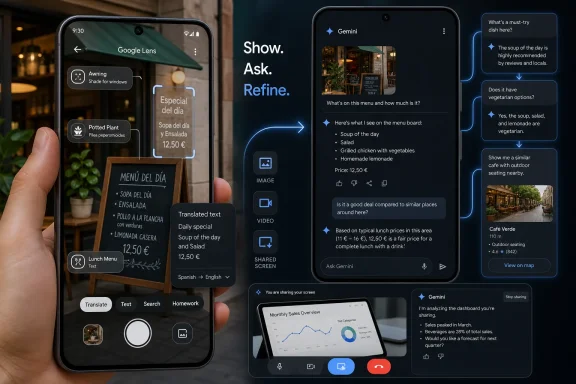
Google’s Gemini app has begun to make Google Lens feel less like the future of visual search and more like a fast, useful specialist, because Gemini can analyze images, videos, and shared screens conversationally on modern Android phones and tablets. That is the uncomfortable lesson inside a week-long Android Police test, and it cuts deeper than a simple app preference. Lens is still excellent at the thing it was built to do: identify, translate, and match the visible world to the web. But Gemini is increasingly better at what users now expect visual search to become: a back-and-forth conversation with context, memory, and reasoning.
For years, Google Lens has been one of Android’s quiet superpowers. It never needed much ceremony because its value was obvious: point your phone at a plant, a menu, a sign, a product, or a train timetable, and Google’s visual search machinery would try to tell you what you were looking at. It was search reduced to the most natural input device humans carry: eyesight.
That simplicity made Lens sticky. The Android Police writer’s setup will sound familiar to many Android users: Lens as a standalone app, a homescreen widget, or a shortcut embedded in the Google Search bar. It became muscle memory, the same way opening Maps became muscle memory when lost in a new city.
The problem is that habits do not disappear because a new app is shinier. They disappear when the old habit starts feeling artificially constrained. Once you have asked an AI assistant to interpret an image, explain the implications, refine the answer, and respond to follow-up questions, a visual search result page begins to feel like a half-finished conversation.
That is the central threat Gemini poses to Lens. It is not merely that Gemini can “see” pictures. Lens has been seeing pictures for years. The disruption comes from Gemini’s ability to treat an image as the opening move in a dialogue rather than the endpoint of a query.
That model still works. In fact, for many quick jobs, Lens remains the better tool precisely because it is so direct. A live translation overlay on a sign or menu does not need a chatbot’s personality. A product match does not need a paragraph of reasoning. A QR code does not need a Socratic exchange.
But the article’s most important observation is that user intent has changed. Once multimodal AI becomes available, people stop asking only identification questions. They begin asking judgment questions, planning questions, and context questions. The image becomes evidence, not just a search key.
A photo of ingredients is no longer merely a route to recipe websites. It becomes the start of a prompt: What can I cook with these, how should I adjust for two people, what if I am out of garlic, and can I make it vegetarian? A picture of a monkey is not just an animal match. It becomes a request for traits, habitat, likely location, behavior, and comparison.
That is where Lens begins to look rigid. It can be very good at recognition and retrieval while still feeling poorly suited to the new expectation: that the system should understand what the user is trying to do with the information.
That changes the object being searched. Lens traditionally treats the captured image as the job. Gemini treats the captured image as part of a continuing chat. The screenshot is saved into a conversation, and the user can return to it later, ask a follow-up, change the language, reframe the task, or demand more specificity.
That history matters more than it sounds. Lens is fast, but it is also amnesiac in the way classic search is amnesiac. If the user wants to refine the visual query, they often begin again: rescan, reselect, retype, retranslate, rerun. Gemini, by contrast, makes the visual query persistent.
This is the same shift that made chat interfaces powerful in text search. A search box is optimized for discrete questions. A chatbot is optimized for evolving intent. Visual search is now undergoing the same transition.
The article’s example of foreign train schedules is instructive. Lens can translate the board. That is useful. But a traveler may not only need translation; they may need to know which platform matters, whether the route requires a transfer, what the color coding means, whether the sign contradicts an app itinerary, or which ticket machine option to choose. Lens can help with the first step. Gemini is built for the messy sequence that follows.
That distinction will become more important. Users do not experience the world only through still images. Doorbell cameras, dashcams, screen recordings, pet videos, appliance error sequences, classroom clips, sports footage, and short social videos all contain information that may need interpretation after the fact.
A still frame can answer “what is this?” A video can answer “what happened?” That is a different class of problem.
Gemini’s video support pushes visual search toward event analysis. A user might ask what warning light flashed on an appliance, what step they missed in a repair process, what ingredient was added in a cooking clip, or what changed between the start and end of a scene. Lens is historically strongest at identifying objects and text; Gemini is pointed toward interpreting sequences.
That does not mean Gemini will always be right. The Android Police writer notes that tasks like counting people or objects are not always 100 percent accurate. That caveat is important because multimodal AI still produces confident mistakes, especially when images are cluttered, ambiguous, or require precise spatial counting.
Still, the direction is obvious. Users will tolerate some rough edges if the tool can handle a broader category of questions. The first product to make video feel searchable in ordinary language will not merely improve visual search; it will redefine it.
That overlap is classic Google. The company often ships powerful capabilities across multiple products before the user experience coheres. Search, Assistant, Lens, Gemini, Photos, Android system intents, and the Google app all compete to be the place where a user asks the next question.
For enthusiasts, that fragmentation is manageable. They will learn which button invokes which mode, which devices support screen sharing, which model gives deeper analysis, and when to fall back to Lens. For mainstream users, it is needless cognitive tax.
The Android Police writer’s conclusion points toward the obvious destination: Google should combine the strengths of Gemini and Lens. The ideal product would preserve Lens’ frictionless immediacy while adding Gemini’s conversational reasoning. It would translate a sign instantly, then let the user ask what the sign implies. It would identify a plant, then advise whether it is invasive, toxic to pets, or suitable for a shaded balcony. It would recognize a product, then compare repairability, reviews, and alternatives.
Google does not need to kill Lens to get there. But it does need to stop making users choose between a fast visual scanner and a smarter visual assistant.
Live translation is the obvious example. If you are standing at a ticket machine or reading a menu, you do not want a model to compose an essay about context. You want the words overlaid quickly and accurately. Lens has spent years optimizing that sort of transactional visual utility.
Object matching is another case where Lens remains compelling. If the task is to find the same chair, identify a sneaker, scan a barcode, or pull text from an image, classic Lens-style retrieval can be faster and more predictable than an AI chat response. Gemini may provide richer analysis, but richness can become friction when the user wanted a single result.
Trust also cuts both ways. Lens may return imperfect matches, but its web-oriented model often exposes the sources or visual neighbors that led it there. Gemini can be more helpful, yet its synthesized answers can obscure uncertainty. When visual AI is identifying plants, animals, medications, safety hazards, or repair steps, a polished paragraph is not automatically more trustworthy than a ranked set of references.
That is the enterprise lesson hiding inside a consumer app test. Multimodal AI is powerful, but IT pros know that power without boundaries creates new failure modes. A tool that can analyze screenshots and videos can also ingest sensitive information, misread operational context, or summarize a private screen into a cloud service. The user experience may be magical; the governance questions are not.
The new race is about intent. When a user points a camera at something, what are they really trying to accomplish? Do they want identification, explanation, translation, purchase, repair, diagnosis, navigation, creativity, or reassurance? Lens is excellent when the intent is obvious from the object. Gemini is stronger when the intent is buried in the user’s next three questions.
This is why the article’s recipe example matters. A pile of ingredients is not a search query unless the system understands that the user is trying to make dinner. A train schedule is not merely text unless the system understands that the user is trying to catch the right train. A screenshot of a settings page is not just an image unless the system understands that the user is trying to fix something.
Gemini’s advantage is that it lets the user state that intent in natural language after the image is supplied. Lens, by design, tries to infer intent from the visual input and a set of established action modes. That makes Lens efficient, but it also makes it feel boxed in.
The future product will likely merge both approaches. It will infer common actions instantly while leaving room for open-ended conversation. The winning interface will not ask users to decide whether they are doing “visual search” or “AI chat.” It will simply let them show the phone something and continue from there.
That makes this less a story about one writer’s preference and more a preview of Android’s direction. Google has spent years trying to make Assistant the connective tissue across apps and services. Gemini is the company’s more ambitious second attempt, armed with better models and multimodal input.
Screen sharing is the key Android-native move. If Gemini can see what is on the display, it can become a help layer for every app, not just Google’s own surfaces. That raises the ceiling dramatically. It also makes the boundary between operating system, assistant, search engine, and app support blurrier than ever.
For WindowsForum readers, the analogy is obvious. Microsoft is attempting its own version of this shift with Copilot across Windows, Edge, Microsoft 365, and developer tooling. The platform owner wants the AI assistant to sit above applications and interpret user context. Google is doing the same on Android, with the camera and screen as its richest inputs.
The difference is that Google already owns the dominant visual search habit through Lens. That gives it a head start and a migration problem at the same time. The company must modernize Lens without breaking the speed and familiarity that made it indispensable.
There is also the cognitive load of choosing depth. Gemini can provide concise answers with faster models or more thorough analysis with more capable ones. Enthusiasts may enjoy that control. Ordinary users may wonder why visual search now feels like selecting a transmission mode.
Then there is the reliability problem. The article is careful to note that Gemini’s advanced queries are not always perfectly accurate. That is not a minor footnote. When AI moves from matching images to interpreting scenes, mistakes become less obvious. A wrong product match is easy to spot. A plausible but wrong explanation may not be.
This is where Google must be careful. Lens earned trust by doing bounded tasks well. Gemini risks overextending that trust into tasks where the model sounds authoritative but lacks certainty. The best version of Gemini-powered visual search would be explicit about confidence, show supporting evidence when relevant, and know when to route the user back to classic search results.
The irony is that Google already has the pieces. Lens has fast recognition and web grounding. Gemini has conversational reasoning and multimodal analysis. The missing layer is editorial judgment inside the product: when to answer, when to search, when to translate, when to ask a clarifying question, and when to say that the image is not enough.
Lens used to be the destination for visual questions. In this new workflow, it becomes a shortcut for the simplest ones. Gemini gets the ambiguous, layered, high-value tasks — the ones where the user’s next question matters as much as the first image.
That is how platform shifts often begin. The old tool does not vanish; it becomes a mode inside a broader experience. Dedicated scanners gave way to camera apps. MP3 players gave way to smartphones. Search boxes are not disappearing, but more exploratory searches are moving into AI interfaces.
Google can probably sustain both products for a while because they serve different moments. But the user’s mental model will not remain split forever. People do not want to remember which Google product understands video, which one translates live, which one keeps chat history, and which one can answer follow-ups.
They want the camera to become a question mark. They want the screen to become shareable context. They want search to remember what was just asked. Gemini makes that feel possible in a way Lens alone does not.
 Google Lens Won the Camera Era, but Gemini Is Winning the Conversation Era
For years, Google Lens has been one of Android’s quiet superpowers. It never needed much ceremony because its value was obvious: point your phone at a plant, a menu, a sign, a product, or a train timetable, and Google’s visual search machinery would try to tell you what you were looking at. It was search reduced to the most natural input device humans carry: eyesight.That simplicity made Lens sticky. The Android Police writer’s setup will sound familiar to many Android users: Lens as a standalone app, a homescreen widget, or a shortcut embedded in the Google Search bar. It became muscle memory, the same way opening Maps became muscle memory when lost in a new city.
The problem is that habits do not disappear because a new app is shinier. They disappear when the old habit starts feeling artificially constrained. Once you have asked an AI assistant to interpret an image, explain the implications, refine the answer, and respond to follow-up questions, a visual search result page begins to feel like a half-finished conversation.
That is the central threat Gemini poses to Lens. It is not merely that Gemini can “see” pictures. Lens has been seeing pictures for years. The disruption comes from Gemini’s ability to treat an image as the opening move in a dialogue rather than the endpoint of a query.
The Old Visual Search Contract Was Fast, Flat, and Surprisingly Durable
Google Lens was designed around a compact bargain. The user supplies an image, Google extracts recognizable objects or text, and the system returns matches, translations, shopping links, homework help, or related search results. It is a tremendously useful bargain because most visual questions are not philosophical. “What is this flower?” “What does this sign say?” “Where can I buy this lamp?” “What building am I standing in front of?”That model still works. In fact, for many quick jobs, Lens remains the better tool precisely because it is so direct. A live translation overlay on a sign or menu does not need a chatbot’s personality. A product match does not need a paragraph of reasoning. A QR code does not need a Socratic exchange.
But the article’s most important observation is that user intent has changed. Once multimodal AI becomes available, people stop asking only identification questions. They begin asking judgment questions, planning questions, and context questions. The image becomes evidence, not just a search key.
A photo of ingredients is no longer merely a route to recipe websites. It becomes the start of a prompt: What can I cook with these, how should I adjust for two people, what if I am out of garlic, and can I make it vegetarian? A picture of a monkey is not just an animal match. It becomes a request for traits, habitat, likely location, behavior, and comparison.
That is where Lens begins to look rigid. It can be very good at recognition and retrieval while still feeling poorly suited to the new expectation: that the system should understand what the user is trying to do with the information.
Gemini Turns the Screenshot Into a Thread
The practical breakthrough in the Android Police test is not only model quality. It is workflow. Gemini can accept images and videos as attachments, and on supported Android devices it can be invoked through Ask Gemini or Gemini Live-style screen sharing to analyze what is currently on the display.That changes the object being searched. Lens traditionally treats the captured image as the job. Gemini treats the captured image as part of a continuing chat. The screenshot is saved into a conversation, and the user can return to it later, ask a follow-up, change the language, reframe the task, or demand more specificity.
That history matters more than it sounds. Lens is fast, but it is also amnesiac in the way classic search is amnesiac. If the user wants to refine the visual query, they often begin again: rescan, reselect, retype, retranslate, rerun. Gemini, by contrast, makes the visual query persistent.
This is the same shift that made chat interfaces powerful in text search. A search box is optimized for discrete questions. A chatbot is optimized for evolving intent. Visual search is now undergoing the same transition.
The article’s example of foreign train schedules is instructive. Lens can translate the board. That is useful. But a traveler may not only need translation; they may need to know which platform matters, whether the route requires a transfer, what the color coding means, whether the sign contradicts an app itinerary, or which ticket machine option to choose. Lens can help with the first step. Gemini is built for the messy sequence that follows.
Video Is the Clearest Sign That Lens Is Becoming Too Narrow
The ability to upload or analyze video is one of the sharper dividing lines between the two products. Lens has live camera capabilities, but the Android Police test emphasizes a limitation that matters in real life: Lens is not built to process already-recorded clips as a visual evidence package.That distinction will become more important. Users do not experience the world only through still images. Doorbell cameras, dashcams, screen recordings, pet videos, appliance error sequences, classroom clips, sports footage, and short social videos all contain information that may need interpretation after the fact.
A still frame can answer “what is this?” A video can answer “what happened?” That is a different class of problem.
Gemini’s video support pushes visual search toward event analysis. A user might ask what warning light flashed on an appliance, what step they missed in a repair process, what ingredient was added in a cooking clip, or what changed between the start and end of a scene. Lens is historically strongest at identifying objects and text; Gemini is pointed toward interpreting sequences.
That does not mean Gemini will always be right. The Android Police writer notes that tasks like counting people or objects are not always 100 percent accurate. That caveat is important because multimodal AI still produces confident mistakes, especially when images are cluttered, ambiguous, or require precise spatial counting.
Still, the direction is obvious. Users will tolerate some rough edges if the tool can handle a broader category of questions. The first product to make video feel searchable in ordinary language will not merely improve visual search; it will redefine it.
Google Has Accidentally Built Two Front Doors to the Same Future
The tension here is not that Lens is bad and Gemini is good. The tension is that Google now has two overlapping answers to one user need. Lens is the legacy front door to visual search. Gemini is the AI front door to multimodal understanding. AI Mode in Search increasingly sits somewhere between them.That overlap is classic Google. The company often ships powerful capabilities across multiple products before the user experience coheres. Search, Assistant, Lens, Gemini, Photos, Android system intents, and the Google app all compete to be the place where a user asks the next question.
For enthusiasts, that fragmentation is manageable. They will learn which button invokes which mode, which devices support screen sharing, which model gives deeper analysis, and when to fall back to Lens. For mainstream users, it is needless cognitive tax.
The Android Police writer’s conclusion points toward the obvious destination: Google should combine the strengths of Gemini and Lens. The ideal product would preserve Lens’ frictionless immediacy while adding Gemini’s conversational reasoning. It would translate a sign instantly, then let the user ask what the sign implies. It would identify a plant, then advise whether it is invasive, toxic to pets, or suitable for a shaded balcony. It would recognize a product, then compare repairability, reviews, and alternatives.
Google does not need to kill Lens to get there. But it does need to stop making users choose between a fast visual scanner and a smarter visual assistant.
Lens Still Has the Advantage Where Latency and Trust Matter
It would be a mistake to read the Android Police experiment as a death notice for Lens. There are tasks where Gemini’s conversational nature is not an advantage. Sometimes the best interface is the one that gets out of the way.Live translation is the obvious example. If you are standing at a ticket machine or reading a menu, you do not want a model to compose an essay about context. You want the words overlaid quickly and accurately. Lens has spent years optimizing that sort of transactional visual utility.
Object matching is another case where Lens remains compelling. If the task is to find the same chair, identify a sneaker, scan a barcode, or pull text from an image, classic Lens-style retrieval can be faster and more predictable than an AI chat response. Gemini may provide richer analysis, but richness can become friction when the user wanted a single result.
Trust also cuts both ways. Lens may return imperfect matches, but its web-oriented model often exposes the sources or visual neighbors that led it there. Gemini can be more helpful, yet its synthesized answers can obscure uncertainty. When visual AI is identifying plants, animals, medications, safety hazards, or repair steps, a polished paragraph is not automatically more trustworthy than a ranked set of references.
That is the enterprise lesson hiding inside a consumer app test. Multimodal AI is powerful, but IT pros know that power without boundaries creates new failure modes. A tool that can analyze screenshots and videos can also ingest sensitive information, misread operational context, or summarize a private screen into a cloud service. The user experience may be magical; the governance questions are not.
The Real Product Battle Is Over Intent, Not Image Recognition
The old visual search race was about recognition. Which service could identify the landmark, translate the label, extract the text, match the product, or name the plant? That race is not over, but it is no longer the most interesting one.The new race is about intent. When a user points a camera at something, what are they really trying to accomplish? Do they want identification, explanation, translation, purchase, repair, diagnosis, navigation, creativity, or reassurance? Lens is excellent when the intent is obvious from the object. Gemini is stronger when the intent is buried in the user’s next three questions.
This is why the article’s recipe example matters. A pile of ingredients is not a search query unless the system understands that the user is trying to make dinner. A train schedule is not merely text unless the system understands that the user is trying to catch the right train. A screenshot of a settings page is not just an image unless the system understands that the user is trying to fix something.
Gemini’s advantage is that it lets the user state that intent in natural language after the image is supplied. Lens, by design, tries to infer intent from the visual input and a set of established action modes. That makes Lens efficient, but it also makes it feel boxed in.
The future product will likely merge both approaches. It will infer common actions instantly while leaving room for open-ended conversation. The winning interface will not ask users to decide whether they are doing “visual search” or “AI chat.” It will simply let them show the phone something and continue from there.
Android Is Becoming the Testing Ground for Ambient AI
The choice of test devices in the Android Police piece matters more than it first appears. A Pixel 9 Pro XL and a Samsung Galaxy Tab S10 FE are not exotic developer rigs; they are exactly the kind of modern Android hardware on which Google wants Gemini to become a daily interface layer.That makes this less a story about one writer’s preference and more a preview of Android’s direction. Google has spent years trying to make Assistant the connective tissue across apps and services. Gemini is the company’s more ambitious second attempt, armed with better models and multimodal input.
Screen sharing is the key Android-native move. If Gemini can see what is on the display, it can become a help layer for every app, not just Google’s own surfaces. That raises the ceiling dramatically. It also makes the boundary between operating system, assistant, search engine, and app support blurrier than ever.
For WindowsForum readers, the analogy is obvious. Microsoft is attempting its own version of this shift with Copilot across Windows, Edge, Microsoft 365, and developer tooling. The platform owner wants the AI assistant to sit above applications and interpret user context. Google is doing the same on Android, with the camera and screen as its richest inputs.
The difference is that Google already owns the dominant visual search habit through Lens. That gives it a head start and a migration problem at the same time. The company must modernize Lens without breaking the speed and familiarity that made it indispensable.
The Gemini Upgrade Comes With a Familiar AI Tax
Gemini’s flexibility is impressive, but it is not free. The Android Police writer calls out a clunkier experience when attaching images manually: capture the image, attach it to the prompt, then ask the question. Ask Gemini and screen sharing reduce that friction, but support varies by device and mode.There is also the cognitive load of choosing depth. Gemini can provide concise answers with faster models or more thorough analysis with more capable ones. Enthusiasts may enjoy that control. Ordinary users may wonder why visual search now feels like selecting a transmission mode.
Then there is the reliability problem. The article is careful to note that Gemini’s advanced queries are not always perfectly accurate. That is not a minor footnote. When AI moves from matching images to interpreting scenes, mistakes become less obvious. A wrong product match is easy to spot. A plausible but wrong explanation may not be.
This is where Google must be careful. Lens earned trust by doing bounded tasks well. Gemini risks overextending that trust into tasks where the model sounds authoritative but lacks certainty. The best version of Gemini-powered visual search would be explicit about confidence, show supporting evidence when relevant, and know when to route the user back to classic search results.
The irony is that Google already has the pieces. Lens has fast recognition and web grounding. Gemini has conversational reasoning and multimodal analysis. The missing layer is editorial judgment inside the product: when to answer, when to search, when to translate, when to ask a clarifying question, and when to say that the image is not enough.
The Week Lens Started Feeling Like a Shortcut, Not a Destination
The most revealing phrase in the Android Police piece is not “ruined Google Lens.” It is the writer’s plan to keep Lens around for quick, frictionless tasks. That is not abandonment. It is demotion.Lens used to be the destination for visual questions. In this new workflow, it becomes a shortcut for the simplest ones. Gemini gets the ambiguous, layered, high-value tasks — the ones where the user’s next question matters as much as the first image.
That is how platform shifts often begin. The old tool does not vanish; it becomes a mode inside a broader experience. Dedicated scanners gave way to camera apps. MP3 players gave way to smartphones. Search boxes are not disappearing, but more exploratory searches are moving into AI interfaces.
Google can probably sustain both products for a while because they serve different moments. But the user’s mental model will not remain split forever. People do not want to remember which Google product understands video, which one translates live, which one keeps chat history, and which one can answer follow-ups.
They want the camera to become a question mark. They want the screen to become shareable context. They want search to remember what was just asked. Gemini makes that feel possible in a way Lens alone does not.
The Practical Lesson Is That Visual Search Has Outgrown Search Results
The week-long test leaves a clear message for Android users, admins, and anyone watching the AI assistant race: visual search is no longer just about finding similar images on the web. It is becoming a general-purpose interface for understanding the physical and digital world.- Gemini is better suited to complex visual questions because it can carry context across follow-ups instead of forcing a fresh search each time.
- Google Lens remains the faster choice for live translation, quick identification, text extraction, and simple visual matches.
- Gemini’s support for images, videos, and screen sharing gives it a broader input surface than traditional Lens workflows.
- The biggest weakness in the current setup is fragmentation, because users must still choose between Lens, Gemini, AI Mode, and other Google entry points.
- The most useful future version would merge Lens’ speed with Gemini’s conversational reasoning rather than forcing one tool to replace the other.
- Gemini’s richer answers require more caution, because confident visual analysis is not the same thing as verified accuracy.
References
- Primary source: Android Police
Published: 2026-06-14T13:30:09.644120
Loading…
www.androidpolice.com - Related coverage: androidcentral.com

Google Gemini AI: Gemini 3.5 Flash, Nano Banana, Live, best features, linked apps, and more | Android Central
From Gemini 3.5 Flash to all the Google apps that use Gemini, this guide will break down every key AI feature and whether you need to pay for it.www.androidcentral.com - Related coverage: phonearena.com
Loading…
www.phonearena.com - Related coverage: techcrunch.com
Loading…
techcrunch.com - Official source: support.google.com
Loading…
support.google.com - Related coverage: blog.google
Loading…
blog.google