

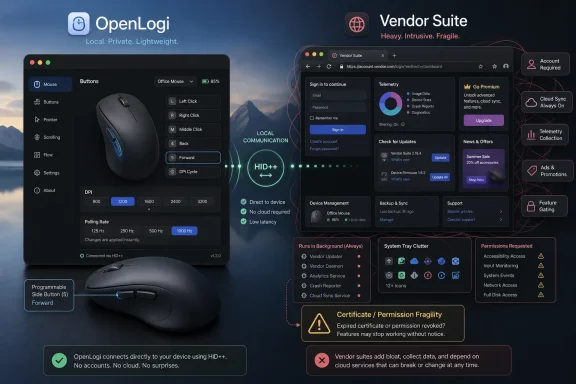
Logitech’s OpenLogi arrived in June 2026 as a free, open-source macOS utility that configures supported Logitech mice locally, using Rust and the HID++ protocol instead of Logitech’s heavier Options+ stack. Its significance is larger than one mouse app: it exposes how much of modern peripheral software is product strategy masquerading as technical necessity. The old bargain was that users accepted background services, accounts, telemetry prompts, and fragile cross-platform wrappers in exchange for programmable buttons and DPI sliders. OpenLogi shows that bargain was never as inevitable as manufacturers implied.
The most irritating part of buying PC hardware in 2026 is no longer the driver hunt. Windows Update usually finds the basic driver, USB devices enumerate cleanly, and Bluetooth pairing is less miserable than it used to be. The irritation now comes after the hardware works, when the vendor insists that working is not enough.
A mouse needs a suite. A keyboard needs a dashboard. A headset needs a launcher, a profile cloud, a tray icon, an updater, a telemetry channel, and a service that starts before the user has opened a single productivity app. The driver has been demoted to plumbing; the “experience” has become the product.
That shift was not accidental. Logitech, Razer, Corsair, ASUS, MSI, SteelSeries, and others learned the same lesson software companies learned a decade earlier: if your product can become a platform, you can keep the customer inside your ecosystem after the sale. RGB profiles, macros, per-game settings, firmware updates, store pages, AI features, account sync, and cross-device automation all become reasons to keep the app installed.
The problem is that peripheral hardware is not a social network or a streaming service. A mouse button should not require the same software architecture as a collaboration suite. When a configuration utility behaves like a resident application platform, users pay the cost every boot.
Individually, each vendor can argue that its software does useful work. The trouble begins when real PCs are built from parts made by several companies. A typical enthusiast or work-from-home setup can easily include a Logitech mouse, a Corsair keyboard, a Razer headset, an ASUS motherboard, a SteelSeries controller, and a monitor with its own control utility.
At that point, the user is not running one device manager. They are running a small federation of competing device ecosystems. Each wants to launch at startup, each wants elevated permissions or background services, and each assumes it deserves to be the authoritative source for lighting, macros, media keys, device state, and firmware.
Corsair’s own support material acknowledging conflicts with other software is a useful accidental confession. The conflict problem is not some rare edge case; it is the natural result of multiple vendors polling the same sensors, touching the same USB devices, hooking the same inputs, or trying to own the same RGB buses. The PC becomes a jurisdictional dispute with fans.
For Windows users, this often shows up as startup drag, RAM use, tray clutter, and mysterious update failures. For laptop users, it also shows up as battery drain. For administrators, it shows up as yet another unsigned-looking updater, another outbound connection, another privilege boundary to audit, and another application that must be packaged, blocked, or tolerated.
But Electron did make it easier for hardware vendors to ship heavy cross-platform utilities with less regard for native operating system behavior. A company can write much of the interface once, wrap it in Chromium, and push versions to Windows and macOS without maintaining a truly native app for each platform. That is attractive if the software is seen as a marketing surface rather than a carefully engineered system utility.
The result is a strange inversion. The hardware is often beautifully engineered: high-polling sensors, low-latency wireless links, custom switches, sophisticated battery management, and polished industrial design. The software used to configure that hardware can feel like a webpage wearing a fake mustache.
This matters because configuration utilities are not ordinary apps. They are supposed to sit quietly in the background, touch input devices reliably, and fail gracefully. If a browser-like shell is used to manage hardware hooks, local servers, helper processes, and permission prompts, the user experiences the worst of both worlds: the fragility of a web app with the persistence of a system service.
The user does not care whether a framework made cross-platform development cheaper. They care that a mouse utility should not feel like opening a second browser. They care that closing a settings window should mean the settings window is closed, not that a constellation of helper processes remains behind to watch the wheel.
Apple’s permission model is stricter about input monitoring, accessibility control, background agents, and code signing. That can be annoying, especially when a legitimate utility needs access to remap buttons or observe application focus. But the model also reveals when an app’s design is brittle. A peripheral manager that depends on multiple daemons, certificates, local communication channels, and permission grants has more ways to fail.
Logitech’s January 2026 macOS certificate incident was the kind of failure that turns a nuisance into an indictment. Options+ and G HUB broke for Mac users after a certificate expired, leaving some users unable to access the software that managed their customizations. The underlying hardware still existed; the mouse still clicked; the keyboard still typed. But the vendor-controlled software layer became the point of failure.
That is the remarkable part. The problem was not that custom mouse buttons are technically exotic. The problem was that a configuration stack had become dependent on a chain of software assumptions far removed from the physical device. A certificate lapse should not make a mouse configuration utility feel like a stranded cloud service.
The incident also underlined a broader truth about macOS peripheral support. Vendors often treat the Mac as a supported platform, but not necessarily as a first-class one. Apps arrive later, behave less naturally, require more permissions, and break in ways that suggest the Mac build is a port rather than a native citizen.
The app talks to supported Logitech mice using HID++, stores configuration locally, and exposes controls through a native-feeling interface and command-line tooling. It does not need a vendor account to understand a side button. It does not need to sell the user on a device ecosystem to change DPI. It does not need to place a marketing portal between the operating system and the hardware.
That simplicity is a political statement in software form. OpenLogi says the quiet part out loud: a large portion of what official peripheral suites do is not required for the core job. Some users may want cloud profiles, game integrations, synchronized lighting scenes, and marketplace-like features. But those should be optional layers, not the toll booth in front of basic configuration.
The use of Rust is also symbolically important, though not because Rust magically makes software lean. It matters because it signals a different set of priorities. OpenLogi is built like a utility, not like a web property. It treats local configuration as the default and network access as something to justify.
That is exactly backwards from the direction many hardware vendors have taken. Their apps often begin with account prompts, update checks, product tiles, feature banners, and background services. The device settings are in there somewhere, but the interface increasingly behaves as if the mouse is merely an endpoint in a larger customer-retention system.
There are legitimate reasons to offer account sync. A competitive gamer may want profiles carried between machines. A creator may want consistent mappings on a desktop and laptop. An enterprise fleet may benefit from managed configuration. But those are use cases, not universal requirements.
The account prompt is the moment when a utility reveals whether it sees the user as an owner or an audience. If the app refuses basic local configuration until the user signs in, the software is no longer merely helping operate purchased hardware. It is extending the vendor’s relationship with the customer beyond the sale.
Privacy policies compound the insult. Users buying a mouse are forced into legal and data-processing relationships that have little to do with the physical object on the desk. Even when the data collected is modest, the posture is wrong. Local peripherals should be private by default because their function is local by nature.
OpenLogi’s local-first model is therefore not just a performance improvement. It is a correction of ownership. The configuration file lives on the user’s machine. The button mappings are not a service. The mouse is not a subscription endpoint pretending to be a peripheral.
Windows is permissive, backwards-compatible, and vendor-friendly. Those are strengths. They are why obscure devices keep working, why enterprise peripherals last for years, and why PC hardware remains the most open mainstream computing ecosystem. They are also why vendor utilities can sprawl across services, scheduled tasks, startup entries, browser components, device hooks, and auto-updaters with relatively little friction.
A lightweight Logitech configuration tool on macOS is a preview of what Windows users should demand from every peripheral maker. Not necessarily OpenLogi itself, and not necessarily open source in every case. The principle is what matters: local configuration first, optional cloud features second, and background persistence only when technically justified.
Windows already has examples of this philosophy in smaller utilities. Enthusiasts have long used focused tools to control fans, remap keys, manage displays, or configure devices without installing a vendor’s entire command center. Microsoft’s own PowerToys, while broader than a device utility, succeeds because it feels modular and user-directed rather than ecosystem-hungry.
The opportunity for Windows is larger because the installed base is larger. If local-first peripheral utilities become credible on Windows, vendors will have to justify why official suites remain so heavy. The answer cannot simply be “because cross-platform development is hard” when independent developers are proving that basic configuration is manageable.
Every peripheral suite is another application lifecycle to manage. It must be installed, updated, tested, inventoried, and sometimes removed. If it includes services, drivers, local web components, or auto-updaters, it becomes part of the endpoint security conversation. If it communicates externally, it becomes part of the network and privacy conversation.
The more ambitious these suites become, the harder they are to classify. Is iCUE a keyboard utility, a cooling utility, a lighting controller, a sensor monitor, or a software development platform with SDK integrations? Is Options+ a mouse settings panel, a productivity automation tool, a cross-computer workflow product, or a plugin host? The answer is often “yes,” which is exactly why administrators dislike them.
A narrow, local tool is easier to reason about. It has fewer moving parts, fewer reasons to require administrator rights, and fewer opportunities to break during a certificate, update, or service failure. It may not satisfy every consumer feature request, but it fits the principle of least privilege far better than a vendor suite trying to be a lifestyle app.
There is also a procurement angle. Businesses often standardize on peripherals because they want predictable support and easy replacement. If the official software becomes a source of instability, the hardware brand loses part of its value. A premium mouse is less premium if its configuration layer creates tickets.
The incentives still favor heavy suites. Vendor apps are surfaces for cross-selling, feature promotion, firmware control, support deflection, and data gathering. They make hardware feel alive after purchase and give marketing teams something to announce between product launches. They also help companies bind multiple products together into an ecosystem that discourages switching.
Some of those goals are legitimate. Firmware updates matter. Security fixes matter. Complex devices sometimes need complex tools. A high-end keyboard with onboard profiles, macro layers, lighting zones, wireless modes, and firmware settings cannot always be managed by a four-button dialog box.
But legitimacy at the high end has been used to justify excess everywhere else. A simple mouse with a few programmable controls should not inherit the software assumptions of an entire gaming battlestation. A productivity keyboard should not need the same resident stack as a motherboard lighting controller.
The healthier model is tiered. Basic configuration should be local, lightweight, and available without an account. Advanced ecosystem features can exist, but they should be opt-in. The user who wants cloud profile sync can enable it. The user who wants a button to send Mission Control, change DPI, or trigger a keyboard shortcut should not have to join a platform.
But open source alone is not the magic ingredient. A poorly maintained open-source utility can be buggy, insecure, or abandoned. Hardware support can be incomplete. Reverse-engineered protocols can break when vendors change firmware behavior. Users still need reliable releases and clear documentation.
The lesson is not that every user should immediately replace official software with community tools. The lesson is that official software should feel embarrassed when community tools do the core job with less ceremony. OpenLogi raises the standard by proving a smaller shape is possible.
It also gives users leverage. Once a credible lightweight alternative exists, vendor claims become easier to challenge. If an independent developer can configure buttons locally, then the account requirement was not a technical necessity. If a small native utility can avoid a persistent cloud-shaped footprint, then the heavy suite reflects product priorities, not physics.
The most concrete lessons are simple enough to state without turning them into a manifesto:
 Peripheral Makers Turned Drivers Into Little Operating Systems
The most irritating part of buying PC hardware in 2026 is no longer the driver hunt. Windows Update usually finds the basic driver, USB devices enumerate cleanly, and Bluetooth pairing is less miserable than it used to be. The irritation now comes after the hardware works, when the vendor insists that working is not enough.A mouse needs a suite. A keyboard needs a dashboard. A headset needs a launcher, a profile cloud, a tray icon, an updater, a telemetry channel, and a service that starts before the user has opened a single productivity app. The driver has been demoted to plumbing; the “experience” has become the product.
That shift was not accidental. Logitech, Razer, Corsair, ASUS, MSI, SteelSeries, and others learned the same lesson software companies learned a decade earlier: if your product can become a platform, you can keep the customer inside your ecosystem after the sale. RGB profiles, macros, per-game settings, firmware updates, store pages, AI features, account sync, and cross-device automation all become reasons to keep the app installed.
The problem is that peripheral hardware is not a social network or a streaming service. A mouse button should not require the same software architecture as a collaboration suite. When a configuration utility behaves like a resident application platform, users pay the cost every boot.
The Bloat Was Hidden Because Each App Looked Defensible Alone
The defense of manufacturer software has always sounded reasonable in isolation. Logitech Options+ enables Flow, per-app mappings, Smart Actions, and device management. Corsair iCUE coordinates lighting, cooling, macros, and sensors across a tower full of parts. Razer Synapse handles gaming profiles and cloud sync. Armoury Crate manages motherboard lighting, firmware, power modes, and bundled ASUS services.Individually, each vendor can argue that its software does useful work. The trouble begins when real PCs are built from parts made by several companies. A typical enthusiast or work-from-home setup can easily include a Logitech mouse, a Corsair keyboard, a Razer headset, an ASUS motherboard, a SteelSeries controller, and a monitor with its own control utility.
At that point, the user is not running one device manager. They are running a small federation of competing device ecosystems. Each wants to launch at startup, each wants elevated permissions or background services, and each assumes it deserves to be the authoritative source for lighting, macros, media keys, device state, and firmware.
Corsair’s own support material acknowledging conflicts with other software is a useful accidental confession. The conflict problem is not some rare edge case; it is the natural result of multiple vendors polling the same sensors, touching the same USB devices, hooking the same inputs, or trying to own the same RGB buses. The PC becomes a jurisdictional dispute with fans.
For Windows users, this often shows up as startup drag, RAM use, tray clutter, and mysterious update failures. For laptop users, it also shows up as battery drain. For administrators, it shows up as yet another unsigned-looking updater, another outbound connection, another privilege boundary to audit, and another application that must be packaged, blocked, or tolerated.
Electron Made the Bad Incentives Easier to Ship
Electron is not the villain by itself. Visual Studio Code is an Electron application, and it is a strong rebuttal to the lazy claim that web-based desktop apps must be bad. Plenty of serious, capable tools use web technologies well.But Electron did make it easier for hardware vendors to ship heavy cross-platform utilities with less regard for native operating system behavior. A company can write much of the interface once, wrap it in Chromium, and push versions to Windows and macOS without maintaining a truly native app for each platform. That is attractive if the software is seen as a marketing surface rather than a carefully engineered system utility.
The result is a strange inversion. The hardware is often beautifully engineered: high-polling sensors, low-latency wireless links, custom switches, sophisticated battery management, and polished industrial design. The software used to configure that hardware can feel like a webpage wearing a fake mustache.
This matters because configuration utilities are not ordinary apps. They are supposed to sit quietly in the background, touch input devices reliably, and fail gracefully. If a browser-like shell is used to manage hardware hooks, local servers, helper processes, and permission prompts, the user experiences the worst of both worlds: the fragility of a web app with the persistence of a system service.
The user does not care whether a framework made cross-platform development cheaper. They care that a mouse utility should not feel like opening a second browser. They care that closing a settings window should mean the settings window is closed, not that a constellation of helper processes remains behind to watch the wheel.
macOS Exposed the Fragility First
Windows users get the bloat. Mac users often get the bloat plus a sharper view of the architectural cracks.Apple’s permission model is stricter about input monitoring, accessibility control, background agents, and code signing. That can be annoying, especially when a legitimate utility needs access to remap buttons or observe application focus. But the model also reveals when an app’s design is brittle. A peripheral manager that depends on multiple daemons, certificates, local communication channels, and permission grants has more ways to fail.
Logitech’s January 2026 macOS certificate incident was the kind of failure that turns a nuisance into an indictment. Options+ and G HUB broke for Mac users after a certificate expired, leaving some users unable to access the software that managed their customizations. The underlying hardware still existed; the mouse still clicked; the keyboard still typed. But the vendor-controlled software layer became the point of failure.
That is the remarkable part. The problem was not that custom mouse buttons are technically exotic. The problem was that a configuration stack had become dependent on a chain of software assumptions far removed from the physical device. A certificate lapse should not make a mouse configuration utility feel like a stranded cloud service.
The incident also underlined a broader truth about macOS peripheral support. Vendors often treat the Mac as a supported platform, but not necessarily as a first-class one. Apps arrive later, behave less naturally, require more permissions, and break in ways that suggest the Mac build is a port rather than a native citizen.
OpenLogi Is Small Because the Job Is Small
OpenLogi’s most provocative feature is not any one mapping option. It is the absence of a mythology around the task.The app talks to supported Logitech mice using HID++, stores configuration locally, and exposes controls through a native-feeling interface and command-line tooling. It does not need a vendor account to understand a side button. It does not need to sell the user on a device ecosystem to change DPI. It does not need to place a marketing portal between the operating system and the hardware.
That simplicity is a political statement in software form. OpenLogi says the quiet part out loud: a large portion of what official peripheral suites do is not required for the core job. Some users may want cloud profiles, game integrations, synchronized lighting scenes, and marketplace-like features. But those should be optional layers, not the toll booth in front of basic configuration.
The use of Rust is also symbolically important, though not because Rust magically makes software lean. It matters because it signals a different set of priorities. OpenLogi is built like a utility, not like a web property. It treats local configuration as the default and network access as something to justify.
That is exactly backwards from the direction many hardware vendors have taken. Their apps often begin with account prompts, update checks, product tiles, feature banners, and background services. The device settings are in there somewhere, but the interface increasingly behaves as if the mouse is merely an endpoint in a larger customer-retention system.
The Account Prompt Was Always the Tell
A manufacturer can make a credible case for an app. It is harder to make a credible case for requiring an account to configure local hardware.There are legitimate reasons to offer account sync. A competitive gamer may want profiles carried between machines. A creator may want consistent mappings on a desktop and laptop. An enterprise fleet may benefit from managed configuration. But those are use cases, not universal requirements.
The account prompt is the moment when a utility reveals whether it sees the user as an owner or an audience. If the app refuses basic local configuration until the user signs in, the software is no longer merely helping operate purchased hardware. It is extending the vendor’s relationship with the customer beyond the sale.
Privacy policies compound the insult. Users buying a mouse are forced into legal and data-processing relationships that have little to do with the physical object on the desk. Even when the data collected is modest, the posture is wrong. Local peripherals should be private by default because their function is local by nature.
OpenLogi’s local-first model is therefore not just a performance improvement. It is a correction of ownership. The configuration file lives on the user’s machine. The button mappings are not a service. The mouse is not a subscription endpoint pretending to be a peripheral.
Windows Should Learn From the Mac App Built Without It
OpenLogi is macOS-first, which may seem like an odd focus for a WindowsForum audience. But Windows users should pay attention precisely because they have been conditioned to tolerate more of this mess.Windows is permissive, backwards-compatible, and vendor-friendly. Those are strengths. They are why obscure devices keep working, why enterprise peripherals last for years, and why PC hardware remains the most open mainstream computing ecosystem. They are also why vendor utilities can sprawl across services, scheduled tasks, startup entries, browser components, device hooks, and auto-updaters with relatively little friction.
A lightweight Logitech configuration tool on macOS is a preview of what Windows users should demand from every peripheral maker. Not necessarily OpenLogi itself, and not necessarily open source in every case. The principle is what matters: local configuration first, optional cloud features second, and background persistence only when technically justified.
Windows already has examples of this philosophy in smaller utilities. Enthusiasts have long used focused tools to control fans, remap keys, manage displays, or configure devices without installing a vendor’s entire command center. Microsoft’s own PowerToys, while broader than a device utility, succeeds because it feels modular and user-directed rather than ecosystem-hungry.
The opportunity for Windows is larger because the installed base is larger. If local-first peripheral utilities become credible on Windows, vendors will have to justify why official suites remain so heavy. The answer cannot simply be “because cross-platform development is hard” when independent developers are proving that basic configuration is manageable.
Enterprise IT Has Better Reasons to Distrust the Suite
Home users experience bloat as annoyance. IT departments experience it as risk.Every peripheral suite is another application lifecycle to manage. It must be installed, updated, tested, inventoried, and sometimes removed. If it includes services, drivers, local web components, or auto-updaters, it becomes part of the endpoint security conversation. If it communicates externally, it becomes part of the network and privacy conversation.
The more ambitious these suites become, the harder they are to classify. Is iCUE a keyboard utility, a cooling utility, a lighting controller, a sensor monitor, or a software development platform with SDK integrations? Is Options+ a mouse settings panel, a productivity automation tool, a cross-computer workflow product, or a plugin host? The answer is often “yes,” which is exactly why administrators dislike them.
A narrow, local tool is easier to reason about. It has fewer moving parts, fewer reasons to require administrator rights, and fewer opportunities to break during a certificate, update, or service failure. It may not satisfy every consumer feature request, but it fits the principle of least privilege far better than a vendor suite trying to be a lifestyle app.
There is also a procurement angle. Businesses often standardize on peripherals because they want predictable support and easy replacement. If the official software becomes a source of instability, the hardware brand loses part of its value. A premium mouse is less premium if its configuration layer creates tickets.
Vendors Will Not Give Up the Platform Dream Easily
It would be comforting to imagine OpenLogi as the start of a rapid industry correction. That is unlikely.The incentives still favor heavy suites. Vendor apps are surfaces for cross-selling, feature promotion, firmware control, support deflection, and data gathering. They make hardware feel alive after purchase and give marketing teams something to announce between product launches. They also help companies bind multiple products together into an ecosystem that discourages switching.
Some of those goals are legitimate. Firmware updates matter. Security fixes matter. Complex devices sometimes need complex tools. A high-end keyboard with onboard profiles, macro layers, lighting zones, wireless modes, and firmware settings cannot always be managed by a four-button dialog box.
But legitimacy at the high end has been used to justify excess everywhere else. A simple mouse with a few programmable controls should not inherit the software assumptions of an entire gaming battlestation. A productivity keyboard should not need the same resident stack as a motherboard lighting controller.
The healthier model is tiered. Basic configuration should be local, lightweight, and available without an account. Advanced ecosystem features can exist, but they should be opt-in. The user who wants cloud profile sync can enable it. The user who wants a button to send Mission Control, change DPI, or trigger a keyboard shortcut should not have to join a platform.
Open Source Is the Pressure Valve, Not the Whole Cure
OpenLogi benefits from being open source because trust is central to the complaint it answers. Users can inspect the project, understand its boundaries, and see whether it is doing more than it claims. That matters when the alternative is a proprietary suite with opaque services and shifting product priorities.But open source alone is not the magic ingredient. A poorly maintained open-source utility can be buggy, insecure, or abandoned. Hardware support can be incomplete. Reverse-engineered protocols can break when vendors change firmware behavior. Users still need reliable releases and clear documentation.
The lesson is not that every user should immediately replace official software with community tools. The lesson is that official software should feel embarrassed when community tools do the core job with less ceremony. OpenLogi raises the standard by proving a smaller shape is possible.
It also gives users leverage. Once a credible lightweight alternative exists, vendor claims become easier to challenge. If an independent developer can configure buttons locally, then the account requirement was not a technical necessity. If a small native utility can avoid a persistent cloud-shaped footprint, then the heavy suite reflects product priorities, not physics.
The Mouse Utility That Makes the Whole Industry Look Overbuilt
OpenLogi does not make every manufacturer app obsolete today, and it does not yet solve the Windows side of the problem. But it changes the argument. It turns “this is just how peripherals work now” into “this is how vendors chose to make peripherals work.”The most concrete lessons are simple enough to state without turning them into a manifesto:
- Basic peripheral configuration should work locally without an account, a cloud profile, or a vendor marketing portal.
- Background services should exist only when a feature truly needs them, not because a settings panel wants permanent residence.
- Cross-platform convenience for developers should not excuse poor native behavior, high idle resource use, or fragile permission handling.
- macOS failures around Logitech’s certificate incident showed how dangerous it is when local hardware control depends on a brittle software chain.
- Windows users should demand the same lightweight, optional model rather than accepting every tray icon as the cost of modern hardware.
- Vendor suites can still serve power users, but they should be an upgrade path, not the default gatekeeper for a mouse button.
References
- Primary source: MakeUseOf
Published: 2026-06-14T13:10:07.315443
Loading…
www.makeuseof.com