

Samsung Heavy Industries is pushing floating AI data centers toward commercialization in 2026 through ship-based designs, classification approvals, and partnerships with Supermicro, Greek shipowner Capital, and Lloyd’s Register as demand for power-hungry AI infrastructure strains land, water, and electric-grid capacity. The premise is simple enough to sound inevitable: if AI factories cannot get land, power, cooling, and permits quickly onshore, move part of the factory offshore. The risk is that the industry may be treating the ocean not as a solution, but as a place to hide the same unresolved constraints. Samsung’s plan is less a moonshot than a mirror held up to the terrestrial data-center boom.
The most important thing about Samsung’s floating AI data-center push is not that it sounds futuristic. It is that it sounds logistical. This is not a consumer-electronics company teasing a concept render for CES; it is Samsung Heavy Industries, the shipbuilding arm of a conglomerate that already understands LNG carriers, offshore platforms, floating production systems, and the grim engineering discipline of keeping machinery alive in saltwater.
That matters because AI infrastructure has entered a phase where the limiting factor is no longer just chips. Nvidia GPUs and high-bandwidth memory remain the glamour objects, but the bottlenecks increasingly sit beneath them: substations, transmission queues, cooling systems, construction labor, land-use fights, water rights, and local political resistance. AI has turned the data center from a quiet warehouse full of servers into a visible industrial facility with neighborhood-scale consequences.
Samsung’s answer is to reframe the data center as maritime infrastructure. A floating data center, in this model, is not merely a barge with racks inside. It is a modular facility that can be built in shipyards, deployed near coastal demand centers, cooled with seawater, and potentially paired with offshore or ship-based power generation. For a shipbuilder, that is a compelling adjacent market: the same industrial base that assembles hulls and offshore facilities can be pointed at compute.
The pitch becomes even more attractive when framed against AI’s hunger for speed. A hyperscale AI project that waits years for grid interconnection is not just delayed; it may miss the economic window in which the model, workload, or customer demand made sense. Samsung and its partners are effectively arguing that speed to power has become as strategic as chips themselves.
That claim has merit. It also deserves scrutiny. Floating data centers may relieve some constraints, but they do not abolish physics, environmental review, network latency, security exposure, or the brutal maintenance realities of marine operations. The ocean gives data-center developers more room to maneuver, but it does not make megawatts free.
That shift has changed the politics of data centers. Communities that once treated them as low-noise, high-tax industrial neighbors now worry about water consumption, grid strain, diesel backup generators, land use, and the mismatch between local sacrifice and limited local employment. In parts of the United States and Europe, the backlash has moved from activist concern to planning-board friction.
The problem for AI companies is that their demand curve is impatient. A model provider, cloud platform, or GPU fleet operator cannot simply wait for a decade of transmission buildout and assume the competitive landscape will hold still. The result is a frantic search for alternative sites: former power plants, industrial brownfields, nuclear-adjacent campuses, desert regions, cold climates, and now the water.
Floating data centers fit neatly into that search. They promise access to coastal industrial zones, ports, offshore energy, and seawater cooling. They also offer a different permitting narrative: less pressure on inland land, potentially less freshwater use, and the possibility of building standardized modules in controlled shipyard conditions rather than fighting every project as a one-off local construction war.
But there is a danger in overselling the escape route. Moving compute offshore can reduce one set of bottlenecks while creating another. Data still needs fiber backhaul or other connectivity. Power still needs generation, conversion, and resilience. Cooling still requires heat rejection. Hardware still fails. Humans still need to board, inspect, repair, secure, and operate the facility.
The AI industry is not escaping infrastructure. It is changing the map on which that infrastructure fight takes place.
Samsung Heavy Industries has been moving through exactly that kind of process. Reports describe concept design approvals and partnerships involving classification organizations such as Lloyd’s Register, along with commercial discussions with shipowners. These details sound bureaucratic, but they are the difference between a speculative render and something financiers, insurers, and customers can start to evaluate seriously.
The Supermicro partnership is equally revealing. Marine-grade hull design is only half the problem; the other half is whether AI server infrastructure can operate reliably in a floating environment for years. GPUs are expensive, power-dense, thermally sensitive assets. The idea of putting them on a ship raises immediate questions about vibration, humidity, corrosion, physical access, spare parts, fire suppression, liquid-cooling integrity, and maintenance windows.
That is why Samsung’s floating data-center story is not simply “data centers at sea.” It is a systems-integration story. The company needs ship design, power architecture, cooling architecture, server integration, classification approval, financing, and customer demand to line up at once. Any one of those pieces can make a press release look premature.
Still, Samsung has a structural reason to try. Shipbuilding is cyclical, capital-intensive, and exposed to swings in trade, energy, and shipping markets. AI infrastructure, by contrast, currently looks like one of the few global sectors where customers are willing to pay extraordinary sums for capacity. If shipyards can become factories for compute infrastructure, the revenue pool changes.
That does not make floating data centers inevitable. It does make them rational.
This is the part of the pitch that will resonate with anyone who has watched data-center water fights intensify. Evaporative cooling can reduce power use but consume freshwater. Mechanical cooling can reduce water use but increase electricity consumption. In hotter climates, both trade-offs get harder. Seawater cooling seems to sidestep the public-relations problem by using an abundant medium that does not come from municipal taps or aquifers.
But “using seawater” is not the same as having no environmental impact. Warm water discharge, marine growth, corrosion, filtration, intake design, chemical treatment, and local ecosystem effects all matter. Industrial cooling systems near water bodies have long been scrutinized for precisely these reasons. A floating AI data center would not get a free pass simply because the coolant is salty.
The engineering challenge is also more subtle than dunking a radiator into the sea. High-density AI systems require stable thermal loops, leak detection, controlled fluid chemistry, and predictable operating conditions. A ship or barge may move, flex, vibrate, and experience weather events in ways a land-based data hall does not. The sea is a heat sink, but it is also a hostile operating environment.
Samsung can credibly argue that shipbuilders know how to manage hostile environments. Offshore platforms, LNG vessels, and floating production units already combine power, cooling, automation, safety systems, and harsh-weather design. The question is whether those lessons translate economically to AI compute, where hardware refresh cycles are shorter and downtime can be brutally expensive.
Cooling is the strongest argument for floating data centers. It is not, by itself, a business model.
Some floating data-center proposals imagine pairing facilities with offshore wind, wave power, floating power plants, fuel cells, LNG-based generation, or nearby grid connections. Samsung’s reported plans and adjacent market activity suggest a range of possibilities rather than a single settled model. That flexibility may help commercialization, but it also shows how unresolved the power question remains.
A 50-megawatt floating data center is not a toy. A 73-megawatt facility, such as the project being pursued in Japan by Mitsui O.S.K. Lines and Karpowership, is a serious industrial load. Multiply those units into clusters and the numbers begin to resemble the same grid-scale challenge faced onshore. Offshore siting may move the interconnection point, but it does not make generation and transmission trivial.
There is also a carbon-accounting problem. If floating data centers are powered by LNG, fuel cells using fossil fuel, or ship-based generation, the environmental case becomes more complicated. Reduced freshwater use and improved cooling efficiency may be meaningful, but they do not automatically offset emissions from dedicated fossil generation. If the industry markets floating data centers as green while quietly leaning on gas, regulators and customers will notice.
The cleanest version of the concept pairs floating compute with abundant renewable or low-carbon energy that is otherwise difficult to use efficiently. Offshore wind curtailment, stranded power, and coastal grid congestion could all create niches where floating compute makes sense. But those niches are not universal. In many cases, the same questions that plague land-based AI campuses will follow the data center offshore: who gets the power, who pays for the infrastructure, and who bears the environmental cost?
The sea solves land scarcity. It does not solve energy scarcity.
This is where the story becomes strategically interesting. AI infrastructure is no longer confined to the cloud providers that rent it out. It now involves chipmakers, memory suppliers, utilities, construction firms, sovereign investors, power developers, and industrial conglomerates. Samsung can plausibly touch several layers of that stack, from memory to construction to ship-based infrastructure.
The OpenAI association also creates a gravitational pull in media coverage. Any infrastructure concept that might serve future frontier-model demand gets framed as part of the race to feed ChatGPT-like systems. That framing is understandable, but it can blur the distinction between a signed development plan, a speculative capacity target, and an actual deployed facility running customer workloads.
For WindowsForum readers, the immediate relevance is not whether a future OpenAI cluster floats off a coastline. It is that AI infrastructure is becoming more geographically and politically complex. The cloud services that power Copilot-style features, enterprise AI tools, developer assistants, Windows integrations, and SaaS automation are backed by physical facilities whose placement and power sources increasingly matter.
Microsoft, OpenAI, Google, Amazon, Meta, Oracle, and their suppliers are all dealing with the same fundamental constraint: AI demand is outpacing the slowest parts of the infrastructure stack. Floating data centers are one proposed workaround. They are not a detour around the AI buildout; they are evidence of how extreme that buildout has become.
If the cloud once trained users to ignore where computing happened, AI is forcing everyone to remember.
That distinction is crucial. A modest floating facility serving conventional workloads is one thing. A high-density AI data center packed with liquid-cooled GPU racks, enormous power draw, and customers expecting hyperscale reliability is another. The jump from single-digit megawatts to tens or hundreds of megawatts is not linear.
Samsung is not alone in testing that boundary. Japan’s MOL and Karpowership project, Singapore’s floating data-center activity, offshore wind-integrated concepts, and wave-powered AI proposals all point to a broader market experiment. The industry is trying multiple versions of the same thesis: compute can move closer to power and cooling resources, even if that means leaving conventional real estate behind.
The diversity of approaches is both encouraging and suspicious. Encouraging, because it suggests real demand for alternatives to land-based campuses. Suspicious, because frothy infrastructure markets often produce a parade of adjacent ideas that are more investable than deployable. Every AI bottleneck now attracts a startup, a shipyard, a sovereign fund, and a glossy rendering.
Samsung’s advantage is that it is not merely a rendering shop. But even for Samsung, the proof will come only when floating data centers host real workloads, with published reliability, power, cooling, security, maintenance, and cost data over time. Until then, the concept remains promising but unproven at the scale that AI boosters are implying.
The first floating AI data centers will be judged less by launch ceremonies than by their third year of operations.
Resilience is the first issue. Marine infrastructure can be engineered for storms, but extreme weather, port disruption, collision risk, maritime security, and maintenance access add new failure modes. A land-based data center can be difficult to repair during a disaster; a sea-based one can be difficult to reach at all. Redundancy helps, but redundancy costs money.
Security is the second issue. A floating data center is a critical digital asset in a physical domain governed by maritime law, port authority rules, national security concerns, and potentially cross-border jurisdictional complications. Undersea cables already show how geopolitically sensitive maritime infrastructure can be. Add AI compute to the mix, and governments will care.
Data sovereignty is the third issue. If a data center can be moved, moored, or operated in coastal waters, regulators will want clarity about jurisdiction, lawful access, compliance, and incident response. Enterprise customers in healthcare, finance, government, and regulated industries will not accept hand-waving about where data is processed. The cloud contract may need to know what the hull is doing.
Maintenance is the fourth issue. AI hardware refresh cycles are aggressive, and GPU clusters are not install-and-forget systems. The industry still has to learn whether marine deployment complicates hardware swaps, cable management, coolant maintenance, fire suppression, and failure isolation enough to erode the promised deployment gains.
None of these objections kill the concept. They do narrow its likely early market. Floating AI data centers may make the most sense for workloads that are power-hungry, latency-tolerant, geographically flexible, and operated by customers comfortable with novel infrastructure risk. That is a real market, but it is not every market.
That does not mean a Samsung vessel will directly power tomorrow’s Windows feature update. The connection is more indirect. AI features in operating systems and productivity suites are increasingly backed by remote inference, and remote inference requires data-center capacity. Every new infrastructure model that expands that capacity becomes part of the software experience, even if users never see it.
For sysadmins, the implications are sharper. Organizations adopting AI-assisted endpoint management, security analytics, code generation, document processing, and help-desk automation are already dependent on cloud reliability and policy controls. If the AI back end becomes more distributed across unconventional infrastructure, administrators will need clearer answers from vendors about data residency, uptime commitments, incident reporting, and compliance boundaries.
Developers should also pay attention. The economics of inference will shape what applications can afford to do. If new data-center models reduce bottlenecks, more software will assume AI calls are cheap, fast, and always available. If those models stumble, developers may discover that AI-dependent features inherit the fragility of a constrained infrastructure market.
The cloud has always hidden complexity behind APIs. AI is making that complexity harder to ignore.
But it is also a rebranding of industrial demand. AI companies still need electricity at massive scale. They still need materials, chips, backup systems, network connectivity, and disposal pathways for obsolete hardware. They still impose environmental and security externalities. A floating platform may shift who sees those externalities, but it does not erase them.
This is where regulators should be careful. If floating data centers become a way to bypass legitimate land-use scrutiny without equivalent maritime oversight, the industry will have learned the wrong lesson. The answer to bad permitting is not no permitting; it is permitting that understands the technology, measures the trade-offs, and forces operators to internalize costs.
At the same time, critics should avoid reflexively dismissing the idea as science fiction. There are plausible cases where floating data centers could reduce freshwater use, speed deployment, improve cooling efficiency, reuse shipbuilding capacity, and place compute near stranded or offshore energy. Those benefits are worth exploring. The point is to demand evidence before accepting the marketing.
The best version of Samsung’s plan would be a transparent industrial experiment with real operating data. The worst version would be another AI-era spectacle: huge capacity numbers, vague green claims, and a future tense that never quite becomes a service-level agreement.
The difference will be measured in megawatts delivered, not metaphors floated.
Floating data centers will have to compete against land-based hyperscale campuses, retrofitted industrial sites, nuclear-adjacent projects, gas-backed private grids, colder-climate facilities, and improvements in chip efficiency. They do not need to beat all of those options everywhere. They need to win specific niches where land, water, permitting, and power constraints make floating infrastructure economically superior.
That niche may be larger than skeptics assume. Coastal megacities consume enormous digital services and face severe land constraints. Port regions already host industrial power and logistics. Offshore energy development is expanding in some markets. Shipyards can build large modules under controlled conditions. A standardized floating design could, in theory, compress construction timelines.
But AI hardware depreciates quickly, and financing infrastructure around fast-changing compute is tricky. A vessel designed for one generation of racks, cooling loops, and power density must adapt to the next. If GPU clusters change form factors, cooling requirements, or networking architecture faster than marine assets can be amortized, the economics get harder.
That is the core tension. Ships and offshore platforms are long-lived industrial assets. AI clusters are rapidly evolving technology assets. Samsung’s challenge is to make the former flexible enough for the latter.
A real market will also need standardization. Enterprise customers and cloud buyers cannot evaluate every floating facility as a bespoke maritime science project. They will need certification regimes, comparable reliability metrics, auditability, and contractual clarity. Classification approvals are a start, but the data-center world will need its own operational confidence.
There is also a transparency issue around environmental claims. If a floating facility uses seawater cooling and LNG power, its sustainability story is mixed. If it uses offshore renewables with backup generation, the details matter. If it avoids freshwater consumption but adds thermal discharge concerns, the trade-off should be quantified rather than waved away.
Samsung’s plan is credible enough to deserve serious attention and immature enough to deserve serious skepticism. That is often where the most interesting infrastructure stories live. The question is not whether the first facilities can be built; it is whether the model can be repeated without turning into an expensive exception.
AI infrastructure has outgrown the clean narratives of the cloud era. Floating data centers are one of the clearest signs that compute is becoming visibly industrial again.
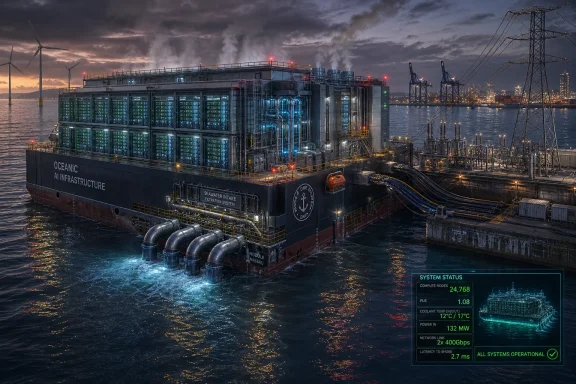 Samsung Is Selling the Sea as the Next Data-Center Industrial Zone
The most important thing about Samsung’s floating AI data-center push is not that it sounds futuristic. It is that it sounds logistical. This is not a consumer-electronics company teasing a concept render for CES; it is Samsung Heavy Industries, the shipbuilding arm of a conglomerate that already understands LNG carriers, offshore platforms, floating production systems, and the grim engineering discipline of keeping machinery alive in saltwater.That matters because AI infrastructure has entered a phase where the limiting factor is no longer just chips. Nvidia GPUs and high-bandwidth memory remain the glamour objects, but the bottlenecks increasingly sit beneath them: substations, transmission queues, cooling systems, construction labor, land-use fights, water rights, and local political resistance. AI has turned the data center from a quiet warehouse full of servers into a visible industrial facility with neighborhood-scale consequences.
Samsung’s answer is to reframe the data center as maritime infrastructure. A floating data center, in this model, is not merely a barge with racks inside. It is a modular facility that can be built in shipyards, deployed near coastal demand centers, cooled with seawater, and potentially paired with offshore or ship-based power generation. For a shipbuilder, that is a compelling adjacent market: the same industrial base that assembles hulls and offshore facilities can be pointed at compute.
The pitch becomes even more attractive when framed against AI’s hunger for speed. A hyperscale AI project that waits years for grid interconnection is not just delayed; it may miss the economic window in which the model, workload, or customer demand made sense. Samsung and its partners are effectively arguing that speed to power has become as strategic as chips themselves.
That claim has merit. It also deserves scrutiny. Floating data centers may relieve some constraints, but they do not abolish physics, environmental review, network latency, security exposure, or the brutal maintenance realities of marine operations. The ocean gives data-center developers more room to maneuver, but it does not make megawatts free.
The AI Boom Has Turned Power Into the New Land Grab
For years, the data-center industry sold itself as digital and weightless, even when the buildings were vast, wired, cooled, and power-dense. AI has ended that polite fiction. Training and inference at scale require not only servers but also immense electrical capacity and cooling systems capable of dealing with racks far denser than the enterprise gear of a decade ago.That shift has changed the politics of data centers. Communities that once treated them as low-noise, high-tax industrial neighbors now worry about water consumption, grid strain, diesel backup generators, land use, and the mismatch between local sacrifice and limited local employment. In parts of the United States and Europe, the backlash has moved from activist concern to planning-board friction.
The problem for AI companies is that their demand curve is impatient. A model provider, cloud platform, or GPU fleet operator cannot simply wait for a decade of transmission buildout and assume the competitive landscape will hold still. The result is a frantic search for alternative sites: former power plants, industrial brownfields, nuclear-adjacent campuses, desert regions, cold climates, and now the water.
Floating data centers fit neatly into that search. They promise access to coastal industrial zones, ports, offshore energy, and seawater cooling. They also offer a different permitting narrative: less pressure on inland land, potentially less freshwater use, and the possibility of building standardized modules in controlled shipyard conditions rather than fighting every project as a one-off local construction war.
But there is a danger in overselling the escape route. Moving compute offshore can reduce one set of bottlenecks while creating another. Data still needs fiber backhaul or other connectivity. Power still needs generation, conversion, and resilience. Cooling still requires heat rejection. Hardware still fails. Humans still need to board, inspect, repair, secure, and operate the facility.
The AI industry is not escaping infrastructure. It is changing the map on which that infrastructure fight takes place.
Samsung’s Advantage Is Not AI Glamour, But Industrial Boredom
Samsung’s credibility here comes from something unfashionable: heavy industry. Floating data centers are less like building a new smartphone and more like building a vessel, a power plant, a telecom landing station, and a high-density computing environment in one package. That combination favors companies comfortable with classification societies, marine safety rules, redundancy planning, and long asset lifecycles.Samsung Heavy Industries has been moving through exactly that kind of process. Reports describe concept design approvals and partnerships involving classification organizations such as Lloyd’s Register, along with commercial discussions with shipowners. These details sound bureaucratic, but they are the difference between a speculative render and something financiers, insurers, and customers can start to evaluate seriously.
The Supermicro partnership is equally revealing. Marine-grade hull design is only half the problem; the other half is whether AI server infrastructure can operate reliably in a floating environment for years. GPUs are expensive, power-dense, thermally sensitive assets. The idea of putting them on a ship raises immediate questions about vibration, humidity, corrosion, physical access, spare parts, fire suppression, liquid-cooling integrity, and maintenance windows.
That is why Samsung’s floating data-center story is not simply “data centers at sea.” It is a systems-integration story. The company needs ship design, power architecture, cooling architecture, server integration, classification approval, financing, and customer demand to line up at once. Any one of those pieces can make a press release look premature.
Still, Samsung has a structural reason to try. Shipbuilding is cyclical, capital-intensive, and exposed to swings in trade, energy, and shipping markets. AI infrastructure, by contrast, currently looks like one of the few global sectors where customers are willing to pay extraordinary sums for capacity. If shipyards can become factories for compute infrastructure, the revenue pool changes.
That does not make floating data centers inevitable. It does make them rational.
The Cooling Story Is Real, but It Is Not Magic
The most obvious appeal of the ocean is cooling. AI servers produce heat at densities that strain conventional air-cooling approaches, pushing operators toward direct-to-chip liquid cooling, immersion systems, rear-door heat exchangers, and more sophisticated facility design. A floating platform surrounded by seawater appears to offer the ultimate heat sink.This is the part of the pitch that will resonate with anyone who has watched data-center water fights intensify. Evaporative cooling can reduce power use but consume freshwater. Mechanical cooling can reduce water use but increase electricity consumption. In hotter climates, both trade-offs get harder. Seawater cooling seems to sidestep the public-relations problem by using an abundant medium that does not come from municipal taps or aquifers.
But “using seawater” is not the same as having no environmental impact. Warm water discharge, marine growth, corrosion, filtration, intake design, chemical treatment, and local ecosystem effects all matter. Industrial cooling systems near water bodies have long been scrutinized for precisely these reasons. A floating AI data center would not get a free pass simply because the coolant is salty.
The engineering challenge is also more subtle than dunking a radiator into the sea. High-density AI systems require stable thermal loops, leak detection, controlled fluid chemistry, and predictable operating conditions. A ship or barge may move, flex, vibrate, and experience weather events in ways a land-based data hall does not. The sea is a heat sink, but it is also a hostile operating environment.
Samsung can credibly argue that shipbuilders know how to manage hostile environments. Offshore platforms, LNG vessels, and floating production units already combine power, cooling, automation, safety systems, and harsh-weather design. The question is whether those lessons translate economically to AI compute, where hardware refresh cycles are shorter and downtime can be brutally expensive.
Cooling is the strongest argument for floating data centers. It is not, by itself, a business model.
Power Remains the Unforgiving Constraint
If cooling is the seductive part of Samsung’s plan, power is the part that decides whether it matters. A modern AI data center is fundamentally a machine for turning electricity into computation and heat. Put it on land, on a barge, under the sea, or in orbit, and that equation does not change.Some floating data-center proposals imagine pairing facilities with offshore wind, wave power, floating power plants, fuel cells, LNG-based generation, or nearby grid connections. Samsung’s reported plans and adjacent market activity suggest a range of possibilities rather than a single settled model. That flexibility may help commercialization, but it also shows how unresolved the power question remains.
A 50-megawatt floating data center is not a toy. A 73-megawatt facility, such as the project being pursued in Japan by Mitsui O.S.K. Lines and Karpowership, is a serious industrial load. Multiply those units into clusters and the numbers begin to resemble the same grid-scale challenge faced onshore. Offshore siting may move the interconnection point, but it does not make generation and transmission trivial.
There is also a carbon-accounting problem. If floating data centers are powered by LNG, fuel cells using fossil fuel, or ship-based generation, the environmental case becomes more complicated. Reduced freshwater use and improved cooling efficiency may be meaningful, but they do not automatically offset emissions from dedicated fossil generation. If the industry markets floating data centers as green while quietly leaning on gas, regulators and customers will notice.
The cleanest version of the concept pairs floating compute with abundant renewable or low-carbon energy that is otherwise difficult to use efficiently. Offshore wind curtailment, stranded power, and coastal grid congestion could all create niches where floating compute makes sense. But those niches are not universal. In many cases, the same questions that plague land-based AI campuses will follow the data center offshore: who gets the power, who pays for the infrastructure, and who bears the environmental cost?
The sea solves land scarcity. It does not solve energy scarcity.
The OpenAI Connection Makes the Story Bigger, and More Ambiguous
Samsung’s floating data-center push gained extra attention because of its broader relationship with OpenAI and South Korea’s role in the AI supply chain. Samsung Electronics and SK hynix are central to memory production, while Samsung C&T and Samsung Heavy Industries have been linked to infrastructure ambitions around global AI data centers. That makes floating compute part of a larger Korean industrial strategy, not just a shipbuilder’s side project.This is where the story becomes strategically interesting. AI infrastructure is no longer confined to the cloud providers that rent it out. It now involves chipmakers, memory suppliers, utilities, construction firms, sovereign investors, power developers, and industrial conglomerates. Samsung can plausibly touch several layers of that stack, from memory to construction to ship-based infrastructure.
The OpenAI association also creates a gravitational pull in media coverage. Any infrastructure concept that might serve future frontier-model demand gets framed as part of the race to feed ChatGPT-like systems. That framing is understandable, but it can blur the distinction between a signed development plan, a speculative capacity target, and an actual deployed facility running customer workloads.
For WindowsForum readers, the immediate relevance is not whether a future OpenAI cluster floats off a coastline. It is that AI infrastructure is becoming more geographically and politically complex. The cloud services that power Copilot-style features, enterprise AI tools, developer assistants, Windows integrations, and SaaS automation are backed by physical facilities whose placement and power sources increasingly matter.
Microsoft, OpenAI, Google, Amazon, Meta, Oracle, and their suppliers are all dealing with the same fundamental constraint: AI demand is outpacing the slowest parts of the infrastructure stack. Floating data centers are one proposed workaround. They are not a detour around the AI buildout; they are evidence of how extreme that buildout has become.
If the cloud once trained users to ignore where computing happened, AI is forcing everyone to remember.
The Nautilus Precedent Shows the Concept Is Not Pure Science Fiction
Floating data centers are not entirely hypothetical. Nautilus Data Technologies has operated a barge-based data center at the Port of Stockton in California, often cited as a commercial proof point for waterborne data-center design. It is much smaller than the AI megaprojects now being discussed, but its existence matters because it moves the argument from “can a data center float?” to “can this scale for AI economics?”That distinction is crucial. A modest floating facility serving conventional workloads is one thing. A high-density AI data center packed with liquid-cooled GPU racks, enormous power draw, and customers expecting hyperscale reliability is another. The jump from single-digit megawatts to tens or hundreds of megawatts is not linear.
Samsung is not alone in testing that boundary. Japan’s MOL and Karpowership project, Singapore’s floating data-center activity, offshore wind-integrated concepts, and wave-powered AI proposals all point to a broader market experiment. The industry is trying multiple versions of the same thesis: compute can move closer to power and cooling resources, even if that means leaving conventional real estate behind.
The diversity of approaches is both encouraging and suspicious. Encouraging, because it suggests real demand for alternatives to land-based campuses. Suspicious, because frothy infrastructure markets often produce a parade of adjacent ideas that are more investable than deployable. Every AI bottleneck now attracts a startup, a shipyard, a sovereign fund, and a glossy rendering.
Samsung’s advantage is that it is not merely a rendering shop. But even for Samsung, the proof will come only when floating data centers host real workloads, with published reliability, power, cooling, security, maintenance, and cost data over time. Until then, the concept remains promising but unproven at the scale that AI boosters are implying.
The first floating AI data centers will be judged less by launch ceremonies than by their third year of operations.
Where Enterprise IT Should Be Skeptical
For enterprise IT leaders, floating AI data centers raise practical questions that do not fit neatly into a launch announcement. Most companies will not directly lease racks on a ship. They will consume services from cloud providers, AI platforms, and managed infrastructure vendors that may or may not disclose where workloads run. Still, the operational model matters.Resilience is the first issue. Marine infrastructure can be engineered for storms, but extreme weather, port disruption, collision risk, maritime security, and maintenance access add new failure modes. A land-based data center can be difficult to repair during a disaster; a sea-based one can be difficult to reach at all. Redundancy helps, but redundancy costs money.
Security is the second issue. A floating data center is a critical digital asset in a physical domain governed by maritime law, port authority rules, national security concerns, and potentially cross-border jurisdictional complications. Undersea cables already show how geopolitically sensitive maritime infrastructure can be. Add AI compute to the mix, and governments will care.
Data sovereignty is the third issue. If a data center can be moved, moored, or operated in coastal waters, regulators will want clarity about jurisdiction, lawful access, compliance, and incident response. Enterprise customers in healthcare, finance, government, and regulated industries will not accept hand-waving about where data is processed. The cloud contract may need to know what the hull is doing.
Maintenance is the fourth issue. AI hardware refresh cycles are aggressive, and GPU clusters are not install-and-forget systems. The industry still has to learn whether marine deployment complicates hardware swaps, cable management, coolant maintenance, fire suppression, and failure isolation enough to erode the promised deployment gains.
None of these objections kill the concept. They do narrow its likely early market. Floating AI data centers may make the most sense for workloads that are power-hungry, latency-tolerant, geographically flexible, and operated by customers comfortable with novel infrastructure risk. That is a real market, but it is not every market.
Windows Users Will Feel This Through the Cloud, Not the Coastline
The average Windows user will never log into a floating data center, but they may still feel its consequences. Microsoft’s AI ambitions, from Copilot in Windows to Azure AI services and developer tooling, depend on a global expansion of compute capacity. If floating infrastructure helps cloud providers add capacity faster, it could affect feature availability, price pressure, latency options, and regional deployment strategies.That does not mean a Samsung vessel will directly power tomorrow’s Windows feature update. The connection is more indirect. AI features in operating systems and productivity suites are increasingly backed by remote inference, and remote inference requires data-center capacity. Every new infrastructure model that expands that capacity becomes part of the software experience, even if users never see it.
For sysadmins, the implications are sharper. Organizations adopting AI-assisted endpoint management, security analytics, code generation, document processing, and help-desk automation are already dependent on cloud reliability and policy controls. If the AI back end becomes more distributed across unconventional infrastructure, administrators will need clearer answers from vendors about data residency, uptime commitments, incident reporting, and compliance boundaries.
Developers should also pay attention. The economics of inference will shape what applications can afford to do. If new data-center models reduce bottlenecks, more software will assume AI calls are cheap, fast, and always available. If those models stumble, developers may discover that AI-dependent features inherit the fragility of a constrained infrastructure market.
The cloud has always hidden complexity behind APIs. AI is making that complexity harder to ignore.
Floating Compute Is Also a Political Rebranding Exercise
There is a public-relations elegance to floating data centers. They move the most visible parts of the data-center fight away from suburbs, farmland, and municipal water systems. They suggest cooling without freshwater conflict, expansion without land grabs, and modular deployment without years of local hearings. In an industry facing rising scrutiny, that is a powerful story.But it is also a rebranding of industrial demand. AI companies still need electricity at massive scale. They still need materials, chips, backup systems, network connectivity, and disposal pathways for obsolete hardware. They still impose environmental and security externalities. A floating platform may shift who sees those externalities, but it does not erase them.
This is where regulators should be careful. If floating data centers become a way to bypass legitimate land-use scrutiny without equivalent maritime oversight, the industry will have learned the wrong lesson. The answer to bad permitting is not no permitting; it is permitting that understands the technology, measures the trade-offs, and forces operators to internalize costs.
At the same time, critics should avoid reflexively dismissing the idea as science fiction. There are plausible cases where floating data centers could reduce freshwater use, speed deployment, improve cooling efficiency, reuse shipbuilding capacity, and place compute near stranded or offshore energy. Those benefits are worth exploring. The point is to demand evidence before accepting the marketing.
The best version of Samsung’s plan would be a transparent industrial experiment with real operating data. The worst version would be another AI-era spectacle: huge capacity numbers, vague green claims, and a future tense that never quite becomes a service-level agreement.
The difference will be measured in megawatts delivered, not metaphors floated.
The Real Test Is Whether the Economics Survive Contact With Saltwater
Every infrastructure boom has a moment when capital chases capacity faster than the industry can verify assumptions. AI is in that moment now. The demand signals are real, but so are the incentives to announce capacity before it exists, to count speculative megawatts as strategic advantage, and to treat engineering risk as a footnote.Floating data centers will have to compete against land-based hyperscale campuses, retrofitted industrial sites, nuclear-adjacent projects, gas-backed private grids, colder-climate facilities, and improvements in chip efficiency. They do not need to beat all of those options everywhere. They need to win specific niches where land, water, permitting, and power constraints make floating infrastructure economically superior.
That niche may be larger than skeptics assume. Coastal megacities consume enormous digital services and face severe land constraints. Port regions already host industrial power and logistics. Offshore energy development is expanding in some markets. Shipyards can build large modules under controlled conditions. A standardized floating design could, in theory, compress construction timelines.
But AI hardware depreciates quickly, and financing infrastructure around fast-changing compute is tricky. A vessel designed for one generation of racks, cooling loops, and power density must adapt to the next. If GPU clusters change form factors, cooling requirements, or networking architecture faster than marine assets can be amortized, the economics get harder.
That is the core tension. Ships and offshore platforms are long-lived industrial assets. AI clusters are rapidly evolving technology assets. Samsung’s challenge is to make the former flexible enough for the latter.
The Numbers That Matter Will Not Fit on a Concept Model
The next phase of floating AI data centers should be judged by boring disclosures. Capacity targets and partnership announcements are useful, but they are not enough. Operators should be pressed for power usage effectiveness, water impact, emissions profile, uptime, maintenance intervals, hardware failure rates, connectivity architecture, storm survivability, insurance costs, and decommissioning plans.A real market will also need standardization. Enterprise customers and cloud buyers cannot evaluate every floating facility as a bespoke maritime science project. They will need certification regimes, comparable reliability metrics, auditability, and contractual clarity. Classification approvals are a start, but the data-center world will need its own operational confidence.
There is also a transparency issue around environmental claims. If a floating facility uses seawater cooling and LNG power, its sustainability story is mixed. If it uses offshore renewables with backup generation, the details matter. If it avoids freshwater consumption but adds thermal discharge concerns, the trade-off should be quantified rather than waved away.
Samsung’s plan is credible enough to deserve serious attention and immature enough to deserve serious skepticism. That is often where the most interesting infrastructure stories live. The question is not whether the first facilities can be built; it is whether the model can be repeated without turning into an expensive exception.
AI infrastructure has outgrown the clean narratives of the cloud era. Floating data centers are one of the clearest signs that compute is becoming visibly industrial again.
Samsung’s Shipyard Bet Leaves IT With a Shorter List of Certainties
Samsung’s floating AI push is not a finished answer to the data-center crunch, but it does clarify the shape of the problem. The industry is no longer optimizing only for server performance or cloud-region count. It is optimizing for megawatts, cooling, permitting, and geopolitical flexibility.- Samsung Heavy Industries is trying to turn shipbuilding expertise into AI infrastructure capacity through floating data-center designs and commercial partnerships.
- The strongest argument for floating data centers is cooling, especially if seawater systems can reduce freshwater demand without creating unacceptable marine impacts.
- Power remains the decisive constraint, because offshore siting does not eliminate the need for large-scale generation, transmission, backup, and emissions accountability.
- Enterprise customers should watch data residency, uptime, security, maintenance, and compliance language before assuming floating compute is just another cloud abstraction.
- The concept is no longer pure speculation, but large-scale AI deployment at sea still needs years of operational evidence before it can be treated as proven infrastructure.
References
- Primary source: NDTV
Published: Sun, 14 Jun 2026 04:59:03 GMT
Loading…
www.ndtv.com - Independent coverage: Android Headlines
Published: Sat, 13 Jun 2026 22:21:32 GMT
Loading…
www.androidheadlines.com - Related coverage: tomshardware.com
Loading…
www.tomshardware.com - Related coverage: techradar.com
Loading…
www.techradar.com - Related coverage: techspot.com
Loading…
www.techspot.com - Related coverage: arstechnica.com
Loading…
arstechnica.com
- Related coverage: techtimes.com
Loading…
www.techtimes.com - Related coverage: datacenterdynamics.com
Loading…
www.datacenterdynamics.com - Related coverage: global.techradar.com
Loading…
global.techradar.com - Related coverage: livescience.com
Loading…
www.livescience.com - Related coverage: itpro.com
Loading…
www.itpro.com