

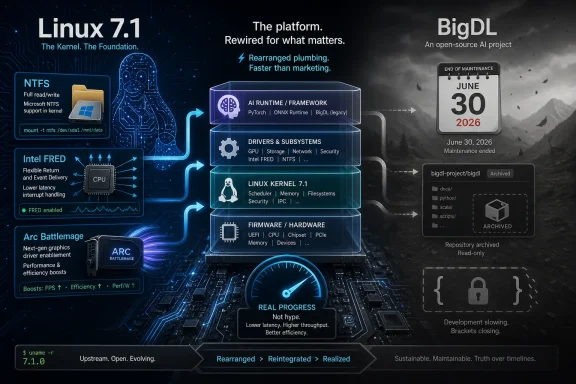
Linux 7.1 became stable on June 14, 2026, bringing a new NTFS driver, Intel FRED support for Panther Lake-era processors, faster Intel Arc Battlemage graphics, and other hardware-facing improvements, while Intel separately moved to end development of its open-source BigDL AI framework by June 30. The timing is awkward in the most revealing way. One side of the Intel-and-Linux story is still about patient enablement in the kernel; the other is about Intel pruning open-source AI projects that no longer fit its corporate priorities. For WindowsForum readers, the lesson is not that Linux is “winning” or Intel is “retreating,” but that the plumbing underneath modern PCs is being rearranged faster than the marketing language can keep up.
The Linux kernel release cycle has become one of the more reliable clocks in computing. Every few months, a new stable kernel lands, and beneath the familiar rhythm is a quiet contest over which hardware will feel polished first, which devices will age gracefully, and which vendors are doing the upstream work before customers notice the gaps.
Linux 7.1 is a classic example. Its headline features are not flashy desktop furniture; they are low-level changes that affect storage compatibility, CPU exception handling, graphics performance, and older GPU support. That makes the release easy to underestimate if your idea of an operating system upgrade is a new Start menu or a redesigned settings panel.
The new NTFS driver is the obvious Windows-adjacent change. NTFS remains the filesystem of the Windows world, and Linux support for it has long mattered most to dual-booters, rescue environments, forensic workflows, and admins moving data between platforms under pressure. A better in-kernel NTFS story is not glamorous, but it is exactly the sort of work that decides whether a mixed Windows-Linux environment feels resilient or brittle.
The other big story is Intel FRED support for Panther Lake and future CPUs. FRED, short for Flexible Return and Event Delivery, is one of those architectural features that most users will never name but may eventually benefit from through lower overhead and cleaner handling of transitions between privilege levels. It belongs to the same category as many kernel changes: invisible until it becomes the reason a machine feels faster, safer, or less weird under load.
For Windows users, the practical value is clear. A Linux live USB is still one of the most useful tools when a Windows installation refuses to boot, a profile corrupts, BitLocker policy allows recovery access, or files need to be copied before reinstalling the OS. The quality of NTFS support determines whether that emergency session is routine or nerve-racking.
For Linux users, this is also a maturity marker. Filesystem interoperability is not a philosophical concession to Windows; it is an admission that real-world computing is messy. People carry drives between operating systems, vendors ship devices into heterogeneous environments, and data outlives platform preferences.
The interesting part is that Linux’s relationship with Windows filesystems has matured from “can I mount this?” to “can I trust this at scale?” That is the same transition Linux itself has made on the desktop, in gaming, and in workstation use. The question is no longer whether Linux can coexist with Windows, but how quietly and safely it can do so.
That distinction matters for Intel. The company is fighting on too many fronts at once: CPUs, GPUs, AI accelerators, process technology, foundry ambitions, and platform credibility. In that environment, Linux support is not charity. It is infrastructure for developers, cloud operators, workstation buyers, hardware reviewers, and OEMs who expect modern silicon to work outside the Windows stack.
Arc Battlemage graphics improvements are particularly important because Intel’s GPU business has been in a credibility-building phase since the first Arc products arrived. Performance is only one part of the story. Driver maturity, kernel integration, Vulkan and Mesa behavior, power management, media acceleration, and bug cadence all shape whether users believe Intel is a serious third GPU vendor rather than a temporary disruptor.
For Windows users, Linux graphics work can still matter indirectly. Shared firmware, compiler work, hardware scheduling assumptions, and developer attention do not stay perfectly fenced by operating system. When Intel improves its graphics stack in the open, it often exposes the state of the hardware more clearly than a polished Windows driver release note ever could.
According to Phoronix’s reporting, the project was marked for archival, with the notice updated to indicate a June 30, 2026, end date rather than an immediate shutdown. BigDL had accumulated work around TensorFlow, Keras, PyTorch, Spark, Flink, Intel SGX, Intel TDX, CPU acceleration, GPU acceleration, and low-latency LLM workflows. In other words, it was not obviously irrelevant.
The shutdown is therefore not just housekeeping. It suggests Intel is becoming more selective about which open-source efforts it continues to staff, maintain, and present as strategic. That may be rational business discipline, especially after a period of restructuring and cost cutting, but rationality does not erase the signal developers receive when a vendor-backed framework goes read-only.
The AI software stack is already fragmented. Developers must choose among CUDA, ROCm, oneAPI components, OpenVINO, PyTorch paths, vendor extensions, inference runtimes, quantization tools, and model-serving frameworks. When a project like BigDL is sunset, the immediate loss may be manageable; the longer-term effect is another reminder that vendor-backed AI tooling can have a shorter shelf life than the workloads it was meant to support.
That difference matters to enterprises. A sysadmin or developer can tolerate rough edges in a community tool if there is a clear maintenance path. They can tolerate vendor lock-in if there is a strong commercial support model. What is harder to tolerate is the in-between state: vendor-originated software that looks strategic during adoption and then becomes archival when budgets change.
Intel is hardly alone here. The industry has spent the AI boom launching projects faster than anyone could evaluate their durability. Some were experiments, some were recruiting tools, some were ecosystem plays, and some were genuine attempts to solve painful technical problems. The cleanup phase was inevitable.
Still, Intel’s position is more delicate because it is asking developers to believe in its AI hardware story at the same time. If the message is “use Intel silicon for AI,” then the surrounding software needs to feel boringly dependable. Ending BigDL does not invalidate Intel’s broader AI stack, but it does make developers more cautious about investing in Intel-specific paths unless the migration story is unusually clear.
That is not necessarily contradictory. Kernel enablement is foundational. If Panther Lake support, interrupt handling, graphics acceleration, and platform basics are weak, everything above them suffers. AI frameworks, by contrast, are closer to product strategy, ecosystem bets, and developer fashion — all of which can shift quickly.
But users do not experience the stack as neat corporate layers. A developer with a Core Ultra laptop, an Arc GPU, and a local LLM workflow wants the hardware, drivers, runtime, libraries, and documentation to form a coherent path. If one layer gets stronger while another disappears, the burden shifts to the user to understand which Intel story is current and which one has quietly expired.
That is the real risk for Intel. Not that every discontinued project will be missed forever, but that developers begin to discount Intel’s software promises in advance. Once that happens, even good projects have to work harder to be trusted.
Linux 7.1’s NTFS work speaks directly to cross-platform reality. Even if you never install Linux as a daily driver, you may rely on Linux-based tools to recover Windows data, clone disks, inspect partitions, or run diagnostics. Better NTFS support reduces the friction at exactly the moment users can least afford ambiguity.
Intel FRED and Panther Lake support matter because the next generation of Windows laptops and desktops will share silicon with Linux machines, cloud developer boxes, and lab systems. When Linux gains early support for new CPU features, it gives developers and reviewers another window into how the platform behaves. It also pressures vendors to keep their hardware documentation and enablement pipelines honest.
The Arc graphics improvements matter for a similar reason. Intel’s GPU credibility is not decided only inside Windows Device Manager. It is decided across driver branches, game compatibility databases, compute stacks, media pipelines, Linux distributions, and the patience of users comparing Intel against NVIDIA and AMD.
BigDL’s retirement, meanwhile, is a warning for anyone building AI workflows on client hardware. Windows users experimenting with local LLMs, developer tools, retrieval systems, or accelerated inference should track not only benchmark claims but maintenance signals. In 2026, a good AI setup is as much about software survival as raw TOPS.
That unsettled state is why BigDL’s end feels bigger than one repository. If a vendor-backed AI project can be actively developed and still headed for archival, then customers must assume that today’s recommended path may not be tomorrow’s supported path. That does not mean avoiding vendor tools; it means treating them as dependencies with life-cycle risk.
For enterprise IT, the procurement question changes. It is not enough to ask whether a laptop has an NPU, whether a GPU supports a given data type, or whether a benchmark looks strong. The better question is which runtimes are likely to be maintained for the machine’s full service life, and whether workloads can move when a vendor changes direction.
For enthusiasts, the calculus is similar but more personal. Local AI is fun until the installation guide breaks, the quantization tool is abandoned, or the driver path only works with a specific version of a framework. Hardware acceleration is valuable, but it becomes truly useful only when the software stack is boring enough to survive a reinstall six months later.
AI frameworks live in a different tempo. They are pulled by model releases, hardware roadmaps, developer fashion, cloud economics, and venture-backed urgency. That speed creates useful breakthroughs, but it also produces churn. Projects can go from strategic to legacy before admins have finished writing internal documentation.
This is why the kernel release matters more than its bullet points suggest. A new NTFS driver, FRED support, and Arc performance work are not just “features.” They are durable changes in a shared foundation. They will be packaged, tested, patched, backported in some cases, and argued over by people whose job is to keep machines booting.
That durability is exactly what the AI stack still lacks. The industry has no shortage of demos. It has fewer boring, stable, well-maintained paths from hardware capability to production deployment. Until it does, every discontinued framework will feel like a tax on trust.
Linux 7.1 has a different calendar. It is stable now, but most users will receive it through distributions on their own schedules. Rolling-release users may see it quickly; enterprise distributions may pick pieces later, backport selectively, or wait for longer validation. Kernel availability and kernel adoption are never the same thing.
That distinction is important for Windows-adjacent users. If you rely on a rescue distribution for NTFS work, you will not benefit from Linux 7.1 until that distribution ships a kernel with the relevant driver changes. If you care about Panther Lake support, the real question is what your preferred distribution, hypervisor, or live environment ships when the hardware arrives.
The same applies to Arc graphics. Kernel improvements are only part of the graphics stack. Mesa, firmware, user-space drivers, compositor behavior, and application-level support all matter. Linux 7.1 may improve the foundation, but the user experience arrives as a bundle.
 Linux 7.1 Turns Hardware Enablement Into the Main Event
The Linux kernel release cycle has become one of the more reliable clocks in computing. Every few months, a new stable kernel lands, and beneath the familiar rhythm is a quiet contest over which hardware will feel polished first, which devices will age gracefully, and which vendors are doing the upstream work before customers notice the gaps.Linux 7.1 is a classic example. Its headline features are not flashy desktop furniture; they are low-level changes that affect storage compatibility, CPU exception handling, graphics performance, and older GPU support. That makes the release easy to underestimate if your idea of an operating system upgrade is a new Start menu or a redesigned settings panel.
The new NTFS driver is the obvious Windows-adjacent change. NTFS remains the filesystem of the Windows world, and Linux support for it has long mattered most to dual-booters, rescue environments, forensic workflows, and admins moving data between platforms under pressure. A better in-kernel NTFS story is not glamorous, but it is exactly the sort of work that decides whether a mixed Windows-Linux environment feels resilient or brittle.
The other big story is Intel FRED support for Panther Lake and future CPUs. FRED, short for Flexible Return and Event Delivery, is one of those architectural features that most users will never name but may eventually benefit from through lower overhead and cleaner handling of transitions between privilege levels. It belongs to the same category as many kernel changes: invisible until it becomes the reason a machine feels faster, safer, or less weird under load.
The NTFS Work Is a Reminder That Windows Still Shapes Linux
It is tempting to treat NTFS support in Linux as a legacy concern, a leftover from the old dual-boot era when Windows users kept an Ubuntu partition around for experiments. That is too narrow. NTFS remains deeply embedded in removable drives, enterprise imaging, backup workflows, repair toolkits, and the habits of people who need one disk to be understood by many machines.For Windows users, the practical value is clear. A Linux live USB is still one of the most useful tools when a Windows installation refuses to boot, a profile corrupts, BitLocker policy allows recovery access, or files need to be copied before reinstalling the OS. The quality of NTFS support determines whether that emergency session is routine or nerve-racking.
For Linux users, this is also a maturity marker. Filesystem interoperability is not a philosophical concession to Windows; it is an admission that real-world computing is messy. People carry drives between operating systems, vendors ship devices into heterogeneous environments, and data outlives platform preferences.
The interesting part is that Linux’s relationship with Windows filesystems has matured from “can I mount this?” to “can I trust this at scale?” That is the same transition Linux itself has made on the desktop, in gaming, and in workstation use. The question is no longer whether Linux can coexist with Windows, but how quietly and safely it can do so.
Intel’s Kernel Work Still Looks Like a Long Game
Intel’s presence in Linux 7.1 is not limited to a press-release checkbox. FRED support for Panther Lake and the Arc Battlemage graphics improvements point to a company that still understands the importance of upstream enablement. If hardware arrives before the kernel is ready, early adopters become beta testers. If the kernel is ready before hardware broadly ships, reviewers and developers see a platform rather than a science project.That distinction matters for Intel. The company is fighting on too many fronts at once: CPUs, GPUs, AI accelerators, process technology, foundry ambitions, and platform credibility. In that environment, Linux support is not charity. It is infrastructure for developers, cloud operators, workstation buyers, hardware reviewers, and OEMs who expect modern silicon to work outside the Windows stack.
Arc Battlemage graphics improvements are particularly important because Intel’s GPU business has been in a credibility-building phase since the first Arc products arrived. Performance is only one part of the story. Driver maturity, kernel integration, Vulkan and Mesa behavior, power management, media acceleration, and bug cadence all shape whether users believe Intel is a serious third GPU vendor rather than a temporary disruptor.
For Windows users, Linux graphics work can still matter indirectly. Shared firmware, compiler work, hardware scheduling assumptions, and developer attention do not stay perfectly fenced by operating system. When Intel improves its graphics stack in the open, it often exposes the state of the hardware more clearly than a polished Windows driver release note ever could.
BigDL’s Shutdown Cuts Against the AI Narrative
That is what makes the BigDL news so striking. Intel is not merely ending a quiet utility project that nobody touched. BigDL was an open-source AI and large language model effort aimed at scaling workloads across Intel hardware, from Core Ultra laptops to discrete GPUs and data center systems. It sat directly in the zone where every silicon vendor claims to be investing aggressively.According to Phoronix’s reporting, the project was marked for archival, with the notice updated to indicate a June 30, 2026, end date rather than an immediate shutdown. BigDL had accumulated work around TensorFlow, Keras, PyTorch, Spark, Flink, Intel SGX, Intel TDX, CPU acceleration, GPU acceleration, and low-latency LLM workflows. In other words, it was not obviously irrelevant.
The shutdown is therefore not just housekeeping. It suggests Intel is becoming more selective about which open-source efforts it continues to staff, maintain, and present as strategic. That may be rational business discipline, especially after a period of restructuring and cost cutting, but rationality does not erase the signal developers receive when a vendor-backed framework goes read-only.
The AI software stack is already fragmented. Developers must choose among CUDA, ROCm, oneAPI components, OpenVINO, PyTorch paths, vendor extensions, inference runtimes, quantization tools, and model-serving frameworks. When a project like BigDL is sunset, the immediate loss may be manageable; the longer-term effect is another reminder that vendor-backed AI tooling can have a shorter shelf life than the workloads it was meant to support.
Open Source Is Not a Warranty
The BigDL decision also punctures a comforting myth about open source. Source availability is not the same thing as institutional continuity. A repository can remain visible, forkable, and legally usable while the people who know why things work — and why they break — are reassigned or gone.That difference matters to enterprises. A sysadmin or developer can tolerate rough edges in a community tool if there is a clear maintenance path. They can tolerate vendor lock-in if there is a strong commercial support model. What is harder to tolerate is the in-between state: vendor-originated software that looks strategic during adoption and then becomes archival when budgets change.
Intel is hardly alone here. The industry has spent the AI boom launching projects faster than anyone could evaluate their durability. Some were experiments, some were recruiting tools, some were ecosystem plays, and some were genuine attempts to solve painful technical problems. The cleanup phase was inevitable.
Still, Intel’s position is more delicate because it is asking developers to believe in its AI hardware story at the same time. If the message is “use Intel silicon for AI,” then the surrounding software needs to feel boringly dependable. Ending BigDL does not invalidate Intel’s broader AI stack, but it does make developers more cautious about investing in Intel-specific paths unless the migration story is unusually clear.
The Same Company Is Accelerating in One Layer and Retrenching in Another
Taken together, Linux 7.1 and BigDL tell a more nuanced story than either item does alone. Intel continues to contribute to the kernel in ways that prepare future client hardware and improve graphics performance. At the same time, it is narrowing the set of open-source projects it maintains in the AI layer.That is not necessarily contradictory. Kernel enablement is foundational. If Panther Lake support, interrupt handling, graphics acceleration, and platform basics are weak, everything above them suffers. AI frameworks, by contrast, are closer to product strategy, ecosystem bets, and developer fashion — all of which can shift quickly.
But users do not experience the stack as neat corporate layers. A developer with a Core Ultra laptop, an Arc GPU, and a local LLM workflow wants the hardware, drivers, runtime, libraries, and documentation to form a coherent path. If one layer gets stronger while another disappears, the burden shifts to the user to understand which Intel story is current and which one has quietly expired.
That is the real risk for Intel. Not that every discontinued project will be missed forever, but that developers begin to discount Intel’s software promises in advance. Once that happens, even good projects have to work harder to be trusted.
Windows Users Should Read This as a Platform Story, Not a Linux Sidebar
WindowsForum readers may reasonably ask why a Linux kernel release and an Intel open-source AI framework belong in the same conversation. The answer is that modern Windows PCs are no longer Windows-only objects. They are firmware platforms, GPU platforms, AI development targets, recovery environments, virtualization hosts, and sometimes dual-boot machines.Linux 7.1’s NTFS work speaks directly to cross-platform reality. Even if you never install Linux as a daily driver, you may rely on Linux-based tools to recover Windows data, clone disks, inspect partitions, or run diagnostics. Better NTFS support reduces the friction at exactly the moment users can least afford ambiguity.
Intel FRED and Panther Lake support matter because the next generation of Windows laptops and desktops will share silicon with Linux machines, cloud developer boxes, and lab systems. When Linux gains early support for new CPU features, it gives developers and reviewers another window into how the platform behaves. It also pressures vendors to keep their hardware documentation and enablement pipelines honest.
The Arc graphics improvements matter for a similar reason. Intel’s GPU credibility is not decided only inside Windows Device Manager. It is decided across driver branches, game compatibility databases, compute stacks, media pipelines, Linux distributions, and the patience of users comparing Intel against NVIDIA and AMD.
BigDL’s retirement, meanwhile, is a warning for anyone building AI workflows on client hardware. Windows users experimenting with local LLMs, developer tools, retrieval systems, or accelerated inference should track not only benchmark claims but maintenance signals. In 2026, a good AI setup is as much about software survival as raw TOPS.
The AI PC Needs Less Branding and More Durable Plumbing
The PC industry has spent the last several years teaching buyers to say “AI PC” before proving that the phrase means something stable. NPUs are arriving, GPU drivers are maturing, local inference is becoming practical, and Windows itself is increasingly shaped around on-device intelligence. But the software layer remains unsettled.That unsettled state is why BigDL’s end feels bigger than one repository. If a vendor-backed AI project can be actively developed and still headed for archival, then customers must assume that today’s recommended path may not be tomorrow’s supported path. That does not mean avoiding vendor tools; it means treating them as dependencies with life-cycle risk.
For enterprise IT, the procurement question changes. It is not enough to ask whether a laptop has an NPU, whether a GPU supports a given data type, or whether a benchmark looks strong. The better question is which runtimes are likely to be maintained for the machine’s full service life, and whether workloads can move when a vendor changes direction.
For enthusiasts, the calculus is similar but more personal. Local AI is fun until the installation guide breaks, the quantization tool is abandoned, or the driver path only works with a specific version of a framework. Hardware acceleration is valuable, but it becomes truly useful only when the software stack is boring enough to survive a reinstall six months later.
Linux 7.1 Shows the Boring Work Still Wins
The contrast between Linux 7.1 and BigDL is also a contrast between two kinds of open-source value. The kernel is slow, procedural, argumentative, and sometimes maddening. But it has a maintenance culture built around continuity. Features land, regressions are chased, hardware support ages into stability, and distributions eventually absorb the work.AI frameworks live in a different tempo. They are pulled by model releases, hardware roadmaps, developer fashion, cloud economics, and venture-backed urgency. That speed creates useful breakthroughs, but it also produces churn. Projects can go from strategic to legacy before admins have finished writing internal documentation.
This is why the kernel release matters more than its bullet points suggest. A new NTFS driver, FRED support, and Arc performance work are not just “features.” They are durable changes in a shared foundation. They will be packaged, tested, patched, backported in some cases, and argued over by people whose job is to keep machines booting.
That durability is exactly what the AI stack still lacks. The industry has no shortage of demos. It has fewer boring, stable, well-maintained paths from hardware capability to production deployment. Until it does, every discontinued framework will feel like a tax on trust.
The Calendar Now Matters More Than the Announcement
There is a practical date buried in the BigDL news: June 30, 2026. That gives users and maintainers a narrow window to audit dependencies, mirror what they need, read migration notes if available, and decide whether any internal tooling depends on BigDL components. For casual users, that may be irrelevant. For labs and enterprise teams, it is the kind of date that should appear in a risk register.Linux 7.1 has a different calendar. It is stable now, but most users will receive it through distributions on their own schedules. Rolling-release users may see it quickly; enterprise distributions may pick pieces later, backport selectively, or wait for longer validation. Kernel availability and kernel adoption are never the same thing.
That distinction is important for Windows-adjacent users. If you rely on a rescue distribution for NTFS work, you will not benefit from Linux 7.1 until that distribution ships a kernel with the relevant driver changes. If you care about Panther Lake support, the real question is what your preferred distribution, hypervisor, or live environment ships when the hardware arrives.
The same applies to Arc graphics. Kernel improvements are only part of the graphics stack. Mesa, firmware, user-space drivers, compositor behavior, and application-level support all matter. Linux 7.1 may improve the foundation, but the user experience arrives as a bundle.
The Signal Hidden Between a Kernel Release and an Archived AI Stack
The concrete lesson from this week’s news is that platform maturity is not evenly distributed. Intel can look strong in upstream kernel enablement and uncertain in open-source AI framework continuity at the same time, and users need to evaluate both realities without collapsing one into the other.- Linux 7.1 is now stable, but most users will experience it only when their distribution or recovery environment adopts it.
- The new NTFS work matters most for dual-boot systems, rescue media, data recovery, removable drives, and mixed Windows-Linux workflows.
- Intel FRED support for Panther Lake is a forward-looking platform investment rather than a feature most users will consciously notice.
- Intel Arc Battlemage improvements reinforce the importance of open driver maturity in Intel’s long campaign to be taken seriously in graphics.
- BigDL’s planned end of maintenance on June 30, 2026, is a reminder that open-source AI projects still carry vendor life-cycle risk.
- Anyone building local AI workflows on Intel hardware should verify the maintained path today rather than assuming last year’s framework remains strategic.
References
- Primary source: Phoronix
Published: Sun, 14 Jun 2026 15:09:00 GMT

Linux 7.1 Released: New NTFS Driver, Intel FRED For Panther Lake, Faster Arc Graphics - Phoronix
Linus Torvalds just released the stable Linux 7.1 kernel and it's coming a half-day early thanks to his travel planswww.phoronix.com
