

Apple introduced Siri AI at WWDC 2026 in Cupertino on June 8, pitching it as a rebuilt, Apple Intelligence-powered assistant for iOS 27, iPadOS 27, macOS 27, watchOS 27, and visionOS 27, with developer testing now and a public beta due later this year. The announcement is less a victory lap than an admission that the old Siri era is over. Apple is not merely adding features to a voice assistant; it is trying to turn Siri into the interface layer that should have existed before ChatGPT made everyone notice the gap. The question now is whether Apple’s privacy-first, ecosystem-heavy approach can make AI useful enough to matter before users conclude they have already moved on.
For nearly 15 years, Siri has occupied a strange place in Apple’s product story. It was early, famous, and everywhere, yet rarely central to how people actually used their devices. Most iPhone owners learned the same narrow muscle memory: set a timer, dictate a message, start a call, maybe ask for the weather if nobody was listening.
That was enough when voice assistants were judged by novelty. It is not enough in 2026, when users have seen large language models summarize documents, write code, interpret images, reason through messy questions, and sustain multi-turn conversations. In that context, the argument that “nobody needs Siri anymore” lands because the old Siri became a shortcut system in a world that now expects assistants to understand intent.
Apple’s answer is to preserve the name while changing the premise. Siri AI is being presented as conversational, context-aware, visually aware, and deeply integrated into the operating system. In plain terms, Apple wants Siri to stop being a command parser and start being a personal computing agent.
That is the right target. It is also the hardest version of the problem.
That matters because Apple is not trying to beat ChatGPT at being a blank text box. Apple’s best chance is to make AI feel like part of the device. If Siri can pull a hotel confirmation from Mail, understand a text thread, identify what is visible on screen, draft a reply in the user’s usual tone, and then act through apps without forcing the user to copy and paste between services, it becomes something different from a chatbot.
This is why the Mac and iPad integrations deserve attention from WindowsForum readers even if they live mostly outside Apple’s garden. Apple is pushing toward an AI-mediated desktop where search, file context, app actions, writing tools, visual understanding, and cloud-assisted reasoning blur together. Microsoft is attempting a similar move with Copilot across Windows, Microsoft 365, Edge, and Azure-backed services. Google is doing it through Gemini across Android, Workspace, Chrome, and search.
The next platform war is not only about which model answers best. It is about which company can sit closest to the user’s work, files, messages, calendar, photos, and screen without triggering a privacy revolt.
That architecture is Apple’s clearest differentiator. It is also a practical limitation. The more useful an assistant becomes, the more it needs context; the more context it touches, the more users and regulators will ask where that context goes. Apple is trying to answer that before the scandal happens.
For IT pros, the privacy story should be treated as a deployment question rather than a slogan. A personal assistant that can read email, summarize messages, inspect screens, draft text, and act across apps is powerful precisely because it sits near sensitive data. In a managed environment, that raises questions about logging, policy controls, data boundaries, app permissions, regional availability, and whether administrators can disable or scope specific capabilities.
Apple has been careful to frame Siri AI as privacy-preserving by design. But enterprise trust is earned in documentation, controls, and incident history, not keynote language. The most important Siri AI details may arrive not in glossy demos, but in MDM payloads, developer APIs, security white papers, and the behavior of the beta when real users start feeding it messy work data.
If true in a meaningful way, that is both sensible and awkward. Sensible because modern AI is brutally expensive, and even Apple does not get extra points for reinventing every layer slowly. Awkward because Apple’s brand is built on owning the stack, especially when it claims superior integration, privacy, and product taste.
There is precedent for pragmatic dependence. Apple has long used Google as the default search provider in Safari, even while competing with Google in mobile operating systems, services, privacy messaging, and app ecosystems. The difference is that AI assistants are not just search boxes. They are positioned as the next layer of user interaction.
If Apple’s assistant depends heavily on a rival’s model, the long-term question becomes strategic. Does Apple control enough of the experience, privacy boundary, orchestration, and developer surface to preserve differentiation? Or does Siri AI become a polished Apple shell around capabilities whose center of gravity sits elsewhere?
That uncertainty is one reason Wall Street’s reaction was muted. Investors do not merely want a better demo. They want evidence that Apple can turn AI into device upgrades, services revenue, ecosystem lock-in, or all three.
The company is asking for patience. Siri AI is available for developer testing now, but ordinary users get a beta later this year, initially in English on supported devices. Some capabilities are limited by hardware. Some regions, including China and initially parts of the EU on mobile platforms, face availability constraints. That is not a finished mass-market revolution; it is a staged rollout.
Analysts are right to ask where monetization comes from. Apple could sell more high-end iPhones if the best on-device models require newer silicon and more memory. It could make iCloud+ more attractive if AI features become tied to storage, home camera analysis, or higher usage limits. It could reduce churn by making personal context so useful that switching platforms feels more costly.
But there is a danger in confusing retention with excitement. A smarter Siri may make iPhone users less likely to leave. That does not automatically make them rush to replace a perfectly good phone.
This is predictable. Running capable AI locally requires compute, memory bandwidth, neural acceleration, and thermal headroom. The user-facing consequence is that “Siri AI” will not mean the same thing on every Apple device.
That is where the story becomes familiar to Windows users. Microsoft’s Copilot+ PC push has similarly turned AI into a hardware dividing line, with neural processing units and minimum performance requirements deciding which machines get which experiences. The PC industry is now using AI not only as software differentiation, but as a reason to define a new upgrade class.
Apple’s version may be smoother because it controls the hardware stack. It can tune models for specific chips, coordinate OS features across devices, and nudge users toward premium iPhones without exposing the messy compatibility matrix that Windows OEMs often face. But the basic economics are the same: AI gives platform owners a new way to make old hardware feel old.
For consumers, that can feel like progress or pressure depending on where they stand. For administrators, it means fleet planning now has another variable. Buying devices that technically support the next OS may not be enough if the flagship AI workflows require the next tier of hardware.
If Siri can only act reliably inside Apple’s own apps, it will be useful but bounded. If developers expose meaningful actions, metadata, and content hooks, Siri becomes a broker across the user’s actual workflow. The difference is enormous.
Apple has an advantage here because its developer ecosystem is accustomed to adopting platform conventions when adoption helps visibility or user experience. But developers will also be cautious. Letting an assistant interpret app content and initiate actions requires trust in permissions, predictable behavior, and user consent. Nobody wants their app blamed because an AI agent misunderstood a command and did something irreversible.
This is one place where Apple’s slower approach may help. The company’s culture favors constrained, reviewed, user-mediated actions over freewheeling automation. That can frustrate power users, but it may also prevent the assistant from becoming a liability before it becomes a habit.
Modern AI assistants are persistent. Their usefulness often comes from continuity: a thread of planning, research, drafting, revision, and follow-up. By giving Siri a dedicated app and conversation history, Apple is acknowledging that voice alone is no longer the right container for an assistant.
This also changes user expectations. Once Siri has history, users will expect recall. Once it syncs across devices, users will expect continuity. Once it can draft and revise, users will expect it to preserve context across tasks. The assistant becomes less like a talking feature and more like a workspace.
That may be uncomfortable for Apple. The company has traditionally excelled at making technology disappear into polished interactions. A persistent AI app is more visible, more stateful, and more likely to expose model mistakes. But it is also necessary. The assistant that forgets everything after each exchange now feels broken by design.
This is where Apple’s hardware footprint matters. The company has cameras, screens, sensors, watches, earbuds, Macs, tablets, and a mixed-reality headset. If Siri AI can move across those surfaces, Apple can make AI feel ambient rather than app-bound.
The risk is that visual AI demos often look more impressive than daily use turns out to be. Identifying an object or summarizing a screen is useful. Doing it accurately, quickly, privately, and with the right action available at the right time is harder. Users abandon assistant features when the failure rate crosses a surprisingly low threshold.
Still, visual context is a necessary frontier. A personal computer assistant that cannot see the screen is like a human helper forced to answer with their eyes closed. Apple knows this, Microsoft knows this, and Google knows this. The difference will be how much control each platform gives users over what the assistant can inspect and remember.
That fragmentation undercuts the clean keynote narrative. Apple sells global platforms, but AI is increasingly regional infrastructure shaped by privacy law, competition rules, content regulation, cloud architecture, and political pressure. The assistant may look universal in marketing and become jurisdiction-specific in deployment.
For multinational organizations, that matters. A company standardizing on Apple devices may find that the same OS version exposes different AI capabilities depending on region, language, device class, and managed settings. Support desks will need to know not only what Siri AI can do, but where it is allowed to do it.
This is not unique to Apple. Every major AI platform faces regulatory friction. But Apple’s brand promise is consistency, and AI is a consistency-breaking technology. The model, the data boundary, the region, the device, and the account type all matter.
But the conclusion does not follow that Apple has no role left. The future assistant that matters most may not be the smartest standalone chatbot. It may be the one that has permission to act where the user already lives.
That is Apple’s opening. Siri does not need to win every benchmark if it can find the message, understand the screen, edit the photo, draft the email, pull the calendar context, and hand off between iPhone, Mac, Watch, and CarPlay more gracefully than a third-party service can. Apple is betting that proximity beats raw model spectacle.
The bet is plausible. It is not proven. And after years of Siri stagnation, Apple has little goodwill left in this category.
Microsoft has moved aggressively, sometimes messily. Copilot has appeared in Windows, Edge, Microsoft 365, Teams, and enterprise tooling, with capabilities that vary by license, region, hardware, tenant settings, and product channel. The upside is reach. The downside is confusion.
Apple is moving later and presenting the experience as more unified. The upside is clarity. The downside is delay and limited proof. Both companies are converging on the same destination: AI as a layer across files, apps, communication, search, and system actions.
The Windows world should pay attention to Apple’s privacy framing, hardware segmentation, and developer integration because those are not Apple-only problems. They are the operating system problems of the next decade.
Can it distinguish between two similar contacts? Can it find the right attachment from a months-old email thread? Can it draft in a user’s tone without sounding uncanny? Can it summarize a screen without leaking confidential information into the wrong workflow? Can it act across apps without becoming a confirmation-dialog machine?
Apple’s reputation gives it a chance to set a higher trust baseline than some competitors. Its history with Siri gives users a reason to be skeptical. Both are true, and that tension defines this launch.
The beta label is doing real work here. Apple is buying time, managing expectations, and letting developers adapt. But a beta also means users will encounter unfinished behavior, and in AI, first impressions are sticky. If Siri AI feels unreliable in its first broad exposure, Apple may not get many chances to persuade users to try again.
The iPhone remains a powerful business without a killer AI feature. People buy iPhones for cameras, battery life, performance, longevity, resale value, iMessage, FaceTime, ecosystem familiarity, and retail support. AI can add to that bundle, but it has not yet replaced those motivations.
This may actually help Apple. The company does not need Siri AI to carry the iPhone business immediately. It needs Siri AI to become one more layer of lock-in and usefulness over time. That is how Apple usually wins: not by making every feature indispensable on day one, but by making the ecosystem harder to leave each year.
Still, investors are right to ask for evidence. If Siri AI becomes a feature users try once and forget, it will not justify the strategic drama. If it becomes the default way users navigate information on their devices, it could be one of Apple’s most important platform shifts since the App Store.
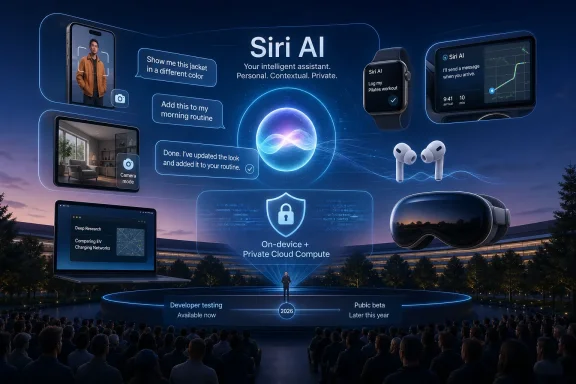 Apple Finally Buries the Old Siri Without Saying So
For nearly 15 years, Siri has occupied a strange place in Apple’s product story. It was early, famous, and everywhere, yet rarely central to how people actually used their devices. Most iPhone owners learned the same narrow muscle memory: set a timer, dictate a message, start a call, maybe ask for the weather if nobody was listening.That was enough when voice assistants were judged by novelty. It is not enough in 2026, when users have seen large language models summarize documents, write code, interpret images, reason through messy questions, and sustain multi-turn conversations. In that context, the argument that “nobody needs Siri anymore” lands because the old Siri became a shortcut system in a world that now expects assistants to understand intent.
Apple’s answer is to preserve the name while changing the premise. Siri AI is being presented as conversational, context-aware, visually aware, and deeply integrated into the operating system. In plain terms, Apple wants Siri to stop being a command parser and start being a personal computing agent.
That is the right target. It is also the hardest version of the problem.
The New Siri Is Really an Operating System Strategy
The most important part of Apple’s announcement is not that Siri can talk more naturally. Natural conversation is now table stakes. The more consequential claim is that Siri AI can understand what is on screen, search through a user’s personal context, act across apps, and live inside Spotlight, context menus, the Camera app, Apple Watch, CarPlay, AirPods, and Vision Pro.That matters because Apple is not trying to beat ChatGPT at being a blank text box. Apple’s best chance is to make AI feel like part of the device. If Siri can pull a hotel confirmation from Mail, understand a text thread, identify what is visible on screen, draft a reply in the user’s usual tone, and then act through apps without forcing the user to copy and paste between services, it becomes something different from a chatbot.
This is why the Mac and iPad integrations deserve attention from WindowsForum readers even if they live mostly outside Apple’s garden. Apple is pushing toward an AI-mediated desktop where search, file context, app actions, writing tools, visual understanding, and cloud-assisted reasoning blur together. Microsoft is attempting a similar move with Copilot across Windows, Microsoft 365, Edge, and Azure-backed services. Google is doing it through Gemini across Android, Workspace, Chrome, and search.
The next platform war is not only about which model answers best. It is about which company can sit closest to the user’s work, files, messages, calendar, photos, and screen without triggering a privacy revolt.
Apple’s Privacy Bet Is Also a Constraint
Apple’s pitch rests on a familiar bargain: deeper personalization, but with stronger privacy controls than rivals. Siri AI uses Apple Foundation Models on device where possible and Private Cloud Compute when requests need server-side processing. Apple says those server-handled requests do not store personal data or make it available to Apple, and that outside experts can verify the system.That architecture is Apple’s clearest differentiator. It is also a practical limitation. The more useful an assistant becomes, the more it needs context; the more context it touches, the more users and regulators will ask where that context goes. Apple is trying to answer that before the scandal happens.
For IT pros, the privacy story should be treated as a deployment question rather than a slogan. A personal assistant that can read email, summarize messages, inspect screens, draft text, and act across apps is powerful precisely because it sits near sensitive data. In a managed environment, that raises questions about logging, policy controls, data boundaries, app permissions, regional availability, and whether administrators can disable or scope specific capabilities.
Apple has been careful to frame Siri AI as privacy-preserving by design. But enterprise trust is earned in documentation, controls, and incident history, not keynote language. The most important Siri AI details may arrive not in glossy demos, but in MDM payloads, developer APIs, security white papers, and the behavior of the beta when real users start feeding it messy work data.
The Gemini Question Cuts Against the Magic
Several reports around WWDC point to Google Gemini technology playing a role in Apple’s revamped Siri strategy. Apple’s own positioning emphasizes Apple Intelligence, Apple Foundation Models, and Private Cloud Compute, but the broader reporting has focused on whether Apple is relying on Google to close the capability gap faster than it could alone.If true in a meaningful way, that is both sensible and awkward. Sensible because modern AI is brutally expensive, and even Apple does not get extra points for reinventing every layer slowly. Awkward because Apple’s brand is built on owning the stack, especially when it claims superior integration, privacy, and product taste.
There is precedent for pragmatic dependence. Apple has long used Google as the default search provider in Safari, even while competing with Google in mobile operating systems, services, privacy messaging, and app ecosystems. The difference is that AI assistants are not just search boxes. They are positioned as the next layer of user interaction.
If Apple’s assistant depends heavily on a rival’s model, the long-term question becomes strategic. Does Apple control enough of the experience, privacy boundary, orchestration, and developer surface to preserve differentiation? Or does Siri AI become a polished Apple shell around capabilities whose center of gravity sits elsewhere?
That uncertainty is one reason Wall Street’s reaction was muted. Investors do not merely want a better demo. They want evidence that Apple can turn AI into device upgrades, services revenue, ecosystem lock-in, or all three.
Wall Street Heard a Roadmap, Not a Breakthrough
The reported share-price dip after the WWDC presentation should not be overread. Apple stock moves for many reasons, and keynote-day reactions often say more about expectations than product quality. Still, the lukewarm response captures a real tension: Apple needed to show enough to calm fears that it had fallen behind, but not so much that it could actually prove Siri AI will change user behavior.The company is asking for patience. Siri AI is available for developer testing now, but ordinary users get a beta later this year, initially in English on supported devices. Some capabilities are limited by hardware. Some regions, including China and initially parts of the EU on mobile platforms, face availability constraints. That is not a finished mass-market revolution; it is a staged rollout.
Analysts are right to ask where monetization comes from. Apple could sell more high-end iPhones if the best on-device models require newer silicon and more memory. It could make iCloud+ more attractive if AI features become tied to storage, home camera analysis, or higher usage limits. It could reduce churn by making personal context so useful that switching platforms feels more costly.
But there is a danger in confusing retention with excitement. A smarter Siri may make iPhone users less likely to leave. That does not automatically make them rush to replace a perfectly good phone.
Hardware Limits Turn AI Into a Segmentation Machine
Apple says Siri AI and Apple Intelligence will support devices including iPhone 16 models and later, iPhone 15 Pro and Pro Max, M-series iPads and Macs, Apple Vision Pro, newer Apple Watch models when paired appropriately, and other recent hardware. The most advanced on-device model and features such as expressive Siri voices and more advanced dictation are reserved for newer, higher-end devices with sufficient memory.This is predictable. Running capable AI locally requires compute, memory bandwidth, neural acceleration, and thermal headroom. The user-facing consequence is that “Siri AI” will not mean the same thing on every Apple device.
That is where the story becomes familiar to Windows users. Microsoft’s Copilot+ PC push has similarly turned AI into a hardware dividing line, with neural processing units and minimum performance requirements deciding which machines get which experiences. The PC industry is now using AI not only as software differentiation, but as a reason to define a new upgrade class.
Apple’s version may be smoother because it controls the hardware stack. It can tune models for specific chips, coordinate OS features across devices, and nudge users toward premium iPhones without exposing the messy compatibility matrix that Windows OEMs often face. But the basic economics are the same: AI gives platform owners a new way to make old hardware feel old.
For consumers, that can feel like progress or pressure depending on where they stand. For administrators, it means fleet planning now has another variable. Buying devices that technically support the next OS may not be enough if the flagship AI workflows require the next tier of hardware.
Siri’s Comeback Depends on Developers, Not Just Apple
Apple can build the system layer, but Siri AI will only become indispensable if apps participate. Apple says personal context understanding can extend to third-party apps when developers integrate with Spotlight, and systemwide app actions are central to the promise. That is the difference between a demo assistant and a practical one.If Siri can only act reliably inside Apple’s own apps, it will be useful but bounded. If developers expose meaningful actions, metadata, and content hooks, Siri becomes a broker across the user’s actual workflow. The difference is enormous.
Apple has an advantage here because its developer ecosystem is accustomed to adopting platform conventions when adoption helps visibility or user experience. But developers will also be cautious. Letting an assistant interpret app content and initiate actions requires trust in permissions, predictable behavior, and user consent. Nobody wants their app blamed because an AI agent misunderstood a command and did something irreversible.
This is one place where Apple’s slower approach may help. The company’s culture favors constrained, reviewed, user-mediated actions over freewheeling automation. That can frustrate power users, but it may also prevent the assistant from becoming a liability before it becomes a habit.
The Dedicated Siri App Is a Quiet Admission
One of the more interesting changes is the new standalone Siri app, which lets users revisit conversations across Apple devices through iCloud sync. That sounds minor, but it marks a philosophical shift. Old Siri was ephemeral. You asked, it answered, the moment vanished.Modern AI assistants are persistent. Their usefulness often comes from continuity: a thread of planning, research, drafting, revision, and follow-up. By giving Siri a dedicated app and conversation history, Apple is acknowledging that voice alone is no longer the right container for an assistant.
This also changes user expectations. Once Siri has history, users will expect recall. Once it syncs across devices, users will expect continuity. Once it can draft and revise, users will expect it to preserve context across tasks. The assistant becomes less like a talking feature and more like a workspace.
That may be uncomfortable for Apple. The company has traditionally excelled at making technology disappear into polished interactions. A persistent AI app is more visible, more stateful, and more likely to expose model mistakes. But it is also necessary. The assistant that forgets everything after each exchange now feels broken by design.
Visual Intelligence Moves the Camera Into the AI Layer
Apple is also folding Siri into visual understanding. On iPhone, a Siri mode in Camera lets users ask about what they are seeing and take actions such as getting information, interpreting food, or splitting a bill with Apple Cash in the United States. On iPad and Mac, Visual Intelligence appears through screenshots, selections, and keyboard shortcuts. On Vision Pro, it extends into spatial computing.This is where Apple’s hardware footprint matters. The company has cameras, screens, sensors, watches, earbuds, Macs, tablets, and a mixed-reality headset. If Siri AI can move across those surfaces, Apple can make AI feel ambient rather than app-bound.
The risk is that visual AI demos often look more impressive than daily use turns out to be. Identifying an object or summarizing a screen is useful. Doing it accurately, quickly, privately, and with the right action available at the right time is harder. Users abandon assistant features when the failure rate crosses a surprisingly low threshold.
Still, visual context is a necessary frontier. A personal computer assistant that cannot see the screen is like a human helper forced to answer with their eyes closed. Apple knows this, Microsoft knows this, and Google knows this. The difference will be how much control each platform gives users over what the assistant can inspect and remember.
The EU and China Gaps Show the Limits of a Global AI Launch
Apple’s availability notes are not fine print; they are part of the story. Siri AI will not initially be available in the EU on iOS, iPadOS, and watchOS, though Mac and Vision Pro users in the EU will be able to access it when set to a supported language. The features will also not be available in China while Apple works through regulatory requirements.That fragmentation undercuts the clean keynote narrative. Apple sells global platforms, but AI is increasingly regional infrastructure shaped by privacy law, competition rules, content regulation, cloud architecture, and political pressure. The assistant may look universal in marketing and become jurisdiction-specific in deployment.
For multinational organizations, that matters. A company standardizing on Apple devices may find that the same OS version exposes different AI capabilities depending on region, language, device class, and managed settings. Support desks will need to know not only what Siri AI can do, but where it is allowed to do it.
This is not unique to Apple. Every major AI platform faces regulatory friction. But Apple’s brand promise is consistency, and AI is a consistency-breaking technology. The model, the data boundary, the region, the device, and the account type all matter.
The “No Need for Siri” Argument Is Right About the Past and Wrong About the Future
The claim that there is no need for Siri anymore captures a real user sentiment. If Siri means the assistant that misheard requests, returned web snippets, failed at follow-ups, and mostly handled timers, then yes, that Siri has been surpassed. Users can get better general answers from ChatGPT, Gemini, Claude, Perplexity, Copilot, or whatever assistant is already embedded in their browser, phone, or workplace suite.But the conclusion does not follow that Apple has no role left. The future assistant that matters most may not be the smartest standalone chatbot. It may be the one that has permission to act where the user already lives.
That is Apple’s opening. Siri does not need to win every benchmark if it can find the message, understand the screen, edit the photo, draft the email, pull the calendar context, and hand off between iPhone, Mac, Watch, and CarPlay more gracefully than a third-party service can. Apple is betting that proximity beats raw model spectacle.
The bet is plausible. It is not proven. And after years of Siri stagnation, Apple has little goodwill left in this category.
Microsoft Should Be Watching the Integration, Not the Branding
For Windows users, the Apple story is easy to dismiss as ecosystem theater. That would be a mistake. Apple’s Siri AI push highlights the same strategic issue Microsoft faces with Copilot: how to turn AI from a sidebar into a system-level capability without alarming users or annoying them.Microsoft has moved aggressively, sometimes messily. Copilot has appeared in Windows, Edge, Microsoft 365, Teams, and enterprise tooling, with capabilities that vary by license, region, hardware, tenant settings, and product channel. The upside is reach. The downside is confusion.
Apple is moving later and presenting the experience as more unified. The upside is clarity. The downside is delay and limited proof. Both companies are converging on the same destination: AI as a layer across files, apps, communication, search, and system actions.
The Windows world should pay attention to Apple’s privacy framing, hardware segmentation, and developer integration because those are not Apple-only problems. They are the operating system problems of the next decade.
The Real Test Starts After the Beta Lands
Keynotes reward choreography. Assistants live or die in edge cases. Siri AI will be judged not by whether it can answer a polished demo prompt, but by whether it can handle the chaotic, underspecified, interruption-filled way people actually use computers.Can it distinguish between two similar contacts? Can it find the right attachment from a months-old email thread? Can it draft in a user’s tone without sounding uncanny? Can it summarize a screen without leaking confidential information into the wrong workflow? Can it act across apps without becoming a confirmation-dialog machine?
Apple’s reputation gives it a chance to set a higher trust baseline than some competitors. Its history with Siri gives users a reason to be skeptical. Both are true, and that tension defines this launch.
The beta label is doing real work here. Apple is buying time, managing expectations, and letting developers adapt. But a beta also means users will encounter unfinished behavior, and in AI, first impressions are sticky. If Siri AI feels unreliable in its first broad exposure, Apple may not get many chances to persuade users to try again.
The Upgrade Cycle Apple Wants Is Still Hypothetical
The business case for Siri AI depends on behavior change. Apple needs users to see AI not as a parlor trick, but as a reason to buy newer hardware, stay inside Apple services, and trust the ecosystem with more personal context. That is a tall order.The iPhone remains a powerful business without a killer AI feature. People buy iPhones for cameras, battery life, performance, longevity, resale value, iMessage, FaceTime, ecosystem familiarity, and retail support. AI can add to that bundle, but it has not yet replaced those motivations.
This may actually help Apple. The company does not need Siri AI to carry the iPhone business immediately. It needs Siri AI to become one more layer of lock-in and usefulness over time. That is how Apple usually wins: not by making every feature indispensable on day one, but by making the ecosystem harder to leave each year.
Still, investors are right to ask for evidence. If Siri AI becomes a feature users try once and forget, it will not justify the strategic drama. If it becomes the default way users navigate information on their devices, it could be one of Apple’s most important platform shifts since the App Store.
The Old Assistant Dies; the Personal Interface Race Begins
Siri AI leaves us with a sharper map of where consumer computing is going.- Apple is replacing the old command-based Siri with a context-aware assistant that can converse, inspect screens, use personal information, and act across apps.
- The rollout begins with developer testing across Apple’s 2026 operating systems, while ordinary users will see a beta later this year on supported devices and languages.
- Hardware requirements will make Siri AI a segmentation tool, with some of the most advanced on-device features reserved for newer and higher-end Apple devices.
- Apple’s privacy architecture is central to the pitch, but enterprises will need concrete controls, documentation, and regional clarity before treating Siri AI as safe by default.
- Availability limits in the EU and China show that AI assistants are now regulatory products as much as software features.
- The most important competitive question is not whether Siri AI is smarter than every chatbot, but whether Apple can make it more useful because it lives closer to the user’s daily device context.
References
- Primary source: bgr.com
Published: 2026-06-14T23:17:28.924551
Loading…
www.bgr.com - Independent coverage: aol.com
Published: 2026-06-14T20:40:28.927623
Loading…
www.aol.com - Independent coverage: Apple
Published: 2026-06-14T17:40:28.918027
Loading…
www.apple.com - Independent coverage: KSL News
Published: 2026-06-14T15:40:28.914269
Loading…
www.ksl.com - Independent coverage: Crypto Briefing
Published: 2026-06-14T14:40:28.941329
Loading…
cryptobriefing.com - Related coverage: tomshardware.com

Apple demonstrates cross-platform Siri upgrades in macOS 27 Golden Gate at WWDC — update brings Liquid Glass improvements and unifies AI strategy | Tom's Hardware
macOS 27 brings new AI features and, finally, matching corner radii.www.tomshardware.com
- Related coverage: techradar.com
Loading…
www.techradar.com - Related coverage: creativebloq.com

Apple has finally caught up on AI with the new Siri for iPhone, iPad and Mac – but there's one problem | Creative Bloq
Every Apple WWDC 2026 update live as it happened.www.creativebloq.com - Related coverage: androidcentral.com
Loading…
www.androidcentral.com - Related coverage: macrumors.com
Apple Announces 'Siri AI' at WWDC 2026
Apple today announced a significantly revamped Siri at WWDC 2026, rebranding it as "Siri AI" and unveiling out a wave of new capabilities spanning conversational depth, system-wide integration, and a redesigned interface across platforms. Apple framed the update with the acknowledgment that... www.macrumors.com
- Related coverage: techcrunch.com

WWDC 2026: Everything announced on Siri AI, iOS 27, Apple Intelligence, and more | TechCrunch
Apple primarily made the case for an improved experience with its long-standing Siri assistant, which like most other announcements had a hefty helping of AI.techcrunch.com - Related coverage: gadgets360.com
Loading…
www.gadgets360.com - Related coverage: theguardian.com
Loading…
www.theguardian.com - Related coverage: 9to5mac.com
Loading…
9to5mac.com - Related coverage: digitaltrends.com
Loading…
www.digitaltrends.com - Related coverage: nerdleveltech.com
Loading…
nerdleveltech.com - Related coverage: apple.gadgethacks.com
Loading…
apple.gadgethacks.com