

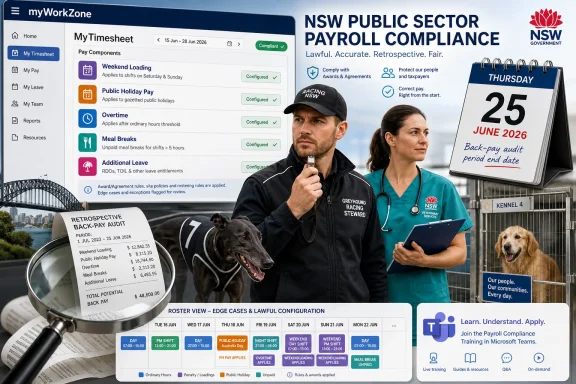
On 15 June 2026, the Public Service Association of NSW said the Greyhound Welfare and Integrity Commission would use its 25 June move to myWorkZone payroll shared services to rectify Crown Employees award compliance problems affecting stewards and veterinarians. The issue is not merely a payroll migration with some awkward training dates attached. It is a reminder that workforce software does not create compliance by itself; it exposes whether the rules underneath have been properly understood, configured, and audited.
For GWIC’s frontline shift workers, the stakes are practical and personal. Rosters, shift loadings, weekend penalties, public holiday payments, meal breaks, overtime, and additional leave are not abstractions in an industrial instrument. They are the difference between a system that recognises the cost of irregular work and one that quietly normalises underpayment through bad configuration, bad assumptions, or both.
GWIC’s transition to myWorkZone is scheduled to go live on 25 June 2026, but the PSA bulletin makes clear that the technology change is now carrying a second burden. It is not just a shared-services implementation. It is also the vehicle through which the agency says it will rectify compliance issues with the Crown Employees award.
That matters because payroll projects often arrive wrapped in the language of efficiency: standardised forms, common workflows, central processing, cleaner reporting. Those benefits are real, but they can obscure the more important question. Does the system reflect the actual legal and industrial obligations attached to the work being performed?
For a conventional office workforce, the answer may be comparatively straightforward. For shift workers such as greyhound racing stewards and veterinarians, it rarely is. Their work can involve evenings, weekends, public holidays, interrupted meal breaks, overtime triggers, and rostering patterns that do not fit neatly into the tidy Monday-to-Friday assumptions embedded in many payroll templates.
The PSA says it was briefed on 15 May 2026 about compliance issues affecting those workers. A review has since examined current rostering practices, shift loadings, weekend and public holiday loadings, meal breaks, overtime entitlements, and additional leave entitlements. That list is telling. It covers the exact areas where payroll systems tend to fail when human rules are translated into digital workflows.
The PSA bulletin says GWIC will begin targeted learning sessions for frontline teams so staff understand updated processes for recording working time and submitting claims through MyTimesheet. That is sensible, but it also underlines a central weakness in many payroll implementations. Compliance depends not only on what payroll calculates, but on what workers are told to enter, what managers approve, and what the system treats as ordinary or exceptional.
If a steward works through a meal break, the payroll system needs more than a timesheet field. It needs a workflow that records the missed break accurately, routes it properly, and applies the correct consequence. If a veterinarian works a public holiday shift that crosses midnight, the system must know how the award treats that shift, not merely which calendar date appears in the roster.
The danger is not that myWorkZone exists. The danger is that agencies sometimes treat software implementation as a substitute for industrial interpretation. A payroll platform can enforce rules, but only after someone has made hard decisions about what those rules require.
That work produces payroll complexity. Weekend and public holiday loadings are not fringe benefits; they are compensation for when the work occurs. Overtime is not a discretionary bonus; it is the mechanism that recognises work beyond ordinary limits. Meal breaks are not merely diary entries; they are fatigue controls as much as industrial entitlements.
Additional leave entitlements also matter because shift work has cumulative effects. Awards often recognise that irregular hours, rotating patterns, and public holiday work impose costs that ordinary annual leave does not fully absorb. If those entitlements have been misapplied, the underpayment risk may not be confined to a handful of missed penalties. It may reach across years of roster history.
That is why GWIC’s promised retrospective review is more significant than the go-live date. Fixing future entries in MyTimesheet is necessary, but it does not answer whether past rosters produced shortfalls. The PSA says GWIC will develop a plan for a comprehensive review of previous payments after implementation, and that the process could take weeks to months because individual work histories must be examined.
A proper back-pay review is painstaking work. It requires rosters, timesheets, approvals, payroll outputs, award rules, employment status, leave records, and exception handling to be reconciled shift by shift. For casual stewards, the problem may differ from full-time staff. For veterinarians, particular work patterns may raise different questions again.
The phrase “several weeks to months” should not surprise anyone who has been close to a payroll remediation exercise. The hard part is rarely discovering that a category of payment was wrong. The hard part is proving who was affected, by how much, across which dates, and under which version of the applicable rules.
That creates a governance challenge for GWIC. Workers will want speed; the agency will need accuracy. The union will want transparency; payroll administrators will need defensible calculations. The worst possible outcome would be a fast but opaque process that leaves members unsure whether the review captured all missed entitlements.
The PSA bulletin identifies sessions for full-time stewards and vets, and separate sessions for casual stewards, beginning Monday 15 June and continuing through the week. A PSA officer is expected to participate in the Monday sessions. That presence matters because workers are more likely to raise practical concerns when the discussion is not only managed by the employer.
The scheduling details also reveal something about the workforce. Separate sessions for casual and full-time staff suggest that employment category affects how the changes will land. Casual workers may face different claim patterns, different assumptions about availability, and different risks of missed penalties. Full-time staff may be more exposed to roster-cycle issues, additional leave questions, and overtime thresholds.
These briefings should not be treated as a one-way demonstration of MyTimesheet. The key questions are likely to come from workers who know how the job actually unfolds. What happens when a shift runs late? How is a missed meal break recorded? Who approves a weekend loading? How are public holidays treated when race-day duties cross ordinary boundaries?
That distinction is important because payroll modernisation can subtly shift responsibility onto employees. Workers are told to enter claims correctly, select the right category, and meet submission deadlines. Those obligations are real, but they do not erase the employer’s responsibility to configure lawful processes and ensure managers approve work consistently.
The PSA’s involvement suggests members were concerned enough for the union to seek clarification and remediation. The bulletin’s language is careful, but it is also pointed. It does not say that myWorkZone merely introduces a nicer way to submit timesheets. It says GWIC has committed to rectifying award compliance matters as part of the implementation.
That creates a testable promise. After 25 June, workers should be able to see whether the updated process actually recognises their shift work. If the new system still requires manual workarounds, informal explanations, or after-the-fact corrections for ordinary roster patterns, then the implementation will not have solved the underlying problem.
Public sector agencies are especially vulnerable to this pattern because they often operate under layered instruments and shared administrative arrangements. A central payroll service may support many agencies, but each workforce can have its own operational reality. Greyhound racing regulation is not a generic desk job, and treating it like one risks translating public service standardisation into payroll error.
There is also a cultural issue. When a payroll system is introduced, attention often focuses on whether employees can log in, submit forms, and meet cutover deadlines. Less attention is paid to whether the system is producing the right result for the most inconvenient edge cases. Yet those edge cases are precisely where shift workers live.
The GWIC case is therefore a useful warning for other agencies implementing shared services. A clean launch is not the same as lawful operation. The real measure is whether the system captures the full cost of the work being done.
This is particularly true for meal breaks and overtime. Rosters may show what was planned, while the actual working day may have unfolded differently. A steward may have been rostered for a break that operationally could not be taken. A veterinarian may have worked beyond the scheduled finish because animal welfare duties could not simply be abandoned at the end of a nominal shift.
Staff should also pay attention to the first pay cycles after go-live. Early payroll periods often reveal configuration problems that did not appear in testing. If a loading is missing or a claim type is unclear, raising it early helps establish whether the issue is individual user error, local management confusion, or a broader system defect.
The PSA has asked members with concerns to provide feedback and quote the relevant case ID. That is not just administrative housekeeping. Centralising concerns allows the union to identify patterns that individual workers may experience only as isolated anomalies.
The retrospective review will be even more consequential. GWIC has not yet completed that work, according to the PSA bulletin. It will develop the plan after implementation, which means workers are being asked to accept a staged approach: fix the future first, then audit the past.
That sequence may be operationally reasonable, but it carries risk. Once a new system goes live, management attention can move quickly to stabilisation and business-as-usual reporting. The back-pay review must not become a secondary project that drifts behind other priorities.
For the PSA, the obvious pressure point will be transparency. Members will want to know the review period, the methodology, the categories of entitlement being checked, how affected workers will be contacted, and whether employees will receive individual explanations of any calculations. Without that, “comprehensive review” remains a phrase rather than a remedy.
The lesson is not that shared payroll services are bad. Standardisation can reduce errors, improve reporting, and make compliance easier to monitor. But standardisation only works when it starts from the real conditions of work, not from an idealised workforce that exists mainly in software design workshops.
In this case, the real conditions include stewards and vets working around an industry that does not confine itself to ordinary office rhythms. Their entitlements are shaped by when and how they work. Any implementation that fails to respect that reality will produce friction, even if the interface is modern and the workflows are neat.
The best outcome for GWIC would be a boring one: the new system goes live, staff understand how to use it, claims are paid correctly, and the retrospective audit identifies and fixes any underpayments. But boring outcomes in payroll are usually the result of serious preparation. They do not happen because a platform has a reassuring name.
For GWIC’s frontline shift workers, the stakes are practical and personal. Rosters, shift loadings, weekend penalties, public holiday payments, meal breaks, overtime, and additional leave are not abstractions in an industrial instrument. They are the difference between a system that recognises the cost of irregular work and one that quietly normalises underpayment through bad configuration, bad assumptions, or both.
 A Payroll Migration Becomes an Industrial Test
GWIC’s transition to myWorkZone is scheduled to go live on 25 June 2026, but the PSA bulletin makes clear that the technology change is now carrying a second burden. It is not just a shared-services implementation. It is also the vehicle through which the agency says it will rectify compliance issues with the Crown Employees award.That matters because payroll projects often arrive wrapped in the language of efficiency: standardised forms, common workflows, central processing, cleaner reporting. Those benefits are real, but they can obscure the more important question. Does the system reflect the actual legal and industrial obligations attached to the work being performed?
For a conventional office workforce, the answer may be comparatively straightforward. For shift workers such as greyhound racing stewards and veterinarians, it rarely is. Their work can involve evenings, weekends, public holidays, interrupted meal breaks, overtime triggers, and rostering patterns that do not fit neatly into the tidy Monday-to-Friday assumptions embedded in many payroll templates.
The PSA says it was briefed on 15 May 2026 about compliance issues affecting those workers. A review has since examined current rostering practices, shift loadings, weekend and public holiday loadings, meal breaks, overtime entitlements, and additional leave entitlements. That list is telling. It covers the exact areas where payroll systems tend to fail when human rules are translated into digital workflows.
The Software Is Only as Lawful as the Rules It Encodes
There is a persistent myth in public administration that moving to a modern payroll platform cleans up compliance problems almost automatically. In reality, a new system can just as easily automate an old mistake at greater scale. If the award logic is wrong, the user interface is not a safeguard; it is a delivery mechanism.The PSA bulletin says GWIC will begin targeted learning sessions for frontline teams so staff understand updated processes for recording working time and submitting claims through MyTimesheet. That is sensible, but it also underlines a central weakness in many payroll implementations. Compliance depends not only on what payroll calculates, but on what workers are told to enter, what managers approve, and what the system treats as ordinary or exceptional.
If a steward works through a meal break, the payroll system needs more than a timesheet field. It needs a workflow that records the missed break accurately, routes it properly, and applies the correct consequence. If a veterinarian works a public holiday shift that crosses midnight, the system must know how the award treats that shift, not merely which calendar date appears in the roster.
The danger is not that myWorkZone exists. The danger is that agencies sometimes treat software implementation as a substitute for industrial interpretation. A payroll platform can enforce rules, but only after someone has made hard decisions about what those rules require.
Shift Workers Live in the Payroll Edge Cases
Stewards and veterinarians occupy a particular place in GWIC’s operations. They are not peripheral administrative staff whose work can always be compressed into predictable office hours. They are tied to the rhythm of racing, animal welfare, race-day integrity, and regulatory oversight.That work produces payroll complexity. Weekend and public holiday loadings are not fringe benefits; they are compensation for when the work occurs. Overtime is not a discretionary bonus; it is the mechanism that recognises work beyond ordinary limits. Meal breaks are not merely diary entries; they are fatigue controls as much as industrial entitlements.
Additional leave entitlements also matter because shift work has cumulative effects. Awards often recognise that irregular hours, rotating patterns, and public holiday work impose costs that ordinary annual leave does not fully absorb. If those entitlements have been misapplied, the underpayment risk may not be confined to a handful of missed penalties. It may reach across years of roster history.
That is why GWIC’s promised retrospective review is more significant than the go-live date. Fixing future entries in MyTimesheet is necessary, but it does not answer whether past rosters produced shortfalls. The PSA says GWIC will develop a plan for a comprehensive review of previous payments after implementation, and that the process could take weeks to months because individual work histories must be examined.
Retrospective Audits Are Where Payroll Promises Meet Evidence
The most important sentence in the PSA bulletin is not the one about the 25 June go-live. It is the commitment to review previous payments to ensure employees have not been underpaid because of past non-compliant practices. That is where the issue moves from system implementation to accountability.A proper back-pay review is painstaking work. It requires rosters, timesheets, approvals, payroll outputs, award rules, employment status, leave records, and exception handling to be reconciled shift by shift. For casual stewards, the problem may differ from full-time staff. For veterinarians, particular work patterns may raise different questions again.
The phrase “several weeks to months” should not surprise anyone who has been close to a payroll remediation exercise. The hard part is rarely discovering that a category of payment was wrong. The hard part is proving who was affected, by how much, across which dates, and under which version of the applicable rules.
That creates a governance challenge for GWIC. Workers will want speed; the agency will need accuracy. The union will want transparency; payroll administrators will need defensible calculations. The worst possible outcome would be a fast but opaque process that leaves members unsure whether the review captured all missed entitlements.
Training Sessions Are a Compliance Control, Not a Courtesy
GWIC’s scheduled Microsoft Teams briefings are framed as learning sessions for frontline teams. That may sound routine, but in this context the sessions are part of the control environment. If staff do not understand how to record their time and claims under the updated process, the new payroll system can still fail in practice.The PSA bulletin identifies sessions for full-time stewards and vets, and separate sessions for casual stewards, beginning Monday 15 June and continuing through the week. A PSA officer is expected to participate in the Monday sessions. That presence matters because workers are more likely to raise practical concerns when the discussion is not only managed by the employer.
The scheduling details also reveal something about the workforce. Separate sessions for casual and full-time staff suggest that employment category affects how the changes will land. Casual workers may face different claim patterns, different assumptions about availability, and different risks of missed penalties. Full-time staff may be more exposed to roster-cycle issues, additional leave questions, and overtime thresholds.
These briefings should not be treated as a one-way demonstration of MyTimesheet. The key questions are likely to come from workers who know how the job actually unfolds. What happens when a shift runs late? How is a missed meal break recorded? Who approves a weekend loading? How are public holidays treated when race-day duties cross ordinary boundaries?
The Award Is the Source of Truth, Not the Payroll Screen
The central industrial principle here is simple. Payroll systems are administrative tools; awards and employment instruments set the entitlement. If the screen does not capture the entitlement, the problem is with the implementation, not with the worker’s expectation of lawful pay.That distinction is important because payroll modernisation can subtly shift responsibility onto employees. Workers are told to enter claims correctly, select the right category, and meet submission deadlines. Those obligations are real, but they do not erase the employer’s responsibility to configure lawful processes and ensure managers approve work consistently.
The PSA’s involvement suggests members were concerned enough for the union to seek clarification and remediation. The bulletin’s language is careful, but it is also pointed. It does not say that myWorkZone merely introduces a nicer way to submit timesheets. It says GWIC has committed to rectifying award compliance matters as part of the implementation.
That creates a testable promise. After 25 June, workers should be able to see whether the updated process actually recognises their shift work. If the new system still requires manual workarounds, informal explanations, or after-the-fact corrections for ordinary roster patterns, then the implementation will not have solved the underlying problem.
The Public Sector’s Payroll Lesson Keeps Repeating
Payroll failures in large organisations rarely begin with malice. More often, they begin with complexity, fragmentation, local custom, and the false comfort of “that’s how we’ve always done it.” Over time, a roster practice becomes normal, a loading is missed, a meal-break assumption is embedded, and the payroll result looks official simply because it came from a system.Public sector agencies are especially vulnerable to this pattern because they often operate under layered instruments and shared administrative arrangements. A central payroll service may support many agencies, but each workforce can have its own operational reality. Greyhound racing regulation is not a generic desk job, and treating it like one risks translating public service standardisation into payroll error.
There is also a cultural issue. When a payroll system is introduced, attention often focuses on whether employees can log in, submit forms, and meet cutover deadlines. Less attention is paid to whether the system is producing the right result for the most inconvenient edge cases. Yet those edge cases are precisely where shift workers live.
The GWIC case is therefore a useful warning for other agencies implementing shared services. A clean launch is not the same as lawful operation. The real measure is whether the system captures the full cost of the work being done.
Workers Need a Paper Trail Before the Audit Begins
For affected staff, the practical advice is not glamorous but it is essential: keep records. A retrospective review will depend on the quality of historical data, but workers should not assume every relevant detail is already captured cleanly in employer systems. Personal notes, rosters, timesheet copies, emails, and records of missed breaks may become important if individual histories are disputed.This is particularly true for meal breaks and overtime. Rosters may show what was planned, while the actual working day may have unfolded differently. A steward may have been rostered for a break that operationally could not be taken. A veterinarian may have worked beyond the scheduled finish because animal welfare duties could not simply be abandoned at the end of a nominal shift.
Staff should also pay attention to the first pay cycles after go-live. Early payroll periods often reveal configuration problems that did not appear in testing. If a loading is missing or a claim type is unclear, raising it early helps establish whether the issue is individual user error, local management confusion, or a broader system defect.
The PSA has asked members with concerns to provide feedback and quote the relevant case ID. That is not just administrative housekeeping. Centralising concerns allows the union to identify patterns that individual workers may experience only as isolated anomalies.
The Implementation Clock Is Now an Accountability Clock
The 25 June go-live date gives GWIC a visible milestone, but it also creates a narrow window for trust. If the briefings are clear, the MyTimesheet process reflects award obligations, and early payroll cycles produce correct payments, the agency can begin rebuilding confidence. If not, the implementation may be remembered less as a modernisation project than as the moment old problems became harder to excuse.The retrospective review will be even more consequential. GWIC has not yet completed that work, according to the PSA bulletin. It will develop the plan after implementation, which means workers are being asked to accept a staged approach: fix the future first, then audit the past.
That sequence may be operationally reasonable, but it carries risk. Once a new system goes live, management attention can move quickly to stabilisation and business-as-usual reporting. The back-pay review must not become a secondary project that drifts behind other priorities.
For the PSA, the obvious pressure point will be transparency. Members will want to know the review period, the methodology, the categories of entitlement being checked, how affected workers will be contacted, and whether employees will receive individual explanations of any calculations. Without that, “comprehensive review” remains a phrase rather than a remedy.
The Small Agency Story With a Larger Payroll Warning
This is not the biggest payroll story in the public sector, and GWIC is not a giant department. But that is exactly why the case is worth watching. If a specialised regulator with a relatively defined group of affected shift workers can encounter this kind of award-compliance problem, larger agencies with more varied workforces face the same risk at greater scale.The lesson is not that shared payroll services are bad. Standardisation can reduce errors, improve reporting, and make compliance easier to monitor. But standardisation only works when it starts from the real conditions of work, not from an idealised workforce that exists mainly in software design workshops.
In this case, the real conditions include stewards and vets working around an industry that does not confine itself to ordinary office rhythms. Their entitlements are shaped by when and how they work. Any implementation that fails to respect that reality will produce friction, even if the interface is modern and the workflows are neat.
The best outcome for GWIC would be a boring one: the new system goes live, staff understand how to use it, claims are paid correctly, and the retrospective audit identifies and fixes any underpayments. But boring outcomes in payroll are usually the result of serious preparation. They do not happen because a platform has a reassuring name.
The Pay System Now Has to Prove It Understands the Track
The immediate facts are concrete, and workers should treat the next few weeks as a verification period rather than a passive rollout.- GWIC’s myWorkZone payroll shared-services transition is scheduled to go live on 25 June 2026.
- The PSA says award compliance issues affect GWIC shift workers, specifically stewards and veterinarians.
- The review has covered rostering practices, shift loadings, weekend and public holiday loadings, meal breaks, overtime, and additional leave.
- GWIC has committed to rectifying the identified matters as part of the myWorkZone implementation.
- A retrospective payment review is expected after implementation and may take weeks to months because individual work histories need to be examined.
- Staff briefings through Microsoft Teams are not just training events; they are an early test of whether workers can identify and record their entitlements properly under the new process.
References
- Primary source: PSA CPSU NSW
Published: 2026-06-15T00:42:07.497680
Loading…
psa.asn.au - Related coverage: service.nsw.gov.au
Loading…
www.service.nsw.gov.au - Related coverage: prod65.schoolinfrastructure.nsw.gov.au
Loading…
prod65.schoolinfrastructure.nsw.gov.au - Related coverage: arp.nsw.gov.au
Loading…
arp.nsw.gov.au - Related coverage: nsw.gov.au
Loading…
www.nsw.gov.au - Related coverage: nswnma.asn.au
Loading…
www.nswnma.asn.au
- Related coverage: yourgov.com.au
Loading…
yourgov.com.au