

Microsoft announced on June 8, 2026, that Windows 11 version 26H1 now has a dedicated Beta channel in the Windows Insider Program for devices built around specific new Arm silicon, including Qualcomm Snapdragon X2 systems and Microsoft’s incoming Nvidia RTX Spark hardware. The move sounds procedural, but it is really a map of Microsoft’s next Windows-on-Arm gamble. For the first time in years, the interesting Windows split is not between Home and Pro, or even consumer and enterprise, but between the processor families underneath the same Windows 11 name.
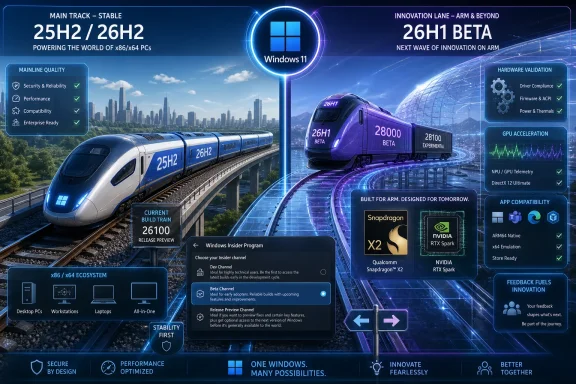
That makes 26H1 more than a point release. It is a staging lane for a Windows platform Microsoft does not yet want to mix with the mainstream 25H2 and 26H2 cadence. The new Beta channel gives Insiders a less volatile path than Experimental, but it also confirms that Microsoft sees next-generation Arm PCs as different enough to deserve their own servicing runway.
Windows 11 26H1 is not the next broad feature update for the PC already sitting on your desk. Microsoft has described it as a targeted Windows release for new device innovations arriving in 2026, with Qualcomm Snapdragon X2 Series devices explicitly named and RTX Spark-class Arm hardware now part of the practical conversation. Existing x86 and x64 PCs are not being invited into this lane.
That distinction matters because the Windows Insider Program has traditionally trained users to think in terms of risk appetite. Canary was rough, Dev was speculative, Beta was safer, and Release Preview was nearly shipping. Microsoft’s 2026 Insider reshuffle simplified some of the naming, but 26H1 complicates the picture in a more important way: the version number now tells you something about the silicon, not just the software.
Until this announcement, 26H1 testers had effectively lived in the noisier branch. They could select the 26H1 path, but the equivalent of a stable-ish Beta branch did not really exist for that release. Microsoft’s June 8 change creates a 28000-series Beta train for 26H1 while pushing Experimental 26H1 onto a newer 28100-series line.
That sounds like build-number trivia until you remember who relies on Insider builds. Developers need to know whether a bug belongs to their code, a driver, Windows, or the hardware enablement layer. OEMs need pre-release images that are daring enough to expose problems but not so unstable that every test result is suspect. Enthusiasts want new features; platform engineers want signal.
The new Beta channel is Microsoft saying that the 26H1 Arm effort has moved from pure platform bring-up to something closer to product validation. That does not mean 26H1 is suddenly boring. It means the bugs are supposed to become more useful.
For mainstream users, 25H2 remains the familiar Windows 11 track. The coming broader update path is expected to serve the existing PC base rather than pull those machines into 26H1. In other words, Microsoft is avoiding a replay of the old pattern where a hardware-enablement release quietly becomes everyone’s feature update, dragging niche platform changes across a billion-device ecosystem.
That restraint is probably wise. Windows 11 24H2 was the cautionary tale: an update closely associated with the first Copilot+ PC wave eventually became a broad platform release, and the wider rollout exposed the familiar mess of driver blocks, compatibility holds, gaming issues, and enterprise caution. Microsoft can insist every major Windows update is tested at scale, but scale is precisely the problem when a build born for one hardware transition becomes the default for machines that have nothing to do with that transition.
26H1 looks like a correction. Instead of pretending that all Windows devices are one harmonious family at every moment, Microsoft is admitting that new Arm systems need a different runway. That admission may be awkward for branding, but it is healthier engineering.
There is a trade-off. Windows users already struggle to understand why version numbers, enablement packages, servicing stacks, and Insider channels do not line up cleanly. Now Microsoft is adding a silicon-specific branch that can sit beside the mainstream branch while wearing the same Windows 11 badge. This is less confusing for engineers than for customers, but customers are the ones who buy the machines.
Microsoft’s task is therefore not only to build a better Arm Windows. It has to explain why “Windows 11 26H1” is not a thing most Windows 11 users should seek out.
That distinction is especially important for Arm PCs because platform maturity is not just about whether File Explorer crashes less often. It is about sleep behavior, thermal policy, neural processing unit exposure, GPU driver stability, app compatibility, emulation performance, firmware coordination, and the tedious places where a new PC either feels effortless or feels like a science project.
Experimental is useful when Microsoft wants to test ideas early. Beta is useful when Microsoft wants to learn whether the pieces can survive ordinary use. For a platform transition, the latter is the more important milestone.
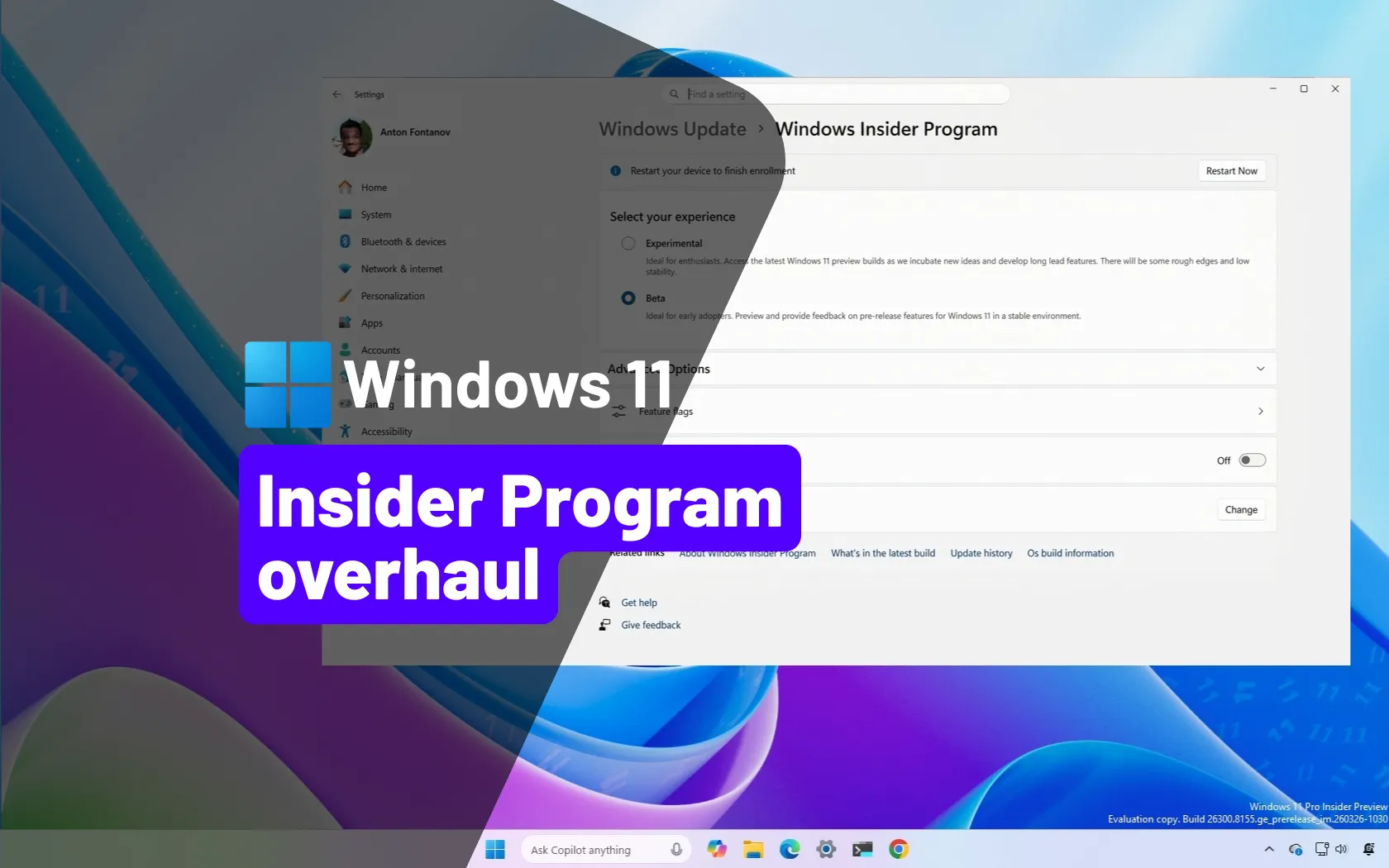
The Insider Program’s April 2026 rework also gives this move more context. Microsoft has been trying to make the program less of a lottery by clarifying the difference between Beta and Experimental and by exposing feature-flag controls for users who actively want the rougher edge. In that framework, a 26H1 Beta channel is not just another dropdown in Settings. It is the missing “normal testing” lane for people who own the hardware Microsoft is trying to bring to market.
That matters for developers who are not writing Windows components but still depend on Windows behavior. A video editor, VPN client, endpoint agent, virtualization tool, game launcher, accessibility utility, or hardware monitoring app can all behave differently on Arm, even when Windows tries hard to hide the architecture difference. A Beta channel gives those developers a place to test against a branch that is less likely to mutate beneath them every week.
For IT pros, it also creates a cleaner evaluation story. Nobody should be approving a fleet rollout from Insider Beta alone, but a Beta branch can reveal whether a new class of Arm devices is likely to break management agents, identity flows, printers, security tooling, or line-of-business applications before procurement gets enthusiastic.
The mention of Nvidia matters even if the exact product mix is still specialized. Nvidia’s relevance to Windows has traditionally meant graphics drivers, gaming, CUDA workflows, AI acceleration, and workstation software. If Microsoft is making sure 26H1 can serve Nvidia Arm platforms as well as Qualcomm laptop silicon, then Windows on Arm is no longer just a thin-and-light laptop story.
That is a meaningful shift. Qualcomm wants Windows on Arm to be an everyday PC platform. Nvidia’s Arm efforts point toward developer boxes, AI workstations, edge compute, and hybrid CPU-GPU systems where Windows may need to compete not just with macOS laptops but with Linux-heavy developer environments. Those are very different audiences.
A single broad Windows release can hide those differences only for so long. The driver model, GPU compute stack, firmware assumptions, and performance priorities of a Snapdragon ultraportable are not the same as an Nvidia-flavored Arm development machine. A shared 26H1 branch may still be efficient, but it needs room to evolve without dragging unrelated Intel and AMD PCs through the turbulence.
That is the best argument for Microsoft’s split. The company is not fragmenting Windows for fun. It is acknowledging that the Arm PC category is no longer a single Qualcomm reference design with a Windows shell on top.
The danger is that this becomes yet another Windows taxonomy that only insiders understand. If consumers see Snapdragon X2 laptops, RTX Spark devices, 25H2 PCs, 26H1 PCs, and 26H2 PCs all marketed as Windows 11 systems, the label does less work than it used to. Microsoft will need OEMs to communicate device class and support expectations clearly, because the old assumption that every Windows 11 PC is on the same annual train is becoming less true.
Those questions are not answered by a benchmark chart. They are answered by months of ordinary friction or the absence of it.
A dedicated Beta channel helps because it gives Microsoft and its partners a more credible funnel for feedback. Experimental builds can surface exciting features, but they can also bury platform regressions under unrelated churn. Beta builds create a better environment for separating Arm-specific problems from general Windows experiments.
This is particularly important for emulation. Windows on Arm lives or dies partly by how invisible x86 and x64 app compatibility can become. Users will forgive an architecture transition only if the apps they care about run with enough speed and stability that the architecture stops being a daily thought.
Drivers remain the more stubborn boundary. Applications can be emulated; kernel-mode drivers cannot be hand-waved in the same way. Security products, hardware utilities, audio gear, scanners, industrial peripherals, and niche enterprise devices often depend on vendor support that arrives late or never. That is where a Beta channel can give the ecosystem time to respond before customers discover the gap after purchase.
The same is true for IT management. Autopilot, Intune policies, endpoint detection, disk encryption, remote support, certificate deployment, VPN configuration, and update controls all need to behave predictably. Arm laptops can be excellent mobile endpoints, but only if administrators can treat them as managed PCs rather than exceptions with keyboards.
Microsoft’s Arm push will not be judged by whether enthusiasts can install a build. It will be judged by whether administrators can forget the architecture most of the time.
The problem is not that Windows updates have bugs. The problem is that platform-enablement work can be invisible to people who do not benefit from it while still exposing them to the risks. If a new scheduler behavior, driver stack change, security default, or hardware abstraction tweak exists mainly to support next-generation devices, the average desktop user reasonably asks why their stable system had to be part of the experiment.
26H1’s isolation looks like an answer to that criticism. Let the Arm-specific release serve the Arm-specific machines. Let mainstream x86 and x64 PCs continue along the broader Windows 11 path. Merge when the platform is ready, not when the calendar demands symmetry.
That does not mean Microsoft has abandoned the annual update machine. It means the company is being more selective about which train carries which payload. That is a subtle but important cultural shift for Windows, where version numbers often become marketing commitments long before engineering reality has finished negotiating.
The new Beta channel fits this more disciplined approach. If 26H1 is not meant for everyone, it still needs a mature pre-release process for the people it is meant for. Without Beta, 26H1 looked like a side branch for experimental hardware. With Beta, it looks more like a productized platform branch awaiting a larger ecosystem.
This is also a hedge against timing. Silicon launches do not always align neatly with Windows feature updates. OEMs need images. Chipmakers need validation. Developers need targets. A dedicated 26H1 Beta gives Microsoft flexibility to support new Arm hardware without pretending that the whole Windows base must move at the same pace.
That is a profound change for a program that has always relied on volunteer enthusiasm. Insiders like to feel close to the future of Windows. But if the future is split across 25H2, 26H1, Experimental, Beta, and Future Platforms branches, the program risks becoming legible only to the people who already follow build numbers as a hobby.
Microsoft has tried to reduce some of that confusion with clearer channel names. Beta is Beta. Experimental is Experimental. Feature flags allow adventurous users to turn on specific early work rather than waiting for a hidden rollout lottery. Those are good changes.
But the silicon-specific dimension cuts in the opposite direction. A user may see 26H1 in Advanced options and assume it is newer, therefore better. Microsoft is explicitly cautioning users to stick with the default Windows core version unless they have the targeted hardware and a reason to move. That caution deserves to be repeated often.
The version number “26H1” is seductive because Windows users have been trained to chase the latest release. In this case, the latest release may be the wrong release. The best Windows version for an Intel or AMD desktop in 2026 is not necessarily the one with the higher-looking branch number.
This is where Microsoft’s messaging has to be unusually plain. If 26H1 is for specific Arm silicon, then Windows Update, OEM support pages, Insider settings, and public blogs all need to say so without burying the point under Insider jargon.
Native Arm64 support remains the gold standard. Emulation is impressive, but it is not a substitute for shipping well-optimized native binaries when performance, battery life, latency, or hardware integration matters. The more Microsoft and its partners push Arm PCs into premium and professional categories, the less acceptable “it runs under emulation” becomes as the final answer.
The Beta channel may expose that gap more clearly. Users on 26H1 Beta will be precisely the kind of people likely to report poor performance, background battery drain, broken shell extensions, or driver-dependent failures. That feedback can be valuable, but only if developers treat Arm as a first-class test target rather than a compatibility footnote.
The same applies to Microsoft’s own software. Windows on Arm cannot succeed if the platform story is strong but key Microsoft workloads feel uneven. Office, Edge, Teams, Visual Studio tooling, Windows Subsystem for Linux scenarios, cloud development workflows, and Copilot-adjacent features all shape the perception of whether Arm Windows is ready.
Nvidia’s presence raises the developer stakes further. If RTX Spark-class systems are part of this wave, the audience includes people who care about AI frameworks, GPU acceleration, containers, local model experimentation, and graphics or compute drivers. Windows will be judged against environments where Linux is often the default and where developers are less forgiving of opaque platform behavior.
A dedicated Beta channel can help Microsoft collect feedback from that audience earlier. But feedback is not the same as trust. Trust arrives when the fixes land quickly, the release notes are honest, and developers can predict which branch they should care about.
The most obvious question is fleet consistency. Organizations generally prefer fewer Windows baselines, not more. If a company is standardizing on Windows 11 25H2 or preparing for the broad 2026 update path, introducing 26H1 Arm devices creates another validation lane. That may be acceptable for executives, developers, field workers, or specialized teams, but it is not free.
The second question is support duration and cadence. A targeted hardware release that does not move in lockstep with the mainstream branch needs clear servicing commitments. IT departments can manage exceptions, but they dislike surprises. If 26H1 devices skip a mainstream update or wait for a later convergence point, Microsoft must make that expectation obvious before purchase orders are signed.
The third question is vendor readiness. Endpoint security vendors, VPN providers, device-control tools, DLP agents, remote management suites, and backup products all have their own Arm maturity curves. Windows may be ready before the enterprise stack is ready, and administrators will not blame the abstract ecosystem. They will blame the device that does not fit the deployment image.
That is why the Beta channel is more important than it looks. It gives large organizations and software vendors a place to test policies and agents before the hardware becomes common. It also gives Microsoft data about where Arm adoption will stall in the real world.
Still, nobody should confuse a Beta channel with enterprise readiness. It is a precondition, not a conclusion. The real enterprise signal will come when OEMs, Microsoft, and third-party vendors can document supported configurations without caveats that read like escape clauses.
Microsoft and Qualcomm have made progress on that front, and the Snapdragon X generation was the first Windows-on-Arm wave that felt commercially serious rather than experimental. But “serious” is not the same as universal. PC buyers still expect Windows to mean maximum compatibility.
26H1’s separate path could help consumers indirectly by keeping Arm-specific work focused. If Microsoft can use the Beta channel to polish sleep, drivers, emulation, graphics behavior, and update reliability before devices scale, buyers will experience fewer of the rough edges that gave earlier Windows-on-Arm machines their niche reputation.
But separate paths can also feed doubt. A savvy buyer may wonder why their new Arm laptop runs a Windows version their desktop does not. A less savvy buyer may never notice until a troubleshooting guide, app installer, or support technician asks for the Windows version and the answer does not match the mainstream script.
This is where OEM messaging becomes crucial. If Snapdragon X2 and RTX Spark devices are sold as ordinary Windows 11 PCs with no explanation, users will assume ordinary compatibility. If they are sold as Arm PCs with clearer benefits and boundaries, some buyers will hesitate, but fewer will feel misled.
Microsoft has spent decades benefiting from the idea that Windows is the universal PC layer. Windows on Arm asks users to accept a more nuanced promise: most of the Windows experience, much of the compatibility, better mobility or specialized performance, and a platform that is still maturing. The 26H1 Beta channel is part of making that promise less risky.
RTX Spark-class hardware suggests a future where Windows on Arm is not just about consumers opening Edge on battery power. It is about compact AI development systems, creator workflows, GPU-heavy local experimentation, and perhaps a more vertically integrated CPU-GPU software stack. That is a territory where Windows has assets but not an automatic win.
Developers working with AI and accelerated computing are comfortable with Linux, containers, command lines, and vendor-specific stacks. They are not waiting for Windows to bless a platform before they build. If Microsoft wants Windows to be the friendly desktop face of local AI development, it needs the underlying platform to be stable, performant, and predictable on nontraditional Arm hardware.
A 26H1 Beta branch gives Microsoft a place to do that work without pretending it is relevant to every office laptop. That is healthy. It lets Windows serve a specialized hardware wave while still preserving the mainstream update track for the majority.
The risk is fragmentation at the developer layer. If some AI or GPU workflows behave best on Nvidia Arm Windows systems running 26H1, while mainstream Windows machines remain elsewhere, documentation and support matrices can sprawl quickly. Microsoft will need to keep the abstractions clean enough that developers are not forced to become Windows branch historians.
Still, this is the kind of problem Microsoft should want. It means Windows on Arm is expanding beyond “Can it run Chrome?” into “Can it be a serious platform for the next generation of local compute?” The new Beta channel is a small but necessary piece of that larger ambition.
That will make Windows messier to explain, but potentially better to use. If Microsoft can keep 26H1 focused, keep mainstream PCs out of unnecessary churn, and give Arm developers and OEMs a stable enough target, the new Beta channel may be remembered as the moment Windows on Arm stopped being a side experiment and started behaving like a platform with its own center of gravity.
That makes 26H1 more than a point release. It is a staging lane for a Windows platform Microsoft does not yet want to mix with the mainstream 25H2 and 26H2 cadence. The new Beta channel gives Insiders a less volatile path than Experimental, but it also confirms that Microsoft sees next-generation Arm PCs as different enough to deserve their own servicing runway.
 Microsoft Gives Arm Its Own Runway Before the Plane Is Full
Windows 11 26H1 is not the next broad feature update for the PC already sitting on your desk. Microsoft has described it as a targeted Windows release for new device innovations arriving in 2026, with Qualcomm Snapdragon X2 Series devices explicitly named and RTX Spark-class Arm hardware now part of the practical conversation. Existing x86 and x64 PCs are not being invited into this lane.That distinction matters because the Windows Insider Program has traditionally trained users to think in terms of risk appetite. Canary was rough, Dev was speculative, Beta was safer, and Release Preview was nearly shipping. Microsoft’s 2026 Insider reshuffle simplified some of the naming, but 26H1 complicates the picture in a more important way: the version number now tells you something about the silicon, not just the software.
Until this announcement, 26H1 testers had effectively lived in the noisier branch. They could select the 26H1 path, but the equivalent of a stable-ish Beta branch did not really exist for that release. Microsoft’s June 8 change creates a 28000-series Beta train for 26H1 while pushing Experimental 26H1 onto a newer 28100-series line.
That sounds like build-number trivia until you remember who relies on Insider builds. Developers need to know whether a bug belongs to their code, a driver, Windows, or the hardware enablement layer. OEMs need pre-release images that are daring enough to expose problems but not so unstable that every test result is suspect. Enthusiasts want new features; platform engineers want signal.
The new Beta channel is Microsoft saying that the 26H1 Arm effort has moved from pure platform bring-up to something closer to product validation. That does not mean 26H1 is suddenly boring. It means the bugs are supposed to become more useful.
The Version Number Is Doing Political Work
The strangest part of 26H1 is not that it exists. Windows has always had special builds, OEM-specific enablement, and hardware-timed releases. The strange part is that Microsoft is using a public Windows version label to draw a line around a hardware generation.For mainstream users, 25H2 remains the familiar Windows 11 track. The coming broader update path is expected to serve the existing PC base rather than pull those machines into 26H1. In other words, Microsoft is avoiding a replay of the old pattern where a hardware-enablement release quietly becomes everyone’s feature update, dragging niche platform changes across a billion-device ecosystem.
That restraint is probably wise. Windows 11 24H2 was the cautionary tale: an update closely associated with the first Copilot+ PC wave eventually became a broad platform release, and the wider rollout exposed the familiar mess of driver blocks, compatibility holds, gaming issues, and enterprise caution. Microsoft can insist every major Windows update is tested at scale, but scale is precisely the problem when a build born for one hardware transition becomes the default for machines that have nothing to do with that transition.
26H1 looks like a correction. Instead of pretending that all Windows devices are one harmonious family at every moment, Microsoft is admitting that new Arm systems need a different runway. That admission may be awkward for branding, but it is healthier engineering.
There is a trade-off. Windows users already struggle to understand why version numbers, enablement packages, servicing stacks, and Insider channels do not line up cleanly. Now Microsoft is adding a silicon-specific branch that can sit beside the mainstream branch while wearing the same Windows 11 badge. This is less confusing for engineers than for customers, but customers are the ones who buy the machines.
Microsoft’s task is therefore not only to build a better Arm Windows. It has to explain why “Windows 11 26H1” is not a thing most Windows 11 users should seek out.
Beta Does Not Mean Safe, but It Means Something Different Now
The new 26H1 Beta channel should not be mistaken for a consumer recommendation. Insider builds remain pre-release software, and anyone installing them on a primary PC is volunteering to be part of Microsoft’s diagnostic net. But Beta has a particular meaning in Microsoft’s current channel model: it is where features and platform changes are meant to be closer to the release path than the work in Experimental.That distinction is especially important for Arm PCs because platform maturity is not just about whether File Explorer crashes less often. It is about sleep behavior, thermal policy, neural processing unit exposure, GPU driver stability, app compatibility, emulation performance, firmware coordination, and the tedious places where a new PC either feels effortless or feels like a science project.
Experimental is useful when Microsoft wants to test ideas early. Beta is useful when Microsoft wants to learn whether the pieces can survive ordinary use. For a platform transition, the latter is the more important milestone.
The Insider Program’s April 2026 rework also gives this move more context. Microsoft has been trying to make the program less of a lottery by clarifying the difference between Beta and Experimental and by exposing feature-flag controls for users who actively want the rougher edge. In that framework, a 26H1 Beta channel is not just another dropdown in Settings. It is the missing “normal testing” lane for people who own the hardware Microsoft is trying to bring to market.
That matters for developers who are not writing Windows components but still depend on Windows behavior. A video editor, VPN client, endpoint agent, virtualization tool, game launcher, accessibility utility, or hardware monitoring app can all behave differently on Arm, even when Windows tries hard to hide the architecture difference. A Beta channel gives those developers a place to test against a branch that is less likely to mutate beneath them every week.
For IT pros, it also creates a cleaner evaluation story. Nobody should be approving a fleet rollout from Insider Beta alone, but a Beta branch can reveal whether a new class of Arm devices is likely to break management agents, identity flows, printers, security tooling, or line-of-business applications before procurement gets enthusiastic.
Qualcomm Is No Longer the Whole Windows-on-Arm Story
The first wave of Copilot+ PCs made Qualcomm the face of Windows on Arm. Snapdragon X Elite and X Plus systems gave Windows laptops better battery life and credible performance, while also reminding everyone that compatibility is not a marketing checkbox. The next wave, represented by Snapdragon X2 and Microsoft’s Nvidia RTX Spark-related ambitions, broadens the stakes.The mention of Nvidia matters even if the exact product mix is still specialized. Nvidia’s relevance to Windows has traditionally meant graphics drivers, gaming, CUDA workflows, AI acceleration, and workstation software. If Microsoft is making sure 26H1 can serve Nvidia Arm platforms as well as Qualcomm laptop silicon, then Windows on Arm is no longer just a thin-and-light laptop story.
That is a meaningful shift. Qualcomm wants Windows on Arm to be an everyday PC platform. Nvidia’s Arm efforts point toward developer boxes, AI workstations, edge compute, and hybrid CPU-GPU systems where Windows may need to compete not just with macOS laptops but with Linux-heavy developer environments. Those are very different audiences.
A single broad Windows release can hide those differences only for so long. The driver model, GPU compute stack, firmware assumptions, and performance priorities of a Snapdragon ultraportable are not the same as an Nvidia-flavored Arm development machine. A shared 26H1 branch may still be efficient, but it needs room to evolve without dragging unrelated Intel and AMD PCs through the turbulence.
That is the best argument for Microsoft’s split. The company is not fragmenting Windows for fun. It is acknowledging that the Arm PC category is no longer a single Qualcomm reference design with a Windows shell on top.
The danger is that this becomes yet another Windows taxonomy that only insiders understand. If consumers see Snapdragon X2 laptops, RTX Spark devices, 25H2 PCs, 26H1 PCs, and 26H2 PCs all marketed as Windows 11 systems, the label does less work than it used to. Microsoft will need OEMs to communicate device class and support expectations clearly, because the old assumption that every Windows 11 PC is on the same annual train is becoming less true.
The Real Test Is Not Installation, It Is Confidence
Windows on Arm has improved dramatically, but the platform’s reputation still turns on confidence. Users ask simple questions: Will my apps run? Will my peripherals work? Will games behave? Will my VPN client, printer driver, DAW plugin, tax software, anticheat system, or ancient corporate utility survive the jump?Those questions are not answered by a benchmark chart. They are answered by months of ordinary friction or the absence of it.
A dedicated Beta channel helps because it gives Microsoft and its partners a more credible funnel for feedback. Experimental builds can surface exciting features, but they can also bury platform regressions under unrelated churn. Beta builds create a better environment for separating Arm-specific problems from general Windows experiments.
This is particularly important for emulation. Windows on Arm lives or dies partly by how invisible x86 and x64 app compatibility can become. Users will forgive an architecture transition only if the apps they care about run with enough speed and stability that the architecture stops being a daily thought.
Drivers remain the more stubborn boundary. Applications can be emulated; kernel-mode drivers cannot be hand-waved in the same way. Security products, hardware utilities, audio gear, scanners, industrial peripherals, and niche enterprise devices often depend on vendor support that arrives late or never. That is where a Beta channel can give the ecosystem time to respond before customers discover the gap after purchase.
The same is true for IT management. Autopilot, Intune policies, endpoint detection, disk encryption, remote support, certificate deployment, VPN configuration, and update controls all need to behave predictably. Arm laptops can be excellent mobile endpoints, but only if administrators can treat them as managed PCs rather than exceptions with keyboards.
Microsoft’s Arm push will not be judged by whether enthusiasts can install a build. It will be judged by whether administrators can forget the architecture most of the time.
Microsoft Is Trying Not to Repeat the 24H2 Lesson
Every Windows release carries old baggage, and 26H1 carries the memory of 24H2. That update became associated with Copilot+ PCs and then rolled outward into the broader Windows population, where the usual compatibility landmines turned a platform update into a rolling support story. Microsoft did what Microsoft usually does: staged rollout, safeguard holds, known issue documentation, fixes over time.The problem is not that Windows updates have bugs. The problem is that platform-enablement work can be invisible to people who do not benefit from it while still exposing them to the risks. If a new scheduler behavior, driver stack change, security default, or hardware abstraction tweak exists mainly to support next-generation devices, the average desktop user reasonably asks why their stable system had to be part of the experiment.
26H1’s isolation looks like an answer to that criticism. Let the Arm-specific release serve the Arm-specific machines. Let mainstream x86 and x64 PCs continue along the broader Windows 11 path. Merge when the platform is ready, not when the calendar demands symmetry.
That does not mean Microsoft has abandoned the annual update machine. It means the company is being more selective about which train carries which payload. That is a subtle but important cultural shift for Windows, where version numbers often become marketing commitments long before engineering reality has finished negotiating.
The new Beta channel fits this more disciplined approach. If 26H1 is not meant for everyone, it still needs a mature pre-release process for the people it is meant for. Without Beta, 26H1 looked like a side branch for experimental hardware. With Beta, it looks more like a productized platform branch awaiting a larger ecosystem.
This is also a hedge against timing. Silicon launches do not always align neatly with Windows feature updates. OEMs need images. Chipmakers need validation. Developers need targets. A dedicated 26H1 Beta gives Microsoft flexibility to support new Arm hardware without pretending that the whole Windows base must move at the same pace.
The Insider Program Becomes a Silicon Map
The Insider Program used to be a rough forecast of future Windows features. Now it is increasingly a map of Microsoft’s platform strategy. The channel you choose is no longer just about how much instability you can tolerate; it can indicate which hardware generation you are testing.That is a profound change for a program that has always relied on volunteer enthusiasm. Insiders like to feel close to the future of Windows. But if the future is split across 25H2, 26H1, Experimental, Beta, and Future Platforms branches, the program risks becoming legible only to the people who already follow build numbers as a hobby.
Microsoft has tried to reduce some of that confusion with clearer channel names. Beta is Beta. Experimental is Experimental. Feature flags allow adventurous users to turn on specific early work rather than waiting for a hidden rollout lottery. Those are good changes.
But the silicon-specific dimension cuts in the opposite direction. A user may see 26H1 in Advanced options and assume it is newer, therefore better. Microsoft is explicitly cautioning users to stick with the default Windows core version unless they have the targeted hardware and a reason to move. That caution deserves to be repeated often.
The version number “26H1” is seductive because Windows users have been trained to chase the latest release. In this case, the latest release may be the wrong release. The best Windows version for an Intel or AMD desktop in 2026 is not necessarily the one with the higher-looking branch number.
This is where Microsoft’s messaging has to be unusually plain. If 26H1 is for specific Arm silicon, then Windows Update, OEM support pages, Insider settings, and public blogs all need to say so without burying the point under Insider jargon.
Developers Get a Better Target, but Not a Simpler One
For developers, the new 26H1 Beta channel is both useful and inconvenient. It gives them a more stable pre-release target for next-generation Arm systems, but it also forces them to think more deliberately about Windows version targeting. The old assumption that testing against the latest Insider build covers the near future is weaker when the near future has multiple hardware-specific branches.Native Arm64 support remains the gold standard. Emulation is impressive, but it is not a substitute for shipping well-optimized native binaries when performance, battery life, latency, or hardware integration matters. The more Microsoft and its partners push Arm PCs into premium and professional categories, the less acceptable “it runs under emulation” becomes as the final answer.
The Beta channel may expose that gap more clearly. Users on 26H1 Beta will be precisely the kind of people likely to report poor performance, background battery drain, broken shell extensions, or driver-dependent failures. That feedback can be valuable, but only if developers treat Arm as a first-class test target rather than a compatibility footnote.
The same applies to Microsoft’s own software. Windows on Arm cannot succeed if the platform story is strong but key Microsoft workloads feel uneven. Office, Edge, Teams, Visual Studio tooling, Windows Subsystem for Linux scenarios, cloud development workflows, and Copilot-adjacent features all shape the perception of whether Arm Windows is ready.
Nvidia’s presence raises the developer stakes further. If RTX Spark-class systems are part of this wave, the audience includes people who care about AI frameworks, GPU acceleration, containers, local model experimentation, and graphics or compute drivers. Windows will be judged against environments where Linux is often the default and where developers are less forgiving of opaque platform behavior.
A dedicated Beta channel can help Microsoft collect feedback from that audience earlier. But feedback is not the same as trust. Trust arrives when the fixes land quickly, the release notes are honest, and developers can predict which branch they should care about.
Enterprise IT Will Watch the Branch, Not the Branding
Enterprise administrators do not buy a Windows story because it sounds elegant. They buy it when the support lifecycle, management tooling, application compatibility, and hardware supply chain make sense. 26H1’s dedicated Beta channel helps with one of those questions, but it raises others.The most obvious question is fleet consistency. Organizations generally prefer fewer Windows baselines, not more. If a company is standardizing on Windows 11 25H2 or preparing for the broad 2026 update path, introducing 26H1 Arm devices creates another validation lane. That may be acceptable for executives, developers, field workers, or specialized teams, but it is not free.
The second question is support duration and cadence. A targeted hardware release that does not move in lockstep with the mainstream branch needs clear servicing commitments. IT departments can manage exceptions, but they dislike surprises. If 26H1 devices skip a mainstream update or wait for a later convergence point, Microsoft must make that expectation obvious before purchase orders are signed.
The third question is vendor readiness. Endpoint security vendors, VPN providers, device-control tools, DLP agents, remote management suites, and backup products all have their own Arm maturity curves. Windows may be ready before the enterprise stack is ready, and administrators will not blame the abstract ecosystem. They will blame the device that does not fit the deployment image.
That is why the Beta channel is more important than it looks. It gives large organizations and software vendors a place to test policies and agents before the hardware becomes common. It also gives Microsoft data about where Arm adoption will stall in the real world.
Still, nobody should confuse a Beta channel with enterprise readiness. It is a precondition, not a conclusion. The real enterprise signal will come when OEMs, Microsoft, and third-party vendors can document supported configurations without caveats that read like escape clauses.
The Consumer Story Is Battery Life Versus Ambiguity
For consumers, Windows on Arm has an easy sales pitch and a hard support pitch. The easy pitch is battery life, instant-on behavior, quiet designs, AI features, and premium mobility. The hard pitch is explaining why some apps, games, drivers, and accessories may behave differently than they do on a familiar Intel or AMD laptop.Microsoft and Qualcomm have made progress on that front, and the Snapdragon X generation was the first Windows-on-Arm wave that felt commercially serious rather than experimental. But “serious” is not the same as universal. PC buyers still expect Windows to mean maximum compatibility.
26H1’s separate path could help consumers indirectly by keeping Arm-specific work focused. If Microsoft can use the Beta channel to polish sleep, drivers, emulation, graphics behavior, and update reliability before devices scale, buyers will experience fewer of the rough edges that gave earlier Windows-on-Arm machines their niche reputation.
But separate paths can also feed doubt. A savvy buyer may wonder why their new Arm laptop runs a Windows version their desktop does not. A less savvy buyer may never notice until a troubleshooting guide, app installer, or support technician asks for the Windows version and the answer does not match the mainstream script.
This is where OEM messaging becomes crucial. If Snapdragon X2 and RTX Spark devices are sold as ordinary Windows 11 PCs with no explanation, users will assume ordinary compatibility. If they are sold as Arm PCs with clearer benefits and boundaries, some buyers will hesitate, but fewer will feel misled.
Microsoft has spent decades benefiting from the idea that Windows is the universal PC layer. Windows on Arm asks users to accept a more nuanced promise: most of the Windows experience, much of the compatibility, better mobility or specialized performance, and a platform that is still maturing. The 26H1 Beta channel is part of making that promise less risky.
The RTX Spark Angle Pushes Windows Beyond Laptop Politics
Nvidia’s role makes this story more interesting than a Snapdragon refresh. Qualcomm’s Windows ambition is obvious: take share in premium laptops and prove Arm can compete with x86 in mainstream mobile computing. Nvidia’s Arm-adjacent Windows opportunity is different and potentially more disruptive.RTX Spark-class hardware suggests a future where Windows on Arm is not just about consumers opening Edge on battery power. It is about compact AI development systems, creator workflows, GPU-heavy local experimentation, and perhaps a more vertically integrated CPU-GPU software stack. That is a territory where Windows has assets but not an automatic win.
Developers working with AI and accelerated computing are comfortable with Linux, containers, command lines, and vendor-specific stacks. They are not waiting for Windows to bless a platform before they build. If Microsoft wants Windows to be the friendly desktop face of local AI development, it needs the underlying platform to be stable, performant, and predictable on nontraditional Arm hardware.
A 26H1 Beta branch gives Microsoft a place to do that work without pretending it is relevant to every office laptop. That is healthy. It lets Windows serve a specialized hardware wave while still preserving the mainstream update track for the majority.
The risk is fragmentation at the developer layer. If some AI or GPU workflows behave best on Nvidia Arm Windows systems running 26H1, while mainstream Windows machines remain elsewhere, documentation and support matrices can sprawl quickly. Microsoft will need to keep the abstractions clean enough that developers are not forced to become Windows branch historians.
Still, this is the kind of problem Microsoft should want. It means Windows on Arm is expanding beyond “Can it run Chrome?” into “Can it be a serious platform for the next generation of local compute?” The new Beta channel is a small but necessary piece of that larger ambition.
The New Beta Lane Tells Buyers Which Windows Future They Are Entering
Microsoft’s announcement is easy to dismiss as Insider housekeeping, but it gives users, developers, and administrators several concrete signals about the 2026 Windows roadmap. The important point is not that 26H1 is “newer” than 25H2. The important point is that 26H1 is narrower, more hardware-specific, and now mature enough to deserve a Beta branch of its own.- Windows 11 26H1 is a targeted release for specific new Arm silicon, not a general upgrade path for existing Intel and AMD PCs.
- The new Beta (26H1) channel uses the 28000-series build train, while Experimental (26H1) moves ahead on a newer 28100-series line.
- Insiders with eligible 26H1 hardware can now choose between a more mature Beta path and a rougher Experimental path without a clean reinstall.
- Developers should treat the 26H1 Beta channel as a practical test target for next-generation Arm compatibility, not as a curiosity.
- Enterprise IT should evaluate 26H1 devices as a distinct platform lane with its own validation requirements, even though they still carry the Windows 11 brand.
- Consumers should not chase 26H1 on existing PCs; the release matters mainly if they are buying new Arm hardware built for it.
That will make Windows messier to explain, but potentially better to use. If Microsoft can keep 26H1 focused, keep mainstream PCs out of unnecessary churn, and give Arm developers and OEMs a stable enough target, the new Beta channel may be remembered as the moment Windows on Arm stopped being a side experiment and started behaving like a platform with its own center of gravity.
References
- Primary source: Research Snipers
Published: 2026-06-15T10:21:20.600588
Loading…
researchsnipers.com - Related coverage: windowscentral.com

Microsoft launches new Windows 11 Beta channel for next-gen Arm PCs powered by Snapdragon X2 and RTX Spark chips | Windows Central
Windows 11 version 26H1 just gained a new preview channel, splitting testing between Experimental and Beta Channels on devices powered by Snapdragon X2 and RTX Spark chips.www.windowscentral.com - Related coverage: tomshardware.com

Microsoft confirms Windows 11 26H1 will be for Arm devices only at launch — Snapdragon X2-powered devices officially shipping with 26H1 | Tom's Hardware
It's 24H2 all over again, but with the caveat that 26H1 will only support specific hardware for its entire lifecycle. Devices running 26H1 will not be able to upgrade to 26H2.www.tomshardware.com - Related coverage: windowsforum.com
Loading…
windowsforum.com - Related coverage: windowslatest.com

Microsoft details Windows 11 26H1 support cycle, CPU requirements (just Snapdragon X2 for now), and more
Microsoft says Windows 11 26H1 is supported until March 2028 for consumers and is now rolling out on PCs with eligible CPUs. www.windowslatest.com
- Official source: blogs.windows.com
Announcing new builds 8 June 2026
[Update 6/11/2026: Release notes have now been published to Windows Insider release notes - Windows Insider Program | Microsoft Learn.]blogs.windows.com
- Related coverage: muycomputer.com
Loading…
www.muycomputer.com - Related coverage: redmondmag.com
Loading…
redmondmag.com - Related coverage: betawiki.net
Loading…
betawiki.net - Related coverage: techradar.com
Microsoft confirms Windows 11 26H1 update won't be coming to your current PC — here's why that's actually great news | TechRadar
It's all about avoiding another 24H2 disaster for existing PCs, which will stay on 25H2 and not get 26H1www.techradar.com - Related coverage: windowsarchive.orangera.in
- Official source: learn.microsoft.com
Loading…
learn.microsoft.com - Related coverage: gadgets360.com
Microsoft Revamps Windows Insider Experience With New Beta and Experimental Channels | Technology News
Microsoft’s planned transition to the new Windows Insider channels kicked off on Friday.www.gadgets360.com - Related coverage: pureinfotech.com
Microsoft overhauls Windows 11 Insider Program with new Experimental and Beta channels
Windows 11 Insider Program gets simpler with Experimental and Beta channels plus feature flag control for faster, predictable testing. pureinfotech.com