

Roughly 30,000 German companies now face a forced rethink of employee onboarding because NIS-2 compliance, AI Act literacy duties, and token-stealing phishing campaigns such as EvilTokens have turned the first days of employment into a regulated cybersecurity control point. The old model — issue a laptop, point the new hire at Microsoft 365, assign a few e-learning modules, and hope for the best — no longer matches the threat. Attackers are not waiting for employees to become productive before targeting them; regulators are no longer treating awareness as optional; and AI tools have made the boundary between helpful automation and dangerous data leakage harder to see. The onboarding checklist has become a security architecture document, whether HR departments are ready for that or not.
For years, onboarding was treated as a people function with an IT appendix. HR handled contracts, managers explained the org chart, facilities assigned a badge, and IT created accounts somewhere in the background. Security training usually arrived as a compliance video, often after the employee had already been given access to email, collaboration tools, customer records, and internal chat.
That sequencing is increasingly indefensible. The new hire’s first authentication into Microsoft 365, SAP, CRM, GitHub, Teams, or an identity portal is no longer a harmless administrative step. It is the moment a person becomes a live attack surface inside the company.
NIS-2 sharpens that reality because it does not merely ask covered organizations to buy better tools. It pushes them toward risk-management processes, incident handling, supply-chain awareness, business continuity, and management accountability. In Germany, where the national implementation has been framed around tens of thousands of newly affected firms, this lands hardest on mid-sized companies that historically did not behave like critical infrastructure operators.
The result is a cultural collision. German Mittelstand firms, retailers, energy suppliers, logistics providers, manufacturers, healthcare operators, and digital service companies are being told that cybersecurity belongs in ordinary business process design. The employee journey is one of those processes. That means onboarding must stop being a ceremonial welcome mat and start functioning as a controlled entry point into a regulated environment.
That is the nasty elegance of modern identity attacks. The password may never be stolen. The authenticator app may never be bypassed in the Hollywood sense. The attacker simply rides the approved login ceremony and captures the result.
For Windows-heavy organizations, this is particularly uncomfortable because Microsoft identity is the connective tissue of the modern workplace. Entra ID, Microsoft 365, Teams, SharePoint, OneDrive, Azure, Intune, and third-party SaaS integrations all depend on trust decisions that happen in seconds and often look routine to users. A new employee told to “enter this code to finish setup” may not yet know what normal looks like.
That makes onboarding the perfect ambush point. New hires expect odd instructions, unfamiliar portals, helpdesk messages, QR codes, device enrollment steps, temporary passwords, and urgent calendar invites. The psychology of onboarding — uncertainty, eagerness, fear of looking incompetent — is exactly what phishing operators exploit.
The lesson is not that MFA has failed. MFA still blocks enormous volumes of commodity attacks. The lesson is that MFA cannot carry the whole burden when attackers have moved up the stack from passwords to sessions, tokens, consent grants, and human context.
A company that sends legitimate onboarding emails from multiple domains has trained employees to ignore domain consistency. A company that asks staff to scan QR codes to enroll devices has normalized QR-code trust. A company that relies on rushed helpdesk handoffs has made urgency part of the official process. Attackers do not need to invent confusion when the employer already supplies it.
This is where the Signal Security Summit’s emphasis on psychology and behavior fits the broader moment. Security awareness has spent years trying to make employees suspicious. That is necessary, but insufficient. The more mature question is whether the company’s own processes are distinguishable from an attack.
If a new hire receives a Teams message from “IT Support” asking them to approve a sign-in, what should they compare it with? If the answer is “use your judgment,” the organization has outsourced policy to a person who has not yet learned the building map. Onboarding has to define trusted channels, expected steps, escalation paths, and red flags before the employee is asked to make consequential decisions.
That is not soft stuff. It is control design.
This has consequences for German companies that have traditionally separated HR development from IT governance. The onboarding curriculum now needs owners from security, legal, HR, compliance, data protection, and operations. It also needs to change by role. A warehouse employee using a handheld scanner does not need the same training as a finance analyst with SAP invoice approval rights, and neither needs the same module as a pharma R&D project manager handling sensitive research data.
This role-based approach is not bureaucracy for its own sake. It is how companies connect the real threat to the real job. Finance employees need to recognize invoice manipulation, supplier fraud, and AI-generated payment pressure. Developers need secure coding, secrets management, and dependency-risk habits. Executives need incident escalation duties and an understanding that management responsibility is no longer abstract.
The uncomfortable part is documentation. If a regulator, insurer, auditor, or customer asks how a company prepares new employees for identity phishing, AI data leakage, and incident reporting, “we have a security awareness video” is a weak answer. A stronger answer includes completion records, scenario tests, access gating, policy acknowledgments, simulated phishing results, and evidence that lessons changed after incidents.
That is where onboarding becomes more than instruction. It becomes an audit trail.
The timing matters. AI tools have diffused through the workplace faster than most companies can write policy. Microsoft Copilot, ChatGPT Enterprise, embedded AI in CRM systems, AI-assisted invoice processing, and prompt-based analytics are no longer exotic pilots. They are becoming the default user interface for work.
That changes onboarding because employees must be taught not only which tools are allowed, but what kind of data those tools may process. “Do not paste secrets into public AI” is a start, but it is too crude for daily business. Staff need examples drawn from their own roles: customer complaints, HR notes, unreleased financials, source code, supplier contracts, patient-adjacent information, and regulated industrial data.
The harder lesson is that AI can create security risk even when no one is trying to break rules. A well-meaning employee may use a model to rewrite a client email and accidentally disclose personal data. A manager may use AI to rank applicants and stumble into employment-law risk. A support agent may rely on a generated answer that sounds authoritative but exposes internal process details.
In other words, AI literacy belongs next to phishing awareness because both are about judgment under uncertainty. The modern employee must learn when a system is being helpful, when it is being manipulative, and when it is making a compliance problem look like a productivity win.
But the patch story also shows why human process matters. BitLocker recovery prompts are not just technical events. They become helpdesk events, user-confusion events, and phishing opportunities. A legitimate recovery-key incident teaches employees that scary security prompts sometimes happen after updates; attackers can then mimic the urgency.
Secure Boot certificate changes have the same operational flavor. To security professionals, certificate lifecycle management is part of platform trust. To a business user, it is invisible until a machine behaves strangely. The human layer appears the moment a device asks for action, a support ticket is opened, or an employee searches for a workaround.
That is why the distinction between “technical controls” and “human controls” is increasingly artificial. BitLocker protects data at rest, but recovery-key handling is a human process. Secure Boot protects the startup chain, but certificate updates require planning and communication. MFA protects identity, but token phishing abuses user expectations around login flows.
The lesson for Windows shops is not that every employee must understand the cryptographic guts of Secure Boot. It is that employees should know what support will and will not ask them to do, which prompts deserve escalation, and how to verify unusual instructions without shame or delay.
A pharma project manager entering an R&D environment may touch intellectual property, clinical-adjacent documentation, partner data, and regulated quality processes. Their onboarding should treat information classification and collaboration boundaries as core job skills, not as legal fine print. A single compromised account in that setting can be more than an IT incident; it can become an IP, regulatory, and competitive problem.
Luxury retail has a different shape. Store associates, warehouse staff, CRM users, and customer-service teams may handle personal data, loyalty records, payment-adjacent workflows, inventory systems, and brand-sensitive operations. Social engineering in retail often thrives on urgency and politeness: a fake VIP request, a bogus supplier message, a rushed refund, a pretend executive demand.
Finance and back-office teams face yet another version. E-invoicing mandates, SAP networks, and AI-driven invoice coding bring efficiency, but they also concentrate trust in digital workflows. If employees do not understand how supplier identity, approval chains, and exception handling work, automation can make fraud faster rather than harder.
This is why generic “cybersecurity awareness” is losing credibility. It is too broad to change behavior and too vague to satisfy the risk picture. Onboarding has to become contextual: not every employee needs more training, but every employee needs the right training before receiving the access that makes their mistakes expensive.
NIS-2 does not care that a company is family-owned, regionally rooted, or historically below the radar of global threat actors. If the company sits in a covered sector and meets the relevant thresholds, it must behave more like a regulated digital operator. That means mapping assets, assessing risks, defining incident reporting paths, and training people accordingly.
The challenge is not simply cost. It is translation. Security teams speak in controls, HR speaks in learning journeys, legal speaks in obligations, and business units speak in productivity. Onboarding is where those languages collide.
A mature company will use that collision productively. It will ask which access rights are granted on day one, which should wait until training is complete, which tools are approved for AI use, which data categories are off-limits, and which incidents must be reported internally within minutes. It will also ask whether managers are rewarded for speeding around controls or for helping employees follow them.
That last point matters. New hires learn the real security culture from managers, not policy documents. If the first week teaches them that “everyone shares the admin login when things are busy,” the annual training module is already dead.
A good onboarding program should begin before the first login. New employees should know which communications to expect, which domains and portals are legitimate, how device enrollment works, and how to contact support through a verified channel. They should be told explicitly that asking security questions is desirable behavior, not a sign of incompetence.
Access should be staged. The company can grant enough capability for day-one productivity without handing over the entire estate. Sensitive systems should require role-specific training, manager confirmation, and technical controls such as conditional access, phishing-resistant MFA where appropriate, device compliance, and least privilege.
Simulation should be realistic but not humiliating. The goal is not to trick new hires so the security team can publish a failure rate. The goal is to expose the gap between policy and reality. If many employees fall for a simulated device-code phish during onboarding, that is not proof that employees are foolish; it is evidence that the onboarding process failed to define a safe login pattern.
This is also where AI can help without becoming a gimmick. Adaptive training can tailor scenarios to finance, retail, R&D, logistics, or administration. AI-assisted analysis can identify confusing policy language. But the organization must be careful not to replace human accountability with dashboards that look impressive and explain little.
This does not mean turning HR into a security operations center. It means acknowledging that HR controls the earliest, most teachable moments in the employee lifecycle. Offer letters, pre-boarding portals, first-day sessions, policy acknowledgments, manager check-ins, and probation reviews are all opportunities to build security behavior before bad habits harden.
Conversely, security teams need to stop treating employees as endpoints with emotions. People do not learn well from fear, jargon, or blame. They learn when expectations are clear, tools are usable, and safe behavior is reinforced by managers and systems.
The best programs will likely be co-owned. HR can design the experience, legal can frame the obligations, security can define the risks, IT can enforce access gates, and business units can supply the role-specific scenarios. That is heavier than the old model, but it is also more honest.
For many companies, the first test will be procurement. Training vendors are already moving into AI literacy, prompt engineering, machine-learning certificates, and cyber-awareness packages. Buyers should resist the temptation to purchase a certificate and call the problem solved. The question is not whether a course exists; it is whether the course changes what employees do when a convincing fake arrives at 8:07 on a Tuesday morning.
That contract should be visible in access rights. Employees should not receive broad permissions simply because the ticketing queue is busy. Contractors should not inherit standing access after a project ends. Managers should not be able to pressure staff into bypassing approval workflows. Admin privileges should be exceptional, monitored, and time-bound.
It should also be visible in AI permissions. If a company allows Copilot or another assistant to summarize documents, employees need to know which repositories are included, which sensitivity labels matter, and what happens when the model surfaces information they did not expect to see. AI onboarding is not just prompt training; it is permission literacy.
Identity security belongs here too. Employees should understand why device-code prompts, OAuth consent screens, unexpected MFA requests, and “approve this sign-in” messages are dangerous when they appear outside a known flow. They should know that a real Microsoft page does not automatically mean a safe Microsoft session.
That is a subtle lesson, but subtlety is now required. The attacker’s advantage is that modern corporate IT is complicated enough to make almost anything plausible.
The deeper shift is that onboarding is becoming the place where Europe’s security, privacy, and AI ambitions meet ordinary office reality. NIS-2 can mandate risk management, the AI Act can demand literacy, and Microsoft can keep patching the platform, but none of it works if the person at the keyboard is dropped into ambiguity and told to be careful. The next competitive advantage in German cybersecurity may not be another dashboard or appliance; it may be a first week of work designed so well that attackers have fewer human gaps to crawl through.
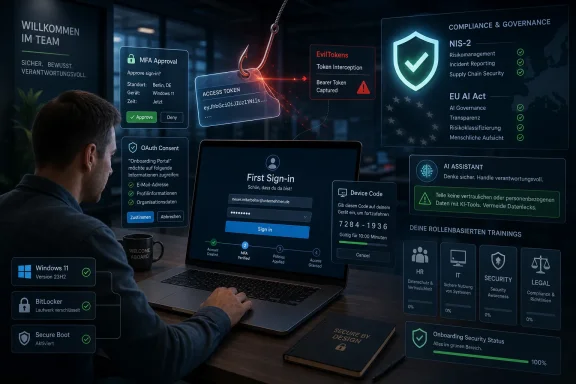 The First Login Is Now a Regulated Event
For years, onboarding was treated as a people function with an IT appendix. HR handled contracts, managers explained the org chart, facilities assigned a badge, and IT created accounts somewhere in the background. Security training usually arrived as a compliance video, often after the employee had already been given access to email, collaboration tools, customer records, and internal chat.That sequencing is increasingly indefensible. The new hire’s first authentication into Microsoft 365, SAP, CRM, GitHub, Teams, or an identity portal is no longer a harmless administrative step. It is the moment a person becomes a live attack surface inside the company.
NIS-2 sharpens that reality because it does not merely ask covered organizations to buy better tools. It pushes them toward risk-management processes, incident handling, supply-chain awareness, business continuity, and management accountability. In Germany, where the national implementation has been framed around tens of thousands of newly affected firms, this lands hardest on mid-sized companies that historically did not behave like critical infrastructure operators.
The result is a cultural collision. German Mittelstand firms, retailers, energy suppliers, logistics providers, manufacturers, healthcare operators, and digital service companies are being told that cybersecurity belongs in ordinary business process design. The employee journey is one of those processes. That means onboarding must stop being a ceremonial welcome mat and start functioning as a controlled entry point into a regulated environment.
EvilTokens Shows Why MFA Is Not a Finish Line
The EvilTokens-style threat matters because it attacks one of the most comforting assumptions in corporate security: that multi-factor authentication has moved the user beyond the danger zone. Device-code phishing and related token-theft techniques exploit legitimate authentication flows rather than simply faking a login page. The victim may authenticate through a real Microsoft domain, complete MFA, and still hand the attacker the usable token that matters.That is the nasty elegance of modern identity attacks. The password may never be stolen. The authenticator app may never be bypassed in the Hollywood sense. The attacker simply rides the approved login ceremony and captures the result.
For Windows-heavy organizations, this is particularly uncomfortable because Microsoft identity is the connective tissue of the modern workplace. Entra ID, Microsoft 365, Teams, SharePoint, OneDrive, Azure, Intune, and third-party SaaS integrations all depend on trust decisions that happen in seconds and often look routine to users. A new employee told to “enter this code to finish setup” may not yet know what normal looks like.
That makes onboarding the perfect ambush point. New hires expect odd instructions, unfamiliar portals, helpdesk messages, QR codes, device enrollment steps, temporary passwords, and urgent calendar invites. The psychology of onboarding — uncertainty, eagerness, fear of looking incompetent — is exactly what phishing operators exploit.
The lesson is not that MFA has failed. MFA still blocks enormous volumes of commodity attacks. The lesson is that MFA cannot carry the whole burden when attackers have moved up the stack from passwords to sessions, tokens, consent grants, and human context.
The Weakest Link Was Always a Workflow
The phrase “the human is the weakest link” is overused because it is convenient. It flatters vendors, absolves architecture, and reduces complicated organizational failures to a user clicking the wrong thing. But the more useful version is harsher: the weakest link is often the workflow that trains people to obey ambiguous instructions.A company that sends legitimate onboarding emails from multiple domains has trained employees to ignore domain consistency. A company that asks staff to scan QR codes to enroll devices has normalized QR-code trust. A company that relies on rushed helpdesk handoffs has made urgency part of the official process. Attackers do not need to invent confusion when the employer already supplies it.
This is where the Signal Security Summit’s emphasis on psychology and behavior fits the broader moment. Security awareness has spent years trying to make employees suspicious. That is necessary, but insufficient. The more mature question is whether the company’s own processes are distinguishable from an attack.
If a new hire receives a Teams message from “IT Support” asking them to approve a sign-in, what should they compare it with? If the answer is “use your judgment,” the organization has outsourced policy to a person who has not yet learned the building map. Onboarding has to define trusted channels, expected steps, escalation paths, and red flags before the employee is asked to make consequential decisions.
That is not soft stuff. It is control design.
NIS-2 Turns Awareness Into Evidence
The practical change under NIS-2 is that security awareness can no longer live as folklore. Covered organizations need to demonstrate risk management, not merely claim good intentions. Training that cannot be assigned, tracked, updated, tested, and tied to role-based access begins to look like theater.This has consequences for German companies that have traditionally separated HR development from IT governance. The onboarding curriculum now needs owners from security, legal, HR, compliance, data protection, and operations. It also needs to change by role. A warehouse employee using a handheld scanner does not need the same training as a finance analyst with SAP invoice approval rights, and neither needs the same module as a pharma R&D project manager handling sensitive research data.
This role-based approach is not bureaucracy for its own sake. It is how companies connect the real threat to the real job. Finance employees need to recognize invoice manipulation, supplier fraud, and AI-generated payment pressure. Developers need secure coding, secrets management, and dependency-risk habits. Executives need incident escalation duties and an understanding that management responsibility is no longer abstract.
The uncomfortable part is documentation. If a regulator, insurer, auditor, or customer asks how a company prepares new employees for identity phishing, AI data leakage, and incident reporting, “we have a security awareness video” is a weak answer. A stronger answer includes completion records, scenario tests, access gating, policy acknowledgments, simulated phishing results, and evidence that lessons changed after incidents.
That is where onboarding becomes more than instruction. It becomes an audit trail.
AI Compliance Makes the First Week Even Harder
The EU AI Act adds a second pressure point because AI literacy is not just for developers building models. It reaches organizations that deploy AI systems and expect staff to use them responsibly. In ordinary workplace terms, that means the employee who pastes customer data into a chatbot, asks Copilot to summarize a confidential meeting, or uses an AI tool to draft performance feedback has entered regulated territory.The timing matters. AI tools have diffused through the workplace faster than most companies can write policy. Microsoft Copilot, ChatGPT Enterprise, embedded AI in CRM systems, AI-assisted invoice processing, and prompt-based analytics are no longer exotic pilots. They are becoming the default user interface for work.
That changes onboarding because employees must be taught not only which tools are allowed, but what kind of data those tools may process. “Do not paste secrets into public AI” is a start, but it is too crude for daily business. Staff need examples drawn from their own roles: customer complaints, HR notes, unreleased financials, source code, supplier contracts, patient-adjacent information, and regulated industrial data.
The harder lesson is that AI can create security risk even when no one is trying to break rules. A well-meaning employee may use a model to rewrite a client email and accidentally disclose personal data. A manager may use AI to rank applicants and stumble into employment-law risk. A support agent may rely on a generated answer that sounds authoritative but exposes internal process details.
In other words, AI literacy belongs next to phishing awareness because both are about judgment under uncertainty. The modern employee must learn when a system is being helpful, when it is being manipulative, and when it is making a compliance problem look like a productivity win.
Patch Tuesday Is the Backdrop, Not the Plot
The June 2026 Patch Tuesday cycle, with reporting around more than 200 Microsoft vulnerabilities and particular attention on BitLocker and Secure Boot, is a reminder that technical hygiene remains brutal, repetitive work. Windows administrators still need patch testing, deployment rings, rollback plans, recovery-key readiness, and asset visibility. Nothing about behavioral security reduces the importance of basic maintenance.But the patch story also shows why human process matters. BitLocker recovery prompts are not just technical events. They become helpdesk events, user-confusion events, and phishing opportunities. A legitimate recovery-key incident teaches employees that scary security prompts sometimes happen after updates; attackers can then mimic the urgency.
Secure Boot certificate changes have the same operational flavor. To security professionals, certificate lifecycle management is part of platform trust. To a business user, it is invisible until a machine behaves strangely. The human layer appears the moment a device asks for action, a support ticket is opened, or an employee searches for a workaround.
That is why the distinction between “technical controls” and “human controls” is increasingly artificial. BitLocker protects data at rest, but recovery-key handling is a human process. Secure Boot protects the startup chain, but certificate updates require planning and communication. MFA protects identity, but token phishing abuses user expectations around login flows.
The lesson for Windows shops is not that every employee must understand the cryptographic guts of Secure Boot. It is that employees should know what support will and will not ask them to do, which prompts deserve escalation, and how to verify unusual instructions without shame or delay.
Sector-Specific Hiring Makes Generic Training Look Lazy
The source material’s spread of examples — pharma R&D leadership in Heidelberg, luxury retail openings in Metzingen, SAP business-network training, AI-assisted procure-to-pay workflows — may look like a grab bag. It is actually the point. The modern onboarding problem is not one problem. It is a set of overlapping risk profiles disguised as hiring.A pharma project manager entering an R&D environment may touch intellectual property, clinical-adjacent documentation, partner data, and regulated quality processes. Their onboarding should treat information classification and collaboration boundaries as core job skills, not as legal fine print. A single compromised account in that setting can be more than an IT incident; it can become an IP, regulatory, and competitive problem.
Luxury retail has a different shape. Store associates, warehouse staff, CRM users, and customer-service teams may handle personal data, loyalty records, payment-adjacent workflows, inventory systems, and brand-sensitive operations. Social engineering in retail often thrives on urgency and politeness: a fake VIP request, a bogus supplier message, a rushed refund, a pretend executive demand.
Finance and back-office teams face yet another version. E-invoicing mandates, SAP networks, and AI-driven invoice coding bring efficiency, but they also concentrate trust in digital workflows. If employees do not understand how supplier identity, approval chains, and exception handling work, automation can make fraud faster rather than harder.
This is why generic “cybersecurity awareness” is losing credibility. It is too broad to change behavior and too vague to satisfy the risk picture. Onboarding has to become contextual: not every employee needs more training, but every employee needs the right training before receiving the access that makes their mistakes expensive.
The German Mittelstand Meets the Security Operating Model
Germany’s mid-sized companies are particularly exposed to this transition because many are highly digitized in production and operations but culturally pragmatic about governance. They often know their processes deeply, rely on trusted long-term employees, and run lean administrative teams. That model can be efficient, but it struggles when compliance demands formal evidence and attackers exploit informal trust.NIS-2 does not care that a company is family-owned, regionally rooted, or historically below the radar of global threat actors. If the company sits in a covered sector and meets the relevant thresholds, it must behave more like a regulated digital operator. That means mapping assets, assessing risks, defining incident reporting paths, and training people accordingly.
The challenge is not simply cost. It is translation. Security teams speak in controls, HR speaks in learning journeys, legal speaks in obligations, and business units speak in productivity. Onboarding is where those languages collide.
A mature company will use that collision productively. It will ask which access rights are granted on day one, which should wait until training is complete, which tools are approved for AI use, which data categories are off-limits, and which incidents must be reported internally within minutes. It will also ask whether managers are rewarded for speeding around controls or for helping employees follow them.
That last point matters. New hires learn the real security culture from managers, not policy documents. If the first week teaches them that “everyone shares the admin login when things are busy,” the annual training module is already dead.
Security Training Must Become a Product, Not a Lecture
The next phase of onboarding should look less like mandatory compliance content and more like product design. It should have users, scenarios, metrics, feedback loops, and version updates. If attackers iterate weekly, training that is refreshed annually is not a defense; it is an archive.A good onboarding program should begin before the first login. New employees should know which communications to expect, which domains and portals are legitimate, how device enrollment works, and how to contact support through a verified channel. They should be told explicitly that asking security questions is desirable behavior, not a sign of incompetence.
Access should be staged. The company can grant enough capability for day-one productivity without handing over the entire estate. Sensitive systems should require role-specific training, manager confirmation, and technical controls such as conditional access, phishing-resistant MFA where appropriate, device compliance, and least privilege.
Simulation should be realistic but not humiliating. The goal is not to trick new hires so the security team can publish a failure rate. The goal is to expose the gap between policy and reality. If many employees fall for a simulated device-code phish during onboarding, that is not proof that employees are foolish; it is evidence that the onboarding process failed to define a safe login pattern.
This is also where AI can help without becoming a gimmick. Adaptive training can tailor scenarios to finance, retail, R&D, logistics, or administration. AI-assisted analysis can identify confusing policy language. But the organization must be careful not to replace human accountability with dashboards that look impressive and explain little.
The CISO and the HR Director Now Share a Calendar
One of the quiet consequences of NIS-2 and AI compliance is organizational: security can no longer be the department that says no after everyone else has designed the process. The CISO needs a seat in onboarding design, and HR needs enough security fluency to understand why the sequence of tasks matters.This does not mean turning HR into a security operations center. It means acknowledging that HR controls the earliest, most teachable moments in the employee lifecycle. Offer letters, pre-boarding portals, first-day sessions, policy acknowledgments, manager check-ins, and probation reviews are all opportunities to build security behavior before bad habits harden.
Conversely, security teams need to stop treating employees as endpoints with emotions. People do not learn well from fear, jargon, or blame. They learn when expectations are clear, tools are usable, and safe behavior is reinforced by managers and systems.
The best programs will likely be co-owned. HR can design the experience, legal can frame the obligations, security can define the risks, IT can enforce access gates, and business units can supply the role-specific scenarios. That is heavier than the old model, but it is also more honest.
For many companies, the first test will be procurement. Training vendors are already moving into AI literacy, prompt engineering, machine-learning certificates, and cyber-awareness packages. Buyers should resist the temptation to purchase a certificate and call the problem solved. The question is not whether a course exists; it is whether the course changes what employees do when a convincing fake arrives at 8:07 on a Tuesday morning.
The New Onboarding Contract Is Written in Access Rights
The most useful way to think about onboarding is as a contract between the company and the employee. The company promises to provide tools, clarity, and support. The employee promises to handle access, data, and systems with care. In 2026, that contract is increasingly enforceable through law, insurance, customer audits, and incident response records.That contract should be visible in access rights. Employees should not receive broad permissions simply because the ticketing queue is busy. Contractors should not inherit standing access after a project ends. Managers should not be able to pressure staff into bypassing approval workflows. Admin privileges should be exceptional, monitored, and time-bound.
It should also be visible in AI permissions. If a company allows Copilot or another assistant to summarize documents, employees need to know which repositories are included, which sensitivity labels matter, and what happens when the model surfaces information they did not expect to see. AI onboarding is not just prompt training; it is permission literacy.
Identity security belongs here too. Employees should understand why device-code prompts, OAuth consent screens, unexpected MFA requests, and “approve this sign-in” messages are dangerous when they appear outside a known flow. They should know that a real Microsoft page does not automatically mean a safe Microsoft session.
That is a subtle lesson, but subtlety is now required. The attacker’s advantage is that modern corporate IT is complicated enough to make almost anything plausible.
The Onboarding Checklist Germany Cannot Afford to Treat as Paperwork
The immediate lesson for German employers is not that every firm must build a lavish security academy. It is that the first week of employment now carries legal, operational, and technical weight. The companies that handle this well will make onboarding narrower, clearer, more role-specific, and more tightly connected to access.- New employees should receive verified instructions for account setup before they are asked to authenticate into company systems.
- Role-specific security and AI literacy training should be completed before access to sensitive systems is granted.
- Device-code phishing, token theft, OAuth consent abuse, and suspicious MFA prompts should be taught as ordinary workplace risks, not specialist topics.
- Windows update communications should explain expected BitLocker or Secure Boot impacts through trusted channels before users encounter confusing prompts.
- HR, IT, security, legal, and business managers should share ownership of onboarding evidence rather than leaving compliance records in separate silos.
- Training success should be measured by reduced risky behavior and faster escalation, not by course-completion percentages alone.
The deeper shift is that onboarding is becoming the place where Europe’s security, privacy, and AI ambitions meet ordinary office reality. NIS-2 can mandate risk management, the AI Act can demand literacy, and Microsoft can keep patching the platform, but none of it works if the person at the keyboard is dropped into ambiguity and told to be careful. The next competitive advantage in German cybersecurity may not be another dashboard or appliance; it may be a first week of work designed so well that attackers have fewer human gaps to crawl through.
References
- Primary source: AD HOC NEWS
Published: 2026-06-15T13:26:07.340804
Loading…
www.ad-hoc-news.de