

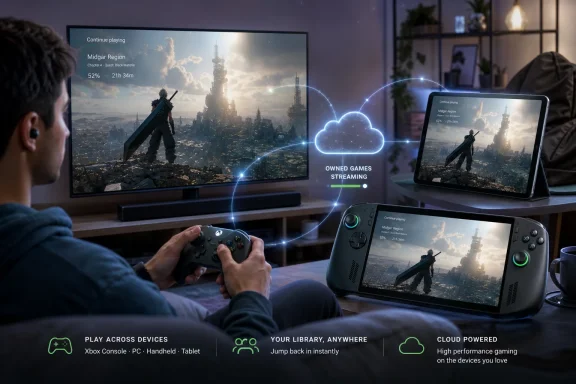
Xbox Game Pass subscribers can now stream more than 1,000 digitally owned Xbox games through Microsoft’s Stream Your Own Game feature after a June 15, 2026 expansion added 51 more titles, including Square Enix’s Final Fantasy VII Rebirth, across supported Xbox Cloud Gaming regions. That milestone is more than a catalog update. It is Microsoft quietly moving the center of gravity for Xbox away from the box under the television and toward the account, the library, and the screen closest to hand.
The important number is not merely 1,000. It is the implication that a paid-for Xbox library is becoming portable in a way that neither physical discs nor traditional console generations ever allowed. Microsoft has spent years telling players that Xbox is a platform rather than a machine; Stream Your Own Game is one of the first consumer-facing features that makes the slogan feel less like branding and more like infrastructure.
Cloud gaming has always suffered from a mismatch between ambition and habit. The pitch was easy: play console games anywhere, without a console, without a download, without waiting. The reality was harder: most players still cared about whether the specific game they owned, wanted, or were already playing was actually available.
That is why passing 1,000 supported owned titles matters. A cloud service with a few dozen showcase games feels like a demo. A service with hundreds feels like a subscription perk. A service with more than 1,000 begins to feel like a second access layer for an existing game library.
Microsoft’s standard Game Pass catalog remains the headline product for many subscribers, but Stream Your Own Game is a different and arguably more strategic idea. Game Pass is about access to a rotating library Microsoft licenses on the subscriber’s behalf. Stream Your Own Game is about access to games the subscriber has already bought digitally, whether or not those games are in the Game Pass catalog at the time.
That distinction is more than accounting. It changes the emotional relationship between the player and the cloud feature. A rotating catalog is entertainment rental; an owned digital library is identity, sunk cost, backlog, and habit. Microsoft is no longer simply asking whether users want to try a cloud game. It is asking whether they want their own Xbox shelf to follow them.
For years, cloud gaming’s best use cases were easy to describe but narrow. It was good for trying a game before downloading it. It was good for slower titles, turn-based games, or short sessions on a phone. It was useful when the television was occupied, when storage was tight, or when travel interrupted a save file. But it struggled to shake the sense that serious games still belonged on serious local hardware.
Rebirth complicates that story. It is visually lavish, lengthy, and structurally substantial, but it is also more forgiving than twitch-first genres. Its combat system blends action and command-driven decision-making, and its more deliberate modes make it a better fit for the small compromises that streaming still introduces.
That does not make latency disappear. It does make latency less fatal. A fighting game or competitive shooter can turn a hundred milliseconds into a lost round; a cinematic RPG can absorb occasional softness if the network is stable and the player is not trying to win an esports final from a hotel Wi-Fi connection.
A player who owns Final Fantasy VII Rebirth digitally can start on a Series X, continue on a tablet, check in from a browser, or hand the television back to the household without fully leaving the game behind. The console remains the best experience for many players, but it is no longer the only doorway into the purchase.
This is where Microsoft’s cloud strategy looks less like an attempt to replace hardware and more like an effort to soften hardware’s edges. Console gaming has always been bound by location, storage, household access, and the particular machine attached to the particular display. Cloud streaming attacks those limitations one by one.
It also changes the value of buying digitally. Physical media still has virtues: resale, collection, preservation, and independence from storefront whims. But Stream Your Own Game is a benefit that only attaches to digital ownership. For better and worse, Microsoft is adding convenience to the digital side of the ledger in a way disc buyers cannot fully replicate through Azure streaming.
This is one of those technical distinctions that doubles as a market signal. Microsoft does not need to tell users that digital libraries are the preferred future; it can simply make the digital version of ownership more useful. The convenience gap does the work.
For collectors and preservation-minded players, this is the uncomfortable part of the story. A disc can still feel more like ownership in the old-fashioned sense, but the digital purchase is increasingly the one that travels. The platform holder controls the account, the entitlement, the storefront, and now the cloud access layer.
That trade-off is not new, but cloud gaming makes it more visible. The user gains portability and loses some independence. Microsoft gains recurring subscription value, deeper account dependence, and a stronger reason for players to keep buying inside the Xbox ecosystem even if they do not always play on Xbox hardware.
Just as important is the presence of children’s licensed games, including entries tied to brands such as Adventure Time, Ben 10, and PAW Patrol. These are not the titles that dominate enthusiast headlines, but they may be among the most practically useful additions for families. A child streaming a familiar game to a tablet while the main console remains free is a far more convincing household scenario than a keynote demo about playing a blockbuster on a phone.
That family use case has always been one of cloud gaming’s underrated strengths. It is not necessarily about replacing the primary gaming setup. It is about adding extra play endpoints without buying extra consoles, juggling installs, or moving hardware between rooms.
For Game Pass, that matters because subscriptions are easier to justify when they solve mundane household friction. A parent may not care about the abstract future of cloud-native gaming. They may care very much that a child’s purchased game now works on a tablet during travel or while the living room television is otherwise occupied.
Games are bundles of contracts. Music, middleware, voice performances, licensed characters, sports likenesses, publishing agreements, platform terms, regional rights, and cloud distribution permissions can all complicate what appears to the player to be a simple question: why can I stream one game I own but not another?
That is why the library grows in batches. Each new wave reflects not just engineering readiness but commercial clearance. Microsoft’s progress past 1,000 titles suggests momentum, but the shape of the catalog will continue to reveal where publishers are comfortable and where older agreements remain awkward.
This also explains why some absences can feel arbitrary. A game may be technically capable of streaming but contractually unavailable. Another may be supported because its publisher sees cloud access as a low-cost way to extend sales. The user experiences this as inconsistency; the industry experiences it as rights management catching up to a distribution model it did not originally anticipate.
Every streamed session still consumes compute, power, bandwidth, operations, and capacity that could be used elsewhere. The idea that Microsoft pays no marginal cost because Azure is internal is too neat. Internal infrastructure still has opportunity costs, and cloud gaming is famously demanding because it requires low-latency interactive performance rather than batch processing or ordinary web delivery.
The advantage is integration, not magic. Microsoft can align Xbox, Azure, identity, payments, storefront entitlements, and subscription packaging under one corporate roof. It can make cloud gaming part of Game Pass rather than a separate meter running in the corner of the screen. That bundling is powerful because consumers are far more likely to try streaming when it feels included.
The remaining problem is experience. A bundled feature still has to work well enough that players come back. Cloud gaming does not need to beat local hardware in every scenario, but it has to be reliable enough that users trust it with more than curiosity clicks.
That matters for network effects. A feature limited to a smaller subscriber slice is harder for publishers to prioritize and harder for players to assume will be there. A feature available broadly across Game Pass tiers becomes a more predictable part of the Xbox value proposition.
The pricing and tier structure of Game Pass has become more complex over time, and users have not always welcomed that complexity. But Microsoft’s cloud logic is increasingly clear: keep cloud access from feeling like a boutique add-on. Make it a default expectation of being inside the Xbox subscription economy.
For Windows users, this is particularly relevant. Xbox is no longer just the console brand across the room; it is an account and services layer that intersects with PC browsers, handheld PCs, smart TVs, and mobile devices. The more Microsoft normalizes cloud access across tiers, the more Xbox becomes a Windows-adjacent service rather than a console silo.
Windows PCs have long been part of Xbox’s extended ecosystem, but cloud gaming changes their role. A low-end laptop that cannot run a modern AAA game locally can still become an Xbox endpoint through the browser. A work-travel machine, a mini PC, or a handheld Windows device can act as a portal into a console-class library without storing hundreds of gigabytes of installs.
That does not erase PC gaming’s local advantages. Native PC play still offers modding, high frame rates, better visual settings, peripheral flexibility, and independence from network quality. But cloud streaming fills a different gap: access without local horsepower.
The ROG Ally-style handheld category makes this especially interesting. Windows handhelds often struggle with battery life, thermals, launcher fragmentation, and shader compilation annoyances. Streaming a purchased Xbox game to such a device is not always the purist’s choice, but it can be the convenient one, particularly for games that are large, cinematic, or storage-hungry.
Cloud support amplifies that shift. It is one thing to launch on Xbox Series X|S and PC. It is another to make the game eligible for Microsoft’s wider screen network, where the buyer’s access is not bound to a single console install.
For Microsoft, Square Enix support carries symbolic weight. Xbox has often struggled in Japan and with parts of the Japanese RPG audience, not because Xbox players dislike those games, but because release patterns trained many fans to look elsewhere. High-profile JRPG availability across Xbox hardware, PC, Play Anywhere, and cloud streaming is a way to repair that perception slowly.
Nobody should overstate a single update. One cloud-enabled Final Fantasy entry does not solve Xbox’s global content-positioning challenges. But it does give Microsoft a cleaner story: major third-party games purchased in the Xbox ecosystem can follow the user beyond the console.
Cloud gaming is least impressive when discussed as a revolution and most persuasive when it quietly removes friction. If a user has to think about the architecture, the architecture has already failed. The best version of Stream Your Own Game is not a spectacle; it is the moment a purchased game appears on another screen and simply works.
That is also where Microsoft’s ambition becomes measurable. A 1,000-title library is impressive, but breadth without dependability becomes clutter. Users will forgive missing titles if the ones that are present work well. They will not forgive a large catalog that feels unpredictable.
This is why titles like Final Fantasy VII Rebirth are useful tests. A major RPG invites long sessions, save continuity, and repeated play over weeks. If cloud access becomes a normal way to chip away at a 70-hour game, Microsoft has something more valuable than a novelty: it has a habit.
The important number is not merely 1,000. It is the implication that a paid-for Xbox library is becoming portable in a way that neither physical discs nor traditional console generations ever allowed. Microsoft has spent years telling players that Xbox is a platform rather than a machine; Stream Your Own Game is one of the first consumer-facing features that makes the slogan feel less like branding and more like infrastructure.
 Microsoft’s Cloud Pitch Finally Has a Library Big Enough to Matter
Cloud gaming has always suffered from a mismatch between ambition and habit. The pitch was easy: play console games anywhere, without a console, without a download, without waiting. The reality was harder: most players still cared about whether the specific game they owned, wanted, or were already playing was actually available.That is why passing 1,000 supported owned titles matters. A cloud service with a few dozen showcase games feels like a demo. A service with hundreds feels like a subscription perk. A service with more than 1,000 begins to feel like a second access layer for an existing game library.
Microsoft’s standard Game Pass catalog remains the headline product for many subscribers, but Stream Your Own Game is a different and arguably more strategic idea. Game Pass is about access to a rotating library Microsoft licenses on the subscriber’s behalf. Stream Your Own Game is about access to games the subscriber has already bought digitally, whether or not those games are in the Game Pass catalog at the time.
That distinction is more than accounting. It changes the emotional relationship between the player and the cloud feature. A rotating catalog is entertainment rental; an owned digital library is identity, sunk cost, backlog, and habit. Microsoft is no longer simply asking whether users want to try a cloud game. It is asking whether they want their own Xbox shelf to follow them.
Final Fantasy VII Rebirth Is the Kind of Addition That Makes the Feature Legible
The arrival of Final Fantasy VII Rebirth is the update’s sharpest example because it is not a small indie title, a legacy curiosity, or a low-risk streaming test. It is a major Square Enix RPG, the second act of the modern Final Fantasy VII remake project, and the sort of sprawling, prestige release that historically anchored console purchases rather than cloud sessions.For years, cloud gaming’s best use cases were easy to describe but narrow. It was good for trying a game before downloading it. It was good for slower titles, turn-based games, or short sessions on a phone. It was useful when the television was occupied, when storage was tight, or when travel interrupted a save file. But it struggled to shake the sense that serious games still belonged on serious local hardware.
Rebirth complicates that story. It is visually lavish, lengthy, and structurally substantial, but it is also more forgiving than twitch-first genres. Its combat system blends action and command-driven decision-making, and its more deliberate modes make it a better fit for the small compromises that streaming still introduces.
That does not make latency disappear. It does make latency less fatal. A fighting game or competitive shooter can turn a hundred milliseconds into a lost round; a cinematic RPG can absorb occasional softness if the network is stable and the player is not trying to win an esports final from a hotel Wi-Fi connection.
The Real Product Is Not the Game, It Is Continuity
Microsoft’s most persuasive argument for Xbox Cloud Gaming is not that streaming is better than a console. It is that streaming is there when the console is not. That sounds modest, but it is precisely where the feature becomes practical.A player who owns Final Fantasy VII Rebirth digitally can start on a Series X, continue on a tablet, check in from a browser, or hand the television back to the household without fully leaving the game behind. The console remains the best experience for many players, but it is no longer the only doorway into the purchase.
This is where Microsoft’s cloud strategy looks less like an attempt to replace hardware and more like an effort to soften hardware’s edges. Console gaming has always been bound by location, storage, household access, and the particular machine attached to the particular display. Cloud streaming attacks those limitations one by one.
It also changes the value of buying digitally. Physical media still has virtues: resale, collection, preservation, and independence from storefront whims. But Stream Your Own Game is a benefit that only attaches to digital ownership. For better and worse, Microsoft is adding convenience to the digital side of the ledger in a way disc buyers cannot fully replicate through Azure streaming.
The Disc Is Becoming the Exception, Not the Center
The limitation is blunt: Stream Your Own Game works with digitally purchased titles, not physical discs. If the license is tied to a disc in a console drive, Microsoft’s cloud servers have no disc to authenticate. Remote Play from a home console can still help in those cases, but that is a different architecture with different dependencies.This is one of those technical distinctions that doubles as a market signal. Microsoft does not need to tell users that digital libraries are the preferred future; it can simply make the digital version of ownership more useful. The convenience gap does the work.
For collectors and preservation-minded players, this is the uncomfortable part of the story. A disc can still feel more like ownership in the old-fashioned sense, but the digital purchase is increasingly the one that travels. The platform holder controls the account, the entitlement, the storefront, and now the cloud access layer.
That trade-off is not new, but cloud gaming makes it more visible. The user gains portability and loses some independence. Microsoft gains recurring subscription value, deeper account dependence, and a stronger reason for players to keep buying inside the Xbox ecosystem even if they do not always play on Xbox hardware.
The 51-Game Batch Shows Microsoft Is Building Around Households, Not Just Hardcore Players
The June 15 batch is notable not only for its marquee RPG but for its spread. The inclusion of the Darksiders franchise gives action-adventure fans a complete series path through the cloud. Alone in the Dark, Battle Chasers: Nightwar, Sayonara Wild Hearts, Biomorph, Splitgate, and other additions broaden the service across horror, RPG, rhythm-action, platforming, and multiplayer niches.Just as important is the presence of children’s licensed games, including entries tied to brands such as Adventure Time, Ben 10, and PAW Patrol. These are not the titles that dominate enthusiast headlines, but they may be among the most practically useful additions for families. A child streaming a familiar game to a tablet while the main console remains free is a far more convincing household scenario than a keynote demo about playing a blockbuster on a phone.
That family use case has always been one of cloud gaming’s underrated strengths. It is not necessarily about replacing the primary gaming setup. It is about adding extra play endpoints without buying extra consoles, juggling installs, or moving hardware between rooms.
For Game Pass, that matters because subscriptions are easier to justify when they solve mundane household friction. A parent may not care about the abstract future of cloud-native gaming. They may care very much that a child’s purchased game now works on a tablet during travel or while the living room television is otherwise occupied.
Licensing, Not Technology, Is the Brake Pedal
The slow rollout of Stream Your Own Game titles is a reminder that cloud gaming is not merely a technical problem. Microsoft can have the servers, the clients, the encoders, and the user interface ready, and still be stopped by rights language written before cloud streaming was a mainstream commercial concern.Games are bundles of contracts. Music, middleware, voice performances, licensed characters, sports likenesses, publishing agreements, platform terms, regional rights, and cloud distribution permissions can all complicate what appears to the player to be a simple question: why can I stream one game I own but not another?
That is why the library grows in batches. Each new wave reflects not just engineering readiness but commercial clearance. Microsoft’s progress past 1,000 titles suggests momentum, but the shape of the catalog will continue to reveal where publishers are comfortable and where older agreements remain awkward.
This also explains why some absences can feel arbitrary. A game may be technically capable of streaming but contractually unavailable. Another may be supported because its publisher sees cloud access as a low-cost way to extend sales. The user experiences this as inconsistency; the industry experiences it as rights management catching up to a distribution model it did not originally anticipate.
Azure Gives Microsoft a Structural Advantage, but Not a Free Lunch
Microsoft’s unique advantage is that Xbox Cloud Gaming runs inside a cloud empire Microsoft already owns. Unlike a console-only competitor renting capacity from someone else, Microsoft can treat gaming workloads as part of a broader Azure strategy. That does not make streaming free, but it changes the economics and the strategic patience available to the company.Every streamed session still consumes compute, power, bandwidth, operations, and capacity that could be used elsewhere. The idea that Microsoft pays no marginal cost because Azure is internal is too neat. Internal infrastructure still has opportunity costs, and cloud gaming is famously demanding because it requires low-latency interactive performance rather than batch processing or ordinary web delivery.
The advantage is integration, not magic. Microsoft can align Xbox, Azure, identity, payments, storefront entitlements, and subscription packaging under one corporate roof. It can make cloud gaming part of Game Pass rather than a separate meter running in the corner of the screen. That bundling is powerful because consumers are far more likely to try streaming when it feels included.
The remaining problem is experience. A bundled feature still has to work well enough that players come back. Cloud gaming does not need to beat local hardware in every scenario, but it has to be reliable enough that users trust it with more than curiosity clicks.
The April Tier Expansion Made the June Milestone More Important
The availability of Stream Your Own Game across Essential, Premium, and Ultimate changes the feature’s meaning. When cloud streaming of owned titles was narrowly associated with the highest subscription tier, it looked like a premium experiment for enthusiasts. Across all tiers, it becomes closer to a platform guarantee.That matters for network effects. A feature limited to a smaller subscriber slice is harder for publishers to prioritize and harder for players to assume will be there. A feature available broadly across Game Pass tiers becomes a more predictable part of the Xbox value proposition.
The pricing and tier structure of Game Pass has become more complex over time, and users have not always welcomed that complexity. But Microsoft’s cloud logic is increasingly clear: keep cloud access from feeling like a boutique add-on. Make it a default expectation of being inside the Xbox subscription economy.
For Windows users, this is particularly relevant. Xbox is no longer just the console brand across the room; it is an account and services layer that intersects with PC browsers, handheld PCs, smart TVs, and mobile devices. The more Microsoft normalizes cloud access across tiers, the more Xbox becomes a Windows-adjacent service rather than a console silo.
Windows Is the Quiet Beneficiary of Xbox’s Screen-Agnostic Strategy
For a WindowsForum audience, the most interesting consequence is not whether a phone can stream Final Fantasy VII Rebirth. It is how Microsoft’s gaming strategy increasingly resembles its broader software strategy: sell the account, synchronize the state, and make the device less decisive.Windows PCs have long been part of Xbox’s extended ecosystem, but cloud gaming changes their role. A low-end laptop that cannot run a modern AAA game locally can still become an Xbox endpoint through the browser. A work-travel machine, a mini PC, or a handheld Windows device can act as a portal into a console-class library without storing hundreds of gigabytes of installs.
That does not erase PC gaming’s local advantages. Native PC play still offers modding, high frame rates, better visual settings, peripheral flexibility, and independence from network quality. But cloud streaming fills a different gap: access without local horsepower.
The ROG Ally-style handheld category makes this especially interesting. Windows handhelds often struggle with battery life, thermals, launcher fragmentation, and shader compilation annoyances. Streaming a purchased Xbox game to such a device is not always the purist’s choice, but it can be the convenient one, particularly for games that are large, cinematic, or storage-hungry.
Square Enix’s Xbox Turn Is Bigger Than One Cloud Toggle
The presence of Final Fantasy VII Rebirth also reflects a broader thaw in Square Enix’s relationship with Xbox. For years, the modern Final Fantasy pipeline often treated Xbox as secondary or absent, leaving Xbox players watching from the other side of timed exclusivity windows. Recent multiplatform moves suggest Square Enix wants a wider reach and a less platform-fragmented audience.Cloud support amplifies that shift. It is one thing to launch on Xbox Series X|S and PC. It is another to make the game eligible for Microsoft’s wider screen network, where the buyer’s access is not bound to a single console install.
For Microsoft, Square Enix support carries symbolic weight. Xbox has often struggled in Japan and with parts of the Japanese RPG audience, not because Xbox players dislike those games, but because release patterns trained many fans to look elsewhere. High-profile JRPG availability across Xbox hardware, PC, Play Anywhere, and cloud streaming is a way to repair that perception slowly.
Nobody should overstate a single update. One cloud-enabled Final Fantasy entry does not solve Xbox’s global content-positioning challenges. But it does give Microsoft a cleaner story: major third-party games purchased in the Xbox ecosystem can follow the user beyond the console.
Cloud Gaming Still Has to Win the Boring Moments
The long-term fate of Stream Your Own Game will not be decided by press-release milestones. It will be decided by boring moments: whether the session starts quickly, whether the controller pairs without drama, whether audio stays in sync, whether a hotel connection holds, whether a save appears where it should, and whether a child can launch a familiar game without summoning household IT support.Cloud gaming is least impressive when discussed as a revolution and most persuasive when it quietly removes friction. If a user has to think about the architecture, the architecture has already failed. The best version of Stream Your Own Game is not a spectacle; it is the moment a purchased game appears on another screen and simply works.
That is also where Microsoft’s ambition becomes measurable. A 1,000-title library is impressive, but breadth without dependability becomes clutter. Users will forgive missing titles if the ones that are present work well. They will not forgive a large catalog that feels unpredictable.
This is why titles like Final Fantasy VII Rebirth are useful tests. A major RPG invites long sessions, save continuity, and repeated play over weeks. If cloud access becomes a normal way to chip away at a 70-hour game, Microsoft has something more valuable than a novelty: it has a habit.
The 1,000-Game Line Turns a Perk Into a Platform Argument
The concrete lesson from this update is that Microsoft is no longer merely experimenting with cloud access to owned games. It is building a second distribution surface for the Xbox library, one that privileges digital ownership, subscription membership, and cross-device continuity.- Stream Your Own Game is separate from the rotating Game Pass catalog because it applies to supported games the subscriber has digitally purchased.
- The June 15, 2026 update added 51 supported titles and pushed the owned-game cloud library past 1,000 games.
- Final Fantasy VII Rebirth is the marquee addition because it is a large, prestige RPG that tests cloud gaming as more than a casual convenience.
- Physical disc ownership does not qualify for Azure-based streaming through this feature, though home-console Remote Play remains a separate option.
- Licensing remains the major reason every owned Xbox game is not instantly available through the cloud.
- The feature’s availability across Game Pass tiers makes it more central to Microsoft’s platform strategy than it was as an Ultimate-only perk.
References
- Primary source: Tech Times
Published: 2026-06-15T14:30:23.126722
Loading…
www.techtimes.com - Related coverage: gamesradar.com
Loading…
www.gamesradar.com - Related coverage: windowscentral.com
Loading…
www.windowscentral.com - Related coverage: trueachievements.com
Loading…
www.trueachievements.com - Related coverage: news.xbox.com

Xbox June Update: Copilot for Gaming Available for Testing on Mobile, Aggregated Gaming Library, and More - XBOX Wire
Exciting Xbox updates this month! Copilot for Gaming now in early preview on mobile, new Aggregated Gaming Library & Publisher Channels on the Xbox PC app, plus enhanced console features! news.xbox.com
- Related coverage: otontechnology.com
Loading…
otontechnology.com