

Capcom pushed a surprise Steam update for Ultimate Marvel vs. Capcom 3 on June 15, 2026, marking the PC version’s first visible patch activity since 2017 and reportedly breaking Dark Phoenix transformation behavior and existing mod compatibility. That is a small patch with an outsized blast radius. In one stroke, a decade-old fighting game became a live-service problem again, not because Capcom added new content, but because it touched a game whose competitive ecosystem had long since stabilized around its flaws.
The strangest thing about this patch is not that something broke. Software breaks all the time, especially old software being nudged into compatibility with modern operating systems. The strange part is that Ultimate Marvel vs. Capcom 3 had effectively become archival software: a fighting game preserved by its community, its tournaments, its mods, and its shared understanding of what the game is supposed to be.
The Steam patch notes, as reported by players and outlets tracking the update, were almost aggressively unhelpful: Windows 11 compatibility verification and miscellaneous bug fixes. That is the kind of changelog language PC users have learned to mistrust. It says “nothing to see here” while giving players no way to judge whether a tournament setup, a modded install, or a training environment is safe to update.
For a modern Windows game, that might be annoying. For a 2017 Steam rerelease of a 2011 fighting game built on years of matchup knowledge, lab work, and community tooling, it is something closer to a continuity error. The game did not just receive a patch. It received a reminder that digital ownership still comes with a remote control in someone else’s hand.
That is why the reported bug lands so hard. If Phoenix can no longer reliably enter Dark Phoenix mode, this is not equivalent to a broken costume, a menu glitch, or a controller prompt problem. It alters a core strategic bargain that has defined team construction and match pacing for more than a decade.
The community reaction has therefore been split between panic and comedy. On one hand, the game is literally broken for players who use Phoenix as intended. On the other hand, Dark Phoenix has terrorized enough brackets that some players are treating the patch like an accidental act of divine justice.
That tension is the perfect encapsulation of Marvel 3. It is a game loved not because it is clean, but because it is explosive, degenerate, and somehow coherent inside its own chaos. Remove one of its great monsters by accident, and even the players cheering know something important has been disturbed.
But compatibility work is also risky precisely because it can be invisible until it is not. A developer may update libraries, rebuild executables, adjust input handling, or touch legacy code paths without intending to alter gameplay. In a fighting game, however, unintended does not mean minor.
That is especially true for PC fighting games, where the executable is often the foundation for everything around the game: training mods, visual mods, rollback experiments, character projects, overlay tools, and community quality-of-life fixes. Even a harmless rebuild can break offsets, loaders, hooks, and assumptions that modders rely on.
WindowsForum readers know this pattern from outside gaming. A firmware update, a graphics driver, a security hardening change, or a runtime upgrade can all fix the thing named in the changelog while breaking the thing everyone actually depends on. This patch is a fighting-game version of that familiar sysadmin nightmare: the change window was real, the notes were vague, and the regression was visible immediately.
This is the paradox of old PC games with active communities. The publisher’s long absence creates space for fans to build infrastructure. Then, when the publisher returns with a small official patch, the community work is suddenly exposed as unofficial, fragile, and subordinate.
Capcom does not need to be acting maliciously for this to be disruptive. A developer can push a legitimate compatibility update and still break the ecosystem that made the game worth updating in the first place. Intent and impact are different stories.
For players, that distinction is cold comfort. A patch that improves Windows 11 compatibility in theory but breaks tournament-relevant behavior and mod support in practice is not a clean win. It is a reminder that maintenance without communication can be more destabilizing than neglect.
For casual users, auto-updates keep games current. For competitive communities, preservationists, and modders, auto-updates can erase the known-good version before anyone has had time to test the new one. That matters for locals, online events, content creators, and anyone who needs reproducible behavior.
The ideal world is obvious: old competitive games should have rollback branches, clear version notes, and tournament-safe builds. The real world is messier. Publishers often treat legacy updates as routine maintenance, while communities experience them as ecosystem events.
This is where the story stops being only about Dark Phoenix. The immediate bug is funny, dramatic, and very Marvel. The larger issue is that PC game preservation increasingly depends on platforms and publishers that were not designed around preserving competitive states indefinitely.
That is exactly what happened here. Players tested the patch, recorded the Dark Phoenix issue, compared notes across social media and Reddit, and began warning others not to update or to expect broken behavior. The community created the real patch notes because the official ones were not specific enough to be useful.
This is not a demand that every internal code change be documented in public. It is a demand that publishers recognize when a game’s mechanics are the product. In a fighting game, a character state failing to trigger is not a footnote. It is a stop-the-line defect.
The irony is that Capcom has spent the last several years rebuilding credibility with fighting-game players through stronger PC releases, better netcode expectations, and more serious long-term support for its modern titles. A sloppy legacy patch does not erase that progress, but it does show how quickly trust can wobble when a community feels surprised rather than served.
Vergil, Zero, Morrigan, Doctor Doom, Phoenix, Magneto, and their peers are not just characters. They are historical arguments. They represent a design era where fighting games allowed oppressive tools to exist and trusted players to build equally oppressive answers.
That is why an accidental Dark Phoenix nerf feels so alien. Players have argued about whether Phoenix is fair for more than a decade, but the argument itself is part of the game. A bug that removes or disrupts her defining comeback state does not settle the argument. It deletes the premise.
The same is true of modding. The PC community’s additions and experiments are not official canon, but they are part of the living culture around the game. Breaking them may be technically expected after an executable update, but for many players, those mods are now part of what Marvel 3 on PC means.
The worst outcome is also straightforward: silence. If the patch remains vague and the regression persists, the message to players will be that legacy support can arrive randomly, break critical behavior, and then linger unresolved. That would be worse than no patch at all.
There is also the possibility that this update was preparatory work for something else. Fans are understandably speculating, because publishers do not usually wake up and patch decade-old licensed fighting games for no reason. But speculation should be treated carefully. A Windows 11 compatibility pass may be exactly what it says on the tin, and the more immediate story is not hidden content or franchise revival but quality control.
Still, Capcom should understand what it touched. Ultimate Marvel vs. Capcom 3 is not abandonware in the cultural sense. It is a legacy competitive platform with a small but deeply invested audience, and those audiences notice everything.
But old competitive games need a different maintenance model than ordinary catalog titles. A patch that looks routine from a storefront operations perspective can be seismic inside a community that has preserved frame data, tournament rules, mod loaders, and matchup theory for years.
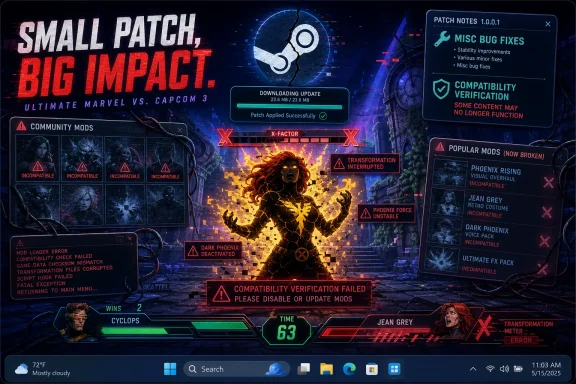 Capcom Accidentally Reopened a Sealed Time Capsule
The strangest thing about this patch is not that something broke. Software breaks all the time, especially old software being nudged into compatibility with modern operating systems. The strange part is that Ultimate Marvel vs. Capcom 3 had effectively become archival software: a fighting game preserved by its community, its tournaments, its mods, and its shared understanding of what the game is supposed to be.The Steam patch notes, as reported by players and outlets tracking the update, were almost aggressively unhelpful: Windows 11 compatibility verification and miscellaneous bug fixes. That is the kind of changelog language PC users have learned to mistrust. It says “nothing to see here” while giving players no way to judge whether a tournament setup, a modded install, or a training environment is safe to update.
For a modern Windows game, that might be annoying. For a 2017 Steam rerelease of a 2011 fighting game built on years of matchup knowledge, lab work, and community tooling, it is something closer to a continuity error. The game did not just receive a patch. It received a reminder that digital ownership still comes with a remote control in someone else’s hand.
Dark Phoenix Was Not Just a Character, She Was a Social Contract
Jean Grey’s Dark Phoenix mechanic is infamous because it turns scarcity into terror. Keep five meters stocked, let Phoenix die, and the player is rewarded with one of the most oppressive comeback states in modern fighting game history. She is fragile, demanding, and hated in precisely the way great villainous fighting-game design is hated: everyone complains, everyone labors against her, and everyone knows the game would feel different without her.That is why the reported bug lands so hard. If Phoenix can no longer reliably enter Dark Phoenix mode, this is not equivalent to a broken costume, a menu glitch, or a controller prompt problem. It alters a core strategic bargain that has defined team construction and match pacing for more than a decade.
The community reaction has therefore been split between panic and comedy. On one hand, the game is literally broken for players who use Phoenix as intended. On the other hand, Dark Phoenix has terrorized enough brackets that some players are treating the patch like an accidental act of divine justice.
That tension is the perfect encapsulation of Marvel 3. It is a game loved not because it is clean, but because it is explosive, degenerate, and somehow coherent inside its own chaos. Remove one of its great monsters by accident, and even the players cheering know something important has been disturbed.
The Windows 11 Line Is Doing a Lot of Work
The official-sounding explanation — compatibility verification for Windows 11 — is plausible. Older PC games often need attention as Windows evolves, drivers change, dependencies age, and storefront requirements shift. Anyone who has tried to keep a beloved Windows-era game running through multiple GPU generations knows that “it still launches” is not a permanent state of nature.But compatibility work is also risky precisely because it can be invisible until it is not. A developer may update libraries, rebuild executables, adjust input handling, or touch legacy code paths without intending to alter gameplay. In a fighting game, however, unintended does not mean minor.
That is especially true for PC fighting games, where the executable is often the foundation for everything around the game: training mods, visual mods, rollback experiments, character projects, overlay tools, and community quality-of-life fixes. Even a harmless rebuild can break offsets, loaders, hooks, and assumptions that modders rely on.
WindowsForum readers know this pattern from outside gaming. A firmware update, a graphics driver, a security hardening change, or a runtime upgrade can all fix the thing named in the changelog while breaking the thing everyone actually depends on. This patch is a fighting-game version of that familiar sysadmin nightmare: the change window was real, the notes were vague, and the regression was visible immediately.
Mods Became Collateral Damage in a Game Capcom Barely Touched
The reported mod breakage is unsurprising, but it still matters. Mods have been a major reason Ultimate Marvel vs. Capcom 3 has remained culturally alive on PC. Community projects have expanded rosters, altered visuals, improved training possibilities, and kept the game circulating far beyond what the original commercial lifecycle would have suggested.This is the paradox of old PC games with active communities. The publisher’s long absence creates space for fans to build infrastructure. Then, when the publisher returns with a small official patch, the community work is suddenly exposed as unofficial, fragile, and subordinate.
Capcom does not need to be acting maliciously for this to be disruptive. A developer can push a legitimate compatibility update and still break the ecosystem that made the game worth updating in the first place. Intent and impact are different stories.
For players, that distinction is cold comfort. A patch that improves Windows 11 compatibility in theory but breaks tournament-relevant behavior and mod support in practice is not a clean win. It is a reminder that maintenance without communication can be more destabilizing than neglect.
Steam’s Convenience Is Also the Trap
The platform layer matters here. Steam’s auto-update model is wonderful when a game is actively maintained, patched frequently, and supported with clear branch options. It is less wonderful when an old competitive title receives an unexpected update that players may not be able to easily avoid.For casual users, auto-updates keep games current. For competitive communities, preservationists, and modders, auto-updates can erase the known-good version before anyone has had time to test the new one. That matters for locals, online events, content creators, and anyone who needs reproducible behavior.
The ideal world is obvious: old competitive games should have rollback branches, clear version notes, and tournament-safe builds. The real world is messier. Publishers often treat legacy updates as routine maintenance, while communities experience them as ecosystem events.
This is where the story stops being only about Dark Phoenix. The immediate bug is funny, dramatic, and very Marvel. The larger issue is that PC game preservation increasingly depends on platforms and publishers that were not designed around preserving competitive states indefinitely.
The Patch Notes Failed the Moment Players Had to Investigate the Patch
“Miscellaneous bug fixes” is a phrase that should be retired from any update touching a competitive game, no matter how old. It tells users nothing about risk. It gives tournament organizers no basis for decision-making. It forces the most invested players to become unpaid QA analysts.That is exactly what happened here. Players tested the patch, recorded the Dark Phoenix issue, compared notes across social media and Reddit, and began warning others not to update or to expect broken behavior. The community created the real patch notes because the official ones were not specific enough to be useful.
This is not a demand that every internal code change be documented in public. It is a demand that publishers recognize when a game’s mechanics are the product. In a fighting game, a character state failing to trigger is not a footnote. It is a stop-the-line defect.
The irony is that Capcom has spent the last several years rebuilding credibility with fighting-game players through stronger PC releases, better netcode expectations, and more serious long-term support for its modern titles. A sloppy legacy patch does not erase that progress, but it does show how quickly trust can wobble when a community feels surprised rather than served.
Marvel 3 Survived Because It Was Broken in the Right Ways
There is a reason this story has traveled so quickly. Ultimate Marvel vs. Capcom 3 is not remembered as a balanced masterpiece in the sterile sense. It is remembered as a game where absurdity became grammar.Vergil, Zero, Morrigan, Doctor Doom, Phoenix, Magneto, and their peers are not just characters. They are historical arguments. They represent a design era where fighting games allowed oppressive tools to exist and trusted players to build equally oppressive answers.
That is why an accidental Dark Phoenix nerf feels so alien. Players have argued about whether Phoenix is fair for more than a decade, but the argument itself is part of the game. A bug that removes or disrupts her defining comeback state does not settle the argument. It deletes the premise.
The same is true of modding. The PC community’s additions and experiments are not official canon, but they are part of the living culture around the game. Breaking them may be technically expected after an executable update, but for many players, those mods are now part of what Marvel 3 on PC means.
Capcom’s Silence Now Carries More Weight Than the Patch
At this stage, the best outcome is straightforward. Capcom should acknowledge the Dark Phoenix regression, clarify what changed, and either hotfix the issue or provide a temporary rollback branch for players who need the previous build. If mod compatibility was broken as a side effect, Capcom does not have to endorse every mod to recognize that the PC community needs time and information.The worst outcome is also straightforward: silence. If the patch remains vague and the regression persists, the message to players will be that legacy support can arrive randomly, break critical behavior, and then linger unresolved. That would be worse than no patch at all.
There is also the possibility that this update was preparatory work for something else. Fans are understandably speculating, because publishers do not usually wake up and patch decade-old licensed fighting games for no reason. But speculation should be treated carefully. A Windows 11 compatibility pass may be exactly what it says on the tin, and the more immediate story is not hidden content or franchise revival but quality control.
Still, Capcom should understand what it touched. Ultimate Marvel vs. Capcom 3 is not abandonware in the cultural sense. It is a legacy competitive platform with a small but deeply invested audience, and those audiences notice everything.
The Phoenix Bug Turns a Tiny Patch Into a Preservation Lesson
The concrete lesson is not that publishers should never update old games. They should. Compatibility fixes matter, especially as Windows, GPUs, controllers, and storefront requirements keep moving under software that was never built for 15 years of survival.But old competitive games need a different maintenance model than ordinary catalog titles. A patch that looks routine from a storefront operations perspective can be seismic inside a community that has preserved frame data, tournament rules, mod loaders, and matchup theory for years.
- The June 15, 2026 Steam update reportedly made Dark Phoenix transformation behavior fail even when Jean Grey has the required five meters.
- The patch notes were limited to Windows 11 compatibility verification and miscellaneous bug fixes, leaving players to discover the gameplay regression themselves.
- Existing PC mods were reportedly broken, which is common after executable updates but unusually disruptive after years without visible patch activity.
- Competitive communities need rollback options or branch controls when old games receive unexpected updates.
- Capcom can still turn the moment into goodwill if it communicates quickly, fixes the regression, and treats the PC community as stakeholders rather than edge cases.
References
- Primary source: Shacknews
Published: 2026-06-15T15:10:08.220901
Loading…
www.shacknews.com - Related coverage: primagames.com
Loading…
primagames.com - Related coverage: gamecharts.org
Loading…
gamecharts.org - Related coverage: store.steampowered.com
Loading…
store.steampowered.com - Related coverage: live-player-count.com
Loading…
live-player-count.com - Related coverage: steambase.io
Loading…
steambase.io