

Amazon executive Panos Panay is scheduled to headline a June 17 fireside chat at the Filoxenia Conference Centre in Nicosia, Cyprus, during the two-day “Shaping the Next Digital Frontier” conference tied to Cyprus’s 2026 Presidency of the Council of the European Union. The appearance matters less as a celebrity booking than as a neatly staged collision between two visions of technology policy: Europe’s institutional push for digital sovereignty and Amazon’s commercial bet that ambient AI can become infrastructure. Panay, the former Microsoft Windows and Surface chief now running Amazon’s Devices and Services business, is an unusually symbolic speaker for that argument. He has spent his career selling the idea that hardware, software, and services only matter when they become habit.
The Nicosia event arrives at a moment when Europe’s digital conversation has become noticeably more impatient. For years, the continent’s policymakers have spoken fluently about artificial intelligence, cloud sovereignty, cybersecurity, digital identity, and industrial competitiveness. The harder problem has been turning that vocabulary into products, services, jobs, and public-sector capacity at the pace set by American and Chinese platform companies.
That is why the wording of Panay’s session, “From Innovation to Real-World Impact,” is doing more work than a conference title usually does. It reflects a shift from invention as spectacle to adoption as the real test. In the AI era, the bottleneck is increasingly not whether a model can generate text, summarize documents, or respond to voice commands. It is whether institutions can redesign workflows, data governance, procurement rules, labor practices, and public trust quickly enough to use those capabilities without breaking something important.
Cyprus is an interesting stage for that discussion precisely because it is not Berlin, Paris, Brussels, or Dublin. As holder of the Council presidency in the first half of 2026, it gets a temporary but meaningful role in shaping the European agenda. The symbolism is obvious: a smaller member state hosting a global platform executive to talk about how digital tools translate into economic and social value.
For WindowsForum readers, the Panay angle adds another layer. This is not just an Amazon story. It is also a Windows story, because Panay’s career tracks one of the great reversals in personal computing: the move from the PC as the center of digital life to the PC as one important surface among many.
Panay became the public face of that bet. His product launches leaned heavily on craft, feel, hinges, pens, magnesium bodies, and the emotional language of making things. That mattered because Microsoft, for much of its history, was better known for licensing models and enterprise contracts than for hardware desire.
Surface did not defeat the iPad, and it did not remake the PC industry overnight. But it did something more strategically useful for Microsoft: it proved there was room for premium Windows hardware that treated the operating system, silicon, accessories, and industrial design as a single product experience. It pressured OEMs to improve, gave Windows a flagship, and helped legitimize form factors that now look ordinary.
By the time Panay became Microsoft’s chief product officer and led Windows and Devices, the center of gravity had shifted again. Windows 11, Copilot, Arm PCs, cloud services, and AI acceleration all pointed toward a future in which the operating system was still essential but no longer sufficient. The product story had to stretch across local hardware, cloud intelligence, developer ecosystems, and user identity.
That is the résumé Amazon bought when Panay joined in 2023. It did not hire only a gadget executive. It hired someone fluent in the politics of platforms, the theater of product launches, and the difficult art of making a mature technology category feel newly alive.
The problem is that first-generation voice assistants trained users to expect narrow utility. Set a timer. Play a song. Turn on a light. Check the weather. The technology was impressive when it arrived, then quietly became furniture.
Generative AI reopened that story. If Alexa can become conversational, contextual, and capable of acting across services, Amazon’s devices look less like a collection of endpoints and more like a distributed interface. The Echo is no longer just a speaker, the Fire TV is no longer just a streaming box, and the Ring camera is no longer just a sensor at the door. They become places where an assistant can observe, infer, recommend, and act.
That is the opportunity Panay is expected to keep pushing. It is also the danger. The smarter and more ambient Alexa becomes, the more it raises questions about privacy, dependency, lock-in, hallucination, consent, and the boundaries between convenience and surveillance.
Europe’s digital policymakers know this tension well. The EU has spent the past several years trying to regulate platform power, data handling, AI risk, and online markets without smothering innovation. Amazon wants to talk about impact. Europe wants impact with guardrails, accountability, and a larger share of the value chain.
That changes the question. A few years ago, executives asked whether AI could perform a task. Now they ask whether the task should be redesigned around AI, whether the output can be trusted, whether workers will accept it, whether regulators will permit it, and whether the economics make sense at scale.
This is where Panay’s Microsoft past becomes relevant. Windows succeeded historically not because it was the most elegant piece of software, but because it became the default working environment for businesses, developers, hardware makers, and users. Its power came from adoption loops. People built for it because people used it; people used it because everything was built for it.
Amazon’s AI device strategy needs a similar loop, but the terrain is different. The PC was a visible machine with a screen, keyboard, file system, and user-controlled applications. Ambient AI is often invisible, distributed, and mediated through speech, sensors, cloud APIs, and subscriptions. Trust becomes harder to inspect.
For governments and enterprises, that matters. A chatbot inside a browser is one thing. An AI assistant connected to commerce, media, smart-home devices, calendars, cameras, and personal preferences is another. The more useful it becomes, the more consequential its mistakes become.
That distinction matters. The EU is not simply a market for American technology companies. It is a regulatory superpower, a standards exporter, and an increasingly assertive buyer of digital infrastructure. Companies that want European scale must speak the language of sovereignty, resilience, interoperability, security, and rights.
Amazon is already embedded across Europe through retail, logistics, cloud infrastructure, entertainment, devices, and marketplace services. But AI intensifies every existing concern about concentration. If assistants become the new front door to services, the companies that control those assistants may gain extraordinary influence over what people see, buy, automate, and trust.
Panay’s task is therefore partly diplomatic. He must describe innovation in terms that appeal not only to consumers but to policymakers who worry that Europe is becoming a rule-maker rather than a builder. That requires a careful message: Amazon can help turn AI into practical value, while Europe can help define the conditions under which that value is legitimate.
This is where the conference framing is clever. “Real-world impact” sounds safe, even civic. But impact is never neutral. A technology that saves time for consumers can disrupt labor markets; a device that improves home convenience can normalize persistent data collection; a cloud service that accelerates startups can deepen dependence on non-European infrastructure.
The AI assistant may become a similar coordination point. Instead of launching applications from a Start menu, users may ask an assistant to complete tasks across services. Instead of choosing among visible software tools, they may accept a suggested action, generated summary, or automated workflow. Instead of device capability being defined by local specs alone, it may be defined by the assistant’s access to models, context, permissions, and APIs.
That has obvious implications for Windows. Microsoft is trying to make Copilot and AI-enhanced Windows experiences feel native to the PC. Amazon is trying to make Alexa and its successors feel native to the home and to everyday consumer services. Google, Apple, OpenAI, Meta, and others are all competing to define the user’s default relationship with AI.
Panay is one of the few executives who can credibly talk across those eras. He understands the PC as a productivity platform and the device as an emotional object. At Amazon, he is operating in a world where the device may matter most as a sensor, speaker, display, or identity anchor for a cloud-based assistant.
For IT pros, the lesson is uncomfortable but useful. The next platform war may not look like Windows versus macOS or Android versus iOS. It may look like a contest over which assistant gets permission to act on behalf of users across work, home, commerce, entertainment, and public services.
That is especially important because digital transformation often concentrates benefits. Major cloud regions, AI labs, chip investments, and platform headquarters cluster in a limited number of places. Smaller economies risk becoming consumers of imported systems rather than producers of exportable capability.
For Cyprus, the value of a conference like this is not only in attracting high-profile speakers. It is in connecting policymakers, researchers, entrepreneurs, and technology professionals around practical implementation. If AI is to produce broad-based economic value, it cannot remain confined to hyperscalers, elite universities, and a handful of capital-rich startups.
The same applies across Europe. The continent’s digital future will not be secured solely by passing regulations or funding research. It will depend on whether small businesses can adopt AI safely, whether public administrations can modernize without surrendering control of sensitive data, whether universities can train talent, and whether startups can scale without immediately becoming acquisition targets for foreign giants.
Panay’s appearance dramatizes the tension. Europe wants autonomy; Amazon offers capability. Europe wants competition; platform economics reward concentration. Europe wants trustworthy AI; consumer adoption often rewards convenience before governance catches up.
Real-world impact means measuring what happens after deployment. Does an AI assistant reduce administrative burden or merely move it? Does it help older users and people with disabilities, or does it leave behind those with accents, limited connectivity, or low digital confidence? Does it make public services faster, or does it create opaque automated decisions that citizens cannot challenge?
These are not abstract European worries. They are product questions. A device ecosystem that cannot earn trust will eventually run into adoption limits, especially in regulated sectors and privacy-conscious households.
Amazon’s challenge is that its greatest strengths also feed suspicion. It has scale, logistics, cloud capacity, retail relationships, media services, smart-home hardware, and enormous user data flows. Those assets make powerful AI experiences possible. They also make users and regulators ask who benefits when the assistant becomes more capable.
Panay’s best argument in Nicosia will likely be pragmatic: innovation matters only when it improves daily life. That is a strong line because it shifts the conversation away from model benchmarks and toward outcomes. But outcomes must be audited, not merely asserted.
Amazon’s ambient AI ambitions could travel the same road faster. A voice assistant in the home touches intimate spaces. A shopping assistant touches household spending. A media assistant shapes attention. A smart-home assistant can affect security, energy use, and domestic routines.
That is why the Windows analogy is useful but incomplete. PCs trained users to expect a certain degree of control: files, settings, installed programs, local peripherals, administrative rights, and visible system behavior. Ambient AI often asks users to delegate intent without seeing every intermediate step.
For sysadmins and security teams, this is the part worth watching. The consumer assistant today can become the enterprise expectation tomorrow. Employees who grow comfortable asking AI to arrange, summarize, purchase, schedule, and troubleshoot at home will bring similar expectations to work. Organizations will then face the usual dilemma: block unsanctioned tools and frustrate users, or adopt sanctioned ones and inherit new governance burdens.
Microsoft is already pushing Copilot through that enterprise door. Amazon’s strongest AI presence remains more consumer and home-centered, though AWS gives the company deep enterprise reach. Panay’s Devices and Services brief sits at the intersection of those worlds, which is exactly why his comments in a European policy setting deserve attention.
In the AI device era, the object is still important, but it is less self-contained. The intelligence lives partly in the cloud, partly in local silicon, partly in user context, and partly in the service integrations behind the scenes. A device may succeed not because its casing is beautiful, but because it is the most convenient place for an assistant to appear.
That creates a design challenge Panay is well suited to discuss. Good AI hardware cannot feel like a generic microphone strapped to a subscription. It must offer clear affordances: when it is listening, what it knows, what it can do, what it cannot do, and how the user can stop it. The old rules of industrial design still matter, but they now include consent and explainability.
This also complicates Europe’s industrial ambitions. Building competitive AI hardware is not just a matter of assembling devices. It requires chips, models, cloud infrastructure, developer ecosystems, privacy frameworks, distribution channels, and consumer trust. The value chain is broad, and Europe is trying to avoid being strong in principles but weak in execution.
Amazon will argue, implicitly or explicitly, that it can provide the execution. Europe’s counterargument is that execution without accountability simply recreates the platform dependencies of the last generation.
That breadth is why Panay is an important speaker for a digital innovation conference. He is not merely selling one assistant. He represents a model in which digital value emerges from the integration of devices, services, networks, AI, and commerce.
Europe’s policymakers will recognize the scale of that model. They will also recognize how difficult it is to reproduce. A startup can build a clever AI application. A government can fund a research program. A university can train engineers. But few actors can connect hardware distribution, cloud compute, consumer accounts, entertainment, retail, and household presence.
This is the platform problem in its modern form. The companies best positioned to make AI useful are often the companies already powerful enough to raise competition concerns. The companies most trusted to regulate the market are often not the companies best positioned to build at speed.
Nicosia will not resolve that contradiction. But it can make it more visible. That alone is useful.
Consumers do not change habits just because a company announces a smarter assistant. They change when the assistant reliably does something valuable, does it faster than the old method, and fails in ways that are understandable and recoverable. That is a high bar, particularly for voice interfaces that many users still associate with timers and trivia.
Amazon has one advantage that many AI startups lack: installed presence. Echo speakers, Fire TV devices, Ring doorbells, and other endpoints already exist in homes. The challenge is to convert that presence into renewed engagement without making users feel that their homes have become test beds for an always-expanding platform.
Microsoft faces a parallel challenge with Windows. Copilot and AI features can be placed in front of hundreds of millions of PC users, but placement is not the same as usefulness. If AI becomes clutter, users will ignore it. If it becomes intrusive, administrators will disable it. If it becomes genuinely helpful, it may redefine expectations for the operating system itself.
Panay’s career connects those two realities. He helped Microsoft turn hardware skepticism into a durable product line. Now he is trying to help Amazon turn assistant fatigue into an AI platform story.
The operating system is no longer the only place where computing platforms assert control. Assistants, browsers, cloud identity systems, app stores, device ecosystems, and AI agents all compete to become the user’s primary interface. Windows remains central, but it now shares the stage with layers that can route around it.
For sysadmins, that means governance must expand beyond the PC. Policies for AI assistants, data sharing, smart devices, home-office hardware, and cross-service automation will become harder to separate. The same user may interact with Microsoft 365 Copilot at work, Alexa at home, ChatGPT in a browser, Gemini on a phone, and Apple Intelligence on a personal device.
For policymakers, the stakes are even broader. Digital innovation becomes social value only when it is widely accessible, economically productive, secure, and trusted. Otherwise it becomes another wave of dependency dressed as modernization.
That tension will define the next phase of consumer and enterprise computing.
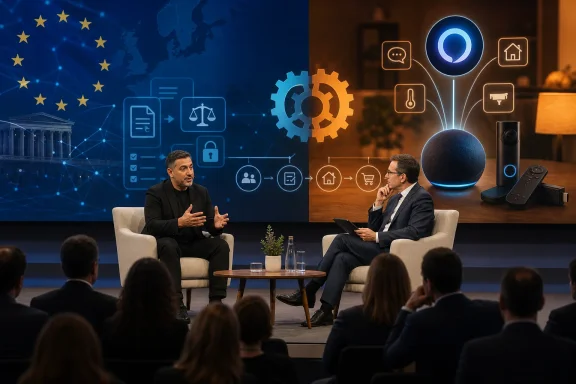 Europe Wants Innovation to Leave the Slide Deck
The Nicosia event arrives at a moment when Europe’s digital conversation has become noticeably more impatient. For years, the continent’s policymakers have spoken fluently about artificial intelligence, cloud sovereignty, cybersecurity, digital identity, and industrial competitiveness. The harder problem has been turning that vocabulary into products, services, jobs, and public-sector capacity at the pace set by American and Chinese platform companies.That is why the wording of Panay’s session, “From Innovation to Real-World Impact,” is doing more work than a conference title usually does. It reflects a shift from invention as spectacle to adoption as the real test. In the AI era, the bottleneck is increasingly not whether a model can generate text, summarize documents, or respond to voice commands. It is whether institutions can redesign workflows, data governance, procurement rules, labor practices, and public trust quickly enough to use those capabilities without breaking something important.
Cyprus is an interesting stage for that discussion precisely because it is not Berlin, Paris, Brussels, or Dublin. As holder of the Council presidency in the first half of 2026, it gets a temporary but meaningful role in shaping the European agenda. The symbolism is obvious: a smaller member state hosting a global platform executive to talk about how digital tools translate into economic and social value.
For WindowsForum readers, the Panay angle adds another layer. This is not just an Amazon story. It is also a Windows story, because Panay’s career tracks one of the great reversals in personal computing: the move from the PC as the center of digital life to the PC as one important surface among many.
Panos Panay Built Microsoft’s Device Story Before Amazon Needed One
Panos Panay’s reputation was forged at Microsoft during the company’s long, awkward, and ultimately consequential attempt to become a serious hardware maker. Surface began as a risky answer to the iPad and to the broader question of whether Windows could remain relevant when computing moved beyond traditional laptops. It was not merely a device line; it was a statement that Microsoft could no longer rely entirely on OEM partners to express its operating-system ambitions.Panay became the public face of that bet. His product launches leaned heavily on craft, feel, hinges, pens, magnesium bodies, and the emotional language of making things. That mattered because Microsoft, for much of its history, was better known for licensing models and enterprise contracts than for hardware desire.
Surface did not defeat the iPad, and it did not remake the PC industry overnight. But it did something more strategically useful for Microsoft: it proved there was room for premium Windows hardware that treated the operating system, silicon, accessories, and industrial design as a single product experience. It pressured OEMs to improve, gave Windows a flagship, and helped legitimize form factors that now look ordinary.
By the time Panay became Microsoft’s chief product officer and led Windows and Devices, the center of gravity had shifted again. Windows 11, Copilot, Arm PCs, cloud services, and AI acceleration all pointed toward a future in which the operating system was still essential but no longer sufficient. The product story had to stretch across local hardware, cloud intelligence, developer ecosystems, and user identity.
That is the résumé Amazon bought when Panay joined in 2023. It did not hire only a gadget executive. It hired someone fluent in the politics of platforms, the theater of product launches, and the difficult art of making a mature technology category feel newly alive.
Amazon’s Device Problem Is Really an AI Interface Problem
Amazon’s Devices and Services business has long been a paradox. Echo speakers, Fire TV devices, Ring cameras, Blink systems, Eero routers, Kindles, and Fire tablets have placed Amazon in millions of homes, but the strategic center of that ecosystem has always been Alexa. Alexa was supposed to be the ambient interface to the household: voice-first, low-friction, always nearby.The problem is that first-generation voice assistants trained users to expect narrow utility. Set a timer. Play a song. Turn on a light. Check the weather. The technology was impressive when it arrived, then quietly became furniture.
Generative AI reopened that story. If Alexa can become conversational, contextual, and capable of acting across services, Amazon’s devices look less like a collection of endpoints and more like a distributed interface. The Echo is no longer just a speaker, the Fire TV is no longer just a streaming box, and the Ring camera is no longer just a sensor at the door. They become places where an assistant can observe, infer, recommend, and act.
That is the opportunity Panay is expected to keep pushing. It is also the danger. The smarter and more ambient Alexa becomes, the more it raises questions about privacy, dependency, lock-in, hallucination, consent, and the boundaries between convenience and surveillance.
Europe’s digital policymakers know this tension well. The EU has spent the past several years trying to regulate platform power, data handling, AI risk, and online markets without smothering innovation. Amazon wants to talk about impact. Europe wants impact with guardrails, accountability, and a larger share of the value chain.
The Real Digital Frontier Is Adoption, Not Invention
The phrase “digital frontier” can sound like conference wallpaper, but in 2026 it points to a real strategic divide. The most advanced AI systems are no longer confined to research labs or developer demos. They are being pushed into office suites, customer support desks, home devices, coding environments, public services, classrooms, and security operations centers.That changes the question. A few years ago, executives asked whether AI could perform a task. Now they ask whether the task should be redesigned around AI, whether the output can be trusted, whether workers will accept it, whether regulators will permit it, and whether the economics make sense at scale.
This is where Panay’s Microsoft past becomes relevant. Windows succeeded historically not because it was the most elegant piece of software, but because it became the default working environment for businesses, developers, hardware makers, and users. Its power came from adoption loops. People built for it because people used it; people used it because everything was built for it.
Amazon’s AI device strategy needs a similar loop, but the terrain is different. The PC was a visible machine with a screen, keyboard, file system, and user-controlled applications. Ambient AI is often invisible, distributed, and mediated through speech, sensors, cloud APIs, and subscriptions. Trust becomes harder to inspect.
For governments and enterprises, that matters. A chatbot inside a browser is one thing. An AI assistant connected to commerce, media, smart-home devices, calendars, cameras, and personal preferences is another. The more useful it becomes, the more consequential its mistakes become.
Nicosia Gives Amazon a European Audience It Cannot Ignore
Amazon does not need a conference in Cyprus to announce a product. If Panay wanted to reveal a new Echo, Kindle, Fire TV device, or Alexa feature, the company has its own stages for that. His Nicosia appearance is more likely to function as soft power: a chance to place Amazon’s consumer AI ambitions inside Europe’s policy conversation about competitiveness and social value.That distinction matters. The EU is not simply a market for American technology companies. It is a regulatory superpower, a standards exporter, and an increasingly assertive buyer of digital infrastructure. Companies that want European scale must speak the language of sovereignty, resilience, interoperability, security, and rights.
Amazon is already embedded across Europe through retail, logistics, cloud infrastructure, entertainment, devices, and marketplace services. But AI intensifies every existing concern about concentration. If assistants become the new front door to services, the companies that control those assistants may gain extraordinary influence over what people see, buy, automate, and trust.
Panay’s task is therefore partly diplomatic. He must describe innovation in terms that appeal not only to consumers but to policymakers who worry that Europe is becoming a rule-maker rather than a builder. That requires a careful message: Amazon can help turn AI into practical value, while Europe can help define the conditions under which that value is legitimate.
This is where the conference framing is clever. “Real-world impact” sounds safe, even civic. But impact is never neutral. A technology that saves time for consumers can disrupt labor markets; a device that improves home convenience can normalize persistent data collection; a cloud service that accelerates startups can deepen dependence on non-European infrastructure.
Windows Veterans Should Recognize the Platform Play
The Windows community has seen this movie before, though the props have changed. In the 1990s and 2000s, Microsoft’s strategic advantage came from controlling the layer where users, developers, and hardware makers met. Windows was not merely software installed on a PC. It was the coordination point for an ecosystem.The AI assistant may become a similar coordination point. Instead of launching applications from a Start menu, users may ask an assistant to complete tasks across services. Instead of choosing among visible software tools, they may accept a suggested action, generated summary, or automated workflow. Instead of device capability being defined by local specs alone, it may be defined by the assistant’s access to models, context, permissions, and APIs.
That has obvious implications for Windows. Microsoft is trying to make Copilot and AI-enhanced Windows experiences feel native to the PC. Amazon is trying to make Alexa and its successors feel native to the home and to everyday consumer services. Google, Apple, OpenAI, Meta, and others are all competing to define the user’s default relationship with AI.
Panay is one of the few executives who can credibly talk across those eras. He understands the PC as a productivity platform and the device as an emotional object. At Amazon, he is operating in a world where the device may matter most as a sensor, speaker, display, or identity anchor for a cloud-based assistant.
For IT pros, the lesson is uncomfortable but useful. The next platform war may not look like Windows versus macOS or Android versus iOS. It may look like a contest over which assistant gets permission to act on behalf of users across work, home, commerce, entertainment, and public services.
Cyprus Is Small, but the Policy Stakes Are Not
Cyprus’s role in this story should not be dismissed as ceremonial. Council presidencies are temporary, but they shape agendas, convene meetings, and give member states a chance to emphasize particular priorities. A digital and AI conference in Nicosia during that window signals that Europe’s smaller states want a voice in the architecture of the next economy.That is especially important because digital transformation often concentrates benefits. Major cloud regions, AI labs, chip investments, and platform headquarters cluster in a limited number of places. Smaller economies risk becoming consumers of imported systems rather than producers of exportable capability.
For Cyprus, the value of a conference like this is not only in attracting high-profile speakers. It is in connecting policymakers, researchers, entrepreneurs, and technology professionals around practical implementation. If AI is to produce broad-based economic value, it cannot remain confined to hyperscalers, elite universities, and a handful of capital-rich startups.
The same applies across Europe. The continent’s digital future will not be secured solely by passing regulations or funding research. It will depend on whether small businesses can adopt AI safely, whether public administrations can modernize without surrendering control of sensitive data, whether universities can train talent, and whether startups can scale without immediately becoming acquisition targets for foreign giants.
Panay’s appearance dramatizes the tension. Europe wants autonomy; Amazon offers capability. Europe wants competition; platform economics reward concentration. Europe wants trustworthy AI; consumer adoption often rewards convenience before governance catches up.
The Social Value Test Is Harder Than the Product Demo
Technology companies are very good at showing what a tool can do under ideal conditions. A keynote demo is designed to remove friction: the network works, the account is configured, the model behaves, the use case is obvious, and the presenter knows exactly what to ask. Real life is less theatrical.Real-world impact means measuring what happens after deployment. Does an AI assistant reduce administrative burden or merely move it? Does it help older users and people with disabilities, or does it leave behind those with accents, limited connectivity, or low digital confidence? Does it make public services faster, or does it create opaque automated decisions that citizens cannot challenge?
These are not abstract European worries. They are product questions. A device ecosystem that cannot earn trust will eventually run into adoption limits, especially in regulated sectors and privacy-conscious households.
Amazon’s challenge is that its greatest strengths also feed suspicion. It has scale, logistics, cloud capacity, retail relationships, media services, smart-home hardware, and enormous user data flows. Those assets make powerful AI experiences possible. They also make users and regulators ask who benefits when the assistant becomes more capable.
Panay’s best argument in Nicosia will likely be pragmatic: innovation matters only when it improves daily life. That is a strong line because it shifts the conversation away from model benchmarks and toward outcomes. But outcomes must be audited, not merely asserted.
The Windows Angle Is a Warning Against Mistaking Ubiquity for Trust
Microsoft learned over decades that ubiquity is both a moat and a liability. Windows became indispensable, and that made every design choice, security flaw, forced update, browser bundling decision, and telemetry change politically charged. The more central a platform becomes, the less users experience its decisions as optional.Amazon’s ambient AI ambitions could travel the same road faster. A voice assistant in the home touches intimate spaces. A shopping assistant touches household spending. A media assistant shapes attention. A smart-home assistant can affect security, energy use, and domestic routines.
That is why the Windows analogy is useful but incomplete. PCs trained users to expect a certain degree of control: files, settings, installed programs, local peripherals, administrative rights, and visible system behavior. Ambient AI often asks users to delegate intent without seeing every intermediate step.
For sysadmins and security teams, this is the part worth watching. The consumer assistant today can become the enterprise expectation tomorrow. Employees who grow comfortable asking AI to arrange, summarize, purchase, schedule, and troubleshoot at home will bring similar expectations to work. Organizations will then face the usual dilemma: block unsanctioned tools and frustrate users, or adopt sanctioned ones and inherit new governance burdens.
Microsoft is already pushing Copilot through that enterprise door. Amazon’s strongest AI presence remains more consumer and home-centered, though AWS gives the company deep enterprise reach. Panay’s Devices and Services brief sits at the intersection of those worlds, which is exactly why his comments in a European policy setting deserve attention.
The AI Hardware Story Has Become Less About Hardware
When Panay ran Surface, the hardware object was the argument. A kickstand could symbolize flexibility. A detachable keyboard could symbolize category fusion. A pen could symbolize creativity and precision. The physical product carried the narrative.In the AI device era, the object is still important, but it is less self-contained. The intelligence lives partly in the cloud, partly in local silicon, partly in user context, and partly in the service integrations behind the scenes. A device may succeed not because its casing is beautiful, but because it is the most convenient place for an assistant to appear.
That creates a design challenge Panay is well suited to discuss. Good AI hardware cannot feel like a generic microphone strapped to a subscription. It must offer clear affordances: when it is listening, what it knows, what it can do, what it cannot do, and how the user can stop it. The old rules of industrial design still matter, but they now include consent and explainability.
This also complicates Europe’s industrial ambitions. Building competitive AI hardware is not just a matter of assembling devices. It requires chips, models, cloud infrastructure, developer ecosystems, privacy frameworks, distribution channels, and consumer trust. The value chain is broad, and Europe is trying to avoid being strong in principles but weak in execution.
Amazon will argue, implicitly or explicitly, that it can provide the execution. Europe’s counterargument is that execution without accountability simply recreates the platform dependencies of the last generation.
The Nicosia Conversation Will Be About More Than Alexa
It would be a mistake to reduce Panay’s appearance to Alexa alone. Amazon’s device universe includes e-readers, streaming hardware, tablets, smart displays, cameras, routers, and services that sit beside one of the world’s largest cloud businesses. The company’s ambitions extend from the living room to connectivity and potentially to new categories that blur the line between consumer electronics and infrastructure.That breadth is why Panay is an important speaker for a digital innovation conference. He is not merely selling one assistant. He represents a model in which digital value emerges from the integration of devices, services, networks, AI, and commerce.
Europe’s policymakers will recognize the scale of that model. They will also recognize how difficult it is to reproduce. A startup can build a clever AI application. A government can fund a research program. A university can train engineers. But few actors can connect hardware distribution, cloud compute, consumer accounts, entertainment, retail, and household presence.
This is the platform problem in its modern form. The companies best positioned to make AI useful are often the companies already powerful enough to raise competition concerns. The companies most trusted to regulate the market are often not the companies best positioned to build at speed.
Nicosia will not resolve that contradiction. But it can make it more visible. That alone is useful.
The Old Microsoft Lesson Still Applies: Ecosystems Win Slowly, Then Suddenly
Surface did not become meaningful because one device launched well. It became meaningful because Microsoft kept iterating until the category made sense. The same patience will be required for AI devices and ambient assistants.Consumers do not change habits just because a company announces a smarter assistant. They change when the assistant reliably does something valuable, does it faster than the old method, and fails in ways that are understandable and recoverable. That is a high bar, particularly for voice interfaces that many users still associate with timers and trivia.
Amazon has one advantage that many AI startups lack: installed presence. Echo speakers, Fire TV devices, Ring doorbells, and other endpoints already exist in homes. The challenge is to convert that presence into renewed engagement without making users feel that their homes have become test beds for an always-expanding platform.
Microsoft faces a parallel challenge with Windows. Copilot and AI features can be placed in front of hundreds of millions of PC users, but placement is not the same as usefulness. If AI becomes clutter, users will ignore it. If it becomes intrusive, administrators will disable it. If it becomes genuinely helpful, it may redefine expectations for the operating system itself.
Panay’s career connects those two realities. He helped Microsoft turn hardware skepticism into a durable product line. Now he is trying to help Amazon turn assistant fatigue into an AI platform story.
The Practical Stakes Are Bigger Than a Fireside Chat
For Windows enthusiasts, the Nicosia appearance is a reminder that the most important computing shifts often arrive disguised as adjacent stories. A former Windows chief speaking in Cyprus about innovation and impact may sound distant from the daily concerns of updates, drivers, endpoints, gaming rigs, and enterprise images. It is not.The operating system is no longer the only place where computing platforms assert control. Assistants, browsers, cloud identity systems, app stores, device ecosystems, and AI agents all compete to become the user’s primary interface. Windows remains central, but it now shares the stage with layers that can route around it.
For sysadmins, that means governance must expand beyond the PC. Policies for AI assistants, data sharing, smart devices, home-office hardware, and cross-service automation will become harder to separate. The same user may interact with Microsoft 365 Copilot at work, Alexa at home, ChatGPT in a browser, Gemini on a phone, and Apple Intelligence on a personal device.
For policymakers, the stakes are even broader. Digital innovation becomes social value only when it is widely accessible, economically productive, secure, and trusted. Otherwise it becomes another wave of dependency dressed as modernization.
The Panay Signal From Nicosia Is Concrete Enough to Read
The most useful way to read the June 17 session is not as a product teaser, but as a signal about where the technology industry wants the AI debate to move next. The companies building AI systems want to be judged by usefulness, not just risk. European institutions want usefulness, but not at the price of sovereignty, competition, or rights.That tension will define the next phase of consumer and enterprise computing.
- Panos Panay’s Nicosia appearance places Amazon’s AI device ambitions inside Europe’s broader debate over digital sovereignty and practical innovation.
- The conference’s “real-world impact” framing reflects a shift away from AI spectacle and toward deployment, adoption, productivity, and social trust.
- Panay’s Microsoft history matters because Surface and Windows taught him how ecosystems become durable only when hardware, software, services, and developers reinforce one another.
- Amazon’s opportunity is to make Alexa and its device portfolio feel newly useful in the generative AI era, but its risk is that ambient intelligence magnifies privacy and platform-power concerns.
- Windows users and IT pros should watch this space because AI assistants are becoming interface layers that may rival operating systems in daily influence.
- Europe’s challenge is to convert regulatory strength and research talent into deployed capability without becoming dependent on the very platforms it seeks to discipline.
References
- Primary source: Cyprus Inform
Published: 2026-06-15T08:52:08.470659

Amazon executive Panos Panay to speak at digital innovation conference in Nicosia | Cyprus inform
Amazon Senior Vice President Panos Panay will headline a fireside chat in Nicosia on June 17 during the conference 'Shaping the Next Digital Frontier'. www.kiprinform.com
- Related coverage: cyprus-presidency.consilium.europa.eu

"Shaping the Next Digital Frontier" Conference
The conference is a premier gathering of policymakers, industry leaders, innovators, and researchers focused on shaping the future of digital transformation in Europe and beyond.cyprus-presidency.consilium.europa.eu - Related coverage: dzs.cz

Shaping the Next Digital Frontier Conference | Dům zahraniční spolupráce
We are Czech National Agency for International Education and Research, a publicly-funded organisation falling under the competence of the Ministry of Education, Youth and Sports.www.dzs.cz - Related coverage: gov.cy

Διεθνές Συνέδριο «Shaping the Next Digital Frontier» - Gov.cy
Ένας διήμερος διάλογος υψηλού επιπέδου για την Τεχνητή Νοημοσύνη και το μέλλον της ευρωπαϊκής και παγκόσμιας ψηφιακής ατζέντας www.gov.cy
- Related coverage: theorg.com

Panos Panay - Senior Vice President, Devices & Services at Amazon | The Org
Panos Panay is a seasoned technology executive currently serving as Senior Vice President of Devices & Services at Amazon.theorg.com - Related coverage: techhive.com

Can Microsoft's Panos Panay right the Alexa ship at Amazon? | TechHive
A 19-year Microsoft veteran who ran the company's Windows and Surface divisions, Panay comes to Amazon at a challenging time for its Alexa group.www.techhive.com
- Related coverage: techradar.com

'It's astonishing to watch the usage patterns' on Alexa+ - Amazon's Panos Panay | TechRadar
Amazon's Device and Services Lead sits down for a big conversationwww.techradar.com - Related coverage: cbn.com.cy

Europe must shape its own digital future, Research Deputy Minister says
Nicodemos Damianou was presenting the outcomes of the Cyprus Presidency at its final TTE Council in that configurationwww.cbn.com.cy - Related coverage: fortune.com

Amazon unveils its long-awaited AI version of the Alexa voice assistant | Fortune
A demo video showed Alexa booking concert tickets, restaurant reservations and texting a babysitter.fortune.com
- Related coverage: youth.europa.eu

Cyprus EU Presidency | Portale Europeo per i Giovani
From 1st January to 30th June 2026, Cyprus holds the EU Council Presidency under the motto: “An Autonomous Union. Open to the World", highlighting resilience and global cooperation.youth.europa.eu - Related coverage: indianexpress.com

Amazon’s Panos Panay on ‘unlearning’ Alexa speak: Why your next Echo won’t just wait for commands
During his recent visit to India, Panos Panay was a guest on The Indian Express’ Our Own Devices podcast.indianexpress.com - Related coverage: tomsguide.com

'It’s just not the goal. I know there’s a lot of rumors out there': Panos Panay denies an Amazon phone is in the works but doesn't shut the door | Tom's Guide
Amazon's head of devices says the company is 'not necessarily' building a new Fire Phone.www.tomsguide.com - Related coverage: consilium.europa.eu
Council_of_the_EU_logo_CMYK
European Union flag. Flag of EU. 3D illustration.www.consilium.europa.eu
- Related coverage: techxplore.com