

Google’s CVE-2026-11659 entry, published June 8, 2026 and modified June 9, describes a high-severity Chrome-on-Linux integer overflow in the browser UI that could let a remote attacker escape the sandbox through a crafted HTML page before version 149.0.7827.103. The short version is simple: update Chrome, and do not treat the word “UI” as a comfort blanket. The longer version is more interesting, because this bug sits at the awkward intersection of browser hardening, Linux desktop exposure, vulnerability scoring, and the still-messy machinery of CPE metadata. For administrators, the question is not whether this is “just Chrome,” but whether their asset inventory can see the vulnerable shape of Chrome accurately enough to patch it before the next chained exploit does.
The phrase “insufficient validation of untrusted input in UI” sounds almost polite, as if the flaw lives in a harmless layer of buttons, tabs, windows, and prompts. That is misleading. In a modern browser, the user interface is not merely decoration around web content; it is part of the security boundary that decides what the user sees, what the renderer can influence, and where trust is supposed to stop.
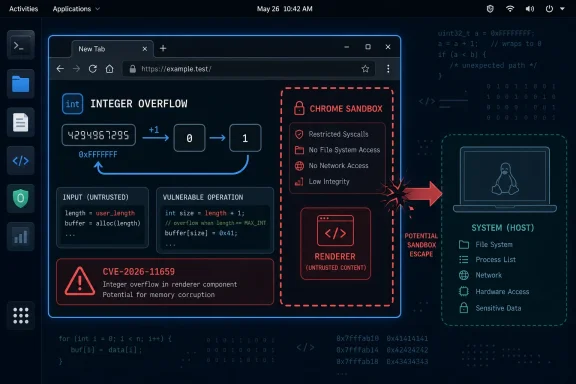
CVE-2026-11659 is described as an integer overflow in Chrome’s UI on Linux. Integer overflows are old-school bugs with modern consequences: a calculation wraps around, a size or index becomes something it should not be, and code that assumed the math was safe starts operating on unsafe assumptions. In browser code, that can become particularly dangerous when the vulnerable path is reachable from a crafted web page.
The notable phrase in the CVE description is “potentially perform a sandbox escape.” Chrome’s sandbox is the reason many browser exploits do not immediately become full system compromise. If an attacker can get malicious code running inside a renderer, the sandbox is supposed to contain the damage. A sandbox escape is the second door in the exploit chain: not merely getting into the browser, but getting out of the part of the browser designed to be disposable.
That does not mean every user who visited a malicious page was instantly compromised. The CVE says “potentially,” and Google’s public bug details remain restricted, which is standard practice while patches are still rolling out. But it does mean defenders should treat this as more than a cosmetic UI defect. A remotely reachable sandbox-escape-class bug is the kind of vulnerability that belongs near the top of the patch queue.
Linux desktop systems are a smaller slice of Chrome’s consumer population, but they punch above their weight in developer, security researcher, cloud engineering, DevOps, and administrative environments. A Linux workstation is often not “just a browser machine.” It may hold SSH keys, Kubernetes credentials, password-manager sessions, cloud consoles, internal dashboards, Git remotes, package-signing material, or access tokens that have far more value than the desktop itself.
That is why Chrome-on-Linux vulnerabilities tend to deserve a different reading inside technical organizations. The affected population may be smaller, but the average affected machine may be more privileged. A crafted HTML page does not need to compromise every laptop in the company if it lands on the one used by someone who can push infrastructure changes.
There is also a policy trap here. Many enterprise patch dashboards are better at Windows browser visibility than Linux workstation visibility. Windows gets the GPOs, the management baselines, and the compliance dashboards. Linux laptops often live in the gray zone between managed endpoint and trusted engineering appliance. CVE-2026-11659 is exactly the kind of bug that punishes that gray zone.
The safest interpretation is also the least clever one: do not stop at “Chrome 149.” Confirm the full build number. The difference between 149.0.7827.53, 149.0.7827.102, and 149.0.7827.103 is not trivia when the vulnerability database uses the exact version boundary as the dividing line between affected and fixed.
For individual users, the path is familiar: open Chrome’s About page, let it check for updates, and restart the browser. For managed fleets, the job is less charming. Inventory must capture the precise Chrome version, update channels must be checked for lag, and Linux package repositories need to be verified rather than assumed.
The restart requirement remains one of Chrome patching’s most persistent weaknesses. The browser can download an update, the package manager can install it, and the user can still be running vulnerable code until the process exits. In other words, a patched package on disk is not always a patched browser in memory.
This kind of CPE modeling is inherently clumsy. Chrome is the vulnerable product; Linux is the affected platform condition. The Linux kernel CPE is not saying the kernel contains the vulnerability. It is being used to constrain applicability to Linux systems. For scanners and vulnerability management tools, that distinction matters because a naïve interpretation could either over-report Chrome everywhere or misread the operating-system CPE as a vulnerable kernel component.
So are we missing a CPE? Possibly not in the sense that the product condition needs both pieces: Chrome plus Linux. But yes in the practical sense that CPEs often fail to represent the real packaging ecosystem cleanly. Linux Chrome may be installed from Google’s repository, a distribution package, a third-party software manager, an enterprise mirror, or a containerized desktop environment. One CPE string for
That gap is not merely academic. Many vulnerability scanners depend on CPE mapping to decide whether a machine is affected. If the CPE is too broad, security teams drown in false positives. If it is too narrow, they miss real exposure. CVE-2026-11659 shows the awkward middle: the vulnerability is not in the kernel, but the affectedness condition is platform-specific, so the database has to encode both application and OS context.
For WindowsForum readers, the lesson is familiar from years of Microsoft servicing metadata: the patch can be correct while the detection logic remains fragile. Security operations live in that gap. The fix may be a browser update, but the risk management problem is inventory fidelity.
Chromium’s internal severity labels reflect the project’s own vulnerability triage model, exploitability assumptions, and ecosystem norms. CVSS, by contrast, is a structured scoring framework that can produce very high numbers when a bug is network-reachable, needs no privileges, requires only user interaction, changes scope, and threatens confidentiality, integrity, and availability. A remote crafted-page sandbox escape maps naturally to a severe CVSS vector.
This is why administrators should avoid arguing themselves into inaction because one label says High rather than Critical. A browser bug that can be reached over the network, triggered by user interaction, and potentially cross a sandbox boundary is a serious enterprise exposure. Whether the badge says High or Critical, it belongs in the same patch window as other urgent browser fixes.
At the same time, CVSS should not be mistaken for exploit intelligence. A 9.6 score does not prove active exploitation. It says the theoretical impact and exploit conditions are severe. Publicly available information for CVE-2026-11659 does not establish that this specific bug is being exploited in the wild. That matters because the same Chrome update also addressed other vulnerabilities, including at least one that public reporting says Google knew had an exploit in the wild.
That is the recurring browser-patching dilemma. Security teams patch the release, not just the one CVE that made headlines. The adversary does not care which entry in the advisory persuaded you to reboot Chrome; they care whether the vulnerable code is still running.
User interaction is required, according to the CVSS vector, but browser user interaction is a low bar. Clicking a link in email, opening a compromised site, visiting an ad-supported page, previewing a document in a web app, or following a chat message can all become plausible delivery routes. “UI:R” in a vector string does not mean “hard to exploit.” It often means “the victim used the web.”
Modern browsers have made that model much safer than it used to be. Site isolation, process sandboxing, memory safety mitigations, exploit hardening, and rapid update channels have all raised the cost of compromise. But the browser remains the universal parser for untrusted content, and the UI remains a privileged mediator between untrusted web code and trusted user decisions.
A sandbox escape in this context is especially uncomfortable because it implies a path from web content toward more privileged browser or system territory. Attackers prize those paths because they turn a renderer compromise from a contained event into a platform event. Even when exploit details are restricted, defenders should assume that the underlying class is attractive.
The result is a deceptively simple question with many wrong answers: “Are we patched?” On a Linux fleet, answering that may require checking installed package versions, running process versions, channel configuration, repository freshness, and whether users have actually restarted the browser. A vulnerability scanner that sees only one of those dimensions can provide false confidence.
There is also a cultural issue. Linux workstations in engineering groups are often treated as semi-autonomous machines. Developers may have local admin rights, custom repositories, pinned packages, nonstandard desktop environments, or browsers installed outside the usual package database. That flexibility is useful until a browser sandbox escape arrives and the security team needs a clean yes-or-no answer by noon.
For organizations that manage Chrome through enterprise policies, this is a moment to verify that Linux endpoints are first-class citizens in the browser management program. If policy enforcement, update reporting, and restart nudges apply only to Windows and macOS, the Linux exception is not a feature. It is an attack surface.
Once a vulnerability is disclosed, attackers can diff patches, study commits, and work backward toward an exploit. With Chrome’s source code and development process, the details eventually surface. The delay is meant to prevent public advisories from becoming exploit roadmaps while large numbers of users remain unpatched.
For defenders, this means the first advisory is often intentionally incomplete. CVE-2026-11659 tells us the bug class, component area, platform, affected version boundary, and potential impact. It does not tell us the exact UI path, exploit primitive, or reliability characteristics. Waiting for those details before patching would invert the whole purpose of the advisory.
The lack of public technical detail also complicates prioritization. Security teams naturally want to know whether a bug is easy to exploit, whether mitigations block it, and whether it has been seen in attacks. In Chrome’s world, the practical answer is frequently: the browser team thought it serious enough to patch in a stable update, and the details are withheld because users need to move first.
The CVE description says a remote attacker could potentially perform a sandbox escape via a crafted HTML page. That does not necessarily mean this single flaw supplies the entire compromise path from page load to system control. It may require a renderer bug first, a specific browser state, or additional conditions. But attackers build chains precisely by combining such primitives.
This is why defenders should not isolate browser CVEs too aggressively in their mental model. A V8 bug, a UI bug, a GPU-process bug, and a sandbox policy weakness may each look like separate issues in a table. In the hands of an exploit developer, they can become chapters in one attack.
The Chrome update that fixes CVE-2026-11659 therefore matters beyond this one entry. It reduces the available inventory of chainable bugs. That is the quiet value of staying current: not every patch closes the headline exploit, but each one removes material from the attacker’s workbench.
A reasonable enterprise response starts with identifying Chrome installations below the fixed build, prioritizing Linux endpoints, and forcing or strongly nudging browser restarts after the update lands. The browser process version should be verified after restart, not merely the package version reported by the system. If Chrome is installed through multiple mechanisms, each mechanism needs separate detection.
Security teams should also watch for Chromium-based browsers that may inherit related code but ship fixes on different timelines. The CVE is assigned to Google Chrome, and affectedness should not be assumed blindly across every Chromium derivative. But in practice, downstream browsers often depend on the same upstream fixes, and administrators should verify their vendors’ advisories rather than assume immunity.
For smaller shops, the advice is simpler: update now, restart Chrome, and check the version. If the machine runs Linux and Chrome is part of your daily administrative workflow, treat this as urgent maintenance rather than background hygiene.
The practical takeaways are concrete:
 A Browser UI Bug Is Still a Browser Bug
The phrase “insufficient validation of untrusted input in UI” sounds almost polite, as if the flaw lives in a harmless layer of buttons, tabs, windows, and prompts. That is misleading. In a modern browser, the user interface is not merely decoration around web content; it is part of the security boundary that decides what the user sees, what the renderer can influence, and where trust is supposed to stop.CVE-2026-11659 is described as an integer overflow in Chrome’s UI on Linux. Integer overflows are old-school bugs with modern consequences: a calculation wraps around, a size or index becomes something it should not be, and code that assumed the math was safe starts operating on unsafe assumptions. In browser code, that can become particularly dangerous when the vulnerable path is reachable from a crafted web page.
The notable phrase in the CVE description is “potentially perform a sandbox escape.” Chrome’s sandbox is the reason many browser exploits do not immediately become full system compromise. If an attacker can get malicious code running inside a renderer, the sandbox is supposed to contain the damage. A sandbox escape is the second door in the exploit chain: not merely getting into the browser, but getting out of the part of the browser designed to be disposable.
That does not mean every user who visited a malicious page was instantly compromised. The CVE says “potentially,” and Google’s public bug details remain restricted, which is standard practice while patches are still rolling out. But it does mean defenders should treat this as more than a cosmetic UI defect. A remotely reachable sandbox-escape-class bug is the kind of vulnerability that belongs near the top of the patch queue.
The Linux-Only Detail Matters More Than It First Appears
The NVD description narrows the affected platform to Google Chrome on Linux prior to 149.0.7827.103. That platform specificity is important. It suggests the vulnerable code path, triggering conditions, or exploitability profile depends on Linux desktop plumbing rather than being uniformly present across Windows and macOS.Linux desktop systems are a smaller slice of Chrome’s consumer population, but they punch above their weight in developer, security researcher, cloud engineering, DevOps, and administrative environments. A Linux workstation is often not “just a browser machine.” It may hold SSH keys, Kubernetes credentials, password-manager sessions, cloud consoles, internal dashboards, Git remotes, package-signing material, or access tokens that have far more value than the desktop itself.
That is why Chrome-on-Linux vulnerabilities tend to deserve a different reading inside technical organizations. The affected population may be smaller, but the average affected machine may be more privileged. A crafted HTML page does not need to compromise every laptop in the company if it lands on the one used by someone who can push infrastructure changes.
There is also a policy trap here. Many enterprise patch dashboards are better at Windows browser visibility than Linux workstation visibility. Windows gets the GPOs, the management baselines, and the compliance dashboards. Linux laptops often live in the gray zone between managed endpoint and trusted engineering appliance. CVE-2026-11659 is exactly the kind of bug that punishes that gray zone.
The Version Number Is the Control Plane
For Chrome administrators, the operational answer is version-driven: vulnerable builds are those before the fixed release line identified by Google and reflected in NVD. The entry names Chrome before 149.0.7827.103, while some public advisory summaries for the same June 2026 desktop update refer to platform-specific patched builds in the 149.0.7827.102/.103 range. That discrepancy is not unusual in Chrome releases, where Windows, macOS, and Linux can carry slightly different build numbers even when they belong to the same security update train.The safest interpretation is also the least clever one: do not stop at “Chrome 149.” Confirm the full build number. The difference between 149.0.7827.53, 149.0.7827.102, and 149.0.7827.103 is not trivia when the vulnerability database uses the exact version boundary as the dividing line between affected and fixed.
For individual users, the path is familiar: open Chrome’s About page, let it check for updates, and restart the browser. For managed fleets, the job is less charming. Inventory must capture the precise Chrome version, update channels must be checked for lag, and Linux package repositories need to be verified rather than assumed.
The restart requirement remains one of Chrome patching’s most persistent weaknesses. The browser can download an update, the package manager can install it, and the user can still be running vulnerable code until the process exits. In other words, a patched package on disk is not always a patched browser in memory.
The CPE Entry Is Awkward, but Not Meaningless
The user’s sharpest question is whether something is missing in the CPE data. Based on the NVD change record, the configuration added by NIST combines a Google Chrome application CPE for versions up to but excluding 149.0.7827.103 with a Linux kernel operating system CPE. That is an attempt to express “Chrome on Linux” rather than “Chrome everywhere.”This kind of CPE modeling is inherently clumsy. Chrome is the vulnerable product; Linux is the affected platform condition. The Linux kernel CPE is not saying the kernel contains the vulnerability. It is being used to constrain applicability to Linux systems. For scanners and vulnerability management tools, that distinction matters because a naïve interpretation could either over-report Chrome everywhere or misread the operating-system CPE as a vulnerable kernel component.
So are we missing a CPE? Possibly not in the sense that the product condition needs both pieces: Chrome plus Linux. But yes in the practical sense that CPEs often fail to represent the real packaging ecosystem cleanly. Linux Chrome may be installed from Google’s repository, a distribution package, a third-party software manager, an enterprise mirror, or a containerized desktop environment. One CPE string for
google:chrome and one for linux_kernel will not capture every path by which the vulnerable code appears on endpoints.That gap is not merely academic. Many vulnerability scanners depend on CPE mapping to decide whether a machine is affected. If the CPE is too broad, security teams drown in false positives. If it is too narrow, they miss real exposure. CVE-2026-11659 shows the awkward middle: the vulnerability is not in the kernel, but the affectedness condition is platform-specific, so the database has to encode both application and OS context.
For WindowsForum readers, the lesson is familiar from years of Microsoft servicing metadata: the patch can be correct while the detection logic remains fragile. Security operations live in that gap. The fix may be a browser update, but the risk management problem is inventory fidelity.
CVSS Says Critical, Chromium Says High, and Both Can Be True
The entry carries a Chromium security severity of High, while CISA-ADP contributed a CVSS 3.1 base score of 9.6, which lands in Critical territory. That difference is not necessarily a contradiction. Vendor severity and CVSS are measuring related but distinct things.Chromium’s internal severity labels reflect the project’s own vulnerability triage model, exploitability assumptions, and ecosystem norms. CVSS, by contrast, is a structured scoring framework that can produce very high numbers when a bug is network-reachable, needs no privileges, requires only user interaction, changes scope, and threatens confidentiality, integrity, and availability. A remote crafted-page sandbox escape maps naturally to a severe CVSS vector.
This is why administrators should avoid arguing themselves into inaction because one label says High rather than Critical. A browser bug that can be reached over the network, triggered by user interaction, and potentially cross a sandbox boundary is a serious enterprise exposure. Whether the badge says High or Critical, it belongs in the same patch window as other urgent browser fixes.
At the same time, CVSS should not be mistaken for exploit intelligence. A 9.6 score does not prove active exploitation. It says the theoretical impact and exploit conditions are severe. Publicly available information for CVE-2026-11659 does not establish that this specific bug is being exploited in the wild. That matters because the same Chrome update also addressed other vulnerabilities, including at least one that public reporting says Google knew had an exploit in the wild.
That is the recurring browser-patching dilemma. Security teams patch the release, not just the one CVE that made headlines. The adversary does not care which entry in the advisory persuaded you to reboot Chrome; they care whether the vulnerable code is still running.
The Crafted Page Remains the Browser’s Oldest Trap
The attack path described here is almost banal: a crafted HTML page. That is exactly what makes it dangerous. Browser exploit delivery does not need an exotic attachment format or a privileged local foothold. It needs a user to load content in the most-used application on the endpoint.User interaction is required, according to the CVSS vector, but browser user interaction is a low bar. Clicking a link in email, opening a compromised site, visiting an ad-supported page, previewing a document in a web app, or following a chat message can all become plausible delivery routes. “UI:R” in a vector string does not mean “hard to exploit.” It often means “the victim used the web.”
Modern browsers have made that model much safer than it used to be. Site isolation, process sandboxing, memory safety mitigations, exploit hardening, and rapid update channels have all raised the cost of compromise. But the browser remains the universal parser for untrusted content, and the UI remains a privileged mediator between untrusted web code and trusted user decisions.
A sandbox escape in this context is especially uncomfortable because it implies a path from web content toward more privileged browser or system territory. Attackers prize those paths because they turn a renderer compromise from a contained event into a platform event. Even when exploit details are restricted, defenders should assume that the underlying class is attractive.
Linux Desktop Security Has an Inventory Problem
Linux defenders often pride themselves on package-manager discipline, but browser patching can still slip. Chrome is not always updated by the same mechanism as the base operating system. Some machines use Google’s official repository, some use enterprise mirrors, some run Chromium variants, and some rely on third-party management tools that lag behind upstream releases.The result is a deceptively simple question with many wrong answers: “Are we patched?” On a Linux fleet, answering that may require checking installed package versions, running process versions, channel configuration, repository freshness, and whether users have actually restarted the browser. A vulnerability scanner that sees only one of those dimensions can provide false confidence.
There is also a cultural issue. Linux workstations in engineering groups are often treated as semi-autonomous machines. Developers may have local admin rights, custom repositories, pinned packages, nonstandard desktop environments, or browsers installed outside the usual package database. That flexibility is useful until a browser sandbox escape arrives and the security team needs a clean yes-or-no answer by noon.
For organizations that manage Chrome through enterprise policies, this is a moment to verify that Linux endpoints are first-class citizens in the browser management program. If policy enforcement, update reporting, and restart nudges apply only to Windows and macOS, the Linux exception is not a feature. It is an attack surface.
Chrome’s Fast Patch Cycle Is Also a Disclosure Strategy
Google’s public handling of Chrome vulnerabilities follows a now-familiar pattern: ship the fix, publish a brief advisory, restrict bug details until users have had time to update, and let the ecosystem catch up. That can frustrate researchers and administrators who want root-cause detail immediately, but it is a rational strategy for browser-scale risk.Once a vulnerability is disclosed, attackers can diff patches, study commits, and work backward toward an exploit. With Chrome’s source code and development process, the details eventually surface. The delay is meant to prevent public advisories from becoming exploit roadmaps while large numbers of users remain unpatched.
For defenders, this means the first advisory is often intentionally incomplete. CVE-2026-11659 tells us the bug class, component area, platform, affected version boundary, and potential impact. It does not tell us the exact UI path, exploit primitive, or reliability characteristics. Waiting for those details before patching would invert the whole purpose of the advisory.
The lack of public technical detail also complicates prioritization. Security teams naturally want to know whether a bug is easy to exploit, whether mitigations block it, and whether it has been seen in attacks. In Chrome’s world, the practical answer is frequently: the browser team thought it serious enough to patch in a stable update, and the details are withheld because users need to move first.
The Real Risk Is the Chain You Cannot See Yet
CVE-2026-11659 should be read as part of an exploit chain story, even if no full chain is public. Browser compromises often require multiple bugs: one to gain code execution or memory access in a renderer, another to escape the sandbox, and sometimes another to elevate privileges or persist. A sandbox escape is valuable because it supplies one of those chain links.The CVE description says a remote attacker could potentially perform a sandbox escape via a crafted HTML page. That does not necessarily mean this single flaw supplies the entire compromise path from page load to system control. It may require a renderer bug first, a specific browser state, or additional conditions. But attackers build chains precisely by combining such primitives.
This is why defenders should not isolate browser CVEs too aggressively in their mental model. A V8 bug, a UI bug, a GPU-process bug, and a sandbox policy weakness may each look like separate issues in a table. In the hands of an exploit developer, they can become chapters in one attack.
The Chrome update that fixes CVE-2026-11659 therefore matters beyond this one entry. It reduces the available inventory of chainable bugs. That is the quiet value of staying current: not every patch closes the headline exploit, but each one removes material from the attacker’s workbench.
The Patch Window Should Be Measured in Hours, Not Weeks
For consumer users, Chrome’s auto-update machinery usually does the right thing eventually. For organizations, “eventually” is not a patch policy. High-impact browser vulnerabilities deserve a short enforcement window, especially when the vulnerable endpoint population includes Linux workstations used by technical staff.A reasonable enterprise response starts with identifying Chrome installations below the fixed build, prioritizing Linux endpoints, and forcing or strongly nudging browser restarts after the update lands. The browser process version should be verified after restart, not merely the package version reported by the system. If Chrome is installed through multiple mechanisms, each mechanism needs separate detection.
Security teams should also watch for Chromium-based browsers that may inherit related code but ship fixes on different timelines. The CVE is assigned to Google Chrome, and affectedness should not be assumed blindly across every Chromium derivative. But in practice, downstream browsers often depend on the same upstream fixes, and administrators should verify their vendors’ advisories rather than assume immunity.
For smaller shops, the advice is simpler: update now, restart Chrome, and check the version. If the machine runs Linux and Chrome is part of your daily administrative workflow, treat this as urgent maintenance rather than background hygiene.
The Evidence Points to a Narrow Bug With Broad Lessons
CVE-2026-11659 is not the loudest browser vulnerability of the year, and it may not become the one that dominates incident reports. Its importance is subtler. It shows how a platform-specific browser UI flaw can still carry sandbox-escape implications, how severity labels can diverge without canceling each other out, and how vulnerability metadata can be both technically correct and operationally awkward.The practical takeaways are concrete:
- Chrome on Linux versions before the fixed 149.0.7827.103 boundary should be treated as exposed to CVE-2026-11659.
- The vulnerability is described as an integer overflow in the UI that can be triggered through a crafted HTML page and may enable a sandbox escape.
- The CPE configuration appears to use Linux as a platform constraint, not as evidence that the Linux kernel itself contains the bug.
- Security teams should verify the running Chrome process version after restart, not just the installed package version.
- Linux workstations used by developers, administrators, and security staff deserve priority because their browser sessions often carry high-value credentials.
- Chrome-derived browsers and delayed enterprise repositories should be checked separately rather than assumed patched.
References
- Primary source: NVD / Chromium
Published: 2026-06-15T19:14:13-07:00

NVD - CVE-2026-11659
 nvd.nist.gov
- Security advisory: MSRC
Published: 2026-06-15T19:14:13-07:00
Original feed URL

Security Update Guide - Microsoft Security Response Center
 msrc.microsoft.com
- Related coverage: securityonline.info

CVE Watchtower • Daily CyberSecurity
Stay ahead with Daily CyberSecurity. We deliver rapid zero-hour alerts and expert analysis on critical vulnerabilities, CVEs, and emerging cyber threats.securityonline.info