

Samsung discontinued Samsung Max VPN & Data Saver on June 15, 2026, ending a Galaxy-exclusive Android app that combined a basic virtual private network, mobile data compression, privacy tools, paid regional server options, and ad-supported free access for users who had kept it installed. The shutdown is not a surprise; Samsung reportedly warned users through an in-app notice in April and then let the deadline arrive without a reprieve. What matters is not that one modest VPN app died. It is that Samsung is continuing to prune the services that once made Galaxy phones feel like a parallel Android universe.
Samsung Max was never the kind of service that defined the Galaxy brand in the way the S Pen, DeX, Knox, or the company’s camera stack did. Many Galaxy users likely never opened it, and many in the United States may never have noticed it at all. But it represented a familiar Samsung instinct: if Android had a category, Samsung wanted its own version of it.
That instinct built some excellent software and some forgettable software. It also gave Galaxy phones their long-running sense of abundance, for better and worse. Open the app drawer on a Samsung handset and you could feel the company’s ambition to make the device less dependent on Google’s defaults.
Samsung Max belonged to the second tier of that strategy. It was useful to some users, confusing to others, and largely invisible to the broader VPN market. Its disappearance will not strand most Android users, but it does mark another place where Samsung has decided that maintaining a branded utility no longer justifies the cost.
The company’s logic is not hard to understand. A VPN service must be operated, secured, updated, marketed, supported, and trusted. If the user base is small or the margins are thin, the service becomes less like a feature and more like technical debt with a privacy policy attached.
That world has not disappeared everywhere. Millions of users still live under restrictive caps, prepaid plans, patchy coverage, and expensive roaming. But the center of gravity has moved. Unlimited or high-cap plans are more common in mature markets, websites have shifted toward encrypted traffic that is harder to compress transparently, and app ecosystems now handle much of their own caching and media optimization.
The original promise of a data-saving VPN was therefore squeezed from both directions. The data-saving part became less dramatic for many users, while the VPN part became more competitive and more sensitive. A lightweight privacy tool attached to a phone brand now has to compete with dedicated VPN providers that sell audits, server fleets, streaming compatibility, WireGuard support, multi-hop routing, tracker blocking, and elaborate no-logs claims.
Samsung Max occupied an awkward middle ground. It was more than a toggle and less than a specialist product. That can work when the feature is deeply integrated into the platform, but Samsung Max never became a front-door Galaxy experience in the way Samsung Pay, SmartThings, or Secure Folder did.
The problem is that exclusivity cuts both ways. A Galaxy-only VPN does not benefit from the scale that a cross-platform VPN provider can build across Android, iOS, Windows, macOS, browsers, routers, and corporate devices. It also has to justify itself inside a company whose biggest strategic priorities now revolve around AI features, premium hardware, foldables, wearables, and ecosystem services with clearer commercial upside.
VPNs are also a trust business, and trust is harder when the product is a side project. Users who care deeply about VPNs tend to scrutinize jurisdiction, logging policies, audits, protocol choices, ownership, DNS behavior, leak protection, and independent testing. Users who do not care deeply about VPNs may never pay for one at all.
That leaves a narrow market for a phone-maker-branded VPN that is convenient enough to use but not distinctive enough to dominate. Samsung could keep it alive as a courtesy feature, but courtesy features become expensive when they touch network routing and privacy. In 2026, no major vendor wants to carry a privacy-sensitive service that lacks strategic gravity.
That does not mean a white-label or partner-backed VPN is inherently bad. Many consumer security products rely on underlying infrastructure partners. But it does mean the branded provider must explain the arrangement clearly and keep the product current, because the user is extending trust to both the front-end brand and the operator behind the scenes.
Samsung’s brand gives it enormous reach, but reach is not the same thing as VPN credibility. A company that sells phones, televisions, appliances, chips, displays, and cloud-connected home devices has a different relationship with user data than a privacy-first VPN provider wants to advertise. The privacy-minded buyer may prefer a company whose entire business depends on being judged as a VPN company.
For casual users, the calculus is different. They may have opened Samsung Max because it was there, because it promised privacy on public Wi-Fi, or because it offered a basic free tier. Those users are the ones most likely to be nudged into doing nothing after the shutdown, which is why the end of a small service still deserves attention.
For a WindowsForum audience, the lesson is familiar from the PC world. Security software categories attract both serious engineering and opportunistic packaging. VPNs are no different. A slick app, a discount timer, and a promise of “military-grade encryption” say very little about whether the provider is trustworthy.
Android makes switching technically simple. Install a replacement VPN, grant the system VPN permission, enable always-on VPN if desired, and verify that DNS and IP leak behavior matches expectations. But choosing the provider is the hard part, particularly for users who did not intentionally shop for Samsung Max in the first place.
The safest replacement is not automatically the most famous one. Users should look for providers with clear ownership, recent independent audits, modern protocols, transparent privacy policies, sensible pricing, and a record of fixing problems in public. They should also be skeptical of free unlimited VPNs, because somebody still has to pay for servers, bandwidth, support, and development.
A VPN does not make a logged-in browser session anonymous. It does not stop a social network, search engine, ad SDK, or shopping app from recognizing an account, device fingerprint, or behavioral pattern. It does not make malware harmless, and it does not erase the need for DNS hygiene, browser hardening, app permission restraint, or operating system updates.
Samsung Max’s branding combined “VPN” and “Data Saver,” which may have encouraged some users to think of it as a general optimization layer rather than a security decision. That ambiguity was common in the earlier mobile era. In 2026, privacy tooling needs sharper language.
For administrators, the point is even clearer. Consumer VPNs should not be confused with enterprise access controls. A corporate VPN, a zero-trust network access platform, a managed tunnel, and a consumer privacy VPN may all use encrypted tunnels, but they solve different problems and create different audit trails.
Still, IT departments should pay attention to the pattern of consumer-facing service retirements. When an OEM bundles or promotes a cloud-connected utility, users may assume that utility is part of the durable platform. When it disappears, support desks inherit questions, confusion, and sometimes risky substitutions.
The practical concern is especially relevant in bring-your-own-device environments. A user who loses a familiar VPN tile may install the first free alternative that appears in an app store search. That can create a worse privacy posture than the one the discontinued app provided, even if the original app was not ideal.
For managed fleets, the response should be policy rather than panic. If VPN use matters, specify approved providers. If it does not, block unmanaged VPN apps where appropriate. If users travel or rely on public Wi-Fi, give them a supported path before they improvise one.
The same broad arc can be seen in the company’s retreat from Samsung Messages in favor of Google Messages in many markets. Messaging is far more central than a VPN, but the strategic logic rhymes: where Google’s Android ecosystem has a dominant default and carrier/platform alignment matters, Samsung has less incentive to keep fighting a parallel war.
This is not simply capitulation to Google. It is triage. Samsung can still differentiate through hardware, camera systems, foldables, displays, AI features, device continuity, security frameworks, and premium services. But every duplicate app requires engineering attention, policy maintenance, localization, customer support, and regulatory care.
The smartphone market has matured into an ecosystem battle where fewer companies can afford ornamental software. Apps that do not strengthen the ecosystem, drive recurring revenue, or support a flagship narrative are vulnerable. Samsung Max looks like exactly that kind of casualty.
That is uncomfortable terrain for a multipurpose consumer electronics giant. Samsung can and does build serious security technology, but a consumer VPN lives in a marketplace where every vague phrase invites scrutiny. “Privacy protection mode” may have sounded good when mobile data compression was the hero feature. Today, it sounds like the beginning of a much longer conversation.
There is also the matter of advertising. Reports noted that Samsung Max included a basic free tier with limited features and in-app ads. That model is not automatically disqualifying, but it sits uneasily beside privacy messaging. Users do not need to be absolutists to wonder how a free, ad-supported privacy utility aligns incentives.
The VPN industry has spent years training users to look for simple slogans: no logs, private browsing, secure Wi-Fi, anonymous access. The reality is messier. Samsung may have decided that this mess was no longer worth owning for a product that did not materially advance the Galaxy platform.
The second task is to review Android’s VPN settings. Users should check whether Samsung Max remains configured as an always-on VPN, whether any private DNS settings were changed, and whether other apps depended on its presence. If a phone was configured to block connections without the VPN, connectivity problems may appear until a new provider is selected or the setting is changed.
The third task is subscription hygiene. Anyone who paid for Samsung Max should verify that recurring billing has stopped through the relevant app store or Samsung account path. Service shutdowns usually include billing wind-downs, but users should not rely on assumptions when subscriptions are involved.
The final task is to choose deliberately. If the old app was used only for occasional public Wi-Fi, a reputable free tier from a known provider may be enough. If it was used for travel, streaming, work-adjacent access, or privacy-sensitive browsing, users should evaluate paid services with more care.
That does not mean the platform chooses a provider for the user. Android supplies the plumbing; the VPN app supplies the service, protocol implementation, account system, server network, and privacy policy. But the system-level controls are important because they let users enforce behavior instead of trusting an app’s dashboard alone.
The best replacement setup is usually boring. Enable always-on VPN if the provider is reliable enough. Enable the option to block connections without VPN if the threat model requires it. Test the connection after rebooting the phone, switching between Wi-Fi and cellular, and moving through captive portals.
Boring is good in security. A VPN that quietly reconnects, behaves predictably, and explains failures clearly is more valuable than one that decorates the interface with dramatic privacy meters. Samsung Max’s retirement should push users toward that more practical standard.
But there is also a loss. Samsung’s willingness to build alternatives helped keep Android pluralistic. It gave users different defaults, pushed Google in some categories, and made Galaxy devices feel less like generic vessels for Mountain View’s services. Even imperfect Samsung apps contributed to that sense of independence.
Samsung Max was not a great symbol of that independence, but it was part of the same family. Its exit reinforces the sense that Samsung is increasingly selective about where it wants to be different. The company seems more willing to concede commodity software layers while concentrating on areas where it can claim premium value.
That is probably the right business decision. It may even be the right user-experience decision. But enthusiasts should recognize the trade: the cleaner Galaxy phone may also be the less idiosyncratic Galaxy phone.
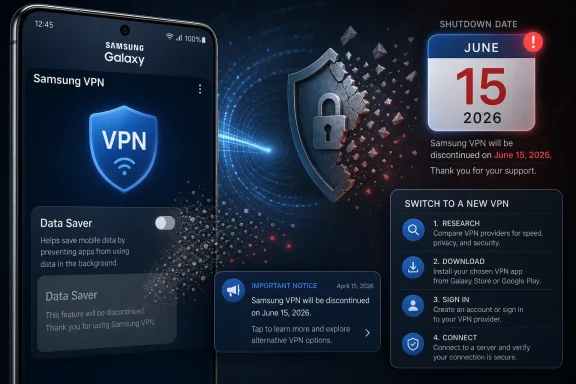 Samsung’s VPN Exit Is Small News With a Bigger Shadow
Samsung Max was never the kind of service that defined the Galaxy brand in the way the S Pen, DeX, Knox, or the company’s camera stack did. Many Galaxy users likely never opened it, and many in the United States may never have noticed it at all. But it represented a familiar Samsung instinct: if Android had a category, Samsung wanted its own version of it.That instinct built some excellent software and some forgettable software. It also gave Galaxy phones their long-running sense of abundance, for better and worse. Open the app drawer on a Samsung handset and you could feel the company’s ambition to make the device less dependent on Google’s defaults.
Samsung Max belonged to the second tier of that strategy. It was useful to some users, confusing to others, and largely invisible to the broader VPN market. Its disappearance will not strand most Android users, but it does mark another place where Samsung has decided that maintaining a branded utility no longer justifies the cost.
The company’s logic is not hard to understand. A VPN service must be operated, secured, updated, marketed, supported, and trusted. If the user base is small or the margins are thin, the service becomes less like a feature and more like technical debt with a privacy policy attached.
The App Was Born From the Data-Saving Era Android Has Mostly Left Behind
Samsung Max was officially pitched as both a privacy app and a data-saving app, a combination that made more sense in the late 2010s than it does in 2026. It descended from the same world that produced Opera Max, Chrome’s data saver, Lite apps, proxy compression services, and carrier-era anxiety over every megabyte. Mobile data was expensive, networks were uneven, and compressing traffic felt like a practical superpower.That world has not disappeared everywhere. Millions of users still live under restrictive caps, prepaid plans, patchy coverage, and expensive roaming. But the center of gravity has moved. Unlimited or high-cap plans are more common in mature markets, websites have shifted toward encrypted traffic that is harder to compress transparently, and app ecosystems now handle much of their own caching and media optimization.
The original promise of a data-saving VPN was therefore squeezed from both directions. The data-saving part became less dramatic for many users, while the VPN part became more competitive and more sensitive. A lightweight privacy tool attached to a phone brand now has to compete with dedicated VPN providers that sell audits, server fleets, streaming compatibility, WireGuard support, multi-hop routing, tracker blocking, and elaborate no-logs claims.
Samsung Max occupied an awkward middle ground. It was more than a toggle and less than a specialist product. That can work when the feature is deeply integrated into the platform, but Samsung Max never became a front-door Galaxy experience in the way Samsung Pay, SmartThings, or Secure Folder did.
The Galaxy-Exclusive Pitch Became Less Persuasive Over Time
Exclusivity used to be one of Samsung’s favorite software weapons. Galaxy buyers did not just get Android; they got Samsung’s version of Android, with extra utilities, cloud hooks, theming engines, health apps, security features, browser features, and store-distributed extras. The company used software as a moat around hardware.The problem is that exclusivity cuts both ways. A Galaxy-only VPN does not benefit from the scale that a cross-platform VPN provider can build across Android, iOS, Windows, macOS, browsers, routers, and corporate devices. It also has to justify itself inside a company whose biggest strategic priorities now revolve around AI features, premium hardware, foldables, wearables, and ecosystem services with clearer commercial upside.
VPNs are also a trust business, and trust is harder when the product is a side project. Users who care deeply about VPNs tend to scrutinize jurisdiction, logging policies, audits, protocol choices, ownership, DNS behavior, leak protection, and independent testing. Users who do not care deeply about VPNs may never pay for one at all.
That leaves a narrow market for a phone-maker-branded VPN that is convenient enough to use but not distinctive enough to dominate. Samsung could keep it alive as a courtesy feature, but courtesy features become expensive when they touch network routing and privacy. In 2026, no major vendor wants to carry a privacy-sensitive service that lacks strategic gravity.
Repackaged Services Age Badly When Trust Is the Product
The reported description of Samsung Max as a repackaged VPN service matters because VPN users are not merely buying bandwidth. They are buying an assertion about who can see their traffic, who cannot, and who is accountable when something goes wrong. The more layers between the brand on the app icon and the infrastructure behind the tunnel, the more complicated that assertion becomes.That does not mean a white-label or partner-backed VPN is inherently bad. Many consumer security products rely on underlying infrastructure partners. But it does mean the branded provider must explain the arrangement clearly and keep the product current, because the user is extending trust to both the front-end brand and the operator behind the scenes.
Samsung’s brand gives it enormous reach, but reach is not the same thing as VPN credibility. A company that sells phones, televisions, appliances, chips, displays, and cloud-connected home devices has a different relationship with user data than a privacy-first VPN provider wants to advertise. The privacy-minded buyer may prefer a company whose entire business depends on being judged as a VPN company.
For casual users, the calculus is different. They may have opened Samsung Max because it was there, because it promised privacy on public Wi-Fi, or because it offered a basic free tier. Those users are the ones most likely to be nudged into doing nothing after the shutdown, which is why the end of a small service still deserves attention.
The Shutdown Lands in a Market Full of Better Choices and Worse Traps
Samsung’s advice, implicit if not formal, is easy enough: choose another Android VPN. That is true, but it is also a little glib. The Android VPN market is crowded with excellent services, mediocre services, aggressive affiliate marketing, opaque ownership structures, exaggerated privacy claims, and free apps that may be worse than no VPN at all.For a WindowsForum audience, the lesson is familiar from the PC world. Security software categories attract both serious engineering and opportunistic packaging. VPNs are no different. A slick app, a discount timer, and a promise of “military-grade encryption” say very little about whether the provider is trustworthy.
Android makes switching technically simple. Install a replacement VPN, grant the system VPN permission, enable always-on VPN if desired, and verify that DNS and IP leak behavior matches expectations. But choosing the provider is the hard part, particularly for users who did not intentionally shop for Samsung Max in the first place.
The safest replacement is not automatically the most famous one. Users should look for providers with clear ownership, recent independent audits, modern protocols, transparent privacy policies, sensible pricing, and a record of fixing problems in public. They should also be skeptical of free unlimited VPNs, because somebody still has to pay for servers, bandwidth, support, and development.
A VPN Is Not a Magic Privacy Cloak
The death of Samsung Max is also a good moment to restate what a VPN does and does not do. A VPN can protect traffic from local network snooping, hide a user’s IP address from destination services, reduce some carrier visibility, and provide safer connectivity on untrusted Wi-Fi. It can also help travelers reach services as if they were connecting from another region, though that use remains a cat-and-mouse game.A VPN does not make a logged-in browser session anonymous. It does not stop a social network, search engine, ad SDK, or shopping app from recognizing an account, device fingerprint, or behavioral pattern. It does not make malware harmless, and it does not erase the need for DNS hygiene, browser hardening, app permission restraint, or operating system updates.
Samsung Max’s branding combined “VPN” and “Data Saver,” which may have encouraged some users to think of it as a general optimization layer rather than a security decision. That ambiguity was common in the earlier mobile era. In 2026, privacy tooling needs sharper language.
For administrators, the point is even clearer. Consumer VPNs should not be confused with enterprise access controls. A corporate VPN, a zero-trust network access platform, a managed tunnel, and a consumer privacy VPN may all use encrypted tunnels, but they solve different problems and create different audit trails.
Enterprise IT Will Mostly Notice the Pattern, Not the Product
Most enterprise fleets were unlikely to standardize on Samsung Max. Managed Android deployments typically rely on MDM policy, per-app VPN configurations, enterprise identity, certificate management, and vendor-supported security stacks. Samsung’s serious enterprise story has long been Knox, not Samsung Max.Still, IT departments should pay attention to the pattern of consumer-facing service retirements. When an OEM bundles or promotes a cloud-connected utility, users may assume that utility is part of the durable platform. When it disappears, support desks inherit questions, confusion, and sometimes risky substitutions.
The practical concern is especially relevant in bring-your-own-device environments. A user who loses a familiar VPN tile may install the first free alternative that appears in an app store search. That can create a worse privacy posture than the one the discontinued app provided, even if the original app was not ideal.
For managed fleets, the response should be policy rather than panic. If VPN use matters, specify approved providers. If it does not, block unmanaged VPN apps where appropriate. If users travel or rely on public Wi-Fi, give them a supported path before they improvise one.
Samsung Is Narrowing Its Software Identity Around Fewer Bets
Samsung is not abandoning software. That would be an absurd reading of a company investing heavily in One UI, Galaxy AI, Knox, SmartThings, Health, Wallet, and cross-device integration. What is changing is the tolerance for maintaining secondary branded apps that duplicate broader Android functionality or compete in mature service categories without a clear Samsung advantage.The same broad arc can be seen in the company’s retreat from Samsung Messages in favor of Google Messages in many markets. Messaging is far more central than a VPN, but the strategic logic rhymes: where Google’s Android ecosystem has a dominant default and carrier/platform alignment matters, Samsung has less incentive to keep fighting a parallel war.
This is not simply capitulation to Google. It is triage. Samsung can still differentiate through hardware, camera systems, foldables, displays, AI features, device continuity, security frameworks, and premium services. But every duplicate app requires engineering attention, policy maintenance, localization, customer support, and regulatory care.
The smartphone market has matured into an ecosystem battle where fewer companies can afford ornamental software. Apps that do not strengthen the ecosystem, drive recurring revenue, or support a flagship narrative are vulnerable. Samsung Max looks like exactly that kind of casualty.
The Privacy Branding Problem Is Getting Harder, Not Easier
The timing also matters because privacy is no longer a soft marketing feature. Regulators, app stores, enterprise buyers, and users increasingly expect precise claims. If a company says it protects privacy, it must be ready to explain data collection, retention, routing, third-party processors, jurisdiction, breach handling, and monetization.That is uncomfortable terrain for a multipurpose consumer electronics giant. Samsung can and does build serious security technology, but a consumer VPN lives in a marketplace where every vague phrase invites scrutiny. “Privacy protection mode” may have sounded good when mobile data compression was the hero feature. Today, it sounds like the beginning of a much longer conversation.
There is also the matter of advertising. Reports noted that Samsung Max included a basic free tier with limited features and in-app ads. That model is not automatically disqualifying, but it sits uneasily beside privacy messaging. Users do not need to be absolutists to wonder how a free, ad-supported privacy utility aligns incentives.
The VPN industry has spent years training users to look for simple slogans: no logs, private browsing, secure Wi-Fi, anonymous access. The reality is messier. Samsung may have decided that this mess was no longer worth owning for a product that did not materially advance the Galaxy platform.
Users Should Treat the Shutdown as a Security Chore, Not an App Funeral
For anyone who still had Samsung Max installed, the first task is mundane: remove or disable what no longer works. A dead VPN app is not useful software. It may also confuse users if it continues to expose settings, notifications, subscriptions, or permissions without providing a functioning service.The second task is to review Android’s VPN settings. Users should check whether Samsung Max remains configured as an always-on VPN, whether any private DNS settings were changed, and whether other apps depended on its presence. If a phone was configured to block connections without the VPN, connectivity problems may appear until a new provider is selected or the setting is changed.
The third task is subscription hygiene. Anyone who paid for Samsung Max should verify that recurring billing has stopped through the relevant app store or Samsung account path. Service shutdowns usually include billing wind-downs, but users should not rely on assumptions when subscriptions are involved.
The final task is to choose deliberately. If the old app was used only for occasional public Wi-Fi, a reputable free tier from a known provider may be enough. If it was used for travel, streaming, work-adjacent access, or privacy-sensitive browsing, users should evaluate paid services with more care.
Android’s Built-In VPN Controls Are Better Than Many Users Realize
One reason Samsung Max could fade quietly is that Android’s native VPN handling has improved over the years. The operating system can manage VPN profiles, expose a persistent key icon, support always-on VPN behavior, and block traffic when a selected VPN is disconnected. Those platform controls reduce the need for an OEM-branded wrapper.That does not mean the platform chooses a provider for the user. Android supplies the plumbing; the VPN app supplies the service, protocol implementation, account system, server network, and privacy policy. But the system-level controls are important because they let users enforce behavior instead of trusting an app’s dashboard alone.
The best replacement setup is usually boring. Enable always-on VPN if the provider is reliable enough. Enable the option to block connections without VPN if the threat model requires it. Test the connection after rebooting the phone, switching between Wi-Fi and cellular, and moving through captive portals.
Boring is good in security. A VPN that quietly reconnects, behaves predictably, and explains failures clearly is more valuable than one that decorates the interface with dramatic privacy meters. Samsung Max’s retirement should push users toward that more practical standard.
The Galaxy Ecosystem Is Becoming Less Cluttered and Less Distinct
There is an upside to Samsung’s pruning. Fewer duplicate apps can mean fewer confusing choices, fewer abandoned services, fewer background processes, and less friction for users who simply want Android to behave consistently across devices. The long-running complaint about Samsung software was never that it lacked features; it was that it often had too many overlapping ones.But there is also a loss. Samsung’s willingness to build alternatives helped keep Android pluralistic. It gave users different defaults, pushed Google in some categories, and made Galaxy devices feel less like generic vessels for Mountain View’s services. Even imperfect Samsung apps contributed to that sense of independence.
Samsung Max was not a great symbol of that independence, but it was part of the same family. Its exit reinforces the sense that Samsung is increasingly selective about where it wants to be different. The company seems more willing to concede commodity software layers while concentrating on areas where it can claim premium value.
That is probably the right business decision. It may even be the right user-experience decision. But enthusiasts should recognize the trade: the cleaner Galaxy phone may also be the less idiosyncratic Galaxy phone.
The June 15 Cutoff Leaves a Practical Checklist Behind
Samsung Max’s shutdown is not a crisis, but it is exactly the kind of low-grade platform change that leaves casual users exposed to bad decisions. The app’s disappearance should be treated as a prompt to clean up settings, subscriptions, and assumptions about mobile privacy.- Samsung Max VPN & Data Saver stopped operating on June 15, 2026, after users were reportedly warned through an in-app notice earlier in the spring.
- Galaxy users who relied on the app should remove stale configurations and check Android’s VPN settings before installing a replacement.
- A replacement VPN should be chosen for ownership transparency, security record, protocol support, audit history, and pricing model rather than app-store popularity alone.
- Free VPNs deserve extra scrutiny because bandwidth and infrastructure costs create incentives that may conflict with privacy claims.
- Businesses managing Galaxy phones should steer users toward approved VPN or zero-trust tools instead of letting them improvise after a consumer app shutdown.
- Samsung’s decision fits a broader pattern of reducing secondary software bets and focusing Galaxy differentiation on fewer, higher-value services.
References
- Primary source: SamMobile
Published: 2026-06-15T19:50:10.521511
Loading…
www.sammobile.com - Related coverage: sammyguru.com
Loading…
sammyguru.com - Related coverage: inkl.com
Loading…
www.inkl.com - Related coverage: tecmundo.com.br
Loading…
www.tecmundo.com.br - Related coverage: androidcentral.com
Loading…
www.androidcentral.com - Related coverage: techspot.com
Loading…
www.techspot.com
- Related coverage: r1.community.samsung.com
Loading…
r1.community.samsung.com - Related coverage: samsung.com
Loading…
www.samsung.com - Related coverage: max.apps.samsung.com
Loading…
max.apps.samsung.com - Related coverage: news.samsung.com
Loading…
news.samsung.com - Related coverage: applion.jp
Loading…
applion.jp - Related coverage: techxplore.com
Loading…
techxplore.com