

On June 16, 2026, Microsoft published a feature from Alaşehir, Türkiye, about Turkish growers using the Azure-built İmeceMobil agriculture app to monitor crops, buy supplies, access loans, and make higher-stakes farming decisions with satellite imagery, AI, weather alerts, and expert support. The story is not really about blueberries, though the blueberries make for a good opening scene. It is about a familiar Microsoft-era bet: that cloud software can move from office workflows into messy physical industries where the cost of bad information is measured in water, fertilizer, debt, and lost harvests. For farmers, the question is no longer whether digital tools belong in agriculture; it is whether the tools can earn trust in a business where every season is a wager.
Pınar Ünsal’s blueberry farm in western Türkiye sounds, at first, like a classic outsider story. A mechanical engineer leaves the corporate world, covers seven hectares with black weed-barrier fabric, places 30,000 plastic pots across the land, and starts growing a crop her neighbors do not associate with the valley. The local verdict was immediate and memorable: plastic pots do not bear fruit.
Five years later, the pots are full of blueberry bushes, some taller than Ünsal and her husband, Utku Atıcı. The farm expects roughly 80 metric tons of fruit this summer, turning what once looked eccentric into something closer to a proof point. The neighborly skepticism has shifted from mockery to curiosity.
That arc matters because it captures the real barrier facing agricultural software. Farmers are not hostile to technology because they are nostalgic. They are cautious because agriculture punishes bad experiments quickly and expensively.
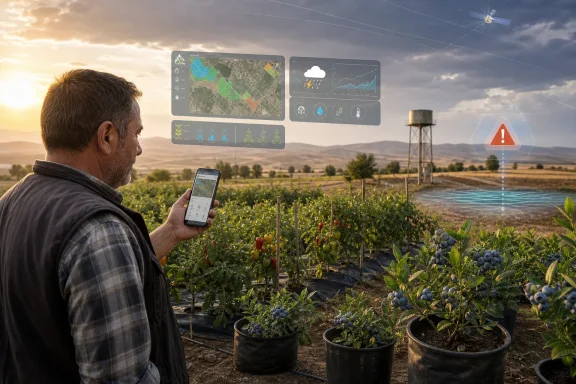
The İmeceMobil app enters that world not as a gadget but as an instrument panel. Ünsal uses it to check satellite views of her orchard, monitor plant health, watch for water stress, receive hyperlocal weather alerts, and time interventions such as fungicide application after rain. In a field where the wrong day can matter, software is valuable only if it changes a decision before the damage is done.
But agriculture is a harder test than office productivity. A late Teams message is annoying. A missed pest outbreak, frost warning, or irrigation failure can be financially devastating. The closer cloud services get to physical operations, the less forgiving the margin of error becomes.
That is what makes İmeceMobil interesting for readers far beyond Türkiye. It is a case study in software moving from systems of record to systems of operational judgment. The app is not just storing a farmer’s information; it is helping interpret fields, weather, inputs, and financing in one interface.
Microsoft has spent years trying to frame Azure as the operating layer for industry-specific platforms. Agriculture is one of the better illustrations of why that strategy can work. The farmer does not need to know which monitoring service is watching the backend or which security product is guarding the data. The farmer needs the app to be available, accurate enough to act on, and useful when the pump breaks, the rain comes, or the leaves begin to change color.
That is the practical threshold for digital transformation. If software merely adds another dashboard to check, it becomes a burden. If it compresses a field inspection, flags a water problem, or points to nitrogen stress before the farmer drives across 60 hectares, it begins to justify itself.
Özacar’s farm near Çırpı grows watermelons, tomatoes, peppers, sweet corn, broccoli, cauliflower, and cabbage. That mix is operationally complex. Each crop has different timing, inputs, vulnerabilities, and market pressures. A generic weather widget is not enough.
The app’s value comes from bundling information that farmers otherwise gather through labor, instinct, phone calls, supplier relationships, and repeated field visits. Satellite analysis does not replace local knowledge, but it can prioritize attention. If one section of a field is visibly under stress from above, the farmer can investigate there first.
This is the place where AI in agriculture becomes less magical and more credible. The pitch is not that an algorithm becomes the farmer. The pitch is that the farmer gets a wider field of view, and that small timing advantages compound across a season.
Özacar describes a water table that has fallen dramatically over a decade. In 2014, he drilled 150 meters to reach water. Three years later, another well required 245 meters. In 2024, he drilled to 400 meters. That is not an abstract sustainability graph; it is a rising electricity bill, a capital expense, and a warning about the future of the farm.
In that context, irrigation advice is not a nice-to-have feature. It is a business survival tool. Overwatering wastes electricity, fertilizer, and a resource the farm may not be able to count on indefinitely. Underwatering risks yield and quality. The old margin for guesswork is narrowing.
This is where the agriculture-app story becomes bigger than one bank subsidiary or one Azure deployment. Climate volatility is turning farming into a data problem at precisely the moment farmers are being asked to produce efficiently, conserve resources, and manage financial risk. The farm is becoming an edge site: distributed, sensor-adjacent, weather-exposed, and dependent on connectivity and cloud interpretation.
There is a temptation to frame this as a futuristic breakthrough. It is more accurate to call it a response to pressure. Farmers are adopting digital tools because the operating environment is becoming too unstable for memory and habit alone.
That bundling is powerful, and it deserves scrutiny. On the useful side, it brings together the daily mechanics of farming: observing crops, buying inputs, getting advice, and financing the season. Farming is capital-intensive before it is profitable, and a platform that reduces friction around procurement and credit can matter as much as satellite imagery.
On the more complicated side, the same integration that makes the app convenient also concentrates influence. A platform that knows crop conditions, input needs, purchasing behavior, and financing requirements sits in a sensitive position. For farmers, the question becomes not only “Does this app help my field?” but “Who can infer what from my field?”
Microsoft’s article emphasizes Defender for Cloud and Sentinel as tools used to support secure growth and manage privacy risks. That is important, but infrastructure security is only one layer of trust. Agricultural data has competitive, financial, and strategic value. A farmer’s planting choices, water stress, expected yield, and loan appetite are not trivial data points.
The platform that wins agriculture will not simply be the one with the best AI model. It will be the one farmers believe is aligned with their interests when seasons go badly, prices move, and lenders become cautious.
Cloud infrastructure changes that math. Managed hosting, security tooling, monitoring, databases, identity systems, and development pipelines reduce the amount of undifferentiated work a team must do before it can ship. The result is not that building reliable software becomes easy. It is that the minimum viable institution gets smaller.
This is one of Azure’s strongest arguments in emerging verticals. A specialized company does not need to build a hyperscale operations team to test whether a sector-specific platform can work. It can assemble cloud services, focus on domain logic, and scale if adoption arrives.
That also changes competition. Agriculture platforms no longer have to come only from giant equipment makers, government agencies, or multinational agribusiness firms. Banks, cooperatives, insurers, startups, and regional specialists can all try to become the digital layer between the grower and the market.
For WindowsForum readers, that is the broader technology lesson. The cloud is not just where business apps moved after the server closet. It is where industry-specific operating systems are being assembled by teams small enough to fit around a conference table.
Ünsal’s own comments are a useful corrective. She says farming is full of bursting pipes, frost, disease, and missed timing. She does not describe the app as a miracle machine. She describes it as a way to check, control, and confirm.
That distinction matters. The most credible agricultural AI is assistive, not autonomous. It gives the farmer better signals, faster. It does not remove uncertainty from a biological and economic system.
The same is true for Özacar, who uses the app to reduce fieldwork and improve decisions around water and fertilizer. His father’s summary of farming as the biggest bet you can make remains intact. The app may improve the odds, but it does not eliminate the wager.
This is where Microsoft’s feature is stronger than much of the AI marketing cycle. The farmers in the story do not sound dazzled by technology. They sound like operators under pressure who have found a tool that saves time, reduces waste, and helps them make calls with more confidence.
That mundane quality is precisely why it matters. The digital farm will not arrive as a single robot replacing a farmer. It will arrive as a sequence of smaller decisions made less blindly.
For Microsoft, this is the kind of story that supports a long-term Azure thesis better than another generic AI demo. The value of cloud computing is easiest to see when it meets a fragmented, high-risk, data-poor workflow. Turkish farms offer exactly that kind of terrain.
For farmers, the risk is becoming dependent on platforms that are useful but not neutral. Once a tool blends crop intelligence, commerce, and finance, it becomes part of the farm’s operating structure. Switching away may become harder over time, especially if historical data, supplier relationships, and credit products become embedded in the same system.
That does not make the model bad. It makes governance, portability, transparency, and trust more important than the launch-day feature list.
But the lesson is not that every farmer should copy her methods. Her farm is unusual, capitalized, engineered, and personally shaped by someone comfortable with measurement and control. That makes her a natural early adopter.
The harder question is how these tools work for farmers with less capital, older equipment, weaker connectivity, smaller margins, or less comfort with apps. A platform that works for the most data-oriented grower still has to prove itself across the long tail of agriculture.
İmeceMobil’s reported user base suggests meaningful traction, but adoption is not the same as dependence, and monthly activity is not the same as measured yield improvement. The next phase for agricultural platforms will require more evidence about outcomes: water saved, fertilizer reduced, harvest improved, losses avoided, and credit made more sustainable.
That evidence will matter because agriculture is crowded with promises. Farmers have heard pitches before. The apps that survive will be the ones that keep proving themselves after the sales story ends.
 The Smart Farm Arrives Wearing Work Boots, Not a Lab Coat
Pınar Ünsal’s blueberry farm in western Türkiye sounds, at first, like a classic outsider story. A mechanical engineer leaves the corporate world, covers seven hectares with black weed-barrier fabric, places 30,000 plastic pots across the land, and starts growing a crop her neighbors do not associate with the valley. The local verdict was immediate and memorable: plastic pots do not bear fruit.Five years later, the pots are full of blueberry bushes, some taller than Ünsal and her husband, Utku Atıcı. The farm expects roughly 80 metric tons of fruit this summer, turning what once looked eccentric into something closer to a proof point. The neighborly skepticism has shifted from mockery to curiosity.
That arc matters because it captures the real barrier facing agricultural software. Farmers are not hostile to technology because they are nostalgic. They are cautious because agriculture punishes bad experiments quickly and expensively.
The İmeceMobil app enters that world not as a gadget but as an instrument panel. Ünsal uses it to check satellite views of her orchard, monitor plant health, watch for water stress, receive hyperlocal weather alerts, and time interventions such as fungicide application after rain. In a field where the wrong day can matter, software is valuable only if it changes a decision before the damage is done.
Microsoft’s Cloud Pitch Finds a Harder Test Than the Office
For Microsoft, the story is obviously flattering. İmeceMobil is built on Azure, and its operators cite Azure App Service, Microsoft Defender for Cloud, Microsoft Sentinel, monitoring, automation, and scalability as part of the infrastructure that made a small team capable of running a national agriculture platform. That is the enterprise cloud pitch in its purest form: fewer people, more reach, stronger controls, faster iteration.But agriculture is a harder test than office productivity. A late Teams message is annoying. A missed pest outbreak, frost warning, or irrigation failure can be financially devastating. The closer cloud services get to physical operations, the less forgiving the margin of error becomes.
That is what makes İmeceMobil interesting for readers far beyond Türkiye. It is a case study in software moving from systems of record to systems of operational judgment. The app is not just storing a farmer’s information; it is helping interpret fields, weather, inputs, and financing in one interface.
Microsoft has spent years trying to frame Azure as the operating layer for industry-specific platforms. Agriculture is one of the better illustrations of why that strategy can work. The farmer does not need to know which monitoring service is watching the backend or which security product is guarding the data. The farmer needs the app to be available, accurate enough to act on, and useful when the pump breaks, the rain comes, or the leaves begin to change color.
Data Becomes Useful Only When It Beats the Farmer to the Field
The most revealing detail in Microsoft’s piece is not the use of AI, nor the satellite imagery, nor even the 150,000 monthly active users cited by İmeceMobil’s technology chief. It is Oğuzhan Özacar’s estimate that the app reduced three to four hours of work to about 45 minutes.That is the practical threshold for digital transformation. If software merely adds another dashboard to check, it becomes a burden. If it compresses a field inspection, flags a water problem, or points to nitrogen stress before the farmer drives across 60 hectares, it begins to justify itself.
Özacar’s farm near Çırpı grows watermelons, tomatoes, peppers, sweet corn, broccoli, cauliflower, and cabbage. That mix is operationally complex. Each crop has different timing, inputs, vulnerabilities, and market pressures. A generic weather widget is not enough.
The app’s value comes from bundling information that farmers otherwise gather through labor, instinct, phone calls, supplier relationships, and repeated field visits. Satellite analysis does not replace local knowledge, but it can prioritize attention. If one section of a field is visibly under stress from above, the farmer can investigate there first.
This is the place where AI in agriculture becomes less magical and more credible. The pitch is not that an algorithm becomes the farmer. The pitch is that the farmer gets a wider field of view, and that small timing advantages compound across a season.
The Real Killer App Is Water
If İmeceMobil’s story has a center of gravity, it is not yield. It is water.Özacar describes a water table that has fallen dramatically over a decade. In 2014, he drilled 150 meters to reach water. Three years later, another well required 245 meters. In 2024, he drilled to 400 meters. That is not an abstract sustainability graph; it is a rising electricity bill, a capital expense, and a warning about the future of the farm.
In that context, irrigation advice is not a nice-to-have feature. It is a business survival tool. Overwatering wastes electricity, fertilizer, and a resource the farm may not be able to count on indefinitely. Underwatering risks yield and quality. The old margin for guesswork is narrowing.
This is where the agriculture-app story becomes bigger than one bank subsidiary or one Azure deployment. Climate volatility is turning farming into a data problem at precisely the moment farmers are being asked to produce efficiently, conserve resources, and manage financial risk. The farm is becoming an edge site: distributed, sensor-adjacent, weather-exposed, and dependent on connectivity and cloud interpretation.
There is a temptation to frame this as a futuristic breakthrough. It is more accurate to call it a response to pressure. Farmers are adopting digital tools because the operating environment is becoming too unstable for memory and habit alone.
The Bank in the Field Is Also the Platform
İmeceMobil is not just an agronomy app. It is backed by İşbank subsidiary İmeceMobil, and it includes marketplace and finance features alongside crop monitoring. Farmers can compare prices, buy fertilizer, machinery, and tools, and apply for short- or long-term loans.That bundling is powerful, and it deserves scrutiny. On the useful side, it brings together the daily mechanics of farming: observing crops, buying inputs, getting advice, and financing the season. Farming is capital-intensive before it is profitable, and a platform that reduces friction around procurement and credit can matter as much as satellite imagery.
On the more complicated side, the same integration that makes the app convenient also concentrates influence. A platform that knows crop conditions, input needs, purchasing behavior, and financing requirements sits in a sensitive position. For farmers, the question becomes not only “Does this app help my field?” but “Who can infer what from my field?”
Microsoft’s article emphasizes Defender for Cloud and Sentinel as tools used to support secure growth and manage privacy risks. That is important, but infrastructure security is only one layer of trust. Agricultural data has competitive, financial, and strategic value. A farmer’s planting choices, water stress, expected yield, and loan appetite are not trivial data points.
The platform that wins agriculture will not simply be the one with the best AI model. It will be the one farmers believe is aligned with their interests when seasons go badly, prices move, and lenders become cautious.
Small Teams Can Now Build Systems That Used to Require Institutions
One striking claim from İmeceMobil’s chief technology officer, Hakan Kadıyoran, is that the app was created by a compact team: three developers, one manager-architect, one test specialist, and himself. That would have sounded implausible in an earlier software era for a platform claiming national reach and active use by tens of thousands of farmers.Cloud infrastructure changes that math. Managed hosting, security tooling, monitoring, databases, identity systems, and development pipelines reduce the amount of undifferentiated work a team must do before it can ship. The result is not that building reliable software becomes easy. It is that the minimum viable institution gets smaller.
This is one of Azure’s strongest arguments in emerging verticals. A specialized company does not need to build a hyperscale operations team to test whether a sector-specific platform can work. It can assemble cloud services, focus on domain logic, and scale if adoption arrives.
That also changes competition. Agriculture platforms no longer have to come only from giant equipment makers, government agencies, or multinational agribusiness firms. Banks, cooperatives, insurers, startups, and regional specialists can all try to become the digital layer between the grower and the market.
For WindowsForum readers, that is the broader technology lesson. The cloud is not just where business apps moved after the server closet. It is where industry-specific operating systems are being assembled by teams small enough to fit around a conference table.
The Farmer Still Owns the Judgment
The danger in stories like this is the overclaim. AI does not make farming predictable. Satellite imagery does not stop frost. Weather alerts do not repair pumps. A marketplace does not guarantee affordable fertilizer. A loan button does not make debt safe.Ünsal’s own comments are a useful corrective. She says farming is full of bursting pipes, frost, disease, and missed timing. She does not describe the app as a miracle machine. She describes it as a way to check, control, and confirm.
That distinction matters. The most credible agricultural AI is assistive, not autonomous. It gives the farmer better signals, faster. It does not remove uncertainty from a biological and economic system.
The same is true for Özacar, who uses the app to reduce fieldwork and improve decisions around water and fertilizer. His father’s summary of farming as the biggest bet you can make remains intact. The app may improve the odds, but it does not eliminate the wager.
This is where Microsoft’s feature is stronger than much of the AI marketing cycle. The farmers in the story do not sound dazzled by technology. They sound like operators under pressure who have found a tool that saves time, reduces waste, and helps them make calls with more confidence.
The Platform Future Will Be Won in Mundane Moments
The most important software in agriculture may turn out to be deeply unglamorous. It will warn before frost. It will show where leaves are less green. It will suggest when a field may be overwatered. It will make fertilizer buying less opaque. It will connect a farmer to an agronomist without requiring a long chain of calls.That mundane quality is precisely why it matters. The digital farm will not arrive as a single robot replacing a farmer. It will arrive as a sequence of smaller decisions made less blindly.
For Microsoft, this is the kind of story that supports a long-term Azure thesis better than another generic AI demo. The value of cloud computing is easiest to see when it meets a fragmented, high-risk, data-poor workflow. Turkish farms offer exactly that kind of terrain.
For farmers, the risk is becoming dependent on platforms that are useful but not neutral. Once a tool blends crop intelligence, commerce, and finance, it becomes part of the farm’s operating structure. Switching away may become harder over time, especially if historical data, supplier relationships, and credit products become embedded in the same system.
That does not make the model bad. It makes governance, portability, transparency, and trust more important than the launch-day feature list.
The Blueberry Farm Is the Demo Microsoft Could Not Stage
Ünsal’s farm works as a metaphor because it began as something visibly strange. The black fabric, the plastic pots, the unfamiliar crop, and the corporate engineer turned grower all invited doubt. The transformation into a productive blueberry operation gives the story a satisfying arc.But the lesson is not that every farmer should copy her methods. Her farm is unusual, capitalized, engineered, and personally shaped by someone comfortable with measurement and control. That makes her a natural early adopter.
The harder question is how these tools work for farmers with less capital, older equipment, weaker connectivity, smaller margins, or less comfort with apps. A platform that works for the most data-oriented grower still has to prove itself across the long tail of agriculture.
İmeceMobil’s reported user base suggests meaningful traction, but adoption is not the same as dependence, and monthly activity is not the same as measured yield improvement. The next phase for agricultural platforms will require more evidence about outcomes: water saved, fertilizer reduced, harvest improved, losses avoided, and credit made more sustainable.
That evidence will matter because agriculture is crowded with promises. Farmers have heard pitches before. The apps that survive will be the ones that keep proving themselves after the sales story ends.
Where the Harvest Meets the Dashboard
The concrete lesson from Türkiye is that agricultural AI becomes credible when it narrows the distance between observation and action. İmeceMobil is not selling farmers an abstract future; it is giving them a way to inspect, compare, buy, borrow, and decide in a business where delay is expensive.- Ünsal’s blueberry farm shows how data-friendly growers can use satellite imagery and weather alerts to manage unconventional, high-value crops with more confidence.
- Özacar’s experience shows that the strongest near-term use case may be saving time and reducing irrigation and fertilizer waste, not replacing farmer expertise.
- The app’s Azure foundation demonstrates how small teams can build sector-specific platforms using managed cloud services that would once have required much larger infrastructure operations.
- The combination of agronomy, marketplace, and loans makes the platform useful, but it also raises sharper questions about data control and farmer dependence.
- Water scarcity gives these tools urgency because better irrigation decisions can translate directly into lower energy costs and longer-term farm viability.
- The real test for agricultural AI will be measured outcomes across ordinary farms, not polished anecdotes from successful early adopters.
References
- Primary source: Microsoft Source
Published: 2026-06-16T08:03:07.822740
Loading…
news.microsoft.com