

Bandai Namco and Game Studio have listed Windows 11-only PC requirements for Echoes of Aincrad ahead of its July 10, 2026 launch on Steam, PlayStation 5, and Xbox Series X|S, with SSD storage required and Steam Deck support explicitly ruled out. The headline is not that the specs are outrageous; it is that the floor is narrowing. A game that looks, on paper, like a console-friendly anime action RPG is still drawing a hard line around Microsoft’s current desktop platform, DirectX 12, and discrete-class graphics. For Windows players, the message is simple: Aincrad may be fictional, but the hardware gate is very real.
The published requirements make Echoes of Aincrad less interesting as a raw horsepower story than as a platform story. The minimum 30 FPS target asks for an Intel Core i5-8400 or AMD Ryzen 3 3300X, 8GB of RAM, and a GPU in the GeForce GTX 1060, Radeon RX Vega 56, or Intel Arc A750 class. That is not a 2026 monster spec, but it is also not a low-end PC spec anymore.
The 60 FPS minimum tier moves the graphics ask up to a GeForce RTX 2060, Radeon RX 5700, or Intel Arc B580, while the CPU jumps to an Intel Core i7-9700K on the Intel side. The recommended balanced preset asks for an i7-10700K or Ryzen 5 5600G, plus a GeForce RTX 2070 or Radeon RX 6700 XT. The image-quality-priority recommendation goes further, naming a GeForce RTX 3060 Ti or Radeon RX 6800, both with 16GB listed in the provided requirements.
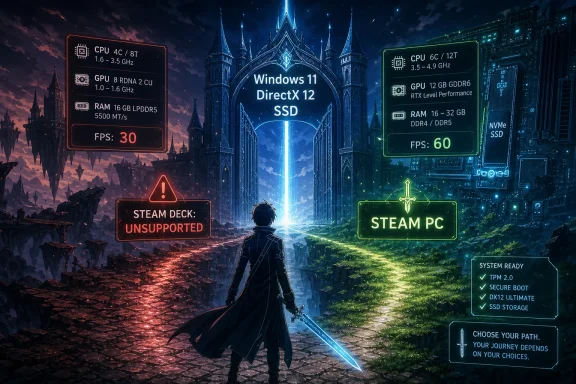
The oddity is not any one component. It is the overall shape: Windows 11, DirectX 12, SSD required, no Steam Deck compatibility. This is the current PC gaming contract in miniature. Developers are not merely asking whether your machine can draw frames; they are asking whether it sits inside a predictable modern software and storage environment.
That matters because Echoes of Aincrad is not being sold as a niche PC benchmark. It is a Bandai Namco-published action RPG attached to one of anime gaming’s most durable fantasies: being trapped in a beautiful, lethal virtual world and climbing your way upward. The requirements suggest the fantasy is being built for contemporary consoles first and contemporary Windows PCs second, with handheld Linux-based PCs left outside the castle gate.
There are several possible explanations, and not all of them are equally damning. The game may depend on middleware, video playback, launcher behavior, anti-tamper systems, controller assumptions, shader compilation patterns, or graphical features that behave poorly on SteamOS. It may also simply be a matter of certification discipline: if Bandai Namco cannot guarantee a decent experience, it would rather say “unsupported” than watch players turn frame-time graphs into launch-week discourse.
But the practical impact is the same. Steam Deck owners can no longer treat Echoes of Aincrad as a presumed portable RPG. Even if the demo or retail build can be coaxed into launching, the official position means no promise of performance, UI comfort, battery reasonableness, or future fixes aimed at Valve’s handheld.
That is a consequential choice for a game whose genre looks handheld-friendly. Anime action RPGs are exactly the kind of long-session, grind-capable, story-driven releases that often thrive on portable PC hardware. By stepping away from Steam Deck support, Echoes of Aincrad narrows one of the most valuable audiences for PC JRPGs: players who want console-style games without being chained to a desk or TV.
That does not automatically mean the game will fail to run on Windows 10. Steam pages and requirement sheets often describe supported configurations rather than every technically possible configuration. But official support matters when launch-day bugs appear, drivers misbehave, or customer service starts triaging crash reports.
For sysadmins and enthusiasts maintaining household gaming rigs, the distinction is not academic. A Windows 10 box that still runs most of a Steam library may increasingly find new releases offering no guarantee, no QA target, and no sympathy. Microsoft’s own lifecycle calendar has already made Windows 10 a shrinking island; games like this make the cultural transition more visible.
The requirements also reflect where DirectX 12 development has settled. Developers targeting PS5, Xbox Series X|S, and PC are increasingly building around modern graphics APIs, faster storage assumptions, and shader-heavy pipelines. Windows 11 is not required for DirectX 12 as a broad category, but it gives publishers a cleaner, more current baseline for drivers, security features, and support expectations.
But “moderate” is not the same as “accessible.” The minimum experience is explicitly framed around 30 FPS and performance priority. That is the survival tier, not the preferred way to play. The moment the target moves to 60 FPS, the requirements climb into more serious 2019-to-2022 gaming hardware.
The inclusion of Intel Arc in the minimum tiers is a welcome sign. Intel’s discrete GPU push has often suffered from uneven perception, even when driver progress has been real. Seeing Arc A750 and Arc B580 named alongside Nvidia and AMD hardware suggests the PC build is at least being positioned for a three-vendor graphics market rather than the old GeForce/Radeon binary.
Still, the 8GB RAM requirement across all tiers is curious. Modern Windows 11 gaming PCs can run with 8GB, but the experience is rarely luxurious once background apps, launchers, overlays, browsers, and security tools join the party. If Echoes of Aincrad genuinely behaves well at 8GB, that is good news. If 8GB merely means “the game starts,” players may discover that the real-world comfort spec is higher than the requirement sheet admits.
This is now the dividing line in PC game design. Mechanical hard drives are no longer just slower; they are increasingly incompatible with how developers stream assets, hide loading, and manage traversal in worlds designed around console SSDs. Even when a game is not huge, it may assume that textures, geometry, audio, and animation data can be fetched quickly and predictably.
For desktop players, the SSD requirement is not especially burdensome in 2026. SATA SSDs are cheap, NVMe drives are common, and any Windows 11 gaming system worthy of the name should already have solid-state storage. But requirements are statements of design intent, and this one says Echoes of Aincrad is not being built around the slowest surviving PC configurations.
That matters for the game’s premise. Aincrad is a tower of floors, encounters, hubs, transitions, and spectacle. The less time the game spends disguising storage bottlenecks, the more it can lean into seamless exploration and responsive combat. If the SSD requirement pays off, players may barely notice it. If it does not, they will wonder why the gate was there at all.
That anime inclusion is not a minor bonus in the world of Sword Art Online. This franchise has always existed across games, animation, light novels, and fandom speculation. A feature-length promotional video tied to a premium edition turns the game purchase into a media bundle, one aimed at fans who do not merely want to play in Aincrad but collect a new branch of its mythology.
Death Game Mode is the more provocative feature. The premise, as described, is deliciously on-brand: clear the main story or pay for an edition that unlocks it early, then enter a mode where dying leads to deletion. The series’ entire emotional engine is built around the terror of death inside a game world, and the mode translates that into a mechanical threat.
But it also raises the familiar modern edition problem. When a mode built around the game’s central fantasy is available early through a pricier SKU, the line between bonus convenience and monetized identity gets blurry. Bandai Namco is hardly alone here, but Echoes of Aincrad makes the tension especially visible because permadeath is not just a modifier. It is the franchise’s thesis with a save-file knife attached.
That is a smart move. The enduring fantasy of Sword Art Online has never been simply “watch Kirito be good at games.” It has been the audience’s desire to imagine themselves inside the death game: choosing a weapon, forming bonds, surviving a floor boss, and becoming the kind of player other survivors remember. A custom character is the obvious vessel for that fantasy.
The system overview described by Bandai Namco emphasizes equipment, weapons, statistics, partners, special skills, leveling, and synergy. None of those ideas are revolutionary in isolation. Together, they sketch an action RPG that wants identity and buildcraft to matter without abandoning real-time reflex combat.
That design balance will decide whether Echoes of Aincrad feels like a living climb or a licensed checklist. If the partner system meaningfully changes tactics and emotional stakes, the game could find its own lane. If it becomes a stat funnel with anime dressing, the custom avatar pitch may only deepen the sense that the player is touring a brand museum.
The distinction matters because Echoes of Aincrad is not just selling difficulty. It is selling consequence. A Soulslike typically turns death into pedagogy: lose, learn, recover, repeat. A Sword Art Online game built around Death Game Mode turns death into dread, or at least tries to.
That is a more fragile contract. If the game feels unfair, deletion becomes a gimmick that punishes players for bad tuning. If the game feels too safe, the mode becomes cosplay for risk rather than risk itself. The sweet spot is brutal but legible: every death must feel like something the player can trace back to a decision, hesitation, greed, or poor preparation.
PC performance will feed directly into that perception. Frame pacing issues, shader hitches, input latency, or camera instability are annoying in any action RPG. In a mode where death has extra meaning, they become grounds for revolt. This is where the requirements sheet stops being paperwork and starts being part of the design.
The listed tiers give players a map, but not a guarantee. “Performance priority,” “balanced preset,” and “image quality priority” are useful labels, yet they leave open the hardest questions. What resolution are these targets based on? Are upscalers involved? How stable is 60 FPS during boss fights? Are cutscenes locked? How does the game behave on CPUs with fewer performance cores but newer architectures?
Those questions are not nitpicking. They define whether the PC version feels cared for or merely exported. A game can meet its requirement sheet and still disappoint if the settings are opaque, the frame pacing is uneven, or the default configuration makes poor assumptions.
The Steam demo is therefore more important than usual. It gives players a chance to test their own machines before launch and gives Bandai Namco a public feedback channel before July 10. If the demo performs well, the Steam Deck exclusion may be treated as a disappointing but honest limitation. If the demo struggles on machines that meet the published requirements, the requirements will become evidence in the prosecution.
But “better shot” is not the same as “good support.” The published requirements are built around desktop-class parts, not 15-watt handheld tuning. Even a Windows handheld that can launch the game may need aggressive resolution cuts, upscaling, power-profile juggling, and acceptance of inconsistent battery life.
This is the awkward reality of the post-Steam Deck handheld market. Windows gives handheld PCs compatibility advantages, especially for games that reject Linux or Proton. Yet the form factor still lives below the assumptions of many desktop requirement sheets. A game can be Windows-only and still not be truly handheld-friendly.
For Microsoft, this remains a strategic sore spot. Windows handhelds exist because Windows has the library, but Windows itself has not fully become a handheld gaming OS. Every new game that says “no Steam Deck” creates an opening for Windows devices, but every new game that demands desktop-like power reminds users why Valve’s appliance-like model became attractive in the first place.
That is why the requirements feel both reasonable and strict. The CPU and GPU tiers are not absurd because the consoles themselves are not absurd by 2026 PC standards. But the SSD and Windows 11 requirements suggest the developers want to reduce variability where they can. The fewer old drives, older operating systems, and unsupported handheld configurations in the support pool, the easier launch becomes.
This is not inherently anti-PC. In fact, a focused support matrix can lead to a better PC release if it lets developers spend time optimizing for realistic machines rather than chasing edge cases. The risk is that publishers use “focus” as a polite word for minimalism: enough settings to ship, enough hardware coverage to sell, and not enough attention to make the PC version feel native.
The inclusion of a free demo helps counter that concern. It puts performance claims into players’ hands before money changes hands. For a game with multiple premium editions and a mode tied to deletion, that transparency is not just consumer-friendly. It is necessary.
When a publisher asks for $89.99 or $109.99 before launch, players evaluate not only content but confidence. Is the PC version polished? Is the demo representative? Is Death Game Mode tuned well enough to justify early access? Is the 110-minute anime a meaningful story or a premium-edition lure?
That is why the Steam Deck note lands harder than it might otherwise. A premium bundle asks fans to lean in, but the compatibility disclaimer tells part of the PC audience to back away. Those two messages can coexist, yet they create friction: the most devoted fans are often the ones most likely to want the game everywhere, including on a handheld.
Bandai Namco’s best defense is clarity. If the company keeps the requirements specific, updates the demo, and explains compatibility limits plainly, the audience can make informed choices. The worst outcome would be ambiguity: a game that is technically purchasable on unsupported setups but miserable enough to generate resentment.
In Echoes of Aincrad, the mode carries unusual thematic power. The source material’s central horror is not just danger but entrapment: a game world where stakes escape the screen. A mode that deletes progress when the player dies is the closest a commercial action RPG can come to adapting that feeling without becoming absurd.
But the mode also depends on technical trust. Players will accept deletion after a bad dodge, a greedy combo, or a failed read. They will not accept deletion after a stutter, a camera freak-out, a crash-adjacent freeze, or an input eaten by a frame-time spike. On PC especially, the system requirements become part of the ethical contract around permadeath.
This is where Echoes of Aincrad faces a higher bar than a normal action RPG. Its most marketable hardcore feature will be judged by the stability of its least glamorous systems. Save handling, autosave timing, crash recovery, input buffering, and performance consistency may matter as much as boss design.
For PC users, the demo should answer questions that the requirements sheet cannot. It should reveal whether 8GB RAM is plausible, whether SSD streaming is smooth, whether Arc support is mature, and whether the 30 FPS minimum feels like a stable floor or a compromise nobody should willingly choose. It will also show whether the Steam Deck disclaimer reflects total incompatibility or simply performance below publisher standards.
For Bandai Namco, the demo is a chance to build trust before the edition ladder starts looking too extractive. A polished demo can make the premium offering feel like a fan celebration. A shaky demo can turn every extra dollar into a liability.
The timing is useful. With launch set for July 10, 2026, there is still a small window for driver notes, patches, settings guidance, and expectation management. That window is not large enough to reinvent the port, but it is large enough to prevent avoidable confusion.
Echoes of Aincrad now has a month to prove that its narrower target produces a better game rather than merely a cleaner support queue. If Bandai Namco and Game Studio deliver a stable Windows 11 build, a credible demo, and a Death Game Mode that punishes player mistakes instead of platform rough edges, the Steam Deck exclusion may become an unfortunate footnote. If not, the first boss players fight will not be waiting on an upper floor of Aincrad; it will be the requirements screen.
 Aincrad Arrives With a Very Modern Windows Filter
The published requirements make Echoes of Aincrad less interesting as a raw horsepower story than as a platform story. The minimum 30 FPS target asks for an Intel Core i5-8400 or AMD Ryzen 3 3300X, 8GB of RAM, and a GPU in the GeForce GTX 1060, Radeon RX Vega 56, or Intel Arc A750 class. That is not a 2026 monster spec, but it is also not a low-end PC spec anymore.The 60 FPS minimum tier moves the graphics ask up to a GeForce RTX 2060, Radeon RX 5700, or Intel Arc B580, while the CPU jumps to an Intel Core i7-9700K on the Intel side. The recommended balanced preset asks for an i7-10700K or Ryzen 5 5600G, plus a GeForce RTX 2070 or Radeon RX 6700 XT. The image-quality-priority recommendation goes further, naming a GeForce RTX 3060 Ti or Radeon RX 6800, both with 16GB listed in the provided requirements.
The oddity is not any one component. It is the overall shape: Windows 11, DirectX 12, SSD required, no Steam Deck compatibility. This is the current PC gaming contract in miniature. Developers are not merely asking whether your machine can draw frames; they are asking whether it sits inside a predictable modern software and storage environment.
That matters because Echoes of Aincrad is not being sold as a niche PC benchmark. It is a Bandai Namco-published action RPG attached to one of anime gaming’s most durable fantasies: being trapped in a beautiful, lethal virtual world and climbing your way upward. The requirements suggest the fantasy is being built for contemporary consoles first and contemporary Windows PCs second, with handheld Linux-based PCs left outside the castle gate.
The Steam Deck Exclusion Is the Sharpest Line in the Sand
“Not compatible with Steam Deck” is the smallest line in the requirements and the one most likely to annoy the loudest group of PC players. Valve’s handheld has trained a generation of buyers to expect that many Japanese PC releases, action RPGs, and mid-budget console ports will at least try to run under Proton. When a publisher says no upfront, it changes the tone from hopeful tinkering to caveat emptor.There are several possible explanations, and not all of them are equally damning. The game may depend on middleware, video playback, launcher behavior, anti-tamper systems, controller assumptions, shader compilation patterns, or graphical features that behave poorly on SteamOS. It may also simply be a matter of certification discipline: if Bandai Namco cannot guarantee a decent experience, it would rather say “unsupported” than watch players turn frame-time graphs into launch-week discourse.
But the practical impact is the same. Steam Deck owners can no longer treat Echoes of Aincrad as a presumed portable RPG. Even if the demo or retail build can be coaxed into launching, the official position means no promise of performance, UI comfort, battery reasonableness, or future fixes aimed at Valve’s handheld.
That is a consequential choice for a game whose genre looks handheld-friendly. Anime action RPGs are exactly the kind of long-session, grind-capable, story-driven releases that often thrive on portable PC hardware. By stepping away from Steam Deck support, Echoes of Aincrad narrows one of the most valuable audiences for PC JRPGs: players who want console-style games without being chained to a desk or TV.
Windows 11 Is No Longer Just a Footnote
The Windows 11-only requirement may provoke less immediate emotion than the Steam Deck note, but it is arguably more important for the WindowsForum crowd. For years, Windows 10 remained the safe default for PC gaming, even as Microsoft pushed Windows 11 through new hardware, upgrade prompts, and security messaging. A Windows 11-only requirement in a mainstream licensed release is another sign that publishers are becoming more comfortable leaving Windows 10 out of the official support matrix.That does not automatically mean the game will fail to run on Windows 10. Steam pages and requirement sheets often describe supported configurations rather than every technically possible configuration. But official support matters when launch-day bugs appear, drivers misbehave, or customer service starts triaging crash reports.
For sysadmins and enthusiasts maintaining household gaming rigs, the distinction is not academic. A Windows 10 box that still runs most of a Steam library may increasingly find new releases offering no guarantee, no QA target, and no sympathy. Microsoft’s own lifecycle calendar has already made Windows 10 a shrinking island; games like this make the cultural transition more visible.
The requirements also reflect where DirectX 12 development has settled. Developers targeting PS5, Xbox Series X|S, and PC are increasingly building around modern graphics APIs, faster storage assumptions, and shader-heavy pipelines. Windows 11 is not required for DirectX 12 as a broad category, but it gives publishers a cleaner, more current baseline for drivers, security features, and support expectations.
The Specs Are Moderate, but the Baseline Is Not Casual
It would be easy to overstate the brutality of these requirements. A GTX 1060 6GB has been the people’s GPU for much of the last decade, and an i5-8400 is hardly exotic. Even the 60 FPS minimum tier starts with hardware that many PC gamers have already owned for years.But “moderate” is not the same as “accessible.” The minimum experience is explicitly framed around 30 FPS and performance priority. That is the survival tier, not the preferred way to play. The moment the target moves to 60 FPS, the requirements climb into more serious 2019-to-2022 gaming hardware.
The inclusion of Intel Arc in the minimum tiers is a welcome sign. Intel’s discrete GPU push has often suffered from uneven perception, even when driver progress has been real. Seeing Arc A750 and Arc B580 named alongside Nvidia and AMD hardware suggests the PC build is at least being positioned for a three-vendor graphics market rather than the old GeForce/Radeon binary.
Still, the 8GB RAM requirement across all tiers is curious. Modern Windows 11 gaming PCs can run with 8GB, but the experience is rarely luxurious once background apps, launchers, overlays, browsers, and security tools join the party. If Echoes of Aincrad genuinely behaves well at 8GB, that is good news. If 8GB merely means “the game starts,” players may discover that the real-world comfort spec is higher than the requirement sheet admits.
The SSD Requirement Says More Than the 30GB Install
The storage requirement is a compact 30GB, which is almost quaint in an era when premium releases can devour triple-digit gigabytes. Yet the important word is not “30GB.” It is “SSD.”This is now the dividing line in PC game design. Mechanical hard drives are no longer just slower; they are increasingly incompatible with how developers stream assets, hide loading, and manage traversal in worlds designed around console SSDs. Even when a game is not huge, it may assume that textures, geometry, audio, and animation data can be fetched quickly and predictably.
For desktop players, the SSD requirement is not especially burdensome in 2026. SATA SSDs are cheap, NVMe drives are common, and any Windows 11 gaming system worthy of the name should already have solid-state storage. But requirements are statements of design intent, and this one says Echoes of Aincrad is not being built around the slowest surviving PC configurations.
That matters for the game’s premise. Aincrad is a tower of floors, encounters, hubs, transitions, and spectacle. The less time the game spends disguising storage bottlenecks, the more it can lean into seamless exploration and responsive combat. If the SSD requirement pays off, players may barely notice it. If it does not, they will wonder why the gate was there at all.
Bandai Namco Is Selling More Than a Game Build
The PC requirements arrived alongside a broader commercial picture that is more aggressive than a simple standard edition launch. Echoes of Aincrad is being sold with Deluxe and Ultimate Edition hooks, including early access to Death Game Mode and a 110-minute promotional anime video, Unanswered//butterfly, packaged with the $109.99 Ultimate Edition.That anime inclusion is not a minor bonus in the world of Sword Art Online. This franchise has always existed across games, animation, light novels, and fandom speculation. A feature-length promotional video tied to a premium edition turns the game purchase into a media bundle, one aimed at fans who do not merely want to play in Aincrad but collect a new branch of its mythology.
Death Game Mode is the more provocative feature. The premise, as described, is deliciously on-brand: clear the main story or pay for an edition that unlocks it early, then enter a mode where dying leads to deletion. The series’ entire emotional engine is built around the terror of death inside a game world, and the mode translates that into a mechanical threat.
But it also raises the familiar modern edition problem. When a mode built around the game’s central fantasy is available early through a pricier SKU, the line between bonus convenience and monetized identity gets blurry. Bandai Namco is hardly alone here, but Echoes of Aincrad makes the tension especially visible because permadeath is not just a modifier. It is the franchise’s thesis with a save-file knife attached.
The Custom Avatar Pitch Reframes the Old Sword Art Online Fantasy
The most important design shift is not technical. It is authorial. Echoes of Aincrad places players in the setting through a custom avatar rather than asking them merely to reenact someone else’s story beat for beat.That is a smart move. The enduring fantasy of Sword Art Online has never been simply “watch Kirito be good at games.” It has been the audience’s desire to imagine themselves inside the death game: choosing a weapon, forming bonds, surviving a floor boss, and becoming the kind of player other survivors remember. A custom character is the obvious vessel for that fantasy.
The system overview described by Bandai Namco emphasizes equipment, weapons, statistics, partners, special skills, leveling, and synergy. None of those ideas are revolutionary in isolation. Together, they sketch an action RPG that wants identity and buildcraft to matter without abandoning real-time reflex combat.
That design balance will decide whether Echoes of Aincrad feels like a living climb or a licensed checklist. If the partner system meaningfully changes tactics and emotional stakes, the game could find its own lane. If it becomes a stat funnel with anime dressing, the custom avatar pitch may only deepen the sense that the player is touring a brand museum.
The “Not a Soulslike” Problem Was Always About Expectations
The Steam tags and combat footage invite one predictable comparison: Soulslike. Developers have reportedly pushed back on that label, while also acknowledging that death can come easily. That is a narrow ridge to walk in 2026, when dodge rolls, parries, stamina pressure, large monsters, and punishing encounters instantly pull players into FromSoftware’s gravitational field.The distinction matters because Echoes of Aincrad is not just selling difficulty. It is selling consequence. A Soulslike typically turns death into pedagogy: lose, learn, recover, repeat. A Sword Art Online game built around Death Game Mode turns death into dread, or at least tries to.
That is a more fragile contract. If the game feels unfair, deletion becomes a gimmick that punishes players for bad tuning. If the game feels too safe, the mode becomes cosplay for risk rather than risk itself. The sweet spot is brutal but legible: every death must feel like something the player can trace back to a decision, hesitation, greed, or poor preparation.
PC performance will feed directly into that perception. Frame pacing issues, shader hitches, input latency, or camera instability are annoying in any action RPG. In a mode where death has extra meaning, they become grounds for revolt. This is where the requirements sheet stops being paperwork and starts being part of the design.
PC Players Will Judge the Port, Not the Franchise
Bandai Namco has a large and passionate audience for anime games, but PC players have become less forgiving about the mechanics of PC releases. They expect shader compilation handled intelligently, ultrawide behavior at least considered, controller support that does not fight Windows, and settings menus that explain what they are doing. They also expect performance to scale in a way that makes sense.The listed tiers give players a map, but not a guarantee. “Performance priority,” “balanced preset,” and “image quality priority” are useful labels, yet they leave open the hardest questions. What resolution are these targets based on? Are upscalers involved? How stable is 60 FPS during boss fights? Are cutscenes locked? How does the game behave on CPUs with fewer performance cores but newer architectures?
Those questions are not nitpicking. They define whether the PC version feels cared for or merely exported. A game can meet its requirement sheet and still disappoint if the settings are opaque, the frame pacing is uneven, or the default configuration makes poor assumptions.
The Steam demo is therefore more important than usual. It gives players a chance to test their own machines before launch and gives Bandai Namco a public feedback channel before July 10. If the demo performs well, the Steam Deck exclusion may be treated as a disappointing but honest limitation. If the demo struggles on machines that meet the published requirements, the requirements will become evidence in the prosecution.
Steam Deck’s Absence Leaves Windows Handhelds in an Awkward Middle
The explicit Steam Deck rejection does not automatically condemn Windows handhelds. Devices like the ROG Ally, Legion Go, and MSI Claw run Windows rather than SteamOS, and some of them offer stronger hardware than Valve’s handheld. On paper, that gives them a better shot.But “better shot” is not the same as “good support.” The published requirements are built around desktop-class parts, not 15-watt handheld tuning. Even a Windows handheld that can launch the game may need aggressive resolution cuts, upscaling, power-profile juggling, and acceptance of inconsistent battery life.
This is the awkward reality of the post-Steam Deck handheld market. Windows gives handheld PCs compatibility advantages, especially for games that reject Linux or Proton. Yet the form factor still lives below the assumptions of many desktop requirement sheets. A game can be Windows-only and still not be truly handheld-friendly.
For Microsoft, this remains a strategic sore spot. Windows handhelds exist because Windows has the library, but Windows itself has not fully become a handheld gaming OS. Every new game that says “no Steam Deck” creates an opening for Windows devices, but every new game that demands desktop-like power reminds users why Valve’s appliance-like model became attractive in the first place.
The Requirements Expose the Console-Port Reality Without Saying It
The PS5 and Xbox Series X|S versions explain much of the PC profile. Modern console-first development gives studios a clear CPU, GPU, memory, and storage target. PC support then becomes an exercise in mapping that target across a messy universe of components.That is why the requirements feel both reasonable and strict. The CPU and GPU tiers are not absurd because the consoles themselves are not absurd by 2026 PC standards. But the SSD and Windows 11 requirements suggest the developers want to reduce variability where they can. The fewer old drives, older operating systems, and unsupported handheld configurations in the support pool, the easier launch becomes.
This is not inherently anti-PC. In fact, a focused support matrix can lead to a better PC release if it lets developers spend time optimizing for realistic machines rather than chasing edge cases. The risk is that publishers use “focus” as a polite word for minimalism: enough settings to ship, enough hardware coverage to sell, and not enough attention to make the PC version feel native.
The inclusion of a free demo helps counter that concern. It puts performance claims into players’ hands before money changes hands. For a game with multiple premium editions and a mode tied to deletion, that transparency is not just consumer-friendly. It is necessary.
The Edition Strategy Makes Trust Part of the System Requirement
The Deluxe and Ultimate Edition structure places Echoes of Aincrad squarely inside the modern premium-game economy. There is the base game, the extra content path, the early unlock, and the collector-bait media object. None of this is surprising, but it changes how players interpret every technical caveat.When a publisher asks for $89.99 or $109.99 before launch, players evaluate not only content but confidence. Is the PC version polished? Is the demo representative? Is Death Game Mode tuned well enough to justify early access? Is the 110-minute anime a meaningful story or a premium-edition lure?
That is why the Steam Deck note lands harder than it might otherwise. A premium bundle asks fans to lean in, but the compatibility disclaimer tells part of the PC audience to back away. Those two messages can coexist, yet they create friction: the most devoted fans are often the ones most likely to want the game everywhere, including on a handheld.
Bandai Namco’s best defense is clarity. If the company keeps the requirements specific, updates the demo, and explains compatibility limits plainly, the audience can make informed choices. The worst outcome would be ambiguity: a game that is technically purchasable on unsupported setups but miserable enough to generate resentment.
Death Game Mode Could Be Brilliant or Brutal in the Wrong Way
Permadeath modes are easy to market and hard to design. The idea is instantly understandable: die and lose something that matters. The execution is where games either become unforgettable or merely punitive.In Echoes of Aincrad, the mode carries unusual thematic power. The source material’s central horror is not just danger but entrapment: a game world where stakes escape the screen. A mode that deletes progress when the player dies is the closest a commercial action RPG can come to adapting that feeling without becoming absurd.
But the mode also depends on technical trust. Players will accept deletion after a bad dodge, a greedy combo, or a failed read. They will not accept deletion after a stutter, a camera freak-out, a crash-adjacent freeze, or an input eaten by a frame-time spike. On PC especially, the system requirements become part of the ethical contract around permadeath.
This is where Echoes of Aincrad faces a higher bar than a normal action RPG. Its most marketable hardcore feature will be judged by the stability of its least glamorous systems. Save handling, autosave timing, crash recovery, input buffering, and performance consistency may matter as much as boss design.
The Demo Is the Real Launch Before Launch
A free demo across platforms is not merely a marketing beat. It is an early referendum. Players will use it to test GPUs, handhelds, drivers, ultrawide monitors, Windows builds, controllers, and expectations.For PC users, the demo should answer questions that the requirements sheet cannot. It should reveal whether 8GB RAM is plausible, whether SSD streaming is smooth, whether Arc support is mature, and whether the 30 FPS minimum feels like a stable floor or a compromise nobody should willingly choose. It will also show whether the Steam Deck disclaimer reflects total incompatibility or simply performance below publisher standards.
For Bandai Namco, the demo is a chance to build trust before the edition ladder starts looking too extractive. A polished demo can make the premium offering feel like a fan celebration. A shaky demo can turn every extra dollar into a liability.
The timing is useful. With launch set for July 10, 2026, there is still a small window for driver notes, patches, settings guidance, and expectation management. That window is not large enough to reinvent the port, but it is large enough to prevent avoidable confusion.
The Castle Gate Is Narrower Than the Marketing Art Suggests
The concrete lesson from the requirements is that Echoes of Aincrad is being positioned as a modern Windows-and-console action RPG, not a broadly elastic PC release. The specs are not terrifying, but they are opinionated. They assume a current OS, solid-state storage, DirectX 12, and a GPU with enough memory and driver maturity to keep up.- Players on Windows 11 desktops with midrange discrete GPUs should be the safest audience for the Steam version.
- Windows 10 users should treat the absence of official support as a real risk, even if the game might technically run.
- Steam Deck owners should not buy the game expecting Valve-style portability unless later testing or patches change the situation.
- Windows handheld owners may fare better than Steam Deck users, but the desktop-class requirements make performance far from guaranteed.
- The free demo is the best way to validate performance before committing to the base game or premium editions.
- Death Game Mode raises the importance of stability because permadeath feels very different when a technical hitch can be blamed for a loss.
Echoes of Aincrad now has a month to prove that its narrower target produces a better game rather than merely a cleaner support queue. If Bandai Namco and Game Studio deliver a stable Windows 11 build, a credible demo, and a Death Game Mode that punishes player mistakes instead of platform rough edges, the Steam Deck exclusion may become an unfortunate footnote. If not, the first boss players fight will not be waiting on an upper floor of Aincrad; it will be the requirements screen.
References
- Primary source: Noisy Pixel
Published: 2026-06-16T00:10:08.405562
Loading…
noisypixel.net - Related coverage: store.steampowered.com
Loading…
store.steampowered.com - Related coverage: bandainamcoent.com
Loading…
www.bandainamcoent.com - Related coverage: game8.co
Loading…
game8.co - Related coverage: ethelialung.com
Loading…
ethelialung.com - Related coverage: shared.akamai.steamstatic.com
Loading…
shared.akamai.steamstatic.com