

Aembit announced on June 16, 2026, that it now supports Microsoft Copilot Studio agents, adding runtime credential issuance, least-privilege policy enforcement, and access auditing for agents that connect to enterprise resources. The pitch is not simply that another security vendor has added another Microsoft integration. It is that the agent boom is dragging identity teams into a category of workload they did not design their access models to govern. Copilot Studio makes it easy to build agents; Aembit is betting that ease will become a liability unless enterprises can control what those agents touch.
Microsoft Copilot Studio is no longer just a chatbot builder with a friendly enterprise wrapper. Microsoft’s own documentation now frames it as a place to create, extend, deploy, evaluate, and administer agents that can use connectors, knowledge sources, workflows, and Model Context Protocol servers. That matters because the security boundary is no longer the prompt box. It is the moment an agent decides to call a tool.
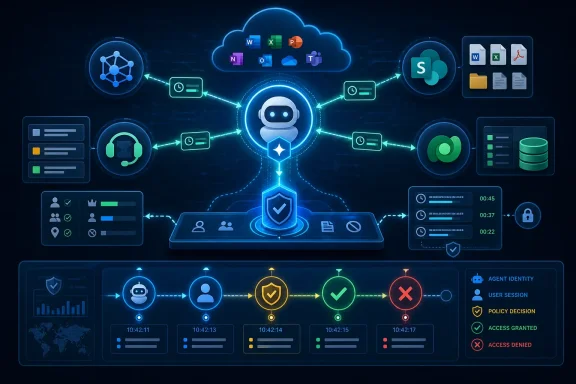
Aembit’s announcement lands squarely in that gap. The company says its new Copilot Studio support lets security teams govern how agents authenticate to internal systems, external APIs, and enterprise resources. Instead of allowing an agent to hold or reuse a broad credential, Aembit places itself between the agent and the destination service, evaluates the access request, and issues a short-lived credential only when policy allows it.
That sounds like familiar zero-trust language, and in many ways it is. The difference is that AI agents are not conventional service accounts, cron jobs, or microservices. They are software actors driven by user context, model output, tool descriptions, orchestration rules, and runtime decisions. The identity problem is therefore not just “which app is calling which API?” It is “which agent, acting for which session, decided to call which tool, under what conditions, and why was that allowed?”
For WindowsForum readers, the Microsoft angle is the point. Copilot Studio sits inside the same enterprise gravitational field as Microsoft 365, Power Platform, Entra ID, Dataverse, Teams, SharePoint, and the rest of the Microsoft cloud estate. If agents become another way into those systems, then agent identity becomes part of Windows and Microsoft 365 administration, not a boutique AI governance concern.
The arrival of MCP support sharpened that proposition. Model Context Protocol gives agents a standardized way to discover and invoke tools and resources exposed by a server. In practice, that means an agent can be connected to systems that were never designed specifically for Copilot Studio, provided the right MCP layer exists. The enterprise value is speed: the agent can move from answering questions to taking action.
But speed is also the security problem. When a tool becomes easy enough to add in a few clicks, the number of pathways from agent to enterprise resource can multiply faster than centralized security teams can review them. This is the old shadow IT story with a new runtime: instead of unsanctioned SaaS apps, the risk is semi-sanctioned agents with unclear access boundaries.
Microsoft does provide administration and governance capabilities around Copilot Studio, including authentication configuration, data policies, environment management, analytics, and security controls. But Aembit is arguing that the specific act of agent-to-resource authentication needs a more dynamic control plane than many existing IAM deployments provide. That is a narrow claim, but it is also a consequential one.
The reason is simple: Copilot Studio agents can be useful precisely because they are not locked to one deterministic path. They can choose tools based on a user request and the orchestration instructions they have been given. The same agent may answer a simple knowledge question in one exchange, call a ticketing system in another, and query a finance API in a third. A static access model starts to look brittle when the caller’s behavior is probabilistic.
AI agents are legible in a different way. They are not human, but they often act in response to a human. They are not a normal workload, because their tool selection can vary by request. They may need access to a resource only for a single task, but the simplest deployment pattern may leave them with broader or longer-lived credentials than that task deserves.
That is the mismatch Aembit is trying to commercialize. Its announcement argues that OAuth consent or a service account can get an agent working, but may not give security teams enough control, attribution, or auditability. If multiple agents share infrastructure, a log entry showing a credential was used may not explain which agent triggered it, which user session was involved, or which policy decision authorized the request.
There is a practical Windows-admin version of this problem. Imagine a Copilot Studio agent built to help employees retrieve HR policy, open support tickets, and summarize SharePoint documents. In a demo, it looks benign. In production, it may need to call Microsoft Graph, a help desk API, a document repository, and a workflow endpoint. If the agent is over-permissioned because no one wants it to fail, the organization has converted convenience into standing access.
Aembit’s answer is to make credentials ephemeral. At runtime, the agent requests access, Aembit evaluates the request against policy, and an authorized request receives a scoped credential that expires after use. The key claim is not that short-lived credentials are new. It is that agent access should be brokered at the moment of action, rather than preloaded into the agent’s environment as a persistent secret.
Auditors do not usually ask whether an architecture felt modern. They ask who accessed what, when, under whose authority, and whether that access was appropriate. With agents, that question becomes messier. If an employee asks an agent to perform a task, and the agent calls three systems to complete it, the resulting access chain must preserve both the user context and the agent identity.
Aembit uses the term blended identity for this model: an identity distinct from the user, but tied to the user’s session, with credentials issued at runtime for a specific task. The branding is vendor-specific, but the underlying concept is likely to become unavoidable. Enterprises will need to distinguish between “Alice accessed a record,” “an app accessed a record,” and “an agent acting in Alice’s session accessed a record after a policy engine allowed it.”
That distinction matters in incident response. If a token leaks, a short-lived credential reduces the window of abuse. If an agent behaves unexpectedly, contextual logs give investigators something more useful than a pile of API calls. If a business unit deploys an agent that quietly touches a restricted system, centralized policy enforcement gives the security team a chance to catch the pattern before it becomes institutionalized risk.
There is also a governance benefit. Agent deployments are likely to sprawl across departments because the barrier to creation is intentionally low. Central policy management gives security teams a place to define rules that travel with the access path, rather than relying on every maker, developer, or business analyst to understand the full implications of credential scope.
A tool interface is an invitation to act. Once an agent can discover a tool, understand its description, and invoke it, the agent is no longer merely producing text. It is participating in business processes. Depending on the connected systems, those actions may be low-risk, such as searching public documentation, or high-risk, such as updating records, creating tickets, moving files, or calling transactional APIs.
Microsoft has embraced MCP across parts of its agent ecosystem, including Copilot Studio. That makes sense strategically. If Microsoft wants Copilot Studio to be the enterprise agent workbench, it needs a way to connect agents to the messy world beyond Microsoft’s own connectors. MCP is the bridge.
But every bridge needs a checkpoint. The more agent platforms standardize tool invocation, the more identity teams will need standardized ways to enforce access at invocation time. Otherwise, MCP becomes a neat integration layer sitting atop a credential model inherited from less dynamic software.
This is where Aembit’s announcement should be read less as a one-off integration and more as a market signal. Identity security vendors are beginning to treat AI agents as a first-class workload category. Aembit is not alone in seeing Copilot Studio as an obvious place to plant a flag; other identity security companies have also announced agent identity controls for Microsoft’s agent-building platform. The land grab is on because the enterprise Microsoft estate is where many of these agents will actually run.
The question is whether native platform controls are enough for every enterprise access model. Large organizations rarely run on a single vendor’s identity assumptions. They have legacy systems, non-Microsoft APIs, custom services, multiple clouds, third-party SaaS, and compliance regimes that predate the agent era. They also have security teams that want policy consistency across platforms, not one agent access model for Microsoft, another for Anthropic-based workflows, another for internal LangChain apps, and another for whatever a business unit pilots next quarter.
Aembit’s announcement leans into that heterogeneity. The company says its approach applies not only to Copilot Studio but also to other agent platforms and custom LLM workflows that make API calls. That platform-agnostic framing is important, because enterprises are unlikely to standardize on a single agent builder in the near term. Even organizations committed to Microsoft 365 Copilot will still experiment with developer agents, customer-service agents, internal automation agents, and custom domain-specific assistants.
The real contest will be over where agent access policy should live. Microsoft will naturally argue for deep native governance within its cloud. Third-party identity vendors will argue for cross-platform policy enforcement. Most enterprises will probably use both, because that is how enterprise security usually evolves: platform controls for the basics, external controls where risk, scale, or compliance pressure demands more.
For administrators, the practical advice is to avoid treating these layers as mutually exclusive. Native Copilot Studio governance can define who can create agents, where they run, how they are published, and what platform controls apply. Runtime credential brokering can define whether a particular agent action should receive access to a particular resource at a particular moment. Those are related problems, not identical ones.
That creates a familiar governance lag. First, a tool becomes useful. Then it becomes widely used. Then security teams discover how many exceptions, credentials, connectors, and unofficial workflows now exist. The agent version of this pattern may move faster because building an agent is easier than building a traditional application.
Copilot Studio amplifies the trend because it gives non-specialists access to agent creation inside a Microsoft environment many enterprises already trust. That trust can be beneficial; it means agents may inherit better governance than a random external AI service. But it can also reduce skepticism. If something is “in Microsoft,” a business team may assume it is automatically safe enough.
The right response is not to ban agent building. That would simply push experimentation elsewhere. The better response is to classify agents as production actors as soon as they can access production resources. If an agent can call a system of record, retrieve restricted data, or trigger a workflow, it deserves the same access scrutiny as any other workload — and probably more, because its behavior may be less predictable.
This is where identity teams should be pushing for inventory. Which Copilot Studio agents exist? Which environments host them? Which tools are attached? Which users can publish them? Which resources can they access? Which credentials do they use? Which logs would show an improper access attempt? If those questions cannot be answered quickly, the organization has an agent governance problem whether or not it has suffered an incident.
Aembit’s runtime model is meant to resist that temptation. Instead of granting an agent a persistent credential broad enough for many possible futures, it grants a short-lived credential for the specific interaction that policy approves. In theory, that lets security teams preserve agent flexibility without accepting standing access.
The production challenge will be policy design. Someone still has to define which agents may access which resources under which conditions. If those policies are too strict, agents will fail at legitimate tasks. If they are too loose, ephemeral credentials become a nicer wrapper around excessive privilege. The hard work does not disappear; it moves into a policy engine and audit workflow.
There is also the problem of context quality. To make a good access decision, a broker needs useful signals: agent identity, user session, requested resource, task context, environment, risk posture, and perhaps data sensitivity. Enterprises will need to decide how much of that context is trustworthy and how much can be influenced by the model, the prompt, or the tool description. A security policy that relies too heavily on model-generated intent may be weaker than it looks.
Still, the direction is right. Security teams should prefer temporary, scoped credentials over long-lived secrets embedded in agent configurations. They should prefer attributable access events over shared service accounts. They should prefer centralized policy over ad hoc OAuth consent scattered across departmental projects. Aembit’s integration is notable because it packages those preferences for a Microsoft agent platform that many enterprises are already evaluating.
That framing is more useful than another round of generic AI safety language. Enterprise AI risk is often discussed in terms of hallucination, prompt injection, data leakage, and governance boards. Those are real concerns. But the operational question for many IT shops will be more concrete: when an agent needs a credential, what happens?
If the answer is “it uses a service account someone created during the pilot,” the organization is building debt. If the answer is “the user consented once and now we hope the scope is acceptable,” the organization is relying on a model designed for a less agentic world. If the answer is “we issue short-lived credentials under policy and log every decision,” the organization is at least speaking the language of modern identity.
The identity industry likes to rename old problems, and there is some of that here. Workload identity, just-in-time access, short-lived credentials, and audit logging are not inventions of the agent era. But agents change the pressure on those concepts. They make runtime access decisions more frequent, more varied, and more likely to cross system boundaries in ways that business users do not fully see.
That is why Copilot Studio is a useful test case. It is enterprise-friendly, Microsoft-administered, and designed for broad adoption. If identity teams cannot create workable controls for agents in that environment, they will struggle even more with custom agent stacks spread across clouds, developer laptops, and SaaS automation platforms.
That review should include both official and informal deployments. Copilot Studio agents built in sanctioned environments are only part of the picture. Teams may also be experimenting with MCP servers, custom connectors, Power Automate flows, internal APIs, and agent-like workflows that do not carry the Copilot Studio label. The access model should be assessed across the full path from user prompt to tool invocation to resource action.
Administrators should also separate two kinds of controls. Platform governance answers who can build, publish, and manage agents. Runtime access governance answers what an agent can reach at the moment it tries to act. Organizations need both. A beautifully governed agent catalog does not help much if every production agent shares an overpowered API key.
The other practical issue is logging. Microsoft 365 and Power Platform administrators are used to collecting audit data, but agent actions can blur attribution. If a Copilot Studio agent calls a downstream service through a connector or MCP server, the resulting logs must preserve enough context to reconstruct the event. Otherwise, the organization may know that access occurred but not whether it was appropriate.
Finally, there is the lifecycle question. Agents will change. Tools will be added, prompts will be revised, workflows will be updated, and business owners will ask for broader capabilities once early demos succeed. Access policies need to evolve with those changes. A one-time approval for an agent is not enough if the agent’s tool surface doubles three months later.
 The Copilot Studio Security Story Has Moved From Chat to Access
Microsoft Copilot Studio is no longer just a chatbot builder with a friendly enterprise wrapper. Microsoft’s own documentation now frames it as a place to create, extend, deploy, evaluate, and administer agents that can use connectors, knowledge sources, workflows, and Model Context Protocol servers. That matters because the security boundary is no longer the prompt box. It is the moment an agent decides to call a tool.Aembit’s announcement lands squarely in that gap. The company says its new Copilot Studio support lets security teams govern how agents authenticate to internal systems, external APIs, and enterprise resources. Instead of allowing an agent to hold or reuse a broad credential, Aembit places itself between the agent and the destination service, evaluates the access request, and issues a short-lived credential only when policy allows it.
That sounds like familiar zero-trust language, and in many ways it is. The difference is that AI agents are not conventional service accounts, cron jobs, or microservices. They are software actors driven by user context, model output, tool descriptions, orchestration rules, and runtime decisions. The identity problem is therefore not just “which app is calling which API?” It is “which agent, acting for which session, decided to call which tool, under what conditions, and why was that allowed?”
For WindowsForum readers, the Microsoft angle is the point. Copilot Studio sits inside the same enterprise gravitational field as Microsoft 365, Power Platform, Entra ID, Dataverse, Teams, SharePoint, and the rest of the Microsoft cloud estate. If agents become another way into those systems, then agent identity becomes part of Windows and Microsoft 365 administration, not a boutique AI governance concern.
Microsoft Lowered the Agent Barrier, and That Was the Product
Copilot Studio’s appeal is obvious: it lets business units and IT teams build agents without starting from scratch. A maker can connect an agent to knowledge, add tools, publish it into supported channels, and wire it into workflows with far less engineering effort than a custom LLM application would require. Microsoft has spent the last year making this platform feel more like an agent assembly line than an experimental playground.The arrival of MCP support sharpened that proposition. Model Context Protocol gives agents a standardized way to discover and invoke tools and resources exposed by a server. In practice, that means an agent can be connected to systems that were never designed specifically for Copilot Studio, provided the right MCP layer exists. The enterprise value is speed: the agent can move from answering questions to taking action.
But speed is also the security problem. When a tool becomes easy enough to add in a few clicks, the number of pathways from agent to enterprise resource can multiply faster than centralized security teams can review them. This is the old shadow IT story with a new runtime: instead of unsanctioned SaaS apps, the risk is semi-sanctioned agents with unclear access boundaries.
Microsoft does provide administration and governance capabilities around Copilot Studio, including authentication configuration, data policies, environment management, analytics, and security controls. But Aembit is arguing that the specific act of agent-to-resource authentication needs a more dynamic control plane than many existing IAM deployments provide. That is a narrow claim, but it is also a consequential one.
The reason is simple: Copilot Studio agents can be useful precisely because they are not locked to one deterministic path. They can choose tools based on a user request and the orchestration instructions they have been given. The same agent may answer a simple knowledge question in one exchange, call a ticketing system in another, and query a finance API in a third. A static access model starts to look brittle when the caller’s behavior is probabilistic.
Static Credentials Are the Wrong Abstraction for Agents
Traditional enterprise access models assume relatively stable roles. A human user signs in, receives permissions, and acts through applications. A workload runs as a service identity, does a defined job, and is granted access appropriate to that job. Even when those models are imperfect, they are legible.AI agents are legible in a different way. They are not human, but they often act in response to a human. They are not a normal workload, because their tool selection can vary by request. They may need access to a resource only for a single task, but the simplest deployment pattern may leave them with broader or longer-lived credentials than that task deserves.
That is the mismatch Aembit is trying to commercialize. Its announcement argues that OAuth consent or a service account can get an agent working, but may not give security teams enough control, attribution, or auditability. If multiple agents share infrastructure, a log entry showing a credential was used may not explain which agent triggered it, which user session was involved, or which policy decision authorized the request.
There is a practical Windows-admin version of this problem. Imagine a Copilot Studio agent built to help employees retrieve HR policy, open support tickets, and summarize SharePoint documents. In a demo, it looks benign. In production, it may need to call Microsoft Graph, a help desk API, a document repository, and a workflow endpoint. If the agent is over-permissioned because no one wants it to fail, the organization has converted convenience into standing access.
Aembit’s answer is to make credentials ephemeral. At runtime, the agent requests access, Aembit evaluates the request against policy, and an authorized request receives a scoped credential that expires after use. The key claim is not that short-lived credentials are new. It is that agent access should be brokered at the moment of action, rather than preloaded into the agent’s environment as a persistent secret.
The Audit Trail Is Becoming the Real Product
Security vendors often lead with prevention, but the more interesting part of Aembit’s Copilot Studio pitch is accountability. The company says its integration can log credential issuance, access events, and policy decisions with enough context to support compliance review. That is where agent security becomes operational rather than philosophical.Auditors do not usually ask whether an architecture felt modern. They ask who accessed what, when, under whose authority, and whether that access was appropriate. With agents, that question becomes messier. If an employee asks an agent to perform a task, and the agent calls three systems to complete it, the resulting access chain must preserve both the user context and the agent identity.
Aembit uses the term blended identity for this model: an identity distinct from the user, but tied to the user’s session, with credentials issued at runtime for a specific task. The branding is vendor-specific, but the underlying concept is likely to become unavoidable. Enterprises will need to distinguish between “Alice accessed a record,” “an app accessed a record,” and “an agent acting in Alice’s session accessed a record after a policy engine allowed it.”
That distinction matters in incident response. If a token leaks, a short-lived credential reduces the window of abuse. If an agent behaves unexpectedly, contextual logs give investigators something more useful than a pile of API calls. If a business unit deploys an agent that quietly touches a restricted system, centralized policy enforcement gives the security team a chance to catch the pattern before it becomes institutionalized risk.
There is also a governance benefit. Agent deployments are likely to sprawl across departments because the barrier to creation is intentionally low. Central policy management gives security teams a place to define rules that travel with the access path, rather than relying on every maker, developer, or business analyst to understand the full implications of credential scope.
MCP Makes the Agent Useful, Then Makes IAM Nervous
Model Context Protocol is a major reason this conversation is accelerating. By standardizing how agents connect to tools and resources, MCP helps reduce one-off integration work. It also makes tool access more portable across agent platforms. That is good for developers and platform teams, but it changes the security surface.A tool interface is an invitation to act. Once an agent can discover a tool, understand its description, and invoke it, the agent is no longer merely producing text. It is participating in business processes. Depending on the connected systems, those actions may be low-risk, such as searching public documentation, or high-risk, such as updating records, creating tickets, moving files, or calling transactional APIs.
Microsoft has embraced MCP across parts of its agent ecosystem, including Copilot Studio. That makes sense strategically. If Microsoft wants Copilot Studio to be the enterprise agent workbench, it needs a way to connect agents to the messy world beyond Microsoft’s own connectors. MCP is the bridge.
But every bridge needs a checkpoint. The more agent platforms standardize tool invocation, the more identity teams will need standardized ways to enforce access at invocation time. Otherwise, MCP becomes a neat integration layer sitting atop a credential model inherited from less dynamic software.
This is where Aembit’s announcement should be read less as a one-off integration and more as a market signal. Identity security vendors are beginning to treat AI agents as a first-class workload category. Aembit is not alone in seeing Copilot Studio as an obvious place to plant a flag; other identity security companies have also announced agent identity controls for Microsoft’s agent-building platform. The land grab is on because the enterprise Microsoft estate is where many of these agents will actually run.
Microsoft’s Native Controls Still Matter, but They Will Not End the Debate
It would be wrong to frame this as Microsoft ignoring security. Copilot Studio sits within Power Platform governance, Microsoft 365 administration, and Entra-based identity patterns. Microsoft has also been adding threat protection and administration features around agent behavior, including controls aimed at prompt-injection risks and data exfiltration scenarios.The question is whether native platform controls are enough for every enterprise access model. Large organizations rarely run on a single vendor’s identity assumptions. They have legacy systems, non-Microsoft APIs, custom services, multiple clouds, third-party SaaS, and compliance regimes that predate the agent era. They also have security teams that want policy consistency across platforms, not one agent access model for Microsoft, another for Anthropic-based workflows, another for internal LangChain apps, and another for whatever a business unit pilots next quarter.
Aembit’s announcement leans into that heterogeneity. The company says its approach applies not only to Copilot Studio but also to other agent platforms and custom LLM workflows that make API calls. That platform-agnostic framing is important, because enterprises are unlikely to standardize on a single agent builder in the near term. Even organizations committed to Microsoft 365 Copilot will still experiment with developer agents, customer-service agents, internal automation agents, and custom domain-specific assistants.
The real contest will be over where agent access policy should live. Microsoft will naturally argue for deep native governance within its cloud. Third-party identity vendors will argue for cross-platform policy enforcement. Most enterprises will probably use both, because that is how enterprise security usually evolves: platform controls for the basics, external controls where risk, scale, or compliance pressure demands more.
For administrators, the practical advice is to avoid treating these layers as mutually exclusive. Native Copilot Studio governance can define who can create agents, where they run, how they are published, and what platform controls apply. Runtime credential brokering can define whether a particular agent action should receive access to a particular resource at a particular moment. Those are related problems, not identical ones.
The Agent Sprawl Problem Is Organizational Before It Is Technical
The most revealing line in Aembit’s announcement is not about tokens or audits. It is the assertion that “the agents are already in your environment.” That is marketing, but it is also plausible. In many companies, AI adoption is not moving through a single architecture review board. It is arriving through productivity tools, developer environments, SaaS features, Power Platform projects, and departmental pilots.That creates a familiar governance lag. First, a tool becomes useful. Then it becomes widely used. Then security teams discover how many exceptions, credentials, connectors, and unofficial workflows now exist. The agent version of this pattern may move faster because building an agent is easier than building a traditional application.
Copilot Studio amplifies the trend because it gives non-specialists access to agent creation inside a Microsoft environment many enterprises already trust. That trust can be beneficial; it means agents may inherit better governance than a random external AI service. But it can also reduce skepticism. If something is “in Microsoft,” a business team may assume it is automatically safe enough.
The right response is not to ban agent building. That would simply push experimentation elsewhere. The better response is to classify agents as production actors as soon as they can access production resources. If an agent can call a system of record, retrieve restricted data, or trigger a workflow, it deserves the same access scrutiny as any other workload — and probably more, because its behavior may be less predictable.
This is where identity teams should be pushing for inventory. Which Copilot Studio agents exist? Which environments host them? Which tools are attached? Which users can publish them? Which resources can they access? Which credentials do they use? Which logs would show an improper access attempt? If those questions cannot be answered quickly, the organization has an agent governance problem whether or not it has suffered an incident.
The Least-Privilege Promise Will Be Tested in Production
Least privilege is easy to endorse and hard to implement. With conventional applications, teams often over-scope access because permissions are tedious, ownership is unclear, and nobody wants a business process to break. Agents add another reason: uncertainty. If no one knows exactly which tool path an agent will choose for a given request, the temptation is to grant broader access “just in case.”Aembit’s runtime model is meant to resist that temptation. Instead of granting an agent a persistent credential broad enough for many possible futures, it grants a short-lived credential for the specific interaction that policy approves. In theory, that lets security teams preserve agent flexibility without accepting standing access.
The production challenge will be policy design. Someone still has to define which agents may access which resources under which conditions. If those policies are too strict, agents will fail at legitimate tasks. If they are too loose, ephemeral credentials become a nicer wrapper around excessive privilege. The hard work does not disappear; it moves into a policy engine and audit workflow.
There is also the problem of context quality. To make a good access decision, a broker needs useful signals: agent identity, user session, requested resource, task context, environment, risk posture, and perhaps data sensitivity. Enterprises will need to decide how much of that context is trustworthy and how much can be influenced by the model, the prompt, or the tool description. A security policy that relies too heavily on model-generated intent may be weaker than it looks.
Still, the direction is right. Security teams should prefer temporary, scoped credentials over long-lived secrets embedded in agent configurations. They should prefer attributable access events over shared service accounts. They should prefer centralized policy over ad hoc OAuth consent scattered across departmental projects. Aembit’s integration is notable because it packages those preferences for a Microsoft agent platform that many enterprises are already evaluating.
Identiverse Is the Right Stage for an Identity Reframing
Aembit is announcing the Copilot Studio integration at Identiverse 2026, which is not accidental. Identiverse is an identity conference, not an AI developer showcase. The intended audience is the group that has spent years building controls for human access, workload identity, privileged access, and zero trust. Aembit is telling that audience: agents are your problem now.That framing is more useful than another round of generic AI safety language. Enterprise AI risk is often discussed in terms of hallucination, prompt injection, data leakage, and governance boards. Those are real concerns. But the operational question for many IT shops will be more concrete: when an agent needs a credential, what happens?
If the answer is “it uses a service account someone created during the pilot,” the organization is building debt. If the answer is “the user consented once and now we hope the scope is acceptable,” the organization is relying on a model designed for a less agentic world. If the answer is “we issue short-lived credentials under policy and log every decision,” the organization is at least speaking the language of modern identity.
The identity industry likes to rename old problems, and there is some of that here. Workload identity, just-in-time access, short-lived credentials, and audit logging are not inventions of the agent era. But agents change the pressure on those concepts. They make runtime access decisions more frequent, more varied, and more likely to cross system boundaries in ways that business users do not fully see.
That is why Copilot Studio is a useful test case. It is enterprise-friendly, Microsoft-administered, and designed for broad adoption. If identity teams cannot create workable controls for agents in that environment, they will struggle even more with custom agent stacks spread across clouds, developer laptops, and SaaS automation platforms.
The Practical Reading for Windows and Microsoft 365 Shops
For Microsoft-focused organizations, the Aembit announcement should trigger a review, not a purchasing reflex. The first question is not whether Aembit is the right vendor. The first question is whether Copilot Studio agents in the tenant are already accessing enterprise resources in ways security teams can explain.That review should include both official and informal deployments. Copilot Studio agents built in sanctioned environments are only part of the picture. Teams may also be experimenting with MCP servers, custom connectors, Power Automate flows, internal APIs, and agent-like workflows that do not carry the Copilot Studio label. The access model should be assessed across the full path from user prompt to tool invocation to resource action.
Administrators should also separate two kinds of controls. Platform governance answers who can build, publish, and manage agents. Runtime access governance answers what an agent can reach at the moment it tries to act. Organizations need both. A beautifully governed agent catalog does not help much if every production agent shares an overpowered API key.
The other practical issue is logging. Microsoft 365 and Power Platform administrators are used to collecting audit data, but agent actions can blur attribution. If a Copilot Studio agent calls a downstream service through a connector or MCP server, the resulting logs must preserve enough context to reconstruct the event. Otherwise, the organization may know that access occurred but not whether it was appropriate.
Finally, there is the lifecycle question. Agents will change. Tools will be added, prompts will be revised, workflows will be updated, and business owners will ask for broader capabilities once early demos succeed. Access policies need to evolve with those changes. A one-time approval for an agent is not enough if the agent’s tool surface doubles three months later.
The Missing Credential Layer Is Now the Copilot Studio Battleground
Aembit’s Copilot Studio integration is best understood as part of a larger shift: AI agent security is moving from abstract governance decks into the plumbing of enterprise identity. The concrete takeaways are narrower, and more useful, than the hype around “agentic AI” suggests.- Copilot Studio agents should be treated as workload identities once they can call enterprise tools or access production data.
- Static service accounts and broad API keys are especially risky for agents because agent behavior can vary at runtime.
- Short-lived, scoped credentials reduce standing access, but only if the surrounding policy model is specific enough to prevent over-permissioning.
- Audit logs need to show the agent, the triggering user session, the requested resource, and the policy decision, not merely that a credential was used.
- Microsoft’s native Copilot Studio governance remains important, but cross-platform agent access controls may become necessary in mixed enterprise environments.
- MCP increases the value of agents by expanding their tool reach, which also increases the urgency of runtime access enforcement.
References
- Primary source: Security Boulevard
Published: Tue, 16 Jun 2026 12:20:31 GMT
Loading…
securityboulevard.com - Official source: learn.microsoft.com

Official Microsoft Copilot Studio documentation - Microsoft Copilot Studio
Discover how to build AI-driven agents easily with Microsoft Copilot Studio with online training courses, docs, and videos. Learn how to quickly and simply integrate chat into your website.learn.microsoft.com - Official source: microsoft.com
Loading…
www.microsoft.com - Official source: techcommunity.microsoft.com
Loading…
techcommunity.microsoft.com - Related coverage: copilotconsulting.com
Loading…
www.copilotconsulting.com - Official source: microsoft.github.io
Loading…
microsoft.github.io
- Related coverage: hjarni.com
Loading…
hjarni.com - Related coverage: silverfort.com

Silverfort Integrates AI Agent Identity Control for Microsoft Copilot Studio - Silverfort
Silverfort’s Copilot Studio integration secures AI agents with runtime identity & access controls, accelerating safe adoption of agentic www.silverfort.com
- Official source: cdn-dynmedia-1.microsoft.com
- Related coverage: hkpcacademy.org
Loading…
www.hkpcacademy.org - Official source: adoption.microsoft.com
Loading…
adoption.microsoft.com