

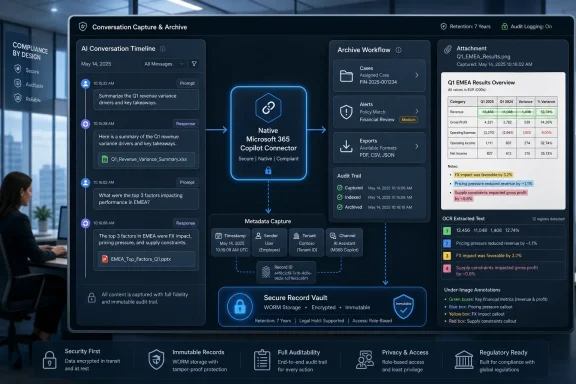
Shield said on June 16, 2026, that its communications surveillance platform for financial services will add a native Microsoft 365 Copilot connector and OCR text extraction for image attachments, bringing employee AI prompts, AI responses, screenshots, scanned documents, and photographed text into existing compliance workflows. The announcement matters less as a point product update than as a marker of where regulated collaboration is heading. Microsoft has spent the past two years pushing Copilot from novelty to workplace substrate; Shield is arguing that compliance infrastructure now has to treat AI conversations and image-borne text as ordinary business records. That is a big claim, but it is also the direction regulators have been nudging the market for years.
The first mistake in reading Shield’s announcement is to think of Microsoft 365 Copilot as merely a productivity feature. In the regulated enterprise, Copilot is better understood as a new communications surface: employees ask it questions, feed it context, receive generated responses, and may use those responses in client work, internal decisions, research workflows, and operational handoffs. That exchange can be casual, but it is not necessarily trivial.
Financial firms already understand this pattern because they have lived through it before. Email was once the channel of record, then chat became unavoidable, then mobile messaging and collaboration platforms created a sprawling surveillance problem that firms are still cleaning up. Every wave arrived with the same managerial hope: perhaps this one is not quite a record, not quite correspondence, not quite something that must be preserved and reviewed.
That hope rarely survives contact with regulators. FINRA’s books-and-records framework, SEC recordkeeping expectations, FCA supervision language, and the broader market abuse regime in Europe all point in the same direction: if a communication is business-related, the tool used to create it is not the deciding factor. The more Copilot is embedded into Microsoft 365, the harder it becomes to argue that prompts and responses sit outside the governance perimeter.
Shield’s pitch is therefore blunt. If a banker asks Copilot to summarize a client thread, draft language around a transaction, extract a position from internal material, or prepare talking points from sensitive information, the prompt and response may become relevant to supervision. The compliance question is not whether AI is magical. It is whether the interaction can affect business conduct.
Generative AI breaks that mental model. A Copilot session may include a user prompt, retrieved enterprise context, generated text, citations or source references inside the Microsoft environment, edits, regeneration, and downstream use in another document or message. The system is not merely transporting a communication; it is helping compose, summarize, transform, and sometimes decide what the user sees.
That makes surveillance more complicated in two ways. First, the prompt itself can reveal intent. A request to “make this sound less like a guarantee” or “summarize the side agreement but leave out the fee discussion” is materially different from the final text that lands in an email. Second, the AI response can become a compliance artifact even if it is never sent verbatim, because it may shape what the employee does next.
This is why Shield’s native connector claim is important. The company says Copilot interactions will flow into the same archive, search, case management, surveillance, and export workflows that compliance teams already use. In practice, that means Shield is trying to avoid the trap that has plagued so many “new channel” compliance rollouts: yet another portal, yet another review queue, yet another operational exception that only specialists know how to search.
The under-24-hour processing claim is also telling. Real-time capture is ideal in theory, but many surveillance programs operate on review cycles measured in hours or days, not milliseconds. What matters for investigations is whether the firm can reliably reconstruct the communication, preserve metadata, search the content, and show that the process is repeatable. Shield is positioning the connector as a compliance-grade ingestion path rather than a dashboard bolted onto Copilot after the fact.
Compliance teams have long known this. The trouble is that traditional surveillance tools often index the email or chat message carrying the image, while leaving the text inside the attachment effectively invisible. A reviewer may see that a PNG or JPEG was attached, but unless the attachment is manually opened and inspected, the most important content can remain outside automated detection.
That is no longer a niche workflow. Employees routinely exchange screenshots because screenshots preserve context, formatting, and perceived proof. Mobile cameras have made photographed documents normal. Remote work has made scans and images part of the ordinary communications stream. The result is a shadow layer of business text that looks searchable to the human eye but remains silent to the archive.
Shield says its OCR Text Extraction capability will extract, index, and analyze text inside screenshots, scanned documents, and photos, with triggered terms highlighted inline below each image. That last detail matters. OCR is only partly about searchability; it is also about reviewer efficiency. If a surveillance analyst has to open every image and visually hunt for a flagged phrase, the system has reduced one blind spot by creating another backlog.
OCR will not be perfect. Image quality, handwriting, compression artifacts, unusual layouts, redactions, multilingual content, and screenshots of dense tables can all produce errors. But surveillance is not usually a quest for pristine literary transcription. It is a risk-reduction discipline. Making image text searchable and reviewable is materially better than pretending the image is just an attachment name and a file size.
For Microsoft, that is evidence that the platform strategy is working. Copilot is not a separate destination in the way earlier enterprise AI pilots often were. It is woven into Outlook, Word, Excel, Teams, SharePoint, and the broader Microsoft 365 graph. The closer AI sits to the employee’s daily work, the more likely it is to be used.
For compliance departments, the same integration is a headache. A standalone AI chatbot can be blocked, approved, logged, or monitored as a discrete application. A native assistant embedded across the productivity suite is harder to classify. It appears at the point of work, where the boundary between drafting, research, communication, and decision support is already blurry.
That is the enterprise bargain Microsoft has created. Copilot becomes valuable precisely because it has access to workplace context. But context is also where governance risk lives. If employees are prompting against sensitive client information, internal deal files, HR data, legal drafts, market commentary, or trading-related communications, then prompt-and-response records become part of the firm’s evidence trail.
Shield’s announcement is not a Microsoft security story in the narrow sense. It does not claim that Copilot is leaking data or that Microsoft lacks compliance features. It is instead a reminder that platform adoption and surveillance adoption move at different speeds. Business units turn on new capabilities because productivity gains are visible. Compliance teams then have to ask the less exciting question: can we prove what happened?
Generative AI adds a new edge to that old problem. FINRA’s 2026 oversight materials explicitly discuss GenAI as an area that can implicate supervision, communications, recordkeeping, cybersecurity, third-party risk, and fair dealing. That does not mean every Copilot prompt is automatically a regulated communication in every context. It does mean firms are expected to perform the analysis before a regulator, examiner, or plaintiff’s lawyer does it for them.
The United Kingdom’s FCA has been similarly direct in tone, warning firms that unmonitored risks without a strategic plan fall short of expectations. In Europe, market abuse surveillance already forces firms to think broadly about communications that may relate to inside information, inducements, manipulation, and conduct risk. AI does not repeal any of that. It simply gives employees another way to generate and transform business text.
This is where vendor language can sound self-serving but still be directionally right. Shield benefits commercially from expanding the definition of surveilled content. But the compliance perimeter really is expanding, because the workplace perimeter has already expanded. The archive follows the work, not the other way around.
The hard part is proportionality. A firm does not necessarily need to surveil every AI interaction with the same intensity or risk model. A Copilot prompt asking for an Excel formula is not the same as a prompt summarizing confidential deal terms. The challenge is designing capture and review workflows flexible enough to support that distinction without leaving the firm unable to retrieve records later.
That is more than convenience. Surveillance programs fail when they become operationally exotic. If one channel is reviewed in the main archive, another in a Microsoft console, a third through exports, and a fourth through a specialist vendor portal, then investigations become archaeology. Analysts must know where to look, how to correlate identities, how to preserve evidence, and how to explain the workflow later.
A native pipeline also helps with policy consistency. Existing lexicons, behavioral models, escalation rules, case notes, legal holds, export workflows, and audit trails can be reused or adapted. That does not eliminate tuning work, but it gives firms a starting point. The alternative is building a bespoke AI surveillance process from scratch, which few compliance teams have the time or staffing to do well.
There is also a defensibility argument. Regulators tend to care not only that a firm has technology, but that the technology is embedded in procedures. A separate AI review tool may impress during procurement and still fail during an exam if no one can show how alerts are handled, how false positives are remediated, how supervision is documented, and how records are exported. The boring plumbing is the control.
That said, native integration should not be treated as magic. Firms will still need to validate completeness, map identities, test metadata preservation, define retention policies, update written supervisory procedures, train reviewers, and decide which Copilot interaction types should trigger heightened scrutiny. The vendor can create the ingestion route. The firm still owns the governance judgment.
That matters because user behavior consistently routes around tidy data models. People paste screenshots into Teams because it is faster than writing a description. They photograph paper because a scanner is inconvenient. They send images of error messages, approvals, charts, IDs, spreadsheets, handwritten notes, and chat excerpts. The format may be casual, but the content may be business-critical.
Once OCR is added, those images become searchable evidence. A term that would have been invisible inside a screenshot can now trigger a review. A scanned document can surface in e-discovery. A photo of a printed instruction can become part of an investigation timeline. For compliance officers, that is a meaningful expansion of visibility.
It also raises its own governance questions. OCR can generate false positives when it misreads text, and false negatives when it misses text. It can expose sensitive content to review workflows that were not previously tuned for images. It may require firms to revisit privacy notices, retention practices, and cross-border data handling where image attachments include personal information.
Still, the direction is hard to resist. If employees use images to communicate business information, the surveillance stack has to treat images as more than binary blobs. The alternative is to leave a known evasion path open while insisting that the formal policy says everything is covered.
Copilot makes that shift unavoidable. A prompt can be an instruction, a request for analysis, a drafting attempt, or a way to probe information the user may not fully understand they can access. A response can be a summary, recommendation, hallucination, transformation, or synthesis. The compliance value is not merely in having the text; it is in placing the exchange within the surrounding workflow.
Shield’s metadata claim points in that direction. Rich metadata is what lets investigators move beyond keyword hits and reconstruct events. Who initiated the interaction? When did it occur? Which account or tenant did it involve? What channel or feature generated the record? How was it preserved? Can it be exported with enough fidelity to satisfy legal or regulatory demands?
The same is true for OCR. Extracted text is useful, but it becomes more useful when it remains tied to the original image, message, sender, timestamp, and review history. Inline highlighting below the image is a small product detail with a larger investigative purpose: it keeps machine-readable text connected to the visual artifact a human may need to inspect.
This is where compliance technology and security technology increasingly overlap. Security teams worry about data exposure, oversharing, malicious prompts, and sensitive content flowing through AI tools. Compliance teams worry about recordkeeping, supervision, market abuse, conduct, and e-discovery. Both need better visibility into the same messy substrate of prompts, responses, attachments, and user behavior.
Microsoft provides administrative controls, audit capabilities, Purview integrations, data protection features, and tenant-level governance options. Those are necessary. They are not automatically equivalent to a firm’s industry-specific surveillance obligations, especially in financial services environments where review, escalation, retention, and production workflows are deeply procedural.
Administrators should assume that Copilot will surface latent governance problems. If SharePoint permissions are sloppy, Copilot may make oversharing more visible. If retention labels are inconsistent, AI-generated workflows may complicate record classification. If employees already use screenshots to bypass structured systems, OCR-enabled surveillance may reveal risks that were always present but rarely measurable.
That means the real work starts before the connector. Firms need to map approved use cases, identify high-risk business functions, decide what prompt and response categories require capture, and align surveillance policies with actual employee workflows. They also need to involve legal, compliance, security, records management, and Microsoft 365 administrators in the same conversation, because none of those groups owns the full problem alone.
The mistake would be to treat Copilot surveillance as a narrow compliance procurement item. It is part of a larger redesign of enterprise evidence. AI-assisted work leaves traces that are neither traditional documents nor ordinary messages. Firms that do not decide how those traces are governed will eventually discover that someone else — a regulator, court, auditor, or incident responder — has decided for them.
 Copilot Has Become a Communications Channel, Whether Compliance Teams Like It or Not
The first mistake in reading Shield’s announcement is to think of Microsoft 365 Copilot as merely a productivity feature. In the regulated enterprise, Copilot is better understood as a new communications surface: employees ask it questions, feed it context, receive generated responses, and may use those responses in client work, internal decisions, research workflows, and operational handoffs. That exchange can be casual, but it is not necessarily trivial.Financial firms already understand this pattern because they have lived through it before. Email was once the channel of record, then chat became unavoidable, then mobile messaging and collaboration platforms created a sprawling surveillance problem that firms are still cleaning up. Every wave arrived with the same managerial hope: perhaps this one is not quite a record, not quite correspondence, not quite something that must be preserved and reviewed.
That hope rarely survives contact with regulators. FINRA’s books-and-records framework, SEC recordkeeping expectations, FCA supervision language, and the broader market abuse regime in Europe all point in the same direction: if a communication is business-related, the tool used to create it is not the deciding factor. The more Copilot is embedded into Microsoft 365, the harder it becomes to argue that prompts and responses sit outside the governance perimeter.
Shield’s pitch is therefore blunt. If a banker asks Copilot to summarize a client thread, draft language around a transaction, extract a position from internal material, or prepare talking points from sensitive information, the prompt and response may become relevant to supervision. The compliance question is not whether AI is magical. It is whether the interaction can affect business conduct.
The Old Archive Model Was Built for Messages, Not Conversations With Machines
Most compliance archives were designed around human-to-human communication. They capture a sender, a recipient, a timestamp, a subject, a body, and attachments. Even when the formats became messier — Teams messages, WhatsApp exports, Bloomberg chats, voice transcripts — the model still assumed that one person was communicating with another person, or with a group of people.Generative AI breaks that mental model. A Copilot session may include a user prompt, retrieved enterprise context, generated text, citations or source references inside the Microsoft environment, edits, regeneration, and downstream use in another document or message. The system is not merely transporting a communication; it is helping compose, summarize, transform, and sometimes decide what the user sees.
That makes surveillance more complicated in two ways. First, the prompt itself can reveal intent. A request to “make this sound less like a guarantee” or “summarize the side agreement but leave out the fee discussion” is materially different from the final text that lands in an email. Second, the AI response can become a compliance artifact even if it is never sent verbatim, because it may shape what the employee does next.
This is why Shield’s native connector claim is important. The company says Copilot interactions will flow into the same archive, search, case management, surveillance, and export workflows that compliance teams already use. In practice, that means Shield is trying to avoid the trap that has plagued so many “new channel” compliance rollouts: yet another portal, yet another review queue, yet another operational exception that only specialists know how to search.
The under-24-hour processing claim is also telling. Real-time capture is ideal in theory, but many surveillance programs operate on review cycles measured in hours or days, not milliseconds. What matters for investigations is whether the firm can reliably reconstruct the communication, preserve metadata, search the content, and show that the process is repeatable. Shield is positioning the connector as a compliance-grade ingestion path rather than a dashboard bolted onto Copilot after the fact.
The Screenshot Was Always the Weak Link
The OCR half of the announcement may sound less glamorous than Copilot capture, but it addresses a more familiar and stubborn problem. A screenshot is one of the simplest ways to move information out of structured systems and into an opaque attachment. It can contain chat text, account details, order information, internal documents, client instructions, or a photo of a whiteboard that no keyword search will find unless the image is converted into text.Compliance teams have long known this. The trouble is that traditional surveillance tools often index the email or chat message carrying the image, while leaving the text inside the attachment effectively invisible. A reviewer may see that a PNG or JPEG was attached, but unless the attachment is manually opened and inspected, the most important content can remain outside automated detection.
That is no longer a niche workflow. Employees routinely exchange screenshots because screenshots preserve context, formatting, and perceived proof. Mobile cameras have made photographed documents normal. Remote work has made scans and images part of the ordinary communications stream. The result is a shadow layer of business text that looks searchable to the human eye but remains silent to the archive.
Shield says its OCR Text Extraction capability will extract, index, and analyze text inside screenshots, scanned documents, and photos, with triggered terms highlighted inline below each image. That last detail matters. OCR is only partly about searchability; it is also about reviewer efficiency. If a surveillance analyst has to open every image and visually hunt for a flagged phrase, the system has reduced one blind spot by creating another backlog.
OCR will not be perfect. Image quality, handwriting, compression artifacts, unusual layouts, redactions, multilingual content, and screenshots of dense tables can all produce errors. But surveillance is not usually a quest for pristine literary transcription. It is a risk-reduction discipline. Making image text searchable and reviewable is materially better than pretending the image is just an attachment name and a file size.
Microsoft’s AI Success Creates Somebody Else’s Control Problem
Microsoft has been unusually successful at turning Copilot into an enterprise default. Its own public adoption claims point to broad Fortune 500 usage, and major financial institutions have announced large deployments. Barclays alone has been tied to a 100,000-employee Copilot rollout; UBS and Lloyds Banking Group have also been cited in the wider wave of bank adoption.For Microsoft, that is evidence that the platform strategy is working. Copilot is not a separate destination in the way earlier enterprise AI pilots often were. It is woven into Outlook, Word, Excel, Teams, SharePoint, and the broader Microsoft 365 graph. The closer AI sits to the employee’s daily work, the more likely it is to be used.
For compliance departments, the same integration is a headache. A standalone AI chatbot can be blocked, approved, logged, or monitored as a discrete application. A native assistant embedded across the productivity suite is harder to classify. It appears at the point of work, where the boundary between drafting, research, communication, and decision support is already blurry.
That is the enterprise bargain Microsoft has created. Copilot becomes valuable precisely because it has access to workplace context. But context is also where governance risk lives. If employees are prompting against sensitive client information, internal deal files, HR data, legal drafts, market commentary, or trading-related communications, then prompt-and-response records become part of the firm’s evidence trail.
Shield’s announcement is not a Microsoft security story in the narrow sense. It does not claim that Copilot is leaking data or that Microsoft lacks compliance features. It is instead a reminder that platform adoption and surveillance adoption move at different speeds. Business units turn on new capabilities because productivity gains are visible. Compliance teams then have to ask the less exciting question: can we prove what happened?
Regulators Have Stopped Treating Channel Sprawl as an Excuse
The most durable lesson from recent enforcement history is that regulators are not sympathetic to channel sprawl. Firms have been fined for failing to preserve off-channel communications, for gaps in approved-channel retention, and for supervisory programs that did not match how employees actually worked. The specific app changes; the theme does not.Generative AI adds a new edge to that old problem. FINRA’s 2026 oversight materials explicitly discuss GenAI as an area that can implicate supervision, communications, recordkeeping, cybersecurity, third-party risk, and fair dealing. That does not mean every Copilot prompt is automatically a regulated communication in every context. It does mean firms are expected to perform the analysis before a regulator, examiner, or plaintiff’s lawyer does it for them.
The United Kingdom’s FCA has been similarly direct in tone, warning firms that unmonitored risks without a strategic plan fall short of expectations. In Europe, market abuse surveillance already forces firms to think broadly about communications that may relate to inside information, inducements, manipulation, and conduct risk. AI does not repeal any of that. It simply gives employees another way to generate and transform business text.
This is where vendor language can sound self-serving but still be directionally right. Shield benefits commercially from expanding the definition of surveilled content. But the compliance perimeter really is expanding, because the workplace perimeter has already expanded. The archive follows the work, not the other way around.
The hard part is proportionality. A firm does not necessarily need to surveil every AI interaction with the same intensity or risk model. A Copilot prompt asking for an Excel formula is not the same as a prompt summarizing confidential deal terms. The challenge is designing capture and review workflows flexible enough to support that distinction without leaving the firm unable to retrieve records later.
Native Integration Is the Real Product Claim
The most interesting word in Shield’s announcement is native. Compliance vendors love the term because it suggests less friction, fewer handoffs, and fewer places for records to disappear. In this case, the claim is that Copilot and OCR content will not require new portals or separate process steps, but will appear inside the existing Shield pipeline.That is more than convenience. Surveillance programs fail when they become operationally exotic. If one channel is reviewed in the main archive, another in a Microsoft console, a third through exports, and a fourth through a specialist vendor portal, then investigations become archaeology. Analysts must know where to look, how to correlate identities, how to preserve evidence, and how to explain the workflow later.
A native pipeline also helps with policy consistency. Existing lexicons, behavioral models, escalation rules, case notes, legal holds, export workflows, and audit trails can be reused or adapted. That does not eliminate tuning work, but it gives firms a starting point. The alternative is building a bespoke AI surveillance process from scratch, which few compliance teams have the time or staffing to do well.
There is also a defensibility argument. Regulators tend to care not only that a firm has technology, but that the technology is embedded in procedures. A separate AI review tool may impress during procurement and still fail during an exam if no one can show how alerts are handled, how false positives are remediated, how supervision is documented, and how records are exported. The boring plumbing is the control.
That said, native integration should not be treated as magic. Firms will still need to validate completeness, map identities, test metadata preservation, define retention policies, update written supervisory procedures, train reviewers, and decide which Copilot interaction types should trigger heightened scrutiny. The vendor can create the ingestion route. The firm still owns the governance judgment.
OCR Turns Attachments Into Evidence, Not Decoration
The OCR capability has a broader implication for Windows and Microsoft 365 shops beyond financial surveillance. It reflects a shift in how enterprises think about unstructured content. The archive is no longer just storing documents and messages; it is trying to understand anything that carries text, regardless of format.That matters because user behavior consistently routes around tidy data models. People paste screenshots into Teams because it is faster than writing a description. They photograph paper because a scanner is inconvenient. They send images of error messages, approvals, charts, IDs, spreadsheets, handwritten notes, and chat excerpts. The format may be casual, but the content may be business-critical.
Once OCR is added, those images become searchable evidence. A term that would have been invisible inside a screenshot can now trigger a review. A scanned document can surface in e-discovery. A photo of a printed instruction can become part of an investigation timeline. For compliance officers, that is a meaningful expansion of visibility.
It also raises its own governance questions. OCR can generate false positives when it misreads text, and false negatives when it misses text. It can expose sensitive content to review workflows that were not previously tuned for images. It may require firms to revisit privacy notices, retention practices, and cross-border data handling where image attachments include personal information.
Still, the direction is hard to resist. If employees use images to communicate business information, the surveillance stack has to treat images as more than binary blobs. The alternative is to leave a known evasion path open while insisting that the formal policy says everything is covered.
The Market Is Moving From Capture to Context
Communications compliance used to be judged primarily by capture. Did the firm retain the email? Did it archive the chat? Could it produce the record? Those questions still matter, but they are no longer sufficient. The next phase is about context: what did the employee ask, what did the system generate, what source material may have shaped the response, and how did that output move through the organization?Copilot makes that shift unavoidable. A prompt can be an instruction, a request for analysis, a drafting attempt, or a way to probe information the user may not fully understand they can access. A response can be a summary, recommendation, hallucination, transformation, or synthesis. The compliance value is not merely in having the text; it is in placing the exchange within the surrounding workflow.
Shield’s metadata claim points in that direction. Rich metadata is what lets investigators move beyond keyword hits and reconstruct events. Who initiated the interaction? When did it occur? Which account or tenant did it involve? What channel or feature generated the record? How was it preserved? Can it be exported with enough fidelity to satisfy legal or regulatory demands?
The same is true for OCR. Extracted text is useful, but it becomes more useful when it remains tied to the original image, message, sender, timestamp, and review history. Inline highlighting below the image is a small product detail with a larger investigative purpose: it keeps machine-readable text connected to the visual artifact a human may need to inspect.
This is where compliance technology and security technology increasingly overlap. Security teams worry about data exposure, oversharing, malicious prompts, and sensitive content flowing through AI tools. Compliance teams worry about recordkeeping, supervision, market abuse, conduct, and e-discovery. Both need better visibility into the same messy substrate of prompts, responses, attachments, and user behavior.
The Windows Shop Cannot Delegate This Entirely to Microsoft
For WindowsForum readers, the practical lesson is not that every organization needs Shield. It is that Microsoft 365 Copilot governance cannot be solved by licensing alone. Turning on Copilot is a platform decision; supervising its use is an operating model.Microsoft provides administrative controls, audit capabilities, Purview integrations, data protection features, and tenant-level governance options. Those are necessary. They are not automatically equivalent to a firm’s industry-specific surveillance obligations, especially in financial services environments where review, escalation, retention, and production workflows are deeply procedural.
Administrators should assume that Copilot will surface latent governance problems. If SharePoint permissions are sloppy, Copilot may make oversharing more visible. If retention labels are inconsistent, AI-generated workflows may complicate record classification. If employees already use screenshots to bypass structured systems, OCR-enabled surveillance may reveal risks that were always present but rarely measurable.
That means the real work starts before the connector. Firms need to map approved use cases, identify high-risk business functions, decide what prompt and response categories require capture, and align surveillance policies with actual employee workflows. They also need to involve legal, compliance, security, records management, and Microsoft 365 administrators in the same conversation, because none of those groups owns the full problem alone.
The mistake would be to treat Copilot surveillance as a narrow compliance procurement item. It is part of a larger redesign of enterprise evidence. AI-assisted work leaves traces that are neither traditional documents nor ordinary messages. Firms that do not decide how those traces are governed will eventually discover that someone else — a regulator, court, auditor, or incident responder — has decided for them.
The Compliance Perimeter Now Includes the Prompt Box
Shield’s announcement gives compliance leaders a concrete checklist for a problem that is otherwise easy to discuss abstractly. The details will vary by firm, jurisdiction, and Microsoft 365 architecture, but the direction is clear: AI interactions and image text are becoming first-class surveillance material.- Microsoft 365 Copilot should be assessed as a business communications surface when employees use it for regulated work.
- Prompt and response capture becomes more defensible when it flows into existing archive, review, case management, and export workflows.
- OCR for screenshots, scans, and photographed documents closes a long-standing search gap in communications surveillance.
- Under-24-hour processing may be operationally sufficient for many review programs, but firms still need to validate completeness and metadata fidelity.
- Native integration reduces reviewer friction, but it does not remove the need for updated policies, testing, training, and supervisory procedures.
- The firms most exposed are those that adopt AI quickly while leaving records, permissions, retention, and surveillance models anchored to older communication patterns.
References
- Primary source: citybiz
Published: Tue, 16 Jun 2026 13:57:28 GMT
Loading…
www.citybiz.co - Official source: microsoft.com
Loading…
www.microsoft.com - Official source: news.microsoft.com
Loading…
news.microsoft.com - Official source: blogs.microsoft.com
Loading…
blogs.microsoft.com - Related coverage: qz.com
Accenture deploying Microsoft 365 Copilot to 200,000 workers
The professional services firm says 97% of employees using the tool complete routine tasks up to 15 times fasterqz.com - Related coverage: myabt.com
Loading…
www.myabt.com
- Related coverage: techradar.com

Barclays signs major Microsoft Copilot deal - over 100,000 workers set for major AI boost | TechRadar
Agreement worth tens of millions per yearwww.techradar.com - Related coverage: financialcommission.org
Loading…
financialcommission.org - Related coverage: labs.cloudsecurityalliance.org
CSA research note M365 Copilot CVE 2026 24299 20260505 csa styled
PDF documentlabs.cloudsecurityalliance.org