

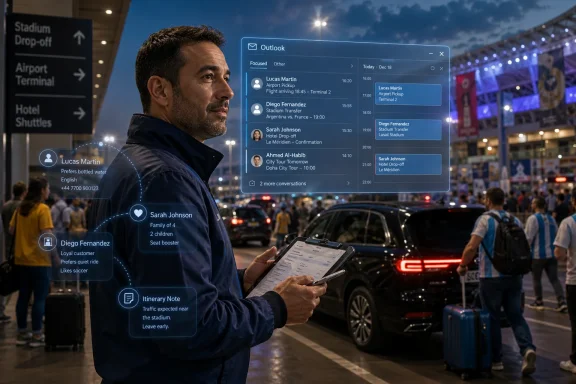
Microsoft’s new “Marcel” spot for Microsoft 365 with Copilot launches in the United States on June 16, 2026, after a UK media start on June 12, following a professional driver who uses Outlook and Copilot to manage World Cup customer demand. The ad is small in plot but large in ambition: Microsoft wants AI to look less like a boardroom abstraction and more like the invisible clerk behind a human service business. In Marcel’s case, the promise is not that Copilot replaces the driver’s charm, memory, or judgment. It is that software can keep those human qualities from collapsing under scale.
The central trick in “Marcel” is that Microsoft does not ask viewers to admire artificial intelligence. It asks them to admire a business owner who still remembers the customer.
That distinction matters. After three years of generative AI marketing, audiences have been trained to expect glowing prompts, magical drafts, and frictionless dashboards. “Marcel” instead gives us a professional driver facing a surge of passengers during the World Cup, a scenario where personal service can quickly become operational chaos. More bookings mean more names, more routes, more preferences, more exceptions, and more chances to make a loyal customer feel like a line item.
Microsoft’s answer is Outlook plus Copilot: a familiar inbox and calendar system made more attentive by an AI layer that can surface previous interactions, customer preferences, schedules, and context. In advertising terms, the product demo is modest. In business terms, it is the whole pitch.
For small businesses, growth is often where quality breaks. The owner knows the regulars, the exceptions, the tiny rituals that make a service feel premium. But once the calendar fills, that knowledge either becomes a brittle mess of sticky notes and memory, or it moves into a system. Microsoft is trying to convince business owners that Copilot can be that system without making the business feel systematized.
Microsoft’s choice of a professional driver is clever because the job is both logistical and personal. A ride is not merely a route from one point to another. It is timing, tone, memory, local knowledge, and the ability to make a customer feel expected rather than processed.
That lets Microsoft dramatize Copilot as a force multiplier without wandering into science fiction. Marcel is not deploying autonomous vehicles, replacing dispatchers with agents, or handing customer relationships to a chatbot. He is using the AI companion to stay on top of information he already has, inside tools Microsoft’s target audience already recognizes.
The World Cup also gives Microsoft a global canvas without turning the ad into a generic enterprise transformation story. A tournament brings international customers, high stakes, and unpredictable volume. It is a neat metaphor for the operating environment many small businesses now face: demand comes in bursts, customers expect personalization, and the back office has to behave like infrastructure even when it is run by one person and a laptop.
This is a departure from the traditional Microsoft productivity playbook, which has often relied on abstract collaboration, generic knowledge workers, and polished conference-room optimism. The Panay Films campaign narrows the lens. It gives us a pizza shop owner, a hurried business operator, an auto repair shop owner, and now a driver preparing for World Cup demand.
The pattern is obvious: Microsoft wants Copilot to become legible to people who do not describe their day in terms of “digital transformation.” These are businesses where a missed email, delayed invoice, forgotten customer preference, or bad pricing decision has immediate consequences. The ad series says, in effect, that AI is not only for analysts and executives; it is for anyone whose business depends on keeping too many small commitments straight.
That is smart positioning because the small-business AI market is not won by model benchmarks. It is won by trust, familiarity, and the belief that the system will help without turning the business into an IT project.
The fear it addresses is not simply, “I am too busy.” It is, “If I get busier, I will stop being the kind of business my customers chose in the first place.” That is a more emotionally potent problem than inbox overload. Small businesses often compete against larger rivals by being more personal, more flexible, and more attentive. Growth threatens those advantages.
Copilot, as presented here, becomes a kind of institutional memory. It remembers what the owner cannot reliably hold in his head during a rush. It gives the business some of the operational resilience of a larger company without sacrificing the face-to-face experience that makes the smaller company appealing.
That is the core argument Microsoft is making across the campaign. AI is not being sold as a replacement for craft, judgment, or customer care. It is being sold as the layer that keeps those things from being drowned by administration.
For many small businesses, Outlook is not just email. It is the de facto customer record, scheduling system, negotiation archive, task list, and evidence locker. The inbox contains what was promised, when it was promised, who asked for it, who changed it, and which detail will cause embarrassment if forgotten.
That makes Outlook a powerful stage for Microsoft’s small-business Copilot pitch. Microsoft does not have to persuade owners to move their customer relationships into a brand-new AI system. It can argue that the valuable context is already there, waiting to be made usable.
There is also a defensive logic here. If Copilot can make Microsoft 365 feel like the natural home for customer context, Microsoft strengthens the gravity of its productivity suite. The more useful Copilot becomes inside Outlook, Excel, Word, Teams, and related business tools, the harder it becomes for a small company to treat Microsoft 365 as a commodity subscription.
That is why this advertising campaign should be read as more than brand polish. It is Microsoft’s attempt to turn everyday work artifacts into AI fuel, and then turn that AI layer into a reason not to leave the ecosystem.
If Copilot is drawing on customer preferences and past interactions, the obvious question is whether those records are accurate, current, and appropriately protected. A customer’s favorite route is harmless enough. A travel schedule, payment issue, accessibility need, or VIP itinerary may not be. The more personal the service becomes, the more sensitive the underlying data can be.
Microsoft’s enterprise answer has generally been that Copilot respects existing Microsoft 365 permissions and security boundaries. That is important, but it is not magic. If a tenant has messy sharing practices, overbroad mailbox access, stale groups, or poorly classified files, AI can make those weaknesses more visible and more consequential.
For small businesses, this is the uncomfortable tradeoff. The same context that lets Copilot personalize service can also expose how casually customer data has been handled. AI does not create the information hygiene problem, but it removes the illusion that scattered information is safely obscure.
That notebook may be literal, or it may be a spreadsheet, a phone contact list, a memory habit, a whiteboard, a shared mailbox, or a set of rituals that only make sense to the people who created them. These systems are inefficient, but they are trusted. They are close to the work and shaped by years of improvisation.
“Marcel” tries to cross that trust gap by showing Copilot as an assistant to an existing way of working rather than a replacement for it. Marcel still drives. Marcel still greets. Marcel still decides how to treat each customer. Copilot merely helps him arrive prepared.
That is the right emotional posture for this audience. Small businesses are not allergic to technology, but they are allergic to tools that create a second job. If AI requires constant prompt engineering, data cleanup, workflow redesign, and subscription management, it becomes another burden. If it quietly improves the tools already in use, it has a chance.
The challenge is that integration is a boring word. “Marcel” translates it into a feeling: the driver knows who you are, remembers what matters, and handles a high-pressure day without losing the personal touch. That is integration as hospitality.
This is the same move Microsoft has been making across the broader campaign. “Pete” framed Copilot as help for a garage owner dealing with rising parts costs. “Hank” and “Jimmy” put the AI layer into ordinary business chores like spreadsheets and email. “Marcel” pushes the idea into customer experience, which is arguably the more compelling frontier.
The implication is that Copilot is not just a tool for producing documents faster. It is a way of making a small business feel more composed from the outside. That is a much richer promise, and a much harder one to fulfill consistently.
That packaging matters because small businesses do not buy software the way large enterprises do. They have fewer procurement layers, less administrative specialization, and less patience for licensing complexity. A bundle that says “your productivity apps, your AI, and your security in one place” is easier to understand than a matrix of add-ons and prerequisites.
The ad therefore functions as a narrative wrapper around a licensing strategy. Marcel is the story; the bundle is the business model. Microsoft is trying to make the purchase feel like a practical upgrade to the business’s operating system rather than a speculative bet on AI.
For WindowsForum readers, the interesting part is how much of this strategy depends on Microsoft 365 becoming the default memory layer for work. Windows may be the endpoint, but Microsoft 365 is where the context lives. Copilot’s value rises when the customer’s mail, calendar, files, chats, and business processes remain inside Microsoft’s orbit.
A small business can personalize service because people remember people. A larger operation personalizes service because systems remember patterns. Microsoft wants Copilot to sit between those worlds: structured enough to help, but human-facing enough not to feel like a call center script.
That middle ground is valuable. It is also fragile. If Copilot surfaces the wrong detail, misses an important update, or encourages a tone that feels synthetic, the business owner still owns the customer experience. AI may assist the interaction, but the reputational risk remains human.
This is why Microsoft’s small-business campaign is more interesting than another generic AI productivity spot. It forces the company’s marketing to deal with a real operational truth: the best small businesses are not merely efficient. They are trusted. AI can support that trust only if it is accurate, governed, and restrained.
This is not just an enterprise concern. Small businesses often accumulate years of information in shared mailboxes, personal OneDrives, exported spreadsheets, and informal Teams chats. Copilot’s promise is to make that information easier to use. Its risk is that it may also make bad habits harder to ignore.
The most important preparation is not exotic. It is the basic discipline many organizations postponed because the old way mostly worked. Clean up access. Know where customer data lives. Decide what should be retained and what should not. Train users not to treat AI output as authoritative simply because it sounds polished.
Microsoft’s advertising understandably shows the happy path. IT’s job is to build the road under it.
That formula helps Microsoft avoid the uncanny valley of AI advertising. The company does not need to show Copilot as a glowing brain, a robot colleague, or a disembodied oracle. It can show a business owner using familiar software to avoid letting people down.
The risk is repetition. Once every small-business archetype has its Copilot moment — the driver, the mechanic, the restaurateur, the retailer, the consultant — the campaign will need evidence beyond charm. Viewers may enjoy the vignettes, but buyers will eventually ask whether Copilot produces reliable gains, whether employees adopt it, and whether the subscription cost pays for itself.
For now, “Marcel” works because it is specific. A driver preparing for World Cup demand is not a generic productivity fantasy. It is a recognizable pressure test, and the ad’s best idea is that AI’s value may be most visible when demand spikes and memory fails.
That is why the spot matters more than its runtime. It presents AI not as a transformation program, but as the difference between a rushed business and a prepared one. The pitch is that Copilot can help small operators preserve the qualities that made customers choose them in the first place.
 Microsoft Sells AI as the Memory of the Business
The central trick in “Marcel” is that Microsoft does not ask viewers to admire artificial intelligence. It asks them to admire a business owner who still remembers the customer.That distinction matters. After three years of generative AI marketing, audiences have been trained to expect glowing prompts, magical drafts, and frictionless dashboards. “Marcel” instead gives us a professional driver facing a surge of passengers during the World Cup, a scenario where personal service can quickly become operational chaos. More bookings mean more names, more routes, more preferences, more exceptions, and more chances to make a loyal customer feel like a line item.
Microsoft’s answer is Outlook plus Copilot: a familiar inbox and calendar system made more attentive by an AI layer that can surface previous interactions, customer preferences, schedules, and context. In advertising terms, the product demo is modest. In business terms, it is the whole pitch.
For small businesses, growth is often where quality breaks. The owner knows the regulars, the exceptions, the tiny rituals that make a service feel premium. But once the calendar fills, that knowledge either becomes a brittle mess of sticky notes and memory, or it moves into a system. Microsoft is trying to convince business owners that Copilot can be that system without making the business feel systematized.
The World Cup Is Not Just a Backdrop
The World Cup setting gives the spot a useful kind of pressure. Sports tournaments create sharp, temporary spikes in demand: airport runs, hotel transfers, restaurant reservations, hospitality events, last-minute itinerary changes. That is exactly the sort of moment when a small operator can either look bigger than it is or expose every weakness in its workflow.Microsoft’s choice of a professional driver is clever because the job is both logistical and personal. A ride is not merely a route from one point to another. It is timing, tone, memory, local knowledge, and the ability to make a customer feel expected rather than processed.
That lets Microsoft dramatize Copilot as a force multiplier without wandering into science fiction. Marcel is not deploying autonomous vehicles, replacing dispatchers with agents, or handing customer relationships to a chatbot. He is using the AI companion to stay on top of information he already has, inside tools Microsoft’s target audience already recognizes.
The World Cup also gives Microsoft a global canvas without turning the ad into a generic enterprise transformation story. A tournament brings international customers, high stakes, and unpredictable volume. It is a neat metaphor for the operating environment many small businesses now face: demand comes in bursts, customers expect personalization, and the back office has to behave like infrastructure even when it is run by one person and a laptop.
Panay Films Keeps Turning Office Work Into Character Work
“Marcel” continues Panay Films’ string of Microsoft 365 with Copilot stories, following earlier spots built around names rather than feature labels: “Hank,” “Jimmy,” “Georgia,” “Erin,” and “Pete.” That naming convention is not incidental. Microsoft is trying to humanize the sale by making each ad feel like a small business vignette instead of a software capability tour.This is a departure from the traditional Microsoft productivity playbook, which has often relied on abstract collaboration, generic knowledge workers, and polished conference-room optimism. The Panay Films campaign narrows the lens. It gives us a pizza shop owner, a hurried business operator, an auto repair shop owner, and now a driver preparing for World Cup demand.
The pattern is obvious: Microsoft wants Copilot to become legible to people who do not describe their day in terms of “digital transformation.” These are businesses where a missed email, delayed invoice, forgotten customer preference, or bad pricing decision has immediate consequences. The ad series says, in effect, that AI is not only for analysts and executives; it is for anyone whose business depends on keeping too many small commitments straight.
That is smart positioning because the small-business AI market is not won by model benchmarks. It is won by trust, familiarity, and the belief that the system will help without turning the business into an IT project.
The Small Business Pitch Has Shifted From Productivity to Continuity
Microsoft’s earlier Copilot messaging leaned heavily on productivity: summarize this meeting, draft this email, create this presentation, analyze this spreadsheet. Those tasks still matter, but “Marcel” belongs to a subtler phase of the campaign. The ad is about continuity.The fear it addresses is not simply, “I am too busy.” It is, “If I get busier, I will stop being the kind of business my customers chose in the first place.” That is a more emotionally potent problem than inbox overload. Small businesses often compete against larger rivals by being more personal, more flexible, and more attentive. Growth threatens those advantages.
Copilot, as presented here, becomes a kind of institutional memory. It remembers what the owner cannot reliably hold in his head during a rush. It gives the business some of the operational resilience of a larger company without sacrificing the face-to-face experience that makes the smaller company appealing.
That is the core argument Microsoft is making across the campaign. AI is not being sold as a replacement for craft, judgment, or customer care. It is being sold as the layer that keeps those things from being drowned by administration.
Outlook Becomes the Stage Because the Inbox Is Where Small Businesses Live
The product detail that matters most in “Marcel” is not that Copilot exists. It is that Copilot works through Outlook.For many small businesses, Outlook is not just email. It is the de facto customer record, scheduling system, negotiation archive, task list, and evidence locker. The inbox contains what was promised, when it was promised, who asked for it, who changed it, and which detail will cause embarrassment if forgotten.
That makes Outlook a powerful stage for Microsoft’s small-business Copilot pitch. Microsoft does not have to persuade owners to move their customer relationships into a brand-new AI system. It can argue that the valuable context is already there, waiting to be made usable.
There is also a defensive logic here. If Copilot can make Microsoft 365 feel like the natural home for customer context, Microsoft strengthens the gravity of its productivity suite. The more useful Copilot becomes inside Outlook, Excel, Word, Teams, and related business tools, the harder it becomes for a small company to treat Microsoft 365 as a commodity subscription.
That is why this advertising campaign should be read as more than brand polish. It is Microsoft’s attempt to turn everyday work artifacts into AI fuel, and then turn that AI layer into a reason not to leave the ecosystem.
The Ad Avoids the Hardest AI Question by Design
“Marcel” is not about hallucinations, compliance, retention policies, permissions, or data governance. It is an ad, not an admin center walkthrough. But the things it leaves offscreen are exactly the things IT pros will notice.If Copilot is drawing on customer preferences and past interactions, the obvious question is whether those records are accurate, current, and appropriately protected. A customer’s favorite route is harmless enough. A travel schedule, payment issue, accessibility need, or VIP itinerary may not be. The more personal the service becomes, the more sensitive the underlying data can be.
Microsoft’s enterprise answer has generally been that Copilot respects existing Microsoft 365 permissions and security boundaries. That is important, but it is not magic. If a tenant has messy sharing practices, overbroad mailbox access, stale groups, or poorly classified files, AI can make those weaknesses more visible and more consequential.
For small businesses, this is the uncomfortable tradeoff. The same context that lets Copilot personalize service can also expose how casually customer data has been handled. AI does not create the information hygiene problem, but it removes the illusion that scattered information is safely obscure.
Microsoft’s Real Competitor Is the Owner’s Notebook
The small-business AI market is often discussed as if Microsoft is competing mainly with Google, OpenAI, Salesforce, Intuit, or vertical SaaS vendors. In practice, one of its biggest competitors is the owner’s notebook.That notebook may be literal, or it may be a spreadsheet, a phone contact list, a memory habit, a whiteboard, a shared mailbox, or a set of rituals that only make sense to the people who created them. These systems are inefficient, but they are trusted. They are close to the work and shaped by years of improvisation.
“Marcel” tries to cross that trust gap by showing Copilot as an assistant to an existing way of working rather than a replacement for it. Marcel still drives. Marcel still greets. Marcel still decides how to treat each customer. Copilot merely helps him arrive prepared.
That is the right emotional posture for this audience. Small businesses are not allergic to technology, but they are allergic to tools that create a second job. If AI requires constant prompt engineering, data cleanup, workflow redesign, and subscription management, it becomes another burden. If it quietly improves the tools already in use, it has a chance.
The Campaign Turns Integration Into a Feeling
Microsoft’s strongest technical advantage in the Copilot race is not always the model itself. It is distribution and integration. The company can place AI inside the daily work surfaces that businesses already pay for: Outlook, Word, Excel, PowerPoint, Teams, SharePoint, OneDrive, and the broader Microsoft 365 administrative stack.The challenge is that integration is a boring word. “Marcel” translates it into a feeling: the driver knows who you are, remembers what matters, and handles a high-pressure day without losing the personal touch. That is integration as hospitality.
This is the same move Microsoft has been making across the broader campaign. “Pete” framed Copilot as help for a garage owner dealing with rising parts costs. “Hank” and “Jimmy” put the AI layer into ordinary business chores like spreadsheets and email. “Marcel” pushes the idea into customer experience, which is arguably the more compelling frontier.
The implication is that Copilot is not just a tool for producing documents faster. It is a way of making a small business feel more composed from the outside. That is a much richer promise, and a much harder one to fulfill consistently.
The SMB Bundle Is the Product Strategy Behind the Story
The timing of “Marcel” is not accidental. Microsoft has been pushing Microsoft 365 Business offerings with Copilot more directly toward small and medium-sized businesses, including new bundles that place Copilot inside familiar business plans rather than leaving it as an abstract enterprise add-on.That packaging matters because small businesses do not buy software the way large enterprises do. They have fewer procurement layers, less administrative specialization, and less patience for licensing complexity. A bundle that says “your productivity apps, your AI, and your security in one place” is easier to understand than a matrix of add-ons and prerequisites.
The ad therefore functions as a narrative wrapper around a licensing strategy. Marcel is the story; the bundle is the business model. Microsoft is trying to make the purchase feel like a practical upgrade to the business’s operating system rather than a speculative bet on AI.
For WindowsForum readers, the interesting part is how much of this strategy depends on Microsoft 365 becoming the default memory layer for work. Windows may be the endpoint, but Microsoft 365 is where the context lives. Copilot’s value rises when the customer’s mail, calendar, files, chats, and business processes remain inside Microsoft’s orbit.
The Personal Touch Is Now a Data Problem
The phrase “stay personal” sounds warm, but in 2026 it increasingly means “maintain usable context at scale.” That is both the opportunity and the discomfort of AI-assisted business software.A small business can personalize service because people remember people. A larger operation personalizes service because systems remember patterns. Microsoft wants Copilot to sit between those worlds: structured enough to help, but human-facing enough not to feel like a call center script.
That middle ground is valuable. It is also fragile. If Copilot surfaces the wrong detail, misses an important update, or encourages a tone that feels synthetic, the business owner still owns the customer experience. AI may assist the interaction, but the reputational risk remains human.
This is why Microsoft’s small-business campaign is more interesting than another generic AI productivity spot. It forces the company’s marketing to deal with a real operational truth: the best small businesses are not merely efficient. They are trusted. AI can support that trust only if it is accurate, governed, and restrained.
IT Pros Should Read the Ad as a Governance Warning
For administrators, “Marcel” is a friendly commercial wrapped around a governance checklist. If a business wants Copilot to help with customer context, the tenant needs to be ready for AI-assisted retrieval. That means permissions, retention, labeling, mailbox hygiene, and user training suddenly become part of customer experience.This is not just an enterprise concern. Small businesses often accumulate years of information in shared mailboxes, personal OneDrives, exported spreadsheets, and informal Teams chats. Copilot’s promise is to make that information easier to use. Its risk is that it may also make bad habits harder to ignore.
The most important preparation is not exotic. It is the basic discipline many organizations postponed because the old way mostly worked. Clean up access. Know where customer data lives. Decide what should be retained and what should not. Train users not to treat AI output as authoritative simply because it sounds polished.
Microsoft’s advertising understandably shows the happy path. IT’s job is to build the road under it.
The Ad Business Has Found Its AI Formula
There is a reason these Microsoft spots are built around named characters rather than product names. AI has become both overexposed and underexplained. Most viewers have heard enough claims about productivity gains to become numb. A character gives the technology a job to do.That formula helps Microsoft avoid the uncanny valley of AI advertising. The company does not need to show Copilot as a glowing brain, a robot colleague, or a disembodied oracle. It can show a business owner using familiar software to avoid letting people down.
The risk is repetition. Once every small-business archetype has its Copilot moment — the driver, the mechanic, the restaurateur, the retailer, the consultant — the campaign will need evidence beyond charm. Viewers may enjoy the vignettes, but buyers will eventually ask whether Copilot produces reliable gains, whether employees adopt it, and whether the subscription cost pays for itself.
For now, “Marcel” works because it is specific. A driver preparing for World Cup demand is not a generic productivity fantasy. It is a recognizable pressure test, and the ad’s best idea is that AI’s value may be most visible when demand spikes and memory fails.
The Marcel Lesson Microsoft Wants SMBs to Internalize
“Marcel” is a small ad with a clear strategic message: Microsoft wants the next phase of Copilot adoption to feel ordinary. Not futuristic. Not experimental. Ordinary.That is why the spot matters more than its runtime. It presents AI not as a transformation program, but as the difference between a rushed business and a prepared one. The pitch is that Copilot can help small operators preserve the qualities that made customers choose them in the first place.
- Microsoft is positioning Copilot as a practical assistant for small-business continuity, not just a productivity toy for office workers.
- The World Cup setting turns the ad into a stress test for customer service, scheduling, and personalization under temporary demand spikes.
- Outlook is the crucial product surface because small businesses already use email and calendars as informal customer databases.
- The campaign’s human-centered format lets Microsoft sell integration without making the story sound like an IT architecture diagram.
- The operational upside depends on data hygiene, permissions, and user judgment, especially when customer context becomes AI-accessible.
- The larger strategy is to make Microsoft 365 feel like the natural operating layer for small businesses adopting AI.
References
- Primary source: Little Black Book | LBBOnline
Published: Tue, 16 Jun 2026 17:00:44 GMT
Loading…
lbbonline.com - Official source: microsoft.com

Introducing Microsoft 365 Business with Copilot: The new standard for small business | Microsoft 365 Blog
Meet Microsoft 365 Business with Copilot—the AI-powered solution transforming how small businesses work, collaborate, and compete. www.microsoft.com
- Related coverage: shots.net
Microsoft introduces us to Pete | shots
Panay Films launches new Microsoft Copilot campaign. shots.net
- Official source: techcommunity.microsoft.com
Loading…
techcommunity.microsoft.com - Related coverage: windowsforum.com
Loading…
windowsforum.com - Related coverage: adsoftheworld.com
Loading…
www.adsoftheworld.com
- Official source: partner.microsoft.com
Loading…
partner.microsoft.com - Official source: cdn-dynmedia-1.microsoft.com
- Official source: download.microsoft.com