

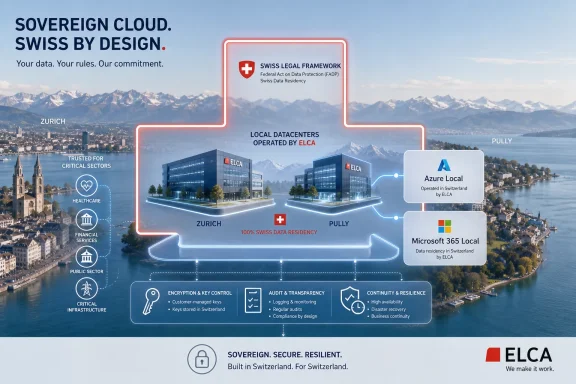
ELCA announced on June 16, 2026, in Zurich and Pully that it plans to expand locally operated sovereign cloud services in Switzerland using Microsoft Azure Local and Microsoft 365 Local for Swiss public-sector, financial, healthcare, and critical-infrastructure customers. The move is more than another partner press release in the crowded sovereignty market. It signals Microsoft’s increasingly pragmatic answer to European unease: if the hyperscale cloud cannot always satisfy political, regulatory, or operational demands, bring a recognizable slice of the Microsoft stack closer to the customer’s legal and physical perimeter. For Swiss IT leaders, the question is no longer whether sovereignty matters, but who gets to define it, operate it, and pay for it.
Microsoft has spent years telling European customers that its cloud can be sovereign enough through regional datacenters, contractual commitments, encryption controls, and governance tooling. That argument still matters, but the ELCA announcement shows a more tactical shift. Microsoft is leaning on local operators that already have standing with national institutions, regulated industries, and boards that instinctively distrust distant platform control.
ELCA is a useful partner for that story because Switzerland is not merely another European market with strict expectations around data protection. It is a country where neutrality, jurisdiction, financial services regulation, and public trust all collide in procurement conversations. A Swiss-operated layer on top of Microsoft technology gives customers something the global cloud alone cannot easily provide: an accountable domestic operator that can sit across the table and own the messy operating details.
That is the core bargain. Microsoft keeps Azure and Microsoft 365 in the architecture, while ELCA supplies local hosting, delivery, governance, and operational continuity. Customers get to say they are not abandoning Microsoft’s productivity and cloud ecosystem, while also saying they have pushed control closer to home.
The arrangement is not framed as a fully isolated national cloud from day one. ELCA says the initial offerings include local extensions for existing Microsoft 365 customers, with the possibility of fully ELCA-hosted Microsoft productivity solutions built on Azure Local. That sequencing matters. It lets organizations start with hybrid sovereignty rather than forcing a dramatic migration into a sealed environment.
Today’s sovereignty debate includes who operates the platform, who can access administrative systems, how outages are handled, how encryption keys are governed, what happens under geopolitical stress, and whether the service can keep functioning when normal cloud connectivity is impaired. It also includes the awkward question of whether an organization can adopt AI services without turning sensitive data, model prompts, collaboration history, and operational telemetry into a new dependency chain.
That is why Azure Local and Microsoft 365 Local are central to this announcement. Azure Local is Microsoft’s on-premises and edge infrastructure platform, evolved from the Azure Stack HCI lineage, designed to bring Azure-style management and workloads into customer-controlled or partner-operated environments. Microsoft 365 Local extends the idea into productivity, allowing familiar workloads such as Exchange and SharePoint to run inside a sovereign operational boundary rather than only as standard cloud services.
This is Microsoft admitting, without quite saying so, that one cloud operating model cannot satisfy every customer. The public cloud remains the center of gravity, but the edge, private cloud, and disconnected environments are no longer treated as legacy exceptions. They are becoming productized escape hatches for customers that cannot make pure SaaS work under their risk model.
That is where ELCA’s role could be more consequential than the infrastructure label. The company is positioning itself as an end-to-end operator that helps customers set objectives, assess exposure, implement governance, and maintain operating models as conditions change. In plain English: ELCA wants to be the party that turns sovereignty from a board-level aspiration into a runbook.
This is also where Microsoft benefits. Sovereign Landing Zones and compliance policies are useful, but they do not operate themselves. A landing-zone architecture can define management groups, policies, identity boundaries, logging, and control baselines; it cannot decide which Swiss agency, hospital network, or bank has the political appetite for a particular residual risk.
The local operator becomes the translator between Microsoft’s global reference architecture and Switzerland’s institutional reality. That translation layer is the product.
Microsoft’s recent sovereign-cloud messaging has increasingly tied Azure Local, Microsoft 365 Local, and local AI capabilities into a single portfolio. The logic is clear. Customers want Copilot-like productivity gains, analytics, automation, and generative AI, but many are not ready to send the most sensitive workflows into a standard global cloud path.
Swiss customers in financial services, healthcare, government, and critical infrastructure are exactly the audience for that pitch. They have data that is valuable, regulated, and politically sensitive. They also face pressure from executives who do not want AI adoption to stall while competitors automate workflows and reduce operational drag.
ELCA and Microsoft are therefore selling a compromise: adopt the Microsoft ecosystem for AI and productivity, but do so through a locally operated sovereign model that can be tuned for risk. The word compromise is not a criticism here. In enterprise IT, compromise is often what gets deployed.
That does not make the model useless. It does mean buyers should be precise about what kind of sovereignty they are buying. Operational sovereignty is not the same as technological independence. Data location is not the same as supply-chain autonomy. A Swiss operator can reduce exposure to some risks while leaving others intact.
This distinction matters because the sovereign-cloud market is full of comforting language. Vendors promise control, resilience, compliance, and continuity, but each architecture makes tradeoffs. A fully disconnected environment may strengthen continuity under extreme conditions, but it can complicate patching, feature delivery, monitoring, support, and integration with modern SaaS workflows. A hybrid model may be easier to run, but it leaves more dependency on cloud connectivity and vendor-operated control planes.
ELCA’s announcement wisely avoids pretending that one deployment model solves every problem. It speaks of local extensions, fully hosted productivity options, hybrid cloud, sovereign public and private environments, and additional capabilities expected over time. That range is commercially useful, but it also means customers will need to scrutinize the exact service boundary before treating “sovereign” as a compliance shortcut.
Those requirements do not always point in the same direction. A bank may want the innovation velocity of Azure services but need strong evidence around third-party risk. A canton may want modern collaboration tools but face political pressure to avoid foreign operational dependence. A hospital may want AI-assisted administration and clinical workflow support but cannot tolerate an architecture that turns a connectivity incident into a productivity crisis.
That is why Microsoft’s use of a trusted independent Swiss IT service provider is significant. The cloud sovereignty argument is partly technical and partly cultural. In markets like Switzerland, local trust can be a technical control in practice because it determines whether institutions will approve, fund, and operate the system.
But local trust also creates local accountability. If ELCA is the face of the service, customers will expect ELCA to answer hard questions about incident response, subcontractors, physical hosting, administrative access, continuity drills, cryptographic controls, and the practical meaning of “locally operated.” That is a higher bar than reselling cloud capacity.
Microsoft 365 Local changes that posture. It acknowledges that productivity workloads are among the most sovereignty-sensitive systems an organization runs. Email, calendars, documents, intranets, Teams-adjacent collaboration patterns, and identity-linked workflows are not peripheral. They are the institutional memory of the enterprise.
For a public-sector ministry, a hospital group, or a financial regulator, productivity data may be just as sensitive as application databases. It includes policy drafts, procurement records, legal discussions, personnel matters, incident investigations, and operational planning. Moving that into a sovereign local environment can be as important as localizing a line-of-business application.
The tradeoff is that local productivity is unlikely to feel identical to the hyperscale Microsoft 365 experience. Feature cadence, integration depth, AI availability, management complexity, and support procedures may diverge. The value proposition is not “the same cloud, just local.” It is “enough of the Microsoft productivity model, operated under a different control regime.”
The last several years have made cloud concentration risk a board-level topic. Organizations have learned that resilience is not just a matter of multi-zone deployment or backup retention. It is also a question of geopolitical exposure, third-party dependency, platform policy changes, regulatory reinterpretation, and the fragility of identity and management planes.
A locally operated Azure Local and Microsoft 365 Local service does not eliminate those risks. It can, however, give customers more options for continuity planning. If critical workloads and productivity services can run within a Swiss operational boundary, organizations may be better positioned to design fallback modes, rehearse disconnection scenarios, and document control over essential data and services.
That is especially relevant for critical infrastructure. In a crisis, the ability to keep communications, records, authentication, and core applications available can matter more than access to the newest cloud feature. Sovereign cloud, at its best, is not a patriotic branding exercise. It is disaster recovery with legal, political, and operational dimensions.
Swiss organizations will therefore need to decide which workloads genuinely require the sovereign treatment. Not every SharePoint site, analytics workload, or application tier deserves the same control boundary. If customers try to sovereignize everything, they may produce a costly platform that satisfies procurement language but slows delivery.
The more realistic pattern is tiering. Highly sensitive workloads and productivity functions may move into ELCA-operated sovereign environments. Less sensitive services may remain in standard Microsoft cloud regions with policy controls. Some AI workloads may run locally, while others use public cloud services after data minimization or anonymization.
That tiered model is messier than slogans, but it is how enterprise IT usually works. The winners in sovereign cloud will be the providers that help customers make those distinctions without turning every architecture review into a political seminar.
ELCA’s collaboration with Microsoft sits between those poles. It is not a clean break from US-origin technology, but it is not simply standard Microsoft 365 with a Swiss flag on the brochure. It is an attempt to localize operations while preserving the software ecosystem that many organizations already use.
That middle position is commercially powerful because most enterprises do not want ideological purity. They want audit evidence, manageable risk, predictable support, and tools their users already know. If ELCA can deliver those things while satisfying Swiss sovereignty expectations, it will have a compelling offer.
Still, competitors will press the dependency point. They will argue that true sovereignty requires local software stacks, open standards, or European-controlled platforms. Microsoft and ELCA will answer that sovereignty without functionality is a dead end. The market will decide how much independence customers are willing to trade for compatibility.
That does not mean the old datacenter is back unchanged. Azure Local is not just a pile of Hyper-V hosts with a new label. It is local infrastructure shaped by Azure management concepts, policy controls, validated hardware, and cloud-adjacent operations. Microsoft 365 Local similarly tries to bring server-based productivity into a managed sovereign architecture rather than leaving customers to nurse aging standalone deployments.
For admins, this means familiar problems return in modern clothing. Capacity planning matters. Patch windows matter. Identity architecture matters. Backup isolation matters. Monitoring matters. So do procurement cycles, hardware refreshes, firmware baselines, and the human availability of engineers who understand both Microsoft’s cloud model and local infrastructure realities.
The cloud did not abolish these concerns; it centralized many of them. Sovereign local cloud redistributes them. That can be a good thing, but only if customers recognize that control comes with work.
That is important because sovereign cloud is not a product you buy in the abstract. It is always interpreted through local law, sector regulation, institutional trust, and political risk. A sovereign service for Switzerland cannot be marketed exactly like one for Germany, France, the Netherlands, or the Nordics, even when the underlying Microsoft components overlap.
The more Microsoft can recruit credible national partners, the more it can argue that its global platform is adaptable rather than monolithic. That is a defensive move against European cloud-sovereignty criticism, but it is also an offensive move into regulated AI adoption. If customers believe Microsoft can meet their control requirements, they are more likely to standardize on its AI, identity, productivity, and security stack.
ELCA, meanwhile, gets to move up the value chain. Instead of merely implementing Microsoft services, it can operate a sovereign layer around them. In a market where trust and compliance command premium budgets, that is a stronger position than being another systems integrator in the Microsoft partner ecosystem.
They will also need clarity on product parity. Microsoft 365 Local can offer productivity continuity and local control, but customers will want to know which Microsoft 365 experiences are included, which are approximated through server workloads, and which cloud-native features remain outside the local boundary. The same applies to AI capabilities, where local inference, model availability, data governance, and update cadence can vary significantly from public-cloud services.
None of this undermines the strategic importance of the announcement. It simply marks the difference between a credible direction and a deployable architecture. CIOs and CISOs should treat the collaboration as a serious option, not a finished answer.
The best buyers will ask uncomfortable questions early. They will map business processes to sovereignty requirements, classify collaboration data, rehearse failure modes, and decide where local operation genuinely reduces risk. They will resist the temptation to treat “Swiss-operated” as a magic compliance phrase.
 Microsoft’s Swiss Bet Is Really a Trust-Broker Strategy
Microsoft has spent years telling European customers that its cloud can be sovereign enough through regional datacenters, contractual commitments, encryption controls, and governance tooling. That argument still matters, but the ELCA announcement shows a more tactical shift. Microsoft is leaning on local operators that already have standing with national institutions, regulated industries, and boards that instinctively distrust distant platform control.ELCA is a useful partner for that story because Switzerland is not merely another European market with strict expectations around data protection. It is a country where neutrality, jurisdiction, financial services regulation, and public trust all collide in procurement conversations. A Swiss-operated layer on top of Microsoft technology gives customers something the global cloud alone cannot easily provide: an accountable domestic operator that can sit across the table and own the messy operating details.
That is the core bargain. Microsoft keeps Azure and Microsoft 365 in the architecture, while ELCA supplies local hosting, delivery, governance, and operational continuity. Customers get to say they are not abandoning Microsoft’s productivity and cloud ecosystem, while also saying they have pushed control closer to home.
The arrangement is not framed as a fully isolated national cloud from day one. ELCA says the initial offerings include local extensions for existing Microsoft 365 customers, with the possibility of fully ELCA-hosted Microsoft productivity solutions built on Azure Local. That sequencing matters. It lets organizations start with hybrid sovereignty rather than forcing a dramatic migration into a sealed environment.
Sovereignty Has Become a Feature, Not a Footnote
For years, data residency did much of the rhetorical work in cloud sales. Put the data in the right geography, promise contractual safeguards, and reassure the customer that compliance teams could sign off. The sovereign-cloud conversation has outgrown that narrow frame.Today’s sovereignty debate includes who operates the platform, who can access administrative systems, how outages are handled, how encryption keys are governed, what happens under geopolitical stress, and whether the service can keep functioning when normal cloud connectivity is impaired. It also includes the awkward question of whether an organization can adopt AI services without turning sensitive data, model prompts, collaboration history, and operational telemetry into a new dependency chain.
That is why Azure Local and Microsoft 365 Local are central to this announcement. Azure Local is Microsoft’s on-premises and edge infrastructure platform, evolved from the Azure Stack HCI lineage, designed to bring Azure-style management and workloads into customer-controlled or partner-operated environments. Microsoft 365 Local extends the idea into productivity, allowing familiar workloads such as Exchange and SharePoint to run inside a sovereign operational boundary rather than only as standard cloud services.
This is Microsoft admitting, without quite saying so, that one cloud operating model cannot satisfy every customer. The public cloud remains the center of gravity, but the edge, private cloud, and disconnected environments are no longer treated as legacy exceptions. They are becoming productized escape hatches for customers that cannot make pure SaaS work under their risk model.
ELCA Is Selling an Operating Model, Not Just Rack Space
The press-release language around “defining and operationalizing a digital sovereignty strategy” sounds like consultancy boilerplate until you look at what regulated organizations actually struggle with. Most do not lack abstract sovereignty goals. They lack a workable map from those goals to identity design, data classification, retention policy, disaster recovery, privileged access, backup isolation, endpoint management, audit evidence, and day-two operations.That is where ELCA’s role could be more consequential than the infrastructure label. The company is positioning itself as an end-to-end operator that helps customers set objectives, assess exposure, implement governance, and maintain operating models as conditions change. In plain English: ELCA wants to be the party that turns sovereignty from a board-level aspiration into a runbook.
This is also where Microsoft benefits. Sovereign Landing Zones and compliance policies are useful, but they do not operate themselves. A landing-zone architecture can define management groups, policies, identity boundaries, logging, and control baselines; it cannot decide which Swiss agency, hospital network, or bank has the political appetite for a particular residual risk.
The local operator becomes the translator between Microsoft’s global reference architecture and Switzerland’s institutional reality. That translation layer is the product.
The AI Angle Makes the Sovereignty Pitch Urgent
If this were only about email, file shares, and virtual machines, the sovereign-cloud argument would still be important but familiar. AI changes the tone because it expands the surface area of sensitive data and raises the stakes around where inference happens, where prompts are stored, how models are governed, and who can inspect the environment.Microsoft’s recent sovereign-cloud messaging has increasingly tied Azure Local, Microsoft 365 Local, and local AI capabilities into a single portfolio. The logic is clear. Customers want Copilot-like productivity gains, analytics, automation, and generative AI, but many are not ready to send the most sensitive workflows into a standard global cloud path.
Swiss customers in financial services, healthcare, government, and critical infrastructure are exactly the audience for that pitch. They have data that is valuable, regulated, and politically sensitive. They also face pressure from executives who do not want AI adoption to stall while competitors automate workflows and reduce operational drag.
ELCA and Microsoft are therefore selling a compromise: adopt the Microsoft ecosystem for AI and productivity, but do so through a locally operated sovereign model that can be tuned for risk. The word compromise is not a criticism here. In enterprise IT, compromise is often what gets deployed.
The Local Cloud Still Depends on the Global Vendor
The obvious counterargument is that a Microsoft-based sovereign service is still a Microsoft-based service. Azure Local and Microsoft 365 Local may change where workloads run and who operates them, but they do not erase the strategic dependency on Microsoft technology, licensing, support channels, security updates, identity patterns, and product roadmaps.That does not make the model useless. It does mean buyers should be precise about what kind of sovereignty they are buying. Operational sovereignty is not the same as technological independence. Data location is not the same as supply-chain autonomy. A Swiss operator can reduce exposure to some risks while leaving others intact.
This distinction matters because the sovereign-cloud market is full of comforting language. Vendors promise control, resilience, compliance, and continuity, but each architecture makes tradeoffs. A fully disconnected environment may strengthen continuity under extreme conditions, but it can complicate patching, feature delivery, monitoring, support, and integration with modern SaaS workflows. A hybrid model may be easier to run, but it leaves more dependency on cloud connectivity and vendor-operated control planes.
ELCA’s announcement wisely avoids pretending that one deployment model solves every problem. It speaks of local extensions, fully hosted productivity options, hybrid cloud, sovereign public and private environments, and additional capabilities expected over time. That range is commercially useful, but it also means customers will need to scrutinize the exact service boundary before treating “sovereign” as a compliance shortcut.
Switzerland Is a Hard Market for Easy Cloud Slogans
Switzerland’s cloud market is attractive precisely because it is demanding. Financial institutions care about auditability, outsourcing rules, resilience, and concentration risk. Public-sector bodies care about jurisdiction, procurement legitimacy, citizen trust, and long-lived records. Healthcare organizations care about privacy, availability, and the operational consequences of downtime.Those requirements do not always point in the same direction. A bank may want the innovation velocity of Azure services but need strong evidence around third-party risk. A canton may want modern collaboration tools but face political pressure to avoid foreign operational dependence. A hospital may want AI-assisted administration and clinical workflow support but cannot tolerate an architecture that turns a connectivity incident into a productivity crisis.
That is why Microsoft’s use of a trusted independent Swiss IT service provider is significant. The cloud sovereignty argument is partly technical and partly cultural. In markets like Switzerland, local trust can be a technical control in practice because it determines whether institutions will approve, fund, and operate the system.
But local trust also creates local accountability. If ELCA is the face of the service, customers will expect ELCA to answer hard questions about incident response, subcontractors, physical hosting, administrative access, continuity drills, cryptographic controls, and the practical meaning of “locally operated.” That is a higher bar than reselling cloud capacity.
Microsoft 365 Local Is the Most Politically Interesting Piece
Azure Local is important, but Microsoft 365 Local is the more revealing part of the story. For years, Microsoft’s productivity strategy has pushed customers toward cloud services where the fastest feature development, integration, security tooling, and AI experiences live. On-premises Exchange and SharePoint persisted because enterprise reality is stubborn, but they were not the strategic headline.Microsoft 365 Local changes that posture. It acknowledges that productivity workloads are among the most sovereignty-sensitive systems an organization runs. Email, calendars, documents, intranets, Teams-adjacent collaboration patterns, and identity-linked workflows are not peripheral. They are the institutional memory of the enterprise.
For a public-sector ministry, a hospital group, or a financial regulator, productivity data may be just as sensitive as application databases. It includes policy drafts, procurement records, legal discussions, personnel matters, incident investigations, and operational planning. Moving that into a sovereign local environment can be as important as localizing a line-of-business application.
The tradeoff is that local productivity is unlikely to feel identical to the hyperscale Microsoft 365 experience. Feature cadence, integration depth, AI availability, management complexity, and support procedures may diverge. The value proposition is not “the same cloud, just local.” It is “enough of the Microsoft productivity model, operated under a different control regime.”
Business Continuity Is the Quiet Center of the Announcement
Sovereignty is the headline, but continuity may be the operational center. ELCA’s announcement repeatedly ties sovereignty to resilience, continuity plans, and the ability to remain actionable as regulatory, geopolitical, or operational conditions change. That language is not accidental.The last several years have made cloud concentration risk a board-level topic. Organizations have learned that resilience is not just a matter of multi-zone deployment or backup retention. It is also a question of geopolitical exposure, third-party dependency, platform policy changes, regulatory reinterpretation, and the fragility of identity and management planes.
A locally operated Azure Local and Microsoft 365 Local service does not eliminate those risks. It can, however, give customers more options for continuity planning. If critical workloads and productivity services can run within a Swiss operational boundary, organizations may be better positioned to design fallback modes, rehearse disconnection scenarios, and document control over essential data and services.
That is especially relevant for critical infrastructure. In a crisis, the ability to keep communications, records, authentication, and core applications available can matter more than access to the newest cloud feature. Sovereign cloud, at its best, is not a patriotic branding exercise. It is disaster recovery with legal, political, and operational dimensions.
The Economics Will Decide How Sovereign Customers Can Afford to Be
The hard part comes after the announcement. Sovereign local services are usually more expensive to operate than commodity public cloud, not because local providers are inefficient, but because redundancy, skilled staff, compliance evidence, isolation, support, and capacity planning all cost money. The hyperscale cloud is cheap in part because it is standardized.Swiss organizations will therefore need to decide which workloads genuinely require the sovereign treatment. Not every SharePoint site, analytics workload, or application tier deserves the same control boundary. If customers try to sovereignize everything, they may produce a costly platform that satisfies procurement language but slows delivery.
The more realistic pattern is tiering. Highly sensitive workloads and productivity functions may move into ELCA-operated sovereign environments. Less sensitive services may remain in standard Microsoft cloud regions with policy controls. Some AI workloads may run locally, while others use public cloud services after data minimization or anonymization.
That tiered model is messier than slogans, but it is how enterprise IT usually works. The winners in sovereign cloud will be the providers that help customers make those distinctions without turning every architecture review into a political seminar.
The Competitive Pressure Comes From Both Sides
Microsoft is not the only company trying to turn European sovereignty anxiety into a platform strategy. European cloud providers, open-source office suites, national cloud initiatives, and other hyperscalers all have versions of the same pitch. Some emphasize local ownership and open technology. Others emphasize hardened versions of global platforms.ELCA’s collaboration with Microsoft sits between those poles. It is not a clean break from US-origin technology, but it is not simply standard Microsoft 365 with a Swiss flag on the brochure. It is an attempt to localize operations while preserving the software ecosystem that many organizations already use.
That middle position is commercially powerful because most enterprises do not want ideological purity. They want audit evidence, manageable risk, predictable support, and tools their users already know. If ELCA can deliver those things while satisfying Swiss sovereignty expectations, it will have a compelling offer.
Still, competitors will press the dependency point. They will argue that true sovereignty requires local software stacks, open standards, or European-controlled platforms. Microsoft and ELCA will answer that sovereignty without functionality is a dead end. The market will decide how much independence customers are willing to trade for compatibility.
For Windows Admins, This Is Hybrid Cloud Wearing a Sovereignty Badge
WindowsForum readers should see this announcement as part of a larger return of hybrid infrastructure, not as a niche Swiss procurement story. The industry spent a decade telling administrators that on-premises infrastructure was a transitional state. Now, under the pressure of sovereignty, AI, latency, cost control, and resilience, the same vendors are rebranding local infrastructure as strategic again.That does not mean the old datacenter is back unchanged. Azure Local is not just a pile of Hyper-V hosts with a new label. It is local infrastructure shaped by Azure management concepts, policy controls, validated hardware, and cloud-adjacent operations. Microsoft 365 Local similarly tries to bring server-based productivity into a managed sovereign architecture rather than leaving customers to nurse aging standalone deployments.
For admins, this means familiar problems return in modern clothing. Capacity planning matters. Patch windows matter. Identity architecture matters. Backup isolation matters. Monitoring matters. So do procurement cycles, hardware refreshes, firmware baselines, and the human availability of engineers who understand both Microsoft’s cloud model and local infrastructure realities.
The cloud did not abolish these concerns; it centralized many of them. Sovereign local cloud redistributes them. That can be a good thing, but only if customers recognize that control comes with work.
The Swiss Announcement Shows Where Microsoft Thinks the Market Is Going
Microsoft’s broader sovereign-cloud push has become more concrete over the past year. The company has talked up sovereign public cloud capabilities for Europe, private sovereign environments based on Azure Local, disconnected operations, and local productivity workloads. The ELCA collaboration turns that portfolio into a country-specific operating story.That is important because sovereign cloud is not a product you buy in the abstract. It is always interpreted through local law, sector regulation, institutional trust, and political risk. A sovereign service for Switzerland cannot be marketed exactly like one for Germany, France, the Netherlands, or the Nordics, even when the underlying Microsoft components overlap.
The more Microsoft can recruit credible national partners, the more it can argue that its global platform is adaptable rather than monolithic. That is a defensive move against European cloud-sovereignty criticism, but it is also an offensive move into regulated AI adoption. If customers believe Microsoft can meet their control requirements, they are more likely to standardize on its AI, identity, productivity, and security stack.
ELCA, meanwhile, gets to move up the value chain. Instead of merely implementing Microsoft services, it can operate a sovereign layer around them. In a market where trust and compliance command premium budgets, that is a stronger position than being another systems integrator in the Microsoft partner ecosystem.
The Fine Print Will Matter More Than the Press Release
The announcement leaves several practical questions open, as early sovereign-cloud announcements often do. Customers will need details on architecture, licensing, service levels, support escalation, administrative access, encryption-key options, audit scope, datacenter arrangements, identity integration, and the exact boundaries between ELCA-operated services and Microsoft-operated services.They will also need clarity on product parity. Microsoft 365 Local can offer productivity continuity and local control, but customers will want to know which Microsoft 365 experiences are included, which are approximated through server workloads, and which cloud-native features remain outside the local boundary. The same applies to AI capabilities, where local inference, model availability, data governance, and update cadence can vary significantly from public-cloud services.
None of this undermines the strategic importance of the announcement. It simply marks the difference between a credible direction and a deployable architecture. CIOs and CISOs should treat the collaboration as a serious option, not a finished answer.
The best buyers will ask uncomfortable questions early. They will map business processes to sovereignty requirements, classify collaboration data, rehearse failure modes, and decide where local operation genuinely reduces risk. They will resist the temptation to treat “Swiss-operated” as a magic compliance phrase.
Switzerland’s Sovereign Microsoft Stack Comes With Practical Tests
The immediate significance of ELCA’s move is that it gives Swiss organizations a more concrete Microsoft-based path between standard public cloud and fully self-managed infrastructure. The long-term significance depends on whether that path proves operable, affordable, and specific enough for auditors and regulators.- ELCA plans to offer locally operated sovereign cloud services in Switzerland using Microsoft Azure Local and Microsoft 365 Local.
- The initial emphasis is on local extensions for existing Microsoft 365 customers, with a path toward fully ELCA-hosted productivity services.
- The strongest early fit is likely to be regulated sectors such as financial services, public sector, healthcare, and critical infrastructure.
- The offer should be evaluated as an operating model, not merely as a hosting location or a Microsoft licensing variation.
- Customers should distinguish operational sovereignty from full technological independence before treating the service as a strategic risk reduction.
- The real test will be the detail of service boundaries, continuity planning, administrative access, AI governance, and day-two operations.
References
- Primary source: Microsoft Source
Published: 2026-06-16T19:12:08.223038
- Official source: learn.microsoft.com

Sovereign Landing Zone (SLZ) | Microsoft Learn
Overview of the Sovereign Landing Zone (SLZ) architecture and scenarios.learn.microsoft.com - Official source: blogs.microsoft.com

Microsoft Sovereign Private Cloud scales to thousands of nodes with Azure Local - The Official Microsoft Blog
Today, I am pleased to announce that Azure Local now scales to support deployments of up to thousands of servers within a single sovereign environment, allowing organizations to run much larger workloads locally across large-footprint datacenters, industrial environments and edge locations while...blogs.microsoft.com - Official source: microsoft.com
Microsoft Sovereign Cloud | Microsoft AI
Empower digital resilience and digital and operational sovereignty with trusted, comprehensive cloud solutions from Microsoft. Discover Microsoft Sovereign Cloud.www.microsoft.com
- Related coverage: techradar.com

Microsoft 365 launches an on-premise edition that wants to solve productivity issues for good | TechRadar
M365 goes Local for EU sovereignty needswww.techradar.com - Related coverage: gettothe.cloud
Azure Local | The Sovereign Cloud Reality Check – GetToTheCloud
When Microsoft renamed Azure Stack HCI to Azure Local, the rebrand felt cosmetic. It was not. Azure Local has become the foundation of Microsoft's Sovereign Clowww.gettothe.cloud


- Official source: techcommunity.microsoft.com

Operationalizing Microsoft’s Sovereign Private Cloud with Azure Local and Microsoft 365 Local | Microsoft Community Hub
Private Sovereign Cloud: Run Azure Local and Microsoft 365 locally with full control, compliance, and continuity. techcommunity.microsoft.com
- Related coverage: itpro.com

Satya Nadella talks up Microsoft's sovereign cloud credentials as firm announces general availability for Azure Local Disconnected, new capabilities for Foundry Local | IT Pro
Microsoft has expanded its Sovereign Cloud for AI and regulated environments, as CEO Satya Nadella hypes up the full extent of AI support the firm now offers.www.itpro.com - Related coverage: windowscentral.com

Windows 365 Cloud PCs expand to 58 countries via Dell and ASUS | Windows Central
With Dell and ASUS launching dedicated hardware in 58 countries, Microsoft is finally scaling its Cloud PC experiment into a full-fledged product category.www.windowscentral.com - Related coverage: tomshardware.com

Microsoft unveils Project Solara AI, a chip-to-cloud platform built to power a new generation of 'agent-first' enterprise devices — hardware designed to run AI agents instead of traditional apps | Tom's Hardware
Microsoft ditches Windows to build OS on Androidwww.tomshardware.com - Official source: download.microsoft.com
- Related coverage: deloitte.com
- Related coverage: inetum.com
1148195855
In Data Center: Male IT Technician Running Maintenance Programme on a Laptop, Controls Operational Server Rack Optimal Functioning. Modern High-Tech Operational Super Computer in Neon Colours, Lightswww.inetum.com
- Official source: local.microsoft.com
