

A KAIST-led research team reported on June 15, 2026, that it had demonstrated an embedded liquid-cooling design for semiconductor chips that keeps silicon below 100°C under heat loads above 2,000 watts per square centimeter using room-temperature water. The claim is not merely that liquid cooling is coming for hotter chips; that has been obvious for years. The sharper point is that the plumbing is moving inward, from the rack and cold plate toward the chip substrate itself. If the result scales beyond the lab, the future Windows workstation, AI server, and gaming rig may be limited less by silicon switching speed than by who controls the microscopic waterworks around it.
For most PC users, “cooling” still evokes fans, heat pipes, vapor chambers, thermal paste, and the occasional intimidating loop of tubing. That mental model is already too coarse for the chips driving AI training clusters, high-end accelerators, and dense server nodes. The old thermal chain — transistor to die, die to package, package to heat spreader, heat spreader to cold plate, cold plate to room — has too many handoffs for the next phase of compute density.
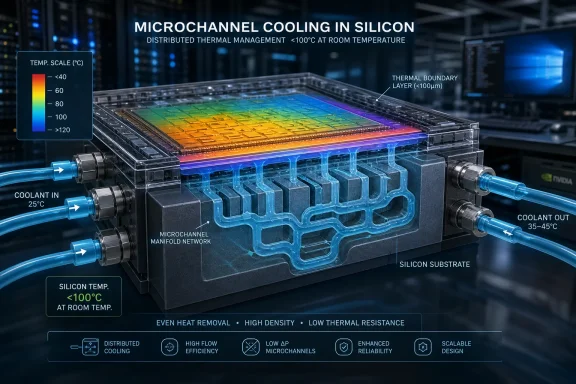
The KAIST work attacks the problem at the level where the heat is born. Instead of asking heat to travel outward through layers of material before meeting coolant, the researchers embedded microchannels directly into silicon and pushed water through those channels. That turns cooling from an external rescue operation into a feature of the chip’s physical design.
This is why the reported coefficient of performance above 100,000 matters. A flashy heat-flux number tells us the device can absorb an extraordinary local thermal load, but the energy-efficiency number tells us whether it does so by creating another power problem somewhere else. In data centers, a cooling breakthrough that demands huge pumping power is not a breakthrough; it is a relocation of the bill.
The research team’s central argument is that manifold microchannels shorten the coolant path, distribute flow more evenly, and lower pressure drop. In plain English: water does not have to fight its way through a long maze. It enters and exits through a more intelligently arranged network, reducing the energy spent just moving coolant through the chip.
That should sound familiar to WindowsForum readers watching desktop CPUs and GPUs steadily normalize power levels that would have looked absurd a decade ago. The consumer PC and the hyperscale AI rack are not the same market, but they are governed by the same physics. Frequency, voltage, transistor density, memory proximity, and packaging all create heat that must be moved somewhere else.
The KAIST result sits inside a broader transition from air cooling to liquid cooling to direct-to-chip liquid cooling and, now, research-grade embedded cooling. Each step cuts away some portion of the thermal distance between heat source and coolant. The remaining question is not whether closer cooling is technically attractive; it is whether manufacturing, reliability, cost, and serviceability can keep up.
That is the practical hinge. A lab demonstration can show an elegant path for heat removal, but commercial chips live inside supply chains, warranty models, validation programs, and conservative procurement departments. A failed fan is annoying. A clogged channel inside a semiconductor package is a different class of nightmare.
A straight microchannel design can create its own problems. Coolant traveling over a long distance heats up, pressure drop rises, and some regions may receive better flow than others. In a chip, uneven cooling is not an academic nuisance; temperature gradients can affect performance, reliability, and lifetime.
The manifold approach borrows a logic familiar from networks. Rather than routing everything through one long congested path, it uses multiple inlets and outlets to shorten flow distance and distribute coolant more uniformly. The researchers also used multi-fidelity optimization, combining faster models with more detailed simulations to explore the design space without drowning in computation.
That combination matters because advanced cooling is a systems problem disguised as a materials problem. Channel width, height, number, placement, flow rate, pressure drop, thermal resistance, and temperature uniformity all pull against one another. Optimize one blindly and you can make another worse.
The result reported by KAIST — maintaining chip temperature below 100°C at more than 2,000 W/cm² — is extreme by ordinary PC standards. But the number is best read as a signpost rather than a shipping spec. The point is that the architecture can handle heat fluxes in the range that advanced packaging roadmaps increasingly make plausible.
Exotic cooling technologies often fail the data-center realism test. They may work beautifully under controlled conditions, but they introduce cost, maintenance, safety, contamination, or sourcing problems that offset the performance gain. Water is not magic, but it is familiar, cheap, and already central to many direct liquid-cooling systems.
The absence of phase-change cooling also simplifies the story. Boiling and condensation can move heat very effectively, but they add complexity and control challenges. A single-phase water system, if it can deliver enough performance, is easier to reason about and potentially easier to integrate into existing operational models.
That does not make it plug-and-play. Water near electronics is always a packaging and reliability challenge, and embedded water channels raise the stakes further. The more intimate the coolant becomes with the silicon, the more unforgiving the design must be about leakage, corrosion, particulate contamination, long-term sealing, and manufacturing variation.
Still, the reported low-temperature fabrication process is an important clue. If a cooling structure requires heroic manufacturing steps incompatible with semiconductor process flows, it risks becoming a beautiful dead end. KAIST’s claim that the process remains compatible with conventional fabrication is therefore not a side note; it is the difference between a research curiosity and something the industry might actually try to industrialize.
Consumer PCs already have relatively mature cooling options. A large tower cooler, 360 mm AIO, vapor chamber GPU cooler, or custom loop can remove impressive amounts of heat at a cost buyers tolerate. Embedded microfluidic cooling, by contrast, asks chipmakers and packaging houses to redesign the device itself.
The first commercial targets will be places where watts per square centimeter matter more than bill-of-material minimalism. AI accelerators with high-bandwidth memory, chiplet-based packages, and dense interconnect fabrics are natural candidates. These products are already expensive, already power hungry, and already constrained by packaging and cooling infrastructure.
That said, desktop users should not ignore the development. Technologies that begin in servers often migrate downward after the manufacturing learning curve bends. Heat pipes, vapor chambers, advanced thermal interface materials, and liquid cooling all followed some version of this pattern.
The more immediate PC consequence may be indirect. If embedded cooling helps server-class accelerators run denser and more efficiently, it affects cloud economics, AI service costs, and the hardware priorities of the companies shaping Windows workloads. Local PCs may not get water-filled silicon soon, but they will live in an ecosystem increasingly designed around thermally aggressive server chips.
That distinction matters because cooling announcements often collapse chip-level results into facility-level promises. A pump that uses one-tenth the power to remove heat at the device level is valuable, but the heat still has to go somewhere. The building still needs heat exchangers, distribution loops, controls, and in many climates some form of heat rejection infrastructure.
The strongest version of the KAIST claim is narrower and more credible: embedded manifold microchannels may dramatically reduce the pumping penalty for removing very high heat flux from silicon. That is enough. It does not need to be inflated into a total data-center energy miracle.
There is also the question of scale. A small test chip can validate physics, but commercial accelerators are large, mechanically complex, and integrated with memory stacks, substrates, power delivery, interposers, stiffeners, and cold plates. Uniform flow across a small device is hard; uniform flow across a large package with manufacturing tolerances and real-world service conditions is harder.
None of this diminishes the work. It simply puts it where it belongs: as a promising research result that addresses one of the hardest pieces of the thermal puzzle, not as a finished product announcement from NVIDIA, AMD, Intel, TSMC, Samsung, or a server OEM.
Today’s data-center cooling stack is divided among chip vendors, board vendors, server OEMs, rack integrators, facility operators, and service contractors. Each party has boundaries. Embedded microfluidics blur those boundaries because the cooling apparatus becomes part of the semiconductor product rather than an external accessory.
That has consequences for qualification. A chipmaker would need confidence not only that the silicon computes correctly, but that its internal coolant structures remain clean, sealed, and performant over the life of the product. A cloud operator would need procedures for monitoring flow and detecting degradation before it becomes thermal throttling or catastrophic failure.
Then there is repairability. Modern server components are already moving toward tightly integrated modules that are difficult to service at a granular level. Embedded cooling accelerates that trend. If the cooling network is inside the package, replacement likely means swapping a very expensive module rather than cleaning a conventional cold plate.
The upside is equally clear. Tighter integration could reduce thermal resistance, improve temperature uniformity, enable denser packaging, and reduce the need for overbuilt external cooling hardware. But the industry has to decide whether those gains justify moving yet another piece of infrastructure into the semiconductor stack.
Modern performance gains increasingly come from putting more things close together: chiplets, cache, memory, accelerators, optical interfaces, power delivery components, and specialized logic. Proximity improves bandwidth and latency, but it also concentrates heat. Cooling from the outside becomes less effective when the hottest components are buried inside increasingly dense packages.
This is where embedded cooling becomes strategically interesting. It is not just a way to overclock a monolithic die. It is a way to make future packaging architectures feasible.
For Windows workstations, that could eventually matter in systems built for local AI inference, simulation, rendering, software development, and content creation. If future CPUs, GPUs, NPUs, and memory are assembled into denser modules, conventional cooling may struggle to reach the hottest internal regions. More integrated thermal design could become a prerequisite for performance rather than a premium feature.
The same logic applies to laptops, though with a different timeline and risk profile. Thin mobile devices are thermally constrained by skin temperature, acoustics, battery capacity, and chassis volume. Embedded cooling would not eliminate those constraints, but it could help move heat more efficiently from internal hotspots to the parts of the system designed to reject it.
That shift changes how we should evaluate chip technology. A faster accelerator that requires a heroic cooling plant may be less attractive than a slightly less aggressive design that deploys faster and runs more predictably. Thermal efficiency is becoming a deployment-speed metric, not just an engineering nicety.
Embedded cooling could strengthen this rack-scale approach. If heat can be extracted more efficiently at the die or package, operators may pack more compute into the same power and cooling envelope. That directly affects capacity planning and the economics of AI services.
But the technology also increases coordination demands. The chip, package, board, server, rack manifold, coolant chemistry, monitoring software, and maintenance regime must be designed as one system. The old modular fantasy — buy parts, bolt them together, and let airflow sort it out — is giving way to co-designed infrastructure.
That is uncomfortable for the PC tradition, which prizes replaceability and enthusiast tinkering. It is entirely natural for hyperscale computing, where efficiency at fleet scale beats component-level freedom.
A chip-level efficiency improvement cannot solve grid constraints by itself. But it can reduce one source of waste in a system where margins matter. If pumping energy falls, if temperatures become more uniform, and if thermal throttling becomes less frequent, operators gain both efficiency and predictability.
Predictability may be the underrated benefit. Data centers are engineered around worst cases: peak load, hot days, component aging, coolant anomalies, and maintenance windows. Better thermal control at the chip level can reduce the size of the safety margins required elsewhere.
That matters for enterprise IT because many organizations do not operate hyperscale facilities. They rent capacity, deploy smaller clusters, or buy appliances that must fit into existing power and cooling envelopes. Technologies that make high-density compute less thermally demanding could broaden where advanced AI and HPC hardware can be installed.
Still, the industry should resist the greenwashing reflex. Better cooling does not automatically mean lower total energy use if it simply enables more compute consumption. Efficiency gains often lower the cost of doing more, and AI demand has shown little sign of politely stopping when hardware improves.
Embedded channels also raise interesting design questions for chip architects. If cooling can be brought closer to hotspots, designers may redistribute power density or change floorplans. Thermal constraints are not merely after-the-fact limits; they influence architecture.
That could produce a feedback loop. Better cooling enables denser chips, denser chips create tougher thermal loads, and those loads require even more integrated cooling. The industry has seen versions of this cycle before with power delivery and memory bandwidth. Once a constraint is partially relieved, designers quickly spend the headroom.
The most plausible future is not one universal cooling solution. It is a hierarchy. Air cooling remains for low- and mid-power systems, direct-to-chip liquid cooling grows in servers, immersion finds niches, and embedded microfluidics appears first in the most expensive packages where nothing else is good enough.
For WindowsForum readers, the significance is not that next year’s desktop CPU will arrive with microscopic water channels. It is that the performance frontier is moving toward technologies that make the chip, package, board, and cooling loop inseparable.
That has several concrete implications for enthusiasts, administrators, and buyers watching the hardware roadmap:
 The Cooling Problem Has Moved Inside the Package
For most PC users, “cooling” still evokes fans, heat pipes, vapor chambers, thermal paste, and the occasional intimidating loop of tubing. That mental model is already too coarse for the chips driving AI training clusters, high-end accelerators, and dense server nodes. The old thermal chain — transistor to die, die to package, package to heat spreader, heat spreader to cold plate, cold plate to room — has too many handoffs for the next phase of compute density.The KAIST work attacks the problem at the level where the heat is born. Instead of asking heat to travel outward through layers of material before meeting coolant, the researchers embedded microchannels directly into silicon and pushed water through those channels. That turns cooling from an external rescue operation into a feature of the chip’s physical design.
This is why the reported coefficient of performance above 100,000 matters. A flashy heat-flux number tells us the device can absorb an extraordinary local thermal load, but the energy-efficiency number tells us whether it does so by creating another power problem somewhere else. In data centers, a cooling breakthrough that demands huge pumping power is not a breakthrough; it is a relocation of the bill.
The research team’s central argument is that manifold microchannels shorten the coolant path, distribute flow more evenly, and lower pressure drop. In plain English: water does not have to fight its way through a long maze. It enters and exits through a more intelligently arranged network, reducing the energy spent just moving coolant through the chip.
AI Has Made Thermals a First-Class Architecture Constraint
The timing is not accidental. AI accelerators have turned thermal design from a support function into a boardroom issue because the limiting factor in many deployments is no longer simply how many chips can be bought. It is how much power can be delivered, how much heat can be removed, and how much infrastructure must be built before a cluster can go live.That should sound familiar to WindowsForum readers watching desktop CPUs and GPUs steadily normalize power levels that would have looked absurd a decade ago. The consumer PC and the hyperscale AI rack are not the same market, but they are governed by the same physics. Frequency, voltage, transistor density, memory proximity, and packaging all create heat that must be moved somewhere else.
The KAIST result sits inside a broader transition from air cooling to liquid cooling to direct-to-chip liquid cooling and, now, research-grade embedded cooling. Each step cuts away some portion of the thermal distance between heat source and coolant. The remaining question is not whether closer cooling is technically attractive; it is whether manufacturing, reliability, cost, and serviceability can keep up.
That is the practical hinge. A lab demonstration can show an elegant path for heat removal, but commercial chips live inside supply chains, warranty models, validation programs, and conservative procurement departments. A failed fan is annoying. A clogged channel inside a semiconductor package is a different class of nightmare.
The Manifold Is the Story, Not Just the Microchannel
Microchannel cooling is not new. Researchers have been cutting or forming tiny coolant paths near electronics for decades, and the concept has had periodic bursts of excitement as power density rose. What makes the KAIST report notable is the emphasis on a manifold structure and optimization rather than simply making the channels smaller.A straight microchannel design can create its own problems. Coolant traveling over a long distance heats up, pressure drop rises, and some regions may receive better flow than others. In a chip, uneven cooling is not an academic nuisance; temperature gradients can affect performance, reliability, and lifetime.
The manifold approach borrows a logic familiar from networks. Rather than routing everything through one long congested path, it uses multiple inlets and outlets to shorten flow distance and distribute coolant more uniformly. The researchers also used multi-fidelity optimization, combining faster models with more detailed simulations to explore the design space without drowning in computation.
That combination matters because advanced cooling is a systems problem disguised as a materials problem. Channel width, height, number, placement, flow rate, pressure drop, thermal resistance, and temperature uniformity all pull against one another. Optimize one blindly and you can make another worse.
The result reported by KAIST — maintaining chip temperature below 100°C at more than 2,000 W/cm² — is extreme by ordinary PC standards. But the number is best read as a signpost rather than a shipping spec. The point is that the architecture can handle heat fluxes in the range that advanced packaging roadmaps increasingly make plausible.
Room-Temperature Water Is a Bigger Deal Than It Sounds
The least glamorous part of the announcement may be the most commercially important: the coolant is ordinary room-temperature water. No exotic phase-change fluid, no diamond substrate, no cryogenic theatrics. That restraint is part of what makes the work interesting.Exotic cooling technologies often fail the data-center realism test. They may work beautifully under controlled conditions, but they introduce cost, maintenance, safety, contamination, or sourcing problems that offset the performance gain. Water is not magic, but it is familiar, cheap, and already central to many direct liquid-cooling systems.
The absence of phase-change cooling also simplifies the story. Boiling and condensation can move heat very effectively, but they add complexity and control challenges. A single-phase water system, if it can deliver enough performance, is easier to reason about and potentially easier to integrate into existing operational models.
That does not make it plug-and-play. Water near electronics is always a packaging and reliability challenge, and embedded water channels raise the stakes further. The more intimate the coolant becomes with the silicon, the more unforgiving the design must be about leakage, corrosion, particulate contamination, long-term sealing, and manufacturing variation.
Still, the reported low-temperature fabrication process is an important clue. If a cooling structure requires heroic manufacturing steps incompatible with semiconductor process flows, it risks becoming a beautiful dead end. KAIST’s claim that the process remains compatible with conventional fabrication is therefore not a side note; it is the difference between a research curiosity and something the industry might actually try to industrialize.
The Data Center Will Get This Before the Desktop Does
Windows enthusiasts often ask when a breakthrough like this will reach PCs. The honest answer is: not soon in the form described here. The economics point first toward AI accelerators, HPC systems, dense servers, defense electronics, and high-power packaging where the cost of cooling failure is high and the value of extra thermal headroom is enormous.Consumer PCs already have relatively mature cooling options. A large tower cooler, 360 mm AIO, vapor chamber GPU cooler, or custom loop can remove impressive amounts of heat at a cost buyers tolerate. Embedded microfluidic cooling, by contrast, asks chipmakers and packaging houses to redesign the device itself.
The first commercial targets will be places where watts per square centimeter matter more than bill-of-material minimalism. AI accelerators with high-bandwidth memory, chiplet-based packages, and dense interconnect fabrics are natural candidates. These products are already expensive, already power hungry, and already constrained by packaging and cooling infrastructure.
That said, desktop users should not ignore the development. Technologies that begin in servers often migrate downward after the manufacturing learning curve bends. Heat pipes, vapor chambers, advanced thermal interface materials, and liquid cooling all followed some version of this pattern.
The more immediate PC consequence may be indirect. If embedded cooling helps server-class accelerators run denser and more efficiently, it affects cloud economics, AI service costs, and the hardware priorities of the companies shaping Windows workloads. Local PCs may not get water-filled silicon soon, but they will live in an ecosystem increasingly designed around thermally aggressive server chips.
Efficiency Claims Need a Skeptical Reading
The headline comparison — 10 times more efficient than the previous record — is impressive, but readers should treat it with the same care they would apply to any benchmark. Coefficient of performance depends on test conditions, temperature rise, heat flux, flow geometry, measurement boundaries, and what is counted as input power. It is not the same as saying an entire data center cooling bill falls by 90 percent.That distinction matters because cooling announcements often collapse chip-level results into facility-level promises. A pump that uses one-tenth the power to remove heat at the device level is valuable, but the heat still has to go somewhere. The building still needs heat exchangers, distribution loops, controls, and in many climates some form of heat rejection infrastructure.
The strongest version of the KAIST claim is narrower and more credible: embedded manifold microchannels may dramatically reduce the pumping penalty for removing very high heat flux from silicon. That is enough. It does not need to be inflated into a total data-center energy miracle.
There is also the question of scale. A small test chip can validate physics, but commercial accelerators are large, mechanically complex, and integrated with memory stacks, substrates, power delivery, interposers, stiffeners, and cold plates. Uniform flow across a small device is hard; uniform flow across a large package with manufacturing tolerances and real-world service conditions is harder.
None of this diminishes the work. It simply puts it where it belongs: as a promising research result that addresses one of the hardest pieces of the thermal puzzle, not as a finished product announcement from NVIDIA, AMD, Intel, TSMC, Samsung, or a server OEM.
The Supply Chain Question Is Brutal
The hardest part of embedded cooling may not be thermal physics. It may be accountability. If coolant channels are part of the chip or package, who owns the failure mode?Today’s data-center cooling stack is divided among chip vendors, board vendors, server OEMs, rack integrators, facility operators, and service contractors. Each party has boundaries. Embedded microfluidics blur those boundaries because the cooling apparatus becomes part of the semiconductor product rather than an external accessory.
That has consequences for qualification. A chipmaker would need confidence not only that the silicon computes correctly, but that its internal coolant structures remain clean, sealed, and performant over the life of the product. A cloud operator would need procedures for monitoring flow and detecting degradation before it becomes thermal throttling or catastrophic failure.
Then there is repairability. Modern server components are already moving toward tightly integrated modules that are difficult to service at a granular level. Embedded cooling accelerates that trend. If the cooling network is inside the package, replacement likely means swapping a very expensive module rather than cleaning a conventional cold plate.
The upside is equally clear. Tighter integration could reduce thermal resistance, improve temperature uniformity, enable denser packaging, and reduce the need for overbuilt external cooling hardware. But the industry has to decide whether those gains justify moving yet another piece of infrastructure into the semiconductor stack.
Windows Users Should Read This as a Packaging Story
For Windows users, the temptation is to read any chip-cooling breakthrough through the lens of CPU clocks and GPU boost behavior. That is understandable, but incomplete. The bigger story is packaging.Modern performance gains increasingly come from putting more things close together: chiplets, cache, memory, accelerators, optical interfaces, power delivery components, and specialized logic. Proximity improves bandwidth and latency, but it also concentrates heat. Cooling from the outside becomes less effective when the hottest components are buried inside increasingly dense packages.
This is where embedded cooling becomes strategically interesting. It is not just a way to overclock a monolithic die. It is a way to make future packaging architectures feasible.
For Windows workstations, that could eventually matter in systems built for local AI inference, simulation, rendering, software development, and content creation. If future CPUs, GPUs, NPUs, and memory are assembled into denser modules, conventional cooling may struggle to reach the hottest internal regions. More integrated thermal design could become a prerequisite for performance rather than a premium feature.
The same logic applies to laptops, though with a different timeline and risk profile. Thin mobile devices are thermally constrained by skin temperature, acoustics, battery capacity, and chassis volume. Embedded cooling would not eliminate those constraints, but it could help move heat more efficiently from internal hotspots to the parts of the system designed to reject it.
The Rack Is Becoming the Computer
The KAIST research also lands at a moment when the boundary between computer and facility is dissolving. In AI infrastructure, a “system” is no longer just a server. It is a rack, a row, a coolant loop, a power distribution design, and a building-level energy strategy.That shift changes how we should evaluate chip technology. A faster accelerator that requires a heroic cooling plant may be less attractive than a slightly less aggressive design that deploys faster and runs more predictably. Thermal efficiency is becoming a deployment-speed metric, not just an engineering nicety.
Embedded cooling could strengthen this rack-scale approach. If heat can be extracted more efficiently at the die or package, operators may pack more compute into the same power and cooling envelope. That directly affects capacity planning and the economics of AI services.
But the technology also increases coordination demands. The chip, package, board, server, rack manifold, coolant chemistry, monitoring software, and maintenance regime must be designed as one system. The old modular fantasy — buy parts, bolt them together, and let airflow sort it out — is giving way to co-designed infrastructure.
That is uncomfortable for the PC tradition, which prizes replaceability and enthusiast tinkering. It is entirely natural for hyperscale computing, where efficiency at fleet scale beats component-level freedom.
The Real Breakthrough Is Making Heat Less Political
There is a political economy to cooling. Power utilities, municipalities, data-center operators, chip vendors, cloud customers, and regulators all now care about how much energy AI infrastructure consumes and where that energy goes. Cooling is part of that argument because it determines how much non-compute overhead is attached to every model training run, inference request, or cloud service.A chip-level efficiency improvement cannot solve grid constraints by itself. But it can reduce one source of waste in a system where margins matter. If pumping energy falls, if temperatures become more uniform, and if thermal throttling becomes less frequent, operators gain both efficiency and predictability.
Predictability may be the underrated benefit. Data centers are engineered around worst cases: peak load, hot days, component aging, coolant anomalies, and maintenance windows. Better thermal control at the chip level can reduce the size of the safety margins required elsewhere.
That matters for enterprise IT because many organizations do not operate hyperscale facilities. They rent capacity, deploy smaller clusters, or buy appliances that must fit into existing power and cooling envelopes. Technologies that make high-density compute less thermally demanding could broaden where advanced AI and HPC hardware can be installed.
Still, the industry should resist the greenwashing reflex. Better cooling does not automatically mean lower total energy use if it simply enables more compute consumption. Efficiency gains often lower the cost of doing more, and AI demand has shown little sign of politely stopping when hardware improves.
The Silicon Plumbing Era Has a Long Validation Road
The path from a paper in Energy Conversion and Management to a shipping accelerator is long. It runs through wafer processing, yield analysis, packaging compatibility, contamination studies, mechanical stress testing, coolant qualification, field monitoring, service models, and brutal cost accounting. Any one of those can slow or redirect the technology.Embedded channels also raise interesting design questions for chip architects. If cooling can be brought closer to hotspots, designers may redistribute power density or change floorplans. Thermal constraints are not merely after-the-fact limits; they influence architecture.
That could produce a feedback loop. Better cooling enables denser chips, denser chips create tougher thermal loads, and those loads require even more integrated cooling. The industry has seen versions of this cycle before with power delivery and memory bandwidth. Once a constraint is partially relieved, designers quickly spend the headroom.
The most plausible future is not one universal cooling solution. It is a hierarchy. Air cooling remains for low- and mid-power systems, direct-to-chip liquid cooling grows in servers, immersion finds niches, and embedded microfluidics appears first in the most expensive packages where nothing else is good enough.
For WindowsForum readers, the significance is not that next year’s desktop CPU will arrive with microscopic water channels. It is that the performance frontier is moving toward technologies that make the chip, package, board, and cooling loop inseparable.
The Chip Cooler That Turns a Lab Result Into an Industry Warning
The KAIST work should be read as both an engineering achievement and a warning about where compute is headed. If chips now require internal cooling structures to keep scaling efficiently, the industry has entered a phase where thermal design is no longer downstream from architecture. It is architecture.That has several concrete implications for enthusiasts, administrators, and buyers watching the hardware roadmap:
- The KAIST team reported an embedded manifold microchannel cooler that kept silicon below 100°C at heat fluxes above 2,000 W/cm² using room-temperature water.
- The reported coefficient of performance above 100,000 points to a major reduction in pumping power at the chip-cooling level, not an automatic 90 percent reduction in total data-center energy use.
- The design’s reliance on manifold routing is important because shorter, more evenly distributed coolant paths reduce pressure drop and improve temperature uniformity.
- The first realistic commercial targets are AI accelerators, HPC systems, advanced packages, power electronics, and defense hardware rather than mainstream desktop PCs.
- The biggest barriers are likely to be manufacturability, reliability, serviceability, coolant management, and responsibility across the semiconductor and data-center supply chain.
- The long-term PC relevance is packaging: denser CPUs, GPUs, NPUs, memory stacks, and chiplets will increasingly need cooling strategies designed into the device rather than attached afterward.
References
- Primary source: Interesting Engineering
Published: Tue, 16 Jun 2026 16:06:00 GMT
New technique cools high-performance chips from the inside out
KAIST researchers have developed a technique to carve microscopic liquid-cooling channels directly inside silicon semiconductor chips.interestingengineering.com - Independent coverage: Tech Xplore
Published: Mon, 15 Jun 2026 22:30:03 GMT
- Related coverage: researchgate.net
(PDF) Highly energy-efficient manifold microchannel for cooling electronics with a coefficient of performance over 100,000
PDF | Thermal management has become a critical challenge, as the die-level heat flux of advanced electronics surpasses 1,000 W/cm2. Microfluidic cooling... | Find, read and cite all the research you need on ResearchGate www.researchgate.net
- Related coverage: the-innovation.org
