
Nvidia CEO Jensen Huang told the Associated Press in Sherman, Texas, on June 16, 2026, that society needs “new social norms” for artificial intelligence and urged people to use AI more broadly as the technology reshapes work, industry, national security, and daily life. His argument was not merely that AI is useful. It was that resisting it is becoming impractical, and that the real political fight is now over the rules, infrastructure, and distribution of power around it.
Jensen Huang’s central claim is simple enough to fit on a bumper sticker: use the tools, learn the tools, normalize the tools. But coming from the CEO of Nvidia, it lands less like public-service advice than like a doctrine for the next phase of the AI economy.
That tension is the story. Huang is not a neutral observer of AI adoption; he runs the company whose chips turned the current AI boom from a software story into an infrastructure gold rush. Nvidia’s fortunes are now tied to the proposition that artificial intelligence will become as ordinary as electricity, cloud computing, or the web browser.
His “new social norms” line is therefore doing several jobs at once. It reassures the public that technology shocks can be domesticated. It tells policymakers that the answer to anxiety is not retreat. And it tells investors that AI demand is still in its early cultural phase, not its mature technical one.
The analogy Huang reached for was the automobile. Cars were once seen as dangerous intrusions into public life, he argued, but society adapted with sidewalks, crosswalks, and new expectations about where children should play. The implication is clear: AI’s hazards are real, but they can be managed by redesigning behavior around the technology rather than freezing the technology in place.
That is a powerful metaphor, and also an incomplete one. Automobiles did not merely require new norms; they required traffic laws, insurance regimes, urban redesign, licensing, policing, product-liability rules, and decades of political fights over who pays for roads and who suffers the pollution. If AI is the car in Huang’s analogy, then we are not at the crosswalk stage yet. We are still arguing over who gets to build the roads.
Huang’s comments in Texas came at an event tied to Coherent’s manufacturing expansion, where the practical concern was not a chatbot’s cleverness but the physical machinery of AI. Coherent is working on laser technology for transmitting data among chips, the kind of less glamorous but crucial infrastructure that determines whether AI systems become cheaper, faster, and less power-hungry.
This is where Nvidia’s story intersects most directly with the WindowsForum audience. AI is no longer something that lives only inside a browser tab. It is becoming a workload class, a procurement category, a power-planning problem, a data-governance headache, and a new reason for enterprises to revisit hardware lifecycles they thought they understood.
For consumers, that shows up as AI buttons, Copilot panels, local inference promises, cloud subscriptions, and a slow redefinition of what a “PC” is supposed to do. For sysadmins, it shows up as another layer of policy: which users can access which models, what data can be pasted into them, whether logs are retained, whether prompts become discoverable, and whether the toolchain still works when a vendor changes access terms overnight.
Huang’s optimism rests on the claim that AI lowers the skill barrier. He says people can now design websites, analyze complex documents, guide research, or plan a kitchen remodel without learning to program. That is true in a narrow sense and consequential in a broader one: AI turns many tasks from how do I operate this software? into how do I ask for the outcome I want?
But lowering the skill barrier does not eliminate the expertise barrier. It often moves it. The person using AI to generate PowerShell still needs to know whether the script is safe. The employee asking AI to summarize a contract still needs to know what has been missed. The developer accepting generated code still inherits the bug.
When he says everybody should use AI, he is not just encouraging experimentation. He is expanding the imagined market for Nvidia’s hardware and systems. The more AI becomes a default layer in education, office work, research, design, manufacturing, and software development, the more compute demand looks structural rather than speculative.
That matters because Nvidia’s valuation is now a proxy for belief in the durability of AI infrastructure spending. The company’s roughly $5 trillion market capitalization reflects more than sales of GPUs; it reflects the expectation that compute-intensive AI will be embedded into the global economy. In that sense, Huang’s public argument is also a defense of the market’s argument.
The risk is that infrastructure narratives can outrun adoption realities. Enterprises are interested in AI, but many are still struggling to convert pilots into measurable productivity gains. Developers use AI coding tools, but they also report new burdens in review, security, and maintenance. Knowledge workers may save time on drafts and summaries while organizations create new layers of oversight to prevent data leakage and hallucination-driven mistakes.
Huang’s answer is not to slow down. His answer is to normalize the technology so that the surrounding institutions catch up. That is a familiar Silicon Valley move, but this time the stakes are larger because AI is being sold simultaneously as a productivity tool, a national-security asset, a scientific accelerator, and an industrial policy engine.
That shift matters because it signals that Washington increasingly sees frontier AI not as software, but as strategic capability. Chips were the first obvious target for export controls because they are physical, traceable, and central to model training. Models themselves are harder to regulate, but the Anthropic episode shows the government is willing to test that boundary.
The result is a new uncertainty for enterprise buyers. If access to an advanced model can be curtailed on national-security grounds, then AI dependency becomes more complicated than cloud dependency. A cloud region outage is bad; a regulatory intervention that changes who may use a model, where, and under what citizenship rules is a different kind of operational risk.
Huang’s response was carefully calibrated. He said national security should be the top concern for all technologies, while also arguing that policymakers need to be specific about the risks before setting export-control policy. That is the position one would expect from Nvidia: accept the legitimacy of national security, but resist rules that could shrink the global market or accelerate foreign alternatives.
This was also the argument Nvidia made during the Biden-era fight over chip exports to China. Huang warned then that restricting sales could damage America’s influence over the AI ecosystem by encouraging China to build and adopt its own chips. In the abstract, that is a free-market argument. In practice, it is also an argument for keeping Nvidia at the center of the global AI stack.
There is truth in the competition frame. AI capabilities matter for cybersecurity, military planning, semiconductor design, drug discovery, manufacturing, logistics, and intelligence analysis. No major government can be indifferent to who leads in those domains.
But the China frame also has a political convenience. It compresses messy domestic questions into a single external contest. Job disruption, copyright fights, data-center siting battles, electricity prices, model safety, market concentration, and public-sector procurement all become secondary to the demand that America must not fall behind.
That is why Huang’s “everybody use AI” message is more than motivational. It is an adoption strategy aligned with geopolitical urgency. If millions of Americans use AI daily, the United States grows a larger base of AI-fluent workers, companies find more use cases, and the domestic market supports larger infrastructure buildouts.
Still, framing AI primarily as a race can make democratic governance harder. Races reward speed. Public legitimacy often requires slowness: hearings, standards, audits, appeals, procurement rules, and the boring paperwork that prevents transformative technology from becoming a trust-destroying mess.
Data centers already shape local politics in parts of the United States because they compete for power, water, land, tax incentives, and grid capacity. AI intensifies that fight because training and serving large models require dense, power-hungry infrastructure. Even efficiency gains can be swallowed by demand growth if every saved watt invites more computation.
This is where Huang’s appearance at a Coherent facility becomes symbolically useful. The company’s laser work could reduce power use in AI systems by improving data movement among chips. That matters because in modern computing, moving data can be as important as processing it, and inefficiency at scale becomes a grid problem rather than a mere engineering annoyance.
But efficiency is not a substitute for policy. If data centers bring jobs, tax base, and industrial prestige, they also bring questions residents can understand without reading an AI white paper: will my utility bill rise, will my grid become less reliable, and why is a server farm getting priority over housing, schools, or existing industry?
Huang praised Trump’s energy posture, though he did not address the administration’s hostility toward wind and solar in the comments provided. That omission is politically convenient and analytically important. If AI’s future depends on abundant electricity, then the energy mix is not a side issue. It is part of the architecture.
There is a plausible version of this story. AI demand can support semiconductor fabs, advanced packaging, optical components, electrical infrastructure, cooling systems, construction projects, and specialized maintenance work. It can also make some manufacturers more productive by improving design, simulation, quality control, and robotics.
But the other side of the ledger is not imaginary. AI can automate white-collar tasks, compress teams, reduce demand for entry-level roles, and shift bargaining power toward firms that own models, compute, and data. Workers may be told to “use AI” at the same time employers use AI to justify smaller headcounts.
The problem is not that Huang is wrong to see job creation. It is that job creation and job destruction can happen simultaneously, in different places, to different workers, on different timelines. A data-center construction boom in one region does not automatically help a laid-off analyst in another. A new optical-components plant does not solve the problem of how junior developers gain experience if AI tools absorb the starter work.
That is why the “new social norms” argument needs an economic counterpart. If society must adapt to AI, then companies must adapt their training pipelines, schools must adapt curricula, unions and workers must adapt bargaining strategies, and governments must adapt safety nets. Otherwise, adaptation becomes a polite word for leaving individuals to absorb systemic change alone.
There is some merit to that argument. Public-market gains do flow into retirement accounts, index funds, and institutional portfolios. Corporate profits generate tax revenue. Large technology ecosystems create suppliers, partners, developers, and service businesses.
But the distribution question is more stubborn than Huang’s formulation allows. Stock ownership is uneven. Tax systems are contested. Jobs created by AI infrastructure may not match the jobs displaced by AI software. And if the most valuable layer of the economy is concentrated among a handful of model companies, cloud providers, and chip suppliers, broad social benefit is not automatic.
This is why the government-equity idea has surfaced across ideological lines, from Donald Trump to Bernie Sanders to Sam Altman’s orbit. The proposals differ in motive and mechanism, but they reflect the same anxiety: if AI creates extraordinary rents from public inputs, public research, public infrastructure, and public tolerance of disruption, perhaps the public should receive more than indirect benefits.
Huang’s skepticism is predictable. Corporate leaders generally prefer broad economic-growth arguments to direct public-ownership schemes. Yet the fact that the idea is being discussed at all shows how large the AI wealth concentration problem has become.
The political danger for Nvidia is that success itself changes the scrutiny. A $5 trillion company does not get to talk like a scrappy innovator forever. When a firm becomes infrastructure for the world’s next computing paradigm, every claim about public benefit invites a harder question about public leverage.
This is not unusual in one sense. Presidents cultivate relationships with industrial titans, especially when the industry in question is central to economic strategy. Semiconductor leaders, automakers, defense contractors, energy executives, and tech CEOs have always sought proximity to power.
But AI makes the optics sharper. Nvidia is not simply another large company lobbying over tax credits or export rules. It sits near the center of a supply chain that touches military capability, stock-market performance, energy planning, cloud infrastructure, and the future of work. Personal access to the president therefore becomes a governance issue, not just a Washington gossip item.
Sen. Elizabeth Warren’s criticism of Huang for skipping Senate testimony while attending a high-dollar Mar-a-Lago dinner captures the Democratic concern. The issue is not merely whether Huang likes Trump. It is whether the AI economy is being shaped through public deliberation or private access.
Huang’s answer was to separate politics from national success. He said Americans should want the president to succeed regardless of party because the country succeeds when the president succeeds. That is a statesmanlike line, but it does not dissolve the underlying problem: in a sector this consequential, legitimacy depends on more than good intentions and late-night phone calls.
But the connection is getting harder to ignore. If governments regulate frontier models, software vendors may change availability by region or user category. If electricity demand rises, data-center politics may affect utility bills and local permitting. If enterprises adopt AI aggressively, administrators will need to enforce policies that did not exist five years ago.
Windows has always been where grand technology strategies become mundane operational realities. The browser wars became default settings. Cloud identity became sign-in flows. Security architecture became prompts, baselines, and compliance dashboards. AI will follow the same path.
That means Windows professionals should treat Huang’s remarks not as executive futurism but as early notice. The “new social norms” of AI will eventually become acceptable-use policies, endpoint controls, audit logs, procurement requirements, and employee training modules. Culture becomes configuration.
There is also a local-compute angle. The more AI inference moves onto PCs, the more users and administrators will face questions about hardware capability, data residency, update cadence, and model trust. Running AI locally may reduce some privacy and latency concerns, but it also creates new management problems around model versions, driver stacks, and hardware acceleration.
In other words, the AI future will not arrive as a single product launch. It will seep into Windows through silicon, cloud services, management consoles, developer tools, and licensing bundles. By the time most users decide whether they wanted it, it may already be part of the platform.
That shift will reward organizations that treat AI as infrastructure rather than magic. It will punish those that adopt tools casually, without thinking through governance, security, cost, and continuity. And it will leave users caught between corporate enthusiasm and public unease unless the rules become clearer.
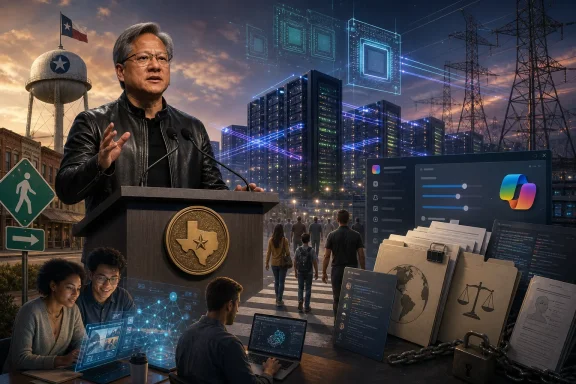 Huang Is Selling Adaptation as the Only Realistic Policy
Jensen Huang’s central claim is simple enough to fit on a bumper sticker: use the tools, learn the tools, normalize the tools. But coming from the CEO of Nvidia, it lands less like public-service advice than like a doctrine for the next phase of the AI economy.That tension is the story. Huang is not a neutral observer of AI adoption; he runs the company whose chips turned the current AI boom from a software story into an infrastructure gold rush. Nvidia’s fortunes are now tied to the proposition that artificial intelligence will become as ordinary as electricity, cloud computing, or the web browser.
His “new social norms” line is therefore doing several jobs at once. It reassures the public that technology shocks can be domesticated. It tells policymakers that the answer to anxiety is not retreat. And it tells investors that AI demand is still in its early cultural phase, not its mature technical one.
The analogy Huang reached for was the automobile. Cars were once seen as dangerous intrusions into public life, he argued, but society adapted with sidewalks, crosswalks, and new expectations about where children should play. The implication is clear: AI’s hazards are real, but they can be managed by redesigning behavior around the technology rather than freezing the technology in place.
That is a powerful metaphor, and also an incomplete one. Automobiles did not merely require new norms; they required traffic laws, insurance regimes, urban redesign, licensing, policing, product-liability rules, and decades of political fights over who pays for roads and who suffers the pollution. If AI is the car in Huang’s analogy, then we are not at the crosswalk stage yet. We are still arguing over who gets to build the roads.
The AI Boom Has Outgrown the Language of Gadgets
For years, much of the AI conversation sounded like a debate over software features. Could a model write emails? Could it summarize PDFs? Could it generate code, pass exams, or draw passable concept art? That framing is now obsolete.Huang’s comments in Texas came at an event tied to Coherent’s manufacturing expansion, where the practical concern was not a chatbot’s cleverness but the physical machinery of AI. Coherent is working on laser technology for transmitting data among chips, the kind of less glamorous but crucial infrastructure that determines whether AI systems become cheaper, faster, and less power-hungry.
This is where Nvidia’s story intersects most directly with the WindowsForum audience. AI is no longer something that lives only inside a browser tab. It is becoming a workload class, a procurement category, a power-planning problem, a data-governance headache, and a new reason for enterprises to revisit hardware lifecycles they thought they understood.
For consumers, that shows up as AI buttons, Copilot panels, local inference promises, cloud subscriptions, and a slow redefinition of what a “PC” is supposed to do. For sysadmins, it shows up as another layer of policy: which users can access which models, what data can be pasted into them, whether logs are retained, whether prompts become discoverable, and whether the toolchain still works when a vendor changes access terms overnight.
Huang’s optimism rests on the claim that AI lowers the skill barrier. He says people can now design websites, analyze complex documents, guide research, or plan a kitchen remodel without learning to program. That is true in a narrow sense and consequential in a broader one: AI turns many tasks from how do I operate this software? into how do I ask for the outcome I want?
But lowering the skill barrier does not eliminate the expertise barrier. It often moves it. The person using AI to generate PowerShell still needs to know whether the script is safe. The employee asking AI to summarize a contract still needs to know what has been missed. The developer accepting generated code still inherits the bug.
Nvidia’s Message Is Cultural, but Its Leverage Is Industrial
Nvidia has become the most important company in AI because the current generation of frontier models needs enormous amounts of parallel compute. That gives Huang a rare role in the technology economy: he is both evangelist and bottleneck.When he says everybody should use AI, he is not just encouraging experimentation. He is expanding the imagined market for Nvidia’s hardware and systems. The more AI becomes a default layer in education, office work, research, design, manufacturing, and software development, the more compute demand looks structural rather than speculative.
That matters because Nvidia’s valuation is now a proxy for belief in the durability of AI infrastructure spending. The company’s roughly $5 trillion market capitalization reflects more than sales of GPUs; it reflects the expectation that compute-intensive AI will be embedded into the global economy. In that sense, Huang’s public argument is also a defense of the market’s argument.
The risk is that infrastructure narratives can outrun adoption realities. Enterprises are interested in AI, but many are still struggling to convert pilots into measurable productivity gains. Developers use AI coding tools, but they also report new burdens in review, security, and maintenance. Knowledge workers may save time on drafts and summaries while organizations create new layers of oversight to prevent data leakage and hallucination-driven mistakes.
Huang’s answer is not to slow down. His answer is to normalize the technology so that the surrounding institutions catch up. That is a familiar Silicon Valley move, but this time the stakes are larger because AI is being sold simultaneously as a productivity tool, a national-security asset, a scientific accelerator, and an industrial policy engine.
Washington Has Stopped Treating AI as Just Another App
The political backdrop to Huang’s remarks is unusually volatile. The Trump administration has recently moved from a lighter-touch posture toward a more interventionist approach, including export controls on Anthropic’s newest models and an executive order establishing a voluntary system for government review of advanced AI systems before release.That shift matters because it signals that Washington increasingly sees frontier AI not as software, but as strategic capability. Chips were the first obvious target for export controls because they are physical, traceable, and central to model training. Models themselves are harder to regulate, but the Anthropic episode shows the government is willing to test that boundary.
The result is a new uncertainty for enterprise buyers. If access to an advanced model can be curtailed on national-security grounds, then AI dependency becomes more complicated than cloud dependency. A cloud region outage is bad; a regulatory intervention that changes who may use a model, where, and under what citizenship rules is a different kind of operational risk.
Huang’s response was carefully calibrated. He said national security should be the top concern for all technologies, while also arguing that policymakers need to be specific about the risks before setting export-control policy. That is the position one would expect from Nvidia: accept the legitimacy of national security, but resist rules that could shrink the global market or accelerate foreign alternatives.
This was also the argument Nvidia made during the Biden-era fight over chip exports to China. Huang warned then that restricting sales could damage America’s influence over the AI ecosystem by encouraging China to build and adopt its own chips. In the abstract, that is a free-market argument. In practice, it is also an argument for keeping Nvidia at the center of the global AI stack.
The China Race Is Becoming the Default Justification
Huang’s comments are steeped in the language of competition with China. That framing is now the easiest way to turn AI from a corporate investment theme into a national project. If the United States is in a race, then delay becomes dangerous, infrastructure becomes patriotic, and adoption becomes a civic duty.There is truth in the competition frame. AI capabilities matter for cybersecurity, military planning, semiconductor design, drug discovery, manufacturing, logistics, and intelligence analysis. No major government can be indifferent to who leads in those domains.
But the China frame also has a political convenience. It compresses messy domestic questions into a single external contest. Job disruption, copyright fights, data-center siting battles, electricity prices, model safety, market concentration, and public-sector procurement all become secondary to the demand that America must not fall behind.
That is why Huang’s “everybody use AI” message is more than motivational. It is an adoption strategy aligned with geopolitical urgency. If millions of Americans use AI daily, the United States grows a larger base of AI-fluent workers, companies find more use cases, and the domestic market supports larger infrastructure buildouts.
Still, framing AI primarily as a race can make democratic governance harder. Races reward speed. Public legitimacy often requires slowness: hearings, standards, audits, appeals, procurement rules, and the boring paperwork that prevents transformative technology from becoming a trust-destroying mess.
The Energy Bill Is the Part of AI Nobody Can Abstract Away
Huang’s most concrete warning was about energy. He said the United States is “woefully behind” in energy production and argued that the country has “suffocated” energy production for too long. Whatever one thinks of the politics behind that line, the underlying issue is real: AI compute turns electricity into intelligence-like services, and the conversion is expensive.Data centers already shape local politics in parts of the United States because they compete for power, water, land, tax incentives, and grid capacity. AI intensifies that fight because training and serving large models require dense, power-hungry infrastructure. Even efficiency gains can be swallowed by demand growth if every saved watt invites more computation.
This is where Huang’s appearance at a Coherent facility becomes symbolically useful. The company’s laser work could reduce power use in AI systems by improving data movement among chips. That matters because in modern computing, moving data can be as important as processing it, and inefficiency at scale becomes a grid problem rather than a mere engineering annoyance.
But efficiency is not a substitute for policy. If data centers bring jobs, tax base, and industrial prestige, they also bring questions residents can understand without reading an AI white paper: will my utility bill rise, will my grid become less reliable, and why is a server farm getting priority over housing, schools, or existing industry?
Huang praised Trump’s energy posture, though he did not address the administration’s hostility toward wind and solar in the comments provided. That omission is politically convenient and analytically important. If AI’s future depends on abundant electricity, then the energy mix is not a side issue. It is part of the architecture.
The Jobs Argument Is Both Plausible and Unsettled
Huang argues that AI infrastructure can help deliver the factory jobs politicians have promised for decades. The Texas setting made that argument tangible: lasers, chips, data movement, facilities, construction, energy, and high-end manufacturing all fit the reindustrialization narrative.There is a plausible version of this story. AI demand can support semiconductor fabs, advanced packaging, optical components, electrical infrastructure, cooling systems, construction projects, and specialized maintenance work. It can also make some manufacturers more productive by improving design, simulation, quality control, and robotics.
But the other side of the ledger is not imaginary. AI can automate white-collar tasks, compress teams, reduce demand for entry-level roles, and shift bargaining power toward firms that own models, compute, and data. Workers may be told to “use AI” at the same time employers use AI to justify smaller headcounts.
The problem is not that Huang is wrong to see job creation. It is that job creation and job destruction can happen simultaneously, in different places, to different workers, on different timelines. A data-center construction boom in one region does not automatically help a laid-off analyst in another. A new optical-components plant does not solve the problem of how junior developers gain experience if AI tools absorb the starter work.
That is why the “new social norms” argument needs an economic counterpart. If society must adapt to AI, then companies must adapt their training pipelines, schools must adapt curricula, unions and workers must adapt bargaining strategies, and governments must adapt safety nets. Otherwise, adaptation becomes a polite word for leaving individuals to absorb systemic change alone.
The Inequality Problem Is Not Solved by Everyone Owning a Mutual Fund
Huang pushed back on the idea that the U.S. government should take equity stakes in AI firms so the public can share in the upside. His response was that Americans already benefit from American companies through stock ownership, tax revenue, jobs, and spillover gains for energy, construction, and hardware firms.There is some merit to that argument. Public-market gains do flow into retirement accounts, index funds, and institutional portfolios. Corporate profits generate tax revenue. Large technology ecosystems create suppliers, partners, developers, and service businesses.
But the distribution question is more stubborn than Huang’s formulation allows. Stock ownership is uneven. Tax systems are contested. Jobs created by AI infrastructure may not match the jobs displaced by AI software. And if the most valuable layer of the economy is concentrated among a handful of model companies, cloud providers, and chip suppliers, broad social benefit is not automatic.
This is why the government-equity idea has surfaced across ideological lines, from Donald Trump to Bernie Sanders to Sam Altman’s orbit. The proposals differ in motive and mechanism, but they reflect the same anxiety: if AI creates extraordinary rents from public inputs, public research, public infrastructure, and public tolerance of disruption, perhaps the public should receive more than indirect benefits.
Huang’s skepticism is predictable. Corporate leaders generally prefer broad economic-growth arguments to direct public-ownership schemes. Yet the fact that the idea is being discussed at all shows how large the AI wealth concentration problem has become.
The political danger for Nvidia is that success itself changes the scrutiny. A $5 trillion company does not get to talk like a scrappy innovator forever. When a firm becomes infrastructure for the world’s next computing paradigm, every claim about public benefit invites a harder question about public leverage.
The Trump-Huang Relationship Makes Industrial Policy Personal
Huang’s closeness with President Trump adds another layer to the story. According to the interview, the relationship began with a dinner invitation at Mar-a-Lago, and Huang described Trump as charismatic, inquisitive, and focused on jobs, reindustrialization, national security, and winning. Trump, in turn, has praised Huang and reportedly insisted that he accompany him on foreign trips.This is not unusual in one sense. Presidents cultivate relationships with industrial titans, especially when the industry in question is central to economic strategy. Semiconductor leaders, automakers, defense contractors, energy executives, and tech CEOs have always sought proximity to power.
But AI makes the optics sharper. Nvidia is not simply another large company lobbying over tax credits or export rules. It sits near the center of a supply chain that touches military capability, stock-market performance, energy planning, cloud infrastructure, and the future of work. Personal access to the president therefore becomes a governance issue, not just a Washington gossip item.
Sen. Elizabeth Warren’s criticism of Huang for skipping Senate testimony while attending a high-dollar Mar-a-Lago dinner captures the Democratic concern. The issue is not merely whether Huang likes Trump. It is whether the AI economy is being shaped through public deliberation or private access.
Huang’s answer was to separate politics from national success. He said Americans should want the president to succeed regardless of party because the country succeeds when the president succeeds. That is a statesmanlike line, but it does not dissolve the underlying problem: in a sector this consequential, legitimacy depends on more than good intentions and late-night phone calls.
Windows Users Will Feel AI Policy Before They Understand It
For many Windows users, the AI debate still arrives as UI clutter. A Copilot icon appears. A search box changes. A settings screen offers cloud-connected assistance. A laptop is marketed as an AI PC. The political economy behind those features feels distant until something breaks.But the connection is getting harder to ignore. If governments regulate frontier models, software vendors may change availability by region or user category. If electricity demand rises, data-center politics may affect utility bills and local permitting. If enterprises adopt AI aggressively, administrators will need to enforce policies that did not exist five years ago.
Windows has always been where grand technology strategies become mundane operational realities. The browser wars became default settings. Cloud identity became sign-in flows. Security architecture became prompts, baselines, and compliance dashboards. AI will follow the same path.
That means Windows professionals should treat Huang’s remarks not as executive futurism but as early notice. The “new social norms” of AI will eventually become acceptable-use policies, endpoint controls, audit logs, procurement requirements, and employee training modules. Culture becomes configuration.
There is also a local-compute angle. The more AI inference moves onto PCs, the more users and administrators will face questions about hardware capability, data residency, update cadence, and model trust. Running AI locally may reduce some privacy and latency concerns, but it also creates new management problems around model versions, driver stacks, and hardware acceleration.
In other words, the AI future will not arrive as a single product launch. It will seep into Windows through silicon, cloud services, management consoles, developer tools, and licensing bundles. By the time most users decide whether they wanted it, it may already be part of the platform.
The New Normal Will Be Written in Policies, Power Contracts, and Prompt Logs
The practical lesson from Huang’s interview is not that everyone should become an AI booster. It is that AI adoption is moving from personal choice to institutional design. The next phase will be less about marveling at model demos and more about deciding who may use them, on what data, under whose jurisdiction, and at whose expense.That shift will reward organizations that treat AI as infrastructure rather than magic. It will punish those that adopt tools casually, without thinking through governance, security, cost, and continuity. And it will leave users caught between corporate enthusiasm and public unease unless the rules become clearer.
- Organizations should assume AI access can become a compliance and continuity risk, not merely a productivity perk.
- IT teams should define what data may be entered into AI systems before employees create their own informal norms.
- Hardware planning should account for local AI workloads, but buyers should be skeptical of vague “AI PC” claims that do not map to real use cases.
- Policymakers should separate concrete national-security risks from broad gestures that create uncertainty without improving safety.
- Communities hosting AI infrastructure should demand clear answers about power, water, jobs, tax benefits, and long-term grid impact.
- Users should learn AI tools while preserving the habit of verification, because fluency without skepticism is exactly how automation turns errors into scale.