
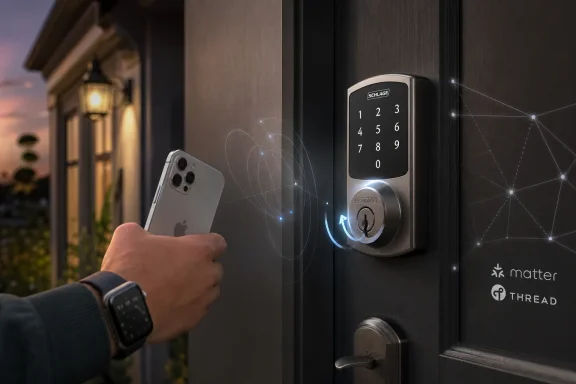
Schlage will begin selling the Sense Pro Smart Deadbolt on June 29, 2026, bringing Apple Home hands-free unlocking over Ultra Wideband to a mainstream U.S. lock brand at a $399 retail price, alongside Matter over Thread, Apple home key, keypad codes, and app-based remote management. The news matters less because another smart lock exists and more because the front door is becoming the next proving ground for proximity computing. Apple’s smart home story has long been competent but oddly cautious; UWB gives it a feature that feels less like automation theater and more like a real upgrade. The catch is that convenience at the deadbolt is where consumer tech’s usual “just works” promise meets the hardest possible test: trust.
For years, smart locks have promised to remove friction from coming home, only to replace one kind of friction with another. Bluetooth unlocks were too slow, geofencing was too vague, Wi-Fi ate batteries, and voice control at the front door always carried an air of “should we really be doing this?” The ideal was obvious: walk up, be recognized, and have the lock open at precisely the right moment.
The Sense Pro is Schlage’s answer to that problem, and its timing is important. Aqara’s U400 already put UWB-based hands-free unlocking into the Apple Home ecosystem earlier this year, but Schlage brings a different kind of credibility. It is a familiar lock brand, not just a smart-home accessory vendor, and that distinction matters when the thing being automated is the barrier between your home and the street.
Schlage calls its UWB implementation Converge, and the company is pitching it as more than a simple proximity trigger. The lock is designed to consider speed, trajectory, and motion, so it can infer whether an authorized user is actually approaching the door rather than merely passing near it. That is the entire bet: the lock should not just know that your iPhone or Apple Watch is nearby; it should know that you intend to enter.
That phrase is doing a lot of work. Intent is what separates a useful smart lock from a haunted one. If the Sense Pro can reliably tell the difference between walking up the path, sitting inside near the door, unloading groceries from a car, or crossing the porch to talk to a neighbor, then UWB becomes the first proximity technology worthy of a deadbolt.
Geofencing has its own problem. A phone crossing a virtual boundary around a home is useful for lighting, thermostat behavior, and low-stakes automations, but a neighborhood-scale signal is far too blunt for a deadbolt. If your automation logic starts at the driveway, the sidewalk, or the apartment hallway, it is not really door intelligence. It is a guess with a nicer app interface.
Ultra Wideband changes the geometry. Instead of asking whether a device is somewhere in the area, UWB can help determine where it is relative to the lock. That makes it better suited to the kind of decision a front door has to make: not “is the owner home?” but “is the owner at this door, moving toward it, right now?”
This is why Apple’s presence matters. Apple has been shipping UWB-capable iPhones for years and has steadily turned the chip from a spec-sheet curiosity into infrastructure for AirTags, device handoff, precision finding, and now home access. The smart home has been waiting for a technology that can make physical presence feel deterministic. UWB is not magic, but it is a more honest foundation than Bluetooth ever was.
Hands-free UWB unlocking is different because it uses the ecosystem as a physical identity system. The iPhone or Apple Watch is not just a remote control; it is a credential with spatial awareness. Apple home key already made the phone or watch a tap-to-unlock key, but UWB removes the final gesture. That may sound minor until you imagine the actual use cases: carrying a sleeping child, dragging luggage, holding groceries, arriving in the rain, or coming home at night when you simply want the door to open without ceremony.
The shift is subtle but important. Most smart-home features require the user to think like a system designer. You create scenes, name rooms, set triggers, manage hubs, and troubleshoot network paths. A good UWB lock asks for none of that in the moment. It simply observes that an authorized device is approaching the correct door and acts.
That is the kind of automation consumers thought they were buying a decade ago. Not “if motion is detected between 6 p.m. and 11 p.m., then set hallway light to 70 percent unless the home is in away mode.” Just walk up and get in.
That may prove to be a wise bet. The Aqara U400’s lower price gives Apple Home users an earlier and cheaper path into UWB unlocking, but locks are not light bulbs. Consumers may be willing to experiment with a cheaper smart plug; they are more conservative about the device that controls their front door. Schlage’s advantage is that it starts from the lock aisle rather than the gadget aisle.
The Sense Pro also makes an architectural choice that will divide users: it has no traditional keyway. Schlage frames that as a security benefit because it removes picking and bumping attacks. That is a reasonable argument, but it also increases the psychological importance of batteries, backup access, firmware reliability, and support. A keyless lock can feel more modern, but it also removes the oldest fallback mechanism in the building.
This is where Schlage’s access mix matters. The Sense Pro offers hands-free unlocking, tap-to-unlock with Apple home key, keypad codes, one-touch locking, and remote management through the Schlage Home app. The point is not that every user will use every method. The point is redundancy. A front-door product cannot afford to make one failure mode catastrophic.
Matter is supposed to solve that problem by creating a shared application layer across major smart-home ecosystems. Thread, meanwhile, is designed to provide a low-power mesh network better suited to battery-powered devices than always-on Wi-Fi. Together, they give a smart lock a more credible technical base: local, efficient, and more interoperable than the older patchwork of proprietary hubs and cloud relays.
The real world is messier. Matter has improved, but it is still not the effortless universal standard consumers were promised. Feature parity varies by ecosystem, onboarding can still be confusing, and advanced device functions often remain trapped in manufacturer apps. A lock may “work with Matter” while still requiring the vendor app for firmware updates, detailed settings, access code management, or special modes.
Even so, Schlage shipping a flagship lock with Matter over Thread is a sign that the center of gravity has moved. Z-Wave and Zigbee are not dead, and many power users still prefer them, especially in Home Assistant-heavy households. But the mainstream premium lock market is now organizing around Matter, Thread, Apple home key, and wallet-based credentials. That is the new baseline.
For now, Apple has the cleanest story because home key already lives in Apple Wallet and UWB support is tied into iPhones and Apple Watches. But the smart lock market cannot remain Apple-only at the high end. Mixed-platform households are normal, and a $399 deadbolt that treats Android users as second-class residents would be a hard sell.
Schlage says support for Samsung Wallet and Google Wallet digital keys is expected later, once certification is in place. That caveat is important. “Compatible” and “available today” are not the same thing, and smart-home buyers have learned to be wary of roadmap promises. Still, Aliro support points toward the right future: door credentials should be portable, secure, and not dependent on everyone in the household buying into the same phone ecosystem.
This is especially relevant for WindowsForum readers because the modern smart home increasingly resembles enterprise identity management, just with worse documentation and more family members. You have devices, users, credentials, revocation, auditing, fallback methods, and platform compatibility. The front door is becoming an access-control endpoint, and the industry is slowly rediscovering problems IT solved years ago.
The security model is no longer only mechanical. Yes, the deadbolt still has to resist force, poor installation, weak strike plates, and bad doors. But the complete security story now includes mobile-device compromise, cloud-account security, update policies, local network stability, app permissions, and the vendor’s ability to patch flaws over time. A smart lock inherits the risks of both locksmithing and software.
That does not make smart locks inherently unsafe. In some households, they are a security improvement. Temporary codes are better than copied keys. Logs can provide accountability. Remote locking can fix forgetfulness. Wallet credentials can be revoked. A properly designed smart lock can reduce many ordinary risks while introducing a smaller number of more technical ones.
But the risk trade is real. A user who installs a premium UWB deadbolt and then secures their Apple ID or Schlage account with weak authentication has not upgraded their security posture as much as they think. The lock is only one layer in a chain. The phone, watch, account, home hub, Wi-Fi network, and recovery process all become part of the lock.
Doors are mechanical systems, and many are badly aligned. A deadbolt that has to fight the strike plate every time it extends will burn more power than one that glides cleanly. Cold weather, weak batteries, high traffic, Wi-Fi use, firmware behavior, and repeated failed unlock attempts can all change the real result. Smart-lock battery life is less about a single spec and more about the quality of the installation.
Thread should help because it gives the lock a low-power network path for smart-home communication. Built-in Wi-Fi can be convenient for remote access, but Wi-Fi remains expensive in battery terms. The best smart locks use Wi-Fi sparingly or indirectly, and buyers should pay attention to which features require which radios.
The practical advice is boring but essential: install the lock carefully, align the bolt properly, keep backup access configured, and treat battery warnings as maintenance, not suggestions. The smartest lock in the world is still a motor pushing a metal bolt into a hole. If that hole is wrong, software will not save it.
Schlage’s case is different. It is asking buyers to pay for brand reputation, hardware design, UWB intent detection, and a lock-maker’s promise of durability. Whether that premium is justified will depend on real-world reviews, installation quality, app behavior, and how quickly the promised broader wallet support arrives.
The smart-home market is full of products that launched with excellent spec sheets and then aged poorly because of unreliable firmware, abandoned apps, or brittle integrations. Locks have less tolerance for that than most categories. A light that fails to turn on is annoying. A lock that fails at the wrong moment can ruin your day.
That is why the Sense Pro’s success will not be decided by launch-day enthusiasm. It will be decided after months of ordinary use: spouses arriving with different watches, teenagers using codes, guests needing access, batteries dipping in winter, Thread networks reconfiguring, phones being replaced, and software updates changing behavior. Smart-home products earn trust slowly.
But the best lock is not the one that feels the most magical. It is the one that behaves predictably enough to become invisible. Users should not have to pause at the door wondering whether the system noticed them. They should not have to develop rituals, like angling their wrist toward the lock or walking a particular path. They should not have to explain to guests that the lock is “usually fine.”
Schlage seems aware of this, which is why the Sense Pro offers different hands-free entrance modes. A fully intuitive mode may suit confident users with a straightforward entry path. A touch-required mode may appeal to households that want UWB tracking but prefer an intentional final action. A delayed mode may help users who want convenience without the eerie feeling of the door moving too early.
That configurability is not a minor detail. It acknowledges that “automatic” is not one preference. Some households want the door to open the instant they arrive. Others want the lock to wait for a human confirmation. The right smart-home product does not force everyone into the same tolerance for automation.
This has been Apple’s quiet advantage. The company controls the wearable, the phone, the wallet, the home hub, the operating system, and the privacy story. That does not guarantee good smart-home execution, as years of uneven HomeKit progress have shown. But when the feature depends on a secure credential moving through physical space, Apple’s stack starts to look unusually coherent.
For Windows users and mixed-device households, that coherence can be both appealing and irritating. Apple may deliver the most polished version first, but the home is rarely a single-vendor environment. PCs, Android phones, work devices, guests, contractors, and family members all need reasonable access. A lock that shines only for one platform risks turning household administration into tech support.
That is why Matter and Aliro are not side notes. They are the difference between Apple Home getting a neat exclusive trick and the smart-lock industry moving toward a durable access model. If UWB unlock becomes a platform war, it will remain a luxury convenience. If it becomes a standard, it may become ordinary.
 Schlage Turns the Front Door Into a Location Test
For years, smart locks have promised to remove friction from coming home, only to replace one kind of friction with another. Bluetooth unlocks were too slow, geofencing was too vague, Wi-Fi ate batteries, and voice control at the front door always carried an air of “should we really be doing this?” The ideal was obvious: walk up, be recognized, and have the lock open at precisely the right moment.The Sense Pro is Schlage’s answer to that problem, and its timing is important. Aqara’s U400 already put UWB-based hands-free unlocking into the Apple Home ecosystem earlier this year, but Schlage brings a different kind of credibility. It is a familiar lock brand, not just a smart-home accessory vendor, and that distinction matters when the thing being automated is the barrier between your home and the street.
Schlage calls its UWB implementation Converge, and the company is pitching it as more than a simple proximity trigger. The lock is designed to consider speed, trajectory, and motion, so it can infer whether an authorized user is actually approaching the door rather than merely passing near it. That is the entire bet: the lock should not just know that your iPhone or Apple Watch is nearby; it should know that you intend to enter.
That phrase is doing a lot of work. Intent is what separates a useful smart lock from a haunted one. If the Sense Pro can reliably tell the difference between walking up the path, sitting inside near the door, unloading groceries from a car, or crossing the porch to talk to a neighbor, then UWB becomes the first proximity technology worthy of a deadbolt.
Bluetooth Was the Wrong Tool for a Security Job
The smart lock industry has spent years learning that “nearby” is not a security model. Bluetooth can estimate proximity, but it was never designed to establish the centimeter-level spatial awareness that a front-door lock demands. It can be delayed, obstructed, or noisy, and it often creates the worst possible user experience: a lock that is both too hesitant when you want in and too ambiguous when you do not.Geofencing has its own problem. A phone crossing a virtual boundary around a home is useful for lighting, thermostat behavior, and low-stakes automations, but a neighborhood-scale signal is far too blunt for a deadbolt. If your automation logic starts at the driveway, the sidewalk, or the apartment hallway, it is not really door intelligence. It is a guess with a nicer app interface.
Ultra Wideband changes the geometry. Instead of asking whether a device is somewhere in the area, UWB can help determine where it is relative to the lock. That makes it better suited to the kind of decision a front door has to make: not “is the owner home?” but “is the owner at this door, moving toward it, right now?”
This is why Apple’s presence matters. Apple has been shipping UWB-capable iPhones for years and has steadily turned the chip from a spec-sheet curiosity into infrastructure for AirTags, device handoff, precision finding, and now home access. The smart home has been waiting for a technology that can make physical presence feel deterministic. UWB is not magic, but it is a more honest foundation than Bluetooth ever was.
Apple Home Finally Gets a Feature That Feels Native to the Hardware
Apple Home has often seemed like a platform built from good intentions and unfinished leverage. It had secure pairing, a clean user model, and the advantage of iPhones, Apple Watches, Apple TVs, and HomePods already being in the home. Yet it rarely produced the kind of “only Apple can do this” smart-home moments that justify ecosystem lock-in.Hands-free UWB unlocking is different because it uses the ecosystem as a physical identity system. The iPhone or Apple Watch is not just a remote control; it is a credential with spatial awareness. Apple home key already made the phone or watch a tap-to-unlock key, but UWB removes the final gesture. That may sound minor until you imagine the actual use cases: carrying a sleeping child, dragging luggage, holding groceries, arriving in the rain, or coming home at night when you simply want the door to open without ceremony.
The shift is subtle but important. Most smart-home features require the user to think like a system designer. You create scenes, name rooms, set triggers, manage hubs, and troubleshoot network paths. A good UWB lock asks for none of that in the moment. It simply observes that an authorized device is approaching the correct door and acts.
That is the kind of automation consumers thought they were buying a decade ago. Not “if motion is detected between 6 p.m. and 11 p.m., then set hallway light to 70 percent unless the home is in away mode.” Just walk up and get in.
Schlage Is Selling Trust as Much as Technology
The Sense Pro’s price tells us where Schlage thinks this market is headed. At $399, it is not chasing the bargain smart-home buyer. It is priced as a premium lock, and that means Schlage is betting buyers will pay extra for a brand they already associate with residential security.That may prove to be a wise bet. The Aqara U400’s lower price gives Apple Home users an earlier and cheaper path into UWB unlocking, but locks are not light bulbs. Consumers may be willing to experiment with a cheaper smart plug; they are more conservative about the device that controls their front door. Schlage’s advantage is that it starts from the lock aisle rather than the gadget aisle.
The Sense Pro also makes an architectural choice that will divide users: it has no traditional keyway. Schlage frames that as a security benefit because it removes picking and bumping attacks. That is a reasonable argument, but it also increases the psychological importance of batteries, backup access, firmware reliability, and support. A keyless lock can feel more modern, but it also removes the oldest fallback mechanism in the building.
This is where Schlage’s access mix matters. The Sense Pro offers hands-free unlocking, tap-to-unlock with Apple home key, keypad codes, one-touch locking, and remote management through the Schlage Home app. The point is not that every user will use every method. The point is redundancy. A front-door product cannot afford to make one failure mode catastrophic.
Matter and Thread Make the Lock Less of an Apple Island
The Apple angle is the headline, but Matter over Thread may matter more over the life of the device. A smart lock is not a two-year gadget in the way a phone case or streaming stick might be. Buyers expect door hardware to last, and they increasingly expect smart-home hardware not to strand them in a single vendor’s app.Matter is supposed to solve that problem by creating a shared application layer across major smart-home ecosystems. Thread, meanwhile, is designed to provide a low-power mesh network better suited to battery-powered devices than always-on Wi-Fi. Together, they give a smart lock a more credible technical base: local, efficient, and more interoperable than the older patchwork of proprietary hubs and cloud relays.
The real world is messier. Matter has improved, but it is still not the effortless universal standard consumers were promised. Feature parity varies by ecosystem, onboarding can still be confusing, and advanced device functions often remain trapped in manufacturer apps. A lock may “work with Matter” while still requiring the vendor app for firmware updates, detailed settings, access code management, or special modes.
Even so, Schlage shipping a flagship lock with Matter over Thread is a sign that the center of gravity has moved. Z-Wave and Zigbee are not dead, and many power users still prefer them, especially in Home Assistant-heavy households. But the mainstream premium lock market is now organizing around Matter, Thread, Apple home key, and wallet-based credentials. That is the new baseline.
Aliro Is the Quiet Signal That Android Cannot Be an Afterthought
One of the more interesting pieces of the Sense Pro announcement is Aliro compatibility. Aliro is the industry effort aimed at standardizing digital access credentials across phones, wearables, and locks. In plain English, it is the attempt to prevent the next generation of smart locks from becoming a wallet-by-wallet compatibility mess.For now, Apple has the cleanest story because home key already lives in Apple Wallet and UWB support is tied into iPhones and Apple Watches. But the smart lock market cannot remain Apple-only at the high end. Mixed-platform households are normal, and a $399 deadbolt that treats Android users as second-class residents would be a hard sell.
Schlage says support for Samsung Wallet and Google Wallet digital keys is expected later, once certification is in place. That caveat is important. “Compatible” and “available today” are not the same thing, and smart-home buyers have learned to be wary of roadmap promises. Still, Aliro support points toward the right future: door credentials should be portable, secure, and not dependent on everyone in the household buying into the same phone ecosystem.
This is especially relevant for WindowsForum readers because the modern smart home increasingly resembles enterprise identity management, just with worse documentation and more family members. You have devices, users, credentials, revocation, auditing, fallback methods, and platform compatibility. The front door is becoming an access-control endpoint, and the industry is slowly rediscovering problems IT solved years ago.
The Front Door Is Now an Endpoint
A UWB smart lock is not just a lock with a radio. It is a battery-powered endpoint that participates in identity, networking, firmware, cryptography, and automation. That should make technically minded buyers both interested and cautious.The security model is no longer only mechanical. Yes, the deadbolt still has to resist force, poor installation, weak strike plates, and bad doors. But the complete security story now includes mobile-device compromise, cloud-account security, update policies, local network stability, app permissions, and the vendor’s ability to patch flaws over time. A smart lock inherits the risks of both locksmithing and software.
That does not make smart locks inherently unsafe. In some households, they are a security improvement. Temporary codes are better than copied keys. Logs can provide accountability. Remote locking can fix forgetfulness. Wallet credentials can be revoked. A properly designed smart lock can reduce many ordinary risks while introducing a smaller number of more technical ones.
But the risk trade is real. A user who installs a premium UWB deadbolt and then secures their Apple ID or Schlage account with weak authentication has not upgraded their security posture as much as they think. The lock is only one layer in a chain. The phone, watch, account, home hub, Wi-Fi network, and recovery process all become part of the lock.
The Battery Claim Is Useful, Not Decisive
Schlage is advertising up to six months of battery life for the Sense Pro. That is a reasonable number for a modern smart lock, but battery life in this category is always a laboratory promise colliding with a household’s actual door.Doors are mechanical systems, and many are badly aligned. A deadbolt that has to fight the strike plate every time it extends will burn more power than one that glides cleanly. Cold weather, weak batteries, high traffic, Wi-Fi use, firmware behavior, and repeated failed unlock attempts can all change the real result. Smart-lock battery life is less about a single spec and more about the quality of the installation.
Thread should help because it gives the lock a low-power network path for smart-home communication. Built-in Wi-Fi can be convenient for remote access, but Wi-Fi remains expensive in battery terms. The best smart locks use Wi-Fi sparingly or indirectly, and buyers should pay attention to which features require which radios.
The practical advice is boring but essential: install the lock carefully, align the bolt properly, keep backup access configured, and treat battery warnings as maintenance, not suggestions. The smartest lock in the world is still a motor pushing a metal bolt into a hole. If that hole is wrong, software will not save it.
The Price Premium Buys a Brand, a Radio, and a Bet
The $399 price invites comparison with Aqara’s U400 at $269. On paper, the cheaper lock looks compelling: UWB, Apple Home support, Matter over Thread, and multiple access methods. For many users, that will be enough.Schlage’s case is different. It is asking buyers to pay for brand reputation, hardware design, UWB intent detection, and a lock-maker’s promise of durability. Whether that premium is justified will depend on real-world reviews, installation quality, app behavior, and how quickly the promised broader wallet support arrives.
The smart-home market is full of products that launched with excellent spec sheets and then aged poorly because of unreliable firmware, abandoned apps, or brittle integrations. Locks have less tolerance for that than most categories. A light that fails to turn on is annoying. A lock that fails at the wrong moment can ruin your day.
That is why the Sense Pro’s success will not be decided by launch-day enthusiasm. It will be decided after months of ordinary use: spouses arriving with different watches, teenagers using codes, guests needing access, batteries dipping in winter, Thread networks reconfiguring, phones being replaced, and software updates changing behavior. Smart-home products earn trust slowly.
The Best Smart Lock Feature Is Still Predictability
There is a temptation to judge the Sense Pro by how futuristic it feels. Hands-free unlock is a great demo. It is easy to imagine a product video where someone walks up with a bike, groceries, or a toddler and the door obediently opens.But the best lock is not the one that feels the most magical. It is the one that behaves predictably enough to become invisible. Users should not have to pause at the door wondering whether the system noticed them. They should not have to develop rituals, like angling their wrist toward the lock or walking a particular path. They should not have to explain to guests that the lock is “usually fine.”
Schlage seems aware of this, which is why the Sense Pro offers different hands-free entrance modes. A fully intuitive mode may suit confident users with a straightforward entry path. A touch-required mode may appeal to households that want UWB tracking but prefer an intentional final action. A delayed mode may help users who want convenience without the eerie feeling of the door moving too early.
That configurability is not a minor detail. It acknowledges that “automatic” is not one preference. Some households want the door to open the instant they arrive. Others want the lock to wait for a human confirmation. The right smart-home product does not force everyone into the same tolerance for automation.
Apple’s Home Strategy Looks Better When It Leaves the Screen
The most promising thing about UWB smart locks is that they move Apple Home away from the app grid and into the physical world. Smart-home platforms are at their worst when they are dashboards. They are at their best when they reduce the need to interact with a dashboard at all.This has been Apple’s quiet advantage. The company controls the wearable, the phone, the wallet, the home hub, the operating system, and the privacy story. That does not guarantee good smart-home execution, as years of uneven HomeKit progress have shown. But when the feature depends on a secure credential moving through physical space, Apple’s stack starts to look unusually coherent.
For Windows users and mixed-device households, that coherence can be both appealing and irritating. Apple may deliver the most polished version first, but the home is rarely a single-vendor environment. PCs, Android phones, work devices, guests, contractors, and family members all need reasonable access. A lock that shines only for one platform risks turning household administration into tech support.
That is why Matter and Aliro are not side notes. They are the difference between Apple Home getting a neat exclusive trick and the smart-lock industry moving toward a durable access model. If UWB unlock becomes a platform war, it will remain a luxury convenience. If it becomes a standard, it may become ordinary.
Schlage’s New Deadbolt Makes the Smart Home Grow Up
The Sense Pro is not important because it is the first smart lock, or even the first UWB smart lock for Apple Home. It is important because a mainstream lock company is treating hands-free spatial authentication as a premium feature ready for normal households. That is a different milestone.- Schlage’s Sense Pro launches on June 29, 2026, with a $399 retail price and Apple Home hands-free unlocking via Ultra Wideband.
- The lock uses Schlage Converge technology to evaluate approach behavior rather than relying only on broad proximity.
- Matter over Thread gives the Sense Pro a more modern smart-home foundation, though some advanced controls may still depend on Schlage’s own app.
- Apple home key support makes iPhone and Apple Watch users the first-class audience at launch.
- Aliro compatibility points toward future Samsung Wallet and Google Wallet support, but buyers should treat that as a roadmap item until it is actually certified and available.
- The real test will be reliability over months of household use, not whether the launch demo looks impressive.
References
- Primary source: 9to5Mac
Published: Tue, 16 Jun 2026 18:50:00 GMT
Apple Home adds new smart lock with auto-unlock that’s hands-free - 9to5Mac
Schlage’s Sense Pro smart lock will ship later this month with Apple Home integration and Ultra Wideband for auto-unlocking and locking.9to5mac.com - Related coverage: aqara.com
Aqara Smart Lock U400: Unlocks on Approach with UWB
U400 uses cutting-edge Ultra-Wideband technology to give you hands-free access to your home, no contact, no biometrics.www.aqara.com - Related coverage: macrumors.com
CES 2026: Aqara Launches U400 Smart Lock With HomeKit and Hands-Free UWB Unlocking
Smart home company Aqara today debuted its latest smart lock, the U400. The Aqara Smart Lock U400 incorporates ultra wideband (UWB) technology for more precise location-based tracking and automated door unlocking. There are few UWB smart locks on the market, but the technology uses the UWB chip...www.macrumors.com - Related coverage: pcworld.com
Aqara's U400 smart lock boasts hands-free unlocking | PCWorld
The Aqara U400 combines Apple Home Keys with an Ultra-wideband radio to unlock your door as you approach with your smart device.www.pcworld.com - Related coverage: consumerreports.org
Aqara Smart Lock U400 Review - Consumer Reports
This Aqara smart lock knows when you've arrived at your door and unlocks itself using UWB technology. This is the future of smart locks.www.consumerreports.org
- Related coverage: tomsguide.com
Aqara U400 review | Tom's Guide
The Aqara U400 offers plenty of unlocking methods and wide smart home support – plus it has UWB for hands-free unlocking.www.tomsguide.com
- Related coverage: iclarified.com
Aqara Launches UWB Smart Lock U400 With Hands-Free Apple Home Key Support - iClarified
Aqara's new Smart Lock U400 uses UWB technology for precise, hands-free Apple Home Key entry, eliminating Bluetooth lag. Supports Matter and Thread.www.iclarified.com - Related coverage: schlage.ca
- Related coverage: cultofmac.com
Aqara Smart Lock U400: Hands-free use via Apple Home Key | Cult of Mac
Thanks to advanced UWB technology via Home Key, Aqara Smart Lock U400 unlocks even as you approach the door.www.cultofmac.com - Related coverage: t3.com
Aqara debuts one of the first-ever smart locks that unlocks automatically on approach | T3
It's available to buy immediatelywww.t3.com - Related coverage: aqarahome.nz