
Microsoft made Copilot Cowork generally available worldwide on June 16, 2026, turning a three-month Frontier preview into a paid Microsoft 365 Copilot add-on that can run long, multi-step workplace tasks across company files, apps, and data systems. The launch is not just another Copilot feature drop; it is Microsoft’s clearest attempt yet to move enterprise AI from assistance to delegation. If Word and Excel Copilot were about making individual workers faster, Cowork is about testing whether companies will trust an agent to own a slice of the work itself.
That is a much bigger bet than a better chatbot. It changes the procurement question from “Does this generate a useful draft?” to “Can this be assigned a project, monitored, billed, governed, and audited like a digital colleague?” Microsoft’s answer is yes, but the harder question for IT is whether the organization is ready for what yes actually means.
For most of its short life, Microsoft 365 Copilot has been sold as a layer on top of familiar work. It summarizes Teams meetings, drafts emails, explains spreadsheets, builds slide outlines, and retrieves documents from the corporate haystack. The worker stays in charge of the workflow, while Copilot supplies fragments of productivity inside the applications where people already live.
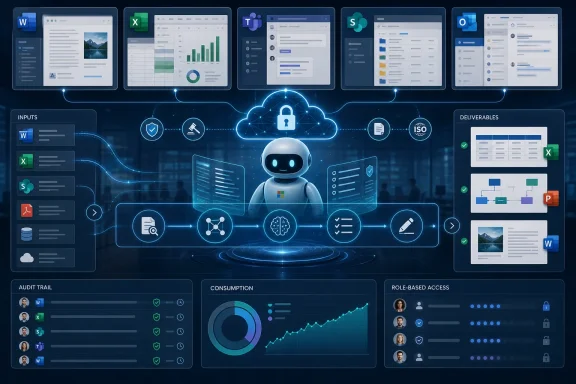
Copilot Cowork pushes past that model. Microsoft describes it as an agentic system that can take on long-running work, reason across company context, use tools, and return completed outputs rather than merely suggesting next steps. In plain office terms, it is designed less like Clippy with a language model and more like the junior analyst who disappears for three hours and comes back with the comparison table, dependency map, and draft recommendation.
That distinction matters because “agent” has become one of the most abused words in enterprise software. Many so-called agents are little more than chatbots with API access and better branding. Cowork is Microsoft’s attempt to put a more serious operating model behind the term: persistent tasks, model selection, context retrieval, cloud execution, and administrative controls wrapped into the Microsoft 365 security perimeter.
The timing is also deliberate. Microsoft has spent the past two years selling Copilot as the front door to AI at work, but many customers have wrestled with the same awkward calculation: a per-user subscription is easy to buy, yet hard to justify if the usage remains shallow. Cowork reframes the value proposition around work completion, where the return on investment can be tied to hours saved, tasks eliminated, and workflows automated.
That is the optimistic version. The more skeptical reading is that Microsoft is trying to turn Copilot from a seat-based productivity product into a metered AI labor platform before customers have fully digested the first wave.
Microsoft says more than half of the Fortune 500 used Cowork during its Frontier preview. That claim deserves the usual caveat applied to vendor launch statistics: “used” can cover a wide range of intensity, from serious production pilots to executive demos and limited test groups. Still, for enterprise software, the number signals that Microsoft’s distribution engine is working exactly as intended.
The company is also naming customers such as Accenture, Zurich Insurance, Capital Group, Avanade, Koch, Advance Local, LTM, and Ooredoo Qatar as early users. These are the sorts of organizations that already have complex Microsoft footprints, deep compliance requirements, and enough internal bureaucracy to make workflow automation appealing. They are also the kinds of customers whose endorsement helps normalize agentic AI for everyone else.
Cowork’s promise is especially potent because it is not limited to a single app. A conventional Excel assistant can help with formulas. A Teams assistant can summarize a meeting. A SharePoint-aware search tool can retrieve a file. Cowork is meant to cross those boundaries and operate against a business problem: compare thousands of files, identify stalled sales opportunities, automate a spreadsheet-heavy review, or create a dependency chart from scattered project materials.
That is the difference between application intelligence and organizational intelligence. Microsoft has been inching toward the latter with Graph, Search, Purview, Loop, and Copilot. Cowork is where those pieces are being recast as the substrate for agentic labor.
That is why Cowork is more than a model selector with a friendly name. A frontier model can reason impressively in isolation, but enterprise work rarely arrives as a clean prompt. The messy reality is that the necessary information is spread across email threads, Teams chats, SharePoint libraries, Excel workbooks, CRM records, PowerPoint decks, and documents with ambiguous filenames created by people who left the company three reorganizations ago.
If Work IQ can reliably ground a task in that sprawl, Cowork becomes materially more useful than a generic agent pasted onto an enterprise tenant. If it cannot, Cowork risks becoming another confident narrator over incomplete context. The product’s credibility will hinge less on dazzling demo prompts and more on mundane retrieval: whether it finds the right version, respects the right permission boundary, and notices the document that contradicts the tidy answer.
For WindowsForum readers who administer Microsoft 365 tenants, this is where the launch becomes operational rather than philosophical. Cowork’s ability to work across corporate context means it inherits the quality of the tenant. Poor file hygiene, overbroad permissions, stale SharePoint sites, inconsistent labeling, and weak data governance all become AI risk multipliers.
The agent does not magically fix that. It amplifies it.
That combination says a lot about the post-OpenAI phase of Microsoft’s AI strategy. Microsoft remains deeply tied to OpenAI, but it is no longer presenting enterprise Copilot as a single-model product. Instead, it wants customers to believe Copilot is an orchestration layer that can route work to whichever model is most appropriate, whether that model comes from OpenAI, Anthropic, or Microsoft itself.
For customers, that could be a genuine advantage. Different models have different strengths, price profiles, latency characteristics, and failure modes. A task that requires deep reasoning over a sprawling set of documents may not need the same model as a quick transformation of a spreadsheet. A mature enterprise AI platform should be able to make those trade-offs behind the scenes, or at least expose them to administrators and power users.
For Microsoft, multimodel Copilot is also strategic insulation. If one model provider stumbles, prices change, or performance leadership shifts, Microsoft can keep selling the Copilot layer. The company does not need to convince every customer that a single model is always best; it needs to convince them that Microsoft 365 is the safest place to consume the best available models against company data.
There is a competitive edge here against both pure-play AI vendors and traditional enterprise software rivals. Anthropic may build powerful models and agentic experiences, but Microsoft owns the productivity estate. Salesforce, Google, ServiceNow, and others have their own agent ambitions, but Microsoft’s hold on documents, email, identity, and Windows endpoints gives it a uniquely broad canvas.
The risk is that customers may struggle to understand what they are actually buying. If Cowork uses different models for different work, cost and behavior may vary in ways that are hard to predict. IT leaders will want clear logs, model disclosures, administrative controls, and a sane way to explain to finance why one “prompt” cost much more than another.
Microsoft says charges are based on the resources consumed by each task, including model usage, context retrieval, tool calls, and runtime. It has described common work categories as light, medium, and heavy, ranging from limited reasoning tasks to larger jobs that draw from multiple sources and require deeper analysis. In other words, the unit of value is no longer the user seat. It is the task.
That pricing model fits the agentic thesis. If Cowork is genuinely doing work that would otherwise take an employee or team hours, then a variable charge is easier to defend. A heavy task that compares thousands of files or surfaces at-risk sales opportunities may be worth more than a flat monthly feature allowance.
But consumption pricing also introduces friction that Microsoft 365 administrators know well from Azure: surprise bills, internal chargeback fights, unclear usage ownership, and the need to govern experimentation before it becomes budget leakage. The more powerful the agent, the more important it becomes to define who can launch which classes of tasks, against which data, and within what spending limits.
Microsoft claims internal testing showed Cowork to be roughly 30% to 40% cheaper per prompt than competing enterprise AI offerings using Microsoft 365 connectors. That may be true under the tested conditions, but customers should treat the number as a starting claim rather than a universal law. Real costs will depend on task complexity, data volume, model choice, retries, tool usage, and how disciplined users are in delegating work.
The deeper point is that Microsoft is pricing Cowork like infrastructure. That makes sense if AI agents become an operating layer for business processes. It also means IT departments will need to manage them like infrastructure, not like an optional productivity toy.
Cowork benefits from that positioning. It can be sold as part of an environment where identity, permissions, auditing, data loss prevention, sensitivity labels, and administrative policies already exist. For regulated industries, that matters more than a clever demo. The difference between an AI tool that “can access your files” and one that respects existing enterprise controls is the difference between pilot and procurement.
Yet governance is not solved by proximity to Microsoft 365. If a user has access to too much data, an agent acting on that user’s behalf may also see too much. If confidential files are poorly labeled, the system may not understand their sensitivity. If legacy SharePoint permissions are a mess, Cowork will operate inside that mess with machine speed.
This is where the launch should make admins uncomfortable in a productive way. Cowork is not merely another endpoint to enable. It is a forcing function for least privilege, retention policy, audit review, information architecture, and internal rules about AI-generated work product. Organizations that treated Copilot readiness as a licensing exercise may find Cowork exposes the shortcuts.
The question is not whether Microsoft can provide controls. It is whether customers will use them before agents become normalized. Shadow AI was the first wave of risk; sanctioned AI may be the second if companies assume that buying from Microsoft automatically makes every workflow safe.
A user who asks Copilot to draft an email can inspect the result in seconds. A user who asks Cowork to compare thousands of files or analyze a sales pipeline must frame the task clearly, choose or accept the right data context, monitor progress, and evaluate the output against business reality. The employee becomes less typist and more reviewer, less operator and more project manager.
That sounds empowering until the accountability question appears. If Cowork misses a dependency in a project plan, misclassifies a sales opportunity, or produces an analysis based on stale files, who owns the failure? The worker who delegated the task? The manager who approved AI use? The IT team that enabled the agent? Microsoft, whose system performed the work?
Enterprises will answer that in policy before they answer it in court, but the cultural effect will be immediate. Teams will need norms around when AI work is acceptable, when a human must verify outputs, and how to document the role Cowork played in a decision. Without that discipline, agentic productivity can become a fog machine for responsibility.
There is also a subtler labor issue. Microsoft is careful to frame Cowork as taking work off employees’ plates, not replacing them. But once organizations measure completed agent tasks, they will inevitably compare them to human effort. The spreadsheet-heavy review that once required three analysts and a week may become an overnight Cowork job plus one human reviewer. That may be excellent for efficiency and uncomfortable for staffing plans.
But Windows still matters because it remains the daily surface where much of this work is initiated, reviewed, and operationalized. The Microsoft 365 Copilot desktop app for Windows and Mac, browser access, Office applications, Teams, Edge, and local workflows all become front doors into agentic work. The PC becomes less of a compute box for AI and more of a command station for cloud agents.
That has practical implications. Endpoint management, identity posture, browser policy, device compliance, and session security all become part of the Cowork story. If agents can launch consequential work from user sessions, then compromised accounts and unmanaged devices become even more dangerous. The attack surface is not just data theft; it is unauthorized task execution.
Microsoft’s broader AI strategy has been to make Windows the place where local context, cloud services, and AI assistance meet. Cowork extends that strategy upward into project execution. It may not require a Copilot+ PC to be valuable, but it reinforces Microsoft’s view that the Windows user should be surrounded by AI-capable surfaces tied back to Microsoft 365.
For sysadmins, this means the endpoint and the tenant can no longer be treated as separate governance domains. Agentic workflows blur them. The policy that decides who can use Cowork, the device from which they can use it, and the data it can touch are parts of the same control plane.
This is why Cowork could matter even if it never produces a magical “AI employee” moment. Enterprise productivity gains often come from compressing dull coordination work. The employee who spends days reconciling versions, checking dependencies, moving figures between spreadsheets, or hunting through CRM records is not lacking creativity. They are trapped in organizational sludge.
If Cowork can reduce that sludge, customers will tolerate imperfections. A system that gets an analyst 70% of the way through a tedious comparison may be valuable if the remaining 30% is review and judgment. The danger is pretending that 70% is 100%, especially when the work feeds decisions about budgets, customers, compliance, or product releases.
The best early use cases will probably be bounded and reviewable. Tasks with clear inputs, clear outputs, and a human validation step are safer than open-ended delegation. “Compare these contract versions and flag differences” is a more sensible starting point than “recommend our restructuring plan.” The former is an accelerant; the latter is a governance nightmare with a polished interface.
Microsoft’s challenge is that the market rewards grand claims. Customers, however, should reward boring reliability. The future of Cowork will be decided less by keynote flourishes than by whether it can survive real tenant messiness, real permissions, real deadlines, and real users who do not write perfect prompts.
That vision is ambitious, but it is also premature for many customers. Most companies are still learning how to measure Copilot adoption, let alone restructure work around agents. Many have not completed the governance cleanup required for safe enterprise AI. Others are still debating whether the first wave of Copilot seats delivered enough measurable productivity to justify broader rollout.
Microsoft knows this, which is why Frontier previews matter. They give the company a way to seed advanced capabilities among enthusiastic customers, collect feedback, and generate adoption stories before the broader market is ready. General availability does not mean every Microsoft 365 tenant should switch Cowork on at scale tomorrow. It means Microsoft thinks the product is ready to become part of enterprise planning.
The Frontier branding also serves another purpose: it makes uncertainty sound strategic. These systems are still evolving quickly. Model behavior changes, pricing evolves, integrations expand, and best practices are being invented in real time. Calling customers “frontier” participants flatters them while acknowledging that the ground is still moving.
That is not a criticism by itself. All major platform shifts begin with uneven maturity. The risk is that executives hear “generally available” and assume “settled.” Cowork may be available, but the operating model around it is still very much under construction.
That sounds obvious, but it is hard to implement under executive pressure. AI has become a board-level topic, and Microsoft’s positioning makes Cowork look like the next obvious step for companies that already bought Copilot. CIOs will be asked why they are not using the tool that Microsoft says large enterprises are already adopting.
The right response is to insist on use-case discipline. Cowork should begin where the work is high-friction, the data is permitted, the outputs are verifiable, and the business owner accepts accountability. It should not begin as an open invitation for every licensed user to launch heavy tasks across poorly governed repositories.
Admins should also demand observability. Agentic systems need logs that ordinary productivity features do not. Organizations should be able to see what was requested, what data sources were consulted, which tools were called, which model class was used, how long the task ran, what it cost, and who approved or reviewed the result. Without that, Cowork becomes a black box with a budget line.
The uncomfortable truth is that AI governance will increasingly look like a blend of security administration, financial operations, records management, and HR policy. Cowork sits at the intersection of all four. That makes it promising, but it also makes it politically complex.
Microsoft’s newest Copilot agent is a bet that the next phase of workplace AI will not be defined by better drafts, prettier slides, or faster summaries, but by whether businesses are willing to hand entire chunks of work to software and trust the result after review. Copilot Cowork makes that future feel closer, and also makes its complications harder to ignore. The winners will be the organizations that move quickly enough to learn, slowly enough to govern, and honestly enough to admit that the hard part was never the model — it was redesigning work around it.
That is a much bigger bet than a better chatbot. It changes the procurement question from “Does this generate a useful draft?” to “Can this be assigned a project, monitored, billed, governed, and audited like a digital colleague?” Microsoft’s answer is yes, but the harder question for IT is whether the organization is ready for what yes actually means.
 Microsoft Turns Copilot From a Window Into a Worker
For most of its short life, Microsoft 365 Copilot has been sold as a layer on top of familiar work. It summarizes Teams meetings, drafts emails, explains spreadsheets, builds slide outlines, and retrieves documents from the corporate haystack. The worker stays in charge of the workflow, while Copilot supplies fragments of productivity inside the applications where people already live.Copilot Cowork pushes past that model. Microsoft describes it as an agentic system that can take on long-running work, reason across company context, use tools, and return completed outputs rather than merely suggesting next steps. In plain office terms, it is designed less like Clippy with a language model and more like the junior analyst who disappears for three hours and comes back with the comparison table, dependency map, and draft recommendation.
That distinction matters because “agent” has become one of the most abused words in enterprise software. Many so-called agents are little more than chatbots with API access and better branding. Cowork is Microsoft’s attempt to put a more serious operating model behind the term: persistent tasks, model selection, context retrieval, cloud execution, and administrative controls wrapped into the Microsoft 365 security perimeter.
The timing is also deliberate. Microsoft has spent the past two years selling Copilot as the front door to AI at work, but many customers have wrestled with the same awkward calculation: a per-user subscription is easy to buy, yet hard to justify if the usage remains shallow. Cowork reframes the value proposition around work completion, where the return on investment can be tied to hours saved, tasks eliminated, and workflows automated.
That is the optimistic version. The more skeptical reading is that Microsoft is trying to turn Copilot from a seat-based productivity product into a metered AI labor platform before customers have fully digested the first wave.
The Agent Arrives With Microsoft’s Favorite Advantage: Distribution
The most important thing about Copilot Cowork may not be its model stack. It is that the product lands inside Microsoft 365, where the documents, calendars, chats, spreadsheets, identity permissions, compliance policies, and admin consoles already sit. That gives Microsoft a structural advantage that standalone AI vendors have to recreate through connectors, permissions, and customer trust.Microsoft says more than half of the Fortune 500 used Cowork during its Frontier preview. That claim deserves the usual caveat applied to vendor launch statistics: “used” can cover a wide range of intensity, from serious production pilots to executive demos and limited test groups. Still, for enterprise software, the number signals that Microsoft’s distribution engine is working exactly as intended.
The company is also naming customers such as Accenture, Zurich Insurance, Capital Group, Avanade, Koch, Advance Local, LTM, and Ooredoo Qatar as early users. These are the sorts of organizations that already have complex Microsoft footprints, deep compliance requirements, and enough internal bureaucracy to make workflow automation appealing. They are also the kinds of customers whose endorsement helps normalize agentic AI for everyone else.
Cowork’s promise is especially potent because it is not limited to a single app. A conventional Excel assistant can help with formulas. A Teams assistant can summarize a meeting. A SharePoint-aware search tool can retrieve a file. Cowork is meant to cross those boundaries and operate against a business problem: compare thousands of files, identify stalled sales opportunities, automate a spreadsheet-heavy review, or create a dependency chart from scattered project materials.
That is the difference between application intelligence and organizational intelligence. Microsoft has been inching toward the latter with Graph, Search, Purview, Loop, and Copilot. Cowork is where those pieces are being recast as the substrate for agentic labor.
Work IQ Is the Product, the Agent Is the Packaging
Microsoft’s phrase “Work IQ” sounds like another piece of corporate AI vocabulary, but it is central to understanding the launch. The model itself is only one part of the system. The valuable layer is the context engine that knows what a user can access, how documents relate to projects, what meetings occurred, where work lives, and which business systems should be consulted.That is why Cowork is more than a model selector with a friendly name. A frontier model can reason impressively in isolation, but enterprise work rarely arrives as a clean prompt. The messy reality is that the necessary information is spread across email threads, Teams chats, SharePoint libraries, Excel workbooks, CRM records, PowerPoint decks, and documents with ambiguous filenames created by people who left the company three reorganizations ago.
If Work IQ can reliably ground a task in that sprawl, Cowork becomes materially more useful than a generic agent pasted onto an enterprise tenant. If it cannot, Cowork risks becoming another confident narrator over incomplete context. The product’s credibility will hinge less on dazzling demo prompts and more on mundane retrieval: whether it finds the right version, respects the right permission boundary, and notices the document that contradicts the tidy answer.
For WindowsForum readers who administer Microsoft 365 tenants, this is where the launch becomes operational rather than philosophical. Cowork’s ability to work across corporate context means it inherits the quality of the tenant. Poor file hygiene, overbroad permissions, stale SharePoint sites, inconsistent labeling, and weak data governance all become AI risk multipliers.
The agent does not magically fix that. It amplifies it.
The Model Stack Is Now a Competitive Weapon
One of the more revealing parts of the Cowork announcement is Microsoft’s explicit embrace of a multimodel strategy. At general availability, Cowork runs on Anthropic’s Opus 4.8 and Sonnet 4.6 models. Frontier customers can also access GPT-5.5, and Microsoft says its own Cowork 1 model is coming soon.That combination says a lot about the post-OpenAI phase of Microsoft’s AI strategy. Microsoft remains deeply tied to OpenAI, but it is no longer presenting enterprise Copilot as a single-model product. Instead, it wants customers to believe Copilot is an orchestration layer that can route work to whichever model is most appropriate, whether that model comes from OpenAI, Anthropic, or Microsoft itself.
For customers, that could be a genuine advantage. Different models have different strengths, price profiles, latency characteristics, and failure modes. A task that requires deep reasoning over a sprawling set of documents may not need the same model as a quick transformation of a spreadsheet. A mature enterprise AI platform should be able to make those trade-offs behind the scenes, or at least expose them to administrators and power users.
For Microsoft, multimodel Copilot is also strategic insulation. If one model provider stumbles, prices change, or performance leadership shifts, Microsoft can keep selling the Copilot layer. The company does not need to convince every customer that a single model is always best; it needs to convince them that Microsoft 365 is the safest place to consume the best available models against company data.
There is a competitive edge here against both pure-play AI vendors and traditional enterprise software rivals. Anthropic may build powerful models and agentic experiences, but Microsoft owns the productivity estate. Salesforce, Google, ServiceNow, and others have their own agent ambitions, but Microsoft’s hold on documents, email, identity, and Windows endpoints gives it a uniquely broad canvas.
The risk is that customers may struggle to understand what they are actually buying. If Cowork uses different models for different work, cost and behavior may vary in ways that are hard to predict. IT leaders will want clear logs, model disclosures, administrative controls, and a sane way to explain to finance why one “prompt” cost much more than another.
Consumption Pricing Makes the AI Labor Pitch Explicit
Copilot Cowork requires a Microsoft 365 Copilot subscription, but Microsoft is billing Cowork usage separately on a consumption basis. That is a major signal. The company is not treating this as a simple feature bundled into the existing per-user license; it is treating agentic work as a metered resource.Microsoft says charges are based on the resources consumed by each task, including model usage, context retrieval, tool calls, and runtime. It has described common work categories as light, medium, and heavy, ranging from limited reasoning tasks to larger jobs that draw from multiple sources and require deeper analysis. In other words, the unit of value is no longer the user seat. It is the task.
That pricing model fits the agentic thesis. If Cowork is genuinely doing work that would otherwise take an employee or team hours, then a variable charge is easier to defend. A heavy task that compares thousands of files or surfaces at-risk sales opportunities may be worth more than a flat monthly feature allowance.
But consumption pricing also introduces friction that Microsoft 365 administrators know well from Azure: surprise bills, internal chargeback fights, unclear usage ownership, and the need to govern experimentation before it becomes budget leakage. The more powerful the agent, the more important it becomes to define who can launch which classes of tasks, against which data, and within what spending limits.
Microsoft claims internal testing showed Cowork to be roughly 30% to 40% cheaper per prompt than competing enterprise AI offerings using Microsoft 365 connectors. That may be true under the tested conditions, but customers should treat the number as a starting claim rather than a universal law. Real costs will depend on task complexity, data volume, model choice, retries, tool usage, and how disciplined users are in delegating work.
The deeper point is that Microsoft is pricing Cowork like infrastructure. That makes sense if AI agents become an operating layer for business processes. It also means IT departments will need to manage them like infrastructure, not like an optional productivity toy.
Security Is the Sales Pitch, but Governance Is the Work
Microsoft’s enterprise AI messaging has leaned heavily on security, compliance, and tenant boundaries from the start. That is not accidental. The company knows that customers are far more likely to let an AI agent roam through sensitive files if it sits inside Microsoft 365 controls rather than behind a browser tab connected to a third-party service with uneven governance.Cowork benefits from that positioning. It can be sold as part of an environment where identity, permissions, auditing, data loss prevention, sensitivity labels, and administrative policies already exist. For regulated industries, that matters more than a clever demo. The difference between an AI tool that “can access your files” and one that respects existing enterprise controls is the difference between pilot and procurement.
Yet governance is not solved by proximity to Microsoft 365. If a user has access to too much data, an agent acting on that user’s behalf may also see too much. If confidential files are poorly labeled, the system may not understand their sensitivity. If legacy SharePoint permissions are a mess, Cowork will operate inside that mess with machine speed.
This is where the launch should make admins uncomfortable in a productive way. Cowork is not merely another endpoint to enable. It is a forcing function for least privilege, retention policy, audit review, information architecture, and internal rules about AI-generated work product. Organizations that treated Copilot readiness as a licensing exercise may find Cowork exposes the shortcuts.
The question is not whether Microsoft can provide controls. It is whether customers will use them before agents become normalized. Shadow AI was the first wave of risk; sanctioned AI may be the second if companies assume that buying from Microsoft automatically makes every workflow safe.
The Human Role Moves From Doing to Supervising
The most consequential shift in Cowork is not technical. It is managerial. Microsoft is asking workers to move from prompting for help to supervising delegated work. That changes the skills required to get value from the system.A user who asks Copilot to draft an email can inspect the result in seconds. A user who asks Cowork to compare thousands of files or analyze a sales pipeline must frame the task clearly, choose or accept the right data context, monitor progress, and evaluate the output against business reality. The employee becomes less typist and more reviewer, less operator and more project manager.
That sounds empowering until the accountability question appears. If Cowork misses a dependency in a project plan, misclassifies a sales opportunity, or produces an analysis based on stale files, who owns the failure? The worker who delegated the task? The manager who approved AI use? The IT team that enabled the agent? Microsoft, whose system performed the work?
Enterprises will answer that in policy before they answer it in court, but the cultural effect will be immediate. Teams will need norms around when AI work is acceptable, when a human must verify outputs, and how to document the role Cowork played in a decision. Without that discipline, agentic productivity can become a fog machine for responsibility.
There is also a subtler labor issue. Microsoft is careful to frame Cowork as taking work off employees’ plates, not replacing them. But once organizations measure completed agent tasks, they will inevitably compare them to human effort. The spreadsheet-heavy review that once required three analysts and a week may become an overnight Cowork job plus one human reviewer. That may be excellent for efficiency and uncomfortable for staffing plans.
The Windows Endpoint Becomes Less Central, but Not Less Important
For Windows enthusiasts, Cowork may look like a cloud-era product that has little to do with the PC. It runs through Microsoft 365 experiences, uses cloud-based processing, and reasons across enterprise services. The endpoint is not where the intelligence primarily lives.But Windows still matters because it remains the daily surface where much of this work is initiated, reviewed, and operationalized. The Microsoft 365 Copilot desktop app for Windows and Mac, browser access, Office applications, Teams, Edge, and local workflows all become front doors into agentic work. The PC becomes less of a compute box for AI and more of a command station for cloud agents.
That has practical implications. Endpoint management, identity posture, browser policy, device compliance, and session security all become part of the Cowork story. If agents can launch consequential work from user sessions, then compromised accounts and unmanaged devices become even more dangerous. The attack surface is not just data theft; it is unauthorized task execution.
Microsoft’s broader AI strategy has been to make Windows the place where local context, cloud services, and AI assistance meet. Cowork extends that strategy upward into project execution. It may not require a Copilot+ PC to be valuable, but it reinforces Microsoft’s view that the Windows user should be surrounded by AI-capable surfaces tied back to Microsoft 365.
For sysadmins, this means the endpoint and the tenant can no longer be treated as separate governance domains. Agentic workflows blur them. The policy that decides who can use Cowork, the device from which they can use it, and the data it can touch are parts of the same control plane.
The Demos Are Impressive Because the Boring Work Is Expensive
The examples Microsoft and early users describe are not glamorous in the consumer AI sense. Comparing thousands of files across product versions, automating spreadsheet workflows, producing dependency charts, and finding stalled sales opportunities are not the sort of tasks that make viral videos. They are better than that: they are expensive, repetitive, and common.This is why Cowork could matter even if it never produces a magical “AI employee” moment. Enterprise productivity gains often come from compressing dull coordination work. The employee who spends days reconciling versions, checking dependencies, moving figures between spreadsheets, or hunting through CRM records is not lacking creativity. They are trapped in organizational sludge.
If Cowork can reduce that sludge, customers will tolerate imperfections. A system that gets an analyst 70% of the way through a tedious comparison may be valuable if the remaining 30% is review and judgment. The danger is pretending that 70% is 100%, especially when the work feeds decisions about budgets, customers, compliance, or product releases.
The best early use cases will probably be bounded and reviewable. Tasks with clear inputs, clear outputs, and a human validation step are safer than open-ended delegation. “Compare these contract versions and flag differences” is a more sensible starting point than “recommend our restructuring plan.” The former is an accelerant; the latter is a governance nightmare with a polished interface.
Microsoft’s challenge is that the market rewards grand claims. Customers, however, should reward boring reliability. The future of Cowork will be decided less by keynote flourishes than by whether it can survive real tenant messiness, real permissions, real deadlines, and real users who do not write perfect prompts.
Microsoft Is Selling the Frontier Firm Before It Exists
Cowork fits neatly into Microsoft’s larger “Frontier Firm” narrative: organizations redesigned around humans and AI agents working together. It is a compelling story because it turns AI from a tool into an organizational architecture. Instead of every employee using a chatbot, the company becomes a network of people supervising digital workers.That vision is ambitious, but it is also premature for many customers. Most companies are still learning how to measure Copilot adoption, let alone restructure work around agents. Many have not completed the governance cleanup required for safe enterprise AI. Others are still debating whether the first wave of Copilot seats delivered enough measurable productivity to justify broader rollout.
Microsoft knows this, which is why Frontier previews matter. They give the company a way to seed advanced capabilities among enthusiastic customers, collect feedback, and generate adoption stories before the broader market is ready. General availability does not mean every Microsoft 365 tenant should switch Cowork on at scale tomorrow. It means Microsoft thinks the product is ready to become part of enterprise planning.
The Frontier branding also serves another purpose: it makes uncertainty sound strategic. These systems are still evolving quickly. Model behavior changes, pricing evolves, integrations expand, and best practices are being invented in real time. Calling customers “frontier” participants flatters them while acknowledging that the ground is still moving.
That is not a criticism by itself. All major platform shifts begin with uneven maturity. The risk is that executives hear “generally available” and assume “settled.” Cowork may be available, but the operating model around it is still very much under construction.
The Real Test Is Whether IT Can Say No Gracefully
A powerful agent inside Microsoft 365 creates a familiar enterprise dilemma: if IT blocks it, users may turn to less governed tools; if IT enables it too broadly, the organization may create avoidable risk. The answer is not blanket enthusiasm or blanket refusal. It is staged adoption with clear boundaries.That sounds obvious, but it is hard to implement under executive pressure. AI has become a board-level topic, and Microsoft’s positioning makes Cowork look like the next obvious step for companies that already bought Copilot. CIOs will be asked why they are not using the tool that Microsoft says large enterprises are already adopting.
The right response is to insist on use-case discipline. Cowork should begin where the work is high-friction, the data is permitted, the outputs are verifiable, and the business owner accepts accountability. It should not begin as an open invitation for every licensed user to launch heavy tasks across poorly governed repositories.
Admins should also demand observability. Agentic systems need logs that ordinary productivity features do not. Organizations should be able to see what was requested, what data sources were consulted, which tools were called, which model class was used, how long the task ran, what it cost, and who approved or reviewed the result. Without that, Cowork becomes a black box with a budget line.
The uncomfortable truth is that AI governance will increasingly look like a blend of security administration, financial operations, records management, and HR policy. Cowork sits at the intersection of all four. That makes it promising, but it also makes it politically complex.
The Cowork Launch Gives Admins a New Checklist to Fight For
Copilot Cowork is not a feature to judge only by whether the demo looks clever. It is a product that should trigger concrete preparation inside Microsoft 365 environments, especially for organizations that have already deployed Copilot or are planning to do so this year.- Organizations should review Microsoft 365 permissions before expanding Cowork, because agentic retrieval will reflect existing access patterns rather than ideal ones.
- Administrators should define approved Cowork use cases around bounded, reviewable tasks before allowing broad experimentation.
- Finance and IT should agree on consumption limits, chargeback rules, and monitoring before heavy agent tasks become routine.
- Security teams should require audit visibility into prompts, retrieved context, tool calls, model usage, runtime, and outputs.
- Business leaders should assign human accountability for Cowork-assisted work so that delegation does not blur responsibility.
- Pilot teams should measure completed work, review burden, error rates, and cost together rather than treating prompt volume as success.
Microsoft’s newest Copilot agent is a bet that the next phase of workplace AI will not be defined by better drafts, prettier slides, or faster summaries, but by whether businesses are willing to hand entire chunks of work to software and trust the result after review. Copilot Cowork makes that future feel closer, and also makes its complications harder to ignore. The winners will be the organizations that move quickly enough to learn, slowly enough to govern, and honestly enough to admit that the hard part was never the model — it was redesigning work around it.
References
- Primary source: Digital Trends
Published: Tue, 16 Jun 2026 19:17:00 GMT
Microsoft's newest AI agent wants to take entire projects off your plate - Digital Trends
Microsoft is bringing Copilot Cowork to businesses worldwide, promising an AI agent that can complete complex, multi-step tasks while offering flexible pay-as-you-go pricing.www.digitaltrends.com - Official source: support.microsoft.com
- Official source: learn.microsoft.com
Copilot Cowork overview | Microsoft Learn
Learn about Microsoft 365 Copilot Cowork, which takes action on your behalf.learn.microsoft.com - Official source: news.microsoft.com
Copilot Cowork ya está disponible de forma general - Source EMEA
 news.microsoft.com
- Official source: techcommunity.microsoft.com
Available today: Anthropic Claude Opus 4.8 in Microsoft 365 Copilot | Microsoft Community Hub
Expanding model choice in Microsoft 365 Copilot: Anthropic's Claude Opus 4.8 is rolling out today in Copilot Cowork.   techcommunity.microsoft.com
- Official source: microsoft.com
Microsoft 365 Roadmap | Microsoft 365
The Microsoft 365 Roadmap lists updates that are currently planned for applicable subscribers. Check here for more information on the status of new features and updates.www.microsoft.com
- Related coverage: windowscentral.com
This is Microsoft's new "Copilot Cowork": An experiment with Anthropic's Claude AI models that plans and delegates your work | Windows Central
Microsoft ships Copilot Cowork to its Frontier program.www.windowscentral.com - Related coverage: techradar.com
'The era of Copilot execution is here': Microsoft's Copilot Cowork is here with Anthropic AI to conquer all your biggest work tasks | TechRadar
Microsoft wants Copilot to 'take action' with your workwww.techradar.com