
EPC Group announced on June 17, 2026, from Houston, Texas, that it has launched a Microsoft Cloud Orchestrator Practice for enterprises, packaging Microsoft strategy, Azure data platforms, analytics, Microsoft 365, Power Platform, governance, and managed services under one senior-architect delivery model. The announcement is not just another consultancy menu refresh. It is a bet that the Microsoft estate has become too sprawling, too regulated, and too AI-sensitive for enterprises to keep stitching together through disconnected vendors. EPC is selling accountability as much as implementation.
The phrase “cloud orchestrator” has a whiff of consultant theater, but the problem EPC Group is pointing at is real. In many enterprises, Microsoft is no longer a productivity vendor or an infrastructure vendor. It is the identity layer, the collaboration layer, the analytics layer, the low-code layer, the endpoint-adjacent security layer, and increasingly the AI control plane.
That breadth creates a procurement paradox. Microsoft has spent years making its cloud portfolio feel integrated on slides, but customers often buy services around it in fragments: one firm for Azure landing zones, another for Power BI, another for SharePoint modernization, another for Copilot readiness, and an offshore managed-services provider once the build phase is done. The result is a Microsoft estate that looks unified in licensing but fractured in accountability.
EPC Group’s new practice is aimed squarely at that fracture. The company says it will organize work across six service pillars and five lifecycle stages, from assessment through operations and enablement. The commercial hook is fixed-fee accountability and continuity: the senior architects who scope the work are meant to remain responsible beyond go-live.
That is the interesting part. In enterprise IT, the handoff is where optimism goes to die. Architecture decks assume clean ownership boundaries; production systems expose the opposite.
Still, badges do not run tenants. A designation can help a buyer filter the field, but it does not answer the harder question: who owns the consequences when Purview policy choices affect Fabric reporting, Entra identity assumptions shape Copilot access, or Power Platform environments begin multiplying faster than governance can keep up?
That is where EPC’s positioning becomes more than marketing. The company is not presenting the practice as a single product or a packaged migration factory. It is presenting it as an operating model for the Microsoft estate, with strategy, build, governance, run, and adoption treated as one continuum.
The emphasis on senior-only delivery is also a deliberate shot at the economics of large consulting. Many enterprise projects are sold by partners and staffed by pyramids. EPC’s claim is that regulated Microsoft work now carries too much architectural coupling for “learn on the client’s dime” delivery.
That changes the risk profile. A poorly governed Power BI workspace is annoying. A poorly governed semantic layer connected to AI-assisted decision-making is a boardroom problem. A stale identity model is inconvenient until non-human identities, agents, automations, and delegated permissions start operating across business systems.
EPC’s practice language reflects that shift. The company talks about Purview-anchored governance, Entra hardening, Copilot guardrails, Dataverse governance, audit trails, escalation rules, monitoring, and named-owner accountability. This is the new Microsoft consulting vocabulary: less “deploy the tool,” more “prove the tool will not become an uncontrolled system of record.”
The significance is not that EPC invented these concerns. It did not. The significance is that a Microsoft partner is wrapping them into the center of the delivery model rather than treating governance as a late-stage workstream after the platform team has already shipped.
That line should resonate with anyone who has inherited a Power BI environment after years of departmental enthusiasm. Power BI succeeded in part because it was easy to start. The enterprise tax arrives later, when leaders need certified datasets, capacity planning, tenant policy, semantic model discipline, lineage, and consistent access controls.
Microsoft Fabric intensifies that dynamic. It promises a more integrated analytics estate, but integration does not remove governance work; it concentrates it. Data engineering, warehousing, real-time analytics, lakehouse patterns, and business intelligence become more tightly coupled, which means weak assumptions propagate faster.
For WindowsForum’s IT pro audience, the lesson is straightforward: analytics modernization is no longer only a data-team concern. Identity, compliance, licensing, retention, endpoint access, and operational support all converge around the same platform decisions. EPC’s pitch is that one accountable architecture group should carry those dependencies from roadmap to run state.
The risk is that the user-facing layer is where invisible architecture becomes visible failure. A tenant consolidation can look like a back-office exercise until permissions break. A Copilot pilot can look like an innovation program until it reveals overshared files. A SharePoint modernization can look like intranet work until it collides with retention, records management, and search.
EPC’s reference to large Microsoft 365 migrations, including a claimed enterprise migration above 102,000 users with zero downtime, is clearly intended to establish credibility in that messy zone between architecture and operations. Large migrations test not only technical skill but communications, coexistence planning, identity hygiene, and support readiness.
The company’s argument is that workplace modernization cannot be isolated from data governance or AI governance. That is correct. Copilot makes the Microsoft 365 tenant a live map of enterprise information discipline.
EPC’s Power Platform pillar is therefore notable for how much of it is governance vocabulary. Environment strategy, Dataverse data governance, application lifecycle management, non-human identity, decision boundaries, escalation rules, monitoring, and named ownership all suggest a maturing view of low-code.
That is the right framing. The enterprise problem with Power Platform is not that users build things. It is that the organization often lacks a credible path from departmental invention to durable, supportable application estate. Low-code without lifecycle discipline becomes shadow IT with a Microsoft logo.
The agentic AI layer raises the stakes again. Once automations and agents move from suggestion to action, enterprises need to know who authorized the action, which identity performed it, which data it touched, which exception path it followed, and who gets paged when it misbehaves. That is not a PowerPoint governance concern. It is production operations.
That matters because many consultancies are most comfortable before go-live. The margins, staffing model, and sales motion often favor assessment, build, and transformation programs. Operations are messier: incidents happen at inconvenient hours, vendor boundaries blur, and architectural shortcuts become support tickets.
EPC is arguing that this is precisely where accountability should continue. If the same partner designs the roadmap, builds the platform, defines governance, and operates the environment, it has fewer places to hide. Conversely, the customer has fewer seams to manage.
There is a commercial risk in that promise. Long-running managed services require depth, discipline, and unglamorous process. But from the buyer’s perspective, the offer aligns with a market reality: the costliest Microsoft failures are often not failed deployments, but successful deployments that nobody is prepared to operate.
EPC’s lifecycle model tries to address this by naming five stages: Assess, Modernize, Govern, Operate, and Enable. The structure is sensible. Assessment produces the roadmap and target architecture. Modernization builds and migrates. Governance defines controls. Operations keeps the system healthy. Enablement tries to make the platform stick.
The harder question is whether enterprises will buy the full arc or cherry-pick stages. EPC says each pillar can be entered standalone or sequenced into a multi-year orchestrator engagement. That flexibility helps procurement, but it also reintroduces the seam problem if customers buy only the attractive pieces and leave governance or operations underfunded.
This is where the sales discipline will matter. A credible orchestrator should sometimes tell a customer that it is not ready for Copilot, not ready for Fabric scale-out, or not ready for low-code expansion. The value of senior architects is not only knowing how to say yes. It is knowing when “yes” creates the next incident.
A compliance finding rarely respects the boundaries of a statement of work. An auditor does not care that the data platform was built by one vendor, the identity model by another, and the reporting layer by a third. The enterprise owns the control failure, even if every contractor can explain why it was not technically in scope.
EPC’s named frameworks and acronyms — HIPAA, SOC 2, FedRAMP, FINRA, CMMC, GxP — are table stakes in this market, but their inclusion signals the practice’s intended buyer. This is not a small-business managed service bundle. It is aimed at organizations where Microsoft architecture is part of the risk register.
The interesting competitive question is whether a mid-sized specialist can outmaneuver larger systems integrators by being more coherent. Big consultancies can bring scale, offshore capacity, and executive relationships. A focused Microsoft partner can bring continuity, platform intimacy, and fewer internal silos. EPC is betting that in the AI era, coherence wins more deals than headcount.
The buyer frustration is especially acute because Microsoft’s product strategy encourages platform consolidation while the services market often remains fragmented. A CIO may standardize on Microsoft for cloud, collaboration, analytics, security, and AI, only to discover that implementation expertise is still divided into narrow guilds.
The result is a strange kind of anti-platform outcome. The customer buys an integrated stack but experiences it as a sequence of disconnected projects. EPC’s announcement is best understood as a services-market answer to that contradiction.
Whether the term “orchestrator” sticks is less important than whether the model works. Enterprises do not need another label. They need fewer gaps between the people who design controls, migrate data, configure tenants, deploy analytics, enable users, and answer the phone after go-live.
That creates opportunity for firms like EPC. Enterprises want to move quickly on AI, but they also want someone to explain where the blast radius is. A partner that can connect Entra, Purview, Microsoft 365, Fabric, Power BI, Power Platform, and Azure operations has a stronger claim to that advisory seat than a vendor focused on one layer.
But AI also raises the standard for proof. Marketing language about governed AI will not be enough. Buyers should ask for concrete control patterns, sample operating procedures, escalation paths, tenant policy examples, model-risk assumptions, and evidence of how incidents are handled after deployment.
The next phase of Microsoft consulting will be judged less by launch decks than by operational telemetry. If Copilot, Fabric, and Power Platform become production-critical, the winning partners will be the ones who can show not just what they built, but how it behaves under stress.
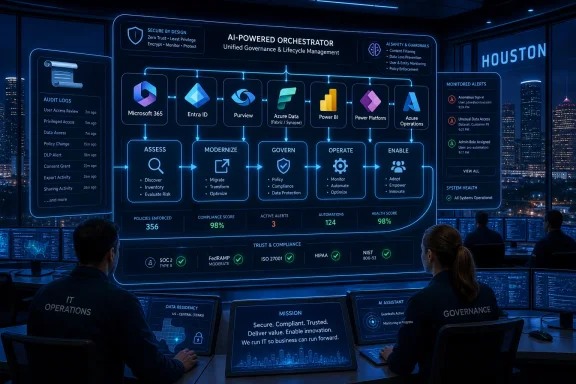 EPC Is Selling the Antidote to Microsoft Sprawl
The phrase “cloud orchestrator” has a whiff of consultant theater, but the problem EPC Group is pointing at is real. In many enterprises, Microsoft is no longer a productivity vendor or an infrastructure vendor. It is the identity layer, the collaboration layer, the analytics layer, the low-code layer, the endpoint-adjacent security layer, and increasingly the AI control plane.That breadth creates a procurement paradox. Microsoft has spent years making its cloud portfolio feel integrated on slides, but customers often buy services around it in fragments: one firm for Azure landing zones, another for Power BI, another for SharePoint modernization, another for Copilot readiness, and an offshore managed-services provider once the build phase is done. The result is a Microsoft estate that looks unified in licensing but fractured in accountability.
EPC Group’s new practice is aimed squarely at that fracture. The company says it will organize work across six service pillars and five lifecycle stages, from assessment through operations and enablement. The commercial hook is fixed-fee accountability and continuity: the senior architects who scope the work are meant to remain responsible beyond go-live.
That is the interesting part. In enterprise IT, the handoff is where optimism goes to die. Architecture decks assume clean ownership boundaries; production systems expose the opposite.
The Partner Badge Matters, but the Operating Model Matters More
EPC is leaning heavily on its Microsoft Solutions Partner credentials, including all six core designations: Data & AI, Modern Work, Infrastructure, Security, Digital & App Innovation, and Business Applications. That matters because Microsoft’s partner model is no longer the old Gold and Silver ladder many IT buyers grew up with. The current designations are aligned to Microsoft Cloud solution areas and are meant to signal capability across customer success, skilling, and performance.Still, badges do not run tenants. A designation can help a buyer filter the field, but it does not answer the harder question: who owns the consequences when Purview policy choices affect Fabric reporting, Entra identity assumptions shape Copilot access, or Power Platform environments begin multiplying faster than governance can keep up?
That is where EPC’s positioning becomes more than marketing. The company is not presenting the practice as a single product or a packaged migration factory. It is presenting it as an operating model for the Microsoft estate, with strategy, build, governance, run, and adoption treated as one continuum.
The emphasis on senior-only delivery is also a deliberate shot at the economics of large consulting. Many enterprise projects are sold by partners and staffed by pyramids. EPC’s claim is that regulated Microsoft work now carries too much architectural coupling for “learn on the client’s dime” delivery.
Microsoft’s AI Push Raises the Cost of Bad Plumbing
The timing is not accidental. Microsoft 365 Copilot, Copilot Studio, Fabric, Purview, and Entra have turned old governance debt into an AI-readiness problem. The data access decision that once produced a messy SharePoint search result can now shape what an AI assistant summarizes, retrieves, or acts upon.That changes the risk profile. A poorly governed Power BI workspace is annoying. A poorly governed semantic layer connected to AI-assisted decision-making is a boardroom problem. A stale identity model is inconvenient until non-human identities, agents, automations, and delegated permissions start operating across business systems.
EPC’s practice language reflects that shift. The company talks about Purview-anchored governance, Entra hardening, Copilot guardrails, Dataverse governance, audit trails, escalation rules, monitoring, and named-owner accountability. This is the new Microsoft consulting vocabulary: less “deploy the tool,” more “prove the tool will not become an uncontrolled system of record.”
The significance is not that EPC invented these concerns. It did not. The significance is that a Microsoft partner is wrapping them into the center of the delivery model rather than treating governance as a late-stage workstream after the platform team has already shipped.
Fabric and Power BI Are Now Governance Projects, Not Just Analytics Projects
The data pillar may be the clearest example of why orchestration is becoming a serious enterprise concern. EPC says its model spans Azure Synapse, Microsoft Fabric, Azure Data Lake Storage Gen2, Azure Databricks, and Microsoft Purview, with governance designed in before the first report ships.That line should resonate with anyone who has inherited a Power BI environment after years of departmental enthusiasm. Power BI succeeded in part because it was easy to start. The enterprise tax arrives later, when leaders need certified datasets, capacity planning, tenant policy, semantic model discipline, lineage, and consistent access controls.
Microsoft Fabric intensifies that dynamic. It promises a more integrated analytics estate, but integration does not remove governance work; it concentrates it. Data engineering, warehousing, real-time analytics, lakehouse patterns, and business intelligence become more tightly coupled, which means weak assumptions propagate faster.
For WindowsForum’s IT pro audience, the lesson is straightforward: analytics modernization is no longer only a data-team concern. Identity, compliance, licensing, retention, endpoint access, and operational support all converge around the same platform decisions. EPC’s pitch is that one accountable architecture group should carry those dependencies from roadmap to run state.
Microsoft 365 Is the Front Door to the Whole Risk Model
The workplace pillar is just as important. EPC is bundling Microsoft 365 strategy, SharePoint Online modernization, Teams engineering, Viva, tenant operations, and Copilot rollout into the same practice. That reflects the reality that for most employees, the Microsoft cloud is not Azure Portal. It is Outlook, Teams, SharePoint, OneDrive, and increasingly Copilot embedded into daily work.The risk is that the user-facing layer is where invisible architecture becomes visible failure. A tenant consolidation can look like a back-office exercise until permissions break. A Copilot pilot can look like an innovation program until it reveals overshared files. A SharePoint modernization can look like intranet work until it collides with retention, records management, and search.
EPC’s reference to large Microsoft 365 migrations, including a claimed enterprise migration above 102,000 users with zero downtime, is clearly intended to establish credibility in that messy zone between architecture and operations. Large migrations test not only technical skill but communications, coexistence planning, identity hygiene, and support readiness.
The company’s argument is that workplace modernization cannot be isolated from data governance or AI governance. That is correct. Copilot makes the Microsoft 365 tenant a live map of enterprise information discipline.
Power Platform Is Where Citizen Development Meets Enterprise Liability
Power Platform often enters organizations through productivity hunger rather than formal architecture. Someone builds an app to replace a spreadsheet. Someone automates approvals. Someone builds a portal. Someone experiments with Copilot Studio. Eventually, IT discovers that the “small” platform now contains business process, customer data, departmental logic, and compliance exposure.EPC’s Power Platform pillar is therefore notable for how much of it is governance vocabulary. Environment strategy, Dataverse data governance, application lifecycle management, non-human identity, decision boundaries, escalation rules, monitoring, and named ownership all suggest a maturing view of low-code.
That is the right framing. The enterprise problem with Power Platform is not that users build things. It is that the organization often lacks a credible path from departmental invention to durable, supportable application estate. Low-code without lifecycle discipline becomes shadow IT with a Microsoft logo.
The agentic AI layer raises the stakes again. Once automations and agents move from suggestion to action, enterprises need to know who authorized the action, which identity performed it, which data it touched, which exception path it followed, and who gets paged when it misbehaves. That is not a PowerPoint governance concern. It is production operations.
Managed Services Are the Part Consulting Firms Prefer to Avoid
The most revealing part of EPC’s announcement is the managed-services pillar. The company says the practice includes 24/7 co-managed services for Power BI, Microsoft Fabric, Microsoft 365 Copilot, Microsoft 365 tenant health, Azure landing zone operations, and Purview governance enforcement, with senior-architect escalation.That matters because many consultancies are most comfortable before go-live. The margins, staffing model, and sales motion often favor assessment, build, and transformation programs. Operations are messier: incidents happen at inconvenient hours, vendor boundaries blur, and architectural shortcuts become support tickets.
EPC is arguing that this is precisely where accountability should continue. If the same partner designs the roadmap, builds the platform, defines governance, and operates the environment, it has fewer places to hide. Conversely, the customer has fewer seams to manage.
There is a commercial risk in that promise. Long-running managed services require depth, discipline, and unglamorous process. But from the buyer’s perspective, the offer aligns with a market reality: the costliest Microsoft failures are often not failed deployments, but successful deployments that nobody is prepared to operate.
The Fixed-Fee Promise Will Live or Die on Scope Discipline
Fixed-fee accountability is attractive because it suggests cost predictability. It can also become dangerous if the scope is vague, the dependencies are unresolved, or the customer’s internal decision-making is slow. In a Microsoft estate, technical scope and organizational scope are rarely separate.EPC’s lifecycle model tries to address this by naming five stages: Assess, Modernize, Govern, Operate, and Enable. The structure is sensible. Assessment produces the roadmap and target architecture. Modernization builds and migrates. Governance defines controls. Operations keeps the system healthy. Enablement tries to make the platform stick.
The harder question is whether enterprises will buy the full arc or cherry-pick stages. EPC says each pillar can be entered standalone or sequenced into a multi-year orchestrator engagement. That flexibility helps procurement, but it also reintroduces the seam problem if customers buy only the attractive pieces and leave governance or operations underfunded.
This is where the sales discipline will matter. A credible orchestrator should sometimes tell a customer that it is not ready for Copilot, not ready for Fabric scale-out, or not ready for low-code expansion. The value of senior architects is not only knowing how to say yes. It is knowing when “yes” creates the next incident.
Regulated Enterprises Are the Natural Buyers
The announcement repeatedly points to regulated industries: healthcare, finance, federal and defense, life sciences, and other compliance-heavy environments. That is not accidental. The more regulated the enterprise, the more expensive vendor seams become.A compliance finding rarely respects the boundaries of a statement of work. An auditor does not care that the data platform was built by one vendor, the identity model by another, and the reporting layer by a third. The enterprise owns the control failure, even if every contractor can explain why it was not technically in scope.
EPC’s named frameworks and acronyms — HIPAA, SOC 2, FedRAMP, FINRA, CMMC, GxP — are table stakes in this market, but their inclusion signals the practice’s intended buyer. This is not a small-business managed service bundle. It is aimed at organizations where Microsoft architecture is part of the risk register.
The interesting competitive question is whether a mid-sized specialist can outmaneuver larger systems integrators by being more coherent. Big consultancies can bring scale, offshore capacity, and executive relationships. A focused Microsoft partner can bring continuity, platform intimacy, and fewer internal silos. EPC is betting that in the AI era, coherence wins more deals than headcount.
The Orchestrator Label Is New, but the Buyer Frustration Is Not
EPC founder Errin O’Connor frames the practice as a response to buyers who are tired of being the system integrator for their own Microsoft estate. That line works because it names the hidden labor inside many enterprise IT departments. Vendor management becomes architecture management. Architecture management becomes risk management. Risk management becomes firefighting.The buyer frustration is especially acute because Microsoft’s product strategy encourages platform consolidation while the services market often remains fragmented. A CIO may standardize on Microsoft for cloud, collaboration, analytics, security, and AI, only to discover that implementation expertise is still divided into narrow guilds.
The result is a strange kind of anti-platform outcome. The customer buys an integrated stack but experiences it as a sequence of disconnected projects. EPC’s announcement is best understood as a services-market answer to that contradiction.
Whether the term “orchestrator” sticks is less important than whether the model works. Enterprises do not need another label. They need fewer gaps between the people who design controls, migrate data, configure tenants, deploy analytics, enable users, and answer the phone after go-live.
The Real Test Will Be Post-Copilot Accountability
Microsoft 365 Copilot and Copilot Studio loom over this announcement even when they are not the only subjects. AI has become the forcing function that exposes weak governance across Microsoft environments. Oversharing, stale groups, poorly classified data, uncontrolled workspaces, unclear app ownership, and inconsistent lifecycle management all become harder to ignore when AI can traverse the estate.That creates opportunity for firms like EPC. Enterprises want to move quickly on AI, but they also want someone to explain where the blast radius is. A partner that can connect Entra, Purview, Microsoft 365, Fabric, Power BI, Power Platform, and Azure operations has a stronger claim to that advisory seat than a vendor focused on one layer.
But AI also raises the standard for proof. Marketing language about governed AI will not be enough. Buyers should ask for concrete control patterns, sample operating procedures, escalation paths, tenant policy examples, model-risk assumptions, and evidence of how incidents are handled after deployment.
The next phase of Microsoft consulting will be judged less by launch decks than by operational telemetry. If Copilot, Fabric, and Power Platform become production-critical, the winning partners will be the ones who can show not just what they built, but how it behaves under stress.
The EPC Bet Comes Down to Five Practical Tests
EPC’s announcement is broad, but the practical implications are easy to distill. The company is trying to make one partner accountable for the Microsoft estate as it actually exists: interconnected, regulated, AI-facing, and operationally persistent.- Enterprises should treat Microsoft architecture as a cross-stack operating model, not as a collection of isolated product deployments.
- Governance needs to be designed before analytics, Copilot, and low-code systems reach broad adoption, not retrofitted after users create business dependence.
- The most important vendor question is increasingly who owns the handoff between strategy, implementation, compliance, and operations.
- Fixed-fee delivery can help buyers control cost only when scope, dependencies, and decision rights are made explicit early.
- Microsoft partner credentials are useful signals, but the decisive proof is whether the same accountable team can stay with the environment after go-live.
References
- Primary source: The Tennessean
Published: 2026-06-17T12:58:39.067887
Loading…
www.tennessean.com - Official source: learn.microsoft.com
Solution Partner Designation qualification criteria - Partner Center | Microsoft Learn
This document lists the Solutions Partner designations that are aligned to Microsoft solution areas, and includes incremental benefits so you can stand out from the competition and increase your customer reach.learn.microsoft.com - Official source: microsoft.com
Microsoft – AI, Cloud, Productivity, Computing, Gaming & Apps
Explore Microsoft products and services and support for your home or business. Shop Microsoft 365, Copilot, Teams, Xbox, Windows, Azure, Surface and more.www.microsoft.com
- Official source: devicepartner.microsoft.com
Loading…
devicepartner.microsoft.com - Official source: partner.microsoft.com
Loading…
partner.microsoft.com - Related coverage: academy.tdsynnex.com
Loading…
academy.tdsynnex.com
- Related coverage: experteach.eu
- Official source: microsoftcloud.s3.amazonaws.com
Loading…
microsoftcloud.s3.amazonaws.com