
Microsoft released Windows 11 Insider Experimental Preview Build 26300.8687 on June 12, 2026, introducing a unified update experience meant to reduce the number of monthly reboots by coordinating more servicing work into a single restart. The change is being framed around the broader Windows K2 quality push, a 2026–2027 effort to make Windows feel less fussy, less fragile, and less hostile to ordinary maintenance. The promise is simple enough to fit on a sticker: one month, one update cycle, one reboot. The harder question is whether Microsoft can make that promise survive the messy reality of Windows hardware.
For years, Windows updates have carried a cost that is larger than the progress bar suggests. A cumulative update may need a restart, a driver may need another, firmware may land through a vendor channel with its own reboot logic, and .NET servicing can add its own choreography. The user sees a machine that keeps asking for attention; the administrator sees a fleet that refuses to settle into a clean compliance state.
Windows K2 appears to treat that behavior not as an annoyance but as a product defect. That is a meaningful change in posture. Microsoft has historically talked about update reliability in terms of percentages, deployment rings, rollback rates, and security urgency. K2 shifts the lens toward experience reliability: not just whether the patch installed, but whether the user trusted the machine while it happened.
Build 26300.8687 is the first visible proof point in that campaign. Microsoft’s release notes describe a unified update experience intended to reduce the number of reboots users see per month, and the build itself is tied to Windows 11 version 25H2 through an enablement package. That detail matters because this is not a flashy new Windows generation or a Windows 12 tease. It is plumbing.
Plumbing, in Windows, is usually where the real pain lives. Nobody buys a PC for the servicing stack, but everyone notices when the servicing stack gets update sequencing wrong. If K2 works, the victory will be measured not in screenshots, but in the absence of a second restart prompt at 4:50 p.m.
That distinction is important because Windows no longer changes in the clean, epochal way it did when a boxed OS release landed every few years. Modern Windows is a rolling platform, with enablement packages, cumulative updates, app updates through the Store, driver distribution through Windows Update, and policy controls layered on top. The operating system is less a product you install once and more a system that is continuously negotiated between Microsoft, OEMs, silicon vendors, software developers, administrators, and users.
K2 seems to acknowledge that Windows 11’s problem is not merely that it lacks features. It is that the experience has become too noisy. Start menu delays, update interruptions, confusing policy states, inconsistent Settings surfaces, driver fragility, and AI-promotional clutter have all contributed to a sense that Windows asks for more patience than it earns.
That makes the unified reboot push a useful symbol. It is not the largest engineering project Microsoft could undertake, but it is one that users immediately understand. A PC that patches itself with fewer interruptions feels more competent, even if the underlying change is mostly invisible.
The trouble is that users do not experience those categories separately. They experience them as “my PC wants to restart again.” In an enterprise, that translates into more maintenance windows, more help desk calls, more policy exceptions, and more machines that report as pending restart long after the nominal patch deployment succeeded.
The cumulative update model already reduced some of the chaos that defined older Windows servicing. But “cumulative” never meant “everything arrives in one coordinated operational moment.” It meant the OS patch payload became more predictable. The surrounding ecosystem remained messier.
A unified pipeline is therefore a more ambitious proposition than it sounds. To combine driver updates, firmware patches, and runtime fixes into a single coordinated activation event, Microsoft has to do more than bundle files together. It has to reason about dependencies, rollback boundaries, install order, device readiness, and whether an update that looks safe in isolation becomes dangerous when staged alongside another component.
That is why the 2027 horizon makes sense. If Microsoft intends to make one reboot the norm rather than a lucky outcome, this cannot be solved by a cosmetic Windows Update page. It requires coordination across the stack.
For a home user, predictability means knowing that a laptop will be ready before a meeting, a game, or a school assignment. For an IT administrator, it means knowing that update compliance dashboards reflect reality rather than machines stranded in “restart required” limbo. For a developer, it means fewer surprise environment changes in the middle of a build, test run, or remote session.
The reboot tax is especially corrosive because it feels arbitrary. Users can understand a restart after a major OS update. They are less forgiving when the machine restarts for one update, boots, installs another, requests another restart, and then spends time “getting things ready.” That sequence teaches people to delay updates, which is the opposite of what Microsoft wants from a security perspective.
This is the central K2 bet: make the safe behavior less annoying, and more users will do the safe thing. Microsoft has spent years tightening Windows security defaults, pushing hardware-backed protections, and accelerating patch delivery. But if the human experience remains aggravating, the patch pipeline becomes a behavioral problem.
Security engineering often fails at the last mile not because the fix is unavailable, but because the workflow is intolerable. A better update pipeline is not just convenience work. It is security adoption work.
That caveat matters because the current online framing risks getting ahead of the evidence. Early testers reportedly saw update-time reductions of up to 40 percent on some test systems, but that kind of number should be treated as directional rather than universal. Update timing depends heavily on hardware, storage speed, firmware behavior, network conditions, patch payload size, and whether the machine was already in a clean servicing state.
The claim is still plausible. Coordinating update activation can reduce redundant staging work, avoid repeated boot transitions, and limit the stop-start pattern that makes servicing feel longer than it is. Fewer restarts can also reduce the chances that a user interrupts the machine at the wrong moment.
But the hardest cases will not be pristine Insider test boxes. They will be aging laptops with marginal SSDs, business desktops carrying years of OEM utilities, domain-joined machines with strict policies, gaming PCs with aggressive driver stacks, and devices whose firmware update behavior was designed for a world before Windows Update became the front door for nearly everything.
That is where K2 will either prove itself or become another well-intentioned servicing promise that works best in Microsoft’s cleanest scenarios.
A driver update is not just another file replacement. It can change device initialization, power behavior, crash patterns, performance characteristics, and compatibility with firmware. In the worst cases, a bad driver can turn a normal patch cycle into a boot failure, a blue screen loop, or a fleet-wide support event.
That is why Microsoft’s broader quality work around drivers matters as much as the unified reboot experience itself. A single coordinated restart is only helpful if the things being coordinated are trustworthy. Otherwise, bundling more work into one reboot simply creates a larger blast radius.
The industry has already learned this lesson in other contexts. Mobile platforms can make updates feel elegant because the hardware matrix is narrower and vendor control is tighter. Windows has the opposite inheritance: compatibility as a feature, heterogeneity as a business model, and decades of third-party assumptions built into the ecosystem.
K2 does not erase that complexity. It tries to discipline it. The success condition is not that Windows becomes iOS. It is that Windows becomes less chaotic without abandoning the hardware freedom that made it dominant.
Putting firmware into a unified update model sounds convenient, but it raises a governance question for IT. Administrators may want OS security fixes to move quickly while holding firmware updates for staged validation. Consumers may prefer one simple update button, but enterprises often need separate rings for firmware because the cost of a bad firmware rollout can dwarf the cost of a delayed convenience improvement.
Microsoft therefore has to preserve control while reducing friction. If the unified experience becomes too blunt, enterprise admins will resist it. If it becomes too optional and fragmented, users will keep seeing multiple restart prompts. The balance is not obvious.
The likely answer is policy. Microsoft can make the consumer path simpler while allowing managed environments to decide which categories are coordinated, deferred, excluded, or staged. That is more complex than the headline promise, but it is the only realistic path for Windows.
A one-reboot model that ignores enterprise nuance would be a consumer feature. A one-reboot model that respects deployment policy could become infrastructure.
A new File Explorer behavior or Settings toggle is easy for testers to discuss. A servicing pipeline change is harder. Users can report whether they saw fewer restarts, but they may not know which payloads were involved, whether a driver was actually included, or whether the reboot reduction came from the new pipeline or from a light update month.
For Microsoft, this creates a measurement challenge. Telemetry can show install success rates, rollback rates, time-to-interactive-desktop, and restart counts. But trust is harder to capture. A user who no longer dreads Patch Tuesday may not file feedback saying “nothing bad happened.”
That is why K2 needs both telemetry and narrative. Microsoft has to show measurable reliability gains while also persuading users that the company is working on the boring problems again. Windows enthusiasts notice when Microsoft spends stage time on AI features while long-standing shell and update frustrations linger.
The unified update experiment is a useful corrective because it is difficult to dismiss as marketing fluff. It is not a Copilot button. It is a direct attempt to remove a category of irritation that Windows users have complained about for years.
That timeline also gives Microsoft room to discover where the model breaks. Perhaps drivers and .NET updates are easy to coordinate, but firmware remains a special case. Perhaps the unified restart works well for unmanaged PCs but needs deeper integration with Windows Autopatch, Intune, Windows Update for Business, and OEM tooling before enterprises trust it. Perhaps the biggest wins come not from reducing restarts to exactly one in every scenario, but from reducing the number of machines that need unexpected follow-up restarts.
That nuance should not be treated as failure. A rigid “one reboot or bust” promise would be foolish. A measurable reduction in restart churn, failed update states, and user-visible interruptions would be a real improvement even if exceptions remain.
The danger is branding. If Windows K2 becomes a catch-all label for every promised Windows improvement, Microsoft risks setting expectations it cannot neatly satisfy. Users do not care whether a reboot was caused by the servicing stack, a GPU driver, a firmware capsule, or a third-party security product. They care that the machine interrupted them again.
K2 will be judged at that level. Not by architecture diagrams, but by whether the average user sees fewer weird update nights.
Yet enterprise Windows management is built on caution for a reason. Administrators need to know what is being bundled, which component triggered the restart, what rollback looks like, and whether the unified pipeline changes reporting semantics. If a device shows compliant after a coordinated update, does that compliance cover firmware, drivers, .NET, and OS patches equally? If one component fails, does the whole package roll back, or does the machine land in a partial state?
These are not academic questions. Fleet management depends on explainability. A help desk technician needs to know why a machine rebooted. A security team needs to know whether a critical patch applied. A desktop engineering team needs to know whether a driver regression came from Microsoft Update, an OEM package, or a vendor tool.
Microsoft’s challenge is to simplify the user experience without making the administrative experience opaque. The best version of K2 would hide noise from users while exposing more structured information to admins. The worst version would make the PC feel smoother while making root-cause analysis harder.
The enterprise verdict will therefore depend less on the consumer headline and more on logging, policy, reporting, and rollback behavior. One reboot is pleasant. One unexplained reboot is not.
A unified update model could reduce that damage by making update activation more predictable. If updates stage quietly and converge on one restart, users can plan around a single disruption. That is vastly better than a sequence of restarts that reveals itself only after the first reboot completes.
The important word is “plan.” Windows Update has improved its active-hours behavior over the years, but users still often feel that the system’s maintenance needs outrank their own. The more Microsoft can make updates quiet, bounded, and legible, the less adversarial the relationship becomes.
Power users will still want control. They will want to know what is pending, when the restart will happen, and how to defer it without accidentally leaving the machine exposed for weeks. K2 should not become a paternalistic simplification layer that removes useful information from those who need it.
A better Windows Update experience should be calmer, not dumber.
Windows is competing against that expectation. Its historical advantage was compatibility and hardware breadth, but those strengths can look like liabilities when the result is a machine that seems perpetually almost done updating. The modern user does not reward an OS for the complexity it absorbs. They reward it for not showing the mess.
That is why K2 matters beyond the servicing stack. It signals that Microsoft understands Windows cannot win trust through feature accumulation alone. AI integration, new Settings pages, redesigned apps, and taskbar tweaks are secondary if the fundamentals feel brittle.
The update system is one of those fundamentals. It is the part of Windows that touches every user, whether they care about Copilot or not. It is also one of the few places where Microsoft can improve both consumer satisfaction and security outcomes at the same time.
If the company can make Windows feel less needy during maintenance, it will have earned more goodwill than another round of Start menu rearrangement.
A unified reboot model must handle the boring cases and the ugly cases. It must be able to say: these updates can be staged together, this one cannot, this device is not ready, this firmware requires special handling, this driver has been held back, and this machine needs administrator attention. The user should not have to parse that complexity, but the system must.
There is also a communication challenge. Microsoft should resist the urge to oversell “one reboot” as a universal law. The honest promise is likely closer to “fewer update-related restarts, with more components coordinated when safe.” That is less catchy, but it is more credible.
Users will forgive exceptions if the normal experience improves. They will not forgive a slogan that turns into another Windows punchline.
The encouraging sign is that Microsoft is starting with an experience users can actually feel. Build 26300.8687 may be only an early step, but it points at a longstanding grievance rather than an invented engagement metric. That is the kind of Windows work enthusiasts have been asking to see.
The one-reboot ambition is modest only if you ignore how Windows is built. In practice, it asks Microsoft to make the world’s most diverse PC platform behave with more of the confidence users expect from tightly controlled devices, while preserving the flexibility that keeps Windows indispensable. That is a difficult bargain, but it is the right one. If Windows K2 succeeds by 2027, its best feature may be that users stop noticing Windows Update at all.
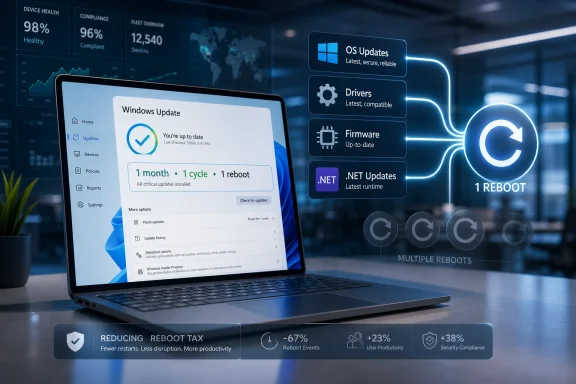 Microsoft Is Finally Attacking the Reboot Tax
For years, Windows updates have carried a cost that is larger than the progress bar suggests. A cumulative update may need a restart, a driver may need another, firmware may land through a vendor channel with its own reboot logic, and .NET servicing can add its own choreography. The user sees a machine that keeps asking for attention; the administrator sees a fleet that refuses to settle into a clean compliance state.Windows K2 appears to treat that behavior not as an annoyance but as a product defect. That is a meaningful change in posture. Microsoft has historically talked about update reliability in terms of percentages, deployment rings, rollback rates, and security urgency. K2 shifts the lens toward experience reliability: not just whether the patch installed, but whether the user trusted the machine while it happened.
Build 26300.8687 is the first visible proof point in that campaign. Microsoft’s release notes describe a unified update experience intended to reduce the number of reboots users see per month, and the build itself is tied to Windows 11 version 25H2 through an enablement package. That detail matters because this is not a flashy new Windows generation or a Windows 12 tease. It is plumbing.
Plumbing, in Windows, is usually where the real pain lives. Nobody buys a PC for the servicing stack, but everyone notices when the servicing stack gets update sequencing wrong. If K2 works, the victory will be measured not in screenshots, but in the absence of a second restart prompt at 4:50 p.m.
K2 Is Not a New Windows, and That Is the Point
The user-facing temptation is to treat “Windows K2” like a codename for the next big platform release. That would be the wrong frame. The available reporting and Microsoft’s visible Insider work point to K2 as an internal quality campaign, not a new edition of Windows, not a branded SKU, and not a conventional feature release.That distinction is important because Windows no longer changes in the clean, epochal way it did when a boxed OS release landed every few years. Modern Windows is a rolling platform, with enablement packages, cumulative updates, app updates through the Store, driver distribution through Windows Update, and policy controls layered on top. The operating system is less a product you install once and more a system that is continuously negotiated between Microsoft, OEMs, silicon vendors, software developers, administrators, and users.
K2 seems to acknowledge that Windows 11’s problem is not merely that it lacks features. It is that the experience has become too noisy. Start menu delays, update interruptions, confusing policy states, inconsistent Settings surfaces, driver fragility, and AI-promotional clutter have all contributed to a sense that Windows asks for more patience than it earns.
That makes the unified reboot push a useful symbol. It is not the largest engineering project Microsoft could undertake, but it is one that users immediately understand. A PC that patches itself with fewer interruptions feels more competent, even if the underlying change is mostly invisible.
The Old Update Model Made Sense Until It Didn’t
Windows servicing became fragmented for understandable reasons. Operating system patches, device drivers, firmware updates, .NET fixes, Store app updates, Microsoft Defender intelligence, and optional feature deliveries each developed their own cadence because they solve different problems. Security fixes must move quickly. Drivers depend on OEM certification and hardware targeting. Firmware updates carry special risk. Runtime updates may be bound to application compatibility.The trouble is that users do not experience those categories separately. They experience them as “my PC wants to restart again.” In an enterprise, that translates into more maintenance windows, more help desk calls, more policy exceptions, and more machines that report as pending restart long after the nominal patch deployment succeeded.
The cumulative update model already reduced some of the chaos that defined older Windows servicing. But “cumulative” never meant “everything arrives in one coordinated operational moment.” It meant the OS patch payload became more predictable. The surrounding ecosystem remained messier.
A unified pipeline is therefore a more ambitious proposition than it sounds. To combine driver updates, firmware patches, and runtime fixes into a single coordinated activation event, Microsoft has to do more than bundle files together. It has to reason about dependencies, rollback boundaries, install order, device readiness, and whether an update that looks safe in isolation becomes dangerous when staged alongside another component.
That is why the 2027 horizon makes sense. If Microsoft intends to make one reboot the norm rather than a lucky outcome, this cannot be solved by a cosmetic Windows Update page. It requires coordination across the stack.
One Reboot Is Really a Trust Metric
The most interesting part of K2 is not the number one. It is what that number represents. A single reboot is a proxy for predictability, and predictability is the currency Microsoft has spent too freely over the last several Windows cycles.For a home user, predictability means knowing that a laptop will be ready before a meeting, a game, or a school assignment. For an IT administrator, it means knowing that update compliance dashboards reflect reality rather than machines stranded in “restart required” limbo. For a developer, it means fewer surprise environment changes in the middle of a build, test run, or remote session.
The reboot tax is especially corrosive because it feels arbitrary. Users can understand a restart after a major OS update. They are less forgiving when the machine restarts for one update, boots, installs another, requests another restart, and then spends time “getting things ready.” That sequence teaches people to delay updates, which is the opposite of what Microsoft wants from a security perspective.
This is the central K2 bet: make the safe behavior less annoying, and more users will do the safe thing. Microsoft has spent years tightening Windows security defaults, pushing hardware-backed protections, and accelerating patch delivery. But if the human experience remains aggravating, the patch pipeline becomes a behavioral problem.
Security engineering often fails at the last mile not because the fix is unavailable, but because the workflow is intolerable. A better update pipeline is not just convenience work. It is security adoption work.
Experimental Means Promising, Not Promised
The first public sign of the unified update work arrived in the Experimental Insider channel, which should temper expectations. Experimental builds are where Microsoft tests ideas, not where it signs a shipping contract. Features can change, disappear, split across channels, or arrive months later in a different form.That caveat matters because the current online framing risks getting ahead of the evidence. Early testers reportedly saw update-time reductions of up to 40 percent on some test systems, but that kind of number should be treated as directional rather than universal. Update timing depends heavily on hardware, storage speed, firmware behavior, network conditions, patch payload size, and whether the machine was already in a clean servicing state.
The claim is still plausible. Coordinating update activation can reduce redundant staging work, avoid repeated boot transitions, and limit the stop-start pattern that makes servicing feel longer than it is. Fewer restarts can also reduce the chances that a user interrupts the machine at the wrong moment.
But the hardest cases will not be pristine Insider test boxes. They will be aging laptops with marginal SSDs, business desktops carrying years of OEM utilities, domain-joined machines with strict policies, gaming PCs with aggressive driver stacks, and devices whose firmware update behavior was designed for a world before Windows Update became the front door for nearly everything.
That is where K2 will either prove itself or become another well-intentioned servicing promise that works best in Microsoft’s cleanest scenarios.
The Driver Problem Is the Wall Microsoft Has to Climb
Drivers are the most obvious reason a one-reboot Windows update model is difficult. Microsoft can control the operating system servicing stack, but Windows runs on an enormous hardware ecosystem that does not behave like a single integrated platform. GPU vendors, Wi-Fi chipmakers, storage controller suppliers, printer makers, OEMs, and peripheral manufacturers all have incentives and release rhythms of their own.A driver update is not just another file replacement. It can change device initialization, power behavior, crash patterns, performance characteristics, and compatibility with firmware. In the worst cases, a bad driver can turn a normal patch cycle into a boot failure, a blue screen loop, or a fleet-wide support event.
That is why Microsoft’s broader quality work around drivers matters as much as the unified reboot experience itself. A single coordinated restart is only helpful if the things being coordinated are trustworthy. Otherwise, bundling more work into one reboot simply creates a larger blast radius.
The industry has already learned this lesson in other contexts. Mobile platforms can make updates feel elegant because the hardware matrix is narrower and vendor control is tighter. Windows has the opposite inheritance: compatibility as a feature, heterogeneity as a business model, and decades of third-party assumptions built into the ecosystem.
K2 does not erase that complexity. It tries to discipline it. The success condition is not that Windows becomes iOS. It is that Windows becomes less chaotic without abandoning the hardware freedom that made it dominant.
Firmware Turns Convenience Into Risk Management
Firmware updates are even trickier than drivers because failure modes can be uglier. A firmware patch may touch the system BIOS or UEFI, a device controller, a docking station, or security-related platform components. Some firmware updates need careful sequencing, battery checks, AC power requirements, BitLocker handling, or vendor-specific safeguards.Putting firmware into a unified update model sounds convenient, but it raises a governance question for IT. Administrators may want OS security fixes to move quickly while holding firmware updates for staged validation. Consumers may prefer one simple update button, but enterprises often need separate rings for firmware because the cost of a bad firmware rollout can dwarf the cost of a delayed convenience improvement.
Microsoft therefore has to preserve control while reducing friction. If the unified experience becomes too blunt, enterprise admins will resist it. If it becomes too optional and fragmented, users will keep seeing multiple restart prompts. The balance is not obvious.
The likely answer is policy. Microsoft can make the consumer path simpler while allowing managed environments to decide which categories are coordinated, deferred, excluded, or staged. That is more complex than the headline promise, but it is the only realistic path for Windows.
A one-reboot model that ignores enterprise nuance would be a consumer feature. A one-reboot model that respects deployment policy could become infrastructure.
The Insider Channel Is Now Microsoft’s Public Workshop
The move also says something about the evolving Windows Insider Program. The Experimental channel has become a place where Microsoft can expose lower-level experience changes without pretending they are ready for broad deployment. That is useful, but it also makes the channel harder to interpret.A new File Explorer behavior or Settings toggle is easy for testers to discuss. A servicing pipeline change is harder. Users can report whether they saw fewer restarts, but they may not know which payloads were involved, whether a driver was actually included, or whether the reboot reduction came from the new pipeline or from a light update month.
For Microsoft, this creates a measurement challenge. Telemetry can show install success rates, rollback rates, time-to-interactive-desktop, and restart counts. But trust is harder to capture. A user who no longer dreads Patch Tuesday may not file feedback saying “nothing bad happened.”
That is why K2 needs both telemetry and narrative. Microsoft has to show measurable reliability gains while also persuading users that the company is working on the boring problems again. Windows enthusiasts notice when Microsoft spends stage time on AI features while long-standing shell and update frustrations linger.
The unified update experiment is a useful corrective because it is difficult to dismiss as marketing fluff. It is not a Copilot button. It is a direct attempt to remove a category of irritation that Windows users have complained about for years.
The 2027 Target Is an Admission of Scale
The reported 2027 timeline is not slow by Windows standards. It is arguably realistic. Servicing changes must be validated across consumer machines, managed business fleets, OEM images, hardware generations, regional configurations, and Insider populations before Microsoft can make them ordinary.That timeline also gives Microsoft room to discover where the model breaks. Perhaps drivers and .NET updates are easy to coordinate, but firmware remains a special case. Perhaps the unified restart works well for unmanaged PCs but needs deeper integration with Windows Autopatch, Intune, Windows Update for Business, and OEM tooling before enterprises trust it. Perhaps the biggest wins come not from reducing restarts to exactly one in every scenario, but from reducing the number of machines that need unexpected follow-up restarts.
That nuance should not be treated as failure. A rigid “one reboot or bust” promise would be foolish. A measurable reduction in restart churn, failed update states, and user-visible interruptions would be a real improvement even if exceptions remain.
The danger is branding. If Windows K2 becomes a catch-all label for every promised Windows improvement, Microsoft risks setting expectations it cannot neatly satisfy. Users do not care whether a reboot was caused by the servicing stack, a GPU driver, a firmware capsule, or a third-party security product. They care that the machine interrupted them again.
K2 will be judged at that level. Not by architecture diagrams, but by whether the average user sees fewer weird update nights.
Enterprises Will Like the Goal and Interrogate the Mechanism
For IT departments, fewer reboots are attractive but not automatically trusted. A reboot is operationally expensive. It disrupts users, delays compliance, complicates maintenance windows, and creates support tickets when applications fail to recover gracefully. Reducing reboots should be an easy sell.Yet enterprise Windows management is built on caution for a reason. Administrators need to know what is being bundled, which component triggered the restart, what rollback looks like, and whether the unified pipeline changes reporting semantics. If a device shows compliant after a coordinated update, does that compliance cover firmware, drivers, .NET, and OS patches equally? If one component fails, does the whole package roll back, or does the machine land in a partial state?
These are not academic questions. Fleet management depends on explainability. A help desk technician needs to know why a machine rebooted. A security team needs to know whether a critical patch applied. A desktop engineering team needs to know whether a driver regression came from Microsoft Update, an OEM package, or a vendor tool.
Microsoft’s challenge is to simplify the user experience without making the administrative experience opaque. The best version of K2 would hide noise from users while exposing more structured information to admins. The worst version would make the PC feel smoother while making root-cause analysis harder.
The enterprise verdict will therefore depend less on the consumer headline and more on logging, policy, reporting, and rollback behavior. One reboot is pleasant. One unexplained reboot is not.
Developers and Power Users Need Fewer Surprise State Changes
Developers, creators, and power users have their own stake in the reboot problem. A Windows machine is often not just a browsing device; it is a working environment full of containers, virtual machines, build tools, remote sessions, GPU workloads, local databases, audio interfaces, and long-running processes. Interruptions are not merely inconvenient. They can corrupt work or force costly context rebuilding.A unified update model could reduce that damage by making update activation more predictable. If updates stage quietly and converge on one restart, users can plan around a single disruption. That is vastly better than a sequence of restarts that reveals itself only after the first reboot completes.
The important word is “plan.” Windows Update has improved its active-hours behavior over the years, but users still often feel that the system’s maintenance needs outrank their own. The more Microsoft can make updates quiet, bounded, and legible, the less adversarial the relationship becomes.
Power users will still want control. They will want to know what is pending, when the restart will happen, and how to defer it without accidentally leaving the machine exposed for weeks. K2 should not become a paternalistic simplification layer that removes useful information from those who need it.
A better Windows Update experience should be calmer, not dumber.
The Real Competition Is the Appliance Feeling
Microsoft’s reboot push also reflects a broader competitive problem. The best modern devices feel like appliances. Phones update overnight. Chromebooks are fast and relatively low-drama. Game consoles patch aggressively but generally within a managed and predictable environment. Even Linux desktops, while hardly uniform, have trained many technical users to expect clearer package state and fewer surprise restarts outside kernel or driver work.Windows is competing against that expectation. Its historical advantage was compatibility and hardware breadth, but those strengths can look like liabilities when the result is a machine that seems perpetually almost done updating. The modern user does not reward an OS for the complexity it absorbs. They reward it for not showing the mess.
That is why K2 matters beyond the servicing stack. It signals that Microsoft understands Windows cannot win trust through feature accumulation alone. AI integration, new Settings pages, redesigned apps, and taskbar tweaks are secondary if the fundamentals feel brittle.
The update system is one of those fundamentals. It is the part of Windows that touches every user, whether they care about Copilot or not. It is also one of the few places where Microsoft can improve both consumer satisfaction and security outcomes at the same time.
If the company can make Windows feel less needy during maintenance, it will have earned more goodwill than another round of Start menu rearrangement.
The Promise Has to Survive Patch Tuesday
The real test will come not in the Experimental channel but in ordinary monthly servicing. Patch Tuesday is where Windows quality promises meet the largest and least forgiving test population. It includes home users who never read release notes, businesses running strict policies, machines with half-forgotten OEM utilities, and devices that have not rebooted in weeks.A unified reboot model must handle the boring cases and the ugly cases. It must be able to say: these updates can be staged together, this one cannot, this device is not ready, this firmware requires special handling, this driver has been held back, and this machine needs administrator attention. The user should not have to parse that complexity, but the system must.
There is also a communication challenge. Microsoft should resist the urge to oversell “one reboot” as a universal law. The honest promise is likely closer to “fewer update-related restarts, with more components coordinated when safe.” That is less catchy, but it is more credible.
Users will forgive exceptions if the normal experience improves. They will not forgive a slogan that turns into another Windows punchline.
The encouraging sign is that Microsoft is starting with an experience users can actually feel. Build 26300.8687 may be only an early step, but it points at a longstanding grievance rather than an invented engagement metric. That is the kind of Windows work enthusiasts have been asking to see.
The Reboot Counter Is Now Microsoft’s Scoreboard
The most concrete way to judge Windows K2 is not by the codename, but by what changes on real machines over the next 18 months. The unified update work in Build 26300.8687 is an early marker, not the finish line, and the difference matters.- Microsoft has started testing a unified Windows Update experience in the Experimental Insider channel with Build 26300.8687, released on June 12, 2026.
- The goal is to reduce monthly restart churn by coordinating more update categories into a single activation event where possible.
- Windows K2 should be understood as a quality initiative running through 2027, not as a new Windows version.
- Early performance claims, including reported update-time reductions on test systems, should be treated as promising but not universal.
- The hardest work will be coordinating drivers and firmware without reducing enterprise control or increasing rollback risk.
- The practical win for users and administrators will be predictability, not a perfect guarantee that every update scenario always needs exactly one reboot.
The one-reboot ambition is modest only if you ignore how Windows is built. In practice, it asks Microsoft to make the world’s most diverse PC platform behave with more of the confidence users expect from tightly controlled devices, while preserving the flexibility that keeps Windows indispensable. That is a difficult bargain, but it is the right one. If Windows K2 succeeds by 2027, its best feature may be that users stop noticing Windows Update at all.
References
- Primary source: Daily Beirut
Published: 2026-06-17T13:20:12.469479
Microsoft Windows K2 Cuts Updates to One Reboot by 2027 · Daily Beirut
Microsoft's Windows K2 initiative consolidates monthly updates into a single reboot, reducing update time by 40% for testers. The project runs through 2027.dailybeirut.com - Related coverage: windowscentral.com
Windows Insiders get first crack at a less annoying Windows 11 update process | Windows Central
Microsoft is laying the groundwork to bundle driver, .NET, and firmware updates together so you only have to reboot your PC once a month.www.windowscentral.com - Official source: learn.microsoft.com
Windows 11 Insider Experimental Preview Build 26300.8687 - Windows Insider Program | Microsoft Learn
Release notes for Windows 11 Insider Experimental Preview Build 26300.8687learn.microsoft.com - Related coverage: elevenforum.com
KB5095027 Windows 11 Insider Experimental (25H2) build 26300.8687 - June 12 | Windows 11 Forum
Windows Insider Blog: Changes and improvements gradually being rolled out [Windows Update] As announced in the Windows Update announce blog, we are now...www.elevenforum.com - Related coverage: windowsforum.com
Windows 11 Insider Build 26300.8687: Explorer Tabs, Unified Updates, Better Search | Windows Forum
Microsoft released Windows 11 Insider Experimental Preview Build 26300.8687 on June 12, 2026, bringing a batch of gradual-rollout changes that include File...windowsforum.com - Related coverage: windowsblogitalia.com
Download e novità di Windows 11 Insider Preview Build 26300.8687
Microsoft ha rilasciato Windows 11 Insider Preview Build 26300.8687 ai Windows Insider che hanno scelto il canale Canary. www.windowsblogitalia.com
- Official source: blogs.windows.com
- Related coverage: pcworld.com
Microsoft's secret 'Windows K2' project aims to fix what users hate most | PCWorld
Windows K2 is a behind-the-scenes initiative to fix performance, reliability, and AI bloat in Windows 11 by 2027.www.pcworld.com - Related coverage: techspot.com
Microsoft's "Windows K2" plan promises a faster Start menu, instant search, and fewer botched updates | TechSpot
Sources tell Windows Central that recent Windows 11 updates are only a sliver of a much larger internal effort to stabilize the operating system after a string...www.techspot.com - Official source: download.microsoft.com
- Official source: techcommunity.microsoft.com