
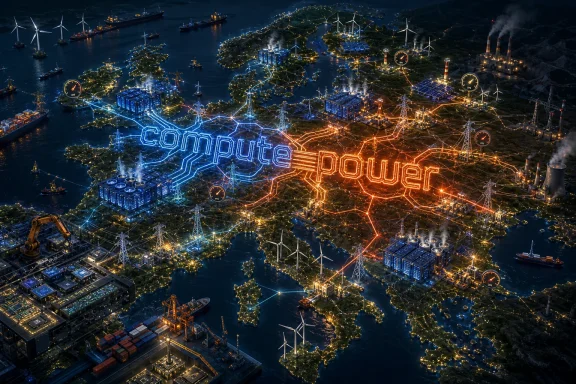
On June 17, 2026, Microsoft’s EU Policy blog published a TechTalk with Ann Mettler, president of Catalyse Europe, arguing that Europe’s AI ambitions now depend as much on abundant electricity, grids, and industrial supply chains as on algorithms or regulation. Her blunt formulation — the “fusion of compute and power” — captures a strategic reality Europe can no longer bureaucratize away. AI is becoming an energy story, and Europe’s energy story remains unfinished.
That matters because Europe has spent years treating digital policy, climate policy, industrial policy, and security policy as adjacent files in separate cabinets. Mettler’s argument is that this separation has become obsolete. In the AI era, compute capacity is not a cloud abstraction; it is a physical system made of chips, substations, cooling, minerals, transmission queues, permits, and power prices.
The fashionable version of the AI race is about models, talent, and venture capital. That version is not wrong, but it is incomplete in a way that flatters Europe’s strengths and hides its weaknesses. Europe has good universities, serious researchers, sophisticated manufacturers, and a long history of translating engineering into regulated markets.
What it does not have, at least not at the scale now demanded by frontier AI, is an easy path to vast amounts of cheap, reliable, low-carbon electricity. Mettler’s point is not simply that Europe needs more data centers. It is that Europe needs to relearn the habit of building the physical foundations that let digital industries scale.
The EU’s energy mix has changed, but not enough to support the political story Europe often tells about itself. Renewables have made real gains in electricity generation, yet the wider energy system remains heavily dependent on fossil fuels, especially once transport, heating, and industry are counted. Mettler’s claim that fossil fuels still account for close to 60 percent of Europe’s energy mix is less a debating point than an indictment of pace.
AI sharpens that indictment because it converts delay into competitive disadvantage. A factory can sometimes absorb high power prices through efficiency gains or subsidies. A data center built for AI training and inference is more brutally exposed: if power is expensive, scarce, slow to connect, or politically uncertain, the workload migrates elsewhere.
Training large models and serving them at scale requires dense compute, and dense compute turns electricity into a first-order input. The competitive map of AI will therefore be shaped not only by who has the best researchers, but by who can connect gigawatts of capacity without blowing up household bills, climate targets, or grid reliability.
That is the useful provocation in Mettler’s phrase “fusion of compute and power.” It suggests that AI infrastructure is no longer merely a customer of the energy system. It is becoming part of the energy system’s planning problem.
This is where Europe’s usual policy instincts become risky. If data centers are treated as just another class of industrial load, regulators may miss their strategic importance. If they are treated as magical engines of productivity, governments may ignore the local consequences for grids, water, land, and energy prices. The hard task is to treat AI infrastructure as both economically strategic and physically constrained.
The risk is that Europe becomes the world’s most sophisticated referee for games played on other people’s infrastructure. That is the shadow hanging over Mettler’s comments. A continent can set standards for trustworthy AI and still find itself renting the compute needed to build the systems that matter.
Microsoft’s own interest in this debate is obvious. The company is one of the biggest buyers and builders of AI infrastructure in the world, and it has every reason to encourage governments to accelerate grids, permits, and clean energy deployment. But vendor self-interest does not make the argument false. If anything, the hyperscalers’ obsession with power availability is one of the clearest market signals Europe has.
The EU’s AI gigafactory push acknowledges the problem. Brussels wants facilities that combine high-performance computing, AI-optimized data centers, and access for researchers and industry. That is a serious attempt to turn compute into shared strategic infrastructure rather than a luxury good available only to the largest American and Chinese platforms.
But the open question is whether Europe can execute at the speed implied by the word “gigafactory.” The phrase sounds muscular. The permitting, grid-connection, procurement, and financing realities often do not.
The clean energy transition was never supposed to mean a permanently constrained energy system. The point was to replace high-carbon abundance with low-carbon abundance. If the result is scarcity, high prices, and dependence on imported clean-tech supply chains, then Europe has not completed the transition; it has merely changed the vocabulary of vulnerability.
This is especially uncomfortable because Europe once had stronger positions in several clean technology sectors. Solar manufacturing moved overwhelmingly to Asia. Batteries became a race in which Europe has struggled to catch up. Green hydrogen has remained more promise than industrial platform. Wind, despite European champions, has been battered by cost inflation, permitting delays, and global competition.
Mettler’s formulation is severe — “not a single solar panel gets made in Europe anymore” is rhetorically sharper than the full industrial picture — but the strategic complaint lands. Europe has often been better at setting targets than creating the conditions for firms to scale into globally dominant producers.
AI makes that failure harder to compartmentalize. The same industrial weaknesses that hurt clean tech also hurt compute: slow permitting, fragmented markets, uncertain demand signals, high energy costs, and a tendency to spread public money thinly across many initiatives rather than concentrate it behind a few scalable bets.
Mettler frames AI in geopolitical terms, arguing that the technology frontier should not reside in an autocracy. That line is aimed primarily at the United States, but it also exposes Europe’s dependency problem. If democratic control over AI matters, then democratic societies need more than principles; they need capacity.
Capacity means the ability to train, fine-tune, deploy, audit, and secure advanced systems inside jurisdictions that share democratic norms. It means European companies should not always have to choose between falling behind or relying entirely on infrastructure owned elsewhere. It means public-sector AI, defense-related AI, health AI, and industrial AI cannot be treated as generic SaaS subscriptions with flags added later.
This does not require Europe to mimic the United States or China. It does require Europe to stop pretending that values can substitute for infrastructure. A European AI strategy that does not solve energy, compute, and industrial scale is not a strategy. It is a position paper.
Fragmentation remains the recurring tax. Energy markets differ. Permitting rules differ. Industrial priorities differ. National champions compete with European champions. Funding streams multiply, and each comes with its own logic, paperwork, eligibility tests, and political constituency.
The problem is not that Europe lacks money or expertise. It is that Europe often makes ambition pass through too many narrow gates before it can become deployment. In fast-moving technology markets, administrative drag is not a neutral inconvenience. It is a strategic cost.
Mettler’s “three S’s” — scale, speed, and simplicity — are therefore more than slogan material. They are a test of whether Europe can adapt its governance style to an era in which infrastructure timing determines technological relevance. A subsidy that arrives after a supply chain has already consolidated elsewhere is not industrial policy; it is consolation.
But the post is not just corporate messaging. It reflects a broader shift in how hyperscalers talk about infrastructure. The cloud giants no longer sound like software companies that happen to run data centers. They sound like industrial actors negotiating power, land, water, chips, and regulation.
For WindowsForum readers, this matters because the AI debate will increasingly reach ordinary IT decisions. The next wave of enterprise Windows, Microsoft 365, Azure, Copilot, security tooling, and developer platforms will assume AI services are available, performant, and economically sustainable. If the infrastructure behind those services becomes constrained or regionally uneven, IT departments will feel it in pricing, latency, data-residency options, procurement terms, and compliance architecture.
This is also why the energy debate cannot be reduced to environmental branding. A company running AI-assisted software development, endpoint security analytics, document processing, or customer support automation is now indirectly exposed to the energy economics of the cloud region it uses. The electricity market has become part of the software stack.
AI workloads may be more flexible than traditional industrial loads. Some training jobs can shift in time or location if the software, contracts, and grid incentives are designed properly. Inference workloads are harder because users expect immediate responses, but even there, caching, model routing, efficiency improvements, and regional load management can change demand patterns.
This creates an opportunity for Europe, if it can move quickly enough. A continent that prides itself on sophisticated energy markets could design AI infrastructure to support rather than merely strain the grid. Data centers could be rewarded for flexibility, required to bring new clean capacity, or integrated with heat reuse and local planning.
The danger is that Europe will spend years designing the perfect framework while projects go elsewhere. The grid does not care about white papers. Neither do GPUs sitting idle while a substation upgrade waits for approval.
If Europe imports the solar panels, batteries, critical minerals processing, advanced chips, and much of the AI infrastructure, it may decarbonize while hollowing out the industrial base needed to sustain its social model. That is the political economy problem behind the blog post’s final quote: the European model requires a strong economy underneath it.
There is no welfare state without productivity. There is no strategic autonomy without firms that can scale. There is no green transition that remains politically durable if citizens experience it mainly as higher costs, industrial closures, and dependence on external suppliers.
Mettler points to materials development, critical mineral substitution, recycling, and circularity as areas where Europe can still lead. That is the constructive part of her argument. Europe does not have to win every layer of the AI stack to matter. But it must choose layers where its research base, industrial culture, and regulatory capacity can become production strength.
Recycling will not solve the near-term mineral crunch by itself. The installed base is not large enough in every category, and recovery processes take time to scale. But a continent that cannot mine, refine, substitute, or recycle enough strategic materials will struggle to control the cost and pace of both electrification and digitalization.
This is where Europe’s strengths could matter. Advanced materials research, industrial process engineering, environmental standards, and high-value manufacturing are not minor assets. If coordinated properly, they could give Europe defensible positions in parts of the supply chain that are less visible than consumer apps but more durable.
The same logic applies to energy optimization. Europe may not build the biggest general-purpose AI platforms, but it can build AI systems that make grids, factories, buildings, logistics, and resource use more efficient. That would be a more European AI victory: less glamorous than a chatbot leaderboard, but potentially more economically meaningful.
In AI and energy, Europe needs rules that accelerate desirable deployment while constraining genuine risks. That means faster permits for grid upgrades and clean power. It means clearer rules for data center siting and energy obligations. It means procurement frameworks that let public institutions buy European AI capabilities without waiting until the technology is obsolete.
It also means being honest about trade-offs. Local opposition to transmission lines, substations, wind farms, solar parks, and data centers cannot be wished away. But neither can the economic consequences of failing to build. A politics that says yes to AI, yes to decarbonization, yes to sovereignty, and no to every piece of infrastructure is not a politics of balance. It is a politics of denial.
The regulatory challenge is therefore not deregulation in the abstract. It is prioritization. Europe needs to decide which infrastructure is strategic and then make the administrative state capable of delivering it.
If compute remains scarce, the first symptom will be price discrimination. Premium AI features will stay bundled into higher tiers. Regional availability may lag. Smaller firms may find themselves priced out of capabilities that larger competitors can absorb.
The second symptom will be control. Organizations with strict data-residency or sovereignty requirements will need local or regional AI capacity. If that capacity is thin, they will face an unpleasant choice between compliance, performance, and functionality.
The third symptom will be architecture. Enterprises may rediscover hybrid models, local inference, smaller specialized models, and workload placement strategies not because they are fashionable, but because they are economically rational. The PC may not become the center of AI again, but endpoint-side AI will look more attractive whenever cloud inference is expensive, constrained, or politically sensitive.
That divide will shape where AI companies locate, where industrial modernization happens, and where public-sector innovation can proceed securely. Regions with clean, reliable, affordable electricity will have leverage. Regions with congested grids and uncertain permitting will become customers rather than builders.
Europe is not doomed in this contest. It has dense industrial clusters, strong grid operators, serious climate targets, and a policy class that understands strategic dependency more clearly after Russia’s invasion of Ukraine and the energy shock that followed. But awareness is not execution.
Mettler’s warning is that Europe’s window is open but narrowing. The AI buildout is happening now. Supply chains, cloud regions, power contracts, and developer ecosystems are being locked in. Once these systems mature elsewhere, catching up becomes much harder.
That matters because Europe has spent years treating digital policy, climate policy, industrial policy, and security policy as adjacent files in separate cabinets. Mettler’s argument is that this separation has become obsolete. In the AI era, compute capacity is not a cloud abstraction; it is a physical system made of chips, substations, cooling, minerals, transmission queues, permits, and power prices.
 Europe’s AI Problem Starts at the Plug
The fashionable version of the AI race is about models, talent, and venture capital. That version is not wrong, but it is incomplete in a way that flatters Europe’s strengths and hides its weaknesses. Europe has good universities, serious researchers, sophisticated manufacturers, and a long history of translating engineering into regulated markets.What it does not have, at least not at the scale now demanded by frontier AI, is an easy path to vast amounts of cheap, reliable, low-carbon electricity. Mettler’s point is not simply that Europe needs more data centers. It is that Europe needs to relearn the habit of building the physical foundations that let digital industries scale.
The EU’s energy mix has changed, but not enough to support the political story Europe often tells about itself. Renewables have made real gains in electricity generation, yet the wider energy system remains heavily dependent on fossil fuels, especially once transport, heating, and industry are counted. Mettler’s claim that fossil fuels still account for close to 60 percent of Europe’s energy mix is less a debating point than an indictment of pace.
AI sharpens that indictment because it converts delay into competitive disadvantage. A factory can sometimes absorb high power prices through efficiency gains or subsidies. A data center built for AI training and inference is more brutally exposed: if power is expensive, scarce, slow to connect, or politically uncertain, the workload migrates elsewhere.
The Cloud Was Never Weightless
For two decades, the technology industry sold the cloud as a metaphor of dematerialization. Enterprises stopped thinking about server rooms, procurement cycles, and power redundancy because hyperscalers made those problems disappear behind dashboards. AI has brought the material world roaring back.Training large models and serving them at scale requires dense compute, and dense compute turns electricity into a first-order input. The competitive map of AI will therefore be shaped not only by who has the best researchers, but by who can connect gigawatts of capacity without blowing up household bills, climate targets, or grid reliability.
That is the useful provocation in Mettler’s phrase “fusion of compute and power.” It suggests that AI infrastructure is no longer merely a customer of the energy system. It is becoming part of the energy system’s planning problem.
This is where Europe’s usual policy instincts become risky. If data centers are treated as just another class of industrial load, regulators may miss their strategic importance. If they are treated as magical engines of productivity, governments may ignore the local consequences for grids, water, land, and energy prices. The hard task is to treat AI infrastructure as both economically strategic and physically constrained.
Europe Regulated the Digital World Before It Built Enough of It
Europe has been influential in writing rules for digital markets. The GDPR, the Digital Markets Act, the Digital Services Act, and the AI Act all reflect a continent that can still project regulatory power beyond its borders. But rulemaking is not the same as platform power, and compliance leadership is not the same as industrial leadership.The risk is that Europe becomes the world’s most sophisticated referee for games played on other people’s infrastructure. That is the shadow hanging over Mettler’s comments. A continent can set standards for trustworthy AI and still find itself renting the compute needed to build the systems that matter.
Microsoft’s own interest in this debate is obvious. The company is one of the biggest buyers and builders of AI infrastructure in the world, and it has every reason to encourage governments to accelerate grids, permits, and clean energy deployment. But vendor self-interest does not make the argument false. If anything, the hyperscalers’ obsession with power availability is one of the clearest market signals Europe has.
The EU’s AI gigafactory push acknowledges the problem. Brussels wants facilities that combine high-performance computing, AI-optimized data centers, and access for researchers and industry. That is a serious attempt to turn compute into shared strategic infrastructure rather than a luxury good available only to the largest American and Chinese platforms.
But the open question is whether Europe can execute at the speed implied by the word “gigafactory.” The phrase sounds muscular. The permitting, grid-connection, procurement, and financing realities often do not.
Cheap Energy Is Now Industrial Policy by Another Name
Mettler’s critique of European energy policy is intentionally unsentimental. She argues that Europe made energy “expensive and scarce” at the very moment when the next industrial cycle requires it to be abundant and affordable. That sentence will annoy many climate policymakers, but it should not be dismissed as anti-transition rhetoric.The clean energy transition was never supposed to mean a permanently constrained energy system. The point was to replace high-carbon abundance with low-carbon abundance. If the result is scarcity, high prices, and dependence on imported clean-tech supply chains, then Europe has not completed the transition; it has merely changed the vocabulary of vulnerability.
This is especially uncomfortable because Europe once had stronger positions in several clean technology sectors. Solar manufacturing moved overwhelmingly to Asia. Batteries became a race in which Europe has struggled to catch up. Green hydrogen has remained more promise than industrial platform. Wind, despite European champions, has been battered by cost inflation, permitting delays, and global competition.
Mettler’s formulation is severe — “not a single solar panel gets made in Europe anymore” is rhetorically sharper than the full industrial picture — but the strategic complaint lands. Europe has often been better at setting targets than creating the conditions for firms to scale into globally dominant producers.
AI makes that failure harder to compartmentalize. The same industrial weaknesses that hurt clean tech also hurt compute: slow permitting, fragmented markets, uncertain demand signals, high energy costs, and a tendency to spread public money thinly across many initiatives rather than concentrate it behind a few scalable bets.
The AI Race Is Also a Systems Race
The United States has an enormous advantage in AI because it combines capital markets, cloud platforms, chip demand, entrepreneurial density, and access to large energy projects. China has an advantage because industrial policy, infrastructure deployment, and state direction can move in concert, even when that model carries deep political and economic costs. Europe’s comparative advantage is less obvious.Mettler frames AI in geopolitical terms, arguing that the technology frontier should not reside in an autocracy. That line is aimed primarily at the United States, but it also exposes Europe’s dependency problem. If democratic control over AI matters, then democratic societies need more than principles; they need capacity.
Capacity means the ability to train, fine-tune, deploy, audit, and secure advanced systems inside jurisdictions that share democratic norms. It means European companies should not always have to choose between falling behind or relying entirely on infrastructure owned elsewhere. It means public-sector AI, defense-related AI, health AI, and industrial AI cannot be treated as generic SaaS subscriptions with flags added later.
This does not require Europe to mimic the United States or China. It does require Europe to stop pretending that values can substitute for infrastructure. A European AI strategy that does not solve energy, compute, and industrial scale is not a strategy. It is a position paper.
“Slow, Small, Complex” Is Not a Brand
Mettler’s most damaging phrase may be her description of Europe’s reputation as “slow, small, complex.” It stings because it is recognizable to anyone who has watched European technology policy from the inside. The EU can mobilize impressive programs, but it often wraps them in processes that feel optimized for institutional balance rather than market speed.Fragmentation remains the recurring tax. Energy markets differ. Permitting rules differ. Industrial priorities differ. National champions compete with European champions. Funding streams multiply, and each comes with its own logic, paperwork, eligibility tests, and political constituency.
The problem is not that Europe lacks money or expertise. It is that Europe often makes ambition pass through too many narrow gates before it can become deployment. In fast-moving technology markets, administrative drag is not a neutral inconvenience. It is a strategic cost.
Mettler’s “three S’s” — scale, speed, and simplicity — are therefore more than slogan material. They are a test of whether Europe can adapt its governance style to an era in which infrastructure timing determines technological relevance. A subsidy that arrives after a supply chain has already consolidated elsewhere is not industrial policy; it is consolation.
Microsoft’s Blog Post Says the Quiet Part Out Loud
It is notable that this argument appears on Microsoft’s European policy site. Microsoft has spent years positioning itself as a partner to governments on cloud, cybersecurity, AI, and digital sovereignty. The company knows that Europe’s AI anxiety creates both a market and a political opening.But the post is not just corporate messaging. It reflects a broader shift in how hyperscalers talk about infrastructure. The cloud giants no longer sound like software companies that happen to run data centers. They sound like industrial actors negotiating power, land, water, chips, and regulation.
For WindowsForum readers, this matters because the AI debate will increasingly reach ordinary IT decisions. The next wave of enterprise Windows, Microsoft 365, Azure, Copilot, security tooling, and developer platforms will assume AI services are available, performant, and economically sustainable. If the infrastructure behind those services becomes constrained or regionally uneven, IT departments will feel it in pricing, latency, data-residency options, procurement terms, and compliance architecture.
This is also why the energy debate cannot be reduced to environmental branding. A company running AI-assisted software development, endpoint security analytics, document processing, or customer support automation is now indirectly exposed to the energy economics of the cloud region it uses. The electricity market has become part of the software stack.
Data Centers Are Becoming Grid Citizens, Not Just Grid Customers
The crude fear is that AI data centers will simply devour electricity and force everyone else to pay. That fear is not baseless, especially in regions where grid planning has lagged demand. But it is too simple.AI workloads may be more flexible than traditional industrial loads. Some training jobs can shift in time or location if the software, contracts, and grid incentives are designed properly. Inference workloads are harder because users expect immediate responses, but even there, caching, model routing, efficiency improvements, and regional load management can change demand patterns.
This creates an opportunity for Europe, if it can move quickly enough. A continent that prides itself on sophisticated energy markets could design AI infrastructure to support rather than merely strain the grid. Data centers could be rewarded for flexibility, required to bring new clean capacity, or integrated with heat reuse and local planning.
The danger is that Europe will spend years designing the perfect framework while projects go elsewhere. The grid does not care about white papers. Neither do GPUs sitting idle while a substation upgrade waits for approval.
Clean Power Without Industrial Capacity Is Half a Strategy
Europe’s climate agenda has often emphasized deployment: more renewables, more efficiency, more electrification. Those goals remain necessary. But Mettler’s comments push toward a tougher question: who captures the industrial value of the transition?If Europe imports the solar panels, batteries, critical minerals processing, advanced chips, and much of the AI infrastructure, it may decarbonize while hollowing out the industrial base needed to sustain its social model. That is the political economy problem behind the blog post’s final quote: the European model requires a strong economy underneath it.
There is no welfare state without productivity. There is no strategic autonomy without firms that can scale. There is no green transition that remains politically durable if citizens experience it mainly as higher costs, industrial closures, and dependence on external suppliers.
Mettler points to materials development, critical mineral substitution, recycling, and circularity as areas where Europe can still lead. That is the constructive part of her argument. Europe does not have to win every layer of the AI stack to matter. But it must choose layers where its research base, industrial culture, and regulatory capacity can become production strength.
The Critical Minerals Gap Is a Warning From the Future
The remark that only around 1 percent of critical minerals are currently recycled should haunt policymakers. It captures the gap between Europe’s circular-economy rhetoric and the physical reality of supply chains. AI infrastructure, clean energy, batteries, grids, and advanced manufacturing all depend on materials whose extraction and processing are geopolitically concentrated.Recycling will not solve the near-term mineral crunch by itself. The installed base is not large enough in every category, and recovery processes take time to scale. But a continent that cannot mine, refine, substitute, or recycle enough strategic materials will struggle to control the cost and pace of both electrification and digitalization.
This is where Europe’s strengths could matter. Advanced materials research, industrial process engineering, environmental standards, and high-value manufacturing are not minor assets. If coordinated properly, they could give Europe defensible positions in parts of the supply chain that are less visible than consumer apps but more durable.
The same logic applies to energy optimization. Europe may not build the biggest general-purpose AI platforms, but it can build AI systems that make grids, factories, buildings, logistics, and resource use more efficient. That would be a more European AI victory: less glamorous than a chatbot leaderboard, but potentially more economically meaningful.
Regulation Must Move From Guardrail to Gearbox
Europe’s regulatory culture is often described as a burden, but that is too lazy. Good regulation can create markets, build trust, and force technical maturity. The problem is when regulation operates only as a brake and never as a gearbox.In AI and energy, Europe needs rules that accelerate desirable deployment while constraining genuine risks. That means faster permits for grid upgrades and clean power. It means clearer rules for data center siting and energy obligations. It means procurement frameworks that let public institutions buy European AI capabilities without waiting until the technology is obsolete.
It also means being honest about trade-offs. Local opposition to transmission lines, substations, wind farms, solar parks, and data centers cannot be wished away. But neither can the economic consequences of failing to build. A politics that says yes to AI, yes to decarbonization, yes to sovereignty, and no to every piece of infrastructure is not a politics of balance. It is a politics of denial.
The regulatory challenge is therefore not deregulation in the abstract. It is prioritization. Europe needs to decide which infrastructure is strategic and then make the administrative state capable of delivering it.
Windows Users Will See This First as Price, Availability, and Control
For consumers, the connection between Europe’s energy mix and AI may feel remote. For IT pros, it should not. Cloud AI is already entering the tools used to manage endpoints, write code, search documents, monitor threats, and automate support.If compute remains scarce, the first symptom will be price discrimination. Premium AI features will stay bundled into higher tiers. Regional availability may lag. Smaller firms may find themselves priced out of capabilities that larger competitors can absorb.
The second symptom will be control. Organizations with strict data-residency or sovereignty requirements will need local or regional AI capacity. If that capacity is thin, they will face an unpleasant choice between compliance, performance, and functionality.
The third symptom will be architecture. Enterprises may rediscover hybrid models, local inference, smaller specialized models, and workload placement strategies not because they are fashionable, but because they are economically rational. The PC may not become the center of AI again, but endpoint-side AI will look more attractive whenever cloud inference is expensive, constrained, or politically sensitive.
The Old Digital Divide Is Becoming an Energy Divide
The digital divide used to mean broadband access, device access, and software skills. Those still matter. But the next divide may be between regions that can host compute and regions that merely consume it.That divide will shape where AI companies locate, where industrial modernization happens, and where public-sector innovation can proceed securely. Regions with clean, reliable, affordable electricity will have leverage. Regions with congested grids and uncertain permitting will become customers rather than builders.
Europe is not doomed in this contest. It has dense industrial clusters, strong grid operators, serious climate targets, and a policy class that understands strategic dependency more clearly after Russia’s invasion of Ukraine and the energy shock that followed. But awareness is not execution.
Mettler’s warning is that Europe’s window is open but narrowing. The AI buildout is happening now. Supply chains, cloud regions, power contracts, and developer ecosystems are being locked in. Once these systems mature elsewhere, catching up becomes much harder.
The Compute-and-Power Bargain Europe Cannot Duck
The most concrete lesson from Mettler’s TechTalk is that Europe’s AI future will be decided outside the usual AI-policy panels as much as inside them. The real contest is now spread across ministries, regulators, utilities, chip suppliers, grid operators, cloud architects, and industrial firms. Europe can still shape that contest, but only if it treats compute and power as one strategic system.- Europe’s AI competitiveness depends on abundant, affordable, reliable electricity, not just research talent or digital regulation.
- The EU’s continued dependence on fossil fuels shows that the clean energy transition has not yet delivered the low-carbon abundance AI-era industry requires.
- AI gigafactories and shared compute infrastructure are necessary, but they will fail to matter if permitting, grids, and power costs remain bottlenecks.
- Europe’s strongest opportunity may lie in applied industrial AI, materials innovation, recycling, energy optimization, and critical-mineral substitution rather than copying every layer of the U.S. platform model.
- For IT departments, the energy constraint will surface as AI pricing, regional availability, compliance choices, and renewed interest in hybrid or local inference.
- The phrase “slow, small, complex” is more than criticism; it is a diagnosis of the administrative drag Europe must overcome to remain technologically relevant.
References
- Primary source: The Official Microsoft Blog
Published: 2026-06-17T14:10:12.244274
Loading…
blogs.microsoft.com - Related coverage: itpro.com
Loading…
www.itpro.com - Related coverage: tomshardware.com
AI data centers trigger massive 'irreversible' 76% electricity price spike in largest US region — federal watchdog demands tech giants pay for their own power infrastructure
Data centers are skewing the power supply market, resulting in higher prices for everyone.www.tomshardware.com