
CrowdStrike on June 16, 2026 announced an open AI gateway partner ecosystem for Falcon AI Detection and Response, extending its security platform across Databricks, Google Cloud, JetStream Security, Kong, LiteLLM, Maxim AI, Microsoft Azure, and TrueFoundry. The company’s pitch is simple: AI is no longer a feature tucked inside a few sanctioned apps, but a traffic layer running across gateways, agents, APIs, models, and developer stacks. If that layer becomes the new place where business logic meets sensitive data, then the security vendor that controls visibility there gets a shot at becoming the control plane for enterprise AI.
That is the real story behind the press release’s polished partner list. CrowdStrike is not merely adding connectors; it is trying to define the security architecture around AI before enterprises settle into a chaotic patchwork of model logs, API gateway rules, content filters, and homegrown prompt scanners. For WindowsForum readers, the Microsoft Azure angle matters because Azure API Management and Microsoft’s broader AI gateway strategy are becoming part of the same enterprise plumbing that already carries Windows, Entra, Defender, Intune, and Azure workloads.
The phrase “AI security control plane” is doing a lot of work here, but it is not empty marketing. In classic enterprise security, the endpoint agent, identity provider, network proxy, SIEM, and cloud control plane each saw a different slice of activity. AI breaks that segmentation because the risky action is often neither a file write nor a process launch nor a login event. It is a prompt, a response, a tool call, a retrieved document, or an agent decision made across a chain of services.
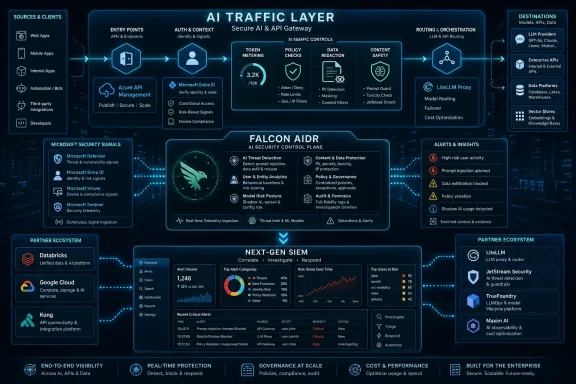
CrowdStrike’s move is an attempt to put Falcon AIDR at that interaction layer. The company says the integrations will bring telemetry, threat detection, data protection, access controls, and policy enforcement into the path of AI traffic. The partner list is deliberately broad: cloud platform gateways, API gateways, developer-oriented LLM routers, AI app platforms, and runtime security specialists.
That breadth is the point. Enterprises are not standardizing on a single model provider or a single AI gateway. A large organization may have Azure OpenAI behind API Management, Gemini or Vertex AI workloads behind Apigee, Databricks-hosted agents, Kong-managed internal APIs, LiteLLM proxying requests for developers, and a scattering of bespoke agent frameworks running in containers. The more successful enterprise AI becomes, the less likely it is to remain architecturally tidy.
CrowdStrike is betting that security teams will not want to manage every one of those points independently. A gateway can enforce policy in its own lane, but a SOC wants correlation. If a user tries prompt injection against an internal chatbot, pulls a credential from a response, and then uses that credential against a SaaS app, the security story cannot end at “the gateway logged a suspicious prompt.” It has to connect to identity, endpoint, cloud, and SIEM data.
That makes gateways a natural enforcement point. If a developer team is using Azure OpenAI, an organization can put Azure API Management in front of the service and apply consistent rules. If another team uses LiteLLM or Kong, the same general pattern applies: traffic flows through a proxy or gateway before it reaches the model, and that is where policy can bite.
But gateways have an obvious weakness: they only see the traffic routed through them. Shadow AI usage, browser-based tools, local agents, SaaS copilots, embedded assistants, and direct API calls can all escape a neat gateway-first architecture. CrowdStrike knows this, which is why the announcement emphasizes the broader Falcon platform rather than just gateway inspection. The company wants AIDR data to feed Falcon Next-Gen SIEM and correlate with endpoint, identity, cloud, SaaS, and third-party sources.
That is a more defensible claim than saying gateways alone can secure AI. The AI interaction layer is not one product category. It is a moving boundary between users, applications, agents, tools, retrieval systems, and models. Gateways are useful because they are enforceable. They are insufficient because they are not universal.
The best reading of CrowdStrike’s strategy is that it wants gateways to become collection and control points inside a larger Falcon data fabric. That is where the company’s endpoint heritage still matters. Falcon became powerful because it watched behavior at high fidelity and linked it to threat intelligence and response workflows. AIDR is trying to apply the same logic to prompts and agents.
That matters because AI governance is quickly becoming an operational problem, not just a policy problem. A security team can write a rule saying regulated data must not be sent to external models. The hard part is proving that the rule is applied across applications, agents, developer tools, and production services. If Azure API Management is already the front door for model traffic, integrating Falcon AIDR into that path gives CrowdStrike a route into the daily machinery of enterprise AI.
There is also a subtle Microsoft-platform angle. Windows endpoints are increasingly just one part of a larger Microsoft-controlled work environment that includes Entra ID, Microsoft 365, Defender, Intune, Azure, GitHub, Power Platform, and Microsoft Foundry. AI workloads cut across all of that. A user might build an agent in a developer environment, deploy it to Azure, authenticate it with Entra, expose it through an API, and interact with it from a Windows desktop or browser.
For administrators, that means the old mental model of “secure the endpoint, secure the server, monitor the network” is not enough. The AI service may not be compromised in the traditional sense. It may be persuaded to misuse the authority it already has. That distinction is why prompt injection and agent misuse are so uncomfortable for defenders: the system can behave dangerously while staying inside approved authentication and infrastructure boundaries.
CrowdStrike’s Azure integration does not eliminate that problem. It does, however, acknowledge where the problem is moving. The security layer has to see both the AI interaction and the surrounding enterprise context. A blocked prompt is useful; a blocked prompt tied to a user, device, identity, application, API, model, and downstream data source is far more useful.
But for most enterprises, the more persistent risk is data movement. Generative AI systems are hungry interfaces. They invite users to paste logs, contracts, source code, incident reports, customer records, and credentials into a box that promises productivity. Even when the model provider is reputable and the app is sanctioned, organizations still need to know what data is being sent, where it is going, and whether it violates policy.
That is why CrowdStrike’s AIDR pitch repeatedly combines threat detection with data protection and access controls. The attack surface is not only adversarial prompts; it is accidental over-sharing, ungoverned model access, and agents that can retrieve or expose data at machine speed. A prompt that includes a secret key is not necessarily an “attack,” but it can become an incident.
The agent dimension makes this harder. A chatbot answers a question; an agent can take actions. Once AI systems can call APIs, query databases, open tickets, modify cloud resources, trigger workflows, or summarize sensitive records, the security concern shifts from content moderation to authorization and intent. The question is not just “is this prompt safe?” It is “should this user, through this agent, using this model, be allowed to perform this operation with this data?”
That is where the control-plane framing becomes more credible. AI security will not be solved by a single classifier that labels prompts as good or bad. It will require identity-aware policy, runtime context, data classification, application telemetry, model telemetry, and response workflows that security teams can actually operate.
That mix shows how fragmented the market has become. AI security is not one buyer, one control point, or one architecture. Some teams approach it from cloud governance. Some from API management. Some from data platforms. Some from application security. Some from SOC operations. Some from endpoint and identity protection. CrowdStrike’s ecosystem is an attempt to turn that fragmentation into a distribution advantage.
There is a defensive reason for this openness too. If CrowdStrike insisted that every enterprise route AI traffic through a CrowdStrike-owned gateway, many customers would reject the architecture. Enterprises already have gateways. Developers already have model routers. Cloud teams already have preferred platforms. By integrating with those existing choices, CrowdStrike can sell AIDR as an overlay rather than a rip-and-replace project.
That is especially important in large organizations where AI adoption is already ahead of central governance. Security teams rarely get to design the whole environment from scratch. They inherit a collection of pilots, production workloads, developer shortcuts, and executive-sponsored initiatives, then get asked to secure them after the fact. An open ecosystem is not just nicer architecture; it is a concession to reality.
Still, “open” has limits. Integrations vary in depth, latency, policy coverage, logging fidelity, and operational maturity. A gateway integration that sends events to Falcon is not the same as one that supports inline blocking, response rewriting, sensitive-data masking, and full prompt-response capture. CrowdStrike’s announcement points toward a broad architecture, but buyers will need to inspect the specific enforcement paths for each gateway and platform.
This matters because AI incidents will often look ambiguous at first. Was a user experimenting with a model, or exfiltrating data through it? Was an agent behaving incorrectly because of a bug, a malicious prompt, a poisoned retrieval source, or compromised credentials? Did an employee paste sensitive information into a chatbot, or did malware automate that interaction? Without correlation, security teams drown in isolated AI alerts.
CrowdStrike’s historical advantage is that it already sits inside many SOC workflows. Falcon is not a new console for many customers; it is already where endpoint alerts, identity signals, cloud detections, and response actions live. If AIDR events arrive there in a usable form, CrowdStrike can reduce the friction that often kills new security categories.
The flip side is that SIEM integration raises expectations. Once AI activity is in the SOC, analysts will expect meaningful detections, not just a searchable warehouse of prompts. They will need severity, entity mapping, suppression, policy context, and playbooks. They will also need careful handling of sensitive prompt and response data, because logging every AI interaction can create a new privacy and compliance problem if done recklessly.
This is the uncomfortable truth of AI telemetry: the logs may contain the very secrets the organization is trying to protect. Security teams will have to decide when to capture full prompt and response content, when to tokenize or mask it, how long to retain it, and who can search it. AIDR products that ignore that governance burden will create as much risk as they reduce.
That history matters here, even though Falcon AIDR is about AI gateways and interaction telemetry rather than Windows kernel sensors. CrowdStrike is again asking customers to let Falcon sit in a powerful control position. It wants to inspect, correlate, and in some cases enforce policy on live AI activity. That is a different technical domain, but the trust equation is similar: if the control plane fails closed, business workflows may break; if it fails open, sensitive data and agent actions may escape policy.
For Windows administrators, the lesson is not “avoid CrowdStrike” or “avoid inline security.” It is that control-plane design must include blast-radius thinking. Inline AI enforcement needs staged rollout, monitoring-only modes, bypass procedures, policy testing, latency budgets, and clear ownership between security, platform, and application teams. A bad AI policy that blocks a production agent could be less dramatic than a blue screen, but still painful if it interrupts customer support, finance operations, or incident response automation.
CrowdStrike appears aware of the need to position AIDR as architecture-friendly. The announcement says the integrations apply controls without requiring changes to existing architectures. That is exactly what enterprises want to hear. But “no architecture change” should not mean “no operational change.” Security teams will still need to define policies, test them against real workloads, and decide which alerts justify blocking.
The mature buyer will treat AIDR like any other high-impact control plane: start with visibility, move to targeted enforcement, then expand only after proving that detections are accurate and business workflows remain stable. The immature buyer will flip on broad blocking rules and discover that AI traffic is far more varied than the policy workshop suggested.
The strategic question is which console becomes the default place where AI risk is understood. If the answer is the cloud console, CrowdStrike becomes one signal source among many. If the answer is the API gateway, enforcement lives with platform engineering. If the answer is the data platform, governance centers on lineage and access. If the answer is the SOC, CrowdStrike has a strong hand.
The likely outcome is not a single winner. Enterprises will use multiple layers because AI risk is multi-layered. But budgets and operational authority do concentrate. The team that owns the dashboard where incidents are triaged usually gains influence over policy. CrowdStrike’s goal is to make Falcon that dashboard for AI security, just as it has become a central console for endpoint and broader detection-and-response operations.
The company’s ecosystem approach is therefore less about generosity than positioning. By integrating with the places AI traffic already flows, CrowdStrike can argue that it is not competing with gateways, clouds, or developer tools. It is coordinating them. That is a compelling message for CISOs who already suffer from tool sprawl.
The danger is that “coordination” becomes another layer of complexity. If policies are authored in one place, enforced in another, logged in a third, and investigated in a fourth, teams may struggle to determine what actually happened. CrowdStrike will need to make the policy model and event lineage legible, not merely centralized.
That means the old habits of enterprise administration apply. Gateways need change control. Policies need review. Logs need retention rules. Access needs least privilege. Integrations need documented failure modes. Agents need identities that can be disabled, scoped, and audited. If AI applications become production dependencies, their gateway layer becomes part of the production security boundary.
Azure API Management’s AI gateway capabilities fit naturally into that model because many Microsoft shops already know how to operate Azure services under governance. But the CrowdStrike announcement makes clear that few enterprises will be Azure-only. Even organizations committed to Microsoft will use third-party models, SaaS assistants, open-source agent frameworks, and developer proxies. The security model must be federated across those choices.
This is where AIDR can be useful if it delivers on the promise. A consistent view of prompts, responses, agents, models, users, and gateways would help administrators answer basic questions that are currently harder than they should be: Which AI services are in use? Which users are sending sensitive data? Which agents have tool access? Which gateways enforce content safety? Which model interactions triggered security policy? Which events correlate with endpoint or identity anomalies?
Those are not theoretical questions. They are the questions auditors, incident responders, and risk committees will ask after the first serious AI incident. The enterprises that can answer them quickly will look prepared. The ones that cannot will discover that “we have an AI policy” is not the same as “we have AI control.”
Before treating Falcon AIDR as an AI control plane, customers should ask unfashionable but necessary questions. Does the integration operate inline or out-of-band? Does it inspect prompts, responses, tool calls, retrieved context, files, images, or only text? What is the measured latency under production load? What happens if the AIDR service is unavailable? Can policies fail open or fail closed by workload? How are logs protected? Can sensitive prompt data be masked before it reaches the SIEM?
They should also ask who owns policy. AI security sits awkwardly between SOC, cloud platform teams, data governance, legal, privacy, application security, and developers. If every group writes rules independently, the environment will become brittle. If only security writes rules, business teams may route around controls. The control plane needs a governance plane above it.
The biggest unknown is detection quality. Prompt injection detection is an adversarial problem, and adversaries will adapt. False positives can block legitimate work; false negatives can create misplaced confidence. Vendor claims about efficacy and latency should be tested with an organization’s own applications, languages, documents, prompts, and agent workflows.
That is not a knock on CrowdStrike. It is the nature of the category. AI security is young, and enterprise AI behavior is highly context-dependent. A policy that works for a customer-support summarizer may be useless for a code-generation agent or a financial-analysis workflow.
That does not make the decision easy. It makes it more concrete.
That is the real story behind the press release’s polished partner list. CrowdStrike is not merely adding connectors; it is trying to define the security architecture around AI before enterprises settle into a chaotic patchwork of model logs, API gateway rules, content filters, and homegrown prompt scanners. For WindowsForum readers, the Microsoft Azure angle matters because Azure API Management and Microsoft’s broader AI gateway strategy are becoming part of the same enterprise plumbing that already carries Windows, Entra, Defender, Intune, and Azure workloads.
 CrowdStrike Wants to Own the Layer Where AI Becomes Operational
The phrase “AI security control plane” is doing a lot of work here, but it is not empty marketing. In classic enterprise security, the endpoint agent, identity provider, network proxy, SIEM, and cloud control plane each saw a different slice of activity. AI breaks that segmentation because the risky action is often neither a file write nor a process launch nor a login event. It is a prompt, a response, a tool call, a retrieved document, or an agent decision made across a chain of services.CrowdStrike’s move is an attempt to put Falcon AIDR at that interaction layer. The company says the integrations will bring telemetry, threat detection, data protection, access controls, and policy enforcement into the path of AI traffic. The partner list is deliberately broad: cloud platform gateways, API gateways, developer-oriented LLM routers, AI app platforms, and runtime security specialists.
That breadth is the point. Enterprises are not standardizing on a single model provider or a single AI gateway. A large organization may have Azure OpenAI behind API Management, Gemini or Vertex AI workloads behind Apigee, Databricks-hosted agents, Kong-managed internal APIs, LiteLLM proxying requests for developers, and a scattering of bespoke agent frameworks running in containers. The more successful enterprise AI becomes, the less likely it is to remain architecturally tidy.
CrowdStrike is betting that security teams will not want to manage every one of those points independently. A gateway can enforce policy in its own lane, but a SOC wants correlation. If a user tries prompt injection against an internal chatbot, pulls a credential from a response, and then uses that credential against a SaaS app, the security story cannot end at “the gateway logged a suspicious prompt.” It has to connect to identity, endpoint, cloud, and SIEM data.
The Gateway Is Becoming the New Chokepoint, but Not the Whole Battlefield
The reason AI gateways are suddenly strategic is that they sit between applications and models at the moment of interaction. They can count tokens, route traffic, enforce quotas, apply content safety checks, log prompts, redact sensitive data, and decide which model should answer which request. In Microsoft’s own Azure world, API Management has been steadily repositioned as an AI gateway, with policies for token limits, token metrics, semantic caching, content safety, and model traffic governance.That makes gateways a natural enforcement point. If a developer team is using Azure OpenAI, an organization can put Azure API Management in front of the service and apply consistent rules. If another team uses LiteLLM or Kong, the same general pattern applies: traffic flows through a proxy or gateway before it reaches the model, and that is where policy can bite.
But gateways have an obvious weakness: they only see the traffic routed through them. Shadow AI usage, browser-based tools, local agents, SaaS copilots, embedded assistants, and direct API calls can all escape a neat gateway-first architecture. CrowdStrike knows this, which is why the announcement emphasizes the broader Falcon platform rather than just gateway inspection. The company wants AIDR data to feed Falcon Next-Gen SIEM and correlate with endpoint, identity, cloud, SaaS, and third-party sources.
That is a more defensible claim than saying gateways alone can secure AI. The AI interaction layer is not one product category. It is a moving boundary between users, applications, agents, tools, retrieval systems, and models. Gateways are useful because they are enforceable. They are insufficient because they are not universal.
The best reading of CrowdStrike’s strategy is that it wants gateways to become collection and control points inside a larger Falcon data fabric. That is where the company’s endpoint heritage still matters. Falcon became powerful because it watched behavior at high fidelity and linked it to threat intelligence and response workflows. AIDR is trying to apply the same logic to prompts and agents.
Microsoft Azure Gives the Pitch Its Enterprise Gravity
Among the named partners, Microsoft Azure is the one that will draw the most attention from Windows-heavy enterprises. Azure API Management is already familiar to many organizations as a managed way to expose, secure, and govern APIs. Its evolution into an AI gateway means Microsoft customers can use existing enterprise infrastructure patterns rather than invent a separate security stack for every AI application.That matters because AI governance is quickly becoming an operational problem, not just a policy problem. A security team can write a rule saying regulated data must not be sent to external models. The hard part is proving that the rule is applied across applications, agents, developer tools, and production services. If Azure API Management is already the front door for model traffic, integrating Falcon AIDR into that path gives CrowdStrike a route into the daily machinery of enterprise AI.
There is also a subtle Microsoft-platform angle. Windows endpoints are increasingly just one part of a larger Microsoft-controlled work environment that includes Entra ID, Microsoft 365, Defender, Intune, Azure, GitHub, Power Platform, and Microsoft Foundry. AI workloads cut across all of that. A user might build an agent in a developer environment, deploy it to Azure, authenticate it with Entra, expose it through an API, and interact with it from a Windows desktop or browser.
For administrators, that means the old mental model of “secure the endpoint, secure the server, monitor the network” is not enough. The AI service may not be compromised in the traditional sense. It may be persuaded to misuse the authority it already has. That distinction is why prompt injection and agent misuse are so uncomfortable for defenders: the system can behave dangerously while staying inside approved authentication and infrastructure boundaries.
CrowdStrike’s Azure integration does not eliminate that problem. It does, however, acknowledge where the problem is moving. The security layer has to see both the AI interaction and the surrounding enterprise context. A blocked prompt is useful; a blocked prompt tied to a user, device, identity, application, API, model, and downstream data source is far more useful.
Prompt Injection Is the Headline Risk, but Data Movement Is the Business Risk
Vendor announcements around AI security tend to lead with prompt injection and jailbreaks because those are vivid, easy to demonstrate, and genuinely important. A malicious instruction hidden in a document can manipulate a retrieval-augmented chatbot. A crafted user prompt can try to override system instructions. An agent with tool access can be pushed toward actions its designer did not intend.But for most enterprises, the more persistent risk is data movement. Generative AI systems are hungry interfaces. They invite users to paste logs, contracts, source code, incident reports, customer records, and credentials into a box that promises productivity. Even when the model provider is reputable and the app is sanctioned, organizations still need to know what data is being sent, where it is going, and whether it violates policy.
That is why CrowdStrike’s AIDR pitch repeatedly combines threat detection with data protection and access controls. The attack surface is not only adversarial prompts; it is accidental over-sharing, ungoverned model access, and agents that can retrieve or expose data at machine speed. A prompt that includes a secret key is not necessarily an “attack,” but it can become an incident.
The agent dimension makes this harder. A chatbot answers a question; an agent can take actions. Once AI systems can call APIs, query databases, open tickets, modify cloud resources, trigger workflows, or summarize sensitive records, the security concern shifts from content moderation to authorization and intent. The question is not just “is this prompt safe?” It is “should this user, through this agent, using this model, be allowed to perform this operation with this data?”
That is where the control-plane framing becomes more credible. AI security will not be solved by a single classifier that labels prompts as good or bad. It will require identity-aware policy, runtime context, data classification, application telemetry, model telemetry, and response workflows that security teams can actually operate.
The Partner List Is Also a Map of Enterprise AI Fragmentation
The named partners are revealing because they represent different layers of the AI stack. Databricks brings the data and AI platform angle, especially for organizations building governed AI applications close to enterprise data. Google Cloud’s Apigee brings API management in distributed environments. Kong represents API and service connectivity. LiteLLM represents the developer-friendly model proxy pattern. Maxim AI and TrueFoundry point toward AI application lifecycle and deployment workflows. JetStream Security emphasizes runtime visibility across the messy places AI actually runs.That mix shows how fragmented the market has become. AI security is not one buyer, one control point, or one architecture. Some teams approach it from cloud governance. Some from API management. Some from data platforms. Some from application security. Some from SOC operations. Some from endpoint and identity protection. CrowdStrike’s ecosystem is an attempt to turn that fragmentation into a distribution advantage.
There is a defensive reason for this openness too. If CrowdStrike insisted that every enterprise route AI traffic through a CrowdStrike-owned gateway, many customers would reject the architecture. Enterprises already have gateways. Developers already have model routers. Cloud teams already have preferred platforms. By integrating with those existing choices, CrowdStrike can sell AIDR as an overlay rather than a rip-and-replace project.
That is especially important in large organizations where AI adoption is already ahead of central governance. Security teams rarely get to design the whole environment from scratch. They inherit a collection of pilots, production workloads, developer shortcuts, and executive-sponsored initiatives, then get asked to secure them after the fact. An open ecosystem is not just nicer architecture; it is a concession to reality.
Still, “open” has limits. Integrations vary in depth, latency, policy coverage, logging fidelity, and operational maturity. A gateway integration that sends events to Falcon is not the same as one that supports inline blocking, response rewriting, sensitive-data masking, and full prompt-response capture. CrowdStrike’s announcement points toward a broad architecture, but buyers will need to inspect the specific enforcement paths for each gateway and platform.
Falcon Next-Gen SIEM Is Where the Announcement Becomes a SOC Story
The most important operational detail may be that AIDR feeds Falcon Next-Gen SIEM. That turns the announcement from an AI governance story into a detection-and-response story. A prompt event by itself is useful for compliance and investigation. A prompt event correlated with endpoint behavior, identity risk, cloud logs, SaaS activity, and known adversary tradecraft is the kind of thing a SOC can act on.This matters because AI incidents will often look ambiguous at first. Was a user experimenting with a model, or exfiltrating data through it? Was an agent behaving incorrectly because of a bug, a malicious prompt, a poisoned retrieval source, or compromised credentials? Did an employee paste sensitive information into a chatbot, or did malware automate that interaction? Without correlation, security teams drown in isolated AI alerts.
CrowdStrike’s historical advantage is that it already sits inside many SOC workflows. Falcon is not a new console for many customers; it is already where endpoint alerts, identity signals, cloud detections, and response actions live. If AIDR events arrive there in a usable form, CrowdStrike can reduce the friction that often kills new security categories.
The flip side is that SIEM integration raises expectations. Once AI activity is in the SOC, analysts will expect meaningful detections, not just a searchable warehouse of prompts. They will need severity, entity mapping, suppression, policy context, and playbooks. They will also need careful handling of sensitive prompt and response data, because logging every AI interaction can create a new privacy and compliance problem if done recklessly.
This is the uncomfortable truth of AI telemetry: the logs may contain the very secrets the organization is trying to protect. Security teams will have to decide when to capture full prompt and response content, when to tokenize or mask it, how long to retain it, and who can search it. AIDR products that ignore that governance burden will create as much risk as they reduce.
CrowdStrike Is Selling Control After Its Own Control Failure
Any CrowdStrike platform story in 2026 still carries the shadow of July 2024. The faulty Falcon Sensor content update that caused widespread Windows crashes was a defining event for enterprise IT, not because it invalidated endpoint security, but because it exposed how much operational trust customers place in privileged security agents. When a security vendor sits close to the kernel, a mistake can become a global outage.That history matters here, even though Falcon AIDR is about AI gateways and interaction telemetry rather than Windows kernel sensors. CrowdStrike is again asking customers to let Falcon sit in a powerful control position. It wants to inspect, correlate, and in some cases enforce policy on live AI activity. That is a different technical domain, but the trust equation is similar: if the control plane fails closed, business workflows may break; if it fails open, sensitive data and agent actions may escape policy.
For Windows administrators, the lesson is not “avoid CrowdStrike” or “avoid inline security.” It is that control-plane design must include blast-radius thinking. Inline AI enforcement needs staged rollout, monitoring-only modes, bypass procedures, policy testing, latency budgets, and clear ownership between security, platform, and application teams. A bad AI policy that blocks a production agent could be less dramatic than a blue screen, but still painful if it interrupts customer support, finance operations, or incident response automation.
CrowdStrike appears aware of the need to position AIDR as architecture-friendly. The announcement says the integrations apply controls without requiring changes to existing architectures. That is exactly what enterprises want to hear. But “no architecture change” should not mean “no operational change.” Security teams will still need to define policies, test them against real workloads, and decide which alerts justify blocking.
The mature buyer will treat AIDR like any other high-impact control plane: start with visibility, move to targeted enforcement, then expand only after proving that detections are accurate and business workflows remain stable. The immature buyer will flip on broad blocking rules and discover that AI traffic is far more varied than the policy workshop suggested.
The Competitive Race Is Really About Who Defines AI Security’s Default Console
CrowdStrike is not alone in chasing this category. Cloud providers, API gateway vendors, data platforms, identity vendors, browser security companies, DSPM vendors, and application security startups all see AI as a new surface where budgets may open. Microsoft has Defender, Purview, Entra, Sentinel, API Management, Foundry, and Copilot governance interests. Google has cloud, model, data, and API management assets. Databricks has governance around data and AI workflows. Kong and LiteLLM are closer to the developer traffic path.The strategic question is which console becomes the default place where AI risk is understood. If the answer is the cloud console, CrowdStrike becomes one signal source among many. If the answer is the API gateway, enforcement lives with platform engineering. If the answer is the data platform, governance centers on lineage and access. If the answer is the SOC, CrowdStrike has a strong hand.
The likely outcome is not a single winner. Enterprises will use multiple layers because AI risk is multi-layered. But budgets and operational authority do concentrate. The team that owns the dashboard where incidents are triaged usually gains influence over policy. CrowdStrike’s goal is to make Falcon that dashboard for AI security, just as it has become a central console for endpoint and broader detection-and-response operations.
The company’s ecosystem approach is therefore less about generosity than positioning. By integrating with the places AI traffic already flows, CrowdStrike can argue that it is not competing with gateways, clouds, or developer tools. It is coordinating them. That is a compelling message for CISOs who already suffer from tool sprawl.
The danger is that “coordination” becomes another layer of complexity. If policies are authored in one place, enforced in another, logged in a third, and investigated in a fourth, teams may struggle to determine what actually happened. CrowdStrike will need to make the policy model and event lineage legible, not merely centralized.
Windows Shops Should Treat AI Gateways Like Domain Controllers for Prompts
For Windows-centric organizations, the practical shift is conceptual. AI gateways should be treated as critical infrastructure, not developer convenience. They may not authenticate users like domain controllers or enforce device posture like Intune, but they increasingly mediate access to knowledge, automation, model capacity, and business workflows.That means the old habits of enterprise administration apply. Gateways need change control. Policies need review. Logs need retention rules. Access needs least privilege. Integrations need documented failure modes. Agents need identities that can be disabled, scoped, and audited. If AI applications become production dependencies, their gateway layer becomes part of the production security boundary.
Azure API Management’s AI gateway capabilities fit naturally into that model because many Microsoft shops already know how to operate Azure services under governance. But the CrowdStrike announcement makes clear that few enterprises will be Azure-only. Even organizations committed to Microsoft will use third-party models, SaaS assistants, open-source agent frameworks, and developer proxies. The security model must be federated across those choices.
This is where AIDR can be useful if it delivers on the promise. A consistent view of prompts, responses, agents, models, users, and gateways would help administrators answer basic questions that are currently harder than they should be: Which AI services are in use? Which users are sending sensitive data? Which agents have tool access? Which gateways enforce content safety? Which model interactions triggered security policy? Which events correlate with endpoint or identity anomalies?
Those are not theoretical questions. They are the questions auditors, incident responders, and risk committees will ask after the first serious AI incident. The enterprises that can answer them quickly will look prepared. The ones that cannot will discover that “we have an AI policy” is not the same as “we have AI control.”
The Fine Print Is Where Buyers Should Spend Their Time
The announcement includes the usual warning that unreleased services or features may still be in development and subject to change. That matters because AI security vendors are racing ahead of customer deployment maturity. Roadmaps are moving fast, product names are multiplying, and integration depth can vary from polished demo to production-ready enforcement.Before treating Falcon AIDR as an AI control plane, customers should ask unfashionable but necessary questions. Does the integration operate inline or out-of-band? Does it inspect prompts, responses, tool calls, retrieved context, files, images, or only text? What is the measured latency under production load? What happens if the AIDR service is unavailable? Can policies fail open or fail closed by workload? How are logs protected? Can sensitive prompt data be masked before it reaches the SIEM?
They should also ask who owns policy. AI security sits awkwardly between SOC, cloud platform teams, data governance, legal, privacy, application security, and developers. If every group writes rules independently, the environment will become brittle. If only security writes rules, business teams may route around controls. The control plane needs a governance plane above it.
The biggest unknown is detection quality. Prompt injection detection is an adversarial problem, and adversaries will adapt. False positives can block legitimate work; false negatives can create misplaced confidence. Vendor claims about efficacy and latency should be tested with an organization’s own applications, languages, documents, prompts, and agent workflows.
That is not a knock on CrowdStrike. It is the nature of the category. AI security is young, and enterprise AI behavior is highly context-dependent. A policy that works for a customer-support summarizer may be useless for a code-generation agent or a financial-analysis workflow.
The Falcon Ecosystem Turns AI Security From Slogan Into Procurement
The immediate value of CrowdStrike’s announcement is not that it magically secures enterprise AI. It is that it gives security leaders a procurement-shaped answer to a problem that has been expanding faster than governance. Instead of building bespoke controls for every model gateway, they can evaluate a platform strategy that plugs into several of the gateways and platforms their teams already use.That does not make the decision easy. It makes it more concrete.
- Enterprises should view CrowdStrike’s AI gateway ecosystem as an attempt to centralize AI telemetry and enforcement across already-fragmented production environments.
- Microsoft shops should pay particular attention to the Azure API Management integration because APIM is becoming a practical control point for Azure OpenAI, Foundry, and other model traffic.
- Security teams should begin with visibility and measured policy enforcement rather than broad blocking, especially where AI agents support production workflows.
- Prompt injection is only one part of the risk; sensitive-data leakage, agent authorization, tool misuse, and poor logging governance may matter more in day-to-day operations.
- Buyers should validate each partner integration separately, because “supported” can mean anything from event collection to low-latency inline enforcement.
- The SOC value depends on whether Falcon Next-Gen SIEM can turn AI activity into actionable correlations rather than another stream of noisy security events.
References
- Primary source: 01net
Published: 2026-06-16T17:30:32.119110
CrowdStrike’s Open Gateway Ecosystem Makes Falcon AI’s Control Plane
With a growing ecosystem of AI gateway partners – including Databricks, Google Cloud, JetStream Security, Kong, LiteLLM, Maxim AI, Microsoft Azure, and TrueFoundry – CrowdStrike extends the Falcon platform to unify visibility, protection, and control ... www.01net.it
- Related coverage: ir.crowdstrike.com
CrowdStrike’s Open Gateway Ecosystem Makes Falcon AI’s Control Plane | CrowdStrike Holdings, Inc.
With a growing ecosystem of AI gateway partners – including Databricks, Google Cloud, JetStream Security, Kong, LiteLLM, Maxim AI, Microsoft Azure, and TrueFoundry – CrowdStrike extends the Falcon platform to unify visibility, protection, and control across AI AUSTIN, Texas --(BUSINESS WIRE)--Jun.ir.crowdstrike.com
- Related coverage: crowdstrike.com
CrowdStrike Falcon AIDR: AI Detection & Response
Protect AI adoption and development with CrowdStrike Falcon AIDR. Gain unified visibility, threat detection, and automated response across endpoints, apps, and cloud.www.crowdstrike.com
- Related coverage: aidr-docs.crowdstrike.com
AIDR - Get Started - Get familiar with AIDR console and choose your deployment path for monitoring AI activity | CrowdStrike
Explore sample data in AIDR console and select the right deployment path for your use case - by choosing between employee AI usage monitoring (AIDR for Workforce) or AI application development (AIDR for Agents).aidr-docs.crowdstrike.com - Related coverage: businesswire.com
- Related coverage: techradar.com
CrowdStrike to acquire Pangea Cyber for $260 million, adding prompt injection defense and AI Detection and Response to its Falcon platform | TechRadar
Acquisition will strengthen defenses against prompt injection and risky usagewww.techradar.com